Objection Handling Cold Calling: Prevent More, Memorize Less
It's 9:02 AM. Your SDR opens the dialer and gets hit with "not interested" on the first three calls. By 9:15, they're tweaking their script. By 10:00, they're scrolling r/sales looking for a magic rebuttal - the same thread that gets posted every week, with the same answers every time.
Here's the problem: most objection handling advice for cold calling gets it backwards. It focuses on what you say after the pushback instead of what you said - or didn't say - before it. Data from 300M+ analyzed calls backs this up, and the fix is simpler than memorizing 20 rebuttals.
The Short Version
- Half of objections are reflexive, not real concerns. Analysis of 300M+ cold calls found 49.5% are dismissive - treat them differently than genuine pushback.
- Your first 10 seconds decide everything. Saying "The reason for my call is..." makes you 2.1x more likely to book a meeting. Asking "Did I catch you at a bad time?" drops you to a 0.9% success rate.
- Bad data kills good talk tracks. Reps lose 27.3% of productive time to wrong numbers and outdated contacts. If your list is stale, your framework doesn't matter.
- The channel still works. 82% of buyers who took meetings last year started with a cold call. The problem isn't cold calling - it's generating avoidable objections.
What 300M Calls Reveal About Objections
Most guides hand you a wall of rebuttals. That's backwards. Gong's analysis of 300M+ cold calls shows objections cluster into three categories, and nearly half aren't real objections at all.
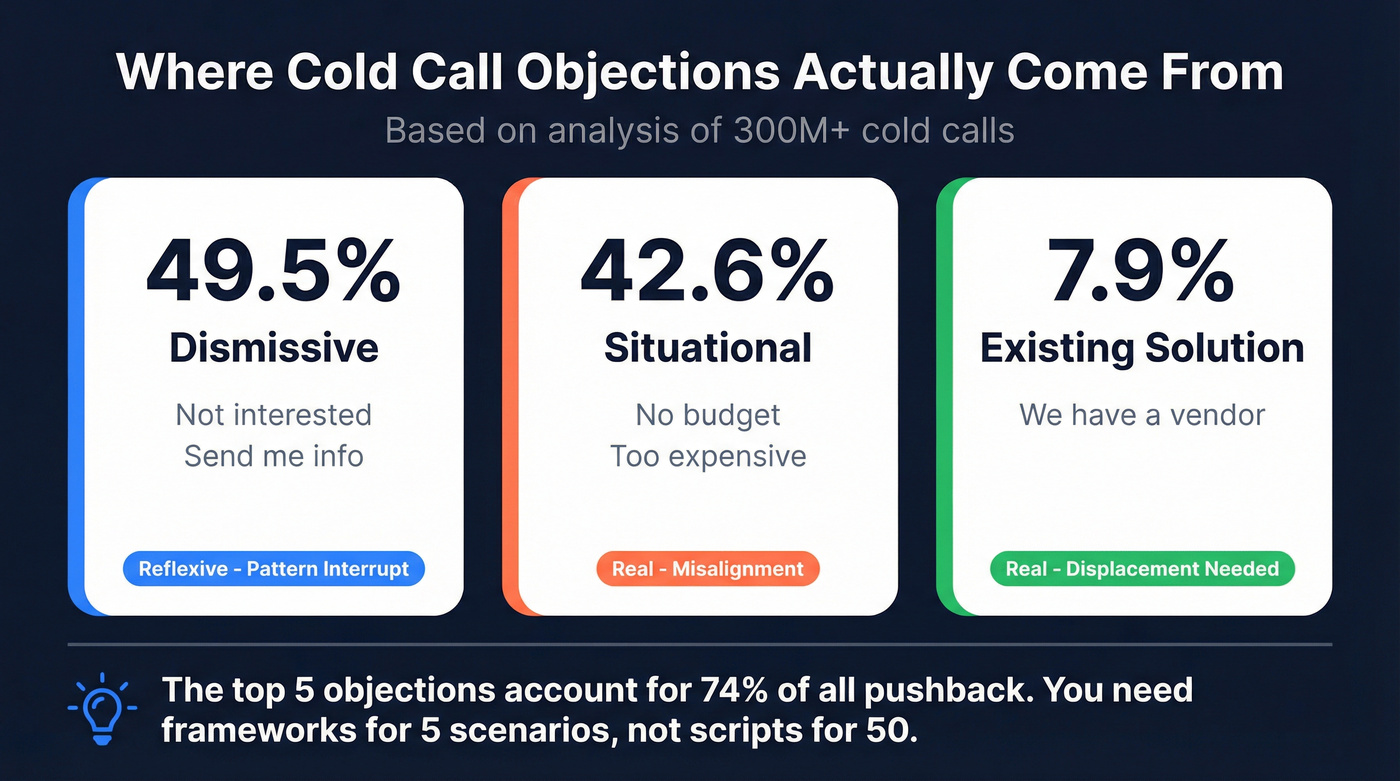
| Category | Share | Examples | Real or Reflexive? |
|---|---|---|---|
| Dismissive | 49.5% | "Not interested," "Send me info" | Reflexive - pattern interrupt |
| Situational | 42.6% | "No budget," "Too expensive" | Real - misalignment |
| Existing solution | 7.9% | "We have a vendor" | Real - displacement needed |
The top 5 objections account for 74% of all pushback. You don't need a script for every possible response. You need frameworks for five scenarios and the discipline to diagnose which category you're in before you open your mouth.
Prevention Beats Rebuttals
The best cold call objection response happens before the objection. What you say in the first 10 seconds determines whether you get a reflexive brush-off or an actual conversation.
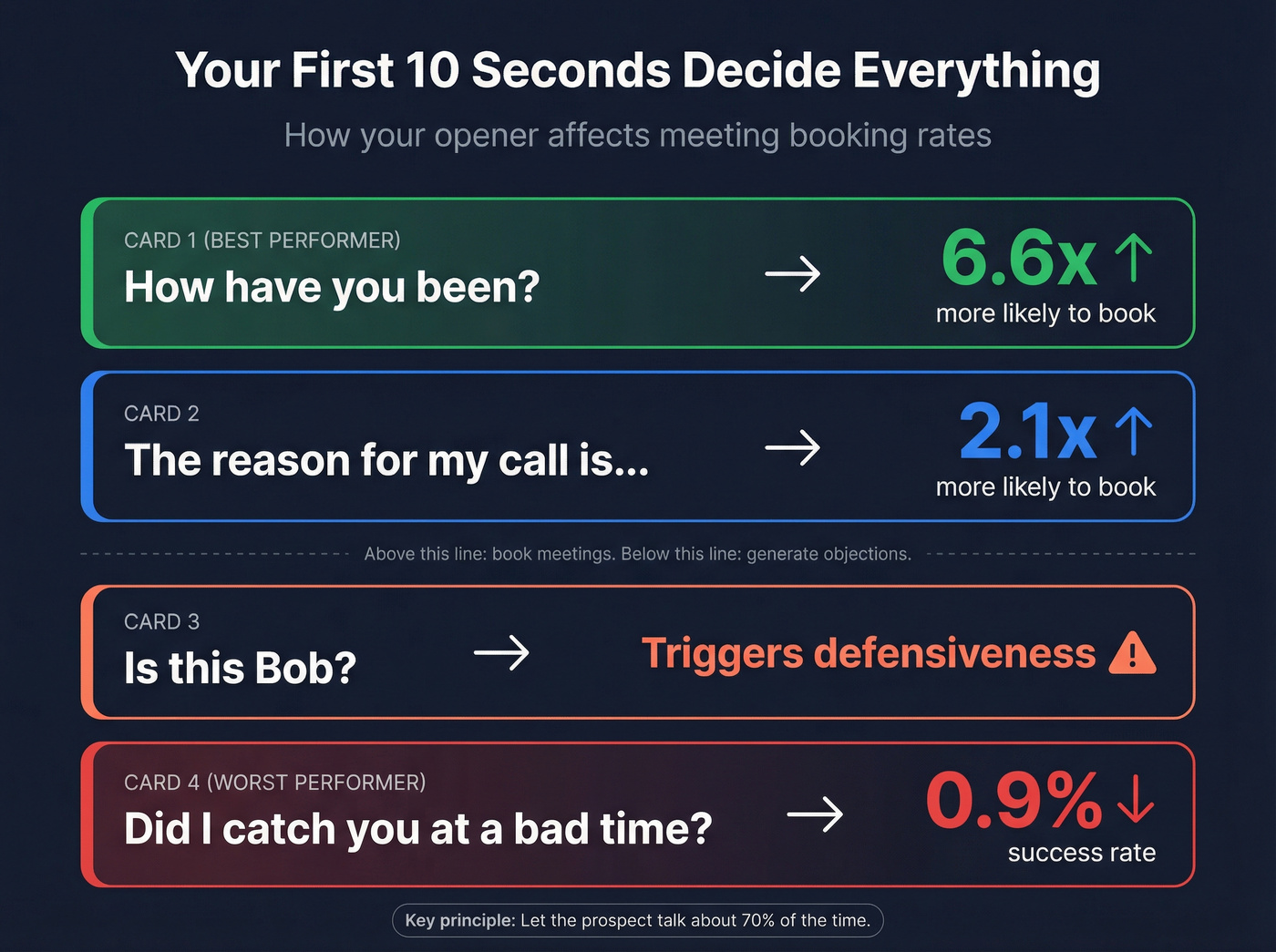
What works: "The reason for my call is..." - 2.1x more likely to book a meeting. It signals respect for their time and gives them a reason to keep listening. Adding "How've you been?" between your intro and your reason boosts meeting odds by 6.6x. The casual warmth disrupts the "sales call" pattern recognition that triggers instant resistance.
What kills you: "Did I catch you at a bad time?" drops your success rate to 0.9%. It hands them an exit before you've said anything of value. Opening with "Is this Bob?" triggers immediate defensiveness - you're verifying their identity like a collections agent. Use an assumptive intro instead: "Hi Bob, this is Sarah from Acme." And skipping the 5-minute research rule - checking their company news, role, or recent activity - means your opener sounds generic, which triggers an instant brush-off.
One principle every framework converges on: the prospect should talk around 70% of the time. Most reps invert this. That's the single fastest way to generate a "not interested."

Reps lose 27.3% of productive time to wrong numbers and outdated contacts. That's not an objection handling problem - it's a data problem. Prospeo's 7-day refresh cycle and 98% email accuracy mean your SDRs spend time on real conversations, not dead leads.
Stop rehearsing rebuttals for calls that never should have bounced.
Blocking vs. Qualifying - Diagnose First
Before you respond to any objection, answer one question: is this a brush-off, or a real concern?
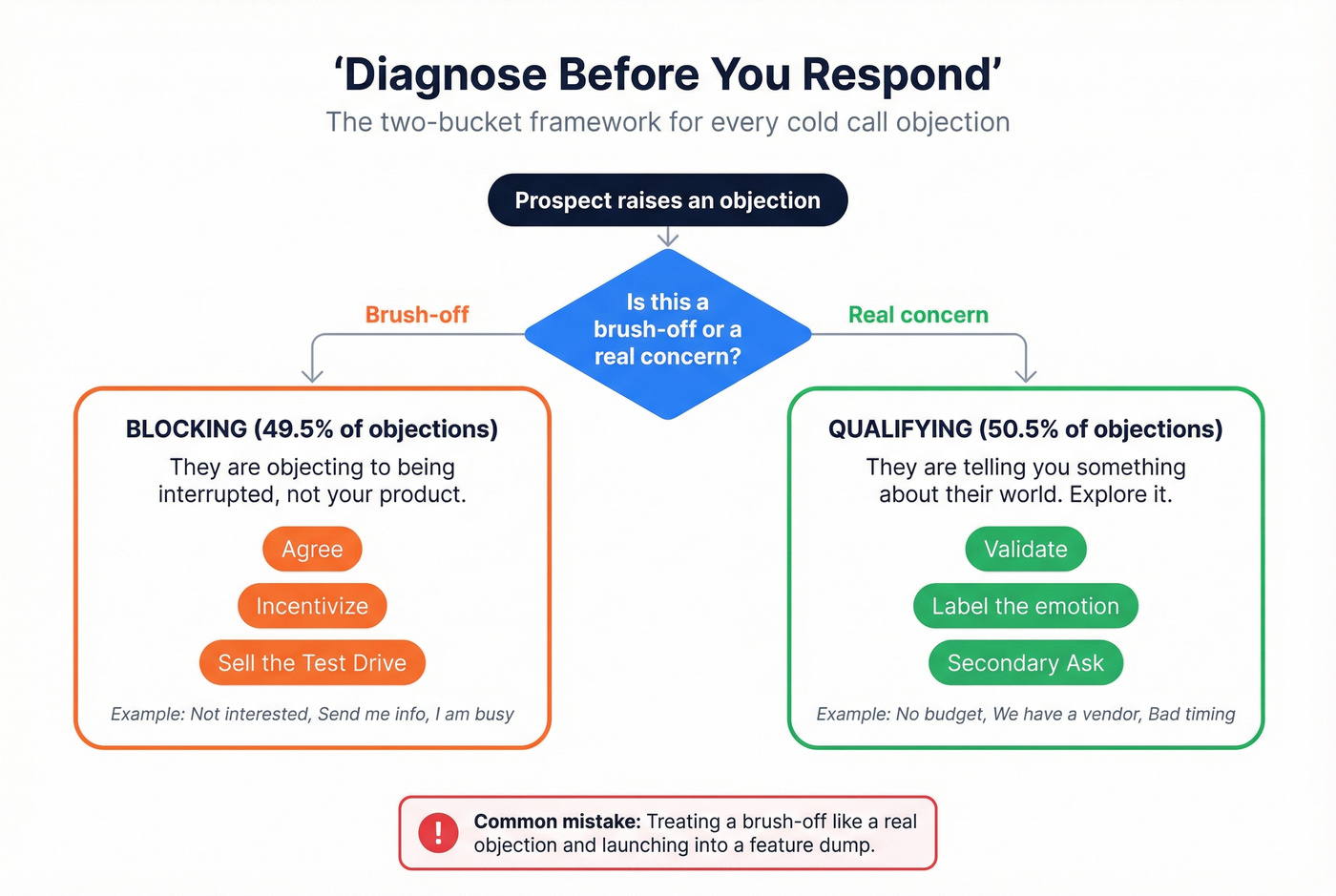
Some frameworks identify up to nine objection types - price, timing, authority, need, competitor, product, trust, indifference, risk - but on a cold call, they all collapse into two diagnostic buckets. Getting this distinction right is the foundation of handling objections on sales calls effectively.
Blocking objections (the 49.5% dismissive category) are pattern interrupts. The prospect isn't objecting to your product - they're objecting to being interrupted. Your job is to re-engage, not argue. The framework: Agree, Incentivize, Sell the Test Drive. Acknowledge the interruption, give them a reason to stay on for 20 more seconds, and pitch the next step - not the product.
Qualifying objections (situational + existing solution) are real. The prospect is telling you something about their world. Your job is to explore, not overcome. The framework: Validate, Label, Secondary Ask. Validate the concern as legitimate, label the emotion or situation ("Sounds like timing is the real issue"), then ask an open-ended question that returns focus to their pain.
We see the same mistake constantly: reps treating a brush-off like a real objection and launching into a feature dump. Diagnose first. Respond second.
The 5 Most Common Objections (With Scripts)
These scripts cover 74% of the pushback your team will face. Master these five, and you can handle cold call objections with confidence rather than a cheat sheet.
"I'm not interested."
SDR: "Totally fair - most people say that before they hear why [similar company] is using us to [specific outcome]. Mind if I take 20 seconds?"
This is a blocking objection. Don't argue. Reframe the priority and ask for a micro-commitment. If you've spent any time in r/sales, you've seen this question every week - the answers always converge here: acknowledge, reframe, earn 20 more seconds.
"I'm busy / bad time."
SDR: "I hear you - can I get 30 seconds to tell you why I called, and you tell me if it's worth a longer conversation? Does that sound fair?"
The "does that sound fair?" close works because it gives explicit permission to say no, which paradoxically makes them more likely to say yes. This rebuttal works precisely because it doesn't feel like one.
"Send me an email."
SDR: "Happy to - what specifically should I cover so it's actually useful?"
If they can't tell you what to include, they weren't going to read the email anyway. This redirects a brush-off into a qualifying conversation. Follow up with: "Most people in your role care about [specific pain]. Is that on your radar?"
"No budget."
This is situational - treat it as real. Don't dismiss the concern with a canned rebuttal; explore the timeline instead.
SDR: "Makes sense. When does your next planning cycle start? I'd rather reach out when the timing works than waste your time now."
"We already have a solution."
SDR: "That's great - what made you evaluate them originally?"
This reactivates the original buying trigger. If the pain that drove the first purchase still exists, you've got an opening. Close with an Interest CTA: "Does it make sense for me to give you more detail on how we approach [that pain] differently?" Sell the conversation, not calendar logistics.
Live Call Mistakes That Quietly Kill You
Beyond individual rebuttals, there are structural errors that undermine your framework before it gets a chance to work.
Talking past the objection. When a prospect raises a concern and you barrel ahead with your pitch, you signal that you're not listening. Pause. Acknowledge. Then respond.
Stacking rebuttals. Hitting a prospect with two or three counterpoints in a row feels combative. One clean response, then a question to hand the conversation back.
Ignoring tone. The same words - "we're all set" - can mean "go away" or "convince me." Let's be honest: reading vocal cues matters more than matching keywords to scripts, and no amount of written frameworks can fully teach that. It comes from reps actually listening to their own call recordings, which most teams skip.
The Objection You're Creating With Bad Data
Here's the thing: if you're dialing against a list that hasn't been refreshed recently, your objection handling framework is irrelevant. You're manufacturing objections before your reps even open their mouths.
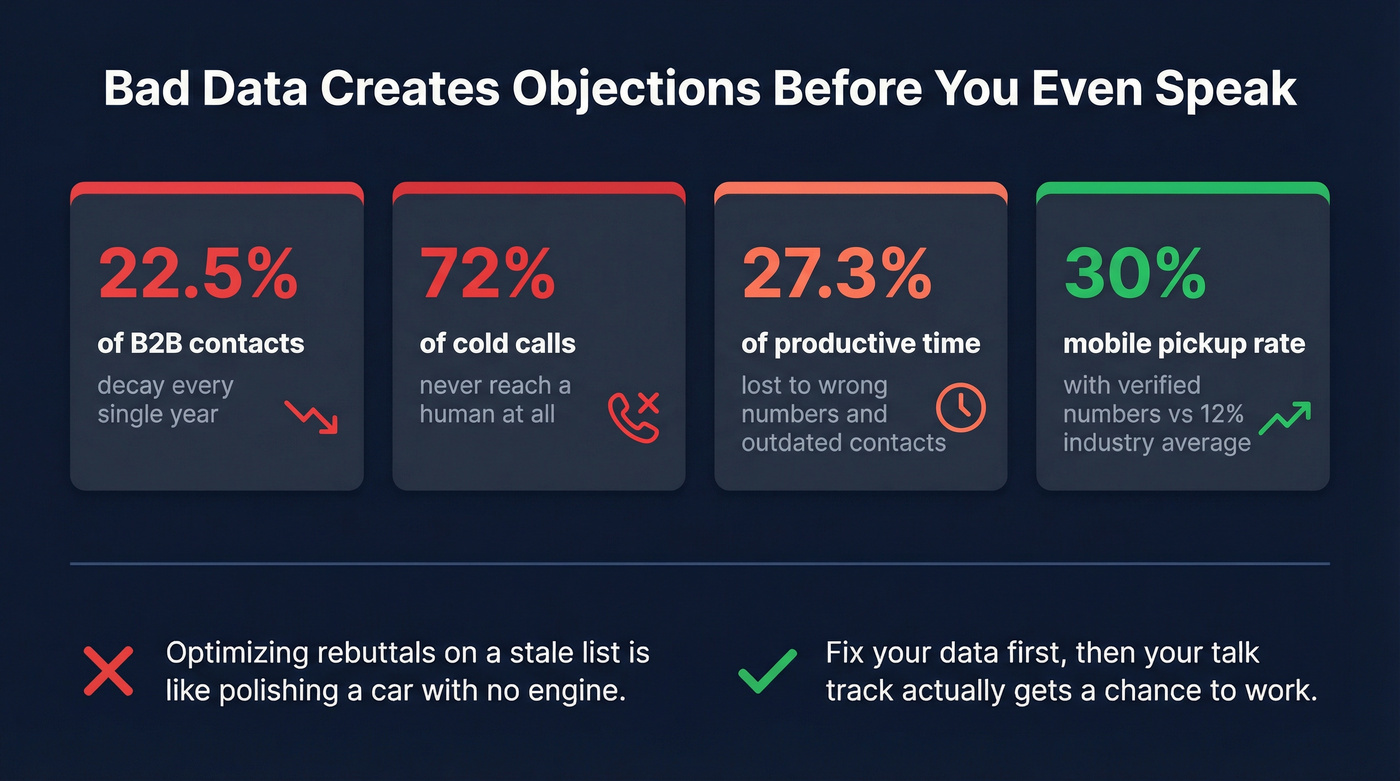
B2B contact data decays at roughly 22.5% per year. That means reps are calling wrong numbers, reaching people who left the company months ago, and burning through dial time that produces nothing. 72% of cold calls never reach a human at all. In our experience working with outbound teams, the ones that fix their data upstream see more improvement than the ones that memorize better rebuttals. No amount of sales training compensates for dialing the wrong person.

We've watched teams obsess over talk tracks while sitting on lists where a quarter of the contacts have changed jobs. Skip the rebuttal training until your data is clean - otherwise you're optimizing the wrong variable. Prospeo handles this upstream with 143M+ verified emails and 125M+ verified mobile numbers on a 7-day refresh cycle, so reps actually reach the right person on the first try. Teams using it see mobile pickup rates around 30%, compared to the 12% industry average. Fewer wrong-person calls, fewer "who is this?" moments, more actual conversations where your talk track can do its job.
Your talk track doesn't matter if you're calling the wrong person. Prospeo gives you 125M+ verified mobile numbers with a 30% pickup rate - so your reps reach actual decision-makers, not voicemail boxes and outdated desk lines.
Reach the right person and the objections handle themselves.
FAQ
What's the best response to "not interested" on a cold call?
Acknowledge it, then reframe: "Totally fair - most people say that before they hear why [specific company type] is using us to [specific outcome]. Mind if I take 20 seconds?" Nearly half of all objections are dismissive brush-offs, not real rejections. Re-engage with a micro-commitment ask, don't argue.
How many objections should you expect per cold call?
One to two per connected call. The top 5 objections account for 74% of all pushback, so you only need frameworks for a handful of scenarios - not a script for every possible response. Correctly diagnosing the five situations you'll actually encounter matters more than memorizing dozens of rebuttals.
Does data quality actually affect cold call objections?
Yes, directly. B2B contact data decays 22.5% per year, meaning stale lists create objections before you speak. Teams that fix data upstream consistently outperform teams that only invest in better talk tracks.
What's the difference between cold call and warm call objections?
On a warm call, the prospect already knows you - objections tend to be genuine concerns about price, fit, or timing. On a cold call, nearly half of objections are reflexive brush-offs triggered by the interruption itself. The blocking-vs.-qualifying diagnostic step matters far more in cold outreach because you're fighting the interruption, not just the concern.