The Complete Prospecting Cold Calling Playbook for 2026
It's 8:47 AM. You've blocked 90 minutes for calls. Twelve dials in, you've reached three switchboards, left four voicemails, and had zero actual conversations. Twenty-five minutes gone.
That's not a skill problem - it's a data problem. 72% of cold calls never reach a human, and most of that failure happens before you even open your mouth. You could have the best opener on the planet and it wouldn't matter if the number's disconnected.
Cold calling still works. 69% of B2B buyers accepted at least one cold call last year, and 59% of executives prefer phone as the first touchpoint. The reps who struggle aren't bad at talking - they're dialing bad numbers. Here's the playbook that fixes that, from the data layer up.
The Three Things That Actually Matter
If you don't read anything else, nail these:
- Verified mobile numbers, not office lines. Mobiles ring in someone's pocket. Office lines route through gatekeepers and auto-attendants that eat your time alive.
- One proven script framework - the 3-minute structure below. Not 13 generic tips. One recipe you can use tomorrow morning.
- A 90-minute focused call block with pre-researched prospects. Quality over volume, every time.
That's the whole system. Start with verified mobiles, pair them with the scripts below, and you'll book more meetings this week than last month.
Cold Call Benchmarks by the Numbers
Most cold calling advice is vibes. Here's what the data actually says.
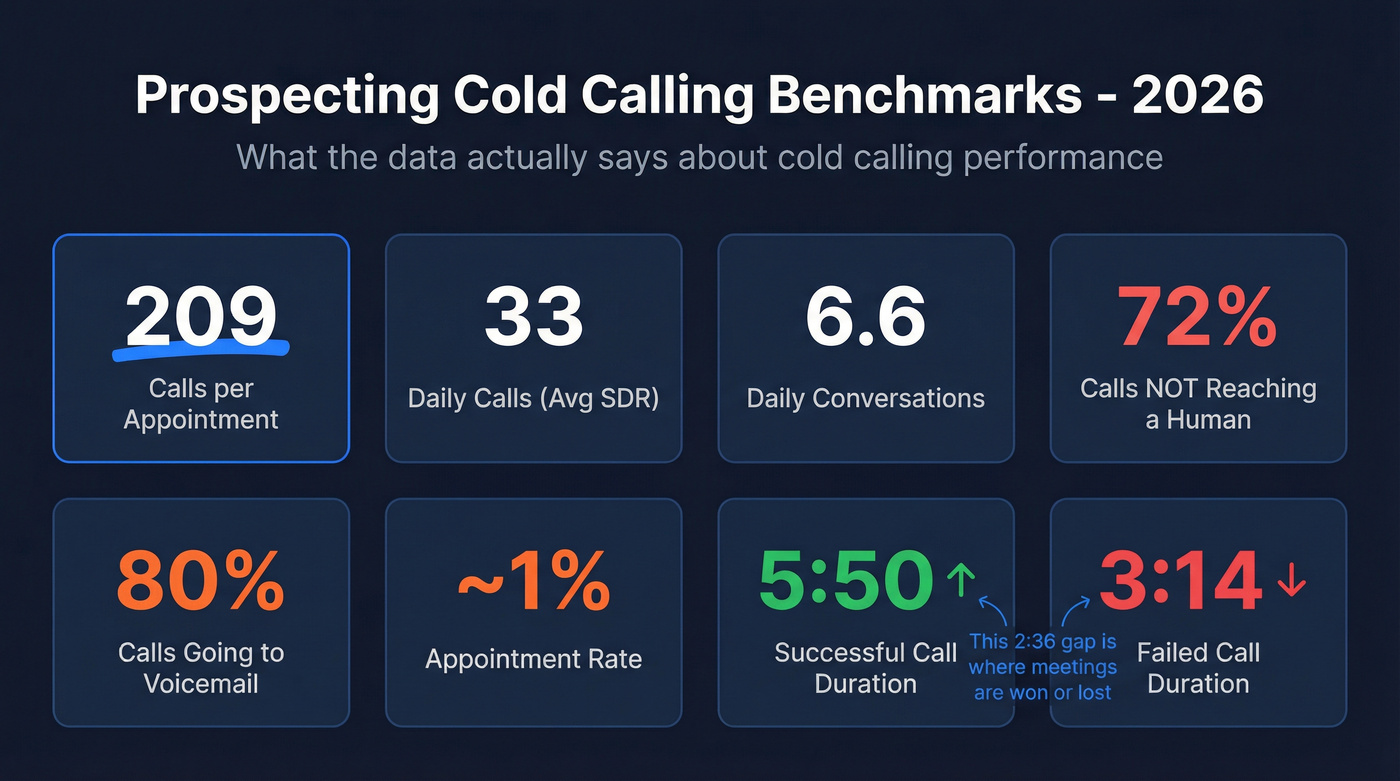
| Metric | Number | Source |
|---|---|---|
| Calls per appointment | 209 | Bridge Group |
| Daily calls (avg SDR) | 33 | Bridge Group |
| Daily conversations | 6.6 | Bridge Group |
| Calls NOT reaching a human | 72% | InsideView |
| Calls to voicemail | 80% | RAIN Group |
| Appointment rate | ~1% | CRMNext |
| Successful call duration | 5:50 | Gong |
| Failed call duration | 3:14 | Gong |
The gap between 5:50 and 3:14 is the most important number on this table. Longer calls win because discovery actually happened - the rep got past the opener, asked real questions, and earned the meeting. Failed calls die in the first minute.
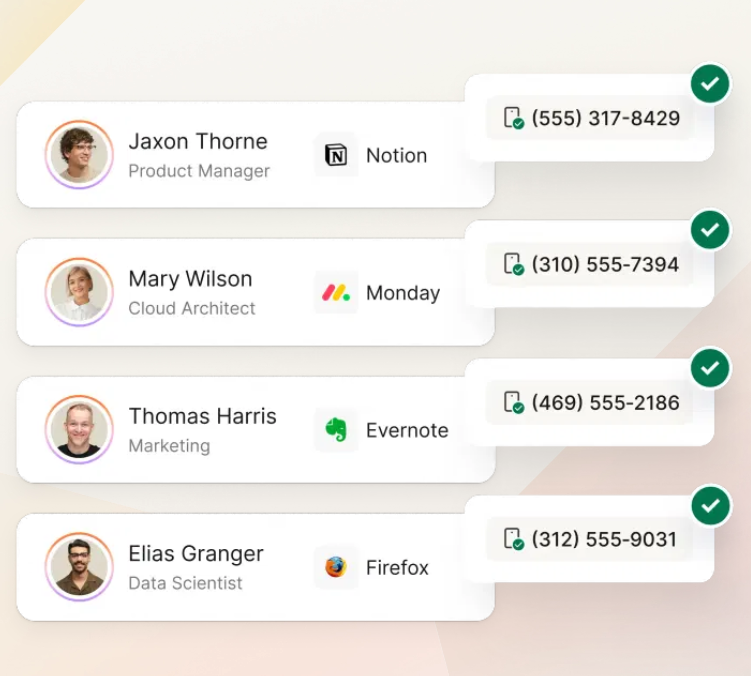
B2B contact data decays at roughly 2.1% per month - about 22.5% per year. If your list hasn't been refreshed in six months, around 12-13% of it is already stale. Every dead number is a wasted dial, a wasted minute, and a rep losing momentum. Across the US, bad data costs companies an estimated $611 billion annually. That's not abstract. It's your SDR staring at a screen while a disconnected number plays a three-tone error.
Why Mobile Numbers Change Everything
Let's be honest about what we've seen play out dozens of times on Friday dashboards. Rep A makes 247 calls on office lines, gets through to 8 people, books 1 meeting. Rep B makes 180 calls on verified mobiles, connects with 36 people, books 4 meetings. Same scripts. Same product. Same day.
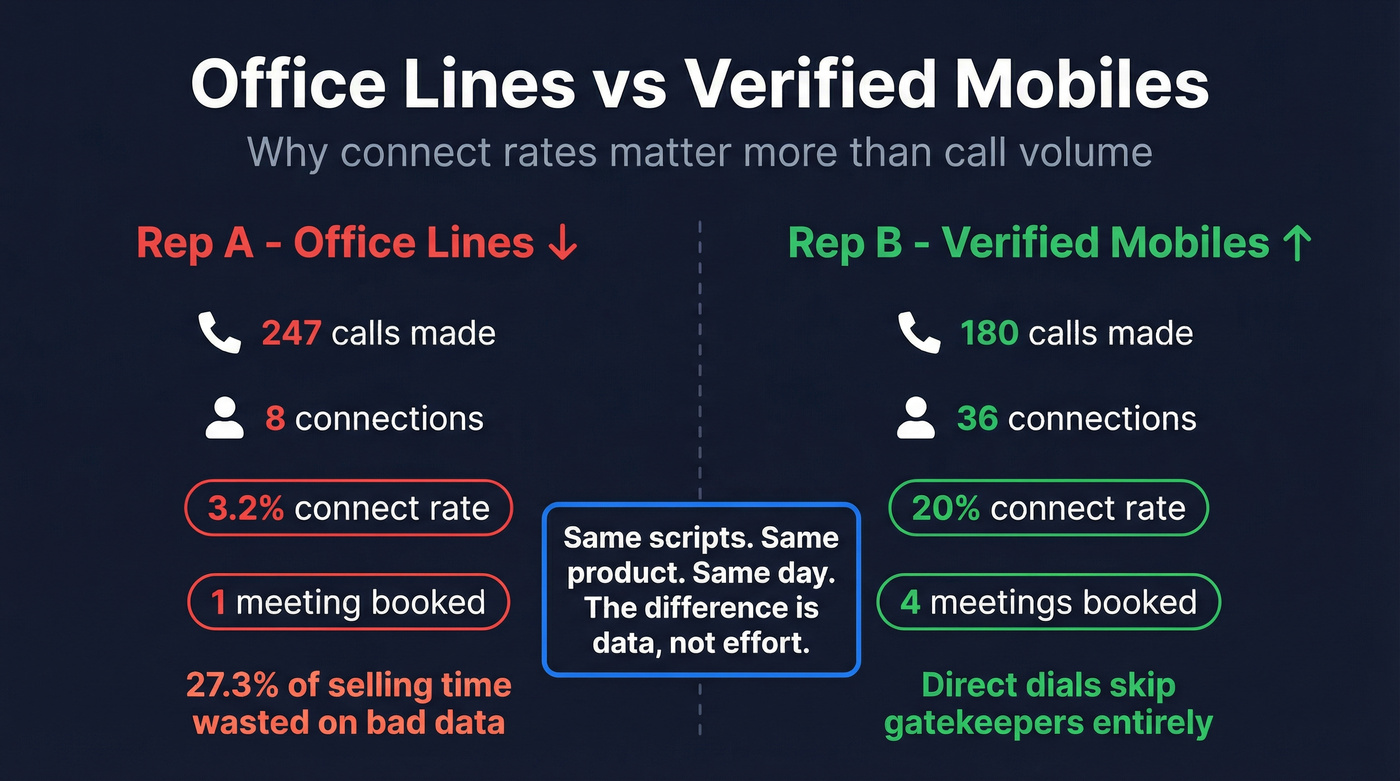
The difference is data, not effort.
Office lines route through gatekeepers, auto-attendants, and shared reception desks. Mobiles ring directly. The connect rate differential isn't marginal - it's 3-5x. Sales reps lose 27.3% of their selling time to bad contact data, which works out to more than a full day per week spent dialing disconnected numbers, navigating switchboards, and leaving voicemails that never get returned.

Your reps lose a full day per week dialing disconnected numbers and navigating switchboards. Prospeo's 125M+ verified mobile numbers connect you directly to decision-makers - no gatekeepers, no auto-attendants. With a 30% pickup rate and data refreshed every 7 days, every dial block counts.
Turn 90 minutes of calls into 4 booked meetings instead of 1.
Before You Dial: The 5-Minute Research Rule
This is what separates reps who book meetings from reps who get hung up on. Before every call, run through this checklist:
- Role and tenure - Are they still in the seat? Someone who started last month has less authority than someone who's been there two years and knows exactly where the pain is.
- Company triggers - Recent funding round, new product launch, leadership change, hiring surge. Any of these gives you a reason to call beyond "I'm selling something." (If you want a system for this, see sales triggers.)
- Recent news - A 30-second scan of their company's press page or recent posts. One specific reference in your opener signals you're not reading from a script.
- Challenge mapping - Based on their role and industry, what's the most likely pain point you can address? Use a simple account qualification lens so you don't waste dials.
- Mutual connections - A shared connection increases meeting chances by 70%. Even a loose tie is worth mentioning.
Five minutes of prep per prospect sounds like a lot when you're used to blasting through a list. But 10 researched calls that produce 3 conversations will always beat 50 blind dials that produce 2.
Post-call scoring tip: After every call, rate yourself 1-10 on preparation, opener delivery, and discovery depth. Track it in a spreadsheet for a week. You'll spot your weak phase within three days. (If you want a ready-made framework, use a cold call scorecard.)
How to Structure a Cold Call
Forget the 20-minute pitch. The best calls run about 3 minutes and follow a tight structure:
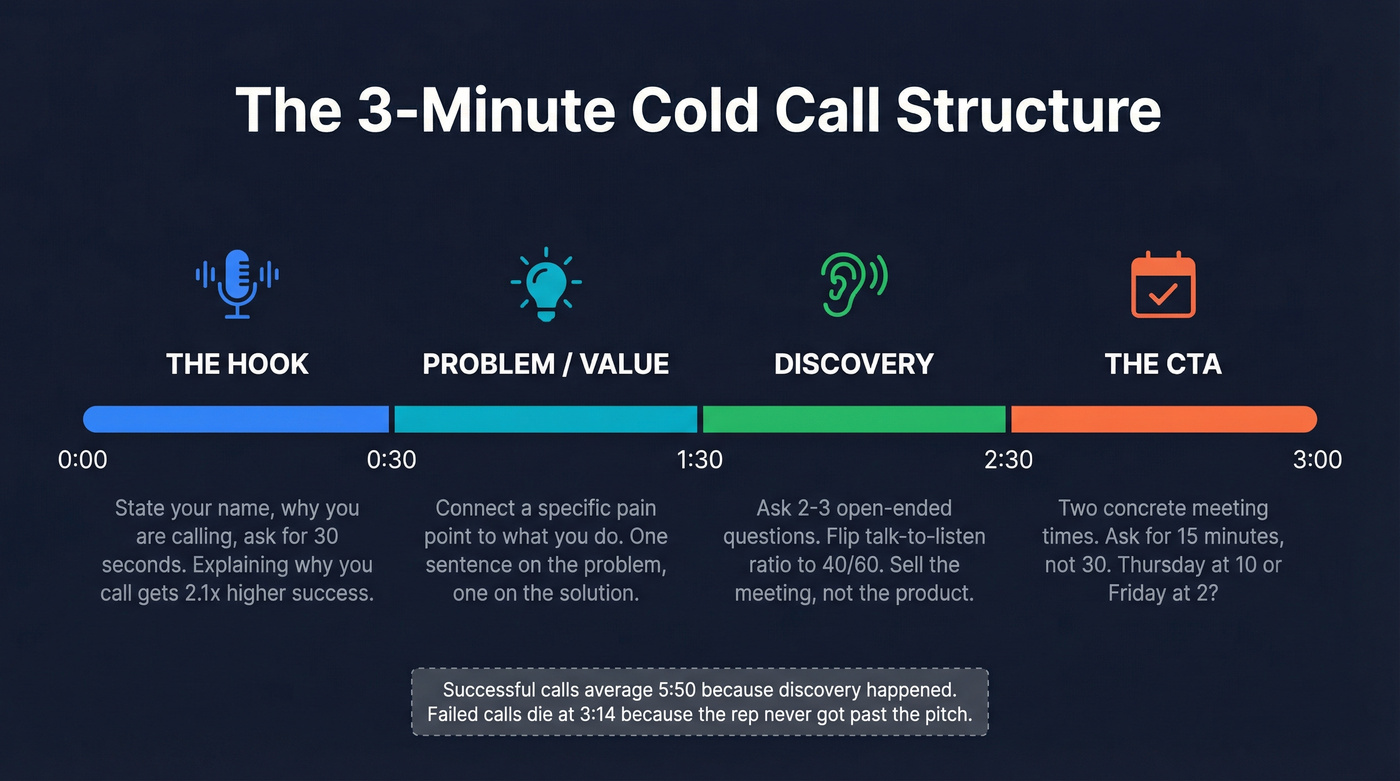
0:00-0:30 - The Hook. Permission-based opener. State your name, why you're calling, and ask for 30 seconds. That's it. Explaining why you're calling produces 2.1x higher success rates. If you want more tested openers, borrow from these sales pitch opening lines.
0:30-1:30 - Problem/Value. Connect a specific pain point to what you do. Use your pre-call research here. One sentence on the problem, one on how you solve it.
1:30-2:30 - Discovery. Ask 2-3 open-ended questions. Flip the talk-to-listen ratio to 40/60. You're selling the meeting, not the product. (More examples: open-ended sales questions.)
2:30-3:00 - The CTA. Two concrete meeting times. "Thursday at 10 or Friday at 2?" Ask for 15 minutes, not 30. If you need more options, here's how to secure a meeting on a cold call.
Gong's data backs this up: successful calls average 5:50 because discovery happened. Failed calls die at 3:14 because the rep never got past the pitch.
The 5-minute research rule only works if your contact data is accurate. Prospeo gives you 50+ data points per prospect - role, tenure, company signals, and verified direct dials - so your pre-call prep actually converts. At $0.01 per email and 10 credits per mobile, bad data stops being a budget line.
Research smarter, connect faster, book more meetings this week.
Cold Call Scripts That Work
Most guides give you 10 tips and zero scripts. That's like giving someone cooking tips without a recipe. Here are four you can use tomorrow morning.
The Gatekeeper Script
"Hi, it's [Your Name] from [Company]. Is [Prospect First Name] available?"
If challenged with "What's this regarding?":
"I'm following up on some correspondence. Could you put me through?"
Keep it casual, confident, and brief. Gatekeepers screen salespeople who sound like salespeople. First-name familiarity and a relaxed tone get you through more often than any clever trick. For more options, see what to say to get past the gatekeeper.
The Opener (Two Versions)
Permission-based (safer, works broadly):
"Hey [Name], it's [Your Name] from [Company]. I know you weren't expecting my call - give me 30 seconds?"
Pattern-interrupt (higher-risk, better with senior buyers):
"Hey [Name], I'll be brief. I'm calling because [specific value prop tied to their company trigger]."
The pattern-interrupt skips the permission ask and leads with relevance. It's higher-reward with executives who respect directness, but it can backfire with mid-level prospects who want to feel in control of the conversation.
Discovery Questions
Don't pitch the product. Sell the meeting.
"How are you currently handling [specific challenge from pre-call research]?"
"If you could fix one thing about that process, what would it be?"
These are open-ended enough to get the prospect talking, and specific enough to show you've done your homework. Listen more than you talk.
The Close
"It sounds like this is worth a deeper conversation. I've got Thursday at 10 or Friday at 2 - which works better for a quick 15 minutes?"
Two options, not an open-ended "when are you free?" A short meeting is easier to say yes to, and you can always run longer if the conversation warrants it.
Objection Handling Matrix
Here's the thing most reps miss: objections are engagement, not rejection. A prospect who objects is still on the phone. A prospect who hangs up didn't give you anything to work with.
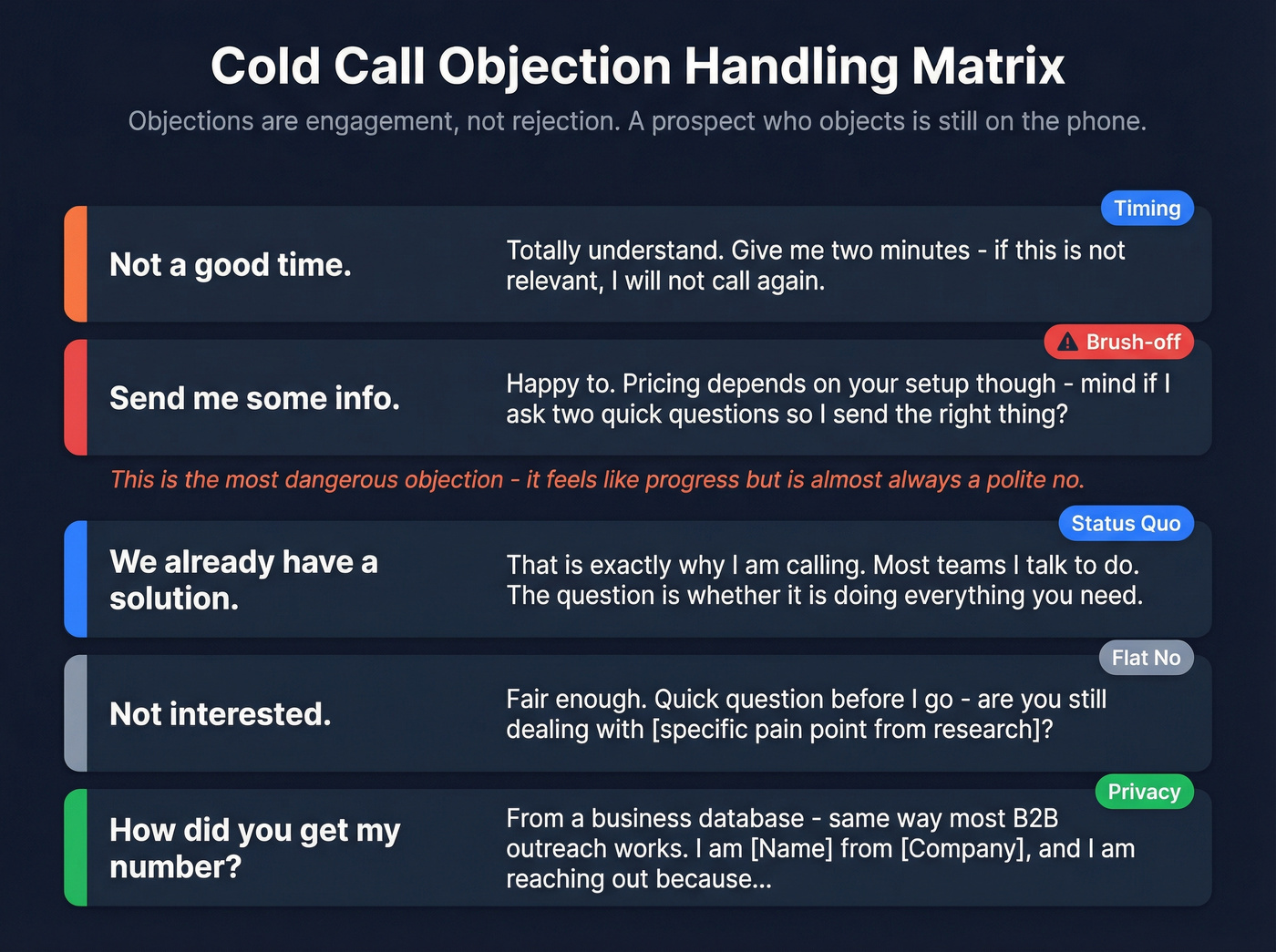
| Objection | Response |
|---|---|
| "Not a good time." | "Totally understand. Give me two minutes - if this isn't relevant, I won't call again." |
| "Send me some info." | "Happy to. Pricing depends on your setup though - mind if I ask two quick questions so I send the right thing?" |
| "We already have a solution." | "That's exactly why I'm calling. Most teams I talk to do. The question is whether it's doing everything you need." |
| "Not interested." | "Fair enough. Quick question before I go - are you still dealing with [specific pain point from research]?" |
| "How did you get my number?" | "From a business database - same way most B2B outreach works. I'm [Name] from [Company], and I'm reaching out because..." |
The "send me info" objection is the most dangerous because it feels like progress. It's almost always a polite no. Push for the live conversation - that's where deals actually start.
Language Swaps That Move the Needle
Small phrasing changes produce outsized results.
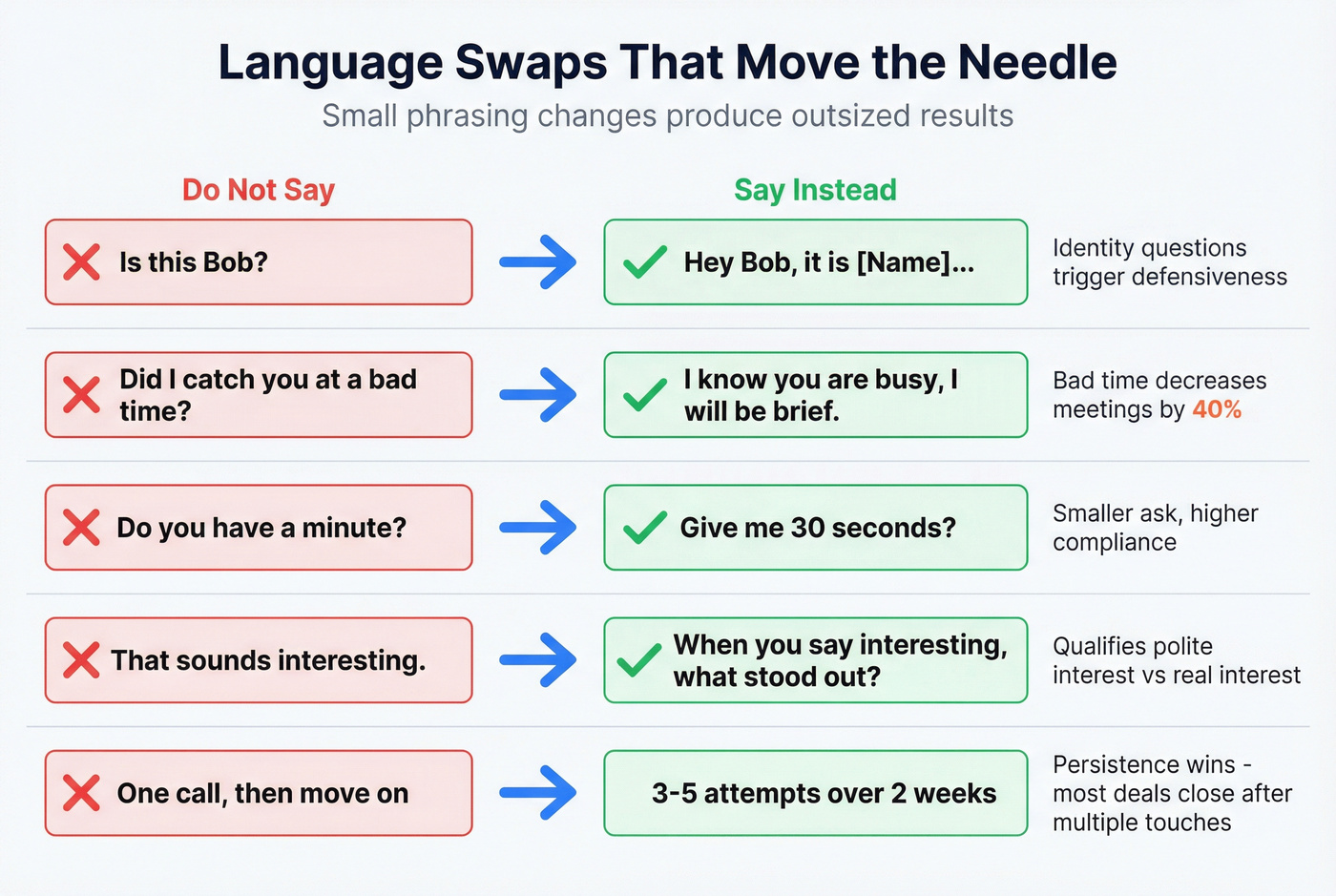
| Don't Say | Say Instead | Why |
|---|---|---|
| "Is this Bob?" | "Hey Bob, it's [Name]..." | Identity questions trigger defensiveness |
| "Did I catch you at a bad time?" | "I know you're busy, I'll be brief." | "Bad time" decreases meetings by 40% |
| "Do you have a minute?" | "Give me 30 seconds?" | Smaller ask, higher compliance |
| "That sounds interesting." | "When you say interesting, what stood out?" | Qualifies polite interest vs. real interest |
| One call, then move on | 3-5 attempts over 2 weeks | 30%+ of leads never get a follow-up |
The biggest mistake isn't any single phrase. It's giving up after one attempt. Additional call attempts increase conversion by 70%, and most reps never make the second call. We've watched teams double their meeting rate just by adding a structured follow-up cadence - no new scripts, no new tools, just persistence. (If you want a plug-and-play cadence, use this sales cadence example.)
Pair Calls with Email for Multichannel Follow-Up
Cold calling in isolation leaves money on the table. The strongest outbound sequences pair calls with email in a structured rhythm: call, then email within 2 hours referencing the conversation, then a second call attempt 48 hours later. Research on 5-8 touchpoint sequences shows this multichannel approach dramatically outperforms single-channel outreach.
The key is making sure your follow-up email actually lands. If you're pulling verified emails alongside mobile numbers from the same platform, your follow-up hits the inbox instead of the spam folder. That continuity - phone to email to phone - is what builds familiarity fast enough to earn a meeting. If you're building this into a repeatable system, start with best sales sequences.
The Right Tech Stack for 2026
You need three things: numbers to call, something to call them with, and a way to learn from the calls.
| Category | Tool | Starting Price | Best For |
|---|---|---|---|
| Phone Numbers | Prospeo | Free tier; ~$0.01/lead | Verified mobiles, accuracy |
| Phone Numbers | Apollo | ~$49/mo | Budget, large database |
| Phone Numbers | ZoomInfo | ~$15-40K/year | Enterprise, intent data |
| Dialer | Allo | $18/user/mo | Small teams, budget |
| Dialer | Aircall | $30/user/mo | Mid-market, integrations |
| Dialer | Kixie | ~$35/user/mo | HubSpot-native teams |
| Recording/Analysis | Gong | ~$100-150/user/mo | Enterprise coaching |
| Recording/Analysis | Avoma | ~$49/user/mo | Mid-market, AI notes |
Look, if your average deal size is under $15K, you don't need ZoomInfo-level data. A self-serve platform with verified mobiles and an $18/month dialer will outperform a $40K/year enterprise stack that your team barely uses. Spend the difference on hiring another SDR.
For dialers, Allo at $18/user/mo is the budget pick for small teams. Aircall adds deeper integrations and AI add-ons at $30/user/mo with a 3-user minimum. Kixie runs ~$35-95/user/mo and is the natural choice if your CRM is HubSpot.
Apollo's free tier gives you a large database but lower accuracy - fine for email-first workflows, less reliable for cold calling where every bad number costs you momentum. ZoomInfo is enterprise-grade but contract-locked and expensive for what most teams actually use. Skip it unless you're running 20+ reps and need intent data baked into your workflow.
Gong is the gold standard for call coaching at ~$100-150/user/mo. Avoma offers a lighter alternative with AI-generated meeting notes - solid for teams under 15 reps who don't need Gong's full analytics suite. If you're rebuilding your tooling, use this B2B sales stack blueprint.
Compliance Essentials
Two federal frameworks govern B2B cold calling in the US: the TCPA and the Telemarketing Sales Rule (TSR). Violations carry penalties of up to $1,500 per call.
The essentials:
- Calling hours: 8 AM to 9 PM in the prospect's local time zone.
- AI and synthetic voices are treated as prerecorded messages per the FCC's 2023 ruling. Consent and disclosure obligations apply. (More detail: AI cold calling.)
- Identify yourself and your company at the start of every call. State the purpose clearly.
- Maintain an internal DNC list. If someone says "don't call me again," that's binding.
- Stricter states include Florida, Oklahoma, Indiana, North Dakota, Louisiana, and Washington - each has additional registration requirements or shorter calling windows.
Consult counsel for your specific situation, especially if you're calling across state lines or internationally. But these basics will keep most teams out of trouble.
FAQ
How many calls should an SDR make per day?
The Bridge Group benchmark is 33 daily calls, yielding about 6.6 conversations. Focus on 90 minutes of focused dialing with pre-researched prospects rather than 4 hours of unfocused volume. If you're making 80+ calls and booking nothing, the problem is your data or targeting, not your effort.
What's a good cold call connect rate?
Expect 5-10% on office lines. With verified mobile numbers, connect rates jump to 20-30%. In our experience, teams using Prospeo's mobile database report around a 30% pickup rate - roughly 3x the industry average on direct dials.
What's the minimum tech stack for prospecting cold calling?
A phone number database with verified mobiles, a dialer like Allo at $18/user/mo, and a CRM to log activity. Total cost: under $20/month per rep. Add call intelligence tools like Gong once you've got consistent conversations happening and need to coach at scale.