Every Step of a Sales Call (With Scripts, Data, and a Checklist You'll Actually Use)
It's 9:02 AM. You've made 47 dials. Three pickups, zero meetings booked. The list your marketing team handed you is six months old, and half the numbers ring to someone who left the company in Q3. 72% of cold calls don't reach a human, and 80% go to voicemail. The problem isn't your pitch - it's that most reps never get a chance to deliver one.
The steps of a sales call haven't changed as much as vendors want you to believe, but the data behind each step has. This framework will make sure that when someone picks up, you know exactly what to say, when to listen, and how to lock a next step that sticks.
The 9 Sales Call Steps
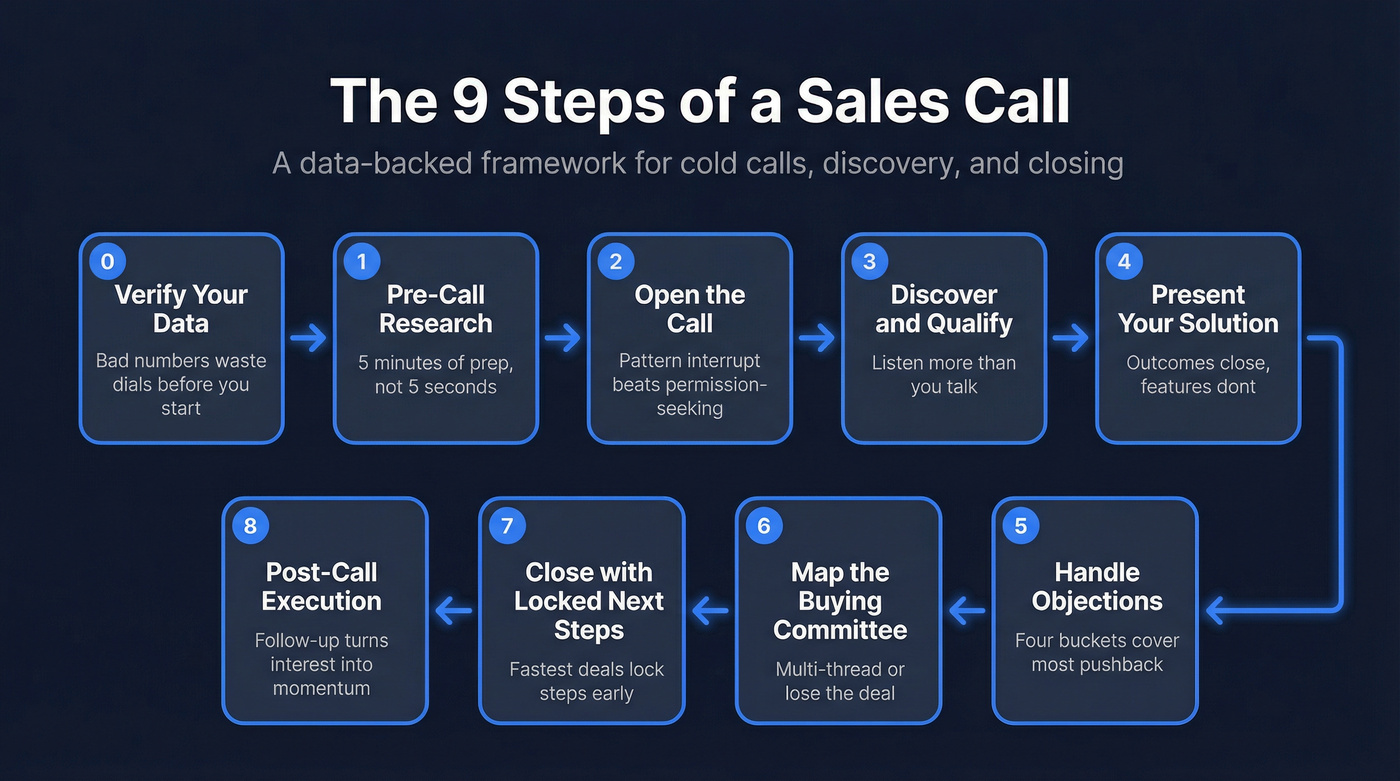
Here's the full sequence. Cold calls and discovery calls don't follow the same playbook - the talk ratios, pacing, and openers change by call type. We break all of that down below.
| Step | Name | One-Line Description | Key Metric |
|---|---|---|---|
| 0 | [Verify your data](#step-0 - verify-your-data) | Bad numbers waste dials before you start | 27.3% of rep time lost |
| 1 | [Pre-call research](#step-1 - pre-call-research) | 5 minutes of prep, not 5 seconds | 77% more revenue (AI-assisted reps) |
| 2 | [Open the call](#step-2 - open-the-call) | Pattern interrupt beats permission-seeking | 6.6x higher success rate |
| 3 | [Discover and qualify](#step-3 - discover-and-qualify) | Talk ratio shifts by call type | 43/57 on discovery |
| 4 | [Present your solution](#step-4 - present-your-solution) | Outcomes close; features don't | +10% win rate discussing price early |
| 5 | [Handle objections](#step-5 - handle-objections) | Four buckets cover most pushback | 23% more spend from trusted brands |
| 6 | [Map the buying committee](#step-6 - map-the-buying-committee) | Closed-won deals have 2x more contacts | 130% win-rate lift (multi-threading) |
| 7 | [Close with locked next steps](#step-7 - close-with-locked-next-steps) | Fastest deals lock next steps early | 53% more time on next steps |
| 8 | [Post-call execution](#step-8 - post-call-execution) | Follow-up turns interest into momentum | Recap sent within 1 hour |
Not All Sales Calls Follow the Same Structure
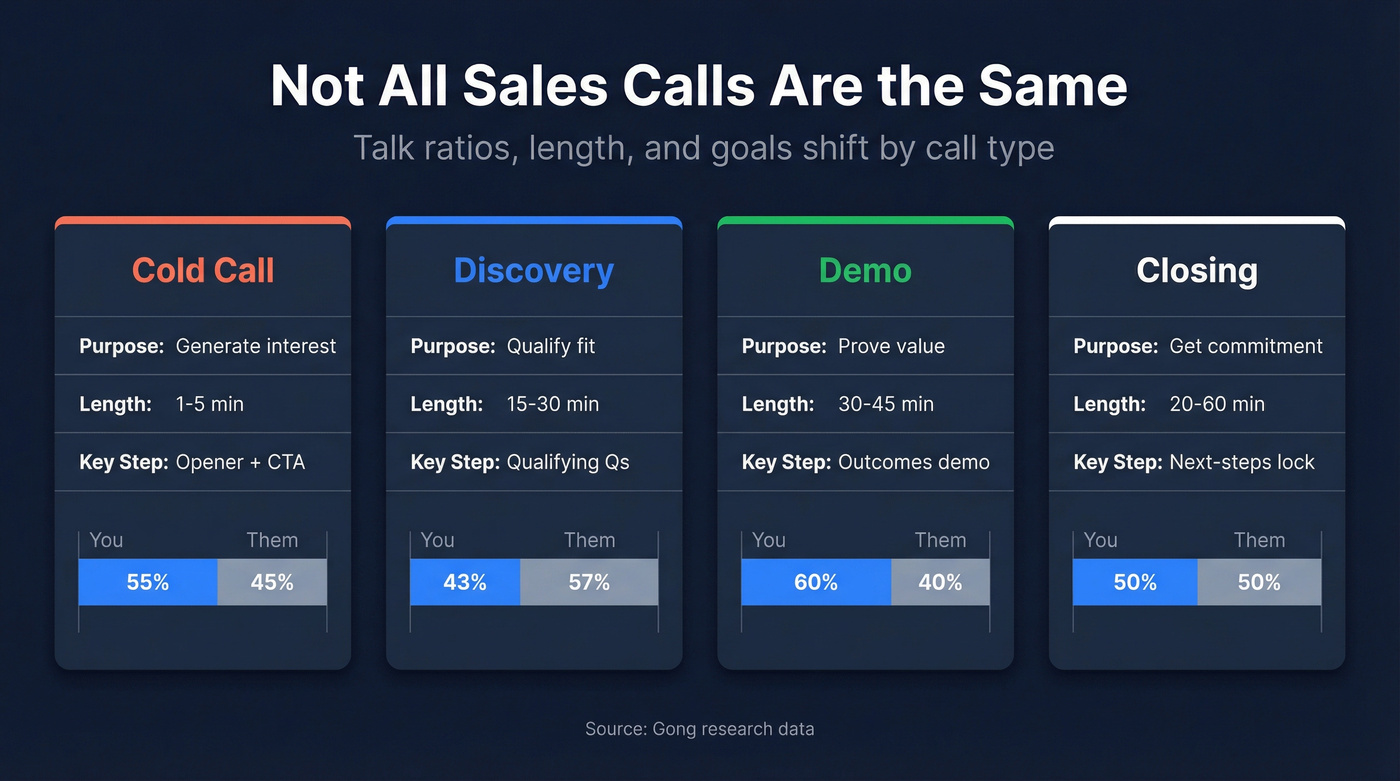
The biggest mistake in sales training is treating every call like it follows the same script. A cold call and a discovery call have different goals, different lengths, and different talk ratios.
| Cold Call | Discovery | Demo | Closing | |
|---|---|---|---|---|
| Purpose | Generate interest | Qualify fit | Prove value | Get commitment |
| Length | 1-5 min | 15-30 min | 30-45 min | 20-60 min |
| Talk ratio | 55/45 (you talk more) | 43/57 (they talk more) | 60/40 | 50/50 |
| Key step | Opener + CTA | Qualifying Qs | Outcomes demo | Next-steps lock |
Cold call talk ratios skew toward the rep because you're delivering a tight value statement in under two minutes. Gong's benchmark for cold calls is 55% talk / 45% listen on successful calls and 42% talk / 58% listen on unsuccessful ones. Discovery flips - Gong's classic benchmark is 43% talk / 57% listen. And 77% of B2B customers say their last purchase was extremely complex, which means your closing call might involve multiple stakeholders and take an hour.

Step 0 exists because 27.3% of rep time dies on bad data. Prospeo verifies emails at 98% accuracy and delivers 125M+ mobile numbers with a 30% pickup rate - refreshed every 7 days, not every 6 weeks.
Stop burning dials on disconnected numbers. Start reaching real buyers.
The Detailed Playbook
Step 0 - Verify Your Data
This is the step nobody talks about, and it determines whether the other eight even matter.
Reps lose 27.3% of their selling time to bad contact data. B2B data decays at roughly 2.1% per month - that's 22.5% of your list going stale every year. When it takes 209 calls to book one appointment, bad data makes that number worse.
Before you start a dial block, verify your list. Prospeo checks emails at 98% accuracy across 143M+ verified addresses, with 125M+ verified mobile numbers that hit a 30% pickup rate. The free tier gives you 75 email verifications per month - enough to test whether your current list is actually worth dialing. Upload a CSV, get results quickly, and stop burning the first hour of your morning on disconnected numbers. If you're comparing tools, start with an email checker tool or a dedicated email ID validators roundup.
Step 1 - Pre-Call Research
The 5-minute research rule exists for a reason. Reps who skip research default to generic pitches, and generic pitches get hung up on. Five minutes is enough to check:
- Company news - recent funding, product launches, leadership changes
- Prospect's role - how long they've been in it, what they own
- Trigger events - job changes, headcount growth, new tech adoption
- Relevant pain - what's their team likely struggling with right now?
AI-assisted prep tools cut this research time dramatically. Reps who use AI frequently generate 77% more revenue, and pre-call enrichment is one of the highest-ROI applications. Pull enrichment signals like job changes, funding rounds, and department headcount through your CRM enrichment workflow. You want 50+ data points per contact, not a Wikipedia summary of their company. If you want a tighter system, use a pre-call research checklist or a tiered guide to Pre Call Research for SDRs.
Step 2 - Open the Call
Your opener determines whether you get 30 more seconds or a dial tone.
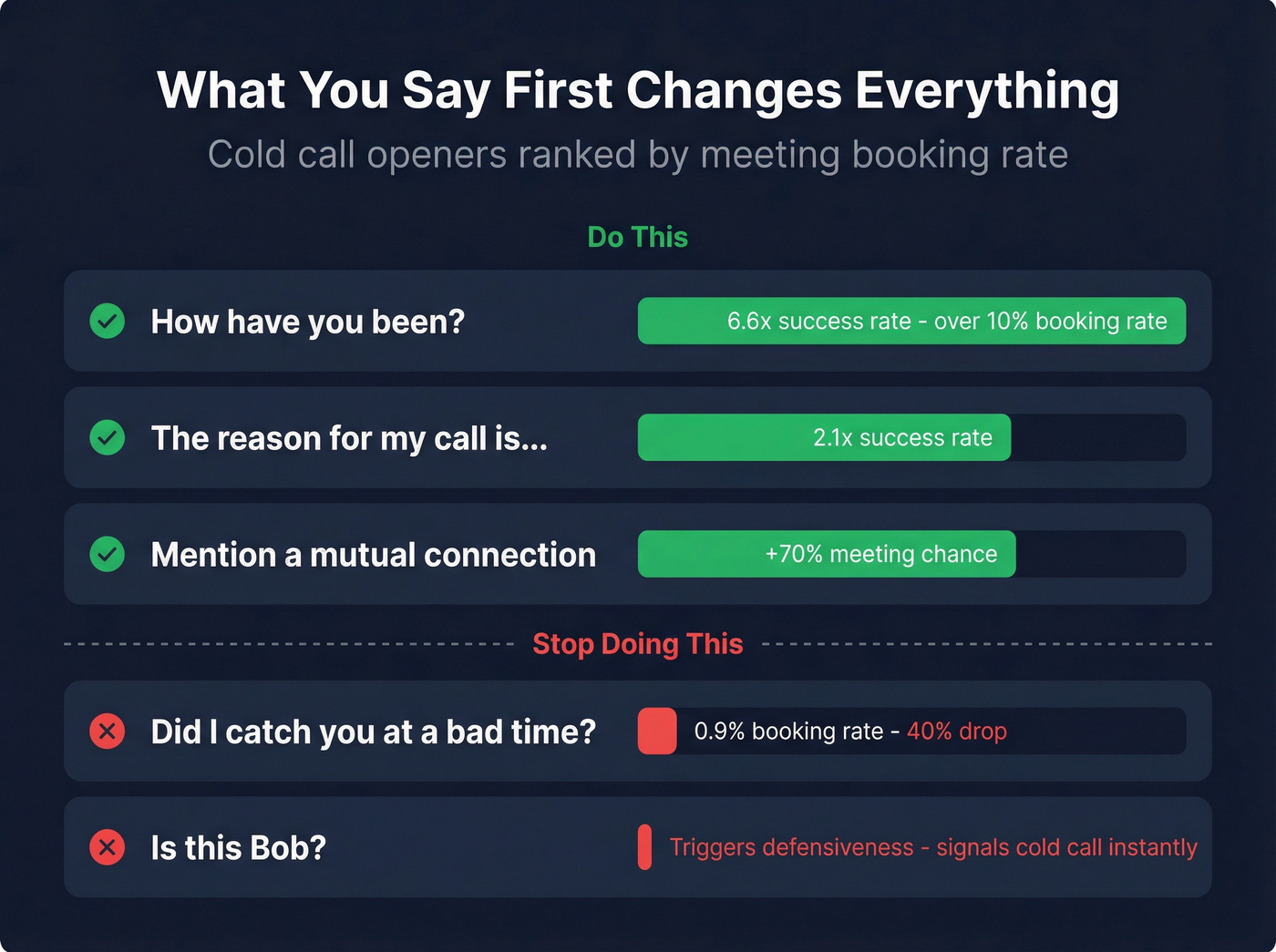
Don't say: "Did I catch you at a bad time?" This drops your meeting-booking rate by 40%. Calls that open with it convert at 0.9%. You're handing the prospect an exit before you've said anything of value. The fix: "Hi Bob, this is [Name] from [Company]. I know you're busy, so I'll be brief. I'm calling because..."
Don't say: "Is this Bob?" Identity-confirming openers trigger defensiveness. The prospect immediately knows it's a cold call from someone who doesn't know them. Use an assumptive greeting instead - "Hi Bob, this is [Name] from [Company]" - and move directly into your reason for calling.
Say instead: "How have you been?" Sounds counterintuitive on a cold call, but it measures at 6.6x higher success - over 10% booking rate. It creates a pattern interrupt that mimics a warm conversation.
Say instead: "The reason for my call is..." Stating your reason upfront hits 2.1x higher success. No preamble, no permission-seeking. Just tell them why you're calling.
Say instead: Reference a mutual connection. Mentioning a mutual connection increases your meeting chance by 70%. If you don't have one, a relevant trigger event works as a substitute.
Every successful cold call script shares five elements: personalization, a clear hook, prepared objection responses, a specific CTA, and confident tone. Miss any one and the call falls apart. For an advanced technique, try a "choose-your-own-path" opener where you give the prospect two options: "I can share a quick insight about [their industry pain] or just tell you why I'm calling - your pick." It hands them control while keeping you in the conversation.
Cold call openers and discovery openers aren't the same. On a cold call, you're earning 30 seconds. The structure is: assumptive greeting, reason for calling, one qualifying question, CTA for a 15-minute meeting. On a discovery call, the prospect already opted in. Your opener should set the frame: "I'd like to understand [their situation]. At the end, we can decide together if it makes sense to keep the conversation going, and if so, what that looks like. Sound fair?" If you want more openers, see Sales Pitch Opening Lines and the data behind why a pitch slap kills momentum.
That framing does two things: it gives the prospect control, which lowers resistance, and it pre-commits both of you to a decision at the end of the call. Remember it - we'll come back to it in Step 7.
Step 3 - Discover and Qualify
Most deals are won or lost during discovery. The rep just doesn't find out until three weeks later.
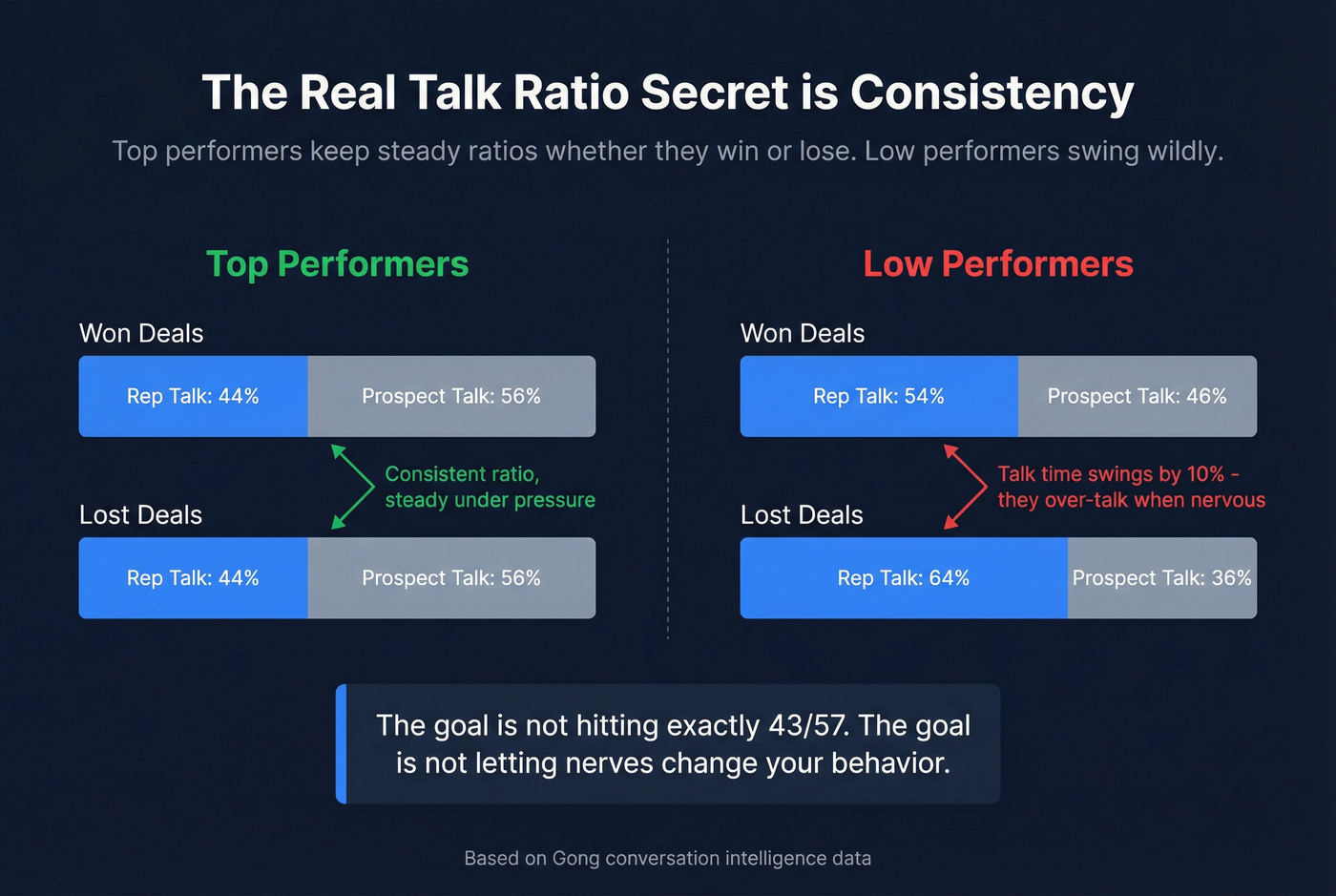
The talk ratio matters, but not the way most training decks teach it. The real separator isn't hitting exactly 43/57 - it's consistency. High performers keep similar ratios whether they win or lose. Low performers' talk time swings by ~10%, jumping from 54% in won deals to 64% in lost ones. They over-talk when they're nervous, which is exactly when they should be listening. For question frameworks, pull from these best open-ended sales questions or a full set of cold call qualifying questions.
For qualification, BANT (Budget, Authority, Need, Timeline) still works for mid-market deals. If you're selling into enterprise, MEDDIC or MEDDPICC gives you the rigor to map complex buying processes. Either way, the principle is the same: ask questions that uncover whether this deal is real, not questions that confirm what you want to hear.
Build in check-ins throughout: "Would it be okay if we got into that next?" or "Are you still tracking with me?" These micro-agreements keep the prospect engaged and give you real-time signal on whether you're losing them. Discovery-to-sale conversion runs 10-30% - the reps at the top of that range qualify ruthlessly and walk away from bad-fit deals early.
Step 4 - Present Your Solution
Here's the thing: if your deal size is under $15K, you probably don't need a 45-minute product tour. Keep your first demo under 10 minutes. Nobody needs a full walkthrough when they're still deciding if the problem is worth solving.
The shift that matters is simple. Stop presenting features and start presenting outcomes. "We have an AI-powered dashboard" means nothing. "Your reps will spend 30 fewer minutes per day on manual data entry" means everything. Frame every capability in terms of what changes for the buyer. If you need a tighter structure, use a step-by-step guide on how to create a sales presentation.
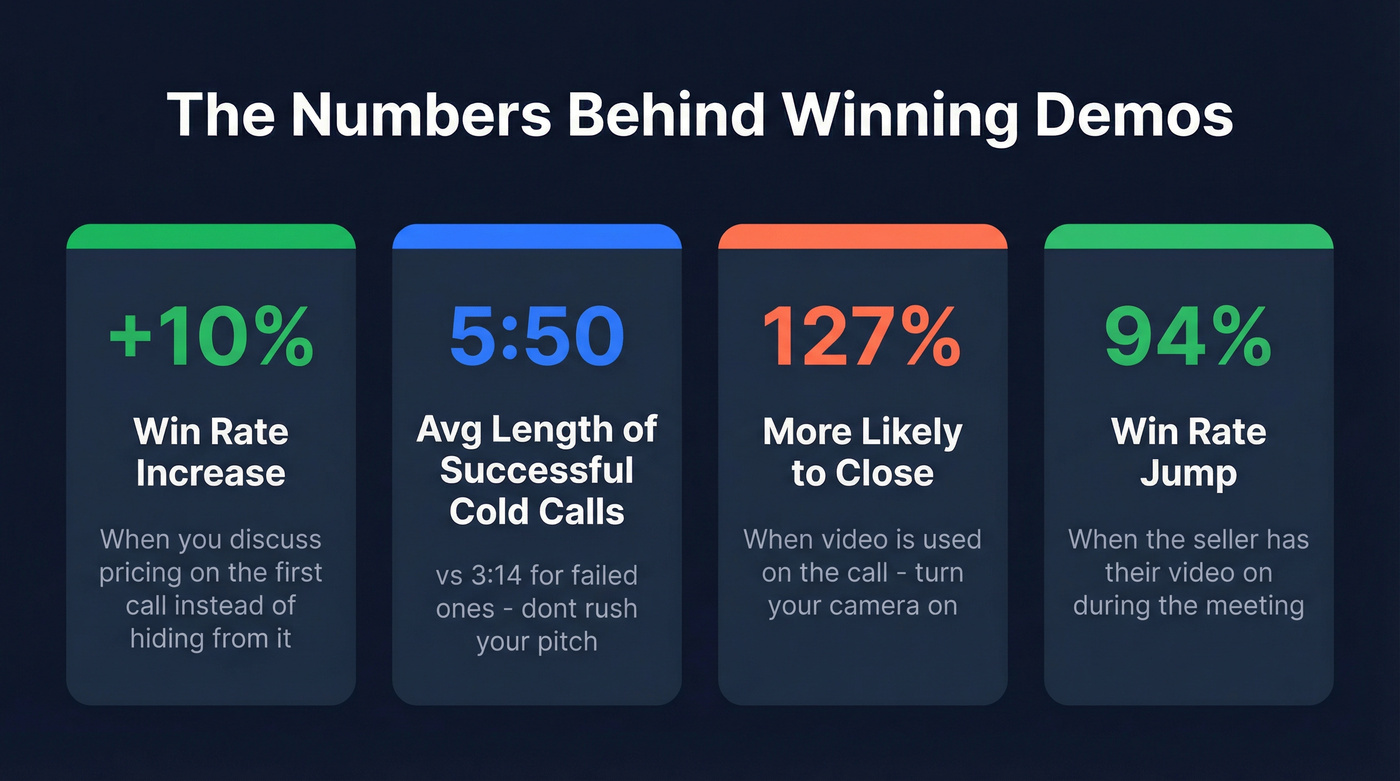
A data point that surprises most reps: discussing pricing on the first call increases win rates by 10%. Don't hide from the money conversation. If you're in range, you want to know now. If you're not, you both want to know now. Successful cold calls average 5:50 in length versus 3:14 for failed ones - rushing through a pitch in under three minutes almost never works.
One more thing: turn your camera on. Deals are 127% more likely to close when video is used, and win rates jump 94% when the seller has video on. It's a small change that signals confidence and builds trust faster than any script.
Sample discovery/demo agenda (share with the prospect beforehand):
- Quick recap of what we discussed (2 min)
- Walk through [specific outcome they care about] (8 min)
- Your questions (5 min)
- Decide on next steps together (5 min)
Sharing the agenda upfront shows respect for their time and keeps the call from drifting.
Step 5 - Handle Objections
35% of salespeople say closing is the hardest part of sales. It's not closing that's hard - it's the objection handling that happens right before the close. Almost every objection falls into four buckets:
| Objection Type | Example | Response Approach |
|---|---|---|
| Budget | "It's too expensive" | Reframe around outcomes |
| Timing | "Not a priority right now" | Map to a trigger event |
| Need | "We already have a solution" | Probe the gap |
| Authority | "I need to check with my boss" | Identify the committee |
Budget: "What would it be worth if your team booked 30% more meetings?" You're not arguing price - you're connecting cost to value. If a competitor is cheaper, shift from sticker price to total value: onboarding, support, what's actually included.
Timing: "When does your team start planning for Q3 pipeline?" You're not pushing urgency - you're anchoring to their calendar.
Need: "How's your current bounce rate? What's your connect rate on cold dials?" You're not dismissing their current solution - you're surfacing the gap they haven't measured.
Authority: "Totally fair - who else would weigh in on this?" You're not going around them - you're helping them build internal consensus.
The principle behind all four: don't push, reframe. Collaborative reframing beats aggressive closing every time, and the data backs it - customers are 23% more likely to spend with brands they trust. Trust compounds across every interaction. For deeper frameworks, see handling sales objections with curiosity and a full taxonomy of types of objections.
Step 6 - Map the Buying Committee
B2B deals require 6-10 decision-makers on average. If you're only talking to one person, you're not selling - you're hoping.
An analysis of 1.8M opportunities makes this brutally clear: closed-won deals have 2x more buyer contacts than closed-lost. For deals over $50K, multi-threading boosts win rates by 130%. Strategic enterprise deals average 17 contacts on the buying side.
Your selling team matters too. Closed-won deals have selling teams 67% larger than lost ones, and bringing in a sales engineer can increase win rates by up to 30%.
The question you need to ask - every single time - is: "Who else would be involved in this decision?" Not at the end of the process. During discovery. During the demo. The earlier you map the committee, the less likely you are to get blindsided by a VP you've never spoken to vetoing the deal in week six.
We've seen teams lose six-figure deals because they built a champion relationship with a director who didn't have budget authority. Multi-threading isn't optional anymore. It's the difference between a forecast and a fantasy. If you want a clean definition + examples, read what is multithreading in sales.
Step 7 - Close with Locked Next Steps
The fastest deals spend 53% more time discussing next steps in the first meeting than average deals. That's not a coincidence.
Here's a scenario every rep knows: the discovery call went perfectly. Great rapport, real pain identified, genuine interest. Then three weeks pass. No response. The deal dies in silence. The problem wasn't the conversation - it was the lack of a locked next step.
Use this 4-item checklist before you hang up:
- Time and date - "Let's lock Tuesday at 2 PM"
- Purpose - "We'll walk through the ROI model with your CFO"
- What will happen - "I'll send a one-pager beforehand"
- What won't happen - "No pressure to sign - this is a fit conversation"
If you set the frame at the start of the call (Step 2), this close feels natural, not pushy. You already agreed to decide together. Now you're following through on that agreement.
The biggest mistake: mistaking interest for intent. "This looks great, let me think about it" isn't a next step. It's a polite exit. Push - gently - for a specific date and a specific purpose.
Step 8 - Post-Call Execution
The call ended. Now the real work starts.
Within 5 minutes: Log the call in your CRM - notes, next steps, stakeholders mentioned. If you wait until end of day, you'll forget half of it.
Within 1 hour: Send a recap email. One paragraph: what you discussed, what you agreed on, what happens next, and by when. Keep it scannable. The consensus across r/sales and most outbound communities is consistent on this point: the follow-up email matters more than the close itself. If you need a cadence, use this prospect follow up playbook.
For complex deals: Build a mutual action plan - shared doc, timeline, milestones, owners on both sides. This is what separates pipeline from closed-won in enterprise sales.
If you hit voicemail, use this template:
"Hi [Prospect], this is [Name] from [Company]. [One sentence of value - e.g., 'We help sales teams cut bounce rates from 35% to under 4%.']. I'll follow up by email. My number is [number]."
That's it. Don't pitch to a machine. The voicemail exists to make your follow-up email expected, not ignored.
Mistakes That Kill Sales Calls
Let's be honest - most of these are things we've all done at some point. The difference between a good rep and a great one is how fast they stop doing them.
- Permission-based opener - "Do you have a minute?" gives them an easy no. State your reason for calling immediately.
- Talking too much on discovery - If you're above 50% talk time on a discovery call, you're pitching, not qualifying. Target the 43/57 ratio.
- Skipping the next-steps lock - "I'll send you some info" isn't a next step. Use the 4-item checklist before you hang up.
- Generic pitch, zero personalization - "We help companies like yours" is invisible. Spend 5 minutes on pre-call research and open with a trigger.
- Calling bad numbers - 27.3% of rep time lost to bad data. Verify your list before every dial block. Skip this step if you enjoy burning two hours a day talking to nobody.
Pre-call research without enrichment data is guesswork. Prospeo returns 50+ data points per contact - job changes, funding, department headcount - so every opener is specific and every qualifying question lands.
Turn your 5-minute research rule into a 30-second enrichment workflow.
FAQ
How many steps are in a sales call?
Most frameworks teach 7 stages - open, qualify, present, handle objections, close, and follow up. This guide covers 9 because it adds data verification (Step 0) and buying-committee mapping (Step 6), two stages modern B2B deals can't skip.
What's the ideal talk-to-listen ratio?
Cold calls convert best at 55/45 (rep talks more); discovery flips to 43/57. Consistency matters more than the exact split - high performers maintain steady ratios across wins and losses, while low performers swing by 10%+.
How do I verify prospect data before calling?
Upload your list to a verification platform like Prospeo and check emails and phone numbers before each dial block. The free tier covers 75 verifications per month - enough to audit whether your current list is worth dialing or needs a full refresh.
How long should a cold call last?
Successful cold calls average 5:50 versus 3:14 for failed attempts. Discovery calls run 15-30 minutes, demos 30-45 minutes, and closing calls 20-60 minutes depending on stakeholder count and deal complexity.