Twitter (X) for B2B Sales: A 2026 Workflow From Intent to Meetings
One good thread can drop $15k/month into your pipeline, then vanish because you never captured a real follow-up path. That's the entire game of twitter for b2b sales in 2026: X surfaces intent in public, but deals close in a trackable process off-platform. The teams that win treat X like a pipeline stage, not a place to hang out.
Here's the thing: X is a prospecting layer, not a nurturing channel. If you try to "build relationships" for months in replies, you'll get engagement and miss quota. The platform rewards attention; your job's to create meetings and next steps.
I hate saying it, but most "X social selling" advice is just content advice wearing a sales hat.
What you need to make this channel work (without living on the app)
You don't need a "content strategy." You need a loop you can run on a Tuesday when you're slammed.

Minimum viable setup (keep this, skip the rest):
- A profile that converts (bio + pinned post + link)
- 10-15 saved intent searches
- 2-3 private Lists (twitter lists for sales you can check in minutes)
- A CRM habit: every meaningful interaction becomes a lead with a next step
Run this cadence:
- Daily (20 minutes): 3 searches -> 5 intent replies -> 2-4 DMs to people you've already engaged with
- Weekly (90 minutes): review Lists -> pull 10 warm accounts into "active" -> push qualified leads into CRM/sequencer
If you only do three things, do these:
- Intent search: find posts where someone's evaluating a tool, vendor, hire, or workaround. (If you want a broader framework, borrow from intent signals thinking.)
- Public reply first: help in-thread, then ask permission to DM.
- Move to verified contact + meeting: once there's interest, capture a verified email/mobile and send a calendar link.
That last step is where most teams drop the bag.
Profile setup that converts (bio + pinned post + link)
Treat your profile like a landing page. When someone clicks your name after a reply, you've got about five seconds.
Bio formula (copy/paste): I help {ICP} get {outcome} without {pain}. | Proof: {metric/logo} | CTA: {what to DM you for}
Example structure:
- "I help RevOps teams cut bounce rates under 5% without burning domains."
- Proof point: "Built outbound for 50+ AEs" or "$X pipeline influenced"
- CTA: "DM 'checklist' for the teardown"
Pinned post template (the one that drives DMs):
- 1 line: who it's for + the pain
- 3 bullets: what you'll fix / what you'll share
- 1 mini-proof: "we did X, got Y"
- 1 CTA: "Reply 'template' and I'll send it" (or "DM me 'audit'")
Link strategy: one page per pain. Don't send people to your homepage. Send them to a page that matches the exact problem they just posted about, because "learn more" pages kill momentum and make the click feel like work. (If your positioning is fuzzy, start with an ideal customer definition and tighten from there.)
Does twitter for b2b sales actually work in 2026?
Yes, when you use it for demand capture and you respect the labor.
Use X if:
- You sell something people talk about publicly: tooling, ops pain, hiring, compliance, security incidents, "alternative to..."
- Your buyers are active there (founders, RevOps, product, growth, security, dev tools)
- You can show up consistently
Skip X if:
- Your ICP's quiet, highly regulated, or allergic to public discussion
- You need predictable reach and tight targeting controls (search and LinkedIn-style targeting win here)
- You won't commit to the routine
We've seen social listening across Reddit/Twitter/LinkedIn hit 38% response and 8 conversions, but it took 15+ hours/week of monitoring and engagement. That's the trade: higher intent, higher labor, and a lot more "human time" than people budget for. If you want more data points, see these social selling statistics.
What people get wrong (and complain about after a month):
- They chase impressions instead of meetings held.
- They DM strangers cold and get throttled.
- They "do X" by scrolling the main feed, then wonder why nothing's repeatable.
The 2026 pipeline for twitter for b2b sales: intent -> engage -> move private -> book
If you don't define stages, you'll end up with "lots of conversations" and no calendar.

Stage-by-stage pipeline (with the handoffs that matter)
Stage 1: Intent discovery (search + Lists)
- Input: saved searches, competitor mentions, "looking for" posts, and twitter lists for sales that keep your ICP in one place
- Output: 5-10 posts/day worth replying to
Stage 2: Public engage (reply)
- Goal: be useful enough that they reply back or click your profile
- Handoff trigger: reply / like + follow / quote-post with a question
Stage 3: Move private (DM)
- Goal: confirm the problem + qualify lightly
- Handoff trigger: permission to send a resource or a 15-min link
Stage 4: Meeting conversion (calendar link)
- Goal: one clear CTA, one time-boxed meeting type
- Handoff trigger: booked + confirmed
Stage 5: CRM log + follow-up
- Goal: don't lose the thread
- Handoff trigger: next step scheduled (not "circle back")
In our experience, the fastest path to meetings is boring: reply publicly first, DM only after engagement, then move to a calendar link within 3-7 messages. Anything longer turns into pen-pal mode.
The handoff checklist (the part that creates pipeline)
When someone's warm on X, do this immediately:

1) Capture contactability
- Verified email (primary)
- Mobile (if you sell bigger deals or time-sensitive solutions) (for direct dials, use this B2B phone number workflow)
2) Log the lead with fields you'll use
- Source: "X intent"
- Intent keyword/topic (what they posted)
- Persona + role seniority (if your team struggles here, use these buyer persona examples)
- Company size band
- Current tool / competitor mentioned
- Next step date (hard date, not "later")
3) Send one next step
- "Want the checklist?" (resource)
- "Want a 15-min fit check?" (meeting)
- "Want me to introduce you to {partner}?" (referral)
Real talk: impressions aren't pipeline. Pipeline is qualified conversations -> contactable leads -> meetings held. If you need a clean definition of stages + rules, align it with B2B sales pipeline management.
Mini vignette: what "good" looks like
We've tested this exact pattern repeatedly.
A founder posts: "Alternative to {tool}? Our process is too manual." You reply with a 3-bullet breakdown of what to evaluate plus one clarifying question. They answer in-thread, so you DM: "Want the 1-page checklist?" They say yes, you send it, ask one qualifying question, then offer a 15-min call. The meeting books, you log it as "X intent," tag the competitor, and set a follow-up task the same day.
That's a sales process. Everything else is vibes.

You just got a warm reply on X. Now what? Most reps lose the deal right here - stuck in DMs with no verified contact data. Prospeo finds 98% accurate emails and direct dials so you can move from X thread to calendar link in minutes, not weeks.
Stop letting warm X conversations die in someone's DMs.
Rules of the road: compliance + account risk (read this before you DM)
X is aggressive about automation abuse. Their automation rules page was updated October 2025, and the practical implications hit sales teams directly.
Do
- Use tools that rely on the official API for automation
- Keep automation helpful and human-paced
- Assume you're responsible for anything connected apps do
- Treat rate limits as hard boundaries
Don't
- Circumvent rate limits
- Script the website UI (browser scripting/scraping the interface)
- Run repetitive mass outreach patterns that look automated
- Use multiple accounts to bypass limits
What happens if you mess this up X will filter posts from search results (the silent killer for social selling) or suspend the account. If your workflow depends on being discoverable in search, search filtering's a revenue event.
Read the official X automation rules once, then build habits around them.
Safe automation for sales teams (what's fine vs what gets flagged)
Safe
- Scheduling posts
- Keyword alerts for intent phrases (so you reply manually)
- Drafting replies/DMs in a tool, then sending manually
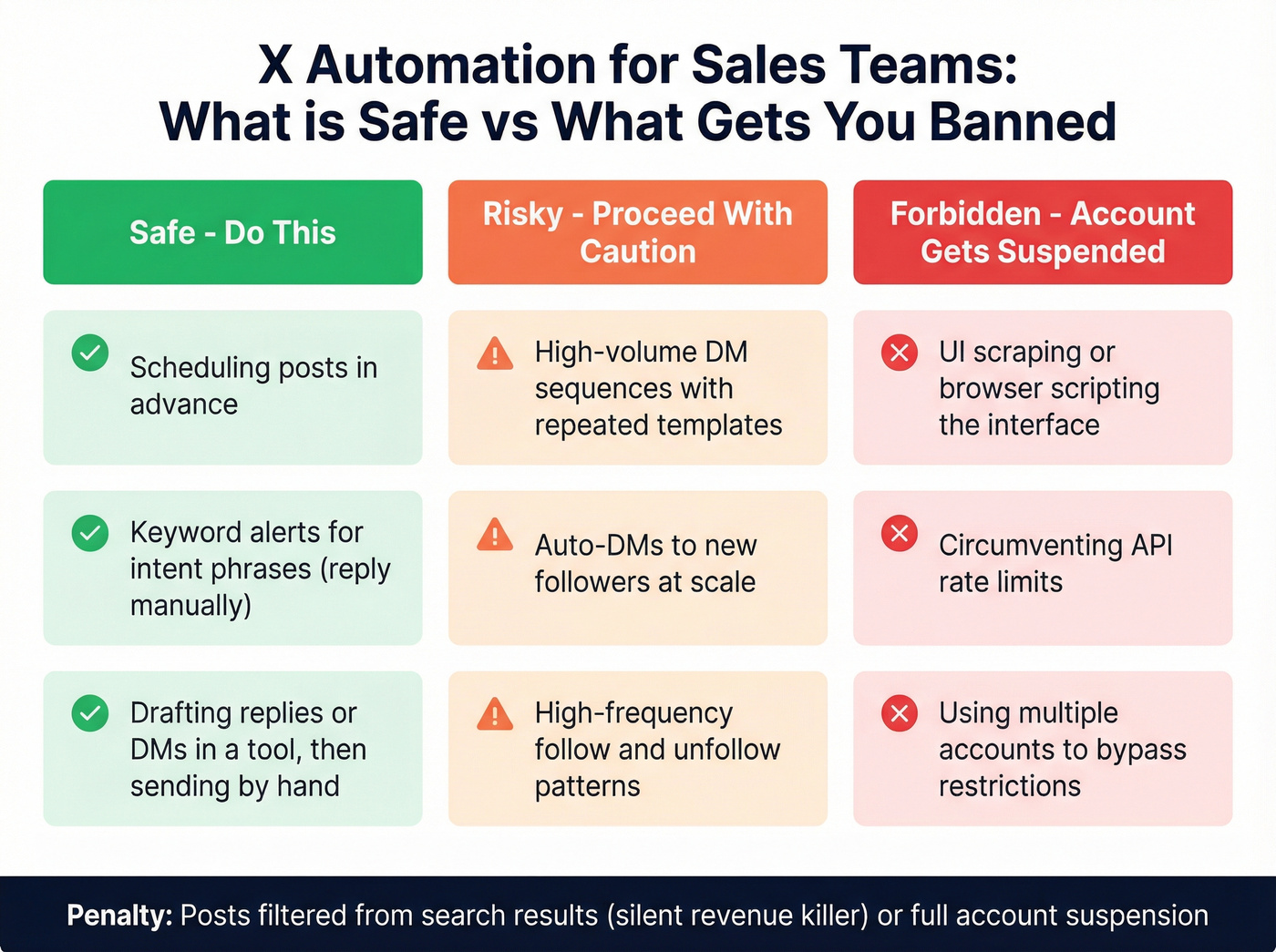
Risky
- High-volume "DM sequence" behavior (repeated templates at scale)
- Auto-DMs to new followers when they're repetitive or sent at volume
- High-frequency follow/unfollow patterns
Forbidden
- UI scraping/scripting
- Rate-limit circumvention
- Multi-account evasion
3 automation patterns that get accounts flagged fast
- Template DMs sent in bursts (same structure, same cadence, same CTA)
- Link-first DMs to people who never engaged with you
- "Human-powered spam": a VA copy/pasting the same message 50 times/day
Prospecting lane #1: find buyers already asking for help (Advanced Search + operators)
X prospecting isn't "build a list of titles." It's "find the moment someone admits they've got a problem."
How to access Advanced Search Log in on X.com, run a search, then open Advanced search under Search filters (upper right), or go More options -> Advanced search. X documents it on their Advanced Search help page.
Operators are the cheat code. A quick reference worth bookmarking: from:, filter:links, filter:replies, since:, until:, url:.
Intent signals that correlate with pipeline
These phrases usually mean budget + urgency exist:

- "Looking for a tool/vendor for..."
- "Any recommendations for..."
- "What's the best tool for..."
- "Anyone used [competitor]?"
- "Alternative to [tool]"
- "We're hiring a [role] to fix..."
- "Our [process] is broken / too manual / doesn't scale"
- "Need an agency for..."
My opinion: "What tool should I use?" is good. "Roast my landing page" is mostly entertainment. You want operational pain, not vanity feedback.
Copy/paste query library (by persona + scenario)
Swap in your category keywords and competitors. Keep date filters tight so you're not replying to ancient posts.
RevOps / Sales Ops pain
"looking for" (crm OR "sales ops" OR revops) since:2026-01-01 -filter:replies("alternative to" OR "switching from") (Salesforce OR HubSpot) since:2026-01-01 filter:replies("sequence" OR "outreach" OR salesloft) ("deliverability" OR "bounces") since:2026-01-01 -filter:links
Marketing ops / demand gen
("recommend" OR "anyone used") (attribution OR "marketing ops") since:2026-01-01 -filter:replies"tool for" ("paid search" OR "landing page") since:2026-01-01 filter:replies
Founders buying for speed
("need a" OR "looking for") (agency OR freelancer) (seo OR outbound OR revops) since:2026-01-01 -filter:replies"anyone used" (apollo OR zoominfo OR cognism) since:2026-01-01 filter:replies
Security / IT (high intent, fewer posts)
("vendor" OR "tool") (SOC2 OR "security review") since:2026-01-01 -filter:replies"alternative to" (okta OR jamf OR crowdstrike) since:2026-01-01 -filter:replies
Technographic "url:" trick (great for niche tools)
url:intercom ("switching" OR "migrating") since:2026-01-01url:stripe ("billing" OR "invoicing") ("tool" OR "platform") since:2026-01-01
Link-filtered "research mode" posts (often buyers sharing shortlists)
("we evaluated" OR "shortlist" OR "RFP") filter:links since:2026-01-01("pricing" OR "quote") ("tool" OR "platform") filter:links since:2026-01-01
Prospecting lane #2: follower graph + engagers (bio keyword filtering)
This lane's the one most people skip, and it's the easiest way to build a steady watch list without relying on daily intent posts.
The workflow (20 minutes, once per week):
- Pick 10 niche accounts your buyers follow (operators, analysts, community builders, tool founders, event hosts).
- Open their followers and their post engagers (replies + likes on relevant posts).
- Scan bios for role keywords (RevOps, Head of Sales, IT, Security, Founder) and context keywords (your category, "hiring," "scaling," "SOC2," etc.).
- Add qualified accounts to a private List called "ICP Watch."
- Check that List daily for intent posts and project signals.
Bio keyword ideas (steal these):
- Role: "VP Sales," "RevOps," "Sales Ops," "Demand Gen," "Security," "IT," "Procurement"
- Stage: "Series A/B," "scaling," "hiring," "building," "rollout"
- Pain: "deliverability," "attribution," "compliance," "migration," "RFP"
This method wins because it compounds. After a month, your List becomes a curated feed of people who actually buy things, and you stop relying on the algorithm to "show you" your market.
Lists + a 20-minute daily routine (so you don't drown in the feed)
Lists are the antidote to the algorithm. They turn X into a controllable feed, especially for twitter for sales professionals who need consistency more than novelty.
Practical truths:
- Lists can be public or private
- Adding accounts to a List doesn't notify them
- Keep client/prospect Lists private so you don't publish your target list
A routine you can sustain
| Cadence | Time | What you do | Output |
|---|---|---|---|
| Daily | 10 min | Check 1-2 Lists | 3 replies |
| Daily | 10 min | Run 2 searches | 2 replies + 2 DMs |
| Weekly | 45 min | Review "active" List | 10 leads logged |
| Weekly | 45 min | Follow-up + cleanup | next steps set |
The mistake is "doing X" by scrolling the main feed. That's entertainment with a sales costume.
Outreach that gets replies (without getting throttled): replies, DMs, follow-ups
Two constraints matter more than copywriting:
- Deliverability (DM settings, message requests, follow-only)
- Pattern detection (volume + repetition triggers blocks)
You'll see people quote big DM limits for unverified accounts. Ignore the headline number. If you want your account to stay healthy, run 20-40 highly personalized DMs/day, spaced out, and only after public engagement. If you want to systematize pacing across channels, use SDR cadence best practices.
Bad DM vs good DM (the difference is permission + specificity)
Bad (gets ignored or flagged): "Hey! We help companies like yours scale revenue. Want to hop on a quick call this week?"
Good (gets replies): "Hey {name} - your post about {specific issue} hit home. Quick question: are you trying to fix it in {timeframe} or just researching options? If it's active, I'll send a 1-page checklist."
The good version works because it proves you actually read the post and it gives them an easy yes/no.
Public reply templates (3)
1) Help-first (best default) "Good question. If you're evaluating {category}, the two things that decide success are {criterion 1} and {criterion 2}. Which use case are you: {A} or {B}?"
2) Proof + offer (when you've done this before) "We fixed this exact issue for a {similar company type}. The fastest win was {tactic}. Want the checklist?"
3) Clarifying question (when you want them to self-qualify) "What's driving the switch - {pain 1}, {pain 2}, or {pain 3}?"
Public replies should earn the DM. If your reply's basically "DM me," you're skipping the trust-building step.
DM scripts (3) + follow-up
DM #1: Context -> value -> permission "Hey {name} - saw your post about {specific problem}. I've got a 1-page {resource} that covers {outcome}. Want me to send it?"
DM #2: Micro-diagnosis "Quick thought on {problem}: most teams get stuck because {root cause}. What's your stack right now ({tool A}/{tool B})? I'll point you to the cleanest fix."
DM #3: Time-bound qualifier "Quick question - are you trying to solve {problem} for {team} this month, or is it a later project?"
Follow-up (2 messages, spaced)
- +48 hours: "Still want that {resource}, or should I drop it?"
- +5-7 days: "Last ping - what's the #1 constraint: budget, time, or internal buy-in?"
The anti-spam checklist (non-negotiable)
- Every first DM is unique (no identical blocks across recipients)
- Don't include links in the first message unless they asked
- Don't run identical "sequences" in DMs
- Space sends across the day
- If someone doesn't respond, stop
We've watched teams torch a strong founder account by outsourcing DMs to a VA with a template. It "works" for two days, then reach falls off a cliff, and suddenly the team decides "X doesn't work" instead of admitting they spammed their way into a shadow penalty.
Paid X Ads vs organic: what to run in 2026 (now that lead-gen cards are gone)
Paid on X isn't LinkedIn. It's cheaper clicks, noisier intent, and your landing page has to do the heavy lifting.
Official campaign objectives
X Ads is objective-based:
- Awareness: Reach
- Consideration: Video views, Website traffic, Pre-roll views, Engagement, App installs
- Conversion: App re-engagements, Website conversions
That's straight from X's campaign types page.
Reality check: Lead Generation Cards are gone. The practical replacement is simple:
- Website traffic or Website conversions -> send to a landing page built for one pain
- If you want in-feed capture, use a hosted form flow and accept lower lead quality
Funnel mapping that makes sense for B2B
- Top: Video views -> POV clips, problem framing, "what we learned" threads
- Mid: Website traffic -> one pain-specific page (not homepage)
- Bottom: Website conversions -> demo/assessment page with tight qualification
My recommendation: earn your first 10 meetings organically before you spend a dollar on ads. Paid doesn't fix unclear positioning; it just spreads it faster.
Benchmarks + KPIs for twitter for b2b sales (not impressions)
If you're doing twitter for b2b sales, your dashboard should look like a funnel, not a creator analytics page.
Directional baselines for budgeting (benchmarks vary by industry and offer)
Use these as 2025-2026 baselines to sanity-check your plan:
- CPC: X $0.38 vs LinkedIn $5.58 vs Google Search $2.69
- CPL: B2B average ~$84; LinkedIn ~$110; Google Search ~$50-70
- Unit economics guardrail: LTV:CAC >= 3:1 (see CAC LTV ratio benchmarks)
- Lead quality reality: LinkedIn MQL->SQL 14-18%, SQL->Opp 50-60%
Channel comparison (pick a winner per row)
| Decision | Winner | Why |
|---|---|---|
| Cheapest clicks | X Ads | Lowest CPC in most B2B tests; great for reach and retargeting pools. |
| Highest intent at the moment of need | Google Search | People are actively looking; fewer drive-by clicks. |
| Best targeting controls for B2B personas | Job/firmographic targeting's still the cleanest. | |
| Best for demand capture conversations | Organic X | Public intent posts + fast back-and-forth beats form fills. |
| Best "start here" for most teams | Organic X | You learn messaging and objections before paying for traffic. |
Organic KPIs (weekly)
Track these and you'll know if X is working:
- Intent posts found
- Replies posted
- DM conversations started
- Qualified leads created (in CRM)
- Meetings booked
- Meetings held
- Opportunities created + $ pipeline
In our experience, "meetings held" is the metric that keeps teams honest. Viral threads don't pay commissions. Held meetings do.
Tooling stack to make X measurable (capture -> verify -> enrich -> sequence)
The stack isn't complicated. The handoff is.
A simple stack that works
- Capture: saved searches + Lists + a note-taking/CRM habit
- Verify: email/mobile verification (use this verify this email SOP)
- Enrich: firmographics + role + routing fields (if you're shopping, compare lead enrichment tools)
- Sequence: your outbound tool + calendar link (start with these cold email outreach tools)
One practical move that helps a lot: once a conversation turns warm, don't guess contact details or copy/paste from random sources. Use a data layer that gives you verified email and mobile so you can follow up outside X, route the lead correctly, and keep the next step from dying in DMs.
Prospeo ("The B2B data platform built for accuracy") fits that verify + enrich step cleanly: 300M+ professional profiles, 143M+ verified emails, 125M+ verified mobile numbers, 98% verified email accuracy, and a 7-day refresh cycle (industry average: 6 weeks). It's self-serve, no contracts, and it plugs into common workflows via native integrations and automation tools.
Your X pipeline has a leak: intent without contactability. Prospeo gives you verified emails at $0.01 each and 125M+ direct mobile numbers so every "alternative to" post becomes a booked meeting, not a forgotten thread.
Turn public intent into private meetings - with data that actually connects.
X is a brutal channel if you treat it like an email blaster. It's an unfair advantage if you treat it like a pipeline stage, with compliance-safe habits, tight pacing, and a real follow-up path.
FAQ: Twitter/X for B2B sales
Is Twitter/X better for demand gen or demand capture in B2B?
Demand capture. X is where people admit problems in public, ask for alternatives, and share shortlists, so you can jump in with a useful reply and move to a 15-minute call within 3-7 messages. Use demand gen to support that motion (POV posts + proof), not replace it.
How many hours per week does X take to generate meetings?
Plan on 3-5 hours/week to get your first meetings (20 minutes/day + a weekly review), and 6-10 hours/week for consistent pipeline. The 15+ hours/week always-on monitoring approach can work, but most teams don't need it if their searches and Lists are tight.
What automation is allowed on X for sales outreach?
Use official-API tools for safe automation like scheduling and keyword alerts, and keep outreach human-paced (think 20-40 personalized DMs/day, spaced out). Avoid UI scripting, rate-limit workarounds, and multi-account evasion; those patterns get accounts filtered from search or suspended.
Should you run X Ads or focus on organic first?
Start organic first and aim for 10 meetings before spending on ads, because organic forces you to earn replies and tighten positioning. Once you can reliably convert intent posts into booked calls, use X Ads for cheaper clicks and retargeting pools.
What tool helps verify emails/mobiles after you identify prospects on X?
Prospeo's a strong pick because it delivers 98% verified email accuracy, refreshes data every 7 days, and includes 125M+ verified mobile numbers with a 30% pickup rate. The free tier includes 75 emails + 100 extension credits/month, which is enough to operationalize follow-up fast.
Summary: the point of twitter for b2b sales is the handoff
twitter for b2b sales works when you treat X like the top of a pipeline stage: find intent, reply in public, DM with permission, then move the conversation to verified contact details and a scheduled meeting. Build the boring loop (searches, Lists, CRM logging, compliance-safe pacing) and you'll get something most channels can't buy: buyers raising their hand in public.