

Social Selling Examples That Actually Generated B2B Pipeline
84% of sales reps missed quota last year. Not because they stopped working - because buyers changed how they buy. McKinsey found that B2B buyers now use 10 different interaction channels, up from 5 in 2016. Your cold call is competing with podcasts, peer recommendations, posts, Reddit threads, and TikTok videos for the same buyer's attention.
The reps who adapted? Social outreach gets a 42% response rate vs. 26% for email. That's not a marginal improvement - it's a different category of prospecting entirely. And the best social selling examples prove it's not just theory. It's a repeatable pipeline engine.
Here's the scenario we've seen play out dozens of times: your VP tells the team to "start doing social selling." No training, no budget, no playbook. You're staring at your feed wondering what to post, who to engage, and whether any of this actually moves pipeline. Every article on the topic tells you to "share valuable content." What content? For whom? This piece covers what actually works - with real examples, a daily routine, and the tools worth paying for.
One thing before we get into it: if your deal sizes exceed $5k and your sales cycle stretches past 30 days, you're leaving pipeline on the table by not doing this. The reps who figure it out first will eat the quota of those who don't.
Social Selling Quick-Start: What You Need This Week
Social selling is using social platforms to find, connect with, and nurture B2B prospects through relationship-building and content. It's not social commerce. It's not running ads. It's a prospecting channel with measurable ROI.
Three things to do this week:
- Fix your profile. It's your landing page. If your headline says "Sales Rep at Company," you've already lost.
- Post 2-3 times. Plain text. Your take on something happening in your industry. No links, no images - just your perspective.
- Comment on 5 prospects' posts daily. Thoughtful, specific comments. Not "Great post!" - that's noise.
Timeline: expect early signals (profile views, DMs, connection accepts) within 14 days. Real pipeline impact takes 90+ days of consistent effort.
What Social Selling Is (and What It Isn't)
Most articles on this topic blur three completely different activities. Let's separate them.

Social selling is using social platforms to identify prospects, build relationships through content and engagement, and create pipeline. It's a prospecting motion with measurable revenue impact - and the skills required are fundamentally different from traditional outbound. (If you want the full system, see social selling.)
Social commerce is selling products directly through platform storefronts - Instagram Shop, TikTok Shop. That's B2C transactional stuff. A massive market, but a different playbook entirely.
Social media marketing is brand awareness - running ads, growing followers, posting from the company page. It's marketing's job, not yours.
Why does the distinction matter? Because 75% of B2B buyers now prefer a rep-free buying experience, according to Gartner. They're researching vendors on social before they ever fill out a demo form. 92% of B2B buyers engage with salespeople they recognize as industry thought leaders. The game has shifted. Buyers aren't waiting for your cold email. They're forming opinions based on what they see you post, share, and comment on - and that determines whether you make the consideration set before the buyer even knows they're buying.

Social selling builds trust. But when a prospect engages with your post, you need their verified contact info to move the conversation off-platform. Prospeo gives you 98% accurate emails and 125M+ verified mobiles - so you can turn every comment, like, and DM into a real pipeline opportunity.
Turn social engagement into booked meetings with data that connects.
9 Social Selling Examples That Actually Generated Pipeline
Every article gives you Nordstrom and Starbucks. Those are B2C. You sell software, services, or solutions to other businesses. Here are nine examples that actually matter for your social selling strategies.
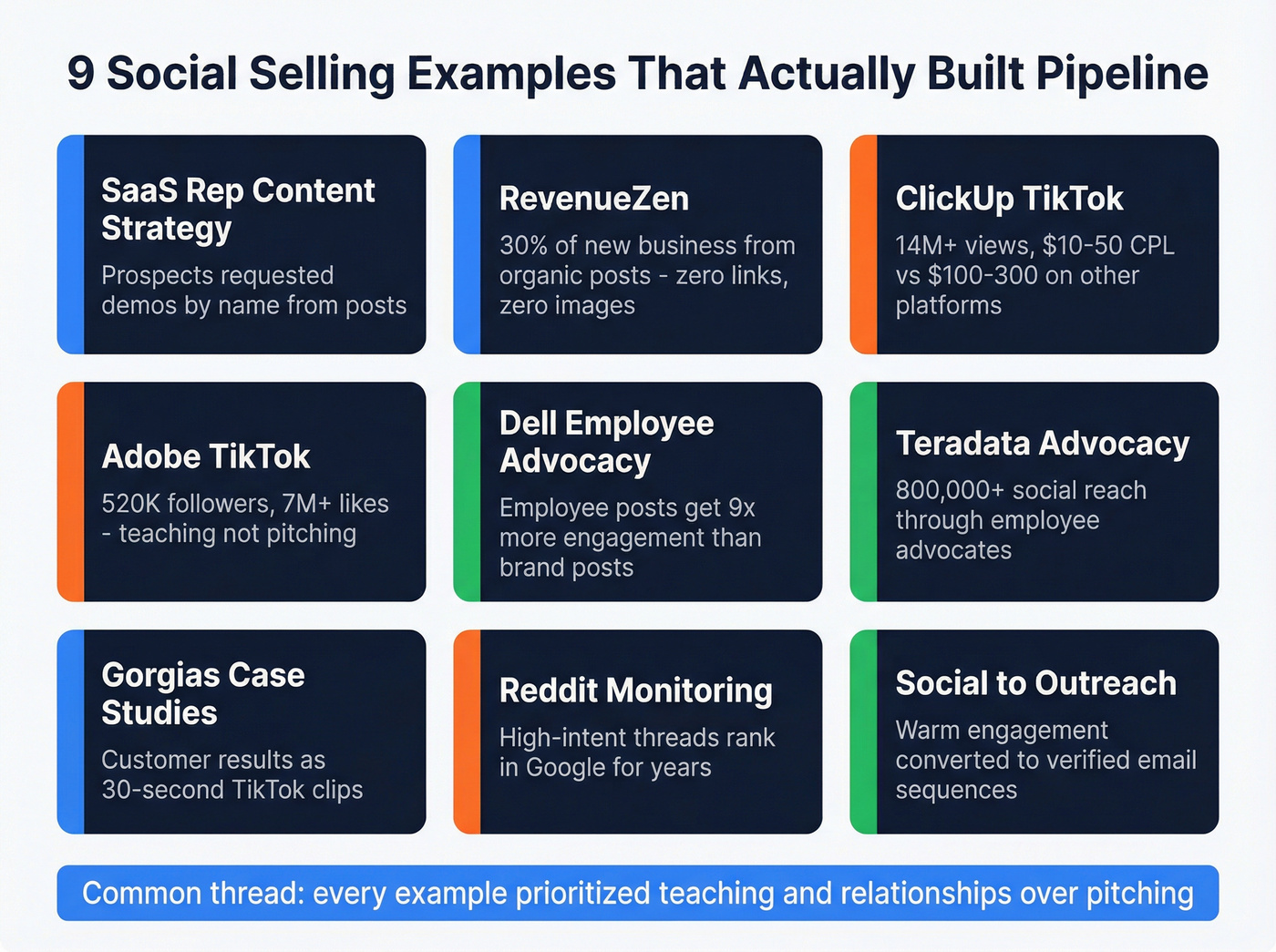
The SaaS Rep Who Won Deals From Content
A SaaS salestech rep shared their story on r/sales: after committing to regular posting, they started getting hundreds and then thousands of engagements per post. Their ICP - VPs of Sales at SaaS companies - was extremely active on the platform.
The results went beyond vanity metrics. Customers started referencing the rep's content during sales cycles. Prospects requested demos directly through social. People filled out demo forms asking for this specific rep by name.
Their takeaway: "I've won deals this month I had no business winning, and I account a lot of that to clout." Content builds relationships with pipeline prospects even when you're not on a call. No cold email sequence can replicate that. This is relationship building in its purest form - earning trust at scale before a single call is booked.
RevenueZen: 30% of New Business From Posts
RevenueZen's CEO shared hard data: over 30% of the agency's new business comes directly from organic posts. Not ads. Not InMail.
The kicker? None of their best-performing posts contained links, videos, or images. All plain text. Authentic voice. Professionally relevant personal stories.
Their principle: let your profile do the selling, not your posts. The post generates engagement and profile visits. The optimized profile - with a clear value proposition, social proof, and a CTA - converts those visitors into conversations. The algorithm rewards text-only posts that keep people on-platform, so you're working with it instead of against it.
This is the contrarian take worth internalizing: your best-performing posts will have zero links, zero images, and zero videos. Every instinct tells you to add a graphic or drop a link. Resist it.
ClickUp's TikTok Strategy: 14M+ Views on B2B Content
I know what you're thinking. TikTok for B2B?
ClickUp built 344K followers and racked up 14M+ views by posting workplace productivity hacks set to trending audio. The content wasn't product demos - it was relatable workplace humor that happened to position ClickUp as the solution. The result: measurable increases in website traffic and free trial signups. And here's the math that matters - TikTok CPL runs $10-$50 vs. $100-$300 on other professional platforms. If your buyers are under 40, they're scrolling TikTok. 73% of B2B buyers prefer short-form video to learn about products.
Adobe on TikTok: 520K Followers Selling Creative Tools
Adobe built 520K TikTok followers and 7M+ likes by sharing creative tips and industry insights - not product walkthroughs. The content educates rather than pitches.
Even on short-form video, the brands that teach outperform the brands that sell. Adobe's TikTok doesn't feel like marketing. It feels like a creative community. That's the point.
Dell's Employee Advocacy Program
Dell empowered its entire workforce to post on social media through a structured employee advocacy program. The results validated what the data already suggested: employee posts get roughly 9x higher engagement than curated brand posts.
Your company page has maybe 5,000 followers. Your sales team of 25 people has a combined network of 12,500+ connections. Employee advocacy turns your sales team into a distributed media company. Dell proved this scales at enterprise level - but the principle works for a 10-person startup too.
Teradata: 800,000+ Social Reach Through Employee Advocates
Teradata expanded their social reach to over 800,000 using EveryoneSocial's advocacy platform. The key wasn't forcing employees to share corporate content - it was making it easy for them to share content they actually wanted to post.
One rep posting consistently is good. Fifty reps posting consistently is a channel.
Gorgias: Customer Case Studies as TikTok Content
Gorgias turned customer success stories into short TikTok videos - "cut support response time by 50%" in 30-second clips. No fancy production. Just results, delivered in the format their audience actually consumes.
Your prospects don't care about your features. They care about outcomes.
Reddit Monitoring for High-Intent B2B Leads
A B2B marketer on r/b2bmarketing made a compelling argument: professional platforms are where people network and brag. Reddit is where people ask honest questions like "What's a cheaper alternative to HubSpot?"
They built an automated monitoring system that treated subreddits like a CRM pipeline - tracking anonymous questions that reveal real buying intent. Meanwhile, Reddit threads rank in Google for years and attract buyers who are actively researching solutions.
Pick one platform and go deep for 90 days before adding a second. For most B2B sellers, that's where your ICP hangs out. But if you're looking for a second channel where intent is highest and competition is lowest, Reddit is it. Spreading yourself across five platforms from day one is how you end up mediocre on all of them.
Converting Social Engagement to Direct Outreach
Here's where most social selling advice falls apart. You've spent weeks commenting, posting, building rapport. A prospect engages with three of your posts. They accept your connection request. They reply to your DM with "Yeah, let's chat next quarter."
Now what?
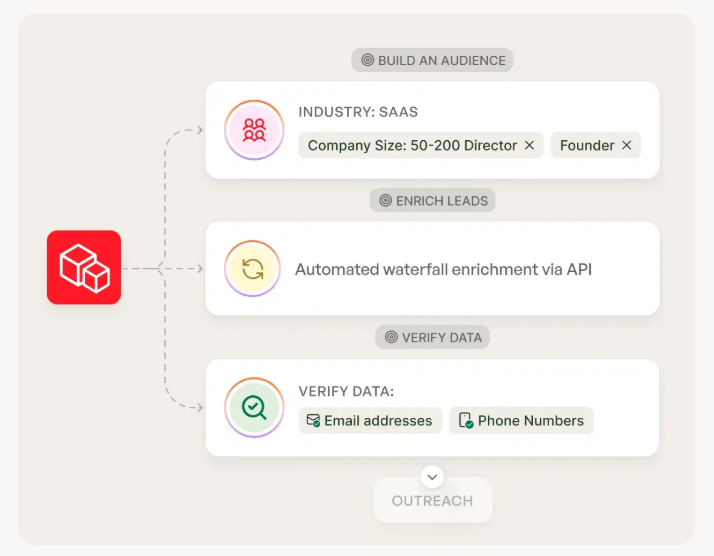
The relationship is warm, but it lives on a platform you don't control. You need to move the conversation into email, into a call, into a sequence. And this is the moment where bad data kills everything. One bounced email after weeks of relationship building, and you've wasted all that effort - plus damaged your domain reputation.
The 5 C's Framework - A Proven Social Selling Playbook
Morgan Ingram - founder of AMP Creative, who's worked with Salesforce, Slack, and Google - developed the 5 C's framework. It's the most actionable playbook I've seen, and it works across team sizes and industries. If you're looking for a structured way to develop your social selling techniques, start here (or grab a full social selling playbook).
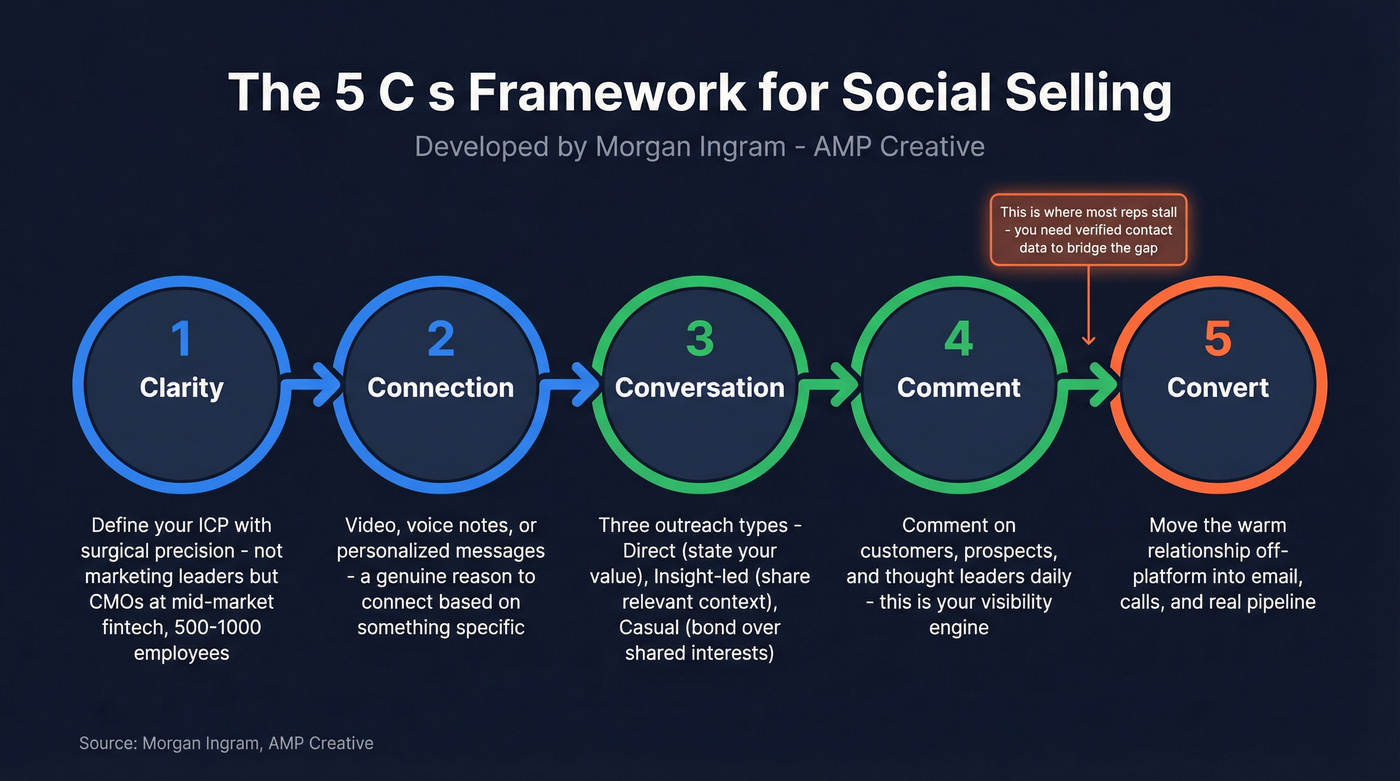
Clarity. Define your ICP with surgical precision. Not "marketing leaders" - "CMOs at mid-market fintech firms with 500-1,000 employees." The tighter your definition, the more relevant your content and outreach become. Everything downstream depends on this step. (If you need a tighter definition, use this ideal customer guide.)
Connection. Reach out with video, voice notes, or personalized written messages. Not cold pitches. Not "I'd love to pick your brain." A genuine reason to connect based on something specific - a post they wrote, a company milestone, a shared interest.
Conversation. Ingram identifies three outreach types: Direct (state your value clearly), Insight-led (share relevant context about their company or industry), and Casual (bond over shared interests). Mix all three. The reps who only do direct outreach burn out their network fast.
Comment. Comment on customers, prospects, and industry thought leaders daily. Not AI-generated fluff - specific, thoughtful reactions that add to the conversation. This is the highest-ROI activity because it puts you in front of your prospect's network without requiring them to seek you out.
Content. Be a curator, not a creator. Share podcast takeaways, react to industry news, offer opinions on trends. You don't need to write 1,000-word thought pieces. A two-sentence take on a relevant article is enough. (For a comment-first approach, see social selling thought leadership.)
The timeline: 14 days for early signals (profile views, replies, DMs). 90+ days for real pipeline impact. Ingram's benchmark: 100 reps before judging whether this approach works for you.
Here's the math that makes the case to your VP: 25 team members x 100 profile views per month = 30,000 impressions per year. That's a media channel. And it's free.
Social Selling Mistakes That Kill Your Pipeline
I've watched teams invest months in this and get nothing. Usually it's one of these five mistakes.
1. Treating social like cold outreach. You connect with a VP of Marketing on Monday. By Tuesday, you've sent a pitch deck, a case study, and a calendar link. By Wednesday, you're muted. Bhavik Sarkhedi, CMO at Content Whale, puts it bluntly: "Bombarding prospects with generic sales pitches is the fastest way to get muted." Social selling is relationship-first. The pitch comes after you've earned attention.
2. The premature pitch. Michele Potts of Zoe Communications Group calls this the #1 reason social selling feels spammy - jumping to the ask before you've earned the right. Engage with someone's content for two weeks before you ever mention your product. If that feels slow, remember: the alternative is a cold email with a 3% reply rate.
3. Writing like a press release. "A formal tone sounds stiff and detached on social media," says Rahul Kumar, CEO of Ranksoldier. He's right. Contractions. Short sentences. Personality. The corporate voice that works in an annual report dies on social. Read your draft out loud - if it sounds like something a committee approved, rewrite it.
4. Ignoring platform fit. Not every platform deserves your time. Ace Zhuo of TradingFXVPS points out that misaligning your platform choice with your audience's preferences wastes effort. Pick one, go deep for 90 days, then consider adding a second.
5. Quitting at day 30. David Breitenbach, CMO at PatentRenewal.com, sees this constantly: "Many reps abandon the process if they don't see immediate results." Remember the 90-day timeline from the 5 C's framework. The honest pushback from practitioners is real - "Everyone is just selling on social and not having real conversations anymore." That's valid, and it's exactly why the 5 C's framework starts with Clarity and Connection, not Content. The reps who push through the noise are the ones who build pipeline.
Your SSI Score - What It Means and How to Improve It
The Social Selling Index scores you 0-100 across four pillars, each worth up to 25 points. Check yours free at linkedin.com/sales/ssi.
The data tells the story: SSI leaders create 45% more opportunities, are 51% more likely to hit quota, and outsell non-social peers 78% of the time.
Most users score 20-40. Active social sellers land 60-80. Top performers hit 75+. Here's how to improve each pillar:
Establish your professional brand (up to 25 pts)
- Complete every profile section - photo, banner, headline, about, experience
- Write your headline for your ICP, not your recruiter. "Helping SaaS teams cut churn by 30%" beats "Account Executive at Company"
- Publish or share content weekly
Find the right people (up to 25 pts)
- Use Sales Navigator filters to build targeted prospect lists
- Connect with decision-makers, not just peers
- Follow companies in your target accounts
Engage with insights (up to 25 pts)
- Comment on 5+ posts daily from prospects and thought leaders
- Share articles with your take - don't just hit "repost"
- React to and engage with content from your network
Build relationships (up to 25 pts)
- Send personalized connection requests (never the default message)
- Respond to every comment on your posts
- Focus on helping, not selling, in your DMs
Track your SSI monthly. It's a lagging indicator, but it correlates strongly with pipeline outcomes.
Social Selling Tools Worth Paying For in 2026
| Tool | Category | Starting Price | Best For |
|---|---|---|---|
| LinkedIn Sales Navigator | Prospecting | $119.99/mo | Must-have for any B2B seller |
| Taplio | Content | $32/mo | Best content scheduling tool for professionals |
| Prospeo | Verification | Free (75/mo) | 98% email accuracy at ~$0.01/lead |
| Buffer | Scheduling | Free, then $6/mo | Budget pick for multi-platform teams |
| Kleo | Inspiration | Free | Studying what top creators actually post |
| Tweet Hunter | X Growth | $23/mo | Only worth it if X is your primary channel |
| Hootsuite | Enterprise | ~$149/mo/user | Skip unless managing 10+ accounts |
| Sprout Social | Analytics | $199/seat/mo | Enterprise compliance and reporting |
| Vista Social | Scheduling | $39/mo | Mid-size teams needing approval workflows |
| DSMN8 | Advocacy | ~$5-10/user/mo | 100+ employee advocacy programs |
Sales Navigator is the foundation. A Forrester TEI study found 312% ROI over three years, with +42% larger deal sizes and +59% revenue influence. At $119.99/mo, it pays for itself with one additional meeting per month. The advanced search filters and lead recommendations are genuinely useful - this isn't a tool you buy and forget.
Taplio solves the content consistency problem. At $32/mo for the starter plan, it handles scheduling, AI-assisted drafting, and analytics. The carousel creator alone saves hours. If you're posting 2-3 times per week, Taplio keeps you consistent without living inside the platform.
Prospeo is the verification layer that protects your sender reputation after social engagement generates warm leads. Its 5-step verification with catch-all handling and spam-trap removal covers 300M+ professional profiles with 98% email accuracy and 125M+ verified mobile numbers. The free tier gives you 75 emails per month, and paid plans run about $0.01 per email with no contracts. It integrates with Salesforce, HubSpot, Lemlist, Instantly, and Clay, so verified contacts flow straight into your sequences. (If you're comparing options, start with an email verifier website roundup.)
Buffer is the budget pick for teams posting across multiple platforms. Free for up to three channels, $6/mo per channel after that. It won't write your content, but it'll make sure it goes out on time.
Kleo is a free Chrome extension that lets you study what top creators in your space are posting. Use it for inspiration, not imitation.
Skip Hootsuite and Sprout Social unless you're an enterprise team managing 10+ accounts with compliance requirements. They're overkill for individual social sellers.
Building a Realistic Daily Routine for Social Selling
Highspot recommends spending 10-15% of your weekly time on social selling. That's roughly 30-45 minutes per day. Here's how to spend it.
Morning block (15 minutes):
- Run your saved Sales Navigator searches. Check for new prospects matching your ICP.
- Send 3-5 personalized connection requests. Reference something specific - a post, a company announcement, a mutual connection.
- Respond to any DMs or comments from yesterday.
Midday block (10 minutes):
- Comment on 5 prospects' or thought leaders' posts. Specific, thoughtful comments - not "Great insight!" Add your perspective, ask a follow-up question, or share a relevant data point.
- React to 10+ posts in your feed. This keeps you visible in the algorithm.
Afternoon block (10 minutes):
- Draft or schedule your next post. Aim for 2-3 posts per week. Plain text, your take on something happening in your industry.
- Review profile views. Anyone from a target account viewing your profile is a warm signal - send them a connection request.
Weekly (30 minutes):
- Message recently connected prospects. Not a pitch - a value-add. Share an article, congratulate them on something, ask a genuine question.
- Review your SSI score and engagement metrics. What's working? Do more of that.
One friction point that comes up repeatedly: retargeting people you reached out to 3-6 months ago. There's no clean way to pull retargeting lists from Sales Navigator. A Reddit practitioner flagged this as their biggest workflow gap - and they're right. The workaround: tag prospects in HubSpot or Salesforce with a "social-connected" property and the connection date. Run a quarterly follow-up email sequence filtered by that tag. It's manual, but it prevents warm relationships from going cold.
Ingram's benchmark applies here: 100 reps before judging. That's roughly 7 weeks of daily effort. If you're not seeing signals by then - profile views trending up, connection accept rates above 30%, occasional DMs - revisit your content and targeting. But don't quit at week 3. The social selling techniques that generate pipeline are the ones you practice consistently, not the ones you try once and abandon. (If you're running social + email together, build a social sales cadence.)
You've spent 90 days building relationships through content and comments. A prospect finally signals intent. Don't lose the deal because you can't find their direct email. Prospeo's Chrome extension lets you pull verified contact data from any profile in one click - used by 40,000+ reps who refuse to let warm leads go cold.
Stop losing warm prospects to bad data. Pay $0.01 per verified email.
FAQ
What's the difference between social selling and social commerce?
Social selling uses social platforms to find, connect with, and nurture prospects through relationship-building and content - it drives B2B pipeline. Social commerce sells products directly through platform storefronts like Instagram Shop or TikTok Shop - it drives transactions. If you're in B2B sales, you're doing social selling, not social commerce.
How long does social selling take to show results?
Expect early signals - profile views, DMs, connection accepts - within 14 days of consistent effort. Real pipeline impact takes 90+ days. Morgan Ingram recommends completing 100 reps (roughly 7 weeks of daily activity) before judging whether it's working for you.
Does social selling work for B2B or just B2C?
B2B is where it delivers the strongest ROI. Social outreach gets a 42% response rate versus 26% for email. Nearly every example in this article is B2B - from SaaS reps winning deals through content to enterprise advocacy programs driving 800,000+ reach.
How do I find a prospect's verified email after connecting on social?
Use a verification tool to pull verified emails from professional profiles - don't guess email formats or use generic company addresses. Prospeo's 98% accuracy across 300M+ profiles means your carefully built social rapport won't die in a bounced inbox. The free tier covers 75 verifications per month.