How to Pre-Qualify Leads (So Your Reps Stop Wasting Hours on Dead Ends)
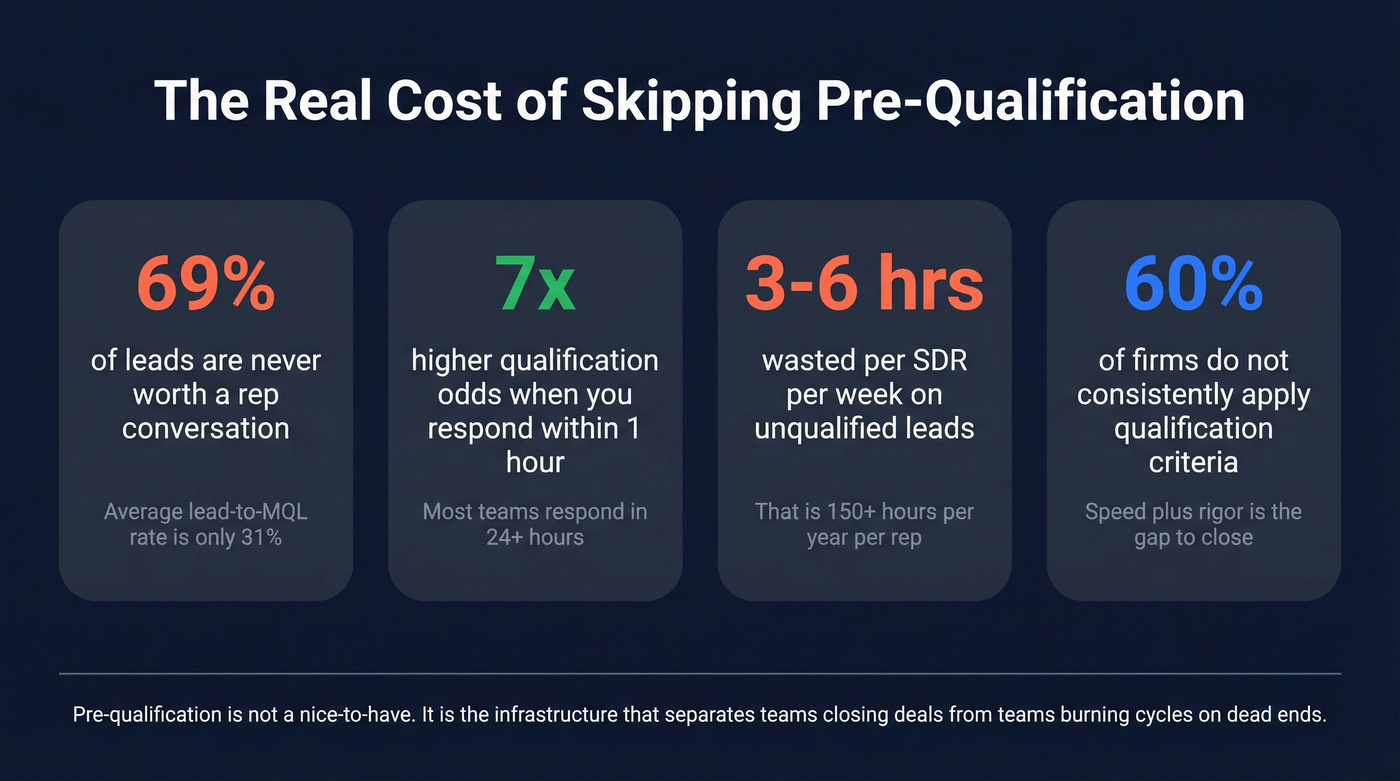
Your rep just spent 45 minutes on a discovery call with someone who has no budget, no authority, and no timeline. Meanwhile, three actual buyers went cold. 67% of lost sales stem from improper lead qualification, and teams that pre-qualify leads often see 2-4x higher win rates on the deals they do work. Pre-qualification isn't a nice-to-have - it's the infrastructure that separates teams closing deals from teams burning 3-6 hours per SDR per week on dead ends.
What Pre-Qualified Leads Actually Are
A pre-qualified lead has been filtered before a sales conversation - through data, scoring, and enrichment - not during a discovery call.
An MQL hit a behavioral threshold: downloaded a whitepaper, visited pricing twice. An SQL passed a human or automated check against your ICP and buying signals. A PQL used your product in a way that signals purchase intent - free-trial users hitting usage limits, for example. All three start with the same foundation: a clearly defined ICP that your scoring model can measure against.
The Cost of Skipping Pre-Qualification
The average lead-to-MQL conversion rate across industries is 31%. Seven out of ten leads aren't worth a rep's time, and that's before data quality issues eat into the remaining three.
| Segment | Type | Lead-to-MQL Rate |
|---|---|---|
| B2B SaaS | Industry | 39% |
| Construction | Industry | 17% |
| Referrals | Channel | 56% |
| SEO | Channel | 41% |
| PPC | Channel | 29% |
Referrals convert at nearly double the rate of paid search. That means your pre-qualification criteria need to flex by source - not apply a single threshold across everything. And responding within one hour gives you 7x higher qualification odds. Only about 40% of firms consistently apply qualification criteria at all. Most teams are slow and sloppy. That's the gap lead pre-qualification closes: speed plus rigor, automated before a rep touches the lead.
Qualification Frameworks Compared
| Framework | Best For | Core Questions | Weakness |
|---|---|---|---|
| BANT | High-ticket, late-stage | Budget, Authority, Need, Timeline | Budget-first bias |
| MEDDIC | Enterprise $50K+ deals | Metrics, Economic Buyer, Decision Process, Pain, Champion | Overkill for SMB |
| CHAMP | Consultative B2B | Challenges, Authority, Money, Prioritization | Slow for high-volume |
| ANUM | Authority-gated sales | Authority, Need, Urgency, Money | Misses challenger dynamics |
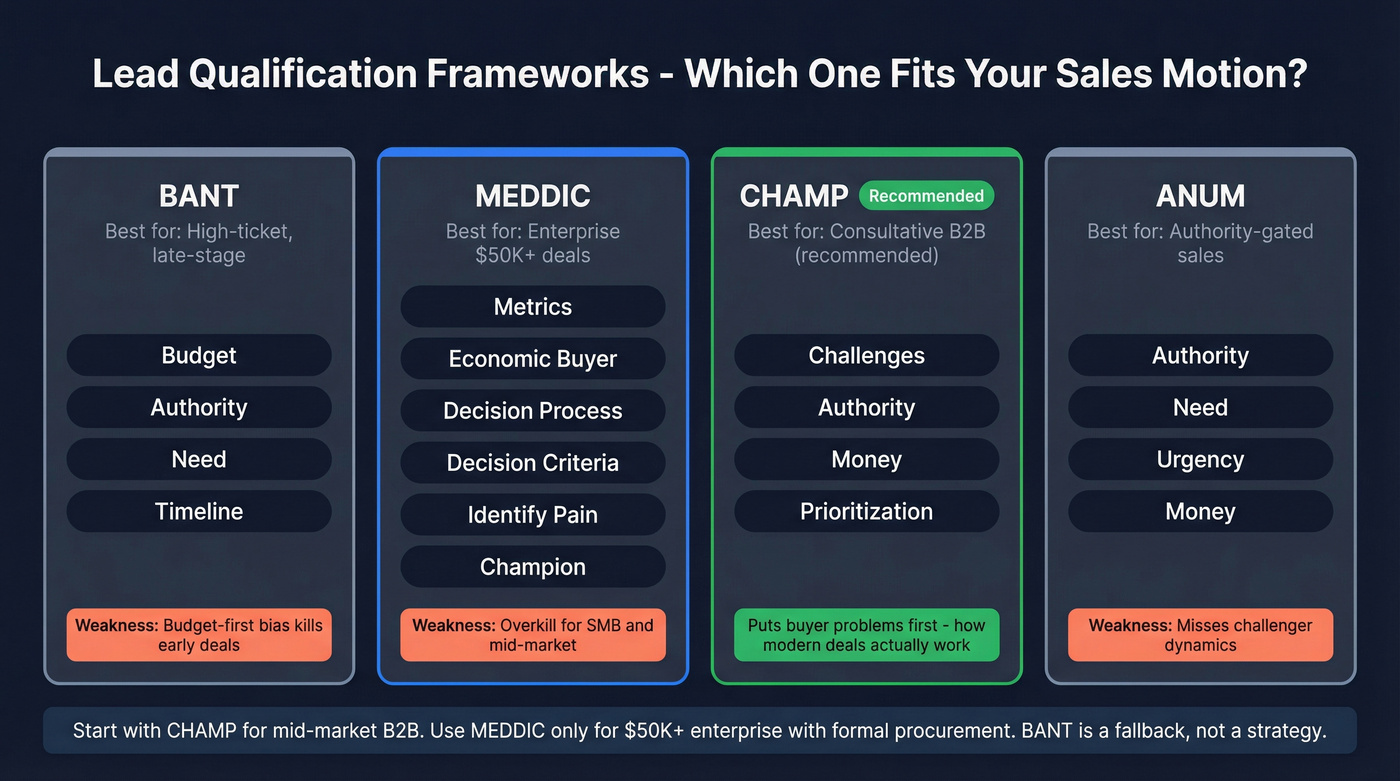
Start with CHAMP for consultative B2B. In our experience, it outperforms BANT for mid-market deals because it puts the buyer's challenges first - which is how modern deals actually progress. Use MEDDIC only for $50K+ enterprise cycles with multiple stakeholders and formal procurement. BANT is a fallback, not a strategy. It was designed for an era when sellers controlled information flow.
One modern addition worth watching: self-qualification mechanisms like interactive assessments and scorecards at top-of-funnel. They let prospects filter themselves before a rep ever gets involved.

Your lead scoring model is worthless if 20% of your contact data has decayed. Prospeo refreshes 300M+ profiles every 7 days - not every 6 weeks - so your ICP filters, intent signals, and grade scores map to real, reachable buyers. 98% email accuracy. 30+ filters for company size, tech stack, funding, and buyer intent.
Pre-qualify leads with data that's actually current.
How to Qualify Leads Before Prospecting
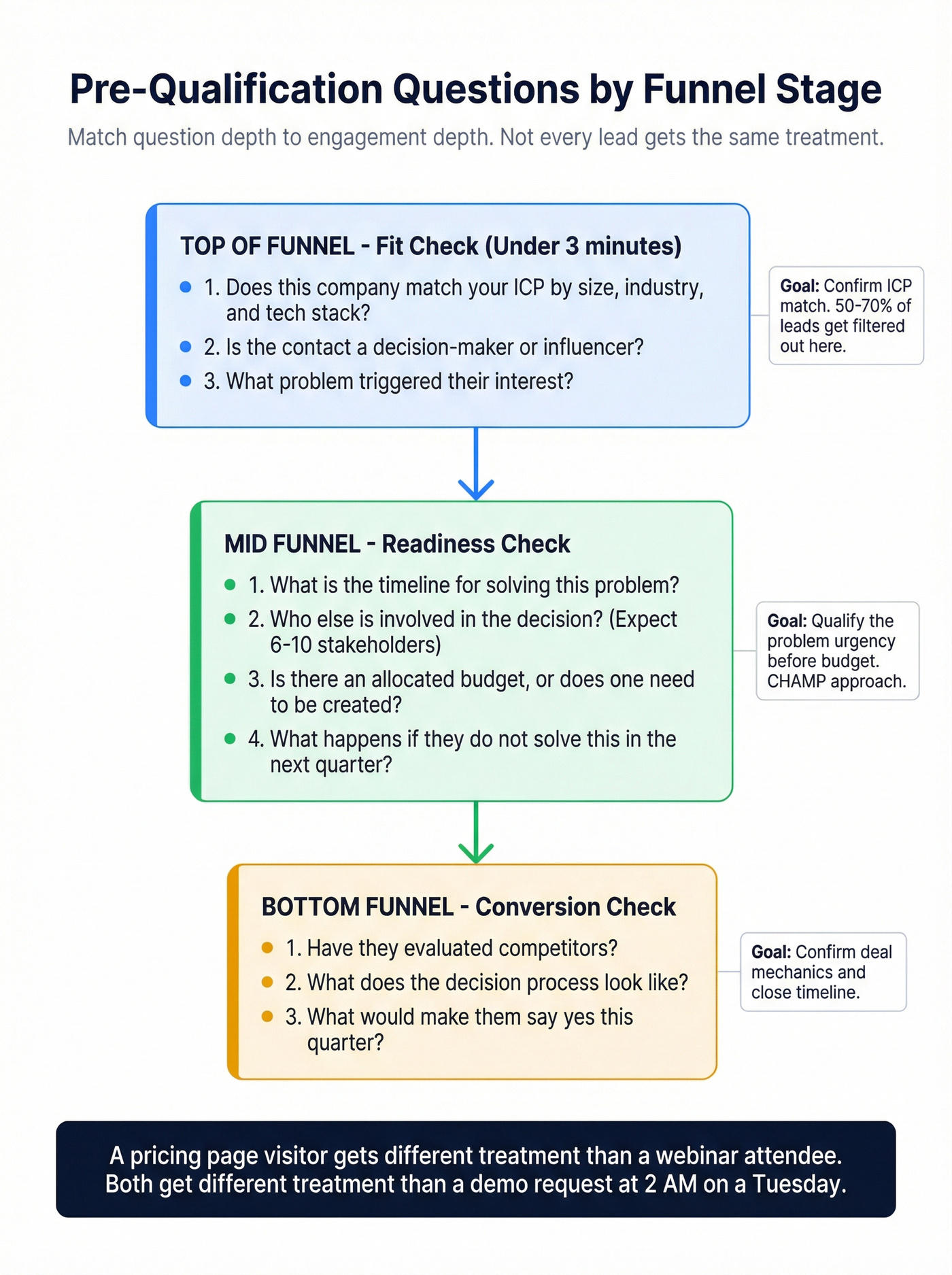
Top-of-funnel (fit):
- Does this company match your ICP by size, industry, and tech stack?
- Is the contact a decision-maker or influencer? B2B deals involve 6-10 decision-makers on average.
- What problem triggered their interest?
Mid-funnel (readiness):
- What's the timeline for solving this problem?
- Who else is involved in the decision?
- Is there an allocated budget, or does one need to be created?
- What happens if they don't solve this in the next quarter?
Notice the CHAMP shift: challenges and stakeholder mapping come before budget. You're qualifying the problem first. If the problem isn't urgent enough, budget doesn't matter. And 60% of prospects say no four times before saying yes, so persistence with pre-qualified leads pays off far more than persistence with unfiltered ones.
How to Build a Lead Scoring Model
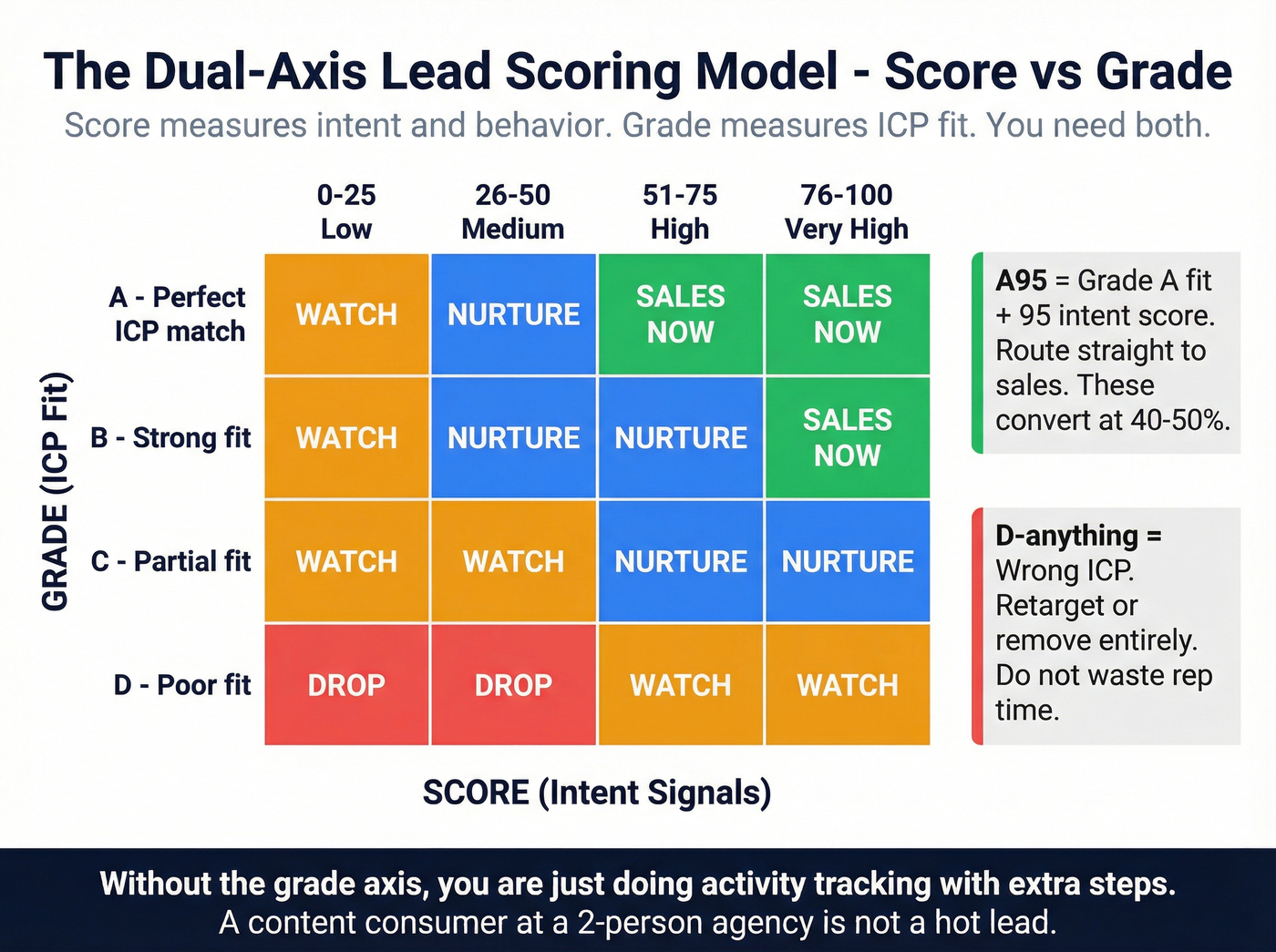
Most teams confuse lead scoring with activity tracking. A lead who downloads five whitepapers but works at a two-person agency isn't a hot prospect - they're a content consumer. The fix is separating score, which tracks intent and behavior, from grade, which measures ICP fit.
If you want a deeper breakdown of scoring rules, SLAs, and routing logic, see AI lead qualification and RevOps lead scoring.
| Signal | Type | Points |
|---|---|---|
| Pricing page visit | Score (intent) | +15 |
| Whitepaper download | Score (intent) | +10 |
| Director+ title | Grade (fit) | Grade A |
| Wrong industry | Grade (fit) | Grade D |
An A95 lead - strong ICP fit plus high behavioral intent - goes straight to sales. A C25 goes into nurture. A D-anything gets retargeted or dropped entirely.
This dual-axis model is what separates teams converting 25-35% of MQLs to SQLs from high-alignment orgs hitting 40-50%. Lead scoring without a grade component is just activity tracking with extra steps.
Here's the thing: if your average deal size is under $10K, you probably don't need a complex scoring model at all. A simple ICP checklist plus one intent signal - like a pricing page visit - will outperform a 50-variable model that nobody maintains.
The Data Quality Step Everyone Skips
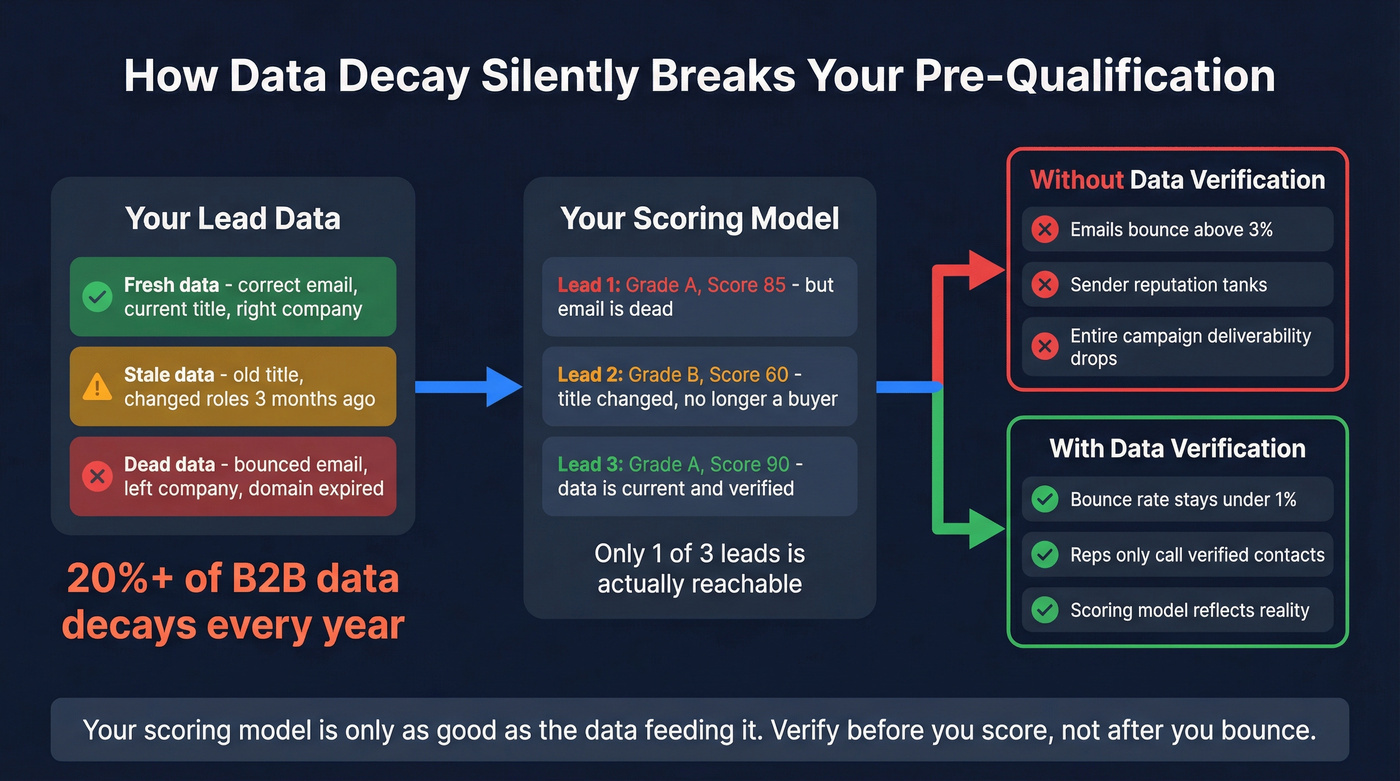
Let's be honest about the real problem most teams won't admit: your scoring model is only as good as the data feeding it. Over 20% of B2B contact data decays within a year - job changes, deactivated emails, company pivots. When a "Grade A" lead bounces because the email is dead, your entire pre-qualification workflow breaks silently. Once your bounce rate crosses 3%, your sender reputation takes compounding damage across every campaign.
To go deeper on decay benchmarks and prevention, read B2B contact data decay and CRM hygiene.
You just read that 6-10 decision-makers are involved in every B2B deal. Prospeo gives you verified emails and direct dials for each one - 125M+ mobile numbers, 143M+ verified emails - so you can map the entire buying committee before your first call. At $0.01 per email, pre-qualification finally scales.
Reach every stakeholder in the deal, not just the gatekeeper.
A Pre-Qualification Script That Works
For cold outreach where you need to filter prospects before pipeline turns into wasted effort:
"Hi [Name], this is [Your Name] from [Company]. I'll be brief - in three minutes, I'd like to ask a couple of questions to see if there's a fit. Does that sound fair?"
If you hit a gatekeeper:
"I'm looking to speak with [Decision Maker] about [specific challenge]. Could you transfer me, or would their direct number be better?"
TOFU calls should confirm fit in under three minutes - ICP match, problem awareness, authority. MOFU calls go deeper into timeline, budget, and competitive evaluation. Don't run a full MEDDIC interrogation on someone who just downloaded a blog post. Match the depth of your questions to the depth of their engagement. A pricing page visitor gets different treatment than a webinar attendee, and both get different treatment than someone who filled out a "request demo" form at 2 AM on a Tuesday.
If your team is still building a repeatable outbound motion, pair this with a prospecting workflow and a B2B cold calling guide.
FAQ
What is a pre-qualified lead?
A lead filtered through data, scoring, and enrichment before any sales conversation. Pre-qualification determines whether a rep should spend time on the lead at all - it's automated infrastructure, not a discovery call. Expect 50-70% of inbound leads to be disqualified at this stage.
What's the difference between pre-qualifying and qualifying?
Pre-qualifying uses automated data checks and scoring before a conversation happens. Qualification occurs during discovery calls using frameworks like BANT or CHAMP. Pre-qualification decides if the conversation happens; qualification decides if the deal moves forward.
How many leads should be disqualified during pre-qualification?
Typically 50-70%, depending on ICP strictness and channel quality. If you're disqualifying fewer than 40%, your criteria are too loose. Referral channels disqualify fewer leads; paid channels disqualify more. Skip loosening your criteria just to hit pipeline volume targets - that's how you end up back where you started, with reps burning hours on dead ends.
What tools help automate lead pre-qualification?
CRMs like HubSpot and Salesforce handle scoring and routing. For data accuracy before scoring begins, Prospeo verifies emails at 98% accuracy and refreshes data every 7 days - critical since bad data silently breaks every downstream step. Intent platforms like Bombora (typically $20K-$60K+/year for enterprise) add buyer-readiness signals. One warning: watch for credits-based pricing that becomes a tax at scale. Always model cost per verified lead before committing.