

Marketing Qualified Leads: How to Define, Score, and Convert MQLs in 2026
Marketing hit their MQL target last quarter. Sales says every lead was garbage. Sound familiar?
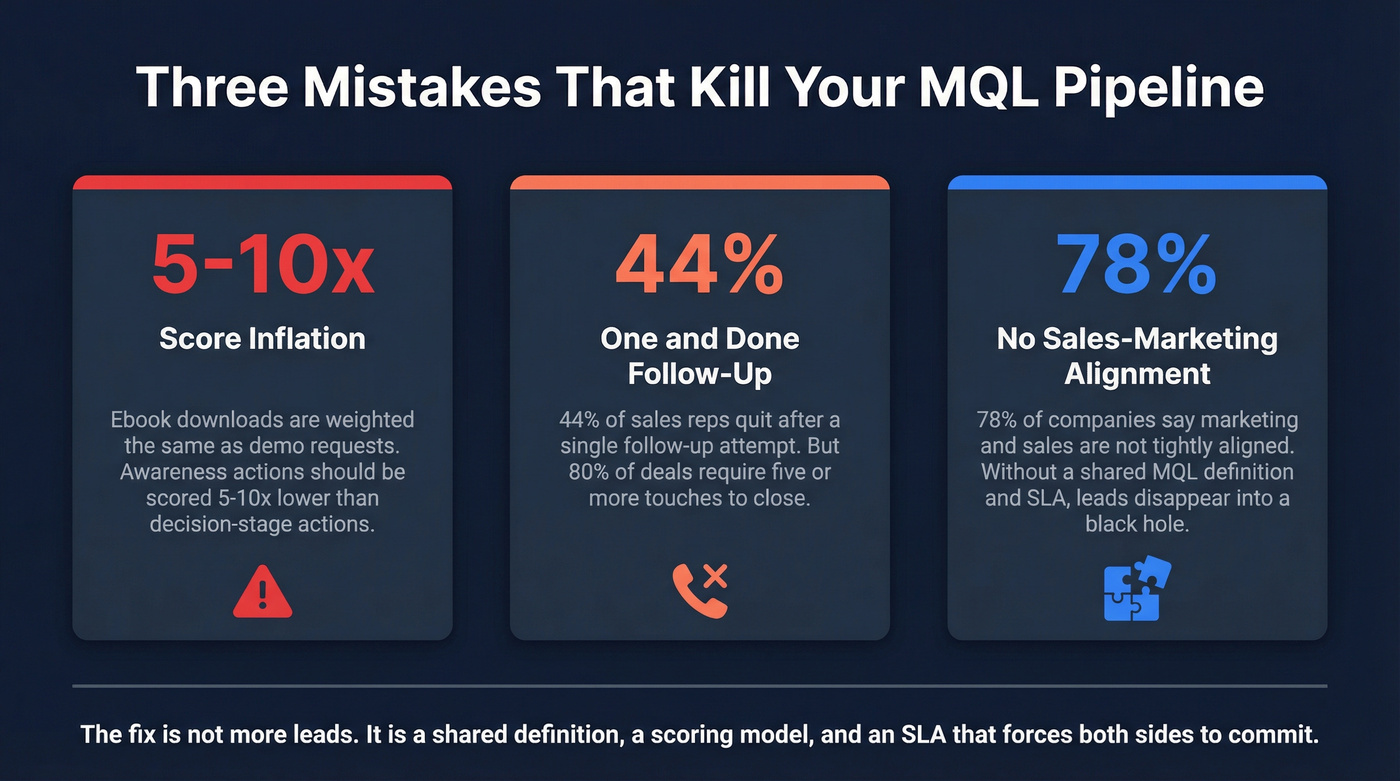
Only 22% of companies feel their marketing and sales teams are tightly aligned - which means the other 78% are burning pipeline arguing over what marketing qualified leads actually are. The fix isn't more leads. It's a shared definition, a scoring model with real numbers, and an SLA that forces both sides to commit.
Quick Operational Checklist
If you're short on time, here's what matters:
- Define MQLs on two axes: engagement (what the lead did) and fit (who the lead is). One without the other is noise.
- Use 13% as your diagnostic baseline. That's the average B2B SaaS MQL-to-SQL conversion rate. Below 10%, your model is broken. Above 25%, you're probably sandbagging.
- Build a scoring model with explicit point values. Demo request = 100 points. Blog visit = 5. Competitor email = minus 100. No ambiguity.
- Lock it in with a marketing-sales SLA. Handoff timelines, response windows, follow-up minimums, and a quarterly review cadence.
- Verify your data first. A lead that scores 85 points is worthless if the email bounces. Clean data is the invisible foundation under everything else.
What Is a Marketing Qualified Lead?
A marketing qualified lead is a prospect who's demonstrated enough interest and fits your ideal customer profile well enough that they deserve a sales conversation. The key word is "enough" - and that's where most teams fall apart, because marketing and sales rarely agree on the threshold.
Here's the framing that actually works: an MQL answers the question "should I call them?" - not "is this an opportunity?" Think of it like a restaurant host checking the reservation list. The host doesn't decide whether you'll order the tasting menu. They confirm you belong at the table. The opportunity determination happens later, after sales has a real conversation.
The most useful way to think about MQL qualification is as a two-axis system. One axis measures engagement - what the lead did. The other measures fit - who the lead is. Together, they create four quadrants that dictate your next move.
Hot MQLs vs Warm MQLs
Not all qualified leads carry the same urgency.
| Type | Behavior | Example | Response |
|---|---|---|---|
| Hot MQL | Gated, high-intent | Demo request, pricing form | Route to sales immediately |
| Warm MQL | Ungated, repeat engagement | Multiple blog visits, video views | Nurture, then route |
Hot MQLs explicitly raised their hand - they filled out a form, requested a demo, or downloaded a gated asset. Warm MQLs show repeated interest through ungated content but haven't taken a conversion action yet. Both matter, but they need different playbooks. If you want a concrete nurture path, use this lead nurturing strategy to move warm MQLs forward without inflating scores.
The Two Questions Every MQL Must Answer
Every MQL framework boils down to two questions. "Is the lead interested in us?" - that's your behavior score. "Are we interested in the lead?" - that's your ICP fit grade.
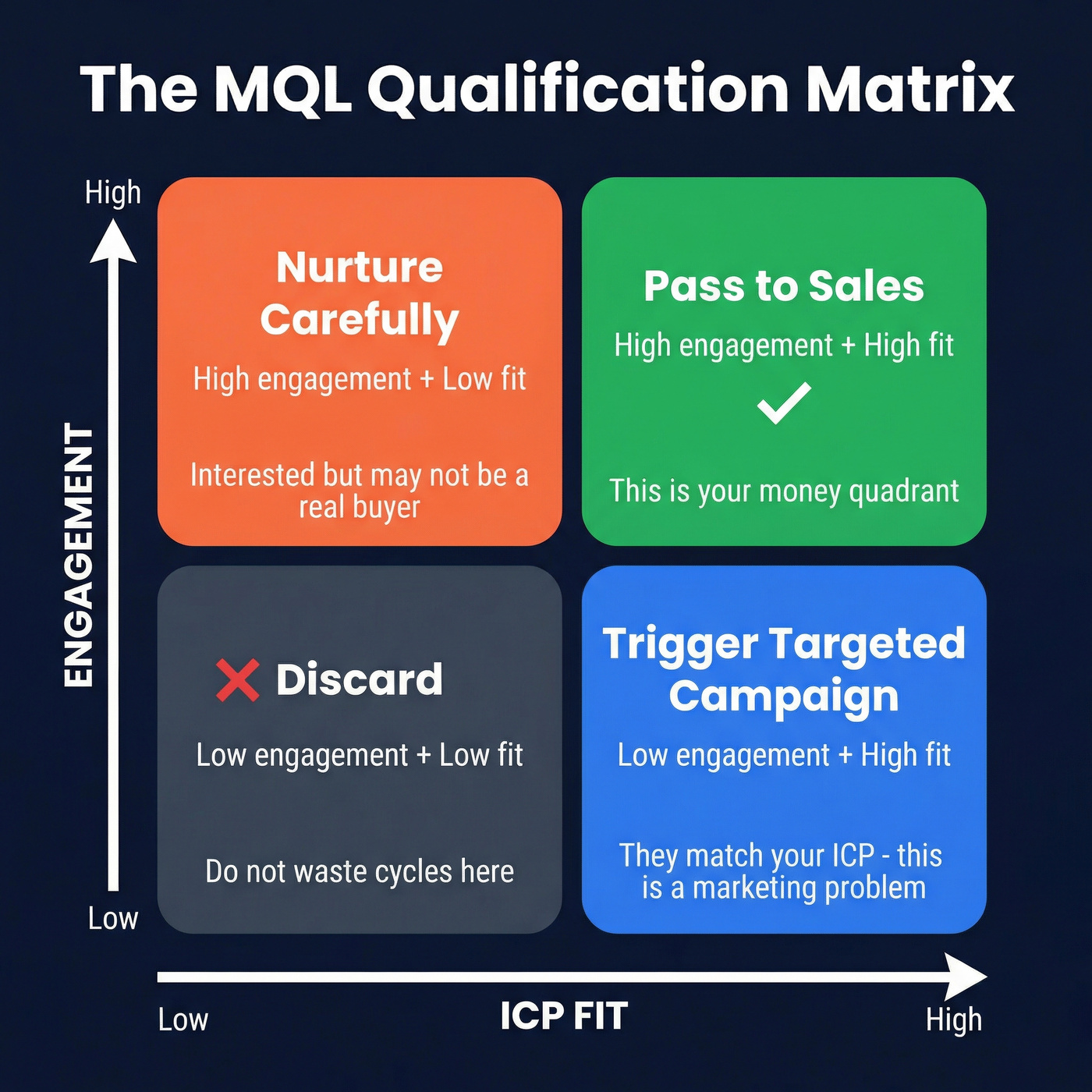
The two-axis matrix plays out like this:
- High engagement + high fit: Pass to sales. This is your money quadrant.
- High engagement + low fit: Nurture carefully. They're interested, but they may not be a real buyer - students, competitors, companies too small for your product.
- Low engagement + high fit: Trigger a targeted campaign. They match your ICP but haven't engaged yet. That's a marketing problem, not a disqualification.
- Low engagement + low fit: Discard. Don't waste cycles.
MQL vs SQL vs SAL vs PQL
These acronyms get thrown around interchangeably, and that's half the problem. Let's be precise.
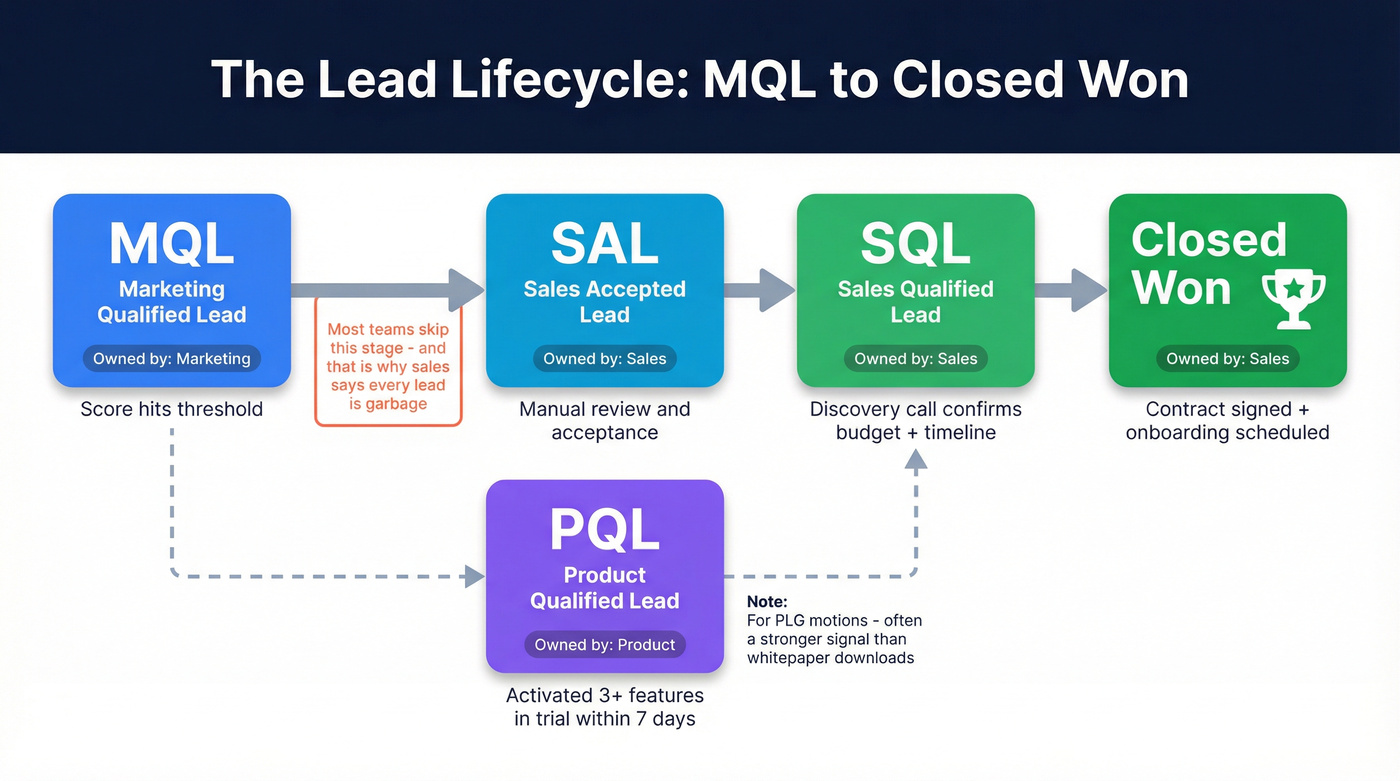
| Stage | Definition | Who Owns It | Key Trigger | Example |
|---|---|---|---|---|
| MQL | Meets engagement + fit threshold | Marketing | Score hits threshold | 3 assets, VP title, 200 employees |
| SAL | Sales accepts the MQL | Sales | Manual review | Rep confirms lead is real and in-territory |
| SQL | Confirmed sales opportunity | Sales | Discovery call | Budget + timeline confirmed |
| PQL | Qualified by product usage | Product | Usage threshold | Activated 3 features in trial within 7 days |
The SAL stage is the one most teams skip - and it's the one that prevents the "marketing sends garbage leads" argument. When sales formally accepts a lead, they're taking ownership. If they reject it, marketing gets specific feedback on why. Without SAL, MQLs disappear into a black hole and nobody learns anything.
If you're running a PLG motion, a user who's activated key features in a free trial is often a stronger signal than someone who downloaded a whitepaper. Layer PQL criteria on top of - or instead of - traditional MQL scoring when product usage data is available. For a deeper breakdown of Product qualified leads, align your usage thresholds to the same SLA rules you use for MQL handoffs.
How to Build an MQL Scoring Model
This is the centerpiece. A scoring model turns subjective "this lead feels good" into a repeatable, auditable system. Three components make it work: behavior, fit, and negative signals. If you need a full build-from-scratch framework, follow this guide on lead scoring systems.
Behavior Scoring
Weight decision-stage actions 5-10x higher than awareness-stage actions. A demo request isn't the same as a blog visit, and your model should reflect that.
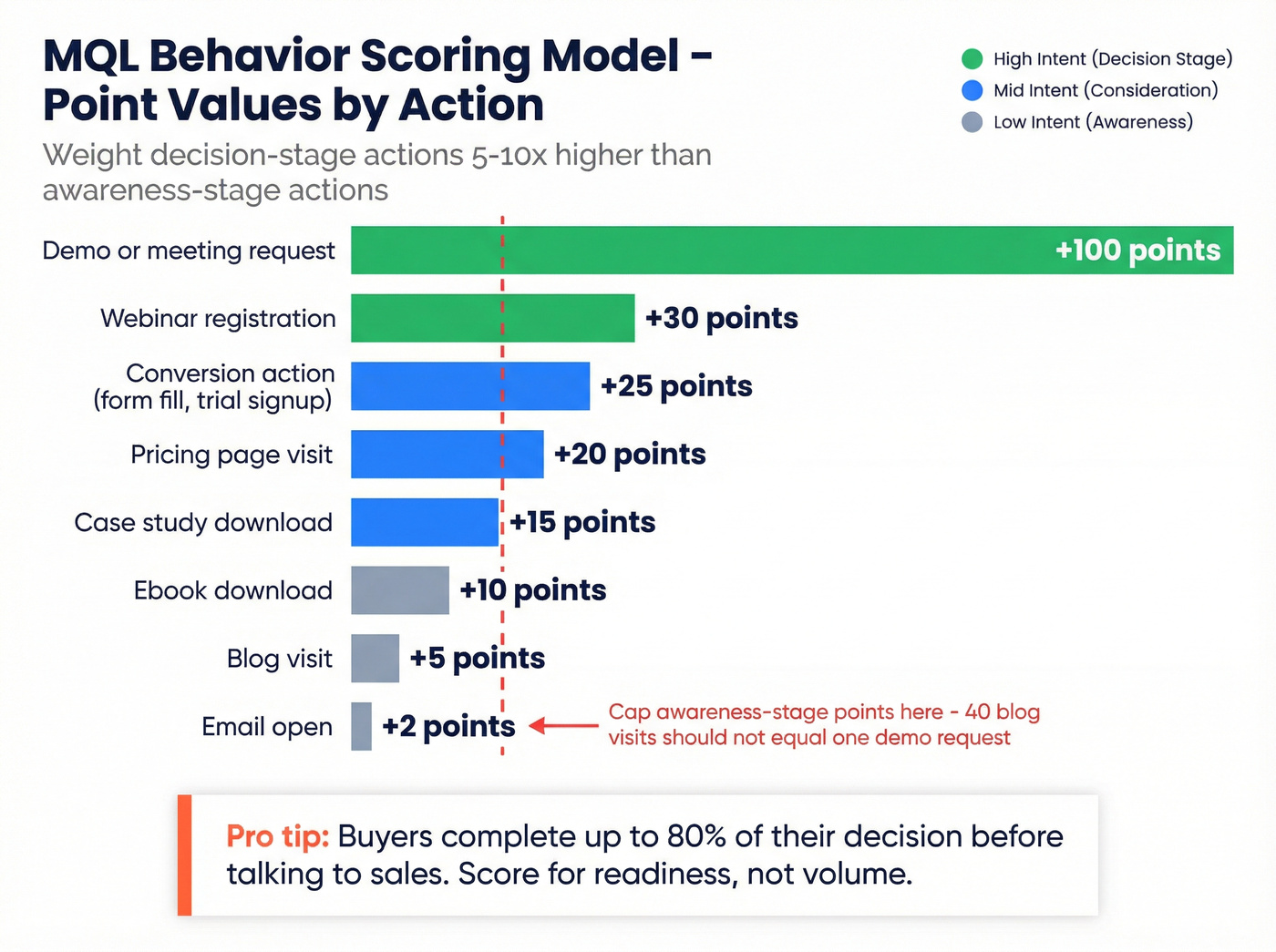
| Action | Points | Rationale |
|---|---|---|
| Demo/meeting request | +100 | Highest intent signal |
| Conversion action (form fill, trial signup) | +25 | Active hand-raise |
| Webinar registration | +30 | Mid-funnel engagement |
| Pricing page visit | +20 | Active evaluation |
| Case study download | +15 | Solution-aware research |
| Ebook download | +10 | Awareness-stage content |
| Blog visit | +5 | Low intent, high volume |
| Email open | +2 | Minimal engagement |
Cap your awareness-stage points. If someone reads 40 blog posts but never visits pricing or requests a demo, they're a researcher - not a buyer. We've seen teams where content binges inflate scores past the MQL threshold without any real purchase intent. Buyers complete up to 80% of their decision-making before ever talking to sales, so the actions that signal they're ready to talk matter far more than passive consumption.
Fit Scoring
Behavior tells you what they did. Fit tells you who they are. Both matter equally.
| Criteria | Points | Example |
|---|---|---|
| Target job title | +15 | VP of Marketing, Head of RevOps |
| Company size match | +10 | 50-500 employees |
| Industry match | +10 | B2B SaaS, fintech |
| Tech stack match | +10 | Uses HubSpot + Outreach |
| Revenue range fit | +5 | $5M-$50M ARR |
Tech stack scoring is the angle most teams miss. If you sell a Salesforce integration and the prospect runs HubSpot, that's a fit signal. If they're on a competitor's platform, that's either a disqualifier or an upsell opportunity - your model should account for both. To score on firmographic and technographic criteria, you need enrichment data. Prospeo's CRM and CSV enrichment returns 50+ data points per contact - company size, tech stack, job title, revenue range - feeding directly into your fit scoring without manual research. For the underlying definitions and fields, see our guide to firmographic and technographic data.
Negative Scoring
Most models fall short here. Negative scoring prevents false positives from polluting your pipeline.
- Competitor email domain: -100 (immediate disqualification)
- Student or personal email: -50
- Unsubscribed from emails: -25
- No activity in 30+ days: -10 per month (decay)
- Job seeker signals: -25
Use negative scoring sparingly but decisively. A competitor downloading your pricing PDF shouldn't trigger a sales call. If you want a ruleset you can copy, use this negative lead scoring playbook.
Setting Your MQL Threshold
There's no magic number. Your threshold should be driven by two things: sales capacity and feedback quality.
If your sales team can handle 200 leads per month and you're sending 500, raise the threshold. If they're starving for pipeline, lower it. Start conservative - a higher threshold means fewer but better leads. Then adjust quarterly based on actual conversion data. One agency reported a 13% improvement in MQL-to-meeting rate after tightening title and seniority filters while lowering the activity threshold. The lesson: fit criteria often matter more than engagement volume. To operationalize the handoff, pair your threshold with inbound lead qualification so reps know exactly what “qualified” means.

Fit scoring requires firmographic and technographic data you probably don't have in your CRM. Prospeo enriches leads with 50+ data points - job title, company size, tech stack, revenue - at a 92% match rate. Your MQL model is only as good as the data feeding it.
Stop scoring leads on incomplete data. Enrich every record for $0.01.
MQL Benchmarks for 2026
Benchmarks are diagnostic tools, not targets. Use them to identify where your funnel is broken.
MQL-to-SQL by Channel
| Channel | MQL-to-SQL Rate |
|---|---|
| SEO | 51% |
| Email marketing | 46% |
| Webinars | 30% |
| PPC | 26% |
| Events | 24% |
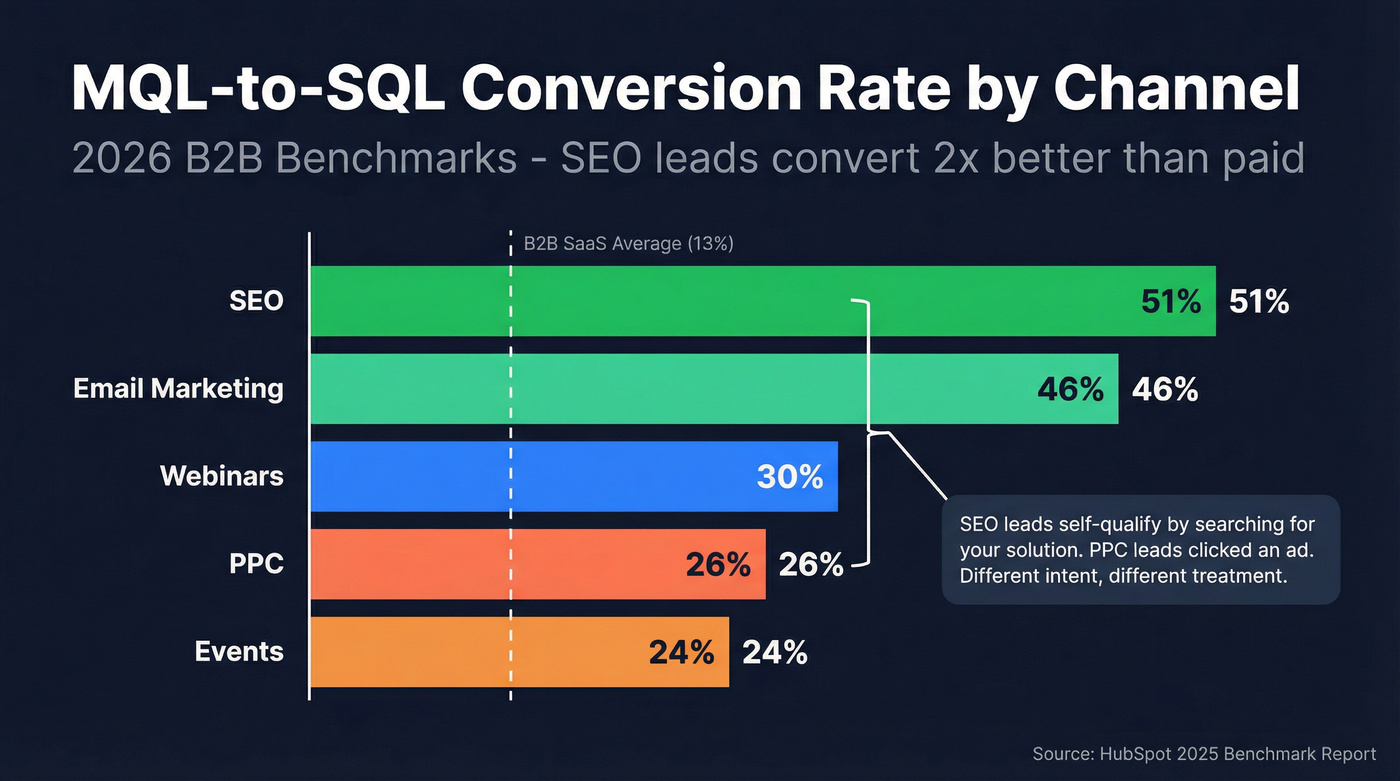
The gap between SEO at 51% and PPC at 26% is massive. If you're spending the same nurture effort on both channels, you're misallocating resources. SEO leads are self-qualifying - they searched for your solution. PPC leads clicked an ad. Different intent, different treatment.
MQL-to-SQL by Industry
| Industry | MQL-to-SQL | SQL-to-Closed Won |
|---|---|---|
| B2B SaaS | 13% | ~15-20% |
| Financial Services | 13% | 16% |
| Fintech | 11% | 14% |
What These Numbers Mean
If your MQL-to-SQL rate is below 10%, your scoring model is too loose - you're passing unqualified leads to sales. Above 25%, and you're likely under-qualifying, meaning marketing is hoarding leads that should've been handed off earlier.
For cost context, the average B2B cost per lead runs $84 across channels. Google Ads averages $70.11; LinkedIn runs about $110. When your MQL-to-SQL rate drops from 13% to 8%, you're not just losing conversions - you're inflating your effective cost per SQL by over 60%. Tighten the model, and the economics fix themselves.
Mistakes That Kill Your Pipeline
1. Score Inflation from Content Downloads
An ebook download isn't intent. It's curiosity. When you weight awareness-stage content too heavily, you flood sales with "MQLs" who have no idea what you sell. Cap awareness points and weight decision-stage actions - pricing page visits, demo requests, case study downloads - 5-10x higher.
2. Giving Up After One Follow-Up
44% of reps quit after a single follow-up attempt. Meanwhile, 80% of deals require five or more touches. That math doesn't work. If your SLA doesn't mandate a minimum follow-up cadence, your MQLs are dying of neglect, not poor quality. If you need a cadence template, use this SDR follow-up strategy.
3. No Shared MQL Definition
RevOps practitioners report the same frustration over and over: marketing celebrates MQL volume while sales sees a pile of unresponsive contacts. The disconnect almost always traces back to a missing SAL stage and a definition that marketing wrote in isolation. The definition needs to be co-created, documented, and reviewed quarterly. No exceptions. This is where revenue operations alignment makes the process stick.
4. Ignoring Speed-to-Lead
Picture this: a VP of Marketing fills out your demo form at 10 a.m. on Tuesday. Your lead gets scored, routed through a round-robin, and assigned to a rep who's in back-to-back meetings. By the time they call back at 3 p.m., the VP has already booked a demo with a competitor.
The average sales team takes five hours to respond to a new lead. Some take up to six days. Leads contacted within five minutes are 20x more likely to convert. Five hours isn't a response time - it's a forfeit. If you want to automate the first touch without breaking process, use an automated sales process that enforces routing + SLA timing.
5. Bad Contact Data
Here's the thing: your scoring model means nothing if half your MQLs have bounced emails and disconnected phones. A lead scores 85 points, gets routed to sales, and the rep can't reach them. That's not a lead quality problem - it's a data quality problem. We've watched teams spend months calibrating scoring models only to lose deals because the contact info was stale. Verify before you hand off. Always. Start with CRM hygiene so your scoring inputs aren’t garbage.
Build a Marketing-Sales SLA
Aligned companies grow ~20% per year, and aligned sales and marketing teams are 3x more likely to exceed their acquisition goals. An SLA is the mechanism that turns alignment from a buzzword into an operational commitment.
What Your SLA Should Include
- Shared MQL definition - co-created, not dictated by marketing
- Handoff timeline - marketing delivers MQLs within 24 hours of qualification
- Response SLA - sales makes first contact within 4 hours
- Follow-up cadence - minimum 5 touches in 10 days
- Disposition feedback - sales provides rejection reasons within 48 hours
- Review cadence - quarterly model review with conversion data
- Escalation path - what happens when either side misses commitments
Example SLA Commitments
Marketing commits to: Deliver X MQLs per month based on sales capacity, hand off within 24 hours of threshold, and include lead score, engagement history, and context notes with every handoff.
Sales commits to: First contact within 4 hours, minimum 5 follow-up attempts in 10 days, and disposition feedback within 48 hours of closing a lead - won, lost, or recycled back to marketing with a reason.
Now for the hot take most marketing leaders don't want to hear: if your deal size is under $10K, you probably don't need a complex MQL scoring model at all. A simple two-field form with company size and job title, combined with fast follow-up, will outperform a 15-variable scoring model that takes six months to calibrate. Scoring models earn their keep at higher ACVs where the cost of a wasted sales conversation justifies the infrastructure. For everyone else, speed and data quality beat sophistication every time.
Stop celebrating MQL volume. The metric that matters is MQL-to-meeting rate. If marketing generates 500 leads and 12 become meetings, that's a 2.4% conversion rate - and no amount of volume fixes a broken handoff.
Is the MQL Dead?
The "MQL is dead" take has been circulating since at least 2019, and it picks up steam every year. The argument has two prongs. Both are half right.
The speed-to-lead argument says MQL queues are too slow. By the time a lead gets scored, routed, and picked up by a rep, the buyer has moved on. The data supports this - 78% of buyers choose the first vendor to respond, and the average response time of five hours is embarrassingly slow. AI SDRs are a real answer here, enabling immediate follow-up without waiting for human routing.
The buying-group argument says individual lead scoring misses the reality of B2B purchasing. Deals are decided by committees, not individuals. Tracking 3+ stakeholders interacting within 30 days is a better qualification signal than one person hitting a score threshold, especially for enterprise deals where the person who downloads the whitepaper is rarely the person who signs the contract. The consensus on r/sales and r/RevOps echoes this: the single-threaded MQL is a relic of a simpler buying process that no longer exists at the enterprise level. If you’re shifting to committee-based qualification, use buying group personas to map roles and signals.
Both arguments are valid. Neither means you should abandon MQLs entirely.
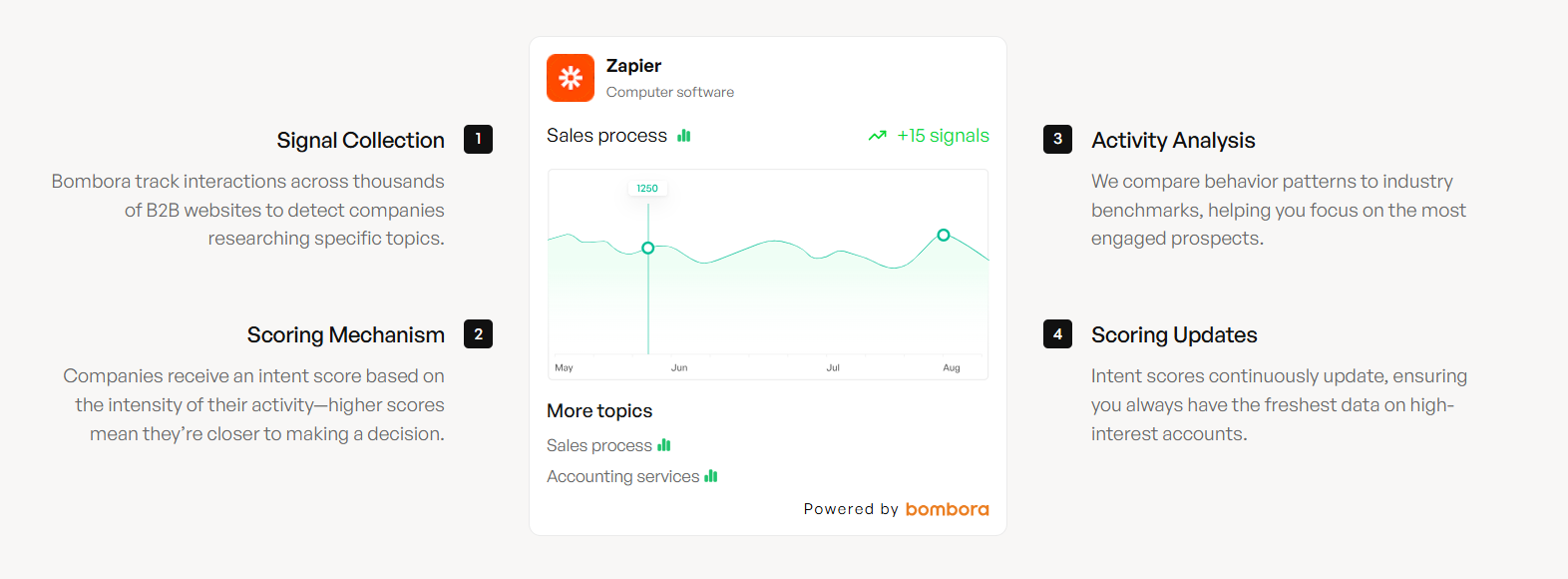
Our position: the MQL isn't dead - the execution is broken. The framework of scoring engagement and fit, then handing qualified leads to sales with context, is fundamentally sound. What's broken is the speed, the data quality, and the single-threaded nature of most implementations. The fix is qualifying on actual purchase signals, not just content consumption. Layering in intent data - tracking topics to filter for in-market buyers before they ever fill out a form - moves you from reactive scoring to proactive qualification. To make that measurable, pair it with a system for intent signals.
A lead that scores 85 points is worthless if the email bounces and the phone number is dead. Prospeo delivers 98% email accuracy and 125M+ verified mobiles - refreshed every 7 days, not every 6 weeks. Clean data is the foundation under your entire MQL-to-SQL pipeline.
Fix your MQL handoff by fixing your data first.
FAQ
What is a marketing qualified lead?
A marketing qualified lead is a prospect who's crossed a predefined threshold of engagement and ICP fit, signaling readiness for a sales conversation. It's scored using behavioral signals like demo requests and page visits alongside firmographic data like title, company size, and industry. It's not a closed deal - it's a green light for outreach.
What's a good MQL-to-SQL conversion rate?
The B2B SaaS average is 13%. Below 10% signals a broken scoring model or misaligned definitions between marketing and sales. Above 25% often means marketing is holding leads too long and leaving pipeline on the table.
What's the difference between an MQL and a PQL?
An MQL is scored by marketing engagement - downloads, webinars, page visits. A PQL is qualified by product usage - free trial activation, feature adoption, usage frequency. PLG companies often prioritize PQLs because in-product behavior is a stronger intent signal than content consumption.
How do I stop sales from ignoring MQLs?
Build the MQL definition with sales input, not just marketing's. Set a response SLA of four hours max and require disposition feedback on every lead. When sales helped define the criteria, they're far more likely to trust the output and actually work the leads.
How does data quality affect MQL conversion?
A lead scoring 85 points is worthless if the email bounces or the phone is disconnected. Bad data erodes sales trust in the entire qualification process. Verifying contact data before handoff - through real-time email verification or enrichment workflows - closes the gap between a qualified lead on paper and one a rep can actually reach.