The Best Tools to Build an ICP (and Actually Use It)
A RevOps lead we know built a beautiful ICP last year. Twelve firmographic attributes, three buyer personas, a TAM slide that made the board smile. Six months later, reps were still prospecting on gut feel and whatever showed up in their inbox. The ICP lived in a Google Doc nobody opened.
Here's the thing: the biggest ICP mistake isn't getting the definition wrong. It's never operationalizing it. Most teams nail the "who should we sell to" question on a whiteboard, then completely fail to wire that answer into their prospecting, scoring, and outreach workflows. The tools that actually matter aren't the ones that help you define your profile - they're the ones that help you use it.
Our Picks (TL;DR)
You don't need eight tools. You need three, working in sequence:
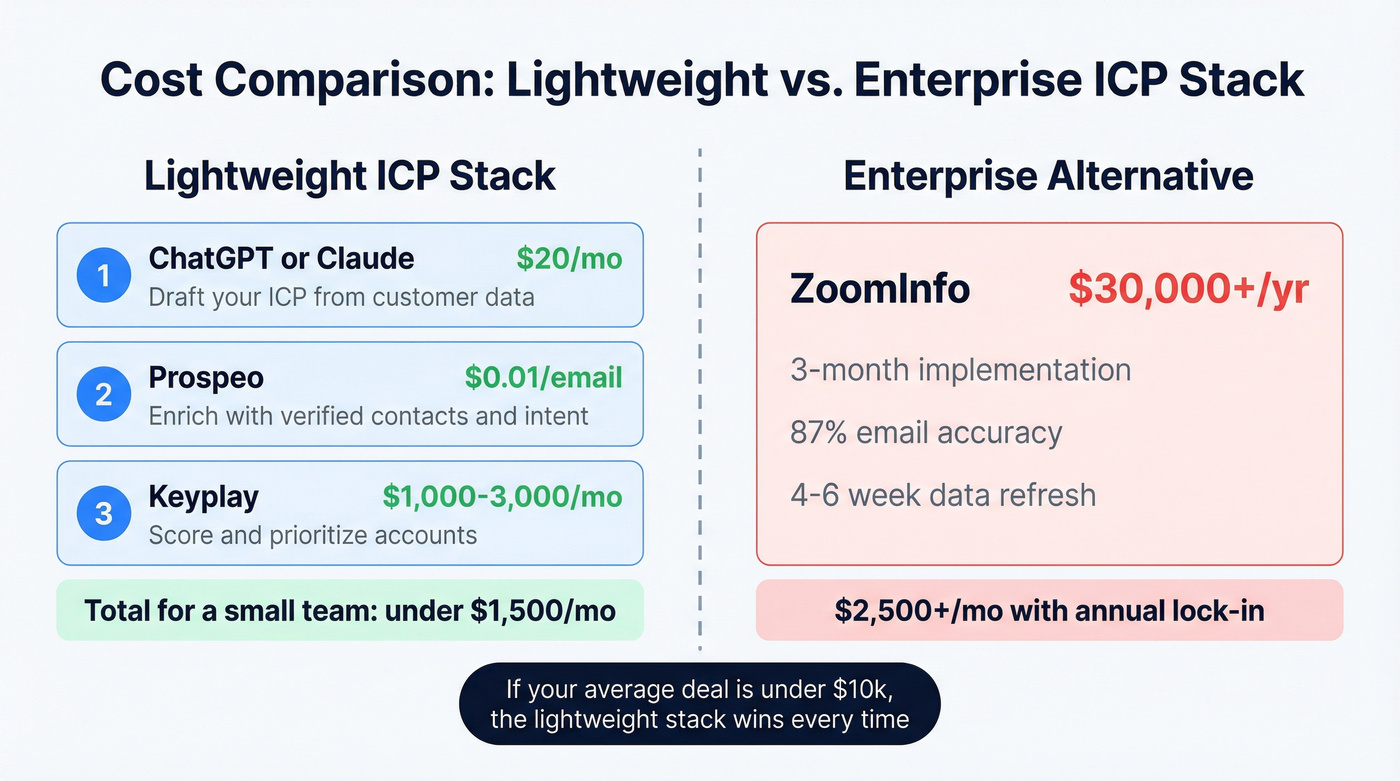
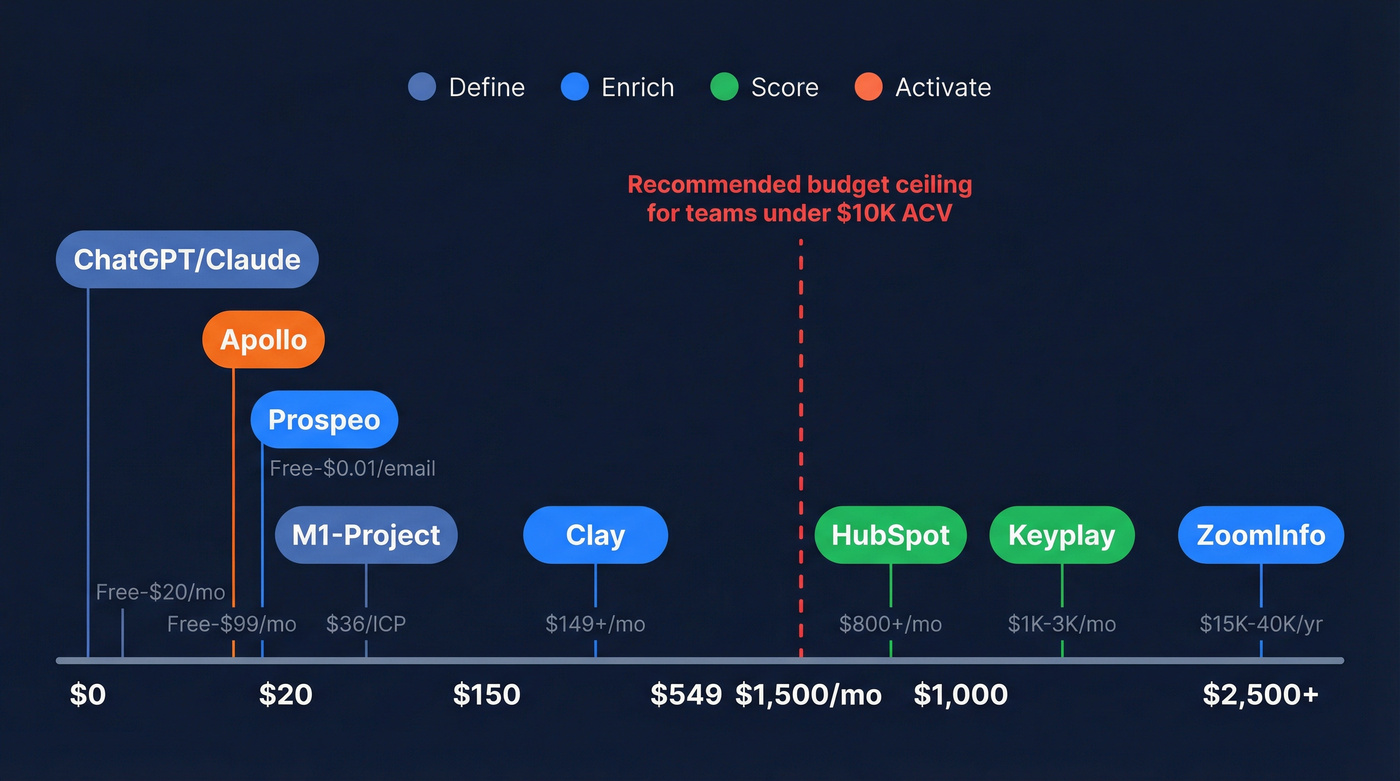
- ChatGPT or Claude - Draft your initial ICP from customer data. Free tiers available, Plus/Pro plans start around $20/mo.
- Prospeo - Enrich your ICP list with verified contacts and intent data. ~$0.01/email, free tier with 75 emails/month.
- Keyplay - Score and prioritize accounts so reps work the right list first. ~$1,000-3,000/mo depending on volume.
That's the define, enrich, score stack. Total cost for a small team: under $1,500/mo. Compare that to a $30k+ ZoomInfo contract that tries to do everything and requires a three-month implementation.
If your average deal size sits below $10k, you almost certainly don't need ZoomInfo-level data infrastructure. A lightweight ICP tool stack will outperform an enterprise platform your team never fully adopts.
ICP vs. Persona vs. TAM
Quick level-set for anyone who conflates these:
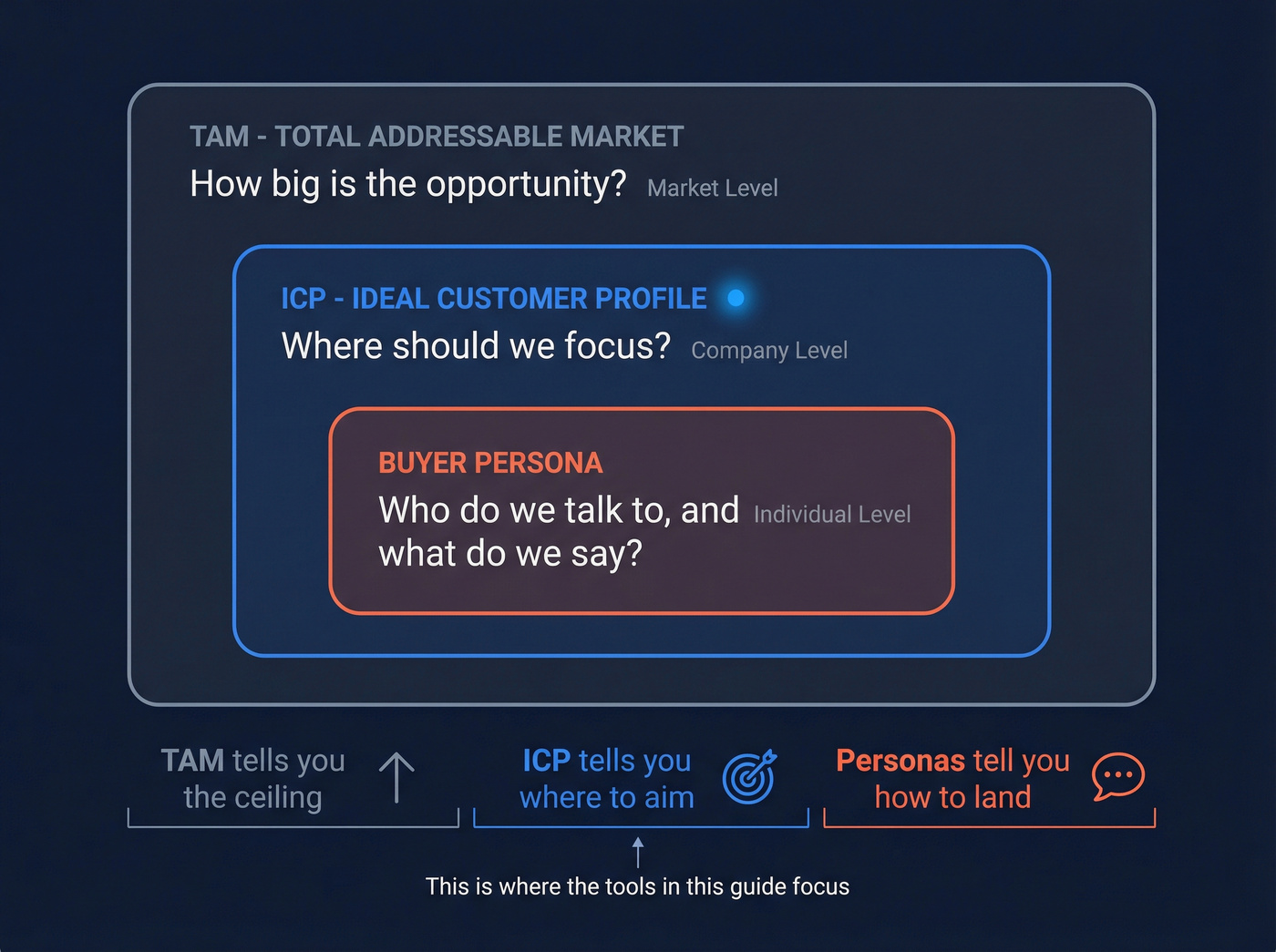
| Concept | What It Answers | Level |
|---|---|---|
| TAM | How big is the opportunity? | Market |
| ICP | Where should we focus? | Company |
| Buyer Persona) | Who do we talk to, and what do we say? | Individual |
TAM tells you the ceiling. ICP tells you where to aim. Personas tell you how to land the message. You need all three, but the tools here focus on ICP - the company-level filter that decides whether your reps are fishing in the right pond.
Define, Enrich, Score, Activate
Most guides stop at Define. That's the easy part.
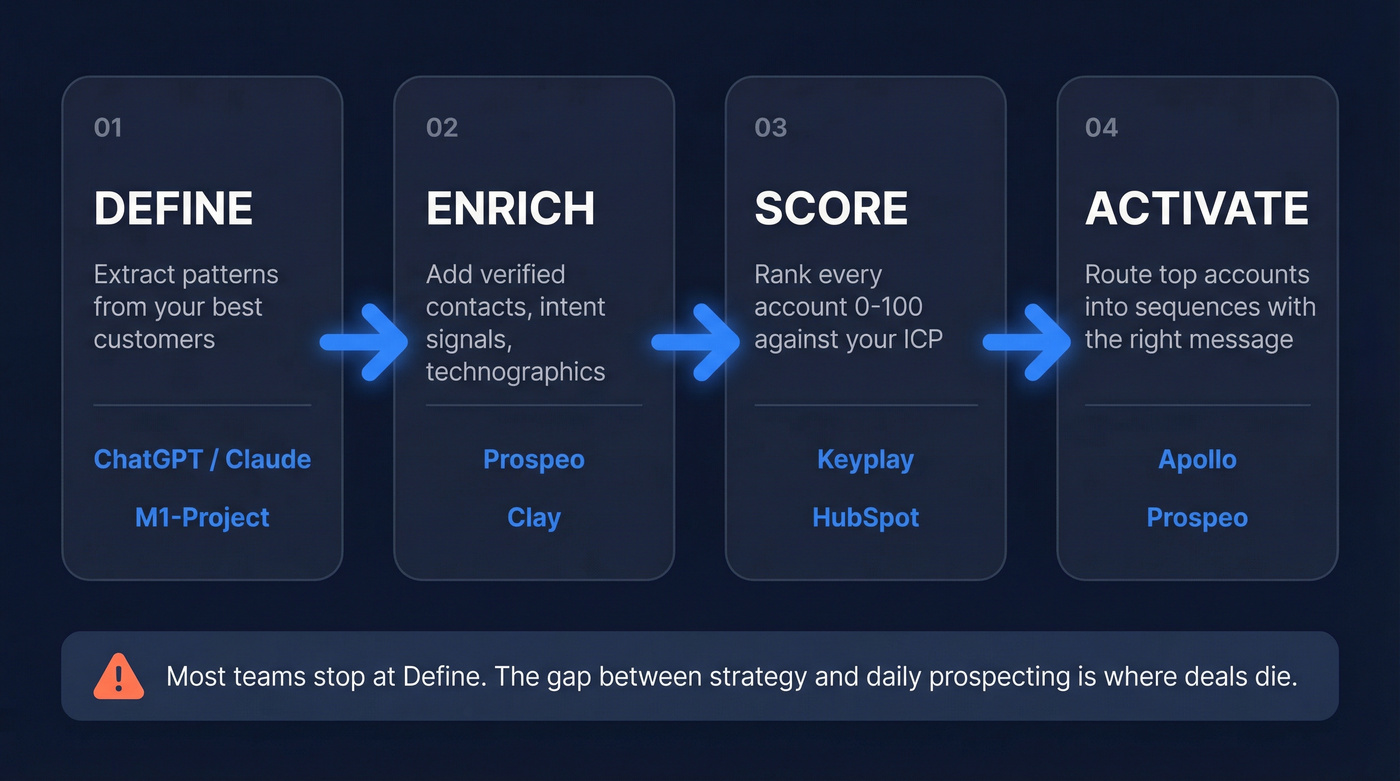
Define your ICP from customer data. Enrich it with verified contacts, technographics, and intent signals. Score every account in your addressable market against that ICP. Activate by routing the highest-scoring accounts into sequences with the right messaging. The gap between "leadership can describe the ICP" and "reps trust the scoring" is where deals die - and it's wider than most teams realize, because nobody owns the translation layer between strategy and daily prospecting behavior.

Your ICP definition means nothing if reps can't reach the accounts it describes. Prospeo turns firmographic and intent filters into verified prospect lists - 30+ filters, 15,000 intent topics, 98% email accuracy, refreshed every 7 days. At ~$0.01/email, you operationalize your ICP for less than one ZoomInfo seat.
Stop defining your ICP. Start activating it.
Best ICP Tools by Stage
Stage: Define
ChatGPT / Claude
Use this if you have real customer data - win/loss records, CRM exports, customer interviews - and want a fast first draft. Feed your top 10 customer profiles into ChatGPT or Claude and ask it to identify firmographic and behavioral patterns. You'll get a surprisingly usable ICP skeleton in minutes.
Skip this if you're hoping AI will magically tell you who to sell to without any input data. These models are pattern-matchers, not oracles. They're excellent for drafting ideal customer profiles, but only when you feed them real customer data first. Free tiers work fine; Plus/Pro plans start around $20/mo and get you longer context windows for bigger datasets.
M1-Project (Elsa AI)
A dedicated ICP generator for teams that don't want to wrestle with prompt engineering. Elsa AI costs roughly $36 per ICP generated (100 credits per ICP, 500 credits for $180) and comes with a 7-day money-back guarantee. Think of it as a structured profile engine that trades flexibility for speed - it won't give you proprietary data, but it will give you a formatted output fast.
If you've already got enough customer data to build one yourself with ChatGPT, save the money.
Stage: Enrich
Prospeo
This is where your ICP stops being a slide deck and starts being a prospect list. Prospeo covers 300M+ professional profiles with 98% email accuracy, 143M+ verified emails, and 125M+ verified mobile numbers. That accuracy number matters - we've seen teams burn entire sending domains because their "verified" data bounced at 35%+.
What makes Prospeo particularly useful for ICP activation is the depth of its search capabilities. You get 30+ filters including buyer intent powered by 15,000 Bombora topics, technographics, job changes, headcount growth, funding rounds, and revenue. Take your ICP definition - "Series B SaaS companies, 50-200 employees, using Salesforce, actively researching sales engagement tools" - and turn it into a live, verified contact list in minutes. The Chrome extension, used by 40,000+ professionals, lets you prospect on the fly from any company website or CRM without switching tabs.

Data freshness is the underrated differentiator here. A 7-day refresh cycle versus the 6-week industry average means your growth signals and funding data are actually current. The results back it up: Meritt tripled pipeline from $100K to $300K/week after switching and cut bounce rate from 35% to under 4%. Snyk dropped bounce rates from 35-40% to under 5% across 50 AEs.
Pricing starts free - 75 emails and 100 Chrome extension credits per month. Paid plans run about $0.01/email with no contracts.
Meritt tripled pipeline from $100K to $300K/week after switching to Prospeo. Snyk cut bounce rates from 35-40% to under 5% across 50 AEs. The difference wasn't their ICP definition - it was enrichment data accurate enough for reps to trust. 143M+ verified emails, 125M+ verified mobiles, intent data across 15,000 topics.
Go from ICP slide deck to booked meetings this week.
Clay
Clay's spreadsheet-like interface lets you build logic-driven enrichment workflows with if/then rules and fallback chains. Need to enrich a founder's email through one provider first, then fall back to another if it misses? Clay handles that elegantly. It pulls from multiple data sources and lets you layer qualification logic directly into your enrichment process.
The downside: steep learning curve. If your team isn't comfortable with workflow logic and API-style thinking, Clay becomes a bottleneck rather than an accelerator. It's also not an outreach tool - you still need a sending platform like Instantly or Lemlist. Pricing starts around ~$149/mo for starter plans plus usage-based enrichment costs; mid-tier often lands around ~$349-800/mo plus usage.
ZoomInfo
ZoomInfo is still the deepest US B2B database for large organizations running ABM, intent, and outreach from a single stack. But at $15,000-40,000/year on annual contracts, it's wildly overpriced for most teams. Email accuracy sits around 87% with a 4-6 week refresh cycle - measurably less fresh and less accurate than alternatives at a fraction of the cost.
If you're enterprise with dedicated RevOps headcount to manage the platform, ZoomInfo earns its keep. Everyone else is paying a luxury tax for data they can get elsewhere.
Stage: Score
Keyplay
Keyplay is the best dedicated ICP scoring tool we've tested. It's purpose-built for one thing: taking your ICP definition and turning it into a 0-100 fit score for every account in your addressable market using lookalikes and signals.
What sets Keyplay apart is the backtesting methodology. You compare your best customers against disqualified leads - not great versus okay, but great versus terrible - to rapidly iterate on your scoring model. In our experience, teams that backtest see rep adoption within weeks, not months. Higher tiers unlock 750+ scoring signals, AI agents, and CRM integration with Salesforce and HubSpot for up to 75K tracked accounts. Mutiny doubled deal size and increased pipeline by 35% after building an ICP model through Keyplay.
Pricing runs ~$1,000-3,000/mo depending on volume and tier. Not cheap, but if your reps are wasting time on bad-fit accounts, the ROI math works fast.
HubSpot vs. Keyplay for Scoring
Already paying for HubSpot Professional (~$800/mo+ depending on seats) or Enterprise? The native predictive scoring uses your existing CRM data to surface high-fit accounts without adding another vendor. It's a solid "good enough" option.
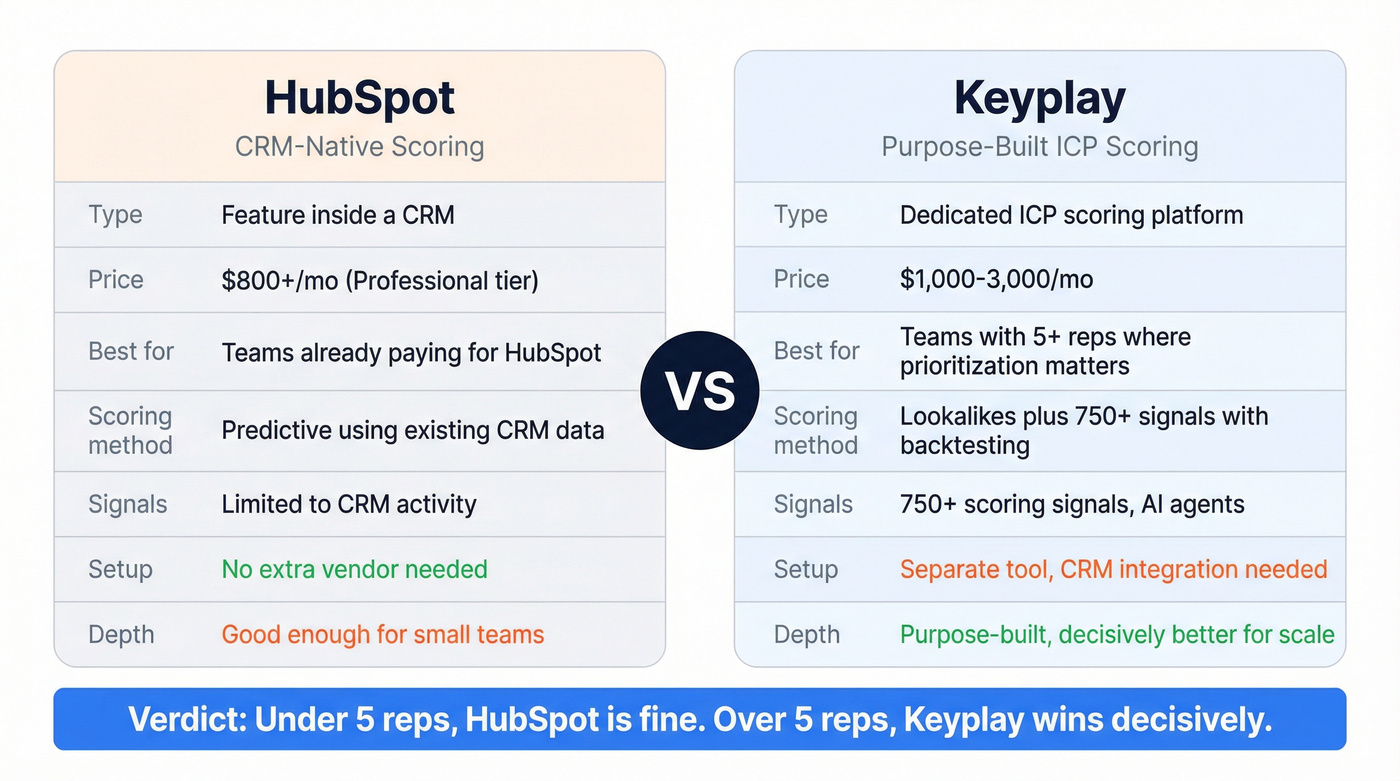
But HubSpot's scoring is a feature inside a CRM, not a purpose-built ICP platform. For teams above 5 reps where account prioritization is a real bottleneck, Keyplay wins this head-to-head decisively.
Stage: Activate
Once you've defined, enriched, and scored your ICP, activation is about getting the right message to the right accounts at the right time. Intent data transforms this step. If your ICP is Series B SaaS companies researching sales engagement, intent signals surface the ~10-20% of your list that's actively in-market this week - so reps prioritize warm accounts over cold ones. That single filter is often the difference between a 2% reply rate and an 8% one.
Apollo
Budget-friendly option for combined prospecting and outreach. Free tier available, paid plans from ~$49-99/mo per user. Apollo's database is solid for getting started, but email accuracy runs around 79% - verify contacts through a dedicated tool before sending. Think of Apollo as training wheels: great for learning outbound mechanics, but you'll outgrow the data quality fast.
Pricing at a Glance
The difference between $0.01/lead and $1/lead adds up fast when you're building lists of thousands.
| Tool | Best For | Starting Price | Model |
|---|---|---|---|
| ChatGPT/Claude | ICP definition drafts | Free | Subscription |
| M1-Project (Elsa AI) | Structured ICP generation | $180/500 credits | Credit-based |
| Prospeo | ICP enrichment + intent | Free (75 emails/mo) | Credit-based |
| Clay | Logic-driven enrichment | ~$149/mo + usage | Subscription + credits |
| ZoomInfo | Enterprise data platform | ~$15,000/yr | Annual contract |
| Keyplay | ICP scoring + prioritization | ~$1,000-3,000/mo | Subscription + credits |
| HubSpot | CRM-native scoring | ~$800/mo+ (Professional) | Subscription |
| Apollo | Budget prospecting | Free tier, ~$49/mo paid | Per user/mo |
ICP Template: What to Include
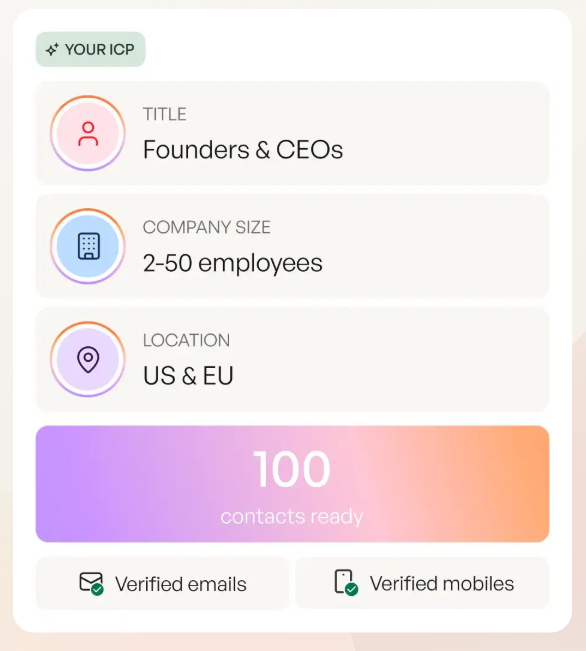
A good ICP fits on a single slide. Here's what belongs on it:
Firmographics: Industry, employee count, annual revenue, geography, growth stage (bootstrapped, Series A, public, etc.).
Technographics: Tech stack and tools used - especially the ones that signal buying intent for your product. If you sell a Salesforce integration, companies running Salesforce are your ICP by definition.
Behavioral signals: Buying triggers like recent funding, leadership changes, and expansion. Layer in intent signals showing active research in your category. The quality of your profile data directly determines whether these signals translate into pipeline or noise.
Buying committee: Decider, payer, and user - often three different people. Map all three so reps know which roles to multi-thread.
One useful heuristic from the r/sales community that we've found holds up: if 30%+ of your customers come from referrals, you're likely at product-market fit. Your ICP should reflect that referral segment's characteristics - they're telling you who loves your product enough to recommend it.
ICP Mistakes That Kill Pipeline
Profitability blindness. Most teams build ICPs around the customers who respond to surveys or show up in case studies. Instead, evaluate the 20% of customers generating 80% of profits. Activity-based costing and LTV-to-CAC ratios will tell you which segments actually make you money.
Static ICPs. Your early adopters look nothing like your mainstream buyers. Treat your ICP as a living document - review quarterly for startups, bi-annually for established orgs. The companies that bought in year one aren't the companies that'll get you to $50M ARR.
Ignoring data quality. Real talk: if your bounce rate is above 10%, the problem isn't your ICP - it's your data. The best ideal customer profile in the world is useless if half your emails never land. A 98% email accuracy benchmark is the standard to hold your data stack against.
FAQ
Can I build an ICP with ChatGPT?
Yes, for the initial draft. Feed it your top 10 customer profiles and ask for firmographic and behavioral patterns. Validate with real sales data and enrich with a dedicated tool before acting on it - AI gives you the skeleton, not the verified contact list.
How often should I update my ICP?
Quarterly for startups, bi-annually for established orgs. Early adopters look nothing like mainstream buyers - treat your profile as a living document and re-validate against closed-won data each cycle.
What's the difference between ICP and buyer persona?
ICP is company-level: firmographics, technographics, buying behavior. Buyer persona is individual-level: job title, goals, pain points. ICP tells you which companies to target; personas tell you who to talk to and what to say.
Do I need an expensive data platform to build an ICP?
No. Start with ChatGPT (free) to define your profile, then use a credit-based enrichment tool (free tier: 75 emails/mo) to build your target list. A working stack can start under $50/month, then scale as pipeline grows.
What's the most important ICP attribute?
Profitability. Not company size, not industry. Evaluate which customers generate the highest LTV relative to CAC, then reverse-engineer the firmographic patterns they share. That analysis alone reshapes most teams' targeting.