The Complete SDR Cold Calling Workflow: Dials to Pipeline
It's 9:15am on a Tuesday. Your SDR has been dialing for forty minutes, hit nothing but voicemail, and is now scrolling Slack with the headset still on. The call list came from a CSV someone pulled last quarter. Half the numbers are wrong. The other half ring to people who left that company months ago.
This isn't a script problem. It's a workflow problem.
The gap between a 2.5% average cold call conversion rate and the 5-8% that top performers hit isn't talent - it's process. A solid SDR cold calling workflow separates teams that book meetings from teams that burn out. Let's break down how to build one that actually works.
What You Need (Quick Version)
The workflow has six layers. Most reps skip the first two - data verification and ICP targeting - then wonder why 80 dials produce zero meetings.
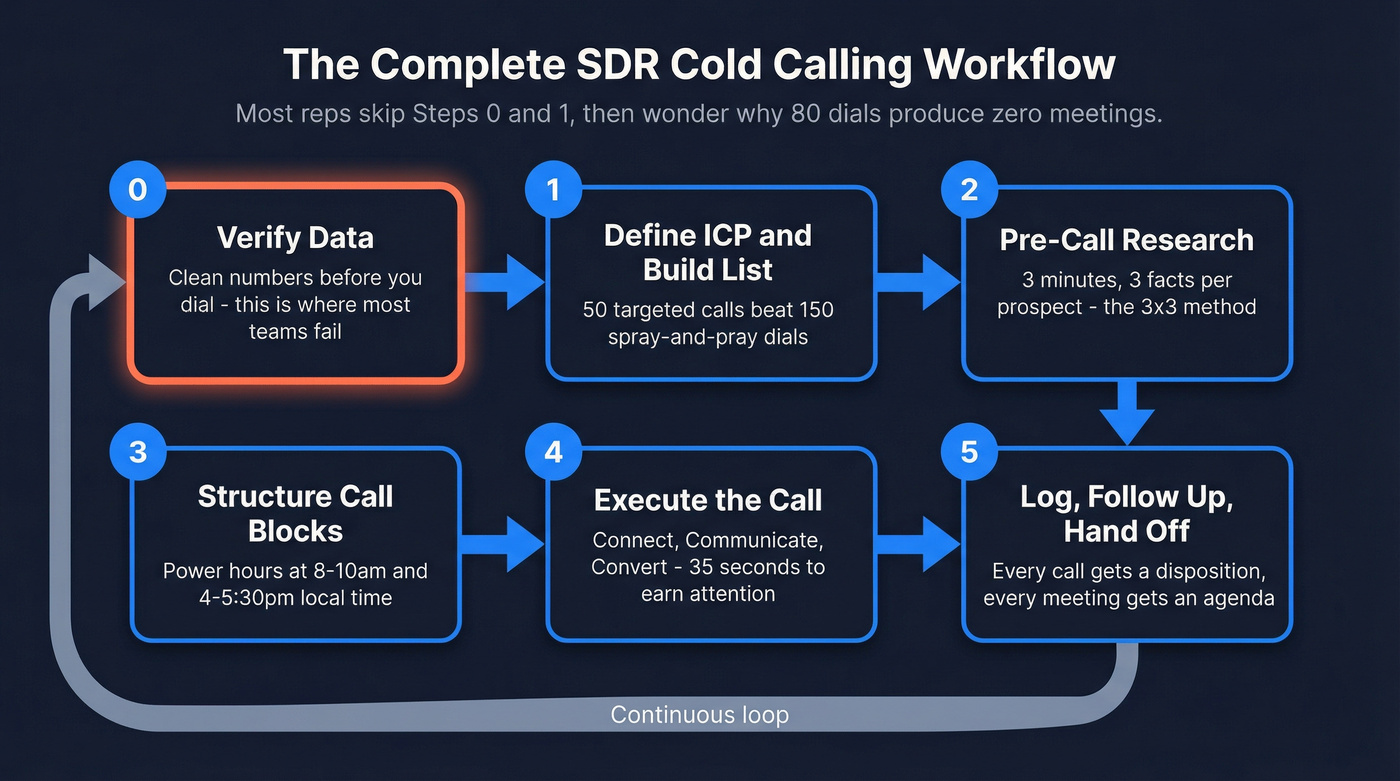
- Verify your data before you touch the dialer
- Define your ICP and build a targeted list
- Pre-call research - 3 minutes, 3 facts per prospect
- Structure call blocks around optimal windows
- Execute the call with a repeatable framework
- Log, follow up, hand off, reduce no-shows
Clean data is step zero. Everything downstream depends on it.
Cold Calling Benchmarks for 2026
Before you redesign anything, know what "good" looks like.
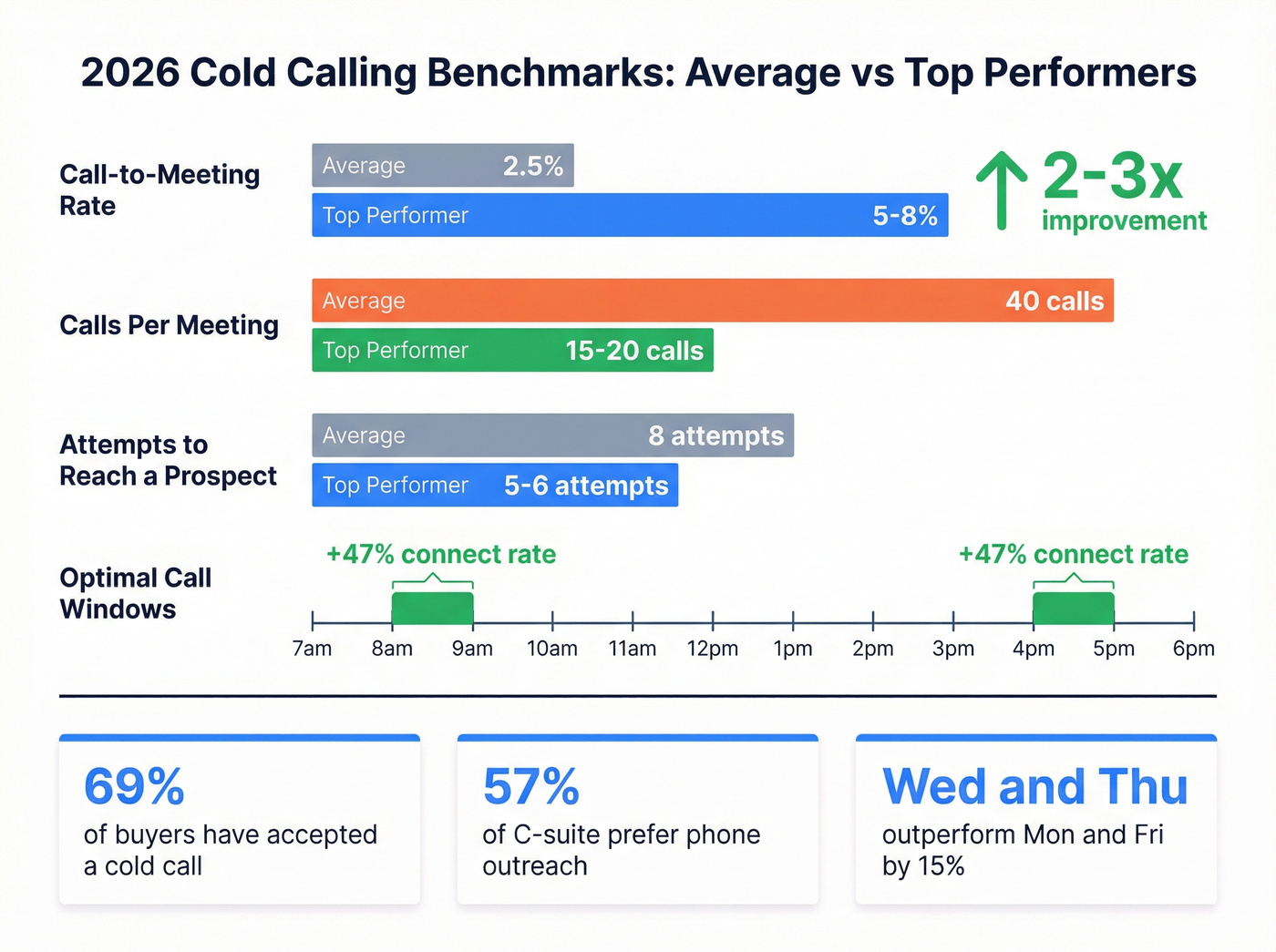
| Metric | Average | Top Performer |
|---|---|---|
| Call-to-meeting rate | 2.5% | 5-8% |
| Calls per meeting | ~40 | 15-20 |
| Attempts to reach | 8 | 5-6 |
| Buyers who've accepted a cold call | 69% | - |
| C-suite preferring phone | 57% | - |
Calling between 8-9am and 4-5pm local time delivers +47% connect rates. Wednesday and Thursday outperform Monday and Friday by roughly 15%.
Conversion swings wildly by lead source. Cold purchased lists convert at 1.5-2%. Marketing-qualified leads hit 4-6%. Warm intros run 15-25%. Where your list comes from shapes your entire funnel math, which is why we've seen teams obsess over scripts when the real lever is upstream - the quality of the numbers they're dialing in the first place.
Building Your Workflow: Six Steps
Step 0 - Verify Data First
87% of Americans don't answer calls from unknown numbers. That stat gets worse when the number is disconnected, belongs to someone who left the company, or routes to a general reception line. Bad data doesn't just waste dials - it kills morale. An SDR who hits voicemail 50 times in a row stops trying on dial 51.
The 3x3 research method - finding 3 relevant facts in 3 minutes - lifts conversion from 1.8% to 3.3%, an 82% improvement. But that research is worthless if the phone number at the end of it is dead.

Bad phone data is the #1 workflow killer for SDRs. Prospeo's 125M+ verified mobile numbers deliver a 30% pickup rate - that's 3x higher than ZoomInfo. Stop burning call blocks on disconnected lines.
Give your SDRs numbers that actually ring.
Step 1 - Define Your ICP and Build a List
Fifty targeted calls beat 150 spray-and-pray dials every time. Before you build a list, lock down your filters:
- Firmographics: industry, headcount, revenue range, tech stack
- Buying signals: recent funding, hiring surges, intent data spikes
- Behavioral triggers: website visits, email opens, content downloads - prioritize these accounts
- Exclusions: existing customers, competitors, previously disqualified accounts
The goal is a list where every name has a reason to pick up and a reason to care. In our experience, reps who make 50 cold calls a day against a tightly filtered list consistently outbook those blasting through hundreds of untargeted dials. It's not even close.
Step 2 - Pre-Call Research (3 Minutes Max)
Don't spend ten minutes per prospect. Two to three minutes is the right window. You need three things:
- Company context - recent news, funding round, hiring pattern
- Role context - what this person's job involves and what keeps them up at night
- Connection point - something specific you can reference in the first 15 seconds
That's it. The 82% conversion lift from the 3x3 method comes from relevance, not depth. You're not writing a briefing doc - you're arming yourself with enough to sound like you've done your homework.
Step 3 - Structure Your Call Blocks
The "power hour" concept works because it eliminates context-switching. Block two hours - no email, no Slack, no CRM admin. Just dials.
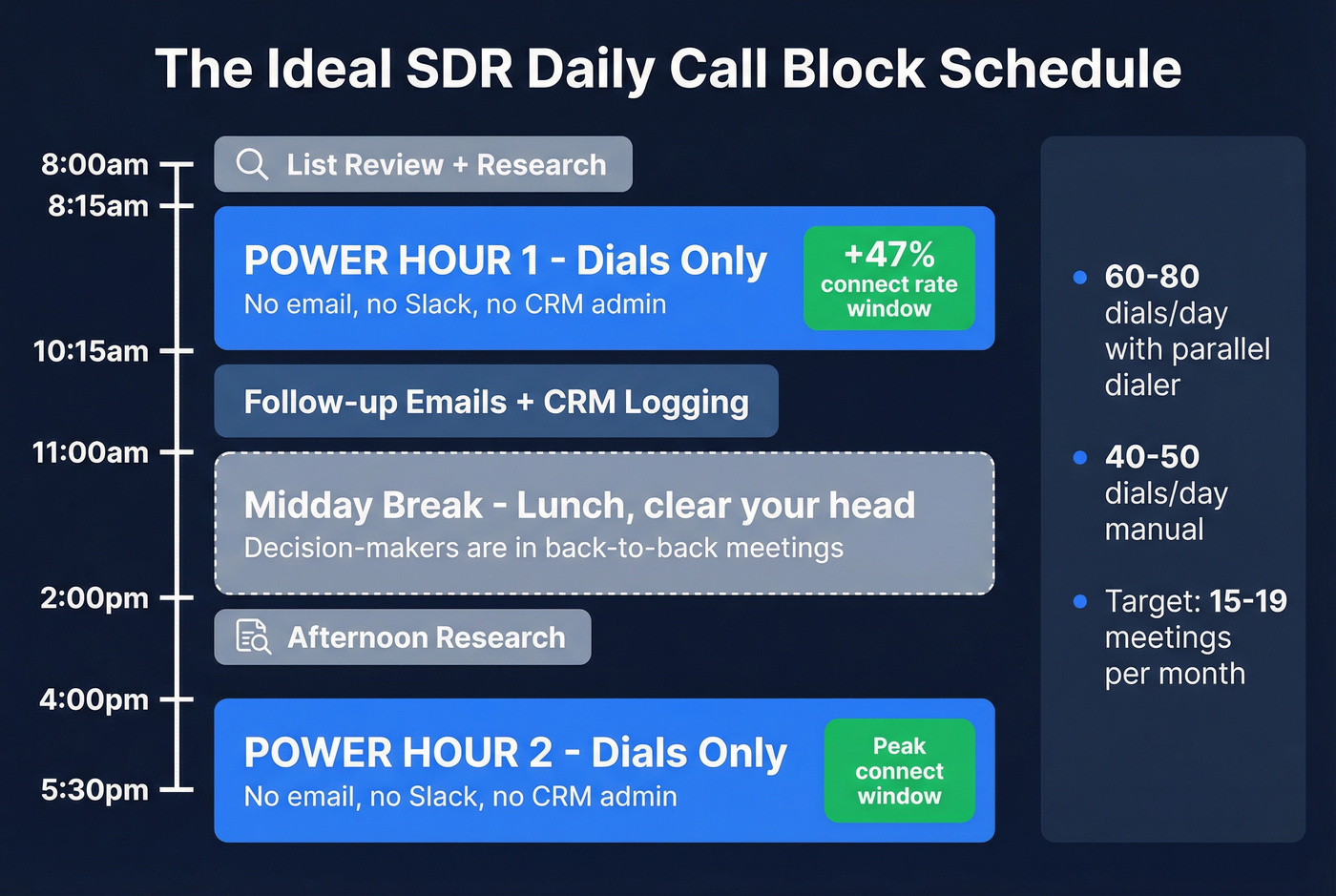
| Time Block | Activity |
|---|---|
| 8:00-8:15 | List review + research |
| 8:15-10:15 | Power hour #1 (dials) |
| 10:15-11:00 | Follow-up emails + logging |
| 2:00-2:15 | Afternoon research |
| 4:00-5:30 | Power hour #2 (dials) |
The midday gap is intentional - eat lunch, clear your head, and don't touch the dialer when decision-makers are in back-to-back meetings. Target 60-80 dials per day with a parallel dialer, or 40-50 manual. The 8-9am and 4-5pm windows aren't arbitrary; they're when decision-makers are at their desks but not yet buried in meetings.
Some managers push for 100 cold calls a day, but that pace only makes sense with a parallel dialer and verified data. Otherwise you're just burning through bad numbers and tanking morale.
Step 4 - Execute the Call
Everything before this determines whether the call even has a chance. Use the 3 C's Framework: Connect, Communicate, Convert.
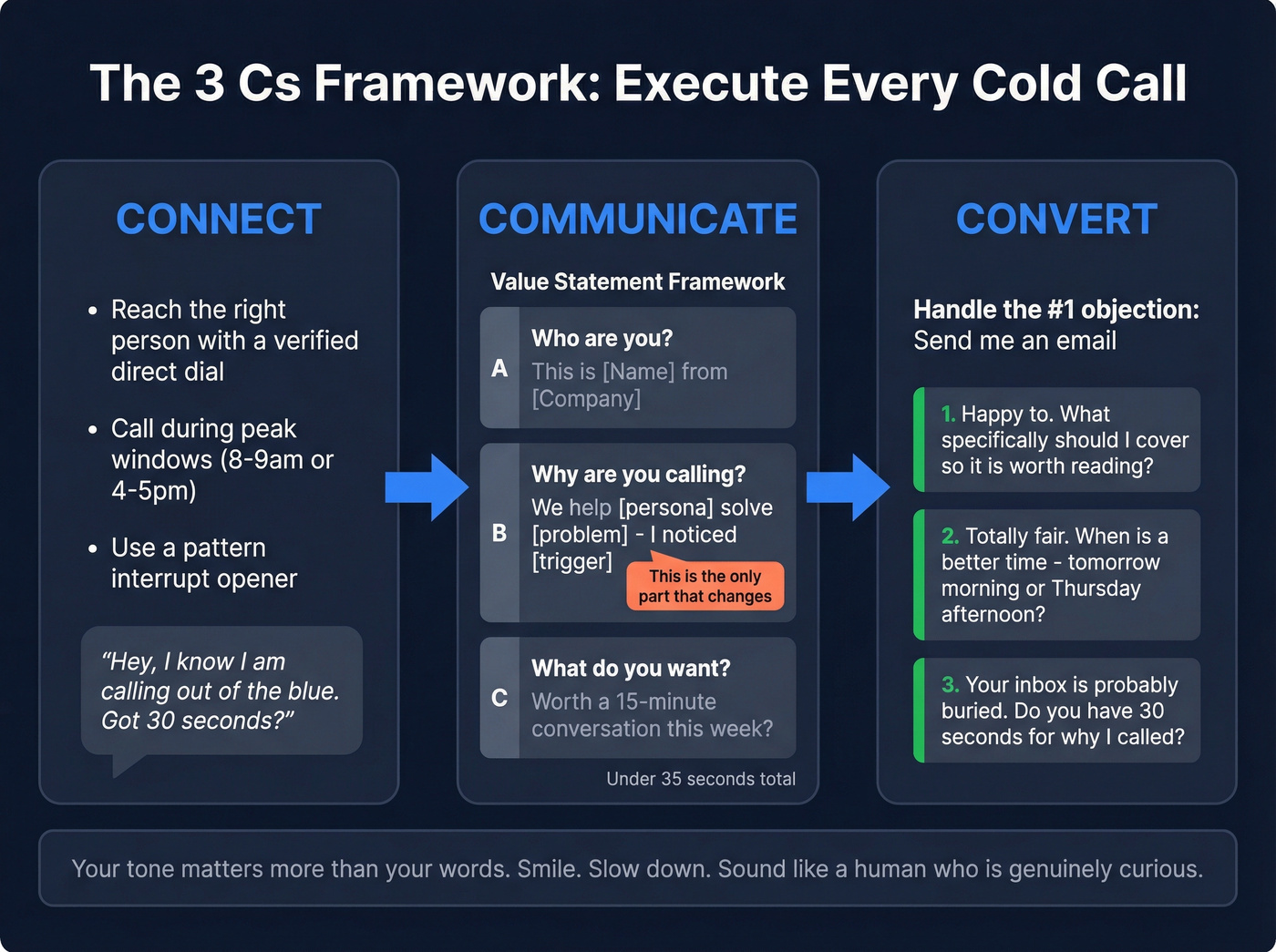
Connect means reaching the right person with a verified direct dial, at the right time, with caller ID that doesn't scream "spam likely." Pattern interrupts work - something like "Hey, I know I'm calling out of the blue. Got 30 seconds?"
Communicate using Connor Murray's Value Statement Framework. Answer three questions in under 35 seconds:
Who are you? "This is [Name] from [Company]." Why are you calling? "We help [persona] solve [specific problem] - I noticed [trigger]." What do you want? "Worth a 15-minute conversation this week?"
Only the middle piece changes by persona. The opener and ask stay consistent, making the framework repeatable at scale.
Convert means handling objections without panic. The most common - "Send me an email" - usually means "I'm busy, go away." Three responses that work:
- "Happy to. What specifically should I cover so it's worth reading?"
- "Totally fair. When's a better time - tomorrow morning or Thursday afternoon?"
- "Your inbox is probably buried. Do you have 30 seconds for why I called?"
Here's the thing: 77% of B2B buyers describe their last purchase as complex or difficult, and buying groups have grown from 6 to 12 stakeholders. Objections aren't rejection - they're a rational response to being interrupted by a stranger. Your tone matters more than your words. Smile. Slow down. Sound like a human who's genuinely curious, not a rep reading from a card.
Step 5 - Log, Follow Up, Hand Off
Every call gets a disposition. No exceptions.
- Connected - had a conversation (meeting set / callback / not interested)
- Voicemail - left a message
- Gatekeeper - reached someone else
- Bad number - disconnected or wrong person
Send a follow-up email after every conversation, even the ones that went nowhere. For meetings booked, send a specific agenda immediately - not "Intro call" but an outline of what you'll cover and why it's worth their time. Confirm the calendar invite while you're still on the phone. Book within the same week whenever possible.
Before the AE takes the meeting, transfer your notes, the trigger that got the prospect's attention, and any objections raised. A clean handoff is the difference between a productive demo and a re-discovery call that wastes everyone's time.
The average no-show rate sits around 20%, and most of it is preventable with a tighter post-call workflow. If your team can't sustain 60+ dials per day consistently, consider outsourcing top-of-funnel before hiring.
Fifty targeted calls beat 150 spray-and-pray dials - but only if the data is clean. Prospeo's 30+ filters let you build ICP-perfect lists with buyer intent, tech stack, and headcount growth signals, refreshed every 7 days.
Build the call list your SDRs actually deserve.
How to Increase Call Volume
The average SaaS SDR produces $3M/year in pipeline. Separately, SDR benchmarks land around 15 meetings/SALs per month on average. With a 20% no-show rate, you need to book ~19 to get ~15 attended.
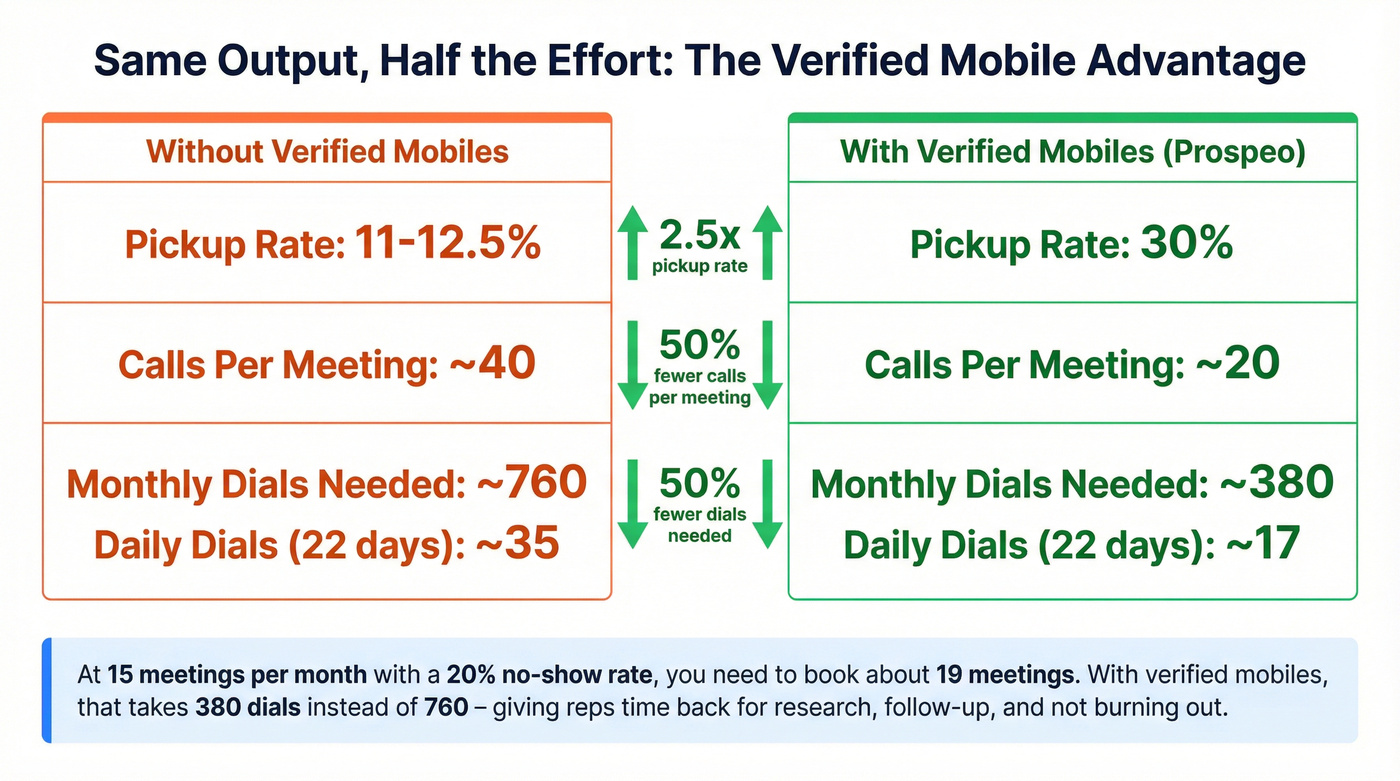
| Metric | Average | With Verified Mobiles |
|---|---|---|
| Calls per meeting | ~40 | ~20 |
| Dials needed/mo | ~760 | ~380 |
| Daily dials (22 days) | ~35 | ~17 |
Same output, half the effort. With a 30% mobile pickup rate - versus the 11% and 12.5% you'll get from Apollo and ZoomInfo respectively - your connect rate roughly doubles, which cuts calls-per-meeting in half and gives reps time back for research, follow-up, and not burning out.
Skip ZoomInfo if your average deal size is under $10k. A lean stack with accurate mobiles and a decent dialer will outperform an enterprise platform your team barely uses. We've watched teams spend $30k/year on data tools and still dial disconnected numbers because nobody configured the refresh settings.
The Cold Calling Tech Stack
B2B companies adopting advanced sales technology grow revenue 2-3x faster, per McKinsey. That doesn't mean expensive - Gong at $160-250/user/month plus platform fees is overkill for a 3-person SDR team. The right tools let you sustain high-volume calling without sacrificing conversation quality.
| Category | Tool | Starting Price | Best For |
|---|---|---|---|
| Data & Verification | Apollo | Free, ~$49/user/mo | All-in-one on a budget |
| Data & Verification | ZoomInfo | $15-40K/year | Enterprise teams |
| Sequencing | Salesloft | ~$100+/user/mo | Full-featured cadences |
| Sequencing | Outreach | ~$100-150/user/mo | Enterprise sequences |
| Dialing | Aircall | $30/user/mo | Budget-friendly dialer |
| Dialing | Orum | ~$80-150/user/mo | Parallel dialing at scale |
| Call Intelligence | Gong | ~$160-250/user/mo | Enterprise call coaching |
| Call Intelligence | Fireflies.ai | ~$10-18/user/mo | Affordable transcription |
| Call Intelligence | Fathom | ~$19/user/mo | Lightweight call notes |
Budget stack (~$130+/user/month, plus data credits): Prospeo + Aircall + Salesloft. This covers verified data, a solid dialer, and multi-channel sequencing - everything a team under 10 reps needs.
Full stack for teams past 10 reps: Add Orum for parallel dialing, Gong for call coaching, and layer in intent data to prioritize accounts showing buying signals.
Common Workflow Killers
Look - if your connect rate is below 8%, check these failures before you blame the script:
- No pre-call research - you sound generic, they hang up
- Generic opener - "How are you today?" is an instant tell
- Pitching before discovery - you don't know their problem yet
- Stale or unverified data - half your dials are wasted before you even start (see B2B contact data decay)
- Ignoring timing windows - calling at 2pm on a Monday is a graveyard
- No disposition logging - you can't improve what you don't measure
- No follow-up email after conversations - pipeline left on the table (use an SDR follow-up strategy)
- Measuring dials instead of conversations - activity theater isn't productivity
The consensus on r/sales is pretty clear: reps who track conversations and meetings booked instead of raw dial counts consistently outperform. Vanity metrics feel productive. They aren't.
FAQ
How many cold calls should an SDR make per day?
Target 60-80 dials with a parallel dialer, or 40-50 manual. Track conversations and meetings booked instead of raw dials - a rep who has 12 conversations from 50 dials outperforms one who makes 100 dials and connects 4 times. Anything below an 8% connect rate signals a data problem, not a volume problem.
What's a good cold call to meeting conversion rate?
Average is 2.5%; top performers hit 5-8%. The gap comes from data quality, pre-call research, and call timing - not script talent. Teams running verified mobile numbers consistently land in the upper range because they're actually reaching decision-makers instead of voicemail boxes.
Can SDRs realistically make 300 cold calls a day?
Hitting 300 dials requires a multi-line parallel dialer and a very large, pre-verified list. It's technically possible but rarely productive - personalization drops to zero and you're essentially running a robocall operation. Most teams see better pipeline from 60-80 well-researched dials than from 300 spray-and-pray attempts.
What tools do SDRs need for a cold calling workflow?
Three essentials: a verified data source for clean contact info and direct dials, a dialer (Aircall for budget, Orum for scale), and a sequencer (Salesloft or Outreach). Add conversation intelligence like Fathom or Fireflies once the team grows past 5 reps. Budget around $130+/user/month total.
How do you fix a low connect rate?
Start with your data - stale numbers are the #1 connect-rate killer. Switch to a provider with weekly data refreshes and verified mobiles (30% pickup rate is the benchmark). Then check your timing: call between 8-9am or 4-5pm local time on Wednesdays and Thursdays. Those two changes alone can double connect rates from 4% to 8%+.