Objection Handling Scripts That Actually Work (2026)
You just watched a rep fumble through a pricing objection, panic-talk at 190 words per minute, and offer a 15% discount before the prospect even finished their sentence. That deal's dead. The worst part? The objection was a buying signal - the prospect was interested enough to push back.
Only 13% of customers believe a salesperson can understand their needs. That trust deficit means every objection is a test - not of your product, but of whether you're worth another minute of the buyer's time. Sellers who successfully defend their product against objections can hit a close rate as high as 64%. The average sales close rate? 29%.
The gap between those two numbers isn't talent or charisma. It's preparation. Having a rehearsed objection handling script ready before the pushback lands is the single highest-leverage skill in sales. Yet 48% of salespeople never make a single follow-up attempt after hearing "no." They treat objections as stop signs instead of what they actually are: invitations to go deeper.
And complexity isn't slowing down. 81% of revenue leaders say their team's deals are more complex than ever, buying committees of 6-10 stakeholders are common, and the largest group of revenue teams in 2026 sits in the 21-25% win-rate bracket. The old playbook - charm the decision-maker, handle one or two concerns, close - doesn't work when you're navigating a committee of skeptics across a six-month cycle.
What does work: data-backed sales objection scripts, practiced until they're reflexive, delivered with the kind of calm confidence that only comes from knowing exactly what to say. Every script below is grounded in Gong's analysis of 67,149 sales meetings, practitioner-tested frameworks from the field, and specific wpm data and AI tool comparisons you won't find in any other guide on this topic.
What You Need (Quick Version)
The #1 behavior change: pause 5X longer after hearing an objection. Gong's analysis of 67,149 sales meetings found this is the single biggest differentiator between top performers and everyone else. Not a clever rebuttal. Not a framework. Just shutting up for a beat.

The 3 scripts worth memorizing first:
- The three-bucket response for "I need to think about it" - forces the prospect to self-categorize as blowing you off, stuck on something specific, or genuinely interested
- "Compared to what?" for price objections - four words that shift the entire conversation
- "Yes, and" for vendor displacement - borrowed from improv, kills defensiveness instantly
The recommended framework: LAARC (Listen, Acknowledge, Assess, Respond, Confirm) for complex enterprise deals. ARC (Acknowledge, Respond, Close) for high-velocity sales where you've got 30 seconds to recover.
What Gong's 67,149-Call Analysis Reveals About Handling Objections
Gong ran AI analysis across 67,149 sales meetings pulled from a database of 5 million recorded calls. The findings are the closest thing we have to a physics of objection handling - I keep coming back to this dataset because nothing else in sales research comes close in sample size or rigor.

The pause finding is the headline. Successful reps pause for 5X longer after hearing an objection than their struggling peers. Not a dramatic, theatrical silence - just a beat. Enough to signal "I heard you" instead of "I'm about to bulldoze you."
Average talking speed in a typical sales conversation runs about 173 words per minute. When a rep gets flustered by an objection, they speed up to 188 wpm. Top producers do the opposite - they slow down. That 15 wpm difference is the sound of panic, and buyers hear it instantly.
The data also killed the monologue myth. Low performers react to objections with knee-jerk speeches - the average underperformer responds with a 21-second monologue. Top reps ask questions instead. They use mirroring (repeating the last few words of the buyer's sentence with an upward tone) to trigger elaboration without interrogating.
Here's the thing: 96% of prospects research your company before engaging. By the time they raise an objection, they've already formed opinions. Your scripts aren't fighting ignorance; they're fighting preconceptions. That changes how you approach every step below.
The 7-step framework that emerged from the data:
- Pause - 3-5 seconds of silence
- Question - "Can you help me understand what's causing that concern?" (never "why?" - it's threatening)
- Validate - "It seems like you're pretty torn on what to do here"
- Isolate - "Aside from [objection], is there anything else holding you back?"
- Get Permission - "Can I bounce a few thoughts off of you?" (neutralizes the buyer's defenses)
- Reframe - Turn "bad timing" into "perfect timing" by shifting the lens
- Resolve - Close with "Does that make sense?" rather than a leading question
The permission step is the one most reps skip. It sounds small, but asking "Can I share a thought?" before launching into your reframe implies vulnerability. It tells the buyer you're not about to steamroll them.
Roughly half of initial objections are smoke screens for deeper concerns. The prospect says "price" but means "I can't justify this to my CFO." The prospect says "timing" but means "I don't trust this will work." The question-and-validate steps exist specifically to get past the surface objection to the real one.
Six Sales Objection Script Frameworks Compared
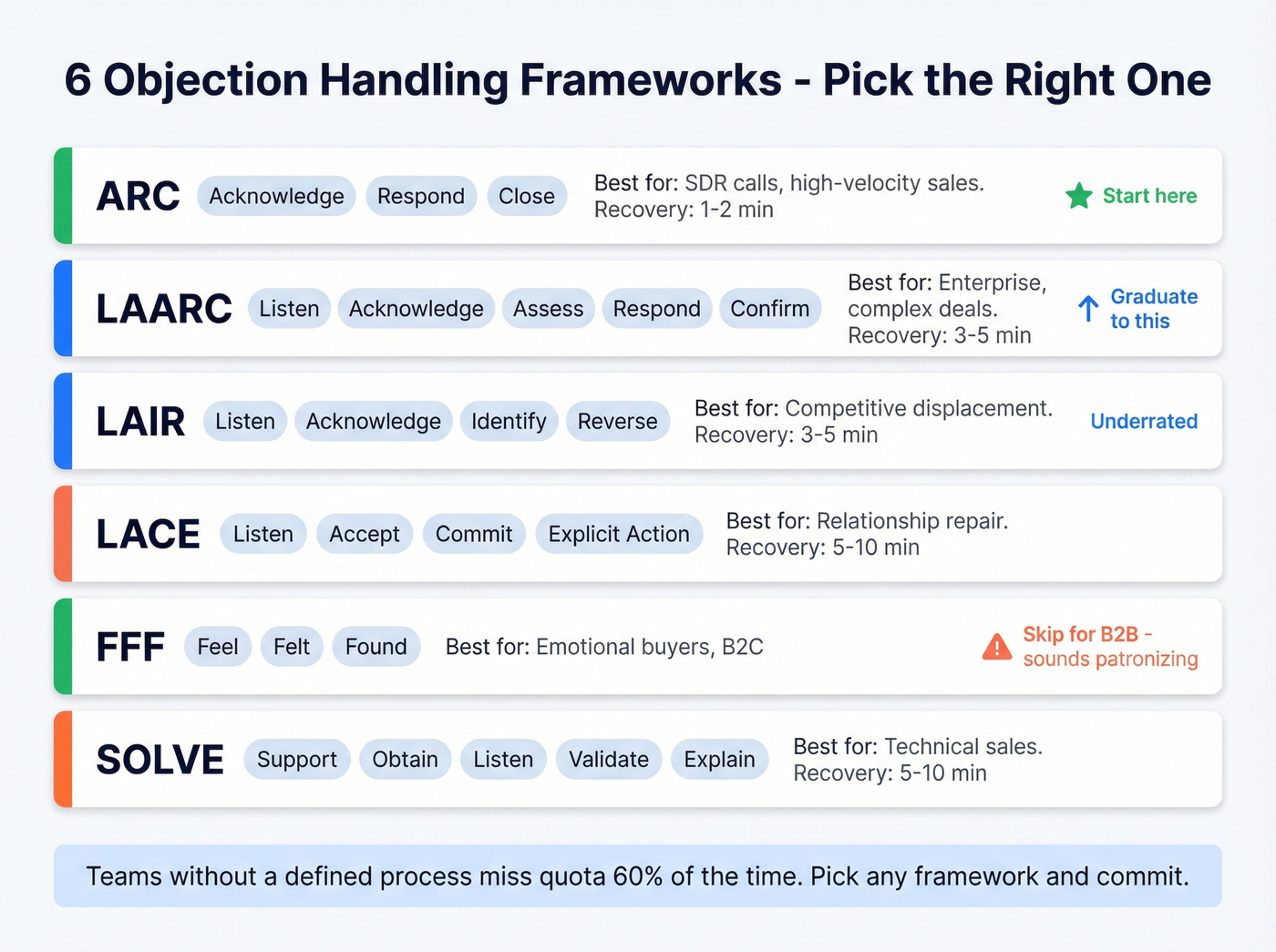
Every framework is just a different way to organize the same instinct: listen, respond, advance. But the structure matters because it gives you a mental model when your brain freezes mid-call. Here's how the six major frameworks stack up:
| Framework | Steps | Best For | Recovery Time |
|---|---|---|---|
| ARC | Acknowledge, Respond, Close | High-velocity, SDR calls | 1-2 min |
| LAARC | Listen, Acknowledge, Assess, Respond, Confirm | Enterprise, complex deals | 3-5 min |
| LAIR | Listen, Acknowledge, Identify, Reverse | Competitive displacement | 3-5 min |
| LACE | Listen, Accept, Commit, Explicit Action | Relationship repair | 5-10 min |
| FFF | Feel, Felt, Found | Emotional buyers, B2C | 1-2 min |
| SOLVE | Support, Obtain, Listen, Validate, Explain | Technical sales | 5-10 min |
My recommendation: learn ARC first, graduate to LAARC. ARC is three steps. You can internalize it in a day and use it on every cold call. LAARC adds the assessment and confirmation steps that matter when you're navigating a six-month enterprise cycle with multiple stakeholders.
Skip Feel-Felt-Found unless you're selling to consumers. It sounds patronizing in B2B: "I understand how you feel. Other clients felt the same way. What they found was..." Most experienced buyers have heard this exact pattern and it triggers an eye-roll. I've watched senior procurement leads visibly check out the moment they hear "felt."
LAIR is underrated for competitive displacement. The "Reverse" step - showing the prospect that the opposite of their objection is actually true - works beautifully when someone says "we're happy with our current vendor." You're not arguing. You're flipping the frame.
Sales teams without a defined objection handling process miss quota about 60% of the time. And here's the stat that should motivate you to pick any framework and commit: 60% of customers say no four times before buying, but 48% of salespeople never make a single follow-up attempt. The framework doesn't matter as much as having one at all.

You just memorized the perfect pricing objection script. But 35% of your emails bounce and half your dials hit dead lines - so the objection never happens. Prospeo delivers 98% verified emails and mobile numbers with a 30% pickup rate. More live conversations means more chances to use those scripts.
Stop rehearsing scripts you never get to deliver. Fix the data first.
Copy-Paste Scripts by Objection Type
Price and Budget Objections
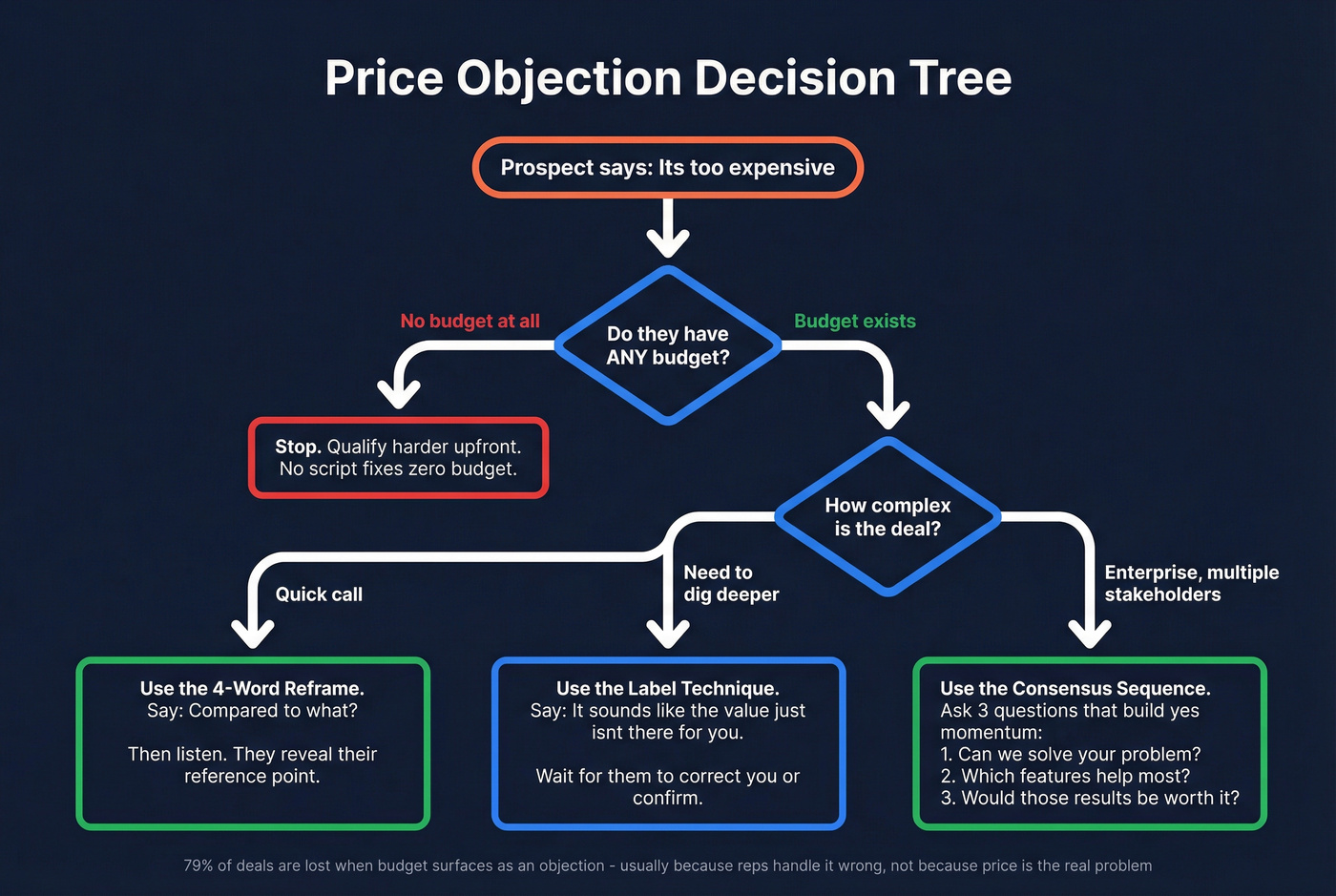
79% of deals are lost when budget surfaces as an objection. That's not because price is the real problem - it's because reps handle it terribly. They either cave immediately or get defensive about value. Both responses kill momentum.
Don't do this:
Prospect: "It's too expensive." Rep: "Well, if you think about the ROI over three years and factor in the time savings plus the integrations and the support package, it's actually very competitive..."
That's a 21-second monologue. The prospect stopped listening after "Well."
Do this instead - the Four-Word Reframe:
Prospect: "It's too expensive." Rep: "Compared to what?"
That's it. Four words. Adam Czeczuk, Head of Consulting at Think Beyond, swears by this because it forces the prospect to articulate their reference point. Are they comparing you to a competitor? To doing nothing? To a budget number their CFO gave them? Each answer requires a completely different response.
When you need to uncover the real issue, use the Label technique (Chris Voss):
"It sounds like the value just isn't there for you."
This gets one of two responses. Either they correct you - "It's not that the value isn't there, we just don't have those funds right now" - which reveals the real objection. Or they confirm, which tells you to dig deeper into what "value" means to them specifically.
For enterprise deals with multiple stakeholders, use the Consensus Sequence (Anthony Iannarino):
- "Setting the price aside, do we have a product that can solve your problems?"
- "Which features do you think will help you get results X, Y, and Z?"
- "If you got those results, would we be a worthwhile investment?"
Each question builds a "yes" that makes the final price conversation feel like a formality rather than a negotiation.
Skip these scripts if the prospect has zero budget. No amount of reframing fixes a company in a hiring freeze with no discretionary spend. Qualify harder upfront instead.
"I Need to Think About It"
This is the objection that feels polite but is actually the most dangerous. It's a slow death - the deal enters limbo, follow-ups get ignored, and three weeks later you're marking it "closed-lost" in your CRM.
Here's the three-bucket framework:
"Whenever I tell someone I need to think about it, I usually mean one of three things:
One - I'm not going to be a deal, and I just don't want to tell you that right now. Two - I kind of like the idea, but something is holding me back, like money or timing. Three - I really like the idea and just need to move a few things around.
Be honest with me - which one is it?"
The Voss combo works when you want something subtler:
Mirror: "Some time to think about it?" (pause - let them fill the silence) Label: "It sounds like you're not confident this is the right decision."
The urgency script for when you've already built value:
"What would you need to see to make a decision by [specific date]?"
"We Already Have a Vendor"
The "yes, and" technique from improv is the best approach here:
"Totally makes sense - almost everyone we talk to already has someone. And usually the reason they still chat with us isn't to replace everything. It's to fix one specific gap their current setup doesn't really cover."
This script, sourced from a practitioner on Reddit, works because it validates their current choice while planting a seed of doubt.
Morgan Ingram's version is more direct:
"That's great. I'm not asking you to rip anything out. A lot of our clients use us alongside [competitor] because we help with [specific differentiator]."
The consensus approach expands the frame:
"Ah, yes, they're a popular solution in this market, and you see the value in using their solution to get X and Y. Can we talk about how we've worked with [similar company] to boost Z too?"
"Send Me an Email" and Other Brush-Offs
| What They Say | What They Mean | Your Move |
|---|---|---|
| "Send me an email" | "Get me off this phone" | Buy 30 more seconds |
| "I don't have time" | "You haven't earned my time" | Offer value regardless of outcome |
| "I'm not interested" | "You haven't said anything interesting yet" | Force a micro-commitment |
These brush-offs are where cold call rebuttal scripts earn their keep - you have seconds to recover or the conversation is over.
For "send me an email" - Morgan Ingram's 30-second script:
"I can send you an email, but I just want to make sure it's relevant. Can I ask you a quick question?"
For "I don't have time" - the time-value script:
"I understand your time is valuable, and I won't waste one minute of the twenty minutes I'm asking for. I'll leave you with our executive briefing, and even if there's no next step, you'll have some new ideas."
For "I'm not interested":
"Totally fair. Quick question before I let you go - is it that [specific problem] isn't a priority right now, or that you've already solved it?"
"I Need to Talk to My Boss"
Calibrated questions that force rehearsal:
"What specifically are you going to tell them about our conversation?"
"They'll probably have a few issues with what we talked about today. What will you tell them to reassure them that this is a good idea?"
Richard Harris's pre-handling technique (ask during discovery):
"Who's the most skeptical person on your team, and what might they be skeptical about?"
The "business case in a box": Give the prospect a one-page summary they can forward. Include these four elements:
- ROI calculation - specific to their numbers, not generic
- 3 key differentiators - why you, not the competitor or the status quo
- Timeline to value - when they'll see results
- Risk mitigation - what happens if it doesn't work (trial, guarantee, pilot)
Most deals die in this phase not because the boss says no, but because the champion can't articulate the value clearly enough to get a yes. Storytelling increases win rates by nearly 30%, and a well-built one-pager is a story your champion can retell without you in the room.
"We Don't Have the Need" and Gatekeeper Objections
The reframe technique:
"That makes sense. A lot of our customers said the same thing before they realized [specific problem] was costing them [specific amount]. Quick question - how are you currently handling [process your product improves]?"
For gatekeepers who say "we're not interested":
"I appreciate you looking out for [decision-maker's name]. I'm not trying to sell anything today - I just need 30 seconds to see if [specific problem] is even on their radar. If it's not, I'll move on."
Soft qualifying approach:
"I might be completely off-base here. Can you help me understand how your team currently handles [specific workflow]? If there's no gap, I'll be the first to tell you we're not the right fit."
Industry-Specific Seller Objection Scripts
SaaS
SaaS buyers are technical. CTOs, IT directors, and engineering leads can smell a generic pitch from the first sentence. Based on analysis of 50,000+ SaaS cold calls, here's what actually works:
The permission opener:
"Do you have 27 seconds for me to tell you why I'm calling?"
In our experience, this gets a "sure" about 70% of the time - far higher than any generic opener. The odd number ("27 seconds" instead of "30") is what makes it land. It signals you've thought about this, not just reading from a sheet.
For competitor displacement:
"What's your biggest frustration with [current tool]?"
Follow-up: "If you could change one thing about [current solution], what would it be?"
The TECH qualification framework keeps SaaS discovery focused across four dimensions:
- T - Technical Fit
- E - Economic Buyer
- C - Current Solution
- H - How Soon
Red flags in SaaS are expensive to ignore. A deal that fails on any TECH dimension will eat 3-6 months of your pipeline before dying. Qualify ruthlessly.
Insurance
The coverage gap opener:
"I'm not calling to sell you something today. I wanted to ask a quick question: if you had to file a claim tomorrow, do you feel confident you'd be fully covered?"
For "I'm happy with my current provider":
"When was the last time your policy was reviewed for possible savings or new features? A quick comparison can reveal hidden benefits or gaps your provider hasn't mentioned."
For price sensitivity:
"Would it help if I shared a few flexible payment options or coverage levels that fit your current situation?"
Recruiting, Financial Services, and Real Estate
Recruiting - the passive candidate approach:
"I know you're probably not actively looking - but based on your background, there's a role I'm working on that's worth hearing about."
Follow up with: "Even if the timing isn't right, I'd love to stay connected for when it is. What would make you consider a move?"
Financial services - the tax optimization angle:
"I specialize in helping professionals like you optimize retirement income and minimize tax exposure. Would it be worth 15 minutes to see if there's money you're leaving on the table?"
Real estate - for FSBO and commission objections:
"I noticed your property has been listed for [X days]. Most homes in this area sell within [Y days] with representation. Would it be worth a conversation about what's different?"
For commission objections specifically, shift to net outcome: "My average client nets 8-12% more after commission than FSBO sellers in this zip code. Want me to show you the numbers?"
Five Objection Handling Mistakes That Kill Deals
1. Believing the first objection is real.
Marcin Pienkowski, Head of Salesforce at Think Beyond, puts it bluntly: "The classic mistake? Believing the first objection is real. It rarely is." When someone mentions budget, the real question is: "Are we talking zero flexibility, or is this about where to prioritize spend?" Dig before you respond.
2. "Handling" instead of diagnosing.
Richard Harris, founder of Harris Consulting Group, nails this: "Nobody wants to be 'handled.' Objections are actually buying signals." David Breitenbach, CCO at PatentRenewal.com, calls it "defending instead of diagnosing" - and it's the fastest way to lose a deal that was still alive.
3. Responding before understanding.
Czeczuk again: "I've never seen a perfect objection response close a deal. What actually moves deals forward is getting the prospect to explain their hesitation in their own words." Stop rehearsing your rebuttal while the prospect is still talking.
4. Never following up.
48% of salespeople never make a single follow-up attempt after an objection. 80% of successful sales require five or more follow-up calls. The math is brutal and obvious. (If you're still losing deals in limbo, fix your follow-up attempt strategy.)
5. Discounting too quickly.
We've seen teams where reps cave on price within 90 seconds of hearing a budget objection. Every premature discount trains your market to negotiate harder. It's infuriating to watch - and it's almost always a coaching problem, not a rep problem.
AI Tools for Objection Handling in 2026
AI adoption in sales jumped from 24% in 2023 to 43% in 2024, and it's accelerated since. The tools have gotten genuinely useful - not "AI-generated email" useful, but "real-time coaching whisper in your ear during a live call" useful.
Teams using AI-enhanced objection handling see a 45% improvement in success rates. New hires ramp up 30-40% faster with AI coaching compared to traditional ride-alongs. What used to take 10-16 hours of manual call review and script building now takes 30-60 minutes with AI analysis.
Speed matters here: deals closed within 50 days have a 47% win rate. After 50 days, it drops to 20% or lower.
Niyati Parikh, Dean of Sales College at Visa University, captures the shift: "Leaders are busy - spending one or two hours in role plays isn't scalable. We're using AI to give reps real-time feedback."
| Tool | Primary Use | Pricing |
|---|---|---|
| Gong | Deal intelligence, call analysis | ~$1,200-1,600/user/yr + platform fee |
| Chorus (ZoomInfo) | Conversation intelligence | ~$100-150/user/mo |
| Hyperbound | AI role-play practice | From ~$40/user/mo |
| Balto | Real-time on-call guidance | ~$100-150/user/mo |
| Salesken | Real-time conversation intelligence | ~$40-80/user/mo |
| Second Nature | AI sales training | ~$50-100/user/mo |
| Revenue.io | Real-time coaching | ~$50-95/user/mo |
Gong also charges a platform fee (typically $5,000-$14,000/year depending on team size) on top of per-user costs - factor that in before you commit.
All of these tools are useless if your reps can't reach the right person in the first place. Bad contact data kills call blocks before objections even enter the picture. I've watched teams invest $50k in Gong licenses while their reps waste 40% of dial time on wrong numbers and bounced emails.

Tools like Prospeo sit underneath the conversation intelligence layer - they're the data foundation that makes those tools worth the investment. Verified emails, direct dials, and targeted list-building with 30+ filters mean reps spend their time on actual conversations instead of chasing dead numbers. (If you're rebuilding your outbound foundation, start with verified emails and a clean B2B phone number workflow.)
How to Practice - Role-Play Exercises That Work
Knowing scripts and knowing how to deliver them under pressure are completely different skills. Weekly role-play is the bridge.
The rotation methodology: Four roles - rep, buyer, manager/coach, and silent observer. Rotate every round. The observer role is the most underrated - watching someone else struggle with an objection teaches you more than struggling yourself.
Scoring criteria (use these every session):
- Active listening - did the rep pause and acknowledge before responding?
- Open-ended questions - did they ask or monologue?
- Confidence - did their pace stay around 173 wpm or spike to 188?
- Reframing - did they shift the prospect's perspective?
- Closing the loop - did they advance to a next step?
KPIs to track over time:
- Objection-to-next-step conversion rate (target: 40%+)
- Average time before offering a discount (longer is better)
- Confidence scores from peer evaluations
- Call conversion rate after objection handling training
Cadence: Weekly or biweekly. Not monthly. Not quarterly. Not "when we have time." Make it recurring and non-negotiable. Record sessions so reps can self-review.
AI tools like Hyperbound can supplement between live sessions - reps practice against AI buyers that throw realistic objections. It's not a replacement for live role-play, but it's a solid way to get reps 20+ practice reps per week instead of 2.
Free Objection Handling Playbook Template
HubSpot gates its objection-handling guide behind an email form and bundles it with a prospecting guide you didn't ask for. Here's the structure you need - no email required.
Build a spreadsheet (or Notion doc, or whatever your team actually uses) with these five columns:
| Column | What Goes Here |
|---|---|
| Objection Category | Price, timing, authority, need, brush-off |
| Specific Objection | The exact words prospects use |
| Why It Happens | Root cause (budget cycle, no champion, etc.) |
| Suggested Response | Your script - verbatim |
| Supporting Proof | Case study, ROI calc, or data point |
Start with your top 10 objections. Not 44. Not 20. Ten. The ones your reps hear every single week. Fill in the template with the scripts from this article, customize the proof points for your product, and distribute it as a living document that gets updated monthly.
The "Supporting Proof" column is the one most teams skip, and it's the most important. A script without proof is just words. A script backed by "Company X saw 3x pipeline after switching" is a story - and storytelling increases win rates by nearly 30%. (To operationalize this, pair it with a simple win-loss analysis process.)
Gong's data proves that reaching the right person is step zero. With 300M+ profiles refreshed every 7 days, Prospeo ensures your reps spend time handling objections from real decision-makers - not chasing outdated contacts. At $0.01 per email, bad data is no longer an excuse.
Give your reps live prospects to practice on. Start with 100 free credits.
FAQ
How many objection handling scripts should a sales rep memorize?
Internalize 5-6 frameworks and 3 go-to scripts: the three-bucket, "Compared to what?", and "yes, and." Gong's data shows top performers rely on patterns, not word-for-word memorization. Fluency with a framework beats recitation every time.
What's the best objection handling framework for beginners?
ARC (Acknowledge, Respond, Close) is the fastest to learn - three steps that work on every cold call. Graduate to LAARC once you're comfortable navigating multi-stakeholder enterprise deals. Avoid SOLVE or LACE until you've logged 100+ objection reps.
How do you handle objections over email instead of on a call?
Use the same frameworks with tighter pacing. Labels and calibrated questions translate well to writing. Expect 15-25% lower conversion than live calls since you lose the pause technique. Keep responses under 100 words with one clear question to advance the conversation.
How often should sales teams practice objection handling?
Weekly or biweekly role-play with scoring criteria and role rotation - anything less frequent is a checkbox, not practice. Record sessions for self-review. AI tools like Hyperbound give reps 20+ practice reps per week between live sessions to build muscle memory.
What tools help with real-time objection handling during calls?
Gong and Balto lead for live coaching and post-call analysis, while Hyperbound handles AI-powered practice. But effective objection handling starts before the call - reps need verified contact data to reach the right person. Bad numbers and bounced emails waste the scripts you've spent weeks perfecting.