Referral Voicemail Script: 12 Templates + the 2-Voicemail System (2026)
Your referral voicemail script isn't there to "get a callback" anymore.
In 2026, it's there to earn an email reply.
If your voicemail doesn't make replying feel effortless, it turns into transcript sludge and dies in the preview.
Referral voicemail script: what you need (quick version)
- One goal: voicemail is for email replies, not callbacks. Gong's 300M+ cold-call dataset found leaving a voicemail doubled email replies from 2.73% to 5.87%.
- Two and done: leave no more than 2 voicemails. Once you leave 3+, email replies fall to 2.2% (worse than leaving none).
- Use the right lengths: VM #1 is ~15 seconds. VM #2 is ~30 seconds.
- Say your name + reason fast: iOS 26 call screening and live transcription punish vague openers, so your first sentence needs clear context.
- Name-dropping rules: only do it when it's a real referral or you have permission. Otherwise use "soft referral" language.
- Always include a low-friction CTA: "Reply to my email" beats "Call me back." (More sales CTA examples here.)
- Log permission status: "permission: yes/no/unknown" changes the script and the risk.

What counts as a "referral" (and when name-dropping is legit)
Most "referrals" in sales are just leads.
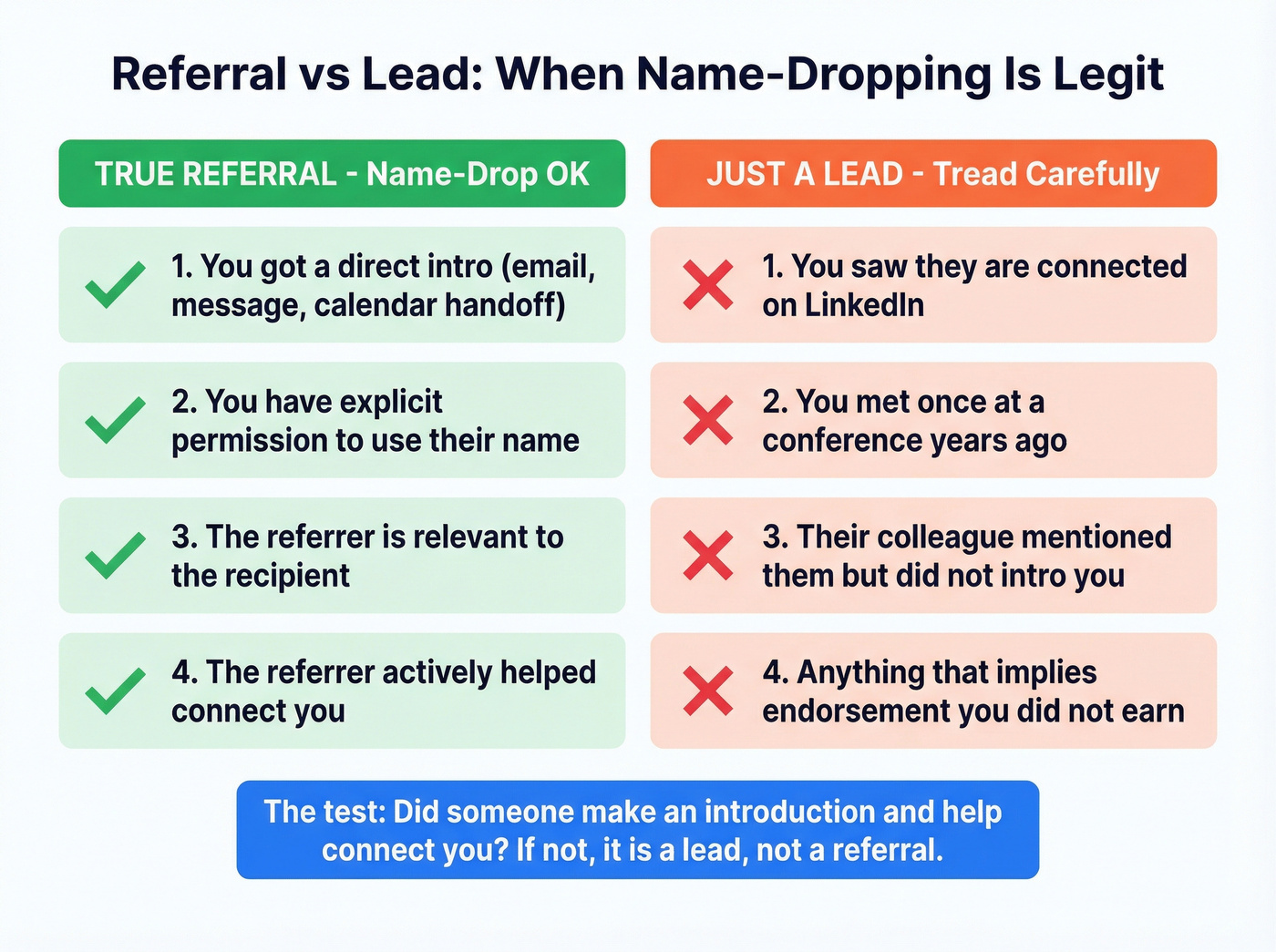
Troy Harrison draws the cleanest line: a referral is when someone makes an introduction and helps connect. A lead is when someone suggests a name but doesn't introduce you. If you didn't get an intro, you're usually holding a lead, not a referral.
That matters because name-dropping borrows credibility. Borrow it without permission and you don't just lose the deal; you risk burning the relationship with the person whose name you used, which is the kind of unforced error that makes teams look sloppy.
Use this rule set:
Legit to name-drop
- You got a direct intro (email thread, message, calendar handoff).
- You have explicit permission to use their name.
- The referrer is relevant to the recipient (same industry, same project, same ecosystem).
Not legit (and usually not smart)
- "I saw you're connected to..."
- "We met once at a conference..."
- "Your colleague mentioned you" when they didn't.
- Anything that implies endorsement.
Ask permission, mention the name once, then move on.
Compliance & trust guardrails (safe phrasing you can copy)
You don't need legalese. You do need to avoid misrepresentation, especially around relationships.
The FTC's Telemarketing Sales Rule bans misrepresenting affiliations, endorsements, or sponsorship. Translation: don't imply the referrer endorses you, is partnering with you, or told you to call if that's not true.
One more practical guardrail: if you're calling consumers or regulated regions, Do Not Call and consent regimes apply. Even in B2B, transmit accurate caller ID and don't spoof. It's a fast way to get blocked, and it's a dumb way to lose trust. (If your team needs the full checklist, see Is Cold Calling Legal?.)
Do / Don't (copy-safe)
DO
- Say how you know the referrer: "We worked together at..." / "We're both in..."
- Use neutral verbs: "suggested," "recommended I reach out," "pointed me your way"
- Add a permission line when you have it: "I have permission to use her name."
- Mention the name once, then shift to relevance.
DON'T
- "John asked me to call you" (unless he literally did)
- "John said you'd want this" (implies endorsement)
- "We're working with John" (implies affiliation)
- "John told me you're struggling with..." (creepy and risky)
"Don't imply endorsement" examples (steal these)
Safe:
- "Maria suggested I reach out because you're leading RevOps."
- "I'm not sure you've met, but we work in the same partner ecosystem."
Not safe:
- "Maria vouched for us."
- "Maria's a big fan and said you should buy this."
- "Maria's sponsoring this outreach."
Use this pattern when you want the credibility transfer without the compliance headache:
"I'm reaching out because [Name]--not because they endorsed anything, just because they pointed me to you as the right person."

Your voicemail doubles email replies - but only if you're emailing the right address. Bad data turns a perfect referral script into a bounced message. Prospeo delivers 98% email accuracy with 7-day refresh cycles, so your follow-up email actually reaches the prospect your referrer pointed you to.
Don't waste a warm referral on a dead email address.
The 2026 reality: screening + transcription changes your first sentence
If you open with "Hey, this is Alex, give me a call back," you're volunteering to be ignored.
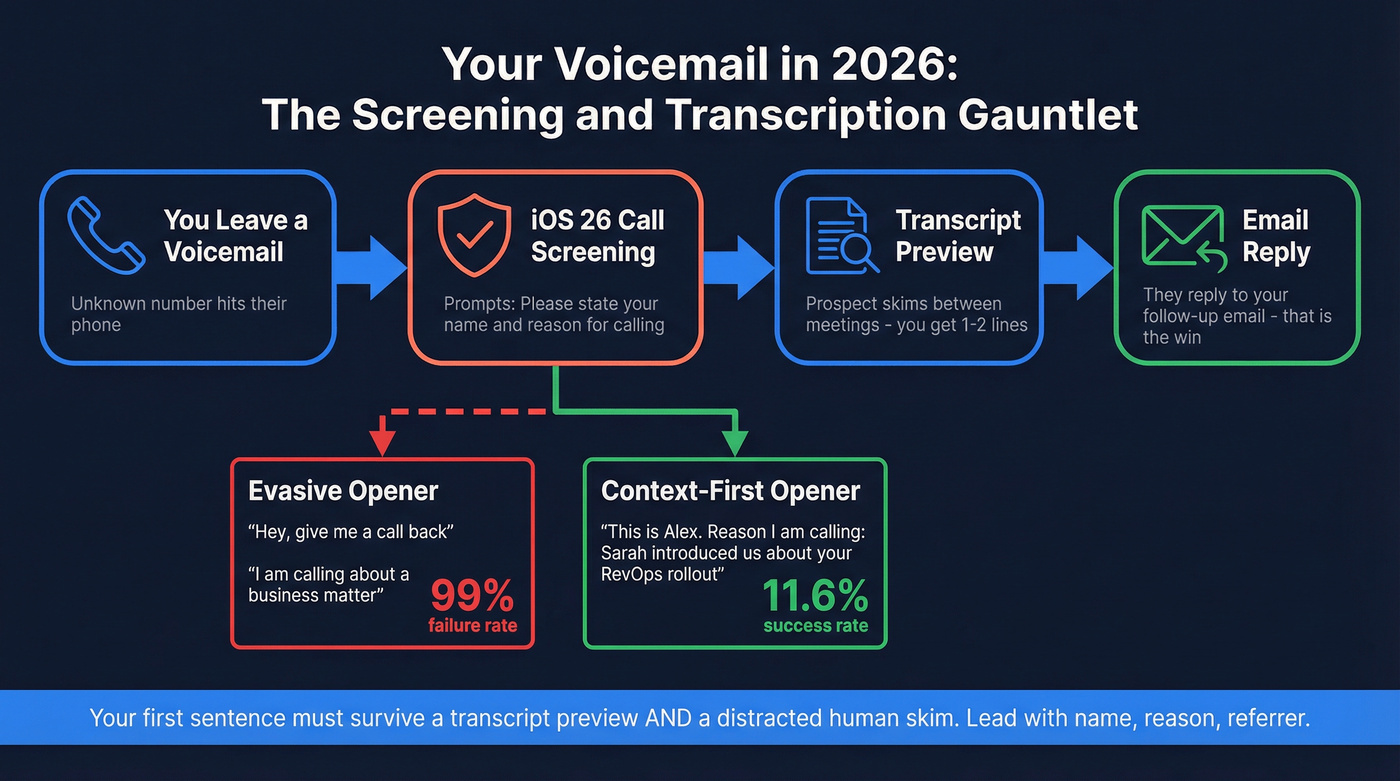
Nooks found iOS 26 screening prompts unknown callers with "Please state your name and reason for calling." Their numbers are blunt: context-first openers succeed 11.6% of the time, while evasive openers fail 99% of the time.
Your first sentence has to survive two things: a transcript preview and a human skimming that transcript while half-paying attention between meetings. (Related: sales pitch opening lines that survive reality.)
Use this (screening-friendly)
- "This is [Name]. Reason I'm calling: [referrer/context] and a quick question about [specific initiative]."
- "Hi [Name], [Your Name] here. Calling because [referrer] introduced us and I'm following up."
- "Hey [Name]--quick context: we spoke with [partner/customer] about [project], and your name came up."
Skip this (gets you screened out)
- "It's Alex, give me a call back." (no reason)
- "I'm calling to discuss a business matter." (sounds like spam)
- "Can you tell [Name] it's urgent?" (evasion)
- "I'll be brief..." (then you aren't)
Caller ID reputation's still messy. Even with STIR/SHAKEN improving (TransNexus reported 44.4% of calls signed at termination in Dec 2026), unknown/spam labeling's common, which is exactly why you lead with crisp context instead of vibes.
The data-backed voicemail strategy (why voicemail is an email-reply play)
Myth: "Voicemail increases callbacks, so I should leave one every time."

Reality: in that 300M+ cold-call benchmark, leaving a voicemail reduced future connect rates (5.17% vs 7.18%). If your only goal is "get them to pick up next time," voicemail's a tax.
But voicemail does something else extremely well: it makes your follow-up email feel real. That's why email replies jump from 2.73% to 5.87% when you leave voicemails.
Here's the system that works:
- Voicemail = credibility + context
- Email = conversion
- Calendar = outcome
Look, if your deal size is small and your cycle is short, you don't need "perfect voicemail craft." You need a clean list, a clean first sentence, and the discipline to stop after voicemail #2. (If you're building the full motion, use this B2B sales stack blueprint.)
Referral voicemail script templates (copy/paste library by scenario)
Global rules
- VM #1: ~15 seconds (identity + context + one question + email CTA)
- VM #2: ~30 seconds (context + proof + same one question + email CTA)
- Mention a referrer once, then move on.
- Use the CTA endings in Callback vs email CTA endings (don't reinvent them per script).
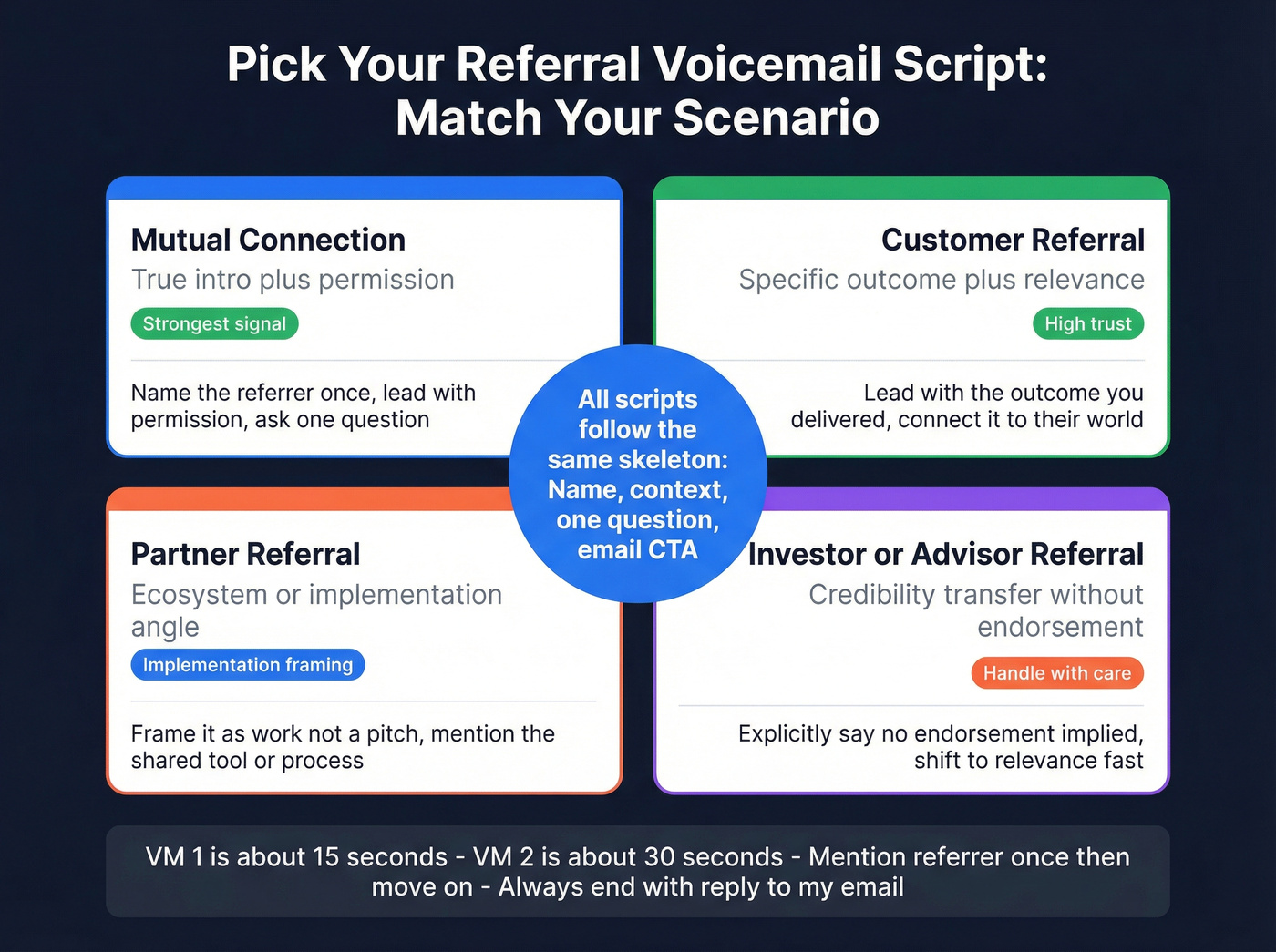
Mutual connection (true intro + permission) {#mutual-connection-true-intro-permission}
When to use: You got a real intro or explicit "yes, use my name." Why it works: Permission + a single question reads cleanly in transcript previews.
VM #1 (~15s) "Hi [Prospect], it's [Your Name]. [Referrer] introduced us, and I have permission to use their name. Reason I'm calling: [one-line relevance]. I just emailed you - can you reply there and tell me if you're the right person?"
VM #2 (~30s) "Hi [Prospect], [Your Name] again. Following up on [Referrer]'s intro - permission to name them. We helped [Referrer's company] with [specific outcome], and I had one quick question: how are you handling [problem] today? I'll resend the email - reply with a quick yes or no."
Common mistake: turning it into a "referrer fan club" voicemail instead of a relevance voicemail.
Customer referral (specific outcome + relevance) {#customer-referral-specific-outcome-relevance}
When to use: A customer told you "reach out to them," and it's directly relevant. Why it works: Outcome proof earns the extra 15 seconds in VM #2.
VM #1 (~15s) "Hi [Prospect], [Your Name] here. [Customer Name] suggested I reach out, and I have permission to mention them. We worked with them on [outcome]. Quick question: are you doing something similar at [Company]? I emailed you - reply there and I'll keep it tight."
VM #2 (~30s) "Hi [Prospect], [Your Name] again. [Customer Name] pointed me your way - permission to use their name. We helped them [metric/outcome] by [mechanism]. Are you the owner for [initiative] this quarter? I'll resend the email - quick yes/no is perfect."
Common mistake: vague proof ("we helped a lot of companies") instead of one concrete outcome.
Partner referral (ecosystem / implementation angle) {#partner-referral-ecosystem-implementation-angle}
When to use: SI, agency, platform partner, or integration partner context. Why it works: "Implementation angle" sounds like work, not a pitch.
VM #1 (~15s) "Hi [Prospect], it's [Your Name]. [Partner Name] suggested I reach out, and I have permission to mention them. This is about [implementation/integration angle]. I emailed you the context - reply there if it's relevant."
VM #2 (~30s) "Hi [Prospect], [Your Name] again. Following up--[Partner Name] sent me your name, permission to use it. We help teams like yours with [implementation outcome] when they roll out [tool/process]. One question: are you the owner for [area]? I'll resend the email."
Common mistake: implying the partner endorses you instead of simply connecting you.
Investor/advisor referral (credibility transfer without implying endorsement) {#investor-advisor-referral-credibility-transfer-without-implying-endorsement}
When to use: An investor/advisor suggested outreach. Why it works: You explicitly remove the "endorsement" implication before it creates distrust.
VM #1 (~15s) "Hi [Prospect], [Your Name] here. [Investor/Advisor Name] suggested I reach out, and I have permission to mention them. They didn't endorse anything - they just pointed me to you as the right person for [topic]. I emailed you one question - reply there when you can."
VM #2 (~30s) "Hi [Prospect], [Your Name] again. Following up on [Investor/Advisor Name]'s suggestion - permission to name them, no endorsement implied. Reason I'm calling: [specific relevance]. We've helped [peer company/type] with [outcome]. I'll resend the email - quick 'worth it' or 'pass' is perfect."
Common mistake: sounding like you're trading on status instead of relevance.
Four more scenarios (use these swap-lines to avoid script bloat)
These are the same skeleton with different "context" and "proof" lines. Keep the structure; swap the lines.
Skeleton (VM #1): "Hi [Name], it's [Your Name]. Reason I'm calling: [context line]. Quick question about [topic]. I emailed you - reply there when you have a second."
Skeleton (VM #2): "Hi [Name], [Your Name] again. Following up on [context line]. Proof: [proof line]. Quick question: [same question]. I'll resend the email - yes/no is great."
Internal referral (same company / colleague handoff) {#internal-referral-same-company-colleague-handoff}
- When to use: Someone inside the company told you who owns it.
- Why it works: It feels like routing help, not cold outreach.
- Context line: "[Employee Name] in [team] suggested you own [area], and I have permission to mention them."
- Proof line: "I'm trying to confirm ownership so I don't bother the wrong team."
Soft referral (no intro, no permission - safe wording) {#soft-referral-no-intro-no-permission-safe-wording}
- When to use: You heard the name through the grapevine - no permission.
- Why it works: It's honest, and honesty survives transcripts.
- Context line: "Your name came up as someone who owns [area] at [Company]."
- Proof line: "We help [peer group] with [outcome], and I'm trying to see if it's relevant there."
"Someone suggested I reach out" (weak referral, honest version) {#someone-suggested-i-reach-out-weak-referral}
- When to use: You want warmth without lying.
- Why it works: You keep the warmth and remove the creep factor.
- Context line: "Someone I trust suggested I reach out about [topic]. I'm skipping names because I'm not sure you've met."
- Proof line: "I'm only trying to confirm if [initiative] is even on your list."
"You were mentioned in a meeting/event" (context-first, screening-friendly) {#you-were-mentioned-in-a-meetingevent-context-first-screening-friendly}
- When to use: You need a transcript-friendly opener that doesn't overclaim.
- Why it works: "Reason for calling" is explicit and non-salesy.
- Context line: "You were mentioned during [event/meeting/context] around [topic]."
- Proof line: "We've helped [peer group] with [outcome], and I'm trying to understand if [initiative] is a priority."
Role-based variants (CEO / VP Sales / RevOps tone shifts) {#role-based-variants-ceo - vp-sales - revops-tone-shifts}
Same referral. Different listener. Change the "reason" and the "question," not the whole voicemail.
CEO: outcome + time respect
- Reason: "quick question about [growth/efficiency outcome]"
- Question: "Is [initiative] on your list this quarter?"
VP Sales: pipeline + execution
- Reason: "quick question about [meeting volume/connect rates]"
- Question: "Are you the owner for [outbound motion]?"
RevOps: process + data + risk
- Reason: "quick question about [routing/enrichment/attribution]"
- Question: "Do you own [system/workflow]?"
Callback vs email CTA endings (2 options per script) {#callback-vs-email-cta-endings-2-options-per-script}
Pick one CTA style and standardize it across reps.
Email-first CTA (my default in 2026):
- "I just emailed you - reply there and I'll keep it to 3 bullets."
- "Hit reply with 'yes' and I'll send details; 'no' and I'll close the loop."
Callback CTA (use when you truly need a live redirect):
- "If you can point me to the right owner, call me at [number]."
- "If it's easier, call me at [number]--60 seconds, tops."
Number placement rule (say it once slowly; optional repeat) {#number-placement-rule-say-it-once-slowly-optional-repeat}
Say your number once, slowly, right after the callback CTA. If you repeat it, repeat it at the end. Don't turn the voicemail into a phone-number recital.
Example: "Call me at 415... 555... 0123. Again, 415... 555... 0123."
Skip the mystery voicemail in referral contexts {#skip-the-mystery-voicemail-in-referral-contexts}
The "name + number only" mystery voicemail is popular because it's short. It's also a bad fit for referrals. It clashes with screening/transcripts and feels deceptive when you're borrowing credibility.
Clarity beats FOMO every time.
Anti-cringe version (more human, less polished) {#anti-cringe-version-more-human-less-polished}
When to use: Your team sounds like they're reading scripts and getting ignored. Why it works: Disarming honesty earns "just email me" responses. I've seen teams switch to this and immediately get more redirects, which is the whole point of referral-style outreach.
VM #1 (~15s) "Hey [Name]--[Your Name]. This is a bit out of the blue. I'm calling because [referrer/context] and I had one quick question about [topic]. I emailed you too - replying there is easiest."
VM #2 (~30s) "Hey [Name], [Your Name] again. Last try on voicemail. The reason I'm reaching out is [one sentence], and we helped [peer] with [outcome]. If it's not relevant, reply 'no' to my email and I'll disappear."
The "Double Tap" cadence for referral voicemail scripts (exact timing + what changes in VM #2)
This is the simplest system that holds up in production.
Step-by-step cadence
Day 1 (morning): Call + VM #1 (~15s) Context + one question. No pitch. CTA: reply to email.
Day 1 (same day): Email #1
Subject: "Just left you a voicemail"
Body: referral/context + one question + easy out. (If you want a full structure, use this follow up email sequence strategy.)
Day 2 (same time window): Call + VM #2 (~30s) Add proof. Restate the same one question. CTA: reply to email again.
Day 2 (same day): Email #2 Short bump in the same thread. Yes/no close.
Don't leave VM #3. Ever. Once you cross that line, you train people to ignore you.
Pre-recorded voicemail drops: when they help (and when they hurt) {#pre-recorded-voicemail-drops-when-they-help-and-when-they-hurt}
Voicemail drops are great for speed and consistency, especially when you're doing high-volume soft referrals or event-based outreach.
They're a bad fit for true referrals where you're using a real person's name and permission. A robotic drop makes the whole thing feel fake. Use drops for soft referral and event mention variants, and keep true-name referrals live.
Voicemail -> email follow-up (the real conversion path)
Voicemail's the spark. Email's where the meeting gets booked.
Send the email within 24 hours and use the subject line "Just left you a voicemail." It creates continuity even if they never listened. (For more options, see cold email subject lines that get opened.)
Here's a scenario we've watched play out a hundred times: rep leaves a clean 15-second voicemail, sends the follow-up email... and it bounces. Now the prospect has a transcript that says "I emailed you" and an inbox that proves you didn't. It's frustrating, and it's avoidable. (If you're seeing hard bounces, start with 550 Recipient Rejected.)
This is where Prospeo (The B2B data platform built for accuracy) fits naturally: if your whole system depends on a same-day voicemail -> email follow-up, you need verified contact data so your "reply to my email" CTA isn't a lie. Prospeo gives you 98% verified email accuracy, 143M+ verified emails, 125M+ verified mobile numbers with a 30% pickup rate across all regions, and a 7-day refresh so your follow-up lands while your voicemail's still fresh.
The 2-day sequence (copy goals + templates)
| Touch | Channel | Copy goal | Template |
|---|---|---|---|
| Day 1 AM | Call + VM #1 | Context only | Use a script from the library (e.g., Mutual connection or Soft referral) |
| Day 1 PM | Email #1 | Earn reply | Email #1 template |
| Day 2 AM | Call + VM #2 | Proof + question | Use the matching VM #2 for your scenario (e.g., Customer referral) |
| Day 2 PM | Email #2 | Yes/no close | Email #2 template |
Email templates (pair with your referral voicemail script) {#email-templates-pair-with-your-referral-voicemail-script}
Email #1 (send within 24 hours)
Subject: Just left you a voicemail
Body: "Hi [Name]--I just left you a quick voicemail. [Referrer/context line]. The reason I'm reaching out: [one sentence relevance].
Quick question: are you the right person for [topic]? If not, who should I speak with?"
Email #2 (short bump, same thread)
Subject: Re: Just left you a voicemail
Body: "[Name]--quick bump. Should I talk to you about [topic], or is this a 'not you' situation? Either answer helps."
If you have permission to name the referrer, add one line:
"I have permission to mention [Referrer]--they suggested I reach out because [reason]."
If you don't have permission, don't play games:
"Your name came up as the owner for [topic], so I figured I'd ask directly."
Links you might want handy:
- https://www.gong.io/blog/should-you-leave-voicemails-when-cold-calling-heres-what-the-data-says
- https://www.yesware.com/template-library/follow-up-just-left-a-voicemail/
- https://www.ftc.gov/business-guidance/resources/complying-telemarketing-sales-rule
Track and improve (simple logging framework for referral outreach)
If you measure callbacks, you'll optimize for the wrong thing. Track email replies as the primary success metric for voicemails. (You can also map this to sales sequence metrics so it’s comparable across channels.)
What to log (minimum viable)
| Field | Values (examples) |
|---|---|
| Referral type | customer/partner/internal/soft |
| Permission status | yes/no/unknown |
| Source strength | intro/lead/weak |
| VM count | 0/1/2 |
| Email reply | yes/no |
| Outcome | meeting/no/redirect |
What good logging reveals (two examples you can steal)
Permission delta: you'll usually see "permission: yes" outperform "permission: no" by a wide margin. That's not just nicer etiquette; it's a routing signal. When permission's "no," shift to the soft-referral script and make the question tighter (ownership confirmation beats a pitch).
Script A/B that matters: test one variable at a time - usually the question. Example:
- A: "Are you the right person for outbound?"
- B: "Who owns outbound at [Company]?" B often wins early because it's easier to answer in one word, and it turns a non-buyer into a helpful redirect. (More variants in how to ask for the right contact person.)
Quick checklist (weekly review)
- Are reps stopping after 2 voicemails?
- Which referral type produces the highest email reply rate?
- Does "permission: yes" outperform "permission: no" (it should)?
- Are replies coming from Email #1 or Email #2?
- Are bounces breaking the 24-hour follow-up promise?
If you only do three things
- Lead with context in the first sentence so screening/transcripts don't bury you.
- Leave two voicemails max: 15 seconds, then 30 seconds with proof.
- Treat voicemail as an email-reply trigger: send "Just left you a voicemail" the same day and make the reply a one-word decision.
FAQ
Can I say I was "referred" if I didn't get an introduction?
No. Without an intro or explicit involvement, it's a lead, not a referral, so use neutral wording like "your name came up" and ask one ownership question. In practice, this cuts the creep factor and gets more simple replies (a redirect or "not me") than pretending there was a warm handoff.
What if I don't have permission to use the referrer's name?
Don't use the name. Say "someone I trust suggested I reach out" and keep it to one question plus an email-first CTA. If you later get permission, upgrade VM #2 or your follow-up email with a single line that states permission clearly (and still avoids implying endorsement).
How long should a referral voicemail be in 2026?
Keep VM #1 around 15 seconds and VM #2 around 30 seconds, because screening and transcript previews punish long, pitchy messages. If you're consistently over 30 seconds, cut adjectives and keep only: identity, context, one question, and "reply to my email."
How many voicemails should I leave before switching to email-only?
Leave up to 2 voicemails, then stop. After the second message, additional voicemails correlate with worse reply rates (2.2% once you hit 3+). Keep calling if you want, but shift effort into short bumps in the same email thread and clean "yes/no" questions.
What's the fastest way to get the right email/mobile for referral follow-up (without bounces)?
Use a platform with real-time verification and frequent refresh, because this system depends on sending the follow-up within 24 hours. Prospeo's built for that: 98% verified email accuracy, 143M+ verified emails, 125M+ verified mobile numbers with a 30% pickup rate, and a 7-day refresh cycle.
Summary
A referral voicemail script that works in 2026 is context-first, permission-safe, and designed to trigger an email reply, not a callback. Keep it to two messages (15 seconds, then 30 with proof), make the CTA "reply to my email," and stop after voicemail #2 so you don't train prospects to ignore you.
You've nailed the 2-voicemail system. Now you need the verified contact data to back it up. Prospeo gives you direct emails and mobile numbers for 300M+ professionals - at $0.01 per email - so every referral voicemail has a real follow-up path behind it.
Build the clean list your referral scripts deserve.