Voicemail Scripts: Templates, Strategy, and Mistakes to Avoid
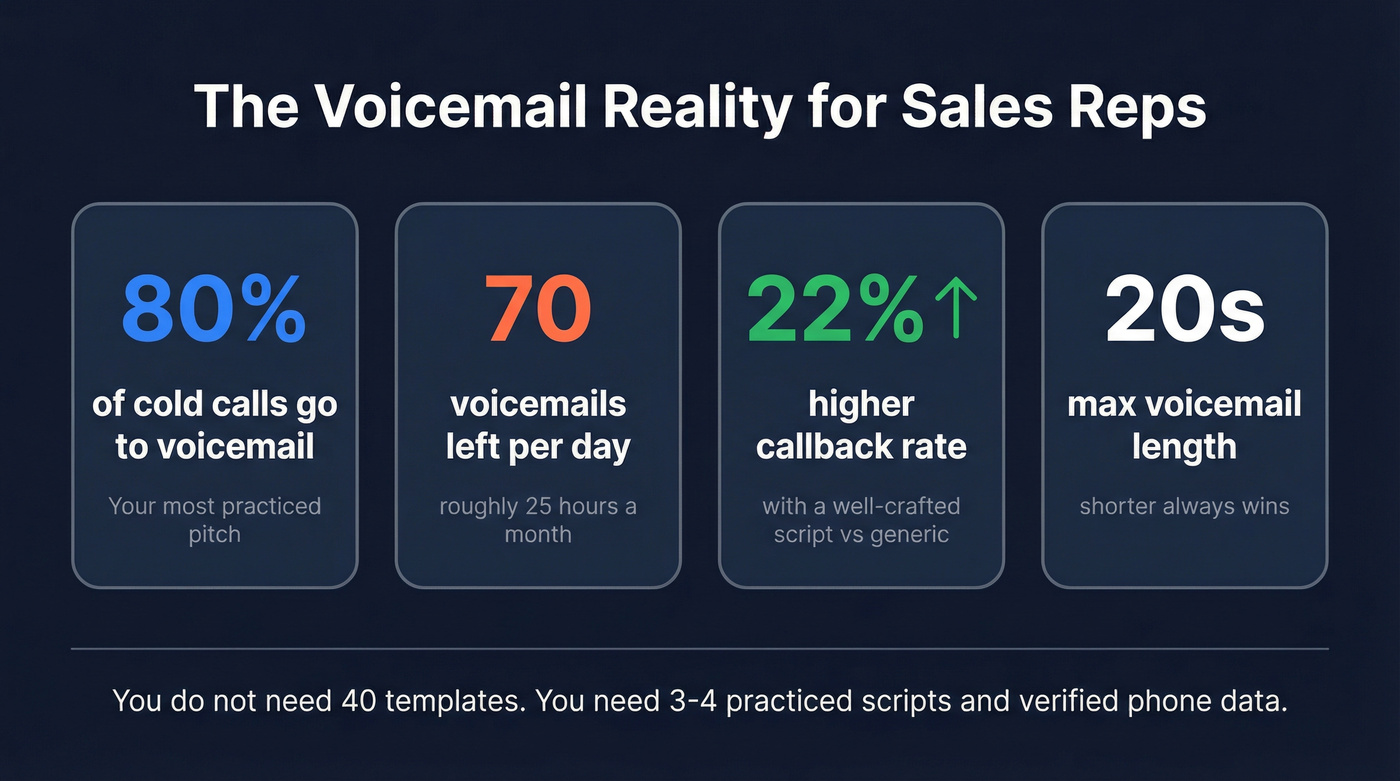
It's 2 PM on a Tuesday. You've made 45 dials. Thirty-eight went to voicemail. You rattled off some version of "Hey, it's Mike from Acme, just wanted to touch base, give me a call back" - and you already know nobody's calling back. 80% of cold calls go to voicemail. At roughly 70 voicemails a day - 25 hours a month talking to machines - the voicemail is your most-practiced sales pitch. Every voicemail script you leave should sound like it.
You don't need 40 templates. You need three or four practiced ones, clean phone data, and a multi-touch cadence that turns a voicemail into the first step of a real conversation.
What You Need (Quick Version)
- For voicemail greetings: Keep it under 20 seconds. Name, alternate contact method, expected callback window. Done.
- For sales voicemails: Lead with a concrete reason you're calling, deliver one value hook, say your number twice. Under 20 seconds.
- Three or four great scripts, verified phone data, and a multi-touch cadence around them will outperform a library of 40 templates every time.
Anatomy of an Effective Voicemail Script
Every voicemail that gets a callback follows the same five-part structure. Doesn't matter if you're leaving a cold outreach message or a post-demo follow-up - the bones are identical.
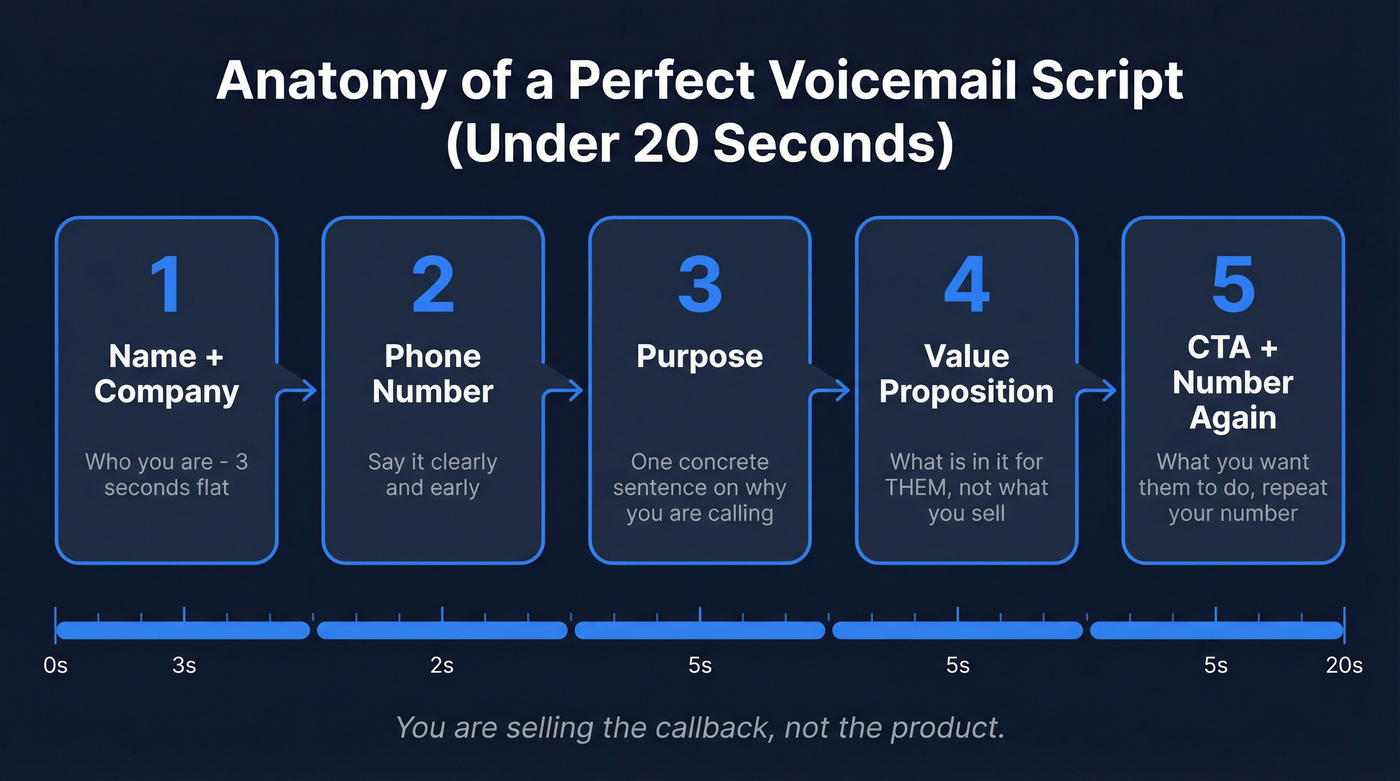
The framework, adapted from HitRate Solutions' building blocks approach:
- Name + Company - who you are, in three seconds flat
- Phone Number - say it clearly, early, so the prospect can jot it down
- Purpose - one sentence on why you're calling, concrete, not vague
- Value Proposition - what's in it for them, not what you sell
- CTA + Number Again - what you want them to do, then repeat your number
Think of it as a 20-second elevator pitch. You're selling the callback, not the product. The entire goal is to create enough curiosity or relevance that they pick up the phone or reply to your follow-up email.
If you're building a repeatable outbound motion, align your voicemail structure with your broader outbound calling strategy so each touchpoint reinforces the same message.
Prospects Read Before They Listen
Apple's iOS 26 expanded Live Voicemail with stronger Caller ID emphasis, expanded Silence Unknown Callers, and message filtering - building on the real-time transcription introduced in iOS 17. Your prospect is watching your words scroll across their screen as you speak. They're reading your voicemail before they ever listen to it.
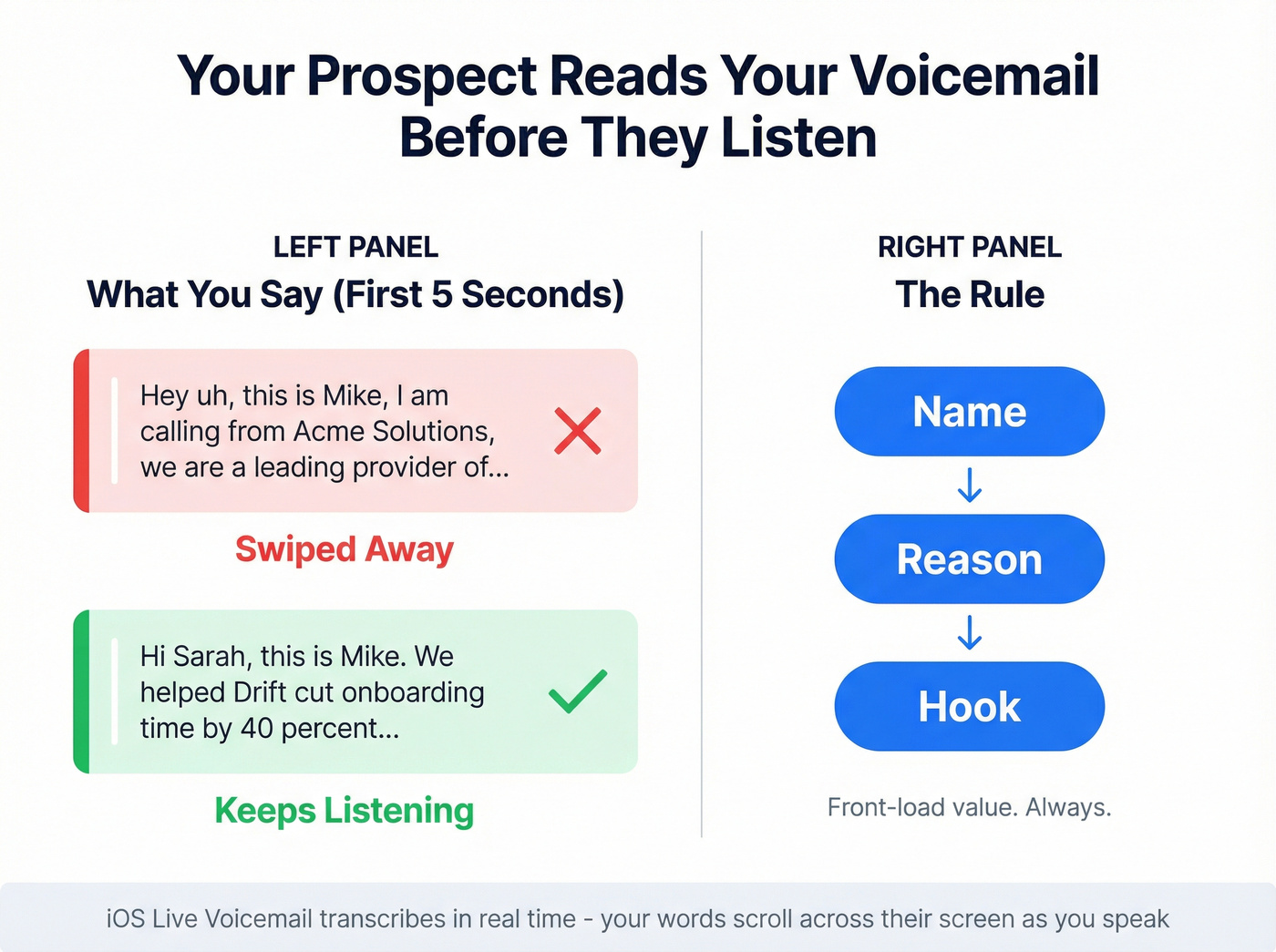
The implication is straightforward: front-load your value. If your first five seconds are "Hey, uh, this is Mike, I'm calling from Acme Solutions, we're a leading provider of..." - the prospect has already swiped away. Name, reason, hook. In that order.
Professional Greeting Scripts
Sales scripts get all the attention, but let's cover greetings first - the voicemail your prospects, clients, and colleagues hear when they call you. A bad greeting signals disorganization. A good one takes 30 seconds to record and works for months.
General Business Greeting
Standard:
"Hi, you've reached [Name] at [Company]. I'm away from my phone - leave your name, number, and a brief message, and I'll return your call within [timeframe]. Thanks."
Shorter version:
"This is [Name] at [Company]. Leave a message and I'll get back to you today."
With email alternative:
"You've reached [Name]. I'm unavailable right now - leave a message or email me at [address] for a faster response."
Why these work: they're short, they set a callback expectation, and they give the caller an alternative channel.
After-Hours / Out-of-Office
"Thanks for calling [Company]. Our office hours are [hours], Monday through Friday. Leave a message and we'll return your call the next business day. For urgent matters, email [address]."
For individual out-of-office greetings, include your return date and who to contact in the meantime. Vague "I'm currently unavailable" messages with no timeline frustrate callers.
Holiday / Temporary Closure
"Happy holidays from [Company]. Our office is closed from [date] through [date]. Leave a message and we'll follow up when we return on [date]. For emergencies, contact [backup name] at [number]."
Update this the day you reopen. Stale holiday greetings in February are a bad look.
Customer Service / Support Line
"Thanks for calling [Company] support. All agents are currently assisting other customers. Leave your name, number, and a brief description of your issue, and we'll call back within [timeframe]. For immediate help, visit [website/chat]."
The timeframe commitment is everything here. "We'll call back" without a window feels like a black hole.
Personal Professional Greeting
"Hi, this is [Name]. I can't take your call right now, but your call is important to me. Leave a message and I'll get back to you as soon as possible."
Simple, warm, professional. Works for consultants, freelancers, and anyone whose personal number doubles as a business line.
What about funny greetings? They work for personal lines and creative industries, but for B2B or client-facing roles, professionalism wins. The risk-reward math just doesn't favor humor when a prospect is deciding whether to leave a message.
How to Record It Right
Write the script first - don't wing it. Even a 10-second greeting benefits from a written draft. Find a quiet room, practice twice, then record. Reading cold sounds robotic; a couple of run-throughs fix that. Listen to the playback. If you're rushing, re-record. If you sound flat, smile while you speak - it genuinely changes your tone.
Update regularly. Seasonal closures, role changes, new phone numbers - stale greetings erode trust fast.
Sales Voicemail Scripts That Get Callbacks
Greetings are passive. Sales voicemails are active - and they're where most reps lose. A well-crafted sales message can lift callbacks by up to 22% compared to generic ones. That's the difference between a pipeline that moves and one that stalls.
Every script below reads aloud in under 20 seconds. Copy them, adapt them, practice them until they don't sound scripted. In our experience, the two highest-performing categories are the referral name-drop and the cold outreach opener - start there.
If you want a deeper framework beyond scripts, pair this with a full B2B cold calling guide and a tighter cold call checklist so reps don’t improvise under pressure.
Cold Outreach (First Touch)
"Hi [First Name], this is [Your Name] with [Company]. I'm calling because we helped [similar company or role] cut their [measurable outcome] by [result], and I think we can do the same for your team. My number is [number] - that's [number]. I'll shoot you a quick email too."
This leads with a relevant result, not a product pitch. The prospect hears a peer company and a tangible outcome - that's curiosity fuel. Saying "I'll send an email too" gives them a lower-friction way to respond. Use it on the first dial in a new outbound sequence, paired with an email the same day.
Follow-Up After Email
"Hey [First Name], [Your Name] from [Company]. I sent you an email yesterday about [one-line topic]. Wanted to make sure it didn't get buried - it's a quick read on [value hook]. Call me back at [number], or just reply to the email. [Number] again."
It references something concrete they can find in their inbox. The voicemail becomes a nudge, not a standalone pitch. Best on Day 2-3 of a sequence, after the initial email has had time to land.
Referral Name-Drop
This is one of the highest-callback scripts we've seen teams deploy. A familiar name cuts through noise faster than any value prop. The prospect's mental model shifts from "cold call" to "warm introduction."
"Hi [First Name], [Your Name] here. [Referral Name] suggested I reach out - they thought you'd want to hear how we [outcome]. I'd love five minutes this week. My number is [number] - [number]."
Use it anytime you have a mutual connection. Even a loose one works - "Your colleague [Name] and I were chatting about..." is enough. (If you need the email version too, use a referral introduction email to make the name-drop consistent across channels.)
Re-Engagement (Cold Lead)
Skip this script if the lead went cold because of a bad experience with your product or team. In that case, lead with the fix, not a generic "things have changed" hook.
"[First Name], it's [Your Name] at [Company]. We spoke about [topic] back in [month]. Things have changed on our end - [one update]. Worth a quick call? [Number]. Again, [number]."
The "things have changed" hook creates a reason to re-engage that feels timely, not desperate. Works best on leads that went cold 3-6 months ago, especially after a product update or new case study.
Inbound Lead Follow-Up
"Hi [First Name], [Your Name] from [Company]. I saw you [downloaded our guide / requested a demo / visited our pricing page] - wanted to connect while it's fresh. I'm at [number]. Happy to answer any questions. That's [number]."
Speed matters on inbound. This script is short because the prospect already raised their hand. You're not selling - you're responding.
Post-Demo / Quote Follow-Up
"[First Name], [Your Name]. Just following up on our conversation [yesterday / last week]. I wanted to see if any questions came up on your end - and I have one idea that might help with [challenge they mentioned]. Call me at [number], or I'll try you again [day]. [Number]."
Reference their exact words from the demo. "You mentioned onboarding was the bottleneck" beats "I have an idea about your challenges." Specificity proves you were listening and gives them a reason to call back beyond just moving the deal forward. Use it 24-48 hours after a demo or proposal delivery. (For the full follow-through, see a dedicated post-demo playbook.)

You're leaving 70 voicemails a day. How many of those numbers are even valid? Prospeo gives you 125M+ verified mobile numbers with a 30% pickup rate - that's 3x the industry average. Fewer voicemails, more live conversations.
Stop perfecting scripts for numbers that never pick up.
Industry-Specific Examples
Different industries demand different tones, compliance guardrails, and CTAs.
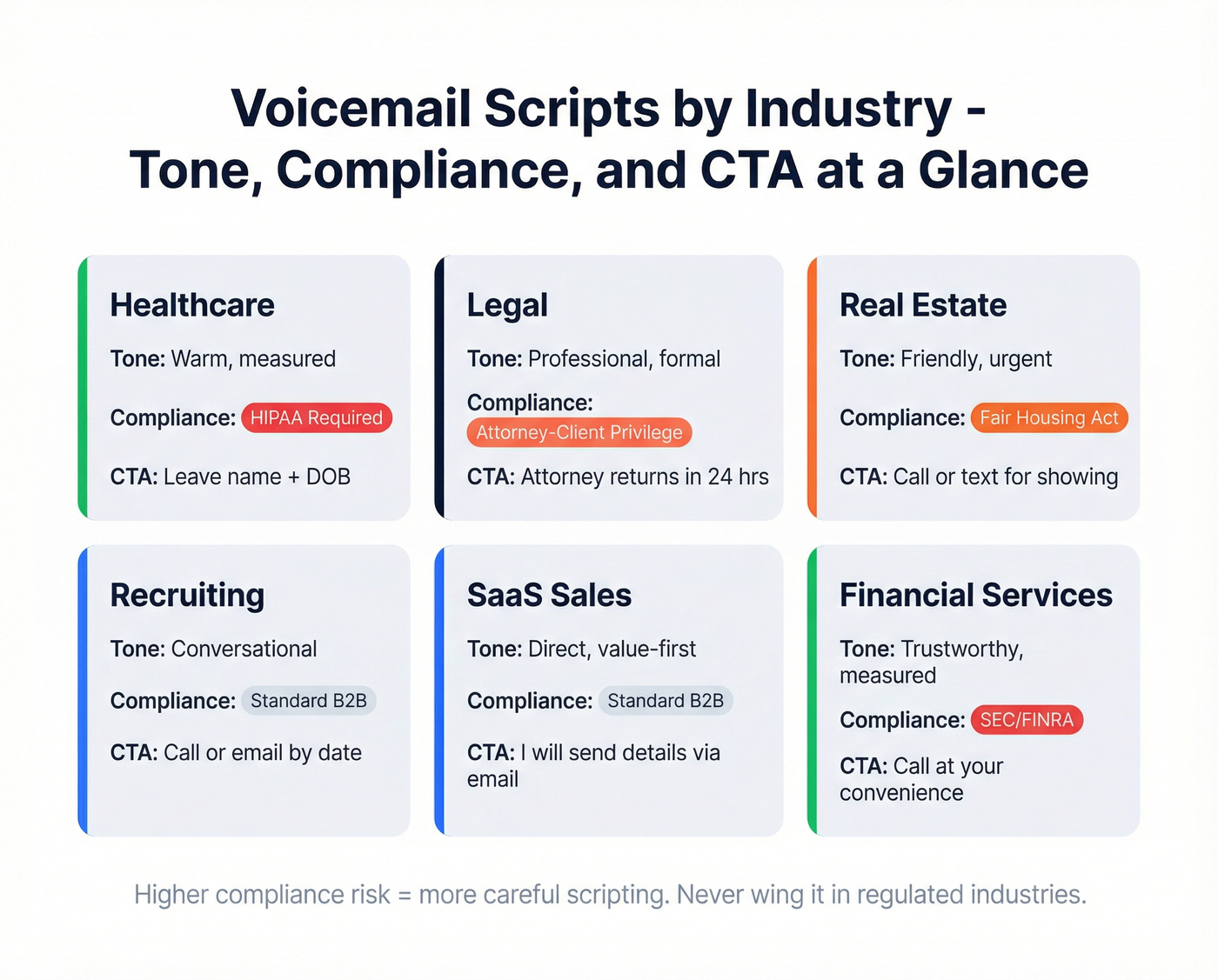
| Industry | Tone | Key Element | Compliance | Typical CTA |
|---|---|---|---|---|
| Healthcare | Warm, measured | Emergency disclaimer | HIPAA required | "Leave name + DOB" |
| Legal | Professional, formal | Confidentiality note | Attorney-client | "Attorney returns in 24 hrs" |
| Real Estate | Friendly, urgent | Property reference | Fair Housing Act | "Call or text for showing" |
| Recruiting | Conversational | Role + timeline | Standard B2B | "Call or email by [date]" |
| SaaS Sales | Direct, value-first | Pain point trigger | Standard B2B | "I'll send details via email" |
| Financial Services | Trustworthy, measured | Credential mention | SEC/FINRA | "Call at your convenience" |
Healthcare
Healthcare voicemails carry real regulatory weight. HIPAA compliance requires avoiding Protected Health Information in voicemail greetings and messages - no appointment details, no diagnoses, no test results.
"You've reached [Practice Name]. Our office hours are [hours]. If this is a medical emergency, please hang up and dial 911. Otherwise, leave your name, date of birth, and a brief message, and we'll return your call by end of business today."
For after-hours, always include the 911 redirect.
Legal
"You've reached the office of [Attorney Name] at [Firm]. All communications are treated as confidential. Please leave your name, number, and a brief description of your matter, and [Attorney Name] will return your call within 24 hours."
The confidentiality assurance isn't just professional courtesy - it sets expectations around attorney-client privilege from the first interaction.
Real Estate
"Hey, this is [Name] with [Brokerage]. Thanks for calling about [property/area]. I'm showing properties right now but I'll call you back within the hour. Or text me at this number for available showing times."
Real estate runs on urgency. Offering a text option captures leads who won't wait for a callback.
Recruiting
"Hi [Candidate Name], this is [Name] from [Agency/Company]. I'm reaching out about the [Role Title] position at [Company]. The team is moving quickly on this - I'd love to chat before [date]. Call me back at [number] or shoot me an email at [address]."
Recruiting voicemails need a deadline. Candidates respond to urgency and specificity, not vague "great opportunity" language.
SaaS / Tech Sales
"Hi [First Name], [Your Name] from [Company]. I noticed your team is using [competitor/technology] - we just helped [similar company] reduce [metric] by [result]. I'll send a quick email with the details. My number is [number]."
Lead with the trigger event or tech signal. SaaS buyers respond to specificity about their stack, not generic pain points.
Financial Services
"Hi [First Name], this is [Your Name], [credential] at [Firm]. I'm reaching out regarding [topic - retirement planning, portfolio review, etc.]. I'd welcome a conversation at your convenience. My direct line is [number]."
Credential mention (CFP, CFA, Series 65) builds trust immediately. Keep the tone measured - financial services prospects are wary of anything that sounds like a hard sell.
Mistakes That Kill Callbacks
Knowing what to say matters. Knowing what not to do matters more.
1. Going over 20 seconds. Most guidance lands between 15-30 seconds, but for cold outreach, under 20 is the sweet spot. Once you cross that threshold, attention drops off a cliff - especially now that iOS transcription means prospects are reading, not listening. Time yourself. Cut ruthlessly.
2. No clear CTA. "Give me a call back" isn't a CTA. "Call me back at [number] or reply to my email - I'll send it right after this" is a CTA. Tell them exactly what to do next.
3. Sounding robotic. Scripts are meant to be internalized, not read verbatim. Practice until the words feel natural. Record yourself, listen back, and adjust. If you sound like you're reading, the prospect tunes out in three seconds. (If tonality is the issue, work on cold call tonality before you rewrite scripts.)
4. Zero personalization. Using someone's first name is table stakes. Real personalization means referencing their company, their role, a recent trigger event, or a mutual connection. "I saw your team just expanded the SDR org" beats "I'm reaching out to leaders like you" every single time. For a systematized approach, use a personalization in outbound sales framework.
5. Bad timing. Avoid Monday mornings and Friday afternoons. Mid-week performs better, especially when you're pairing voicemail with email follow-ups.
6. Giving up after one voicemail. Cognism's data suggests 5-6 calls minimum; other research puts it at eight touches total across channels. One voicemail isn't a strategy - it's a lottery ticket. Leave at least three voicemails spaced across 1-2 weeks, each with a slightly different angle.
7. Calling bad numbers. Here's the thing: nobody talks about this one, but it's the upstream problem that makes everything else harder. Sales teams using stale CRM data waste huge amounts of dial time on disconnected numbers, wrong contacts, and landlines that never get answered. We've watched teams burn 25+ hours a month leaving voicemails on dead lines. The best script in the world doesn't matter if the number doesn't work. This is where data quality becomes a voicemail strategy issue - tools like Prospeo verify 125M+ mobile numbers on a 7-day refresh cycle, so more of your dials actually reach a real voicemail box. (If you’re auditing this, start with B2B contact data decay and a practical phone validator workflow.)
Using Voicemails Inside a Multi-Touch Sequence
A voicemail in isolation is a coin flip. A voicemail inside a multi-touch cadence is a strategy. It takes an average of eight touches to get a prospect to agree to a meeting, and the voicemail-then-email pairing is one of the most effective combinations in outbound.
Here's a template for a four-step cadence:
- Day 1: Call + voicemail, then email referencing the voicemail ("I just left you a quick message about...")
- Day 3: Follow-up email with a new angle or resource
- Day 5: Call + voicemail #2 with a different script and new value hook
- Day 7: Breakup email ("Last note from me unless you'd prefer I follow up later")
Each touch references the others. Your email mentions the voicemail. Your second voicemail mentions the email. The prospect starts to recognize your name across channels, and that familiarity compounds.
Let's be honest about something, though: if your average deal size is under $10k, you probably don't need a seven-touch, three-channel sequence. A voicemail followed by one email is enough. Save the elaborate cadences for deals that justify the effort. Most teams over-engineer their sequences and under-invest in the quality of each individual touch.
For any cadence to work, you need verified addresses for the email leg and verified numbers for the voicemail leg. That's the whole reason we built Prospeo's mobile finder and email finder to work together - so your cadence doesn't break down at the data layer. If you’re building the email side of the sequence, keep a set of proven outreach email template options handy.
Voicemail Automation and Compliance
Voicemail Drop: When to Use It
Voicemail drop lets reps pre-record a message and deliver it with one click. The system detects the voicemail beep and plays the recording automatically, so the rep can move to the next dial immediately. Teams using voicemail drop see roughly 33% more calls per session - which makes sense when you consider how much time reps burn leaving messages manually.
When evaluating providers, prioritize compliance tools like suppression lists, state-specific quiet hours, and opt-out management. Look for CRM integrations with Salesforce and HubSpot, and check pricing transparency. Per-message pricing typically runs $0.02-$0.05 per drop.
Compliance: TCPA, FCC, and HIPAA
Before you automate, read this.
The FCC ruled that ringless voicemail is subject to robocalling rules. Prior express consent is required before sending automated voicemail drops to consumer numbers. Violations can trigger penalties of $500-$1,500 per violation - and those add up fast at scale.
You need to get four things right. First, prior express consent for any automated or pre-recorded voicemail to consumer lines. Second, DNC list compliance - scrub against the National Do Not Call Registry. Third, quiet hours - no calls or drops before 8 AM or after 9 PM in the recipient's time zone. And fourth, opt-out mechanisms - recipients must be able to stop future messages.
For healthcare organizations, HIPAA adds another layer: no PHI in voicemail content, and recordings must be securely stored.
B2B calls to business lines have more flexibility under TCPA, but the safest approach is to treat every number as if consent matters. The cost of getting it wrong is far higher than the cost of getting consent right.
Your voicemail says 'I'll shoot you an email too.' That only works if you have the right email. Prospeo's 98% verified email accuracy means your follow-up actually lands - no bounces, no burned domains.
Pair every voicemail with an email that actually arrives.
FAQ
How long should a voicemail be?
Under 20 seconds for sales voicemails, under 25 seconds for professional greetings. With iOS transcription, prospects read your message as you speak - front-load your value in the first five seconds. Time yourself with a stopwatch during practice runs.
How many voicemails should I leave before giving up?
At least three, spaced across one to two weeks, each using a different angle or value hook. Research suggests eight total touches across channels to book a meeting - don't repeat the same words verbatim.
Is ringless voicemail legal?
Yes, but regulated. The FCC ruled it's subject to robocall rules, meaning you need prior express consent, DNC compliance, and quiet-hours adherence. Penalties range from $500 to $1,500 per violation - scrub your lists before every campaign.
What's the best time to leave a sales voicemail?
Mid-week, Tuesday through Thursday, late morning or mid-afternoon in the prospect's time zone. Avoid Monday mornings and Friday afternoons - connect rates drop significantly at the edges of the work week.
How do I make sure I'm calling valid numbers?
Use a data provider with frequent refresh cycles. Stale data wastes 25+ hours a month on dead lines - we've seen it firsthand. Look for providers that verify numbers weekly rather than monthly, and that give you mobile numbers specifically rather than generic company switchboards.