Good Email vs Bad Email: 5 Side-by-Side Examples You Can Copy
Your manager forwarded your email to leadership - and it was a mess. Vague subject line, the actual request buried in paragraph three, a sign-off that just said "Thanks." The average professional receives 121 emails per day. Nobody's reading yours twice to figure out what you meant.
Below are five bad emails rewritten into good ones, with the exact diagnosis of what went wrong in each.
The Five-Point Email Test
You can diagnose any email with five checks:
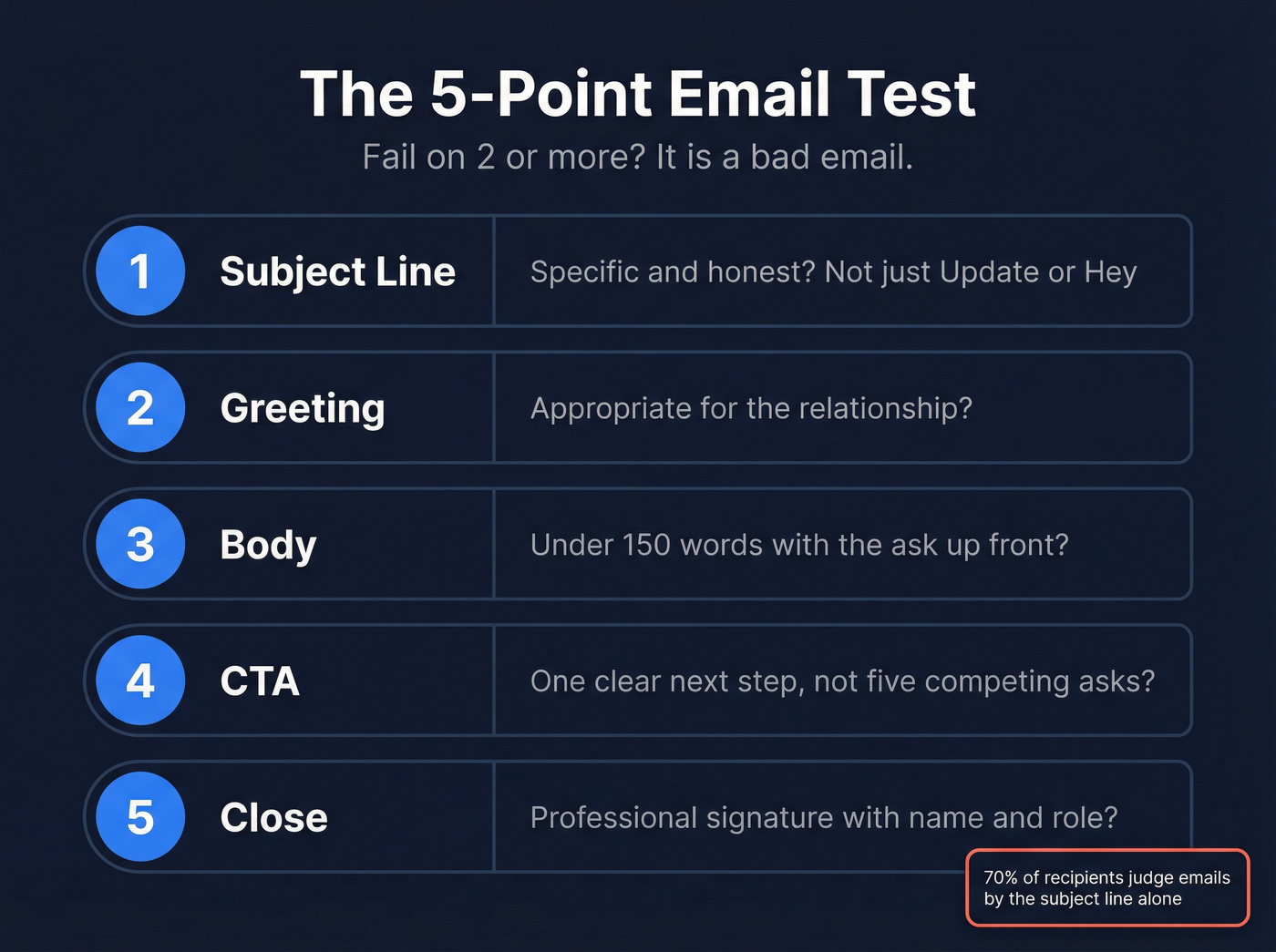
- Subject line - specific and honest? (If you need guardrails, see words to avoid.)
- Greeting - appropriate for the relationship? (If you default to clichés, use these alternatives.)
- Body - under 150 words with the ask up front? (Use a repeatable sales email structure.)
- CTA - one clear next step?
- Close - professional signature with your name and role? (If you want better sign-offs, borrow closing email phrases.)
If an email fails on two or more, it's a bad email. Around 70% of recipients judge relevance by the subject line alone, and emails with a single CTA get 371% more clicks than those with competing asks.
One distinction worth making: email ethics (privacy, honesty, not sharing confidential info) and email etiquette (tone, formatting, clarity) are different problems. Most "bad" emails aren't unethical - they're just poorly structured.

You just learned how to write emails that get responses. But 17% of cold emails never reach the inbox because the address is bad. Prospeo's 5-step verification catches invalid addresses, spam traps, and catch-all domains - so your perfectly crafted email actually lands.
Stop perfecting emails that bounce. Verify first at $0.01 per address.
Bad vs Good Email Examples
Academic Email (Student to Professor)
Professors regularly get student emails with missing subject lines, "hey" greetings, and grade demands with no self-identification. Let's look at the good version first:
The email that gets a response:
Subject: Question About Midterm Grade - ENGL 201, Section 3
Dear Professor Chen,
My name is Sarah Torres (Student ID: 4821903) from your ENGL 201 Tuesday/Thursday section. I'd like to discuss my midterm grade and understand where I lost points. Would you have time to meet during office hours this week?
Thank you for your time, Sarah Torres
Self-identification up front. Specific subject line. Respectful request, not a demand. She also respects the 24-48 hour response window professors typically need.
Now here's what most students actually send:
Subject: grade
hey, i got a 72 on the midterm and i dont think thats fair. can you fix it? thanks
No name, no class, no student ID. Demanding tone. And your email address matters too - sending from "partygirl99@gmail.com" undermines your message before anyone reads it. These show up in professor inboxes every semester, and they almost never get a helpful reply.
Workplace Email (Update to Leadership)
The bad email:
Subject: Update
Hi all, so we had the meeting last week and there were some issues with the vendor timeline and also the budget came in higher than expected but we're working on it and I think we can probably still hit Q2 if we adjust some things. Let me know if you have questions.
The subject line says nothing. The ask is buried in a run-on paragraph. This is the email your manager can't forward - they'd have to rewrite it first.
The good rewrite:
Subject: Q2 Launch at Risk - Need Budget Approval by Friday
Hi team,
Bottom line: the vendor timeline slipped 2 weeks and costs are 15% over estimate. We can still hit Q2 if we approve the revised budget by Friday.
Action needed: Please review the attached revised SOW and confirm by EOD Thursday.
Best, Jamie
BLUF (Bottom Line Up Front)) - the key message is in the first sentence. One clear action item. This is the email your manager can forward to their VP without editing a word.
Cold Outreach Email
Here's the thing most sales content won't tell you: the writing matters less than you think if the email bounces. About 17% of cold emails never reach the inbox due to invalid addresses and spam traps. But assuming your data is clean, the writing still matters a lot. (If you’re building a system, start with these cold email tactics.)
The bad email:
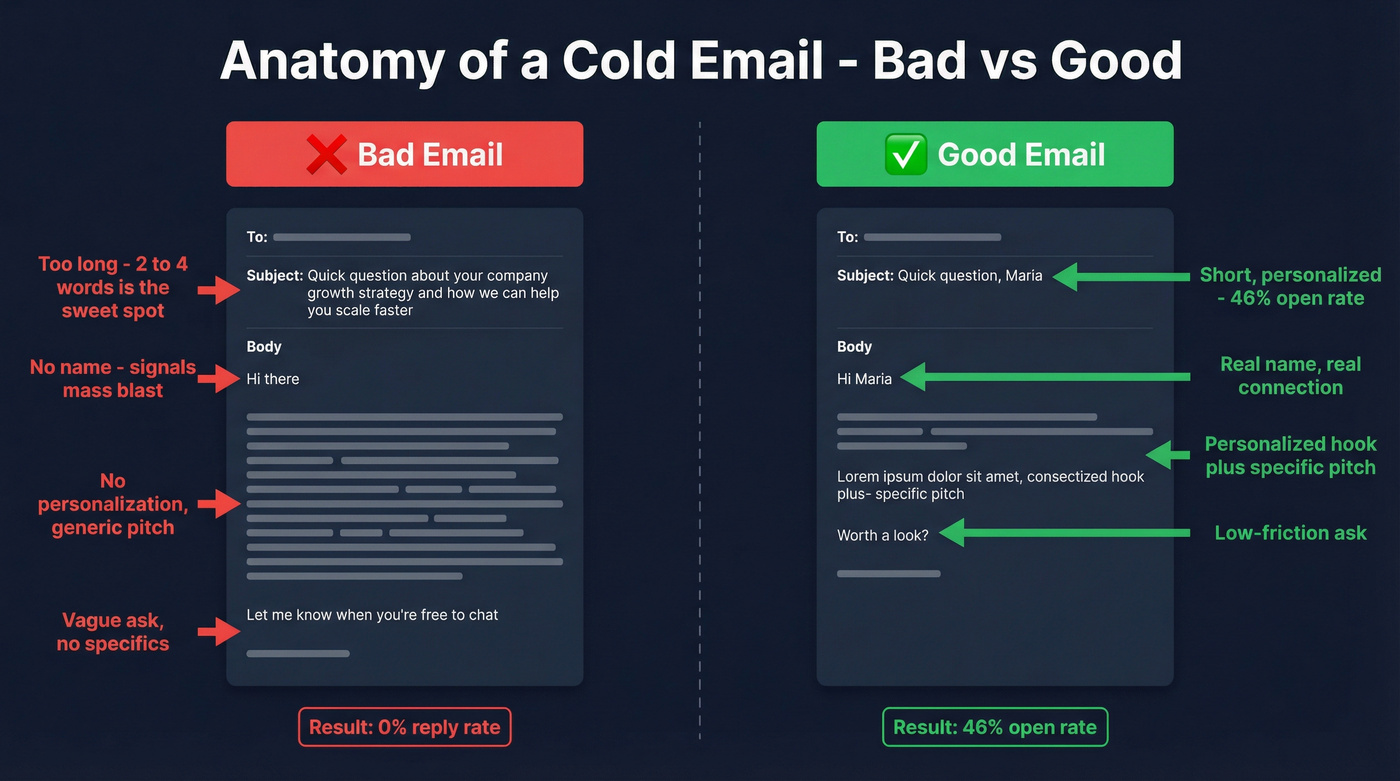
Subject: Quick question about your company's growth strategy and how we can help you scale faster
Hi there, I'm reaching out because I noticed your company is growing and I wanted to introduce myself and our platform which helps companies like yours streamline operations and drive revenue. We've helped 500+ companies achieve 3x ROI. Would love to set up a 30-min call to discuss. Let me know!
That subject line is way too long. A 5.5-million-email study by Belkins found the sweet spot is 2-4 words, which hit 46% open rates. No personalization. Generic pitch. "Hi there" signals mass blast. Subject lines with numbers actually perform slightly worse (27% vs 28% open rate), so skip the "3x ROI" claims. The average cold email reply rate is 5.1% - this email is getting 0%.
The good rewrite:
Subject: Quick question, Maria
Hi Maria,
Saw you just opened a second warehouse in Austin - congrats. When Acme Corp did the same last year, their fulfillment costs spiked 40% before they restructured routing.
We built the routing fix. Takes 20 minutes to show you. Worth a look?
- Jake, Logistics Co.
It matches Woodpecker's 5-part framework - real From name, short subject, personalized hook, specific pitch, low-friction ask. Personalized subject lines hit 46% opens vs 35% without personalization. (For more copy-paste options, use an outreach email template.)
Even this email fails if it bounces. We've seen teams burn through entire prospect lists because they never verified a single address. Prospeo's 5-step verification catches invalid addresses, spam traps, and catch-all domains before they tank your sender reputation. (If you’re comparing tools, start with an email checker tool.)
Marketing / Promotional Email
The bad email:
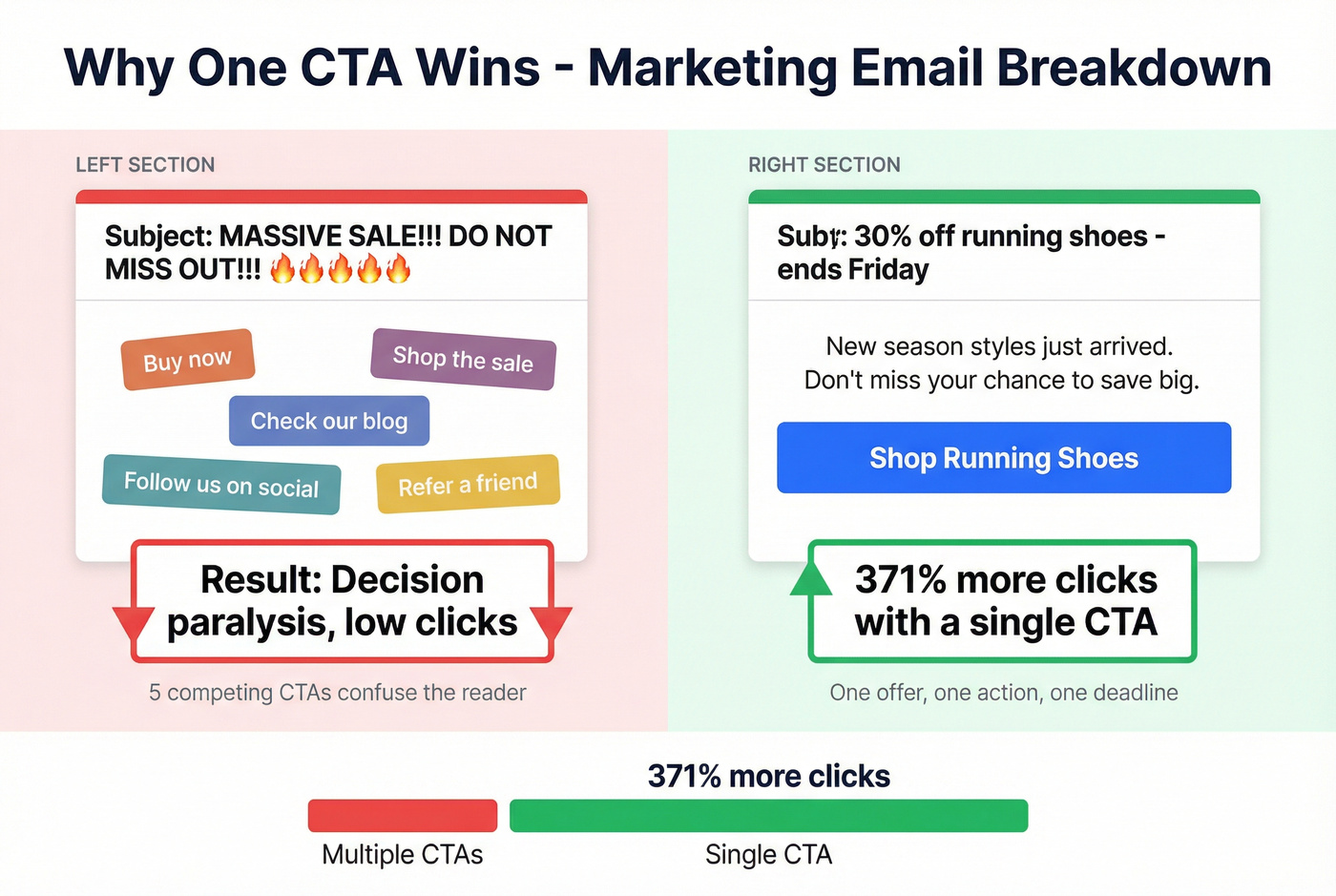
Subject: 🔥🔥🔥 MASSIVE SALE!!! DON'T MISS OUT!!! 🔥🔥🔥
[Giant hero image that doesn't load on mobile]
Buy now! Shop the sale! Check out our blog! Follow us on social! Refer a friend!
Spammy subject line with ALL CAPS and emoji stacking. Five competing CTAs. Over 60% of emails are opened on mobile - that hero image is broken for most readers.
When everything screams, nothing gets heard.
The good rewrite:
Subject: 30% off running shoes - ends Friday
Hi Alex,
Our spring sale is live. 30% off all running shoes through Friday at midnight.
[Shop Running Shoes ->]
Free shipping on orders over $75.
One offer, one CTA, one deadline. The subject line is specific and honest. It renders cleanly on a phone screen. No hype - just the information the reader needs to decide.
Follow-Up Email
48% of sales reps never send a second message. If you're following up at all, you're already ahead. But this follow-up is wasted effort:
Subject: Just checking in
Hi, just wanted to follow up on my last email. Let me know if you're interested. Thanks!
Look - "just checking in" adds zero value. It gives the recipient no reason to respond that they didn't already have.
The good rewrite:
Subject: Re: Quick question, Maria
Hi Maria,
Since my last note, I pulled Acme Corp's case study on the routing fix - they cut fulfillment costs 22% in 90 days. Attached the one-pager.
Still worth 20 minutes?
- Jake
It adds new value (the case study), references the original context, and keeps the same low-friction ask. Consistent follow-ups can improve reply rates by 50%+. That's the difference between persistence and pestering. (If you need timing rules, see when you should follow up.)
Before You Hit Send: The Checklist
In our experience, the ask-buried-in-paragraph-three problem is the single most common email mistake we see - across cold outreach, internal updates, and everything in between. Run through this before every important email:
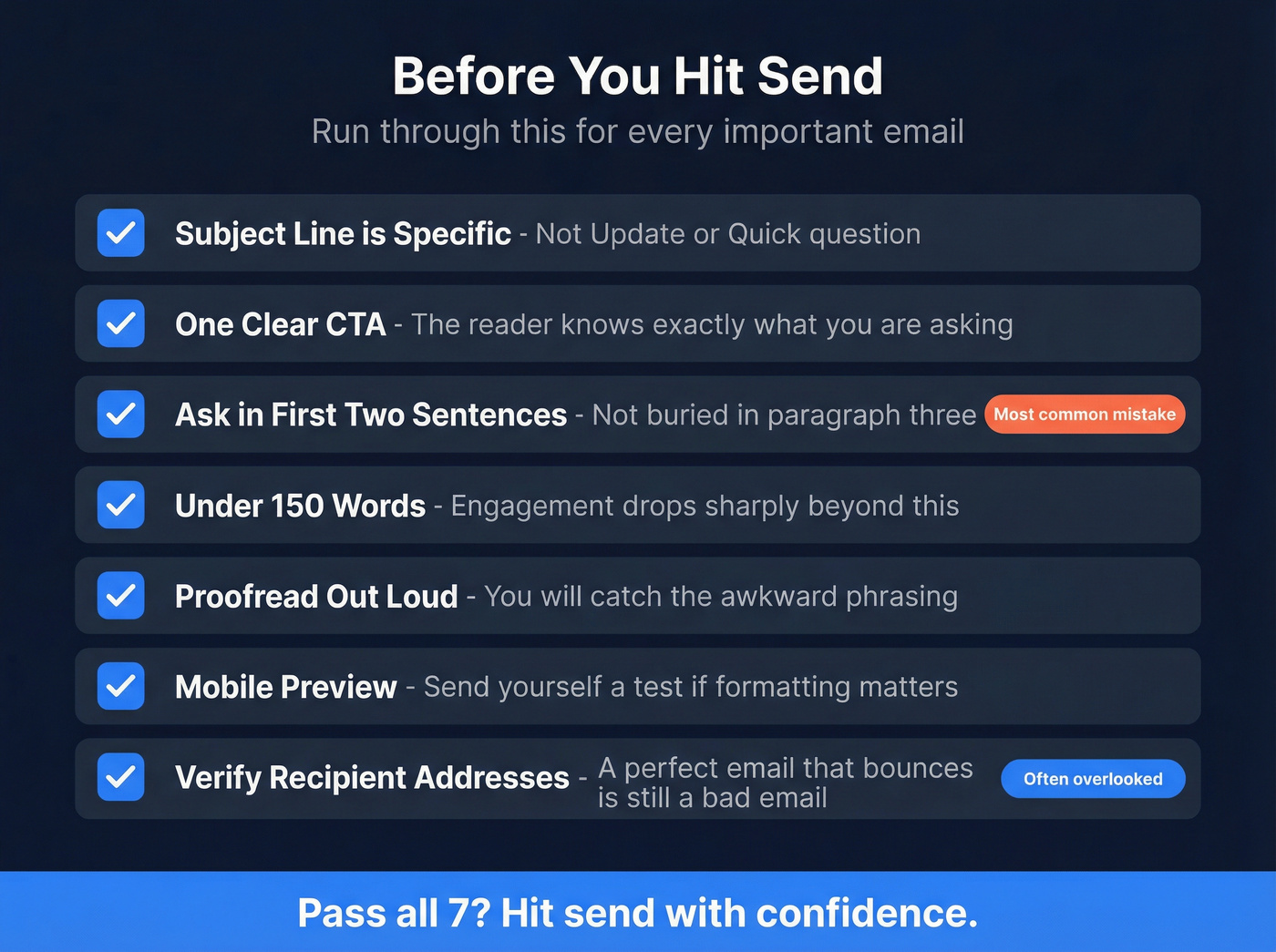
- Subject line is specific (not "Update" or "Quick question")
- One clear CTA - the reader knows exactly what you're asking
- Ask is in the first two sentences, not buried in paragraph three
- Under 150 words for standard emails (engagement drops sharply beyond that)
- Proofread - read it out loud once; you'll catch the awkward phrasing
- Mobile preview - send yourself a test if the formatting matters
- Verify recipient addresses - a perfectly written email that bounces is still a bad email (use an email ID validator)
That last point matters more than most people realize. If you're sending cold outreach or campaigns, even a small percentage of bounces compounds into deliverability problems fast. Prospeo's free tier gives you 75 verifications per month - enough to clean a prospect list before you launch. (If you want the full deliverability workflow, use this email deliverability checklist.)

Good copy gets opens. Clean data gets delivered. Teams using Prospeo cut bounce rates from 35% to under 4% - meaning every follow-up, every personalized subject line, every BLUF paragraph actually reaches a real inbox. 98% email accuracy across 143M+ verified addresses.
Write the perfect email. We'll make sure it lands.
FAQ
What's the biggest mistake in professional emails?
Burying the ask. 70% of recipients judge an email by the subject line, and if your request isn't in the first two sentences, most people won't scroll to find it. Lead with the action you need, then add context below.
How long should a professional email be?
Under 150 words for any standard request or update. Engagement drops sharply beyond that. Lead with your key point in the first two sentences, then add supporting context only if the reader needs it to act.
How do I make sure cold emails actually reach the inbox?
Verify every address before sending. About 17% of cold emails never arrive due to invalid addresses and spam traps. Use a verification tool with catch-all handling and spam-trap removal - don't just trust the data your CRM imported six months ago.
What makes a good cold email subject line?
Keep it to 2-4 words and personalize it. A 5.5-million-email study found short, personalized subject lines hit 46% open rates versus 35% for generic ones. Skip ALL CAPS, emoji stacking, and numeric claims.