How to Write an Elevator Pitch That Doesn't Sound Rehearsed
You're at a conference, someone asks "so, what do you do?" and you watch their eyes glaze over halfway through your second sentence. That moment - the one where you can feel the other person mentally checking out - is what a good elevator pitch prevents.
Knowing how to write an elevator pitch is the single most underrated professional skill. It's not a monologue. It's not your resume read aloud. It's the verbal equivalent of a movie trailer: enough to hook, not enough to bore. A commonly cited BLS benchmark puts it at 70% of jobs being found through networking, and your pitch is the gateway to every one of those conversations.
The concept is often linked to Elisha Otis' 1854 World's Fair-era elevator demonstration, where he had seconds to convince a crowd his elevator brake worked - by cutting the rope while standing on the platform. Your stakes are lower. Your time constraint is the same.
How Long Should Your Pitch Be?
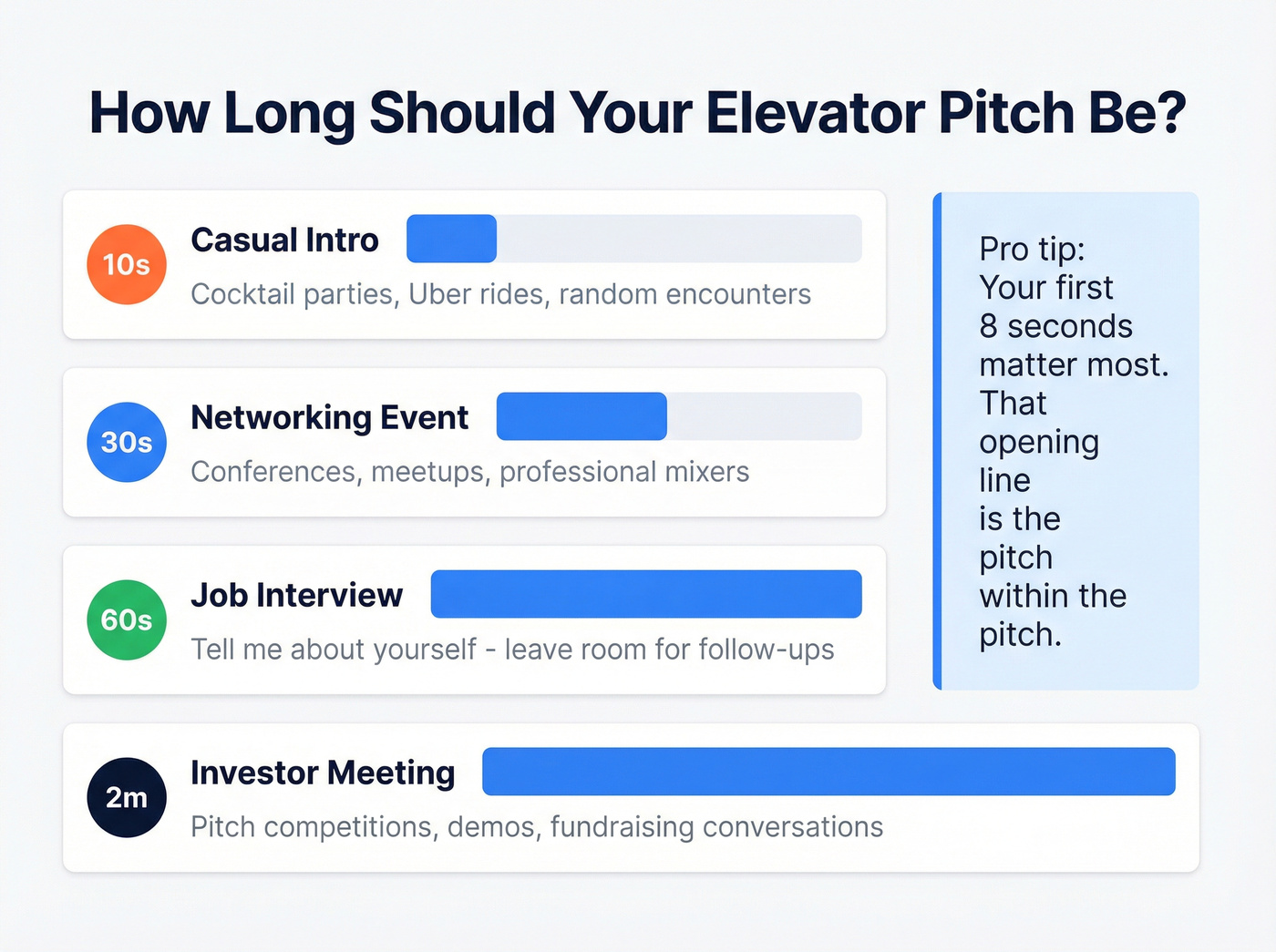
Thirty seconds is the standard answer. That's right for most networking situations, but you actually need three or four versions.
| Situation | Length | When to use it |
|---|---|---|
| Casual intro | 10 seconds | Cocktail party, Uber ride |
| Networking event | 30 seconds | Conferences, meetups |
| Job interview | 60 seconds | "Tell me about yourself" |
| Investor meeting | Up to 2 min | Pitch competitions, demos |
Here's the thing: regardless of which version you're delivering, your opening line carries the most weight. Research on attention span in pitch contexts suggests you've got around eight seconds before someone decides whether to keep listening or start scanning the room for the bar. That first sentence isn't just important - it's the pitch within the pitch.
Write Your Elevator Pitch Step-by-Step
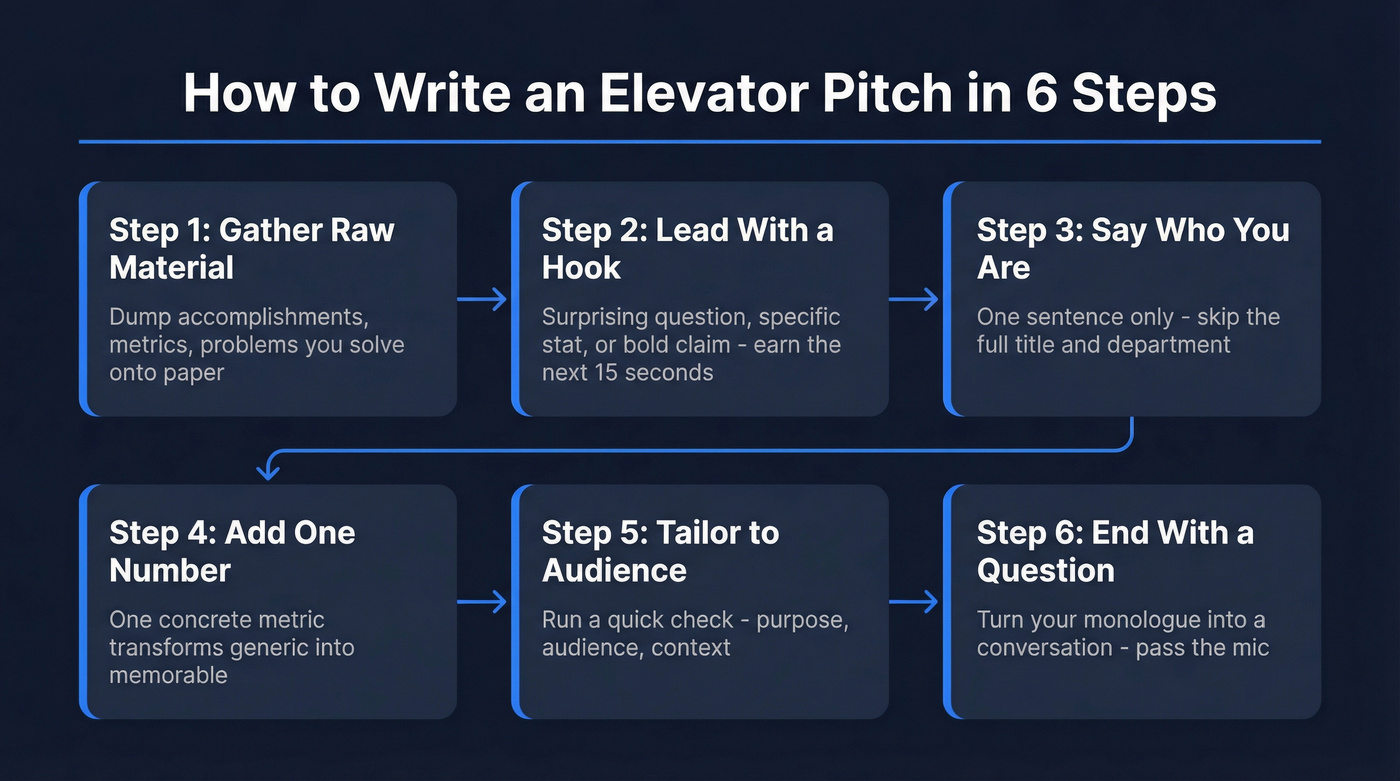
Most elevator pitch advice is written by career counselors who haven't pitched anything in years. We've watched hundreds of pitches land and bomb across sales floors, investor meetings, and networking events. The ones that work follow a pattern.
Step 1: Gather Your Raw Material
Before you write a single word, dump everything onto paper. If you're a job seeker, use the STAR method: pick one or two experiences and distill each into a sentence focused on actions and results. If you're a founder, think problem and solution. If you're in sales, think customer pain and outcome.
Don't edit yet. Just collect the building blocks - accomplishments, metrics, problems you solve, results you've driven.
Step 2: Lead With a Hook
Your first sentence needs to earn the next fifteen seconds. Three approaches work consistently: a surprising question ("Did you know most companies lose 30% of their pipeline to bad contact data?"), a specific stat, or a bold claim that makes someone lean in.
What doesn't work: starting with your name and title. "Hi, I'm Sarah, I'm a product manager at Acme Corp" is technically correct and completely forgettable. Lead with the interesting part. Your name can come second.
Step 3: Say Who You Are (One Sentence)
After the hook, one sentence. That's it. Not your full title, not your department, not your reporting structure.
"I run product for a fintech that helps small businesses get paid faster" beats "I'm a Senior Product Manager at Acme Financial Solutions, a B2B SaaS company in the payments space" every time.
Step 4: Add One Number
This is the single fastest upgrade to any pitch. One concrete number transforms a generic introduction into something memorable. Metrics like "$50M in RFPs," "300% ROI," or "raised client retention by 70%" are what make people remember you the next morning.
No number? Forgettable. Even a rough number beats no number.
Step 5: Tailor to Your Audience
A pitch that works at a tech meetup will bomb at a family dinner. Before you open your mouth, run a quick mental check: who's this person, what do they care about, and what context are we in? That simple framework - purpose, audience, context - works far beyond academia.
For a potential employer, emphasize the problem you solve and the results you've driven. For an investor, lead with market size and traction. For a stranger at a bar, keep it human and skip the jargon entirely.
Step 6: End With a Question
The biggest mistake people make is ending their pitch with a period instead of a question mark. "...and that's what I do" creates an awkward silence. "...what does your team use for that?" turns a monologue into a conversation.
The question doesn't need to be clever. "What about you - what are you working on?" works perfectly. The goal is to pass the mic.
Fill-in-the-Blank Templates
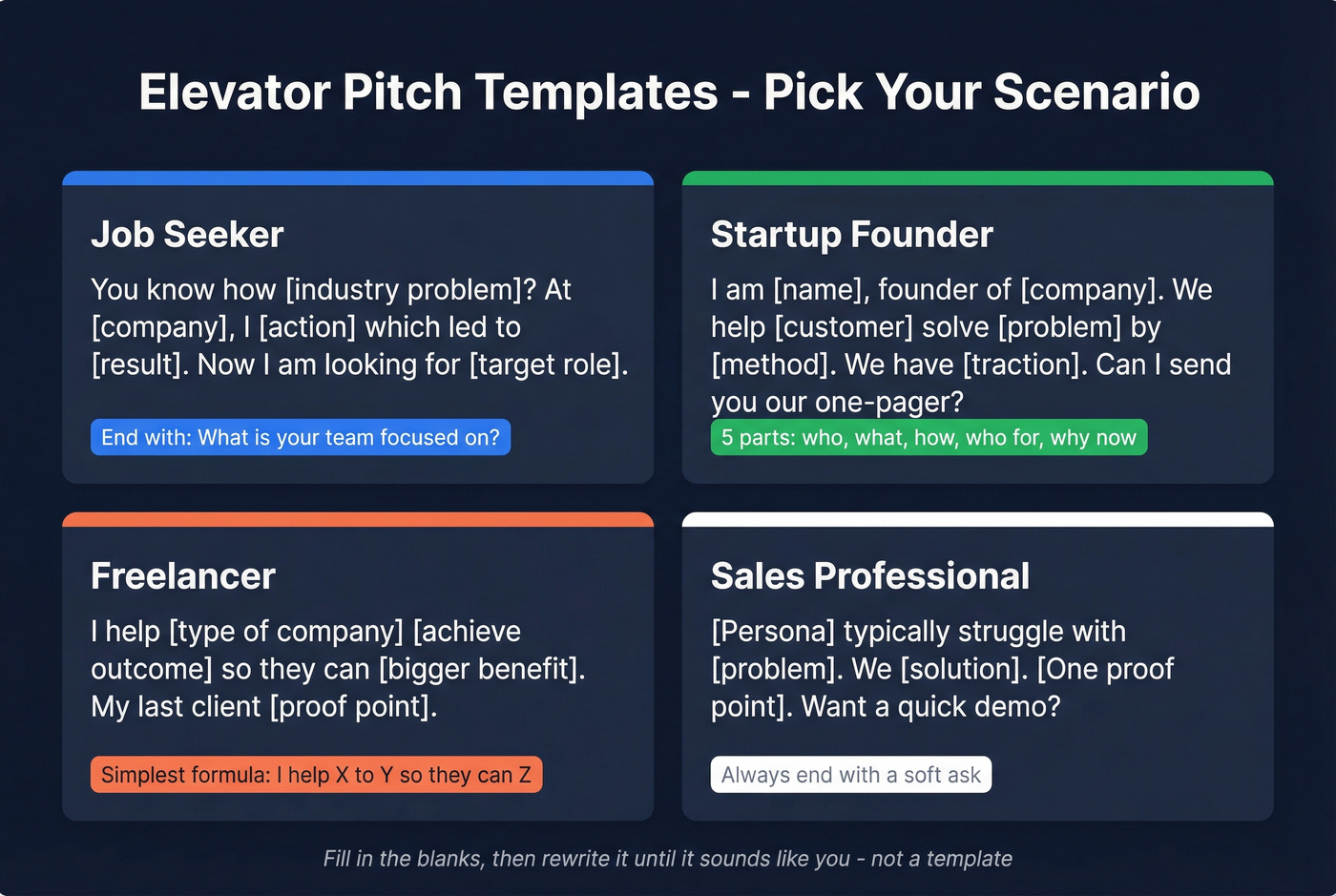
Staring at a blank page is harder than filling in blanks. Grab the template that fits, fill it in, then make it sound like you.
Job Seeker
"You know how [common problem in your industry]? At [previous company], I [specific action] which led to [measurable result]. Now I'm looking for a role where I can [target outcome]. What's your team focused on right now?"
Example: "You know how most marketing teams can't tie content to revenue? At HubSpot, I built an attribution model that connected blog traffic to $2.3M in pipeline. Now I'm looking for a head of content role where I can do that at scale. What's your team's biggest content challenge?"
Startup Founder
A solid five-part structure works here: who you are, what you do, how you do it, who you do it for, and why now.
"I'm [name], founder of [company]. We help [customer type] solve [problem] by [how]. Right now, [why now]. We're [current traction]. Do you have five minutes this week?"
Example: "I'm James, founder of ClearFreight. We help mid-size importers cut customs delays by 60% using automated classification. With new tariff rules hitting in Q2, every importer is scrambling. We've got 40 paying customers and $800K ARR. Can I send you our one-pager?"
Freelancer or Consultant
The simplest formula in the world: "I help X to Y so they can Z."
"I help [type of person/company] [achieve specific outcome] so they can [bigger benefit]."
Example: "I help B2B SaaS companies fix their onboarding flows so they can cut churn in the first 90 days. My last client went from 18% to 9% churn in one quarter."
Sales Professional
"[Target persona] typically struggle with [problem]. We [solution in one sentence]. [One proof point]. Would it make sense to show you how that works?"
Example: "VP Sales at mid-market companies typically lose 20+ hours a week to manual prospecting. We automate list building and verification so reps spend time selling, not searching. One customer tripled their weekly pipeline from $100K to $300K. Want a quick demo?"
Pitch Examples by Scenario
You need three versions of your pitch, not one. Here's how the same core message flexes across different contexts.
Networking Event (30 Seconds)
"I make enterprise software less painful to buy. My company builds procurement tools that cut vendor evaluation time by 40%. We just closed our Series A. What brings you to the conference?"
Tight enough to hold attention, specific enough to be memorable.
Job Interview (60 Seconds)
"For the last five years, I've been the person companies call when their sales team can't hit quota. At Datadog, I rebuilt the outbound motion and took the team from $4M to $11M in sourced pipeline in 18 months. I'm looking for a VP Sales role where I can do that again - ideally somewhere the product is strong but the go-to-market needs building."
A 60-second version gives you room for a second proof point or a brief story, but resist the urge to fill the time. Leave space for the interviewer to ask follow-up questions.
Career Changer
This is the scenario most pitch advice ignores, and it's the one where a strong pitch matters most. Don't apologize for the transition - frame it as an advantage.
"I spent eight years as an ER nurse managing life-or-death triage decisions under pressure. Now I'm bringing that same prioritization instinct to product management. I just shipped my first feature at a health-tech startup, and it cut patient intake time by 25%. What does your team's product org look like?"
Investor Meeting (2 Minutes)
Don't hide behind jargon. Saying "we use the manufacturing techniques of the computer industry to make better vaccines" lands far better than "we're a nanotechnology-enabled biopharmaceutical platform." Always.
"We're building the Shopify for local restaurants. Our platform lets any restaurant launch delivery in 48 hours without paying 30% to DoorDash. 200 restaurants, $1.2M ARR, growing 15% month-over-month. We're raising $3M to expand to 10 cities."
Sales Call
"Quick context on why I reached out - most RevOps teams we talk to spend $30-50K a year on contact data that bounces 15-20% of the time. We fix that. Our data refreshes weekly, and customers typically see bounce rates drop below 4%. Worth a 15-minute look?"
Cold Email
"Hi [Name] - [Company] is hiring 3 AEs this quarter, which usually means the outbound motion needs more pipeline. We helped a similar company add $300K/week in pipeline with verified contact data. Worth a quick look?"
Professional Profile Summary
Your professional summary is an elevator pitch in writing. You've got limited space, and only the first few lines show before the fold. Lead with impact, not a title.
"Built $14M in pipeline from cold outreach in 2 years. Now I help B2B teams do the same - without burning their domain or their budget. Currently leading sales development at [Company], where we've grown outbound-sourced revenue 3x since 2024."

A great elevator pitch gets you the conversation. But who are you pitching to? Prospeo gives you 300M+ verified contacts with 30+ filters - buyer intent, job changes, technographics - so your perfectly crafted pitch lands in front of the right decision-makers, not random strangers at a conference.
Stop pitching into the void. Start pitching to verified buyers.
From Pitch to Inbox
The principles are identical - hook, value, number, ask - but written pitches need to be even tighter. There's no body language to carry you, no vocal energy to hold attention. Every word earns its place or gets cut.
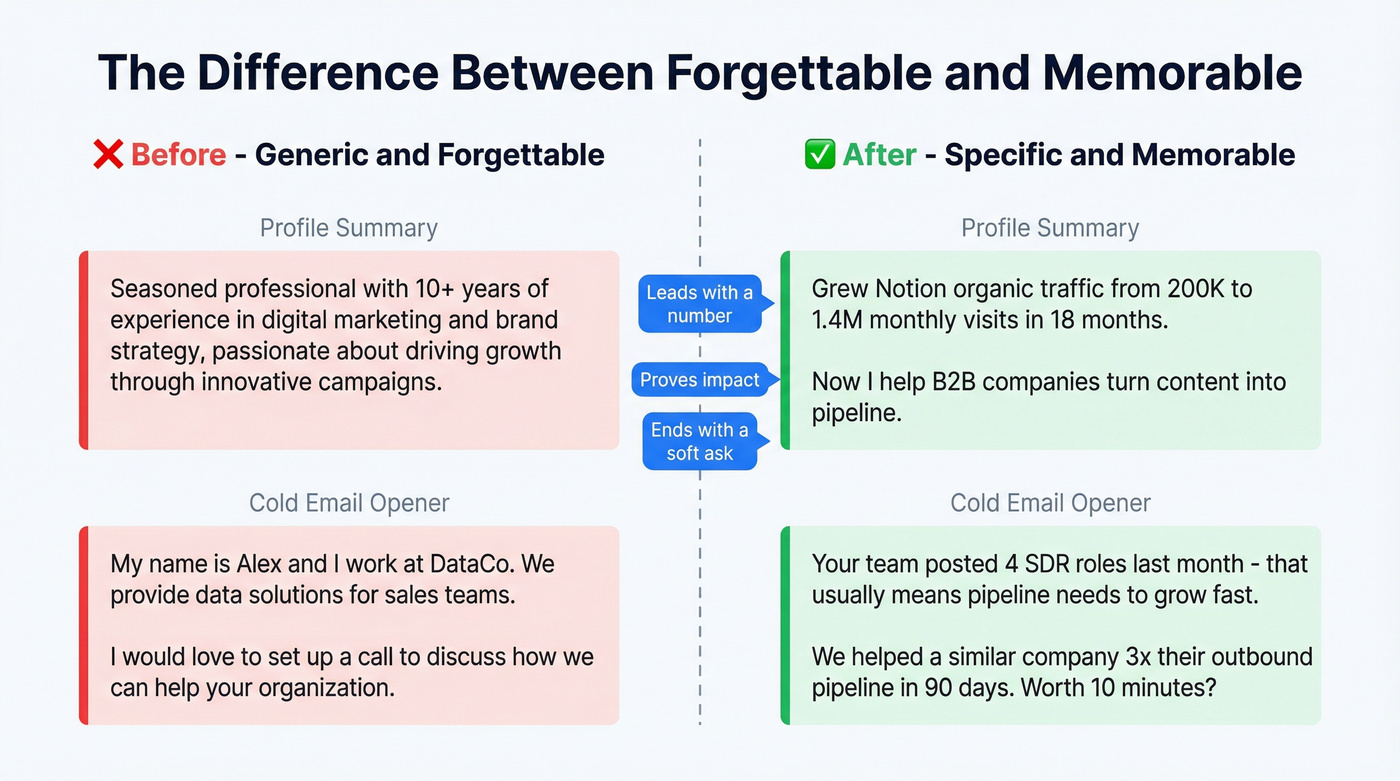
Profile summary - before: "Seasoned professional with 10+ years of experience in digital marketing and brand strategy, passionate about driving growth through innovative campaigns."
Profile summary - after: "Grew Notion's organic traffic from 200K to 1.4M monthly visits in 18 months. Now I help B2B companies turn content into pipeline. Currently Head of Growth at [Company]."
The difference? The first version describes a job title. The second proves impact.
Cold email opener - before: "My name is Alex and I work at DataCo. We provide data solutions for sales teams. I'd love to set up a call to discuss how we can help your organization."
Cold email opener - after: "Your team posted 4 SDR roles last month - that usually means pipeline needs to grow fast. We helped [similar company] 3x their outbound pipeline in 90 days. Worth 10 minutes?"

Here's the bridge most people miss: your cold email pitch is only half the equation. It has to reach the right person. If your beautifully crafted opener bounces, it never existed. Prospeo finds and verifies professional emails with 98% accuracy, and the free tier gives you 75 verified emails per month - enough to test whether your pitch converts before you scale anything.
Common Mistakes (and How to Fix Them)
We've seen these mistakes kill more pitches than anything else.
No metrics. "I help companies grow their revenue" is weak. "I helped three clients add a combined $4.2M in new revenue last year" is strong. One number changes everything.
Too much jargon. "We use AI-driven predictive analytics to optimize go-to-market efficiency" means nothing to most people. "We tell sales teams which prospects are most likely to buy this quarter" means everything. If your mom can't follow it, simplify.
Describing your title instead of your impact. "I'm a Senior Account Executive at a SaaS company" tells me nothing about you. "I close six-figure deals for a SaaS company that helps hospitals reduce patient wait times by 35%" tells me exactly who you are and why I should care.
Too long. If your pitch runs past 45 seconds in a networking context, you've lost them. Time yourself. Cut ruthlessly. The 30-second version should feel almost too short - that's how you know it's right.
No closing question. Ending with "...so yeah, that's what I do" is a conversation killer. Always end with a question that invites the other person to talk.
Sounding rehearsed. Stop memorizing your elevator pitch word-for-word. Know your bullet points - hook, one-liner, number, question - and riff conversationally each time. A pitch that sounds slightly different every time sounds real. A pitch that sounds identical every time sounds like a recording.
Let's be honest: if your pitch takes longer than 30 seconds at a networking event, you're not pitching - you're lecturing. The best pitches I've heard were under 20 seconds. They left the other person wanting more, which is the entire point.
How to Practice Without Sounding Robotic
Record yourself on your phone. Listen back. You'll catch filler words, pacing issues, and the exact moment you start sounding like a robot. It's uncomfortable. Do it anyway.
Run the friend test. Pitch a friend, then ask them to repeat back what you do. If they can't summarize it in one sentence, simplify until they can. This single exercise has fixed more pitches than any framework we've seen.
Master the 10-second version first. If you can nail your value in two sentences, expanding to 30 or 60 seconds is easy. The reverse is much harder - people who start long and try to trim always end up with a bloated mess that's been cut in the wrong places.
Watch your body language. Eye contact, open posture, natural pace. A great pitch delivered while staring at your shoes doesn't land.
Practice scaling up gradually. Once you own the 10-second version, stretch it into a longer narrative by layering in a story and a second proof point. If the longer version feels bloated, you've added filler - cut back until every sentence earns its spot.
Follow up immediately. When the pitch lands, ask for a card, suggest a coffee, send a message that night. When it doesn't land, pivot to a question about them. Not every pitch converts - the question keeps the conversation alive. The consensus on r/sales is that same-day follow-up after a strong pitch doubles your odds of getting a meeting, and in our experience that tracks.
That sales pitch template above? One Prospeo customer used it to triple their pipeline from $100K to $300K per week - because they paired a sharp pitch with 98% accurate contact data. At $0.01 per email, you can build targeted lists of exactly the people your elevator pitch was written for.
Nail the pitch, then nail the prospecting. Try Prospeo free.
Elevator Pitch FAQ
How long should an elevator pitch be?
Thirty seconds covers most networking situations. Have a 10-second version for casual introductions and a 60-second version for job interviews or investor meetings. For formal demo days, you can stretch to two minutes - but even then, the first 30 seconds determine whether anyone stays engaged.
What's the difference between an elevator pitch and an elevator speech?
Nothing meaningful. "Elevator pitch" is more common in business and startup contexts, while "elevator speech" appears more in academic and career-center settings. Same concept, same structure, same goal.
Can I use my elevator pitch in a cold email?
Absolutely, but condense it further. Your cold email opener should be one to two sentences - same hook-value-ask structure, tighter execution. Just make sure you're sending to a verified address so your pitch actually reaches the inbox.
What if my elevator pitch feels fake?
It probably is. Stop memorizing a script. Know your three or four key points - hook, identity, number, question - and practice saying them differently each time until it feels like a conversation, not a performance. If you can't say it naturally to a friend over coffee, it needs simplifying. Skip the version that sounds polished and go with the one that sounds like you.