Polite Follow-Up Email Samples That Get Replies (2026)
You sent the proposal Monday. It's Thursday. Your inbox is empty, and you're staring at a blank compose window trying to nudge without sounding desperate.
You don't need another "just checking in" template. You need a polite follow-up email sample that actually earns a reply - one that adds something new instead of just reminding someone you exist. A study of 16.5 million cold emails found that reply rates peak at 8.4% on the first email and drop with every subsequent touch, which means follow-ups are where most sequences either win or quietly bleed out.
The framework, fast:
- Cadence: Follow the 3-7-7 rule - initial email on Day 0, first follow-up on Day 3, second on Day 10, third on Day 17. (If you want more timing rules, see follow up email timing.)
- Ceiling: Two to three follow-ups max. At four or more emails in a sequence, unsubscribe rates triple and spam-complaint risk more than triples.
- Rule: Every follow-up adds new value or gives them an easy out. "Just checking in" isn't a strategy.
10 Samples for Every Scenario
No Response to Your First Email
Subject: Quick question about [topic from original email]
Hi [Name],
I sent over thoughts on [specific topic] last [day]. Here's the short version: [one-sentence value prop]. Would a 10-minute call on [day] work?
Reference something specific from your first email so they don't have to dig for context. This template works because it restates value instead of just asking "did you see this?" (For more options, borrow from these Outreach email templates.)
After a Meeting
Subject: Next steps from our [day] conversation
Hi [Name],
Great speaking about [specific topic]. As promised, I've attached [resource/notes]. On your end, it'd help to know [specific question] - does [date] work to reconnect?
Always attach something useful. It gives them a reason to open.
After Sending a Proposal
Subject: Any questions on the [project name] proposal?
Hi [Name],
Have you had a chance to review the proposal from [date]? Happy to adjust the scope or walk through pricing if anything doesn't fit. Quick call this week?
Offer to adjust scope, not just "answer questions." It signals flexibility and moves the conversation forward. If you’re chasing a signature specifically, use a follow up email for contract signing.
Job Application Follow-Up
Subject: Following up on my [role title] application
Hi [Name],
I applied for the [role] on [date] and wanted to reiterate my interest. My background in [relevant skill] aligns with what you're building - is there a good time to discuss?
Three sentences max. Hiring managers skim.
After an Interview
This one's about specificity. Generic "thank you for your time" emails blend into the pile - reference one concrete moment from the conversation.
Subject: Thank you - [role title] interview
Hi [Name],
I especially enjoyed discussing [specific topic from interview] - it reinforced my excitement about the role. Please reach out if you need anything else from my end.
Networking Follow-Up
Subject: Good meeting you at [event name]
Hi [Name],
Your point about [specific topic] at [event] stuck with me. I thought you'd find [resource/article] useful given what you mentioned about [their challenge]. Coffee or a quick call sometime?
Lead with something they said, not something you want. It proves you were listening.
Overdue Invoice
Firm but warm. You're not apologizing for wanting to get paid - you're making it easy for them to pay.
Subject: Friendly reminder: Invoice #[number] - due [date]
Hi [Name],
Invoice #[number] for [amount], due [date], is still outstanding - reattached for convenience. Could you confirm when this'll be processed? Let me know if anything's blocking it.
After a Demo or Free Trial
Subject: How's [product] working so far?
Hi [Name],
It's been [X days] since your trial started. Have you tried [specific feature]? If you've hit snags, I'll walk you through it. If it's not the right fit, no hard feelings - just let me know.
Naming a specific feature shows you remember their use case. Generic "how's it going?" emails get deleted. (If you’re running a post-demo motion, follow this post-demo playbook.)
Requesting a Document
Subject: Quick reminder: [document] needed by [date]
Hi [Name],
I still need [document] to move forward with [project]. My deadline is [date], so getting it by [earlier date] keeps us on track. Let me know if anything's blocking this.
Give them a deadline before your actual deadline. Built-in buffer, zero panic.
The Breakup Email
We've tested dozens of follow-up sequences, and the breakup email consistently outperforms every other touch. Giving people an easy out paradoxically makes them more likely to respond - the r/sales community echoes this constantly, with reps reporting breakup emails pulling 2-3x the reply rate of standard follow-ups.
Subject: Should I close this out?
Hi [Name],
I've reached out a few times and haven't heard back - totally fine, priorities shift. I'll assume the timing isn't right and stop filling your inbox. If anything changes, I'm here.
Weak vs. Strong Follow-Ups
Before: "Hi Sarah, just checking in on my last email. Let me know if you have any questions."
After: "Hi Sarah, since I sent the proposal, I came across [this case study] from a company in your space that saw [specific result]. Worth a quick call Thursday?"
The first version adds zero value - it's a guilt trip disguised as politeness. Grammarly's analysis calls "just checking in" overused and often passive-aggressive because it implies impatience while adding no context. The second version gives Sarah something new and makes the next step concrete.
Every professional follow-up should be a new touchpoint with new value, not a reminder that you exist. If you want more examples, see this prospect follow up playbook.
The Cadence That Actually Works
The 16.5 million-email dataset tells a clear story: reply rates peak at 8.4% on the first email and drop to 3.8% by the fifth, while unsubscribe rates triple and spam-complaint risk more than triples at four or more emails in a sequence.
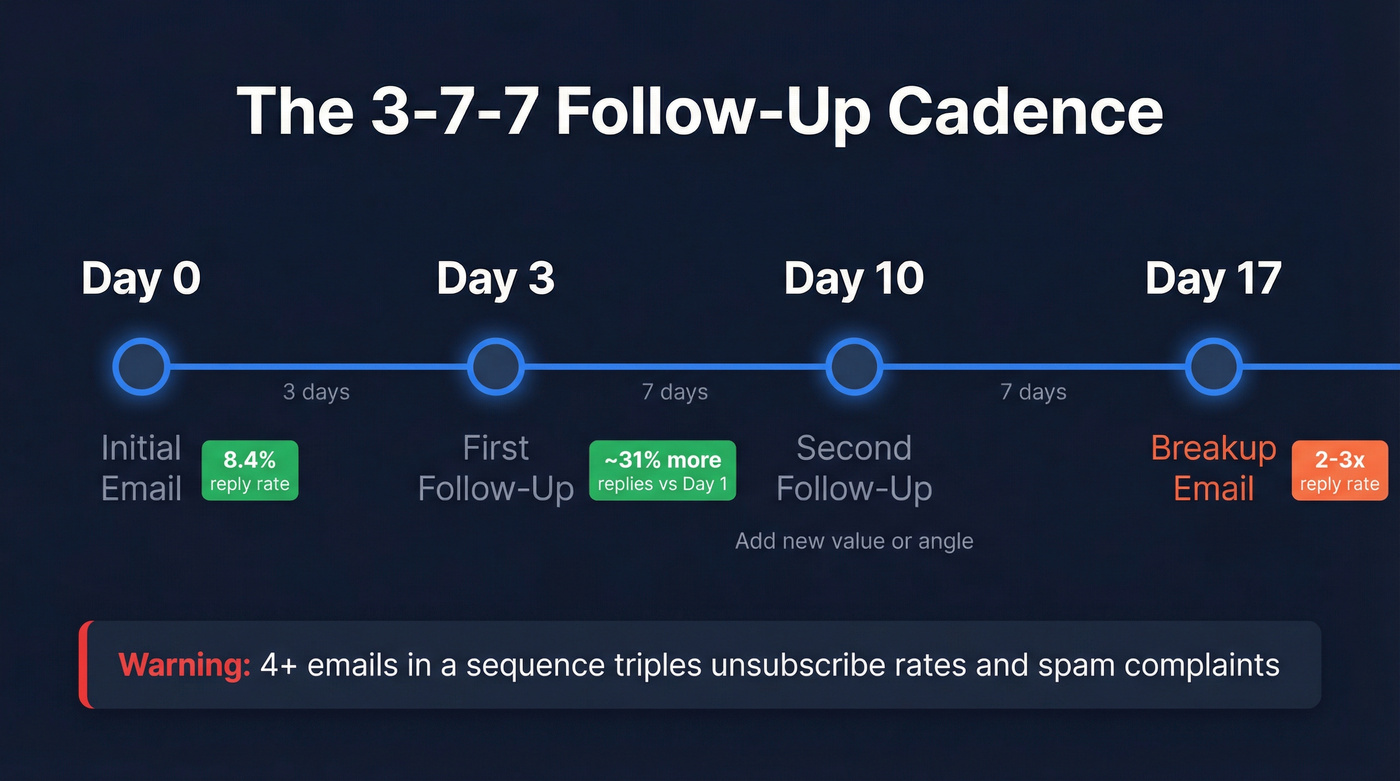
The 3-7-7 framework is the simplest cadence that works. Initial email on Day 0, follow up on Day 3, again on Day 10, final touch on Day 17. Four total touches across 17 days.
Why these intervals? Following up within 24 hours cuts your chances by about 11%. Waiting three days increases replies by roughly 31%. For multi-channel outbound, Outreach recommends 8-12 touchpoints across 17-21 days mixing email, phone, and social - but for email-only follow-ups, two to three is the ceiling before you start burning goodwill. (If you’re building a full sequence, start with a sales cadence example.)
Here's the thing: knowing when to stop matters as much as knowing when to start. Enterprise prospects ghost quickly and punish persistence. SMBs tolerate more. Adjust accordingly.

A perfect follow-up email means nothing if it bounces. Prospeo delivers 98% verified email accuracy with a 7-day refresh cycle, so your polite nudge actually lands in the right inbox - not a dead address.
Stop crafting follow-ups for email addresses that don't exist.
How to Write a Polite Follow-Up Email
| Dead Phrase | Better Alternative |
|---|---|
| "Just checking in" | "I came across [X] and thought of our conversation" |
| "Bumping this" | "Quick update: [new development]" |
| "Circling back" | "I had a new idea about [their problem]" |
| "Per my last email" | "Building on what I shared last week" |
| "I hope this finds you well" | "Saw [their company] just [news] - congrats" |
| "Following up" (subject line) | "[Specific topic] - one more thought" |
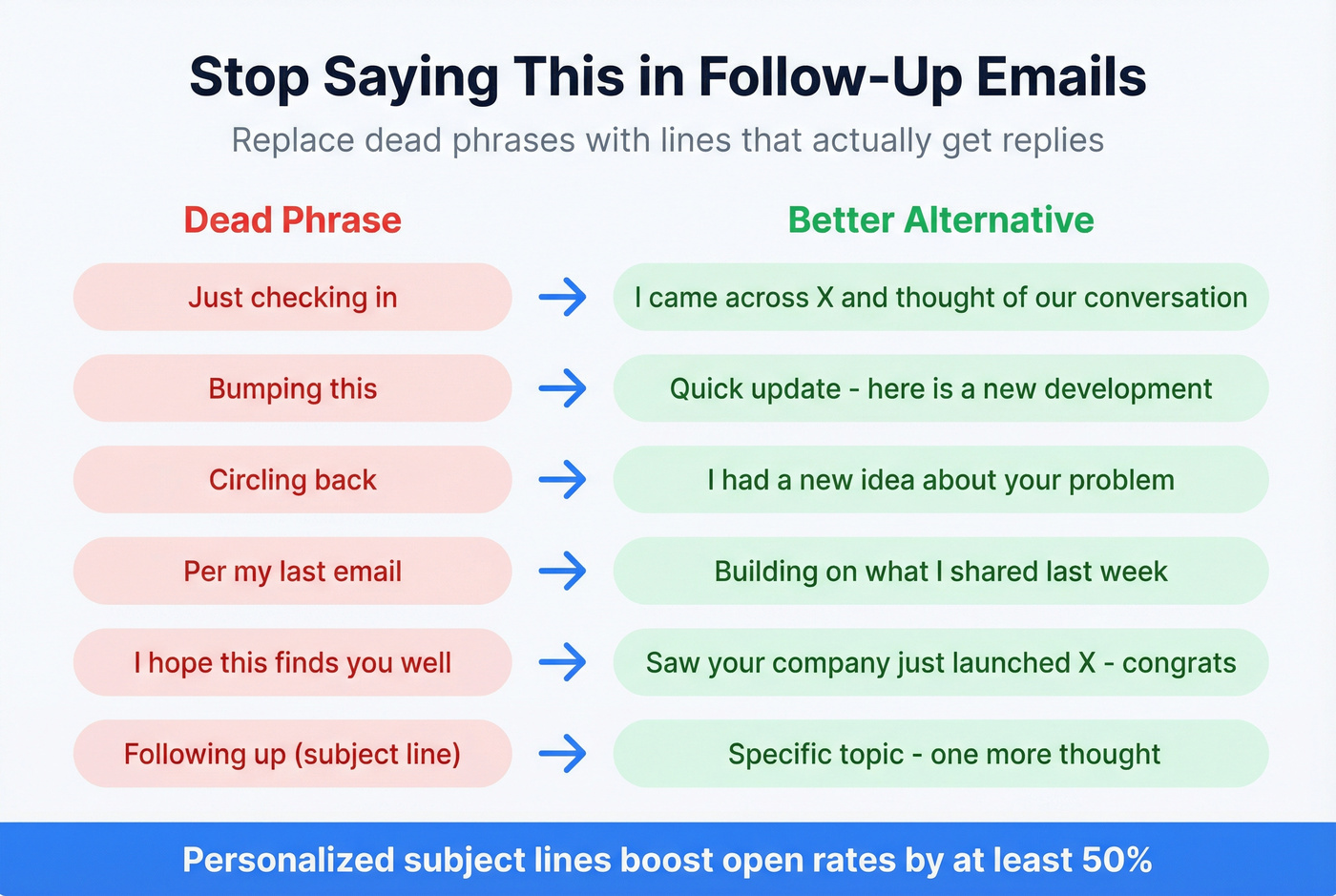
Personalized subject lines boost open rates by at least 50% compared to generic ones. "Following up" as a subject line is the email equivalent of elevator music - technically present, completely forgettable. For more subject ideas, use these subject lines for follow-up emails.
5 Mistakes That Kill Replies
1. No new value. If your follow-up is just "did you see my last email?" you're wasting a touch. Each message should address a different objection - cost, urgency, trust - not repeat the same pitch.
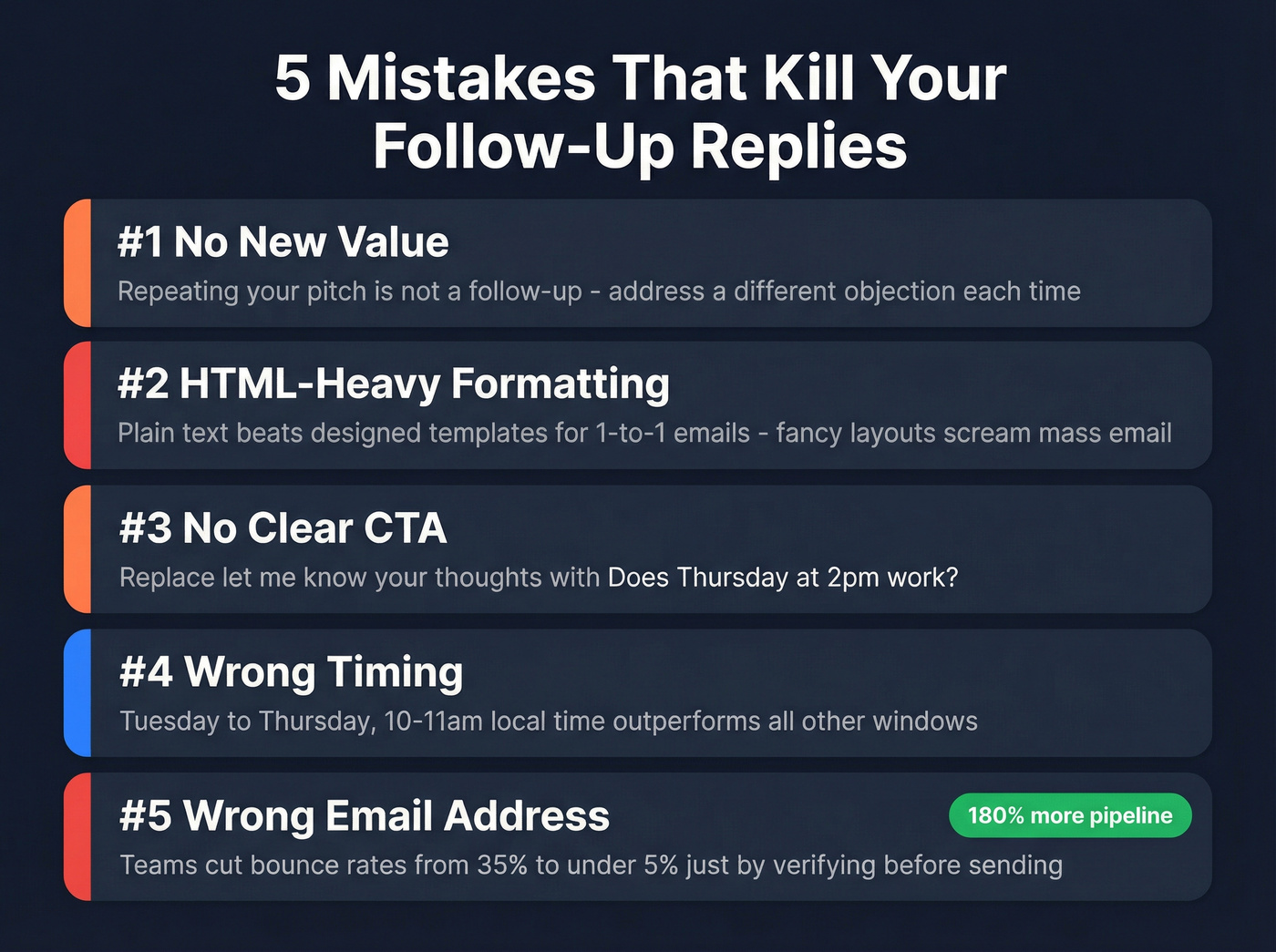
2. HTML-heavy formatting. Plain text outperforms designed HTML for one-to-one follow-ups. Fancy templates scream "mass email" and trigger spam filters. We've A/B tested this across client campaigns and the difference isn't subtle. (If you’re scaling volume, follow cold email volume best practices.)
3. No clear CTA. "Let me know your thoughts" isn't a call to action. "Does Thursday at 2pm work?" is. Give them something specific to say yes or no to. If you need better asks, see how to ask for an appointment.
4. Wrong timing. Mid-week sends (Tuesday through Thursday) around 10-11am local time tend to outperform other windows. Weekend emails get buried under Monday's avalanche.
5. Wrong email address. Look, the best follow-up in the world doesn't matter if it bounces. We've seen teams cut bounce rates from 35% to under 5% just by verifying their list before sending - and bad data doesn't just waste one email, it tanks your sender reputation so future follow-ups land in spam too. Snyk's sales team experienced exactly this: 50 AEs were prospecting 4-6 hours per week with bounce rates hovering around 35-40%, and switching to verified data dropped that under 5% while AE-sourced pipeline jumped 180%. If you’re comparing tools, start with the best email ID validators.
Same Thread or New Email?
Reply in the same thread when you're continuing the same conversation, it's been less than a week, and the thread is short.
Start a new thread when you're introducing a different angle, the original is buried (10+ days, no reply), or a fresh subject line might resuscitate things. When in doubt, reply in thread - it preserves context and keeps your email shorter since the history is right there.
Make Sure It Arrives
With 392.5 billion emails projected daily in 2026, inbox competition is brutal. But competition isn't your biggest enemy - bounces are. Bounced emails hurt deliverability, waste touches, and can drag future follow-ups into spam. If you want the full deliverability playbook, use this email deliverability checklist.
Let's be honest: if your deal sizes are under five figures, you probably don't need a pricey sales engagement platform. You need clean data and good templates. Having the perfect polite follow-up email sample means nothing if the message never reaches the inbox. Verify your list before you send. Prospeo's real-time email verification catches invalid addresses, spam traps, and honeypots before they damage your sender reputation - with 98% accuracy and a free tier of 75 verifications per month, enough to clean a prospect list before launching any follow-up sequence.
Your breakup email won't pull 2-3x replies if it's going to the wrong person. Prospeo gives you 300M+ verified contacts with 30+ filters so every follow-up reaches the actual decision-maker - at $0.01 per email.
Send fewer follow-ups by reaching the right person the first time.
FAQ
How long should I wait before following up?
Wait three days for the first follow-up, then space subsequent touches seven days apart - the 3-7-7 rule (Day 0, Day 3, Day 10, Day 17). Following up within 24 hours cuts reply chances by about 11%.
How many follow-ups is too many?
Two to three follow-ups is the sweet spot. The 16.5 million-email dataset shows unsubscribe rates triple and spam-complaint risk more than triples at four or more emails in a sequence. After three, you're burning goodwill faster than you're building it.
What if they open but don't reply?
Your CTA is probably too vague. Replace "let me know your thoughts" with a specific ask - a date, a time, a yes-or-no question. If open rates are high but replies are flat, the email body needs a stronger hook or a different angle entirely.
How do I verify emails before sending follow-ups?
Use a real-time verification tool to catch invalid addresses, spam traps, and catch-all domains before you hit send. Skip this step and you're not just wasting one email - you're poisoning your sender reputation for every email that follows.