The Educational Selling Approach: Teach First, Close More
61% of B2B buyers now prefer a rep-free buying experience, per Gartner's 2026 survey. Only 1% of decision-makers believe B2B marketing demonstrates a meaningful understanding of human experience. The old playbook - lead with a pitch, follow up relentlessly, hope for a meeting - isn't just ineffective. It's actively repelling the people you're trying to reach.
Here's the thing: buyers want to learn, not be sold to. The educational selling approach means leading with genuine knowledge instead of a pitch. You teach the buyer something valuable about their problem before you ever mention your solution. Below: the framework, a methodology comparison, implementation steps, and the mistakes that kill it.
What Is Educational Selling?
Educational selling focuses on teaching. Rather than starting with a pitch, you start with insight - helping the buyer understand their problem and options, then showing how to move forward whether or not they buy from you. It's a human selling method that respects the buyer's intelligence and autonomy.
A rep selling marketing automation might open with "Here's what we're seeing in email deliverability across 200 SaaS companies" instead of "Let me show you our platform." That's the difference. Buyers are 70-80% through their decision process before they ever talk to sales, so if your first conversation is a feature walkthrough, you've already lost. Educational sellers meet buyers where they are - with context, frameworks, and genuine expertise that earns the right to a deeper conversation.
In our experience, the reps who educate while they sell consistently outperform the ones who pitch. And it's not close.
Four Core Principles
- Be the Favorite Teacher. Think helpful and clear - not "smartest person in the room." Buyers remember the rep who simplified their decision, not the one who buried them in specs. The educator-student dynamic should feel collaborative, not condescending.
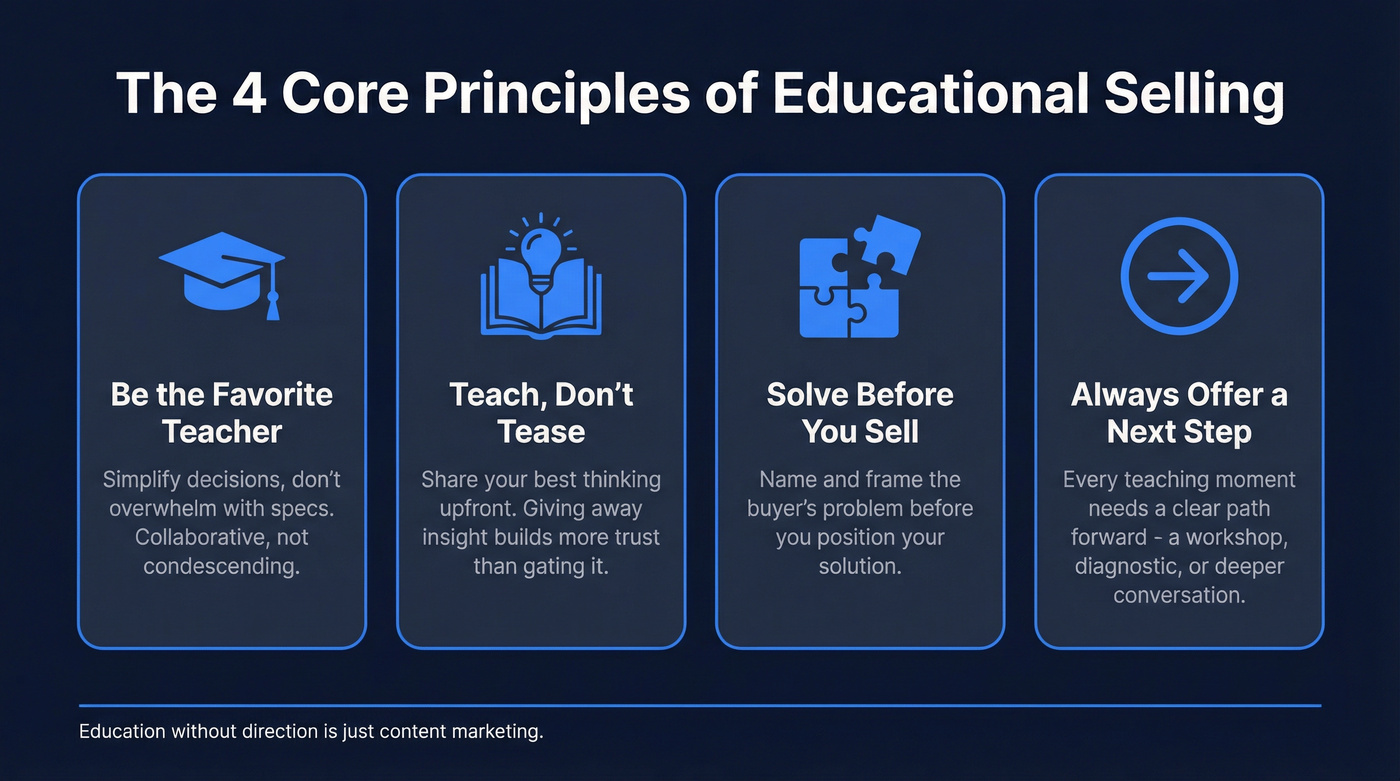
Teach, Don't Tease. Don't withhold value to force a call. Share your best thinking upfront. The paradox: giving away insight freely builds more trust than gating it ever will.
Solve Before You Sell. Help buyers name and frame their problem before you position your solution. When you articulate someone's challenge better than they can, you've already demonstrated competence. This is the serve-don't-sell method in practice - generosity as strategy.
Always Offer a Next Step. Education without a call to action creates no movement. Every teaching moment should end with a clear path forward - a workshop, a diagnostic, a deeper conversation. Generosity without direction is just content marketing.
How It Compares to Other Methodologies
| Educational | Consultative | Solution | Insight | |
|---|---|---|---|---|
| Philosophy | Teach first, sell second | Advise as trusted partner | Diagnose pain, prescribe fix | Reframe with data |
| Seller Role | Educator | Advisor | Problem-solver | Challenger |
| Buyer Assumption | Buyer needs context | Buyer has unarticulated needs | Buyer knows the problem | Buyer misunderstands it |
| Best For | Complex, research-heavy | Enterprise, multi-stakeholder | Shorter cycles, clear pain | Commoditized markets |
| Key Risk | Teaching without closing | Over-investing in wrong deals | Shallow discovery | Coming off as arrogant |
| Our Pick | ✅ Best default for complex B2B | Strong for enterprise | Skip if buyer can't articulate pain | Use selectively |
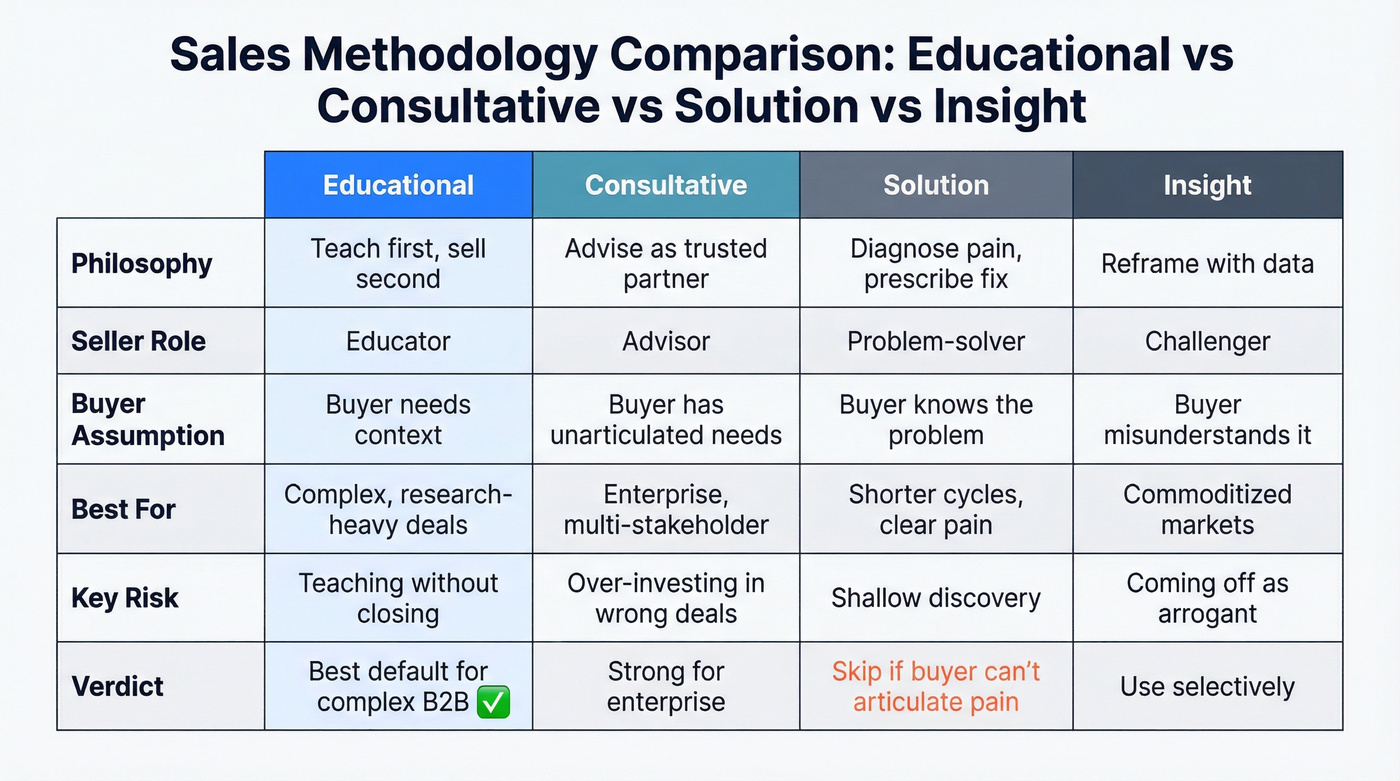
People often lump educational and consultative selling together. They're related but not the same. Consultative selling uncovers needs through questions. An educational approach delivers insight the buyer didn't have before the conversation started. That distinction drives everything - the prep, the content, the conversation arc.
For complex B2B with 6+ month cycles, teaching-first is the best default. Solution selling works when the buyer clearly understands their problem. Insight selling - popularized by the Challenger framework - leads with data-backed reframes. Educational selling borrows from all three but anchors everything in genuine knowledge transfer.
The Challenger Connection
The Challenger Sale maps almost perfectly onto this approach. The core idea: teach, tailor, take control. The execution follows a specific six-step choreography worth internalizing.
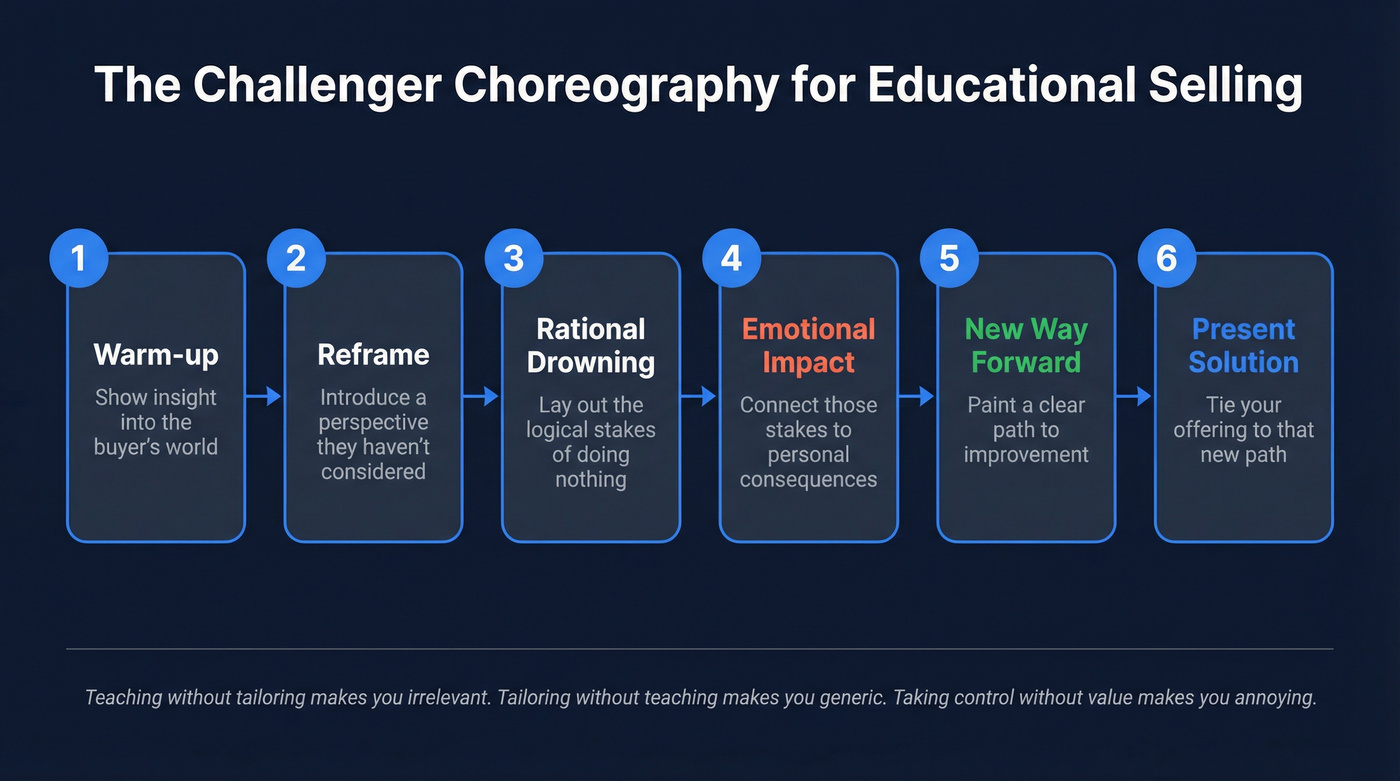
- Warm-up - demonstrate insight into the buyer's world
- Reframe - introduce a vantage point they haven't considered
- Rational drowning - lay out the logical stakes of inaction
- Emotional impact - connect those stakes to personal consequences
- New way forward - paint a path to improvement
- Present solution - tie your offering to that new path
This choreography is the closest thing to a repeatable playbook for education-based selling. Start there. Teaching without tailoring makes you irrelevant, tailoring without teaching makes you generic, and taking control without value makes you annoying. That tension is what separates educational sellers from reps who share articles and hope for the best.

Educational selling only works when you bring insight buyers can't find on their own. Prospeo's intent data tracks 15,000 topics so you know exactly what your prospect is researching - before the first call. Pair that with 30+ filters and 98% verified emails to reach the right buyer with the right lesson.
Lead with insight, not a pitch - powered by real buyer signals.
Humanizing Sales Through Education
One of the most overlooked benefits of this methodology is how it changes the relationship between buyer and seller. Today's customer knows more than the salesperson about product specs, competitor pricing, and peer reviews - they've done the research before the first call. That reality terrifies average reps but empowers great ones.
When you accept that buyers are already informed, you stop trying to control information and start adding to it. You lead with industry benchmarks, trend data, and operational insights the buyer can't easily find on their own. This is how you humanize buyer-seller dynamics: by treating the interaction as a peer exchange rather than a persuasion exercise.
System-level thinking takes this further. Instead of addressing a single pain point, educational sellers help buyers see how their challenge connects to broader organizational dynamics - budget constraints, cross-functional dependencies, market timing. That wider perspective is what earns you a seat at the strategy table rather than a slot in the vendor evaluation spreadsheet.
How to Implement It
Step 1: Build an insight library. Catalog your best customer success stories, industry trends, and competitive intelligence. Organize by industry, buyer role, and deal stage. We've seen teams build these in a week and transform their outreach overnight.
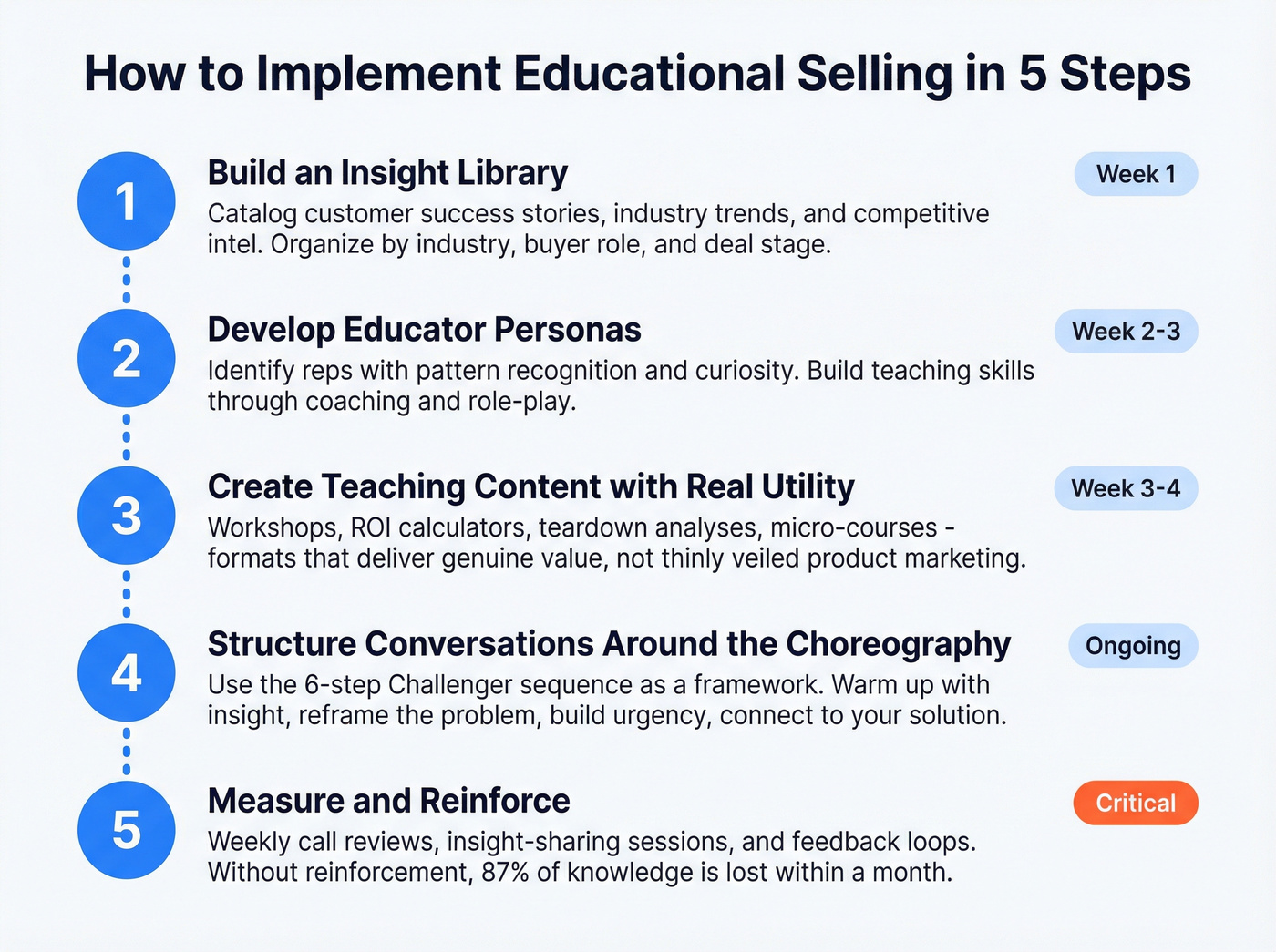
Step 2: Develop educator personas. Not every rep is a natural teacher. Identify who has the pattern recognition and curiosity to lead with insight, then build those skills through coaching and role-play. The goal is to educate customers in sales conversations with the same rigor a consultant would bring to an engagement.
Step 3: Create teaching content with real utility. Workshops, ROI calculators, teardown analyses, micro-courses - formats that deliver genuine value. A "thought leadership" PDF restating obvious trends isn't educational selling. A 15-minute diagnostic that helps a VP quantify their problem is. None of this matters if your insights never reach the right person, though - tools like Prospeo help ensure your carefully crafted outreach actually hits verified inboxes rather than bouncing, with 98% email accuracy and a 7-day data refresh cycle.
Step 4: Structure conversations around the choreography. Use the six-step Challenger sequence as a framework, not a rigid script. Warm up with a relevant insight, reframe the problem, build urgency, then connect to your solution.
Step 5: Measure and reinforce. Without reinforcement, up to 87% of knowledge is lost within a month. A single training workshop doesn't create an educational selling motion. You need weekly call reviews, insight-sharing sessions, and feedback loops that keep the muscle sharp.
Mistakes That Kill It
Prioritizing your brand over the buyer. The buyer is the hero. Your brand is the guide. Flip that, and you're just pitching with extra steps.
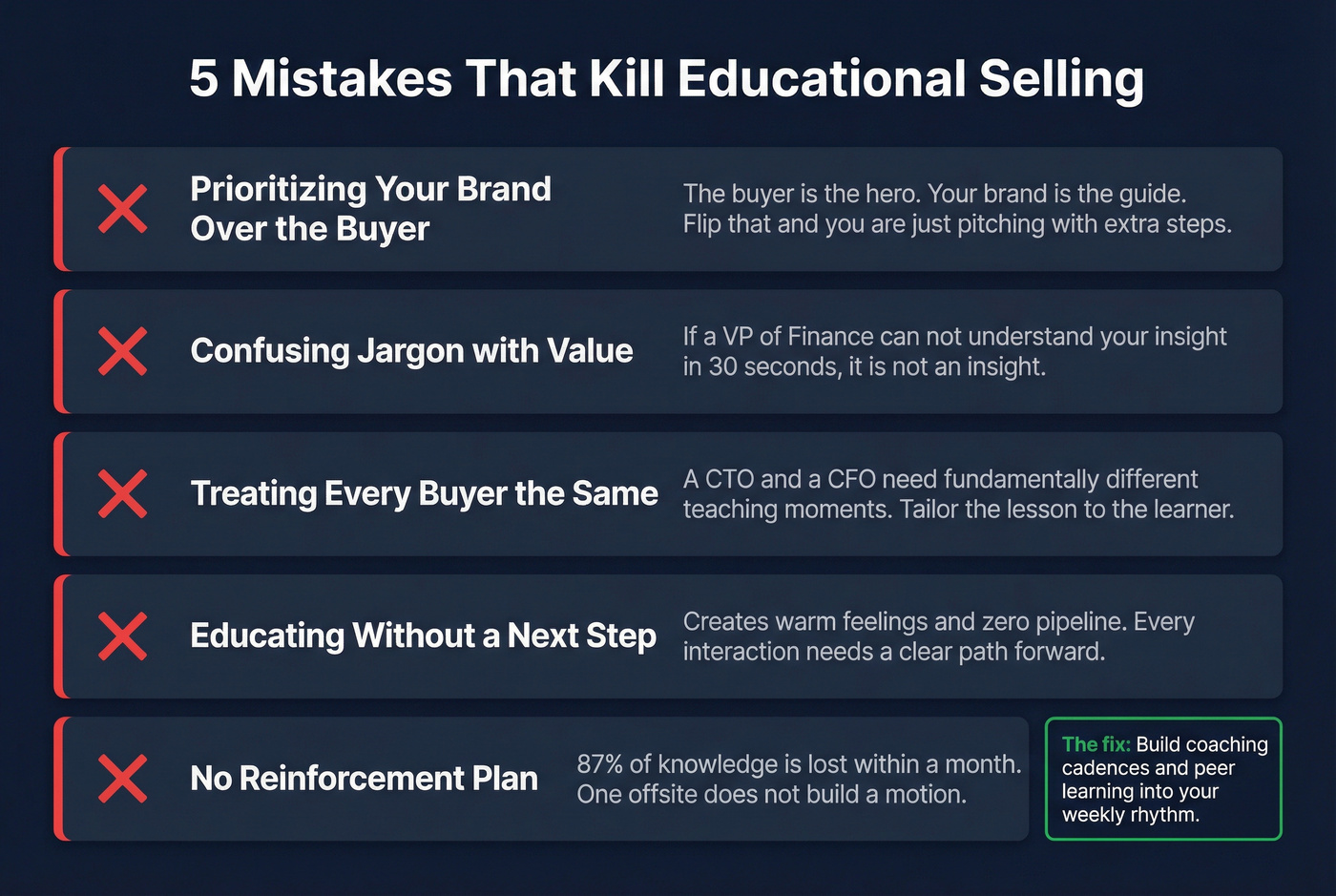
Confusing jargon with value. If a VP of Finance can't understand your insight in 30 seconds, it's not an insight. Cut the acronyms. Complexity doesn't signal expertise - clarity does.
I once watched a rep lose a six-figure deal because they spent 40 minutes "educating" a CFO with slides full of technical architecture diagrams. The CFO wanted to know one thing: how much money they were leaving on the table. Treating every buyer the same is the fastest way to waste your best content. A CTO and a CFO need fundamentally different teaching moments - tailoring the lesson to the learner is non-negotiable.
Educating without a next step creates warm feelings and zero pipeline. Every teaching interaction needs a clear path forward.
No reinforcement plan. That 87% knowledge-loss stat applies to your own team, too. One offsite doesn't build a motion. Build sales coaching cadences and peer learning into the weekly rhythm.
Educational Selling in Action
Diageo's Hospitality Partnership program is one of the clearest examples. Instead of pushing spirits through distribution incentives, Diageo deployed industry experts to train bar and restaurant staff - teaching cocktail technique, menu optimization, and hospitality management. Diageo became a must-have portfolio partner rather than a commoditized supplier. The teaching was the selling.
For an adjacent proof point, LiveRamp's ABM approach identified just 15 best-fit accounts and built deep, insight-led relationships that generated over $50M in annual revenue from those accounts alone.
Let's be honest: most teams fail at educational selling not because the methodology is wrong, but because they don't have the intellectual honesty to give away their best thinking for free. If your "educational content" is thinly veiled product marketing, buyers smell it immediately. The consensus on r/sales backs this up - prospects can tell the difference between a rep who genuinely wants to help and one running a "value-add" script. The teams that win are the ones willing to help a prospect solve their problem even if it means recommending a competitor.
The educational selling approach works because it aligns with how modern buyers actually make decisions - through research, peer validation, and trusted expertise. Adopt the framework, commit to genuine knowledge transfer, and the pipeline follows.
Building an insight library starts with knowing your buyer's world cold. Prospeo surfaces technographics, headcount growth, funding rounds, and job changes across 300M+ profiles - refreshed every 7 days. That's the context educational sellers need to reframe problems and earn trust.
Stop guessing what to teach. Let buyer data write your playbook.
FAQ
Does educational selling work for short sales cycles?
A single sharp insight can compress a six-month cycle into weeks. Even in transactional deals under $15K, the rep who teaches something new in the first call earns trust faster than the one who jumps straight to a demo. Relevance matters more than length.
How is it different from content marketing?
Content marketing attracts buyers to your orbit at the top of the funnel. Educational selling teaches during the live sales conversation itself - the rep is the educator, not a content distributor. One fills the pipeline; the other converts within it.
What tools support an educational selling motion?
You need a CRM for tracking engagement across teaching touchpoints, conversation intelligence for coaching reps on delivery, and a reliable B2B data platform for reaching verified decision-makers. Prospeo's 30+ search filters - including buyer intent and technographics - help you identify which accounts are actively researching your category so your insights land at the right moment.
How does it differ from just being helpful?
Being helpful is a disposition. Educational selling is a structured methodology - the Challenger choreography, tailored insights, and a deliberate path to a commercial outcome. Every piece of value you share is chosen to reframe the buyer's thinking in a direction where your solution naturally fits. Strategy, not just generosity.