Sales Coaching: Frameworks, Templates, and Tools That Actually Work
Your best rep just left. The exit interview said "no development, no feedback, just pipeline reviews." Meanwhile, the manager who lost them spent 80% of their week in forecast calls and Slack fires - and genuinely believed they were coaching.
Talk to enough frontline managers and you'll hear the same pattern: pipeline reviews disguised as development conversations. 84% of sales coaching initiatives fail within 90 days, with reps reverting to old habits before the quarter ends. The gap isn't effort. It's method.
The Short Version
Pick a framework - GROW or Challenger - and pair it with the 60/25/15 time allocation model so you're coaching the right reps the right amount. Use two templates every week: a structured 1:1 agenda (included below) and a weighted call scorecard that gives reps specific, measurable feedback. And fix your contact data, because coaching technique is wasted when reps practice on disconnected numbers and bounced emails.
What Is Sales Coaching, Really?
Sales coaching is ongoing, individualized skill development between a manager and a rep, tied to observed behavior and specific deals. It's not training. It's not a pipeline review. Those three things get conflated constantly, and the confusion is why most "coaching" programs produce nothing.
Training is knowledge transfer - it happens in groups, usually during onboarding or SKO, and it teaches what to do. Coaching is the 1:1 work that teaches how to do it better, based on what actually happened on a call or in a deal cycle. Pipeline inspection - "where's the Acme deal at?" - is forecasting dressed up as development. It helps the manager, not the rep.
The scale problem is brutal. [Only 26% of reps receive weekly 1:1 coaching](https://www.salesforce.com/sales/sales-management/). The other 74% get sporadic check-ins, group trainings, or nothing at all. That's not a coaching program. That's hope.
Why Coaching Drives Revenue and Retention
The data here is unambiguous. Effective coaching lifts sales performance by 8%, according to Gartner research. Sounds modest until you run it against a $10M quota team - 8% is $800K in incremental revenue from a behavioral change, not a new tool or territory.
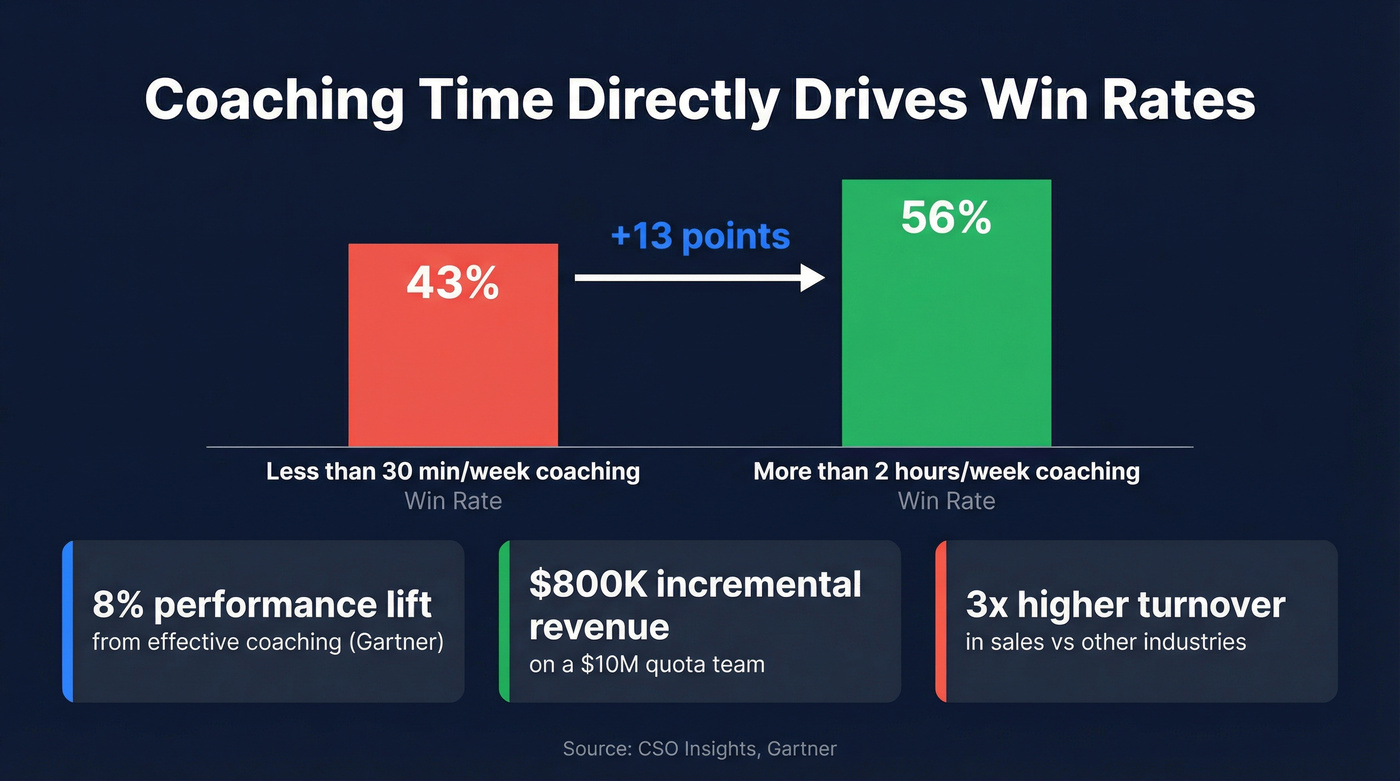
CSO Insights data makes it even sharper: teams receiving less than 30 minutes of structured weekly coaching hit a 43% win rate, while teams getting more than two hours hit 56%. That's a 13-point win rate gap driven entirely by coaching time. We've seen this pattern play out across dozens of sales orgs we've worked with - the teams that protect coaching time on the calendar consistently outperform those that treat it as optional.
Then there's retention. Sales organizations experience turnover rates three times higher than other industries, and "lack of development" consistently ranks in the top three reasons reps leave. Structured rep development isn't just a performance strategy - it's a retention strategy that compounds over time. When reps feel invested in, they stay longer. The compounding effect of lower attrition plus higher win rates makes coaching one of the highest-ROI activities a frontline manager can do.
And yet most managers spend their weeks in forecast calls instead.
Why Most Coaching Programs Fail
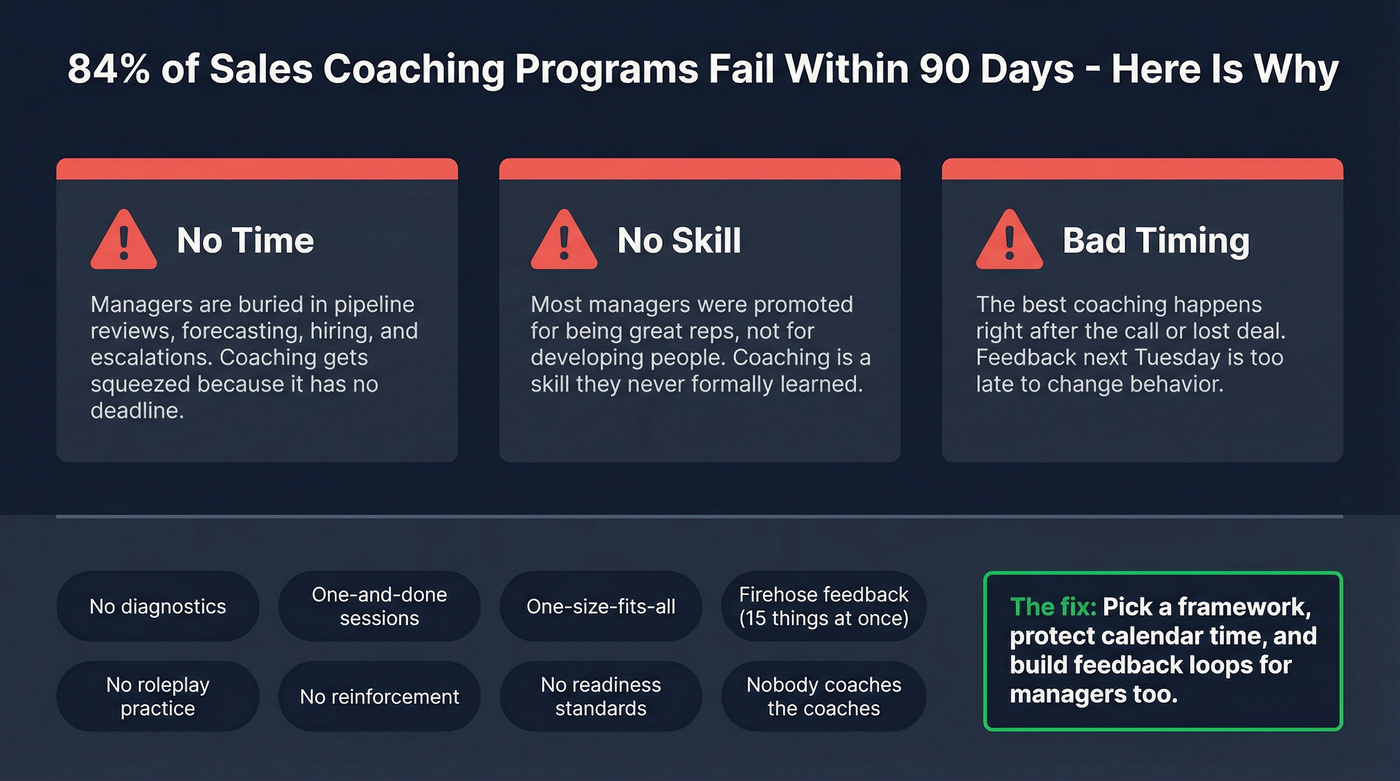
That 84% failure stat gets cited everywhere, but few people explain why it happens. There are three structural causes, and then a longer list of execution failures that compound from there.
The structural problems:
- No time. Managers are buried in pipeline reviews, forecasting, hiring, and escalations. Coaching gets squeezed out because it doesn't have a deadline attached to it.
- No skill. Most frontline managers were promoted because they were great reps, not because they knew how to develop other people. Coaching is a skill most leaders never formally learn. (If you want a tighter system, start with sales coaching best practices.)
- Bad timing. The best coaching happens immediately after the "play" - right after a call, right after a lost deal. Feedback on a discovery call is far more useful the same day than in next Tuesday's 1:1.
The execution failures stack up from there: no diagnostics (coaching without understanding root cause), one-and-done sessions, one-size-fits-all approaches, firehose sessions that dump 15 improvement areas on a rep at once, no practice through roleplay, no reinforcement, and no readiness standards defining what "coached up" looks like.
Here's the thing nobody talks about: nobody coaches the coaches. Second-line leaders rarely observe whether frontline managers are actually executing development conversations or just running pipeline inspections. Without downward feedback loops, bad habits calcify across the entire org.
There's also a productivity trap underneath all of it. Reps spend 60% of their time on non-selling tasks, use an average of 8 tools to close deals, and 42% feel overwhelmed by their stack. Overwhelmed sellers are 45% less likely to attain quota. Coaching can't fix a broken workflow. (If your stack is bloated, use a sales tools checklist to rationalize it.)
Frameworks That Work
A framework gives coaching structure. Without one, 1:1s drift into status updates. Here are the four models worth knowing.
GROW
GROW stands for Goal, Reality, Options, Will. It's the simplest framework and works well for tactical, deal-specific conversations.
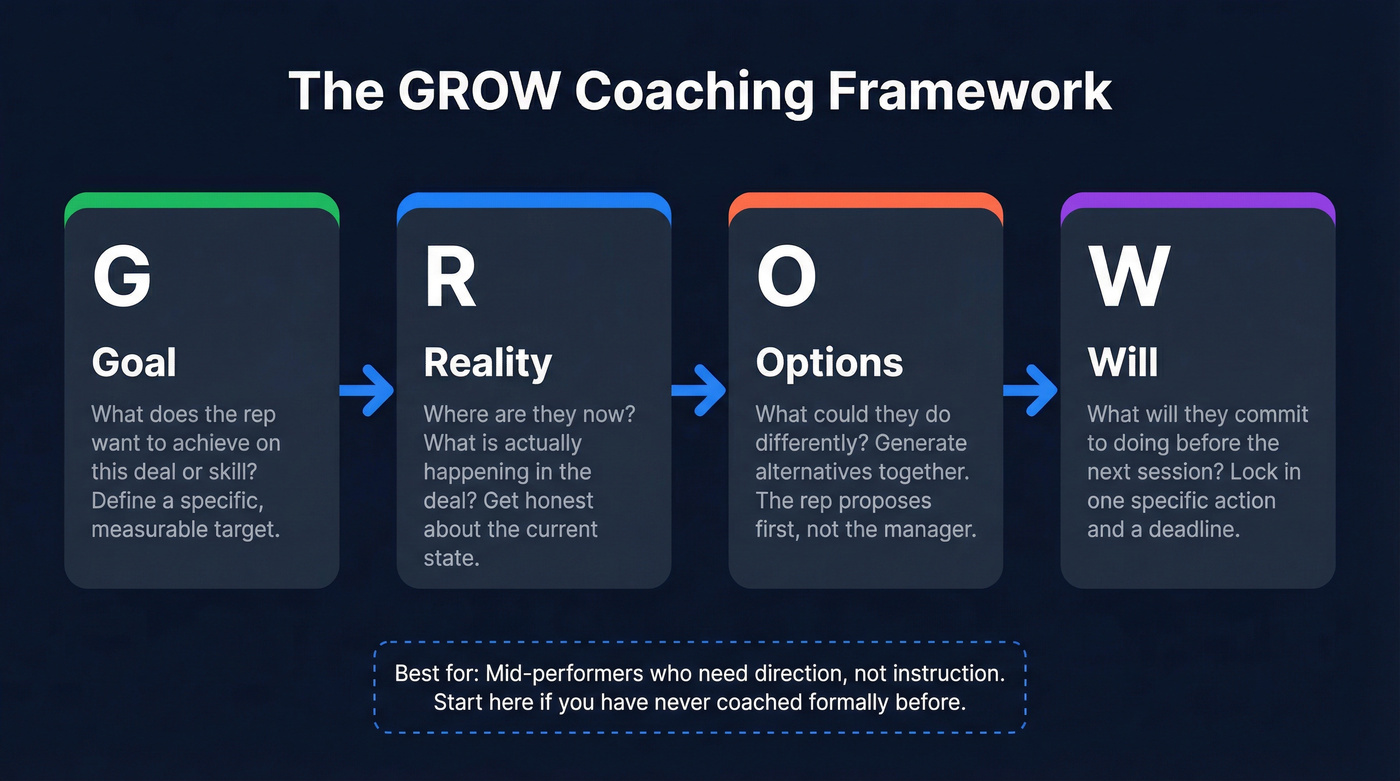
- Goal: What does the rep want to achieve on this deal or skill?
- Reality: Where are they now? What's actually happening?
- Options: What could they do differently? Generate alternatives together.
- Will: What will they commit to doing before the next session?
GROW works because it forces the rep to self-diagnose before the manager prescribes. It's best for mid-performers who need direction, not instruction. If you've never coached formally before, start here.
Challenger Coaching
Challenger reps perform around 40% better in complex sales environments, according to CEB/Gartner research. That single stat explains why the Challenger model - Teach, Tailor, Take Control - dominates enterprise B2B, where buyers spend roughly 17% of the buying journey actually talking to sales reps.
That tiny window means every conversation needs to deliver insight, not just information. Coaching in the Challenger framework means teaching reps to lead with a commercial insight that reframes the buyer's thinking, tailor the message to the stakeholder's priorities, and take control of the deal's momentum rather than deferring to the buyer's process. It's harder to coach than GROW, but it's the most effective model when deal cycles are long and multi-threaded. (For longer, complex cycles, align coaching to your enterprise software sales motion.)
Strategic vs. Tactical
Outreach draws a useful distinction here. Tactical coaching is the weekly work - call reviews, 1:1 feedback, roleplay, follow-up evaluation. Strategic coaching zooms out to market shifts, competitive positioning, and best-in-class call patterns across the team. Most managers default to tactical because it feels productive. But strategic coaching is what turns a team from good to dominant. Aim for roughly 80% tactical, 20% strategic, with strategic sessions happening monthly or quarterly.
The 60/25/15 Rule
This is the model from SBI Growth that changed how we think about coaching distribution. Most managers either spread time equally across all reps or over-invest in their worst performers. Both approaches waste time.
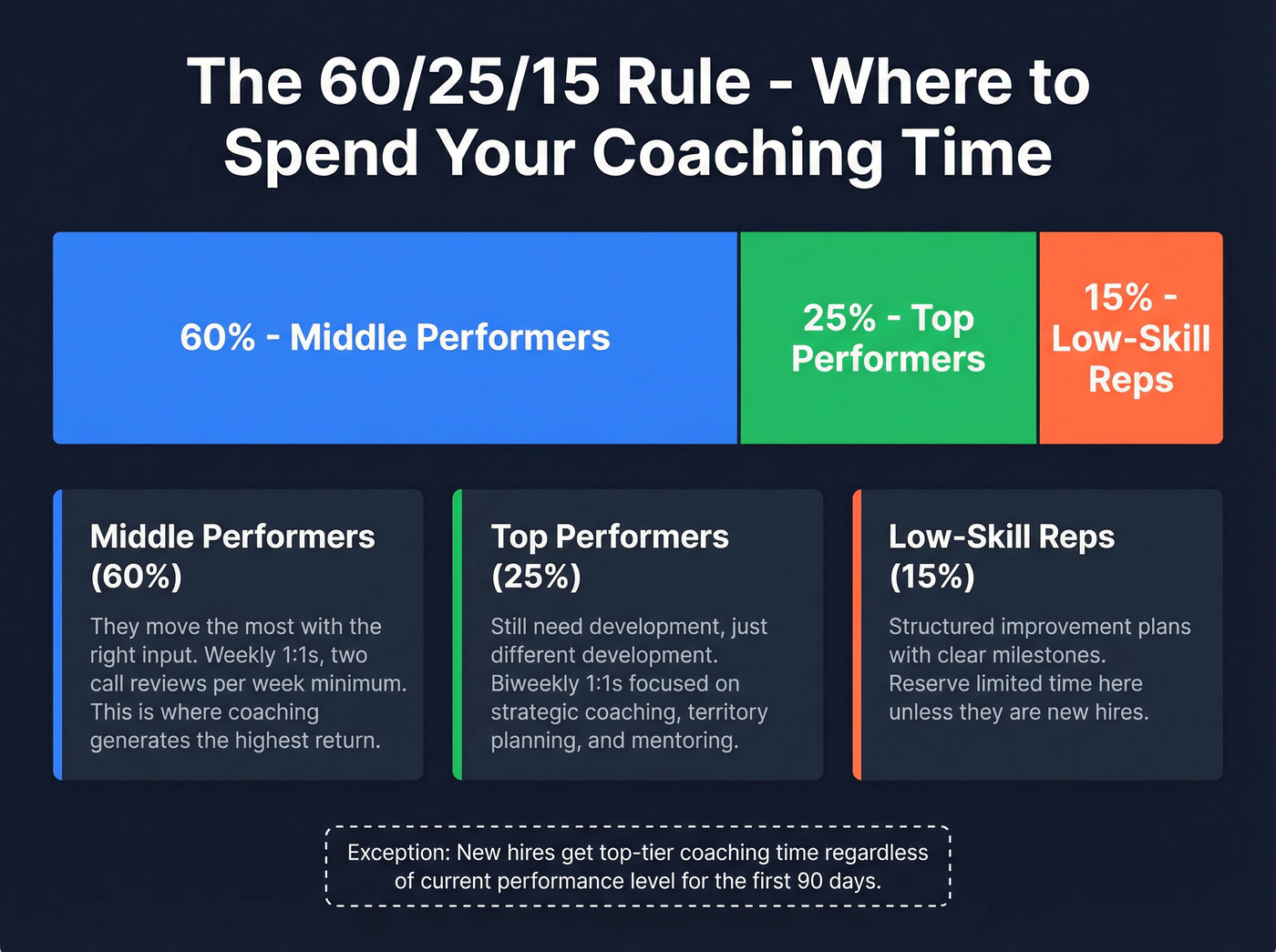
Spend 60% of your coaching time on middle-of-the-pack performers - they move the most with the right input. Give 25% to top performers, who still need development, just different development. Reserve 15% for low-skill reps. New hires temporarily get top-tier time regardless of current performance.
This isn't about abandoning struggling reps. It's about allocating a scarce resource - your time - where it generates the most pipeline.

Coaching technique is wasted when reps dial disconnected numbers and send emails that bounce. Prospeo gives your team 98% verified emails and 125M+ mobile numbers with a 30% pickup rate - so every coached rep actually reaches the buyer they practiced for.
Stop coaching reps to sell, then handing them bad data to sell with.
The Coaching Operating System
Frameworks are useless without execution artifacts. Here are the two templates every sales manager needs, plus a cadence model to tie them together.
Weekly 1:1 Agenda
Copy this, paste it into your calendar invite, and stop winging your 1:1s.
| Block | Time | What Happens |
|---|---|---|
| Check-in | 5 min | Personal/professional rapport. Not optional. |
| Last week's highlights | 10 min | Meetings held, proposals sent, wins, losses |
| This week's priorities | 10 min | Upcoming meetings, proposals, where they need help |
| Pipeline review | 25 min | Rep-led. Start with latest-stage deals. Cover need, solution fit, access to decision-makers, competitive positioning, next steps |
| Performance review | 10 min | Results vs. goal. Rep's forecast vs. plan. Validate realism together. |
Two rules make this work. First, the rep leads the conversation - not the manager. If the manager is doing most of the talking, it's an inspection, not a development session. Second, this meeting never gets canceled. Canceling 1:1s is the fastest way to signal that development doesn't matter. (If your 1:1s keep turning into forecasting, tighten your deal forecast accuracy process separately.)
Call Coaching Scorecard
Buyers now ask an average of 18 questions per sales call, up from 13 in 2022. That rising complexity is exactly why subjective call feedback doesn't cut it anymore. A 25-point scorecard with weighted categories turns vague impressions into measurable improvement.
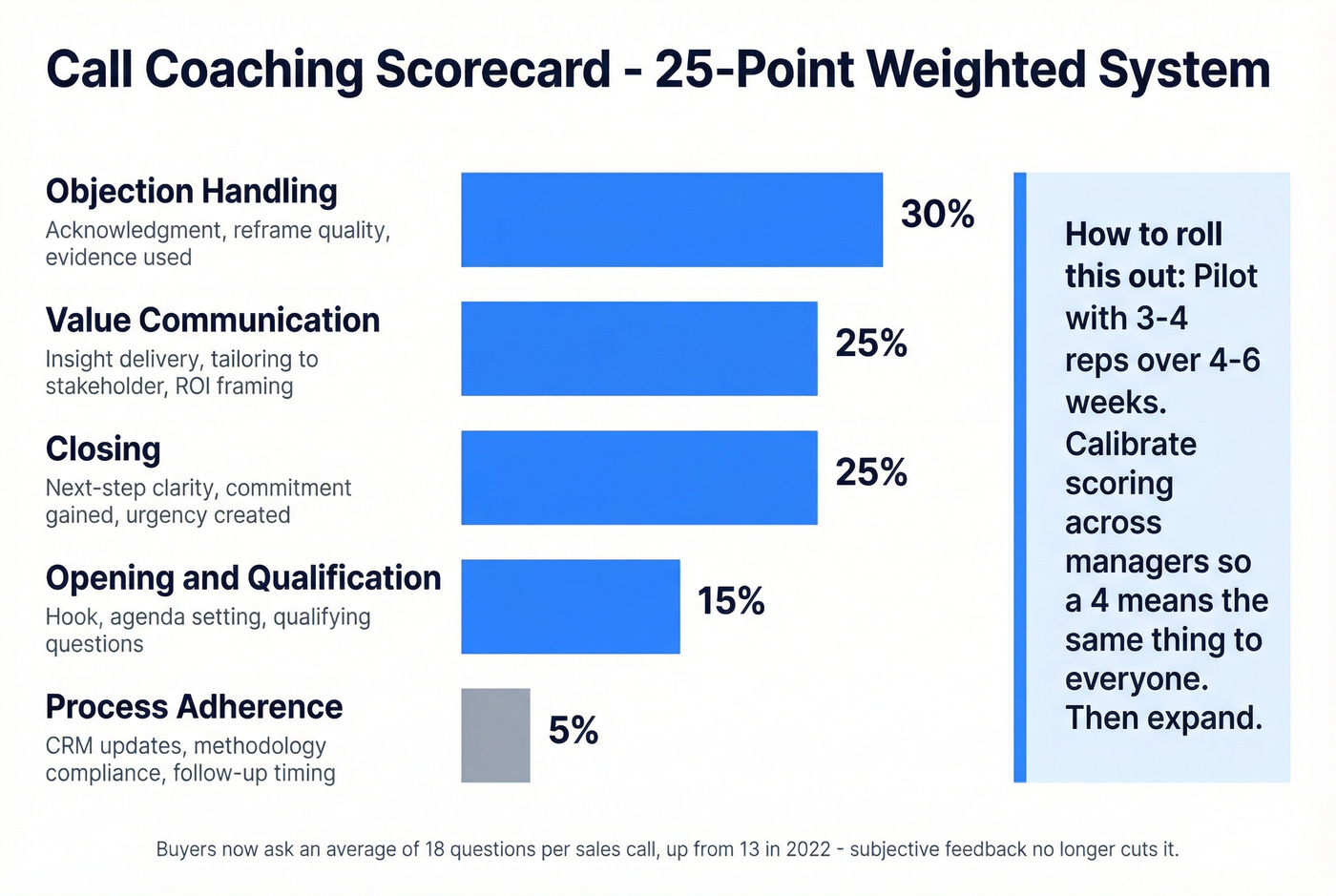
| Category | Weight | What You're Scoring |
|---|---|---|
| Opening/Qualification | 15% | Hook, agenda setting, qualifying questions |
| Value Communication | 25% | Insight delivery, tailoring to stakeholder, ROI framing |
| Objection Handling | 30% | Acknowledgment, reframe quality, evidence used |
| Closing | 25% | Next-step clarity, commitment gained, urgency created |
| Process Adherence | 5% | CRM updates, methodology compliance, follow-up timing |
For discovery calls specifically, score these on a 1-5 scale: understanding the customer's "why," identifying key results and success metrics, mapping competitive solutions, understanding the buying process and stakeholders, building rapport, and creating value in the next step. (If you need better discovery structure, use these discovery call tips.)
Don't roll this out to the whole team on day one. Pilot it with 3-4 reps over 4-6 weeks, calibrate scoring across managers so a "4" means the same thing to everyone, then expand.
Cadence by Rep Level
New hires (first 90 days): Daily check-ins for the first two weeks, then twice-weekly 1:1s with call reviews on every recorded conversation. New hires get disproportionate time regardless of skill level. (Pair this with a repeatable remote sales onboarding plan if your team is distributed.)
Mid-performers: Weekly 1:1s using the full agenda template. Two call reviews per week minimum. This is your 60% - the group where coaching generates the highest return.
Top performers: Biweekly 1:1s focused on strategic coaching - territory planning, enterprise deal strategy, skill expansion. They don't need tactical correction; they need challenge and growth.
Underperformers: Weekly 1:1s with a documented improvement plan. Focus on one skill gap at a time. If three months of focused coaching doesn't move the needle, the problem isn't coachable - skip the coaching and have the harder conversation.
AI and Rep Development
The market is consolidating fast. Clari acquired Salesloft in December 2025, combining roughly $450M in ARR. Highspot and Seismic announced their intent to merge in February 2026. Gartner published its first Magic Quadrant for Revenue Action Orchestration in December 2025, signaling that conversation intelligence, coaching, and forecasting are merging into a single category.
On the adoption side, 36% of sales teams with AI agents already use them for coaching. 88% of reps with AI agents say the technology increases their odds of hitting targets, and sellers who partner with AI tools are 3.7x more likely to meet quota. (If you're evaluating the category, start with an AI sales agent baseline.)
Let's be honest about what AI actually does well here. It surfaces coachable moments brilliantly: flagging calls where talk-to-listen ratio was off, detecting missed objections, summarizing patterns across 200 calls that no manager could review manually. But AI can't build trust with a struggling rep. It can't deliver hard feedback about someone's career trajectory. It can't read the room when a rep is burned out versus undertrained.
Most teams adopt it backwards - they add an AI coaching layer on top of 7 existing tools and wonder why adoption stalls. If your reps are already overwhelmed, another dashboard won't help. Start with a framework and a scorecard. Add AI when the foundation is solid.
Tools and Pricing
You don't need a $100K platform. You need a framework, a scorecard, and two hours a week. Tools amplify good coaching; they don't create it. That said, the right tool at the right stage can meaningfully accelerate results.
| Tool | Best For | Starting Price | Notes |
|---|---|---|---|
| Prospeo | Contact data accuracy | Free tier; ~$0.01/email | 98% email accuracy, 7-day refresh cycle |
| Gong | Conversation intelligence | ~$5K-$50K/yr + ~$1,600/user/yr | 50-seat team: $85K-$130K all-in. 4.8/5 on G2 |
| Clari Copilot | Forecasting + coaching | ~$60-$110/user/mo | Best for revenue teams already on Clari |
| Salesloft (Clari) | Workflow + coaching | ~$100-$150/user/mo | Now part of Clari post-acquisition |
| Outreach | Workflow + coaching | ~$100-$150/user/mo | Strong on sequence analytics |
| Saleshood | SMB coaching | $45/user/mo | Best value full coaching platform |
| Mindtickle | Readiness programs | ~$5,900/yr starting | Best for onboarding and certification |
| Chorus (ZoomInfo) | Budget conversation intel | ~$8K-$30K/yr bundled | 4.5/5 on G2 |
| Revenue.io | Enterprise real-time | ~$85/user/mo | Real-time call guidance |
| HubSpot Sales Hub | CRM-native coaching | ~$100/mo/seat (Pro) | Best if already on HubSpot |
| Forecastio | Analytics-driven coaching | $149/mo | Budget-friendly pipeline analytics |
| Salescamp | Lightweight CRM + coaching | $12/user/mo | Lowest cost entry point |
For most mid-market teams starting out, Saleshood at $45/user/month delivers the best value as a full coaching platform. For enterprise conversation intelligence, Gong remains the standard - but budget $85K+ for a 50-seat team. For startups watching every dollar, Salescamp at $12/user/month gets you started without sticker shock.
How to Choose
Per G2's evaluation framework, the criteria that actually matter are conversation intelligence quality (talk-to-listen ratios, keyword detection, scoring), AI automation depth (call summaries, objection detection, pattern alerts), customization (playbooks, scorecards, onboarding paths), collaboration features (shared feedback, call libraries), and multi-method support (call coaching, video, roleplay, templates). If a tool is strong on conversation intelligence but weak on customization, you'll outgrow it within two quarters.
The Data Quality Layer
Here's something coaching tool vendors won't tell you: conversation intelligence tools analyze what happens on calls, but if 30% of your reps' calls go to voicemail because numbers are stale, you're coaching on a fraction of their actual performance. We've seen teams invest $80K in Gong only to realize their reps weren't reaching enough prospects to generate meaningful call data in the first place. Tools like Prospeo - with a 7-day data refresh cycle and 98% email accuracy - close that gap so managers see a complete picture of call performance rather than a sample biased by bad data. (If you want the benchmarks behind this, start with B2B contact data decay.)
If you're seeing high bounce rates, fix deliverability first with an email verifier and a repeatable email verification list SOP. (Start with an email checker tool or a full email deliverability checklist.)
Reps already spend 60% of their time on non-selling tasks. Bad contact data makes it worse. Prospeo's 7-day data refresh and 5-step verification mean your coached reps spend time in conversations, not chasing dead leads at $0.01 per email.
Give your team data as sharp as your coaching framework.
Measuring Coaching Impact
The 43% vs. 56% win rate gap by coaching hours is your north star metric. But you need leading indicators too.
Track these monthly:
- Win rate - the ultimate output metric. Segment by rep and by coaching hours received.
- Ramp time - how fast new hires reach full quota. Effective coaching should compress this by 20-30%. (If you're building a formal onboarding motion, use a structured SDR training program.)
- Quota attainment distribution - are more reps clustering near 100%, or is it bimodal with a few crushers and many misses?
- Deal velocity - average days from opportunity creation to close. Coaching on deal strategy should tighten this. (If velocity is stuck, diagnose it with a sales cycle acceleration review.)
- Rep retention - coached reps stay longer. Track 12-month retention rates for coached vs. uncoached cohorts.
- Call score improvement - if you're using the scorecard above, track average scores over 90-day windows. Improvement should be visible by week 6-8.
- Session frequency - measure whether managers are actually holding 1:1s. The 8% performance lift only materializes if coaching actually happens consistently.
One thing most measurement frameworks miss: wellbeing. 70% of sellers struggle with mental health. Check in on how reps are doing - not just how their numbers look - during every 1:1. A rep who's burned out won't absorb feedback no matter how good your framework is.
Get Started This Week
If your team has no formal coaching program, don't try to implement everything at once. Three steps, this week: pick one framework (GROW is easiest for beginners), schedule recurring weekly 1:1s with every direct report, and use the call scorecard above on your next two call reviews. The benefits of sales coaching accumulate through consistency, not complexity - two hours of structured development per week will outperform a $50K platform that nobody uses.
If your coaching is focused on outbound, pair this with a dedicated cold call coaching plan and a modern B2B cold calling guide so reps practice on the right talk tracks.
FAQ
What's the difference between sales coaching and sales training?
Training is group-based knowledge transfer - onboarding, SKOs, product certification. Coaching is ongoing 1:1 skill development tied to observed behavior and specific deals. Training teaches what to do; coaching teaches how to do it better based on real performance.
How often should managers coach their reps?
Weekly 1:1s are the minimum effective dose. Teams with 2+ hours of structured weekly coaching achieve 56% win rates versus 43% for teams under 30 minutes. Flex the cadence by level - daily for new hires, weekly for mid-performers, biweekly for top performers.
What's the ROI of a coaching program?
Gartner research shows an 8% performance lift from effective coaching - that's $800K in incremental revenue on a $10M quota team. The real ROI compounds through retention, reducing the $150K+ cost of replacing each departed sales hire.
Do I need expensive software to coach effectively?
No. A framework, a call scorecard, and consistent 1:1s matter more than any platform. Saleshood starts at $45/user/month for structured coaching. Salescamp starts at $12/user/month for tight budgets. Gong runs $85K+ for 50 seats. Tools amplify coaching - they don't replace it.
How does contact data quality affect coaching outcomes?
Reps coached on perfect technique still fail if they're calling disconnected numbers or emailing invalid addresses. Clean, frequently refreshed data ensures coached skills reach real prospects - not voicemail boxes. Bad data creates a blind spot that makes coaching ROI impossible to measure accurately.