SDR Job Progression: Real Numbers, Real Timelines, Real Career Paths
You've been an SDR for 14 months. You've hit quota four out of five months. Your manager keeps saying "keep it up" but won't give you a promotion timeline. Sound familiar? 52% of companies report average SDR tenure under one year, and the biggest driver is simple: people leave orgs that don't have a plan for them.
Here's what the path actually looks like beyond "keep it up" - with real comp data, real timelines, and the career fork that's reshaping the role in 2026.
The Quick Version
- Median SDR OTE: $85,000 on a ~$60k base
- Target promotion window: 12-18 months
- Three paths worth serious consideration in 2026: AE for the highest OTE ceiling, RevOps for analytical leverage, or GTM Engineer to build automated prospecting systems with tools like Clay and n8n
If you're past 18 months with no written promotion timeline, start interviewing externally. The data supports it.
SDR Compensation in 2026
RepVue's February 2026 dataset gives us the clearest snapshot available:
| Metric | Amount |
|---|---|
| Median Base (US) | $60,000 |
| Median OTE (US) | $85,000 |
| Top Performer Comp | $129,300 |
| Quota Attainment | 55.4% |
City-level, Seattle leads at $70k base / $100k OTE. San Francisco and New York both sit around $60k base / $90k OTE. Lower cost-of-living markets? Expect $50k-$55k base. US-specific OTE skews higher - closer to $91,600 - so your mileage depends on whether you're looking at global or domestic benchmarks.
One structural note worth flagging: the best comp plans run a 60-70% base component. If your plan is 50/50 or worse, you're carrying disproportionate risk for a role that's supposed to be a launchpad, not a destination. The fully loaded cost of an SDR runs $100k+ when you factor in tools, management, and training - your employer is investing more than your paycheck suggests.
The Year-by-Year Ladder
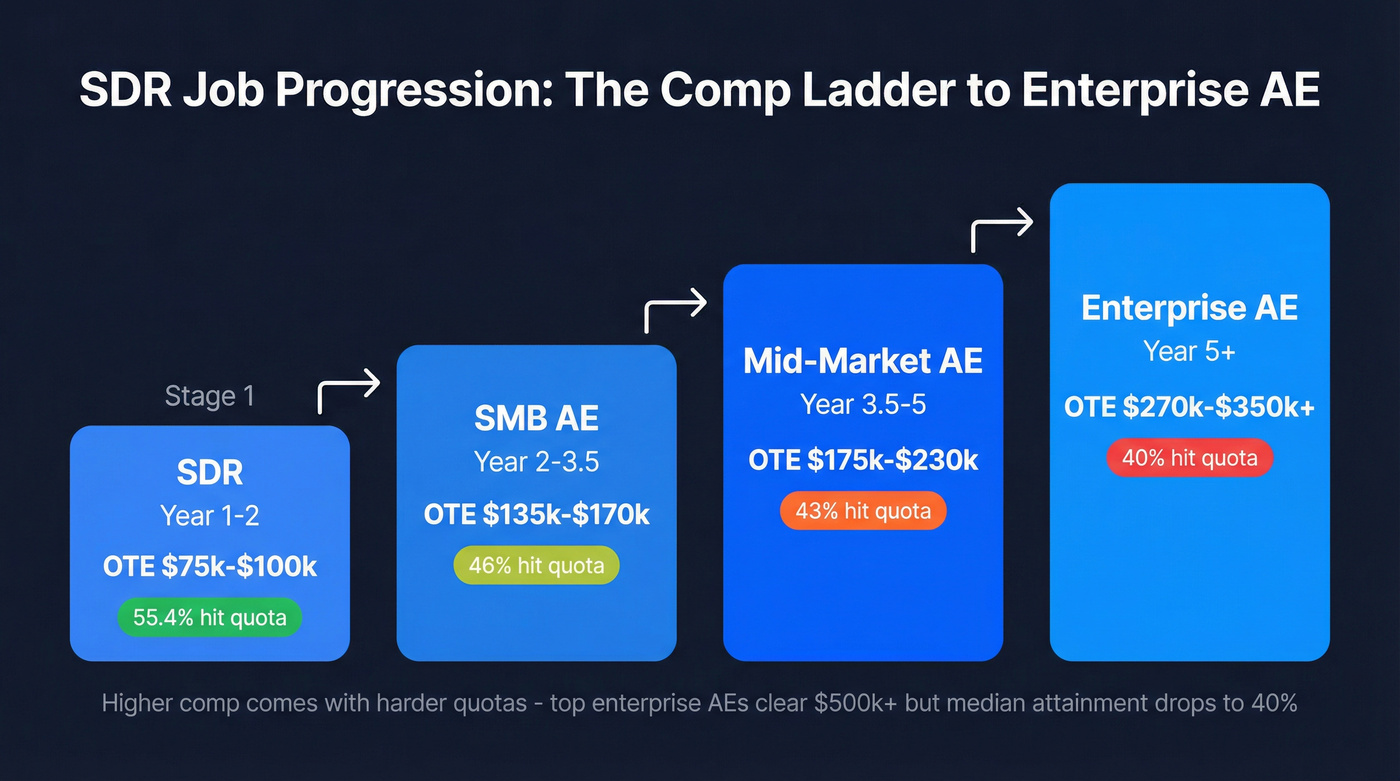
The AE track remains the most common progression, and the comp jumps are real. But so is the quota pressure.
| Stage | Timeline | OTE Range | Quota Attainment |
|---|---|---|---|
| SDR | Year 1-2 | $75k-$100k | 55.4% |
| SMB AE | Year 2-3.5 | $135k-$170k | 46% |
| Mid-Market AE | Year 3.5-5 | $175k-$230k | 43% |
| Enterprise AE | Year 5+ | $270k-$350k+ | 40% |
Notice the pattern: the higher you climb, the harder quota gets. At the enterprise level, only 40% of AEs hit their number. Top performers clear $500k+ with accelerators, but the median experience is a grind. Staying in an SDR role past 24 months without a title change sends a signal to future employers - and it's not the one you want.

The SDRs who get promoted at month 14 aren't just dialing harder - they're generating higher-quality pipeline. Prospeo gives you 98% verified emails and 125M+ direct dials so every touch actually reaches a decision-maker. Bounce rates under 4%, connect rates that make your manager notice.
Hit quota consistently with data that actually connects. Free tier, no sales call required.
Six Career Paths Beyond SDR
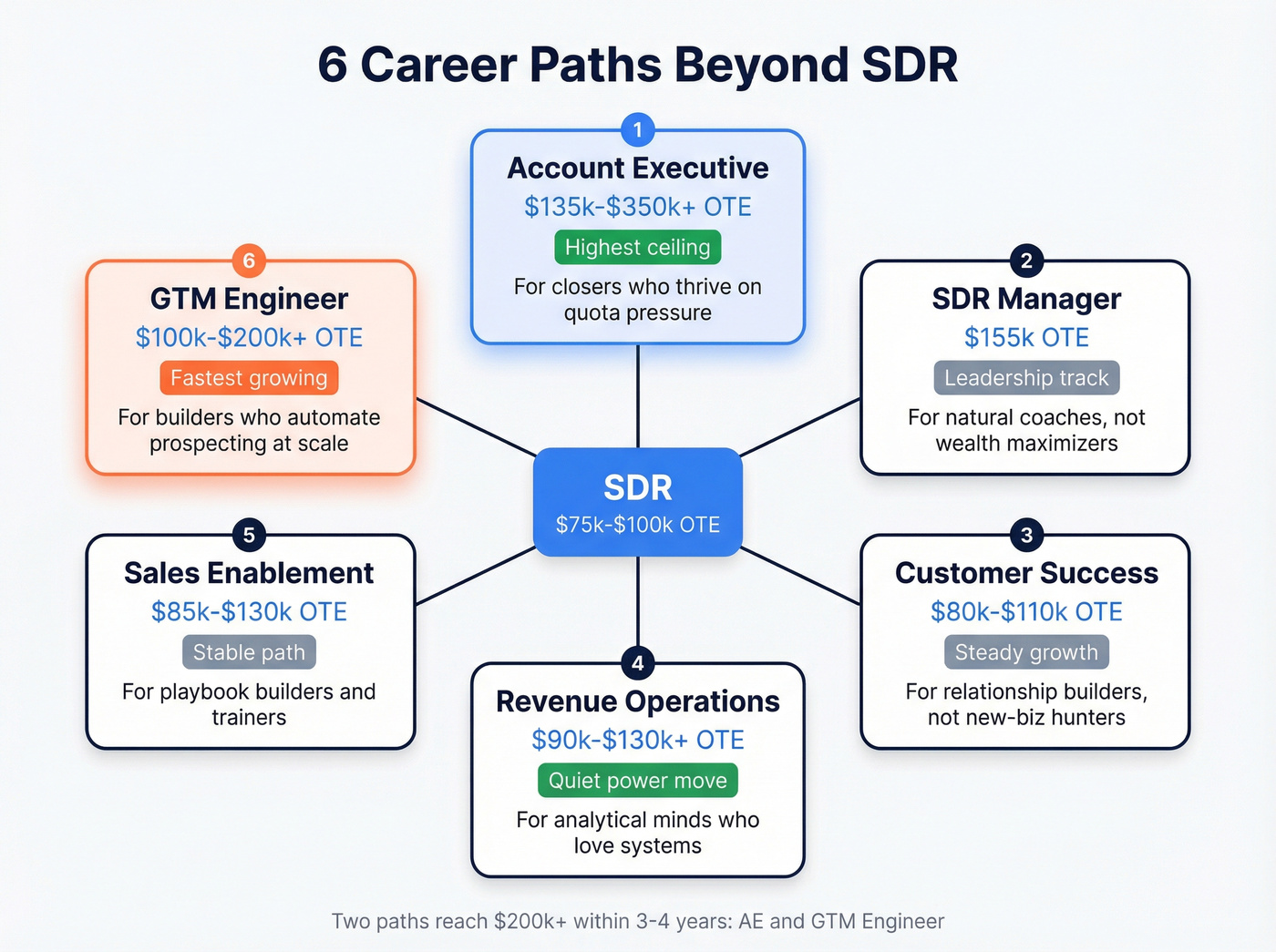
Most guides treat these paths equally. They're not. Two lead to $200k+ within 3-4 years - AE and GTM Engineer. The rest are solid careers but slower climbs.
Account Executive
The AE path is the default for a reason: it has the highest OTE ceiling in sales, period. If you thrive on closing and can stomach carrying a number for the next decade, this is your track. OTE ranges from $135k at SMB to $350k+ at enterprise, and the SDRs who transition fastest are the ones who already shadow discovery calls and understand deal mechanics before they ever get the title. We've seen this pattern repeatedly - the SDR who asks to sit in on a mid-market disco call at month six is the one who gets promoted at month fourteen.
If the idea of perpetual quota pressure makes you miserable, keep reading.
SDR Manager
This one's for natural coaches who get energy from developing people. Skip it if you want to maximize personal comp. SDR Manager OTE sits at $155k on a $105k base, with 63% quota attainment. It's a leadership track, not a wealth track.
Customer Success Manager
CSM comp runs $80k-$110k total, with expansion revenue bonuses pushing higher at orgs with strong upsell motions. The best CSMs eventually move into strategic account management, where comp approaches AE territory. Skip this if you need the adrenaline of closing new business.
Revenue Operations
Revenue Operations is the quiet power move. If you're analytically minded and want to influence the entire GTM motion without carrying a closing quota, this path scales beautifully - $90k-$130k to start, growing into senior roles that touch every part of the revenue engine. The SDRs who transition here are usually the ones who obsess over CRM hygiene and pester RevOps about how they score leads.
Sales Enablement
For the SDR who loves building playbooks, training programs, and process. Enablement roles pay $85k-$130k and grow more slowly than quota-carrying positions, but they offer stability and cross-functional influence. Skip this if you want a fast comp ramp.
GTM Engineer
The newest path - and the one reshaping the SDR function fastest. Comp range: $100k-$200k+ within 2-3 years for strong builders. Keep reading.
The Career Fork: Human vs. Machine
ColdIQ's analysis nailed the split that's been building since 2025: the generalist SDR role is forking into two distinct tracks.

Path one: double down on human skills. Cold calling, complex stakeholder conversations, relationship building, multi-threading into accounts. This path rewards charisma, persistence, and political savvy. It leads naturally to the AE track.
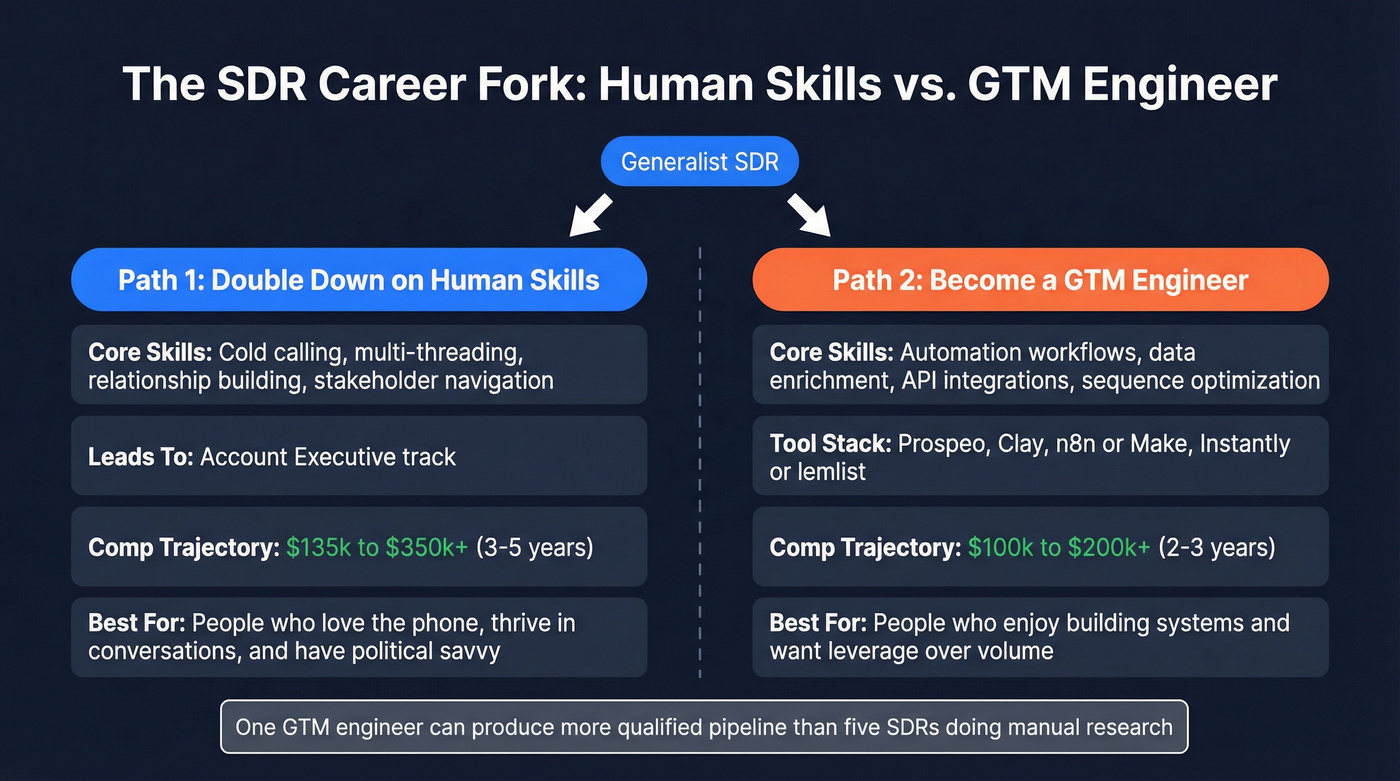
Path two: become a GTM Engineer. Build automated prospecting systems that generate qualified pipeline at scale. One GTM engineer can produce more qualified leads than a team of five SDRs doing manual research. The tool stack typically includes Prospeo for verified emails and direct dials, Clay for enrichment workflows, and Instantly or lemlist for sequencing - wired together with n8n or Make.
Let's be honest: most SDRs don't need to agonize over this choice. If you can write a basic automation workflow and enjoy it, go GTM Engineer. The supply of people who can do this well is tiny relative to demand. If you'd rather pick up the phone and work a room, go AE. The SDRs who stall at 24 months with no clear next step are almost always the ones who tried to stay generalists in a market that's rewarding specialists.
Red Flags Your Org Is a Dead End
Not every company deserves your best 18 months. Here's what to watch for:
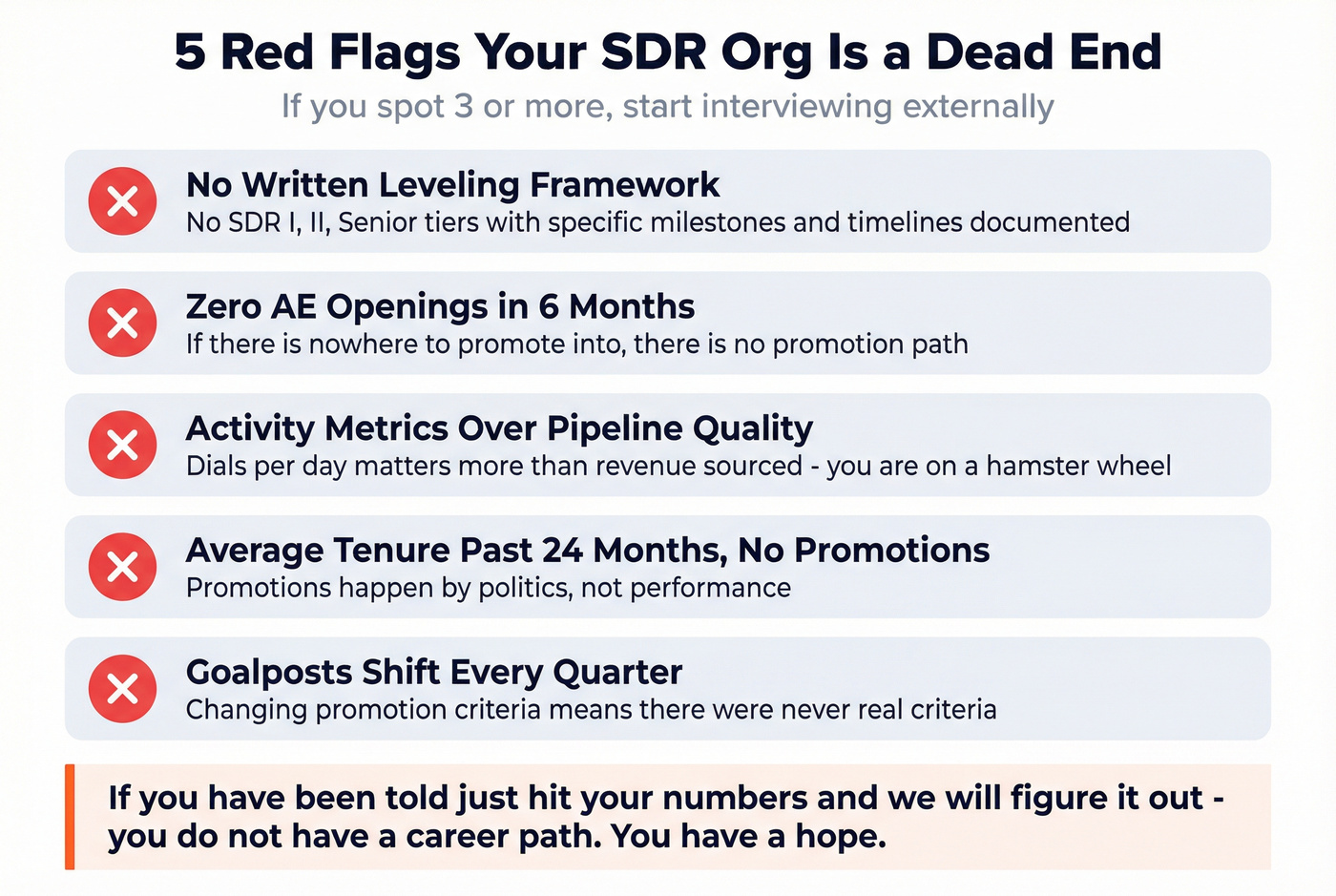
- No written leveling framework. SDR I, II, Senior - with specific quota thresholds, skill milestones, and timeline expectations. If your org can't show you this document, it probably doesn't exist.
- Zero AE openings in the last six months. Where exactly are you supposed to get promoted to?
- Activity-metric obsession. Dials per day matters more than pipeline quality. This is a hamster wheel, not a career path.
- Average SDR tenure past 24 months with no promotions. A clear sign the org promotes on politics, not performance.
- Goalposts that shift quarterly. "We changed the promotion criteria" is management-speak for "we never had real criteria."
If you've been told "just hit your numbers and we'll figure it out," you don't have a career path. You have a hope.
How to Accelerate Your Promotion
The SDRs who get promoted aren't the ones with the most dials. They're the ones with the cleanest pipeline. Here's what actually moves the needle.
Document wins with data, not activity volume. "I sourced 14 opportunities worth $380k in pipeline last quarter" beats "I made 2,000 calls" every single time. Track your pipeline contribution religiously - in a spreadsheet, in your CRM notes, wherever. When the promotion conversation happens, you want receipts, not stories.
Master your prospecting stack. SDRs who verify their contacts before handoff and bring data-quality skills to the AE interview stand out immediately. It signals you think about pipeline, not just activity. The r/sales consensus backs this up - threads consistently mention that SDRs who understand their tools get promoted faster than pure dialers.
Build cross-functional relationships early. Get on the AE interview loop. Shadow discovery calls. Ask RevOps how they score leads. SDRs who understand the full funnel get promoted because they already think like the next role - and hiring managers notice the difference between someone who books meetings and someone who understands why those meetings matter to the business.
Pipeline quality over activity metrics. If your org rewards dials over outcomes, optimize for outcomes anyway and make the results visible. The numbers will speak for themselves.
Going the GTM Engineer route? Prospeo plugs directly into Clay, n8n, Make, and Instantly - the exact stack reshaping the SDR function. Our API returns 50+ data points per contact at a 92% match rate, so your automated workflows produce pipeline, not bounces.
One GTM engineer with verified data outperforms five SDRs with bad lists.
FAQ
How long should an SDR stay in role?
Target 12-18 months. If you've consistently hit quota for 12+ months and there's no promotion timeline, start interviewing externally. Staying beyond 24 months without advancement signals stalling to future employers, not experience-building.
Can I skip the AE path entirely?
Absolutely. RevOps, GTM Engineering, and Sales Enablement are all viable exits that don't require carrying a closing quota. RevOps and GTM Engineering in particular can reach $150k-$200k+ comp within 3-4 years for strong performers.
What tools should SDRs learn to accelerate their career?
Focus on your prospecting and data stack: a verification tool like Prospeo for clean emails and direct dials, your CRM (Salesforce or HubSpot), and a sequencing tool like Instantly or lemlist. SDRs who bring data-quality skills to the promotion conversation stand out because it signals they think about pipeline health, not just volume.
What's the fastest path to $200k+ comp?
The AE track and GTM Engineer track both reach $200k+ within 3-4 years. AE requires closing skills and quota tolerance. GTM Engineering requires automation proficiency with tools like Clay, n8n, and a solid data layer. Both are viable - pick the one that matches how you actually like to work.