Warm Email vs Cold Email: What the Data Actually Says
"I'm TIRED of cold emails and want to get into warm emailing instead, but I'm feeling pretty lost." That's a real post from r/DigitalMarketing, and it captures what thousands of sales teams are wrestling with right now. Another seller put it more bluntly: "Sales influencers say they made millions by cold calling, but they're like just 1% of the sellers out there... what should I focus on, warm or cold?"
The warm email vs cold email debate frames them as competing strategies. They're not. They're different stages of the same pipeline. But the data behind each one matters enormously - and most guides either cherry-pick the best-case numbers or lump everything together into useless averages.
Here's what we're working with: real benchmarks, real costs, real decision criteria.
The Quick Version
- Cold email is your fastest path to pipeline if you've got no inbound traffic - but only if your data's clean and your domain is warmed (see how to warm up an email address). Average reply rate: 3.43%. Top performers: 10.7%+.
- Warm email converts 3-6x better (10-30% response rates) but requires existing leads to nurture. It's a conversion engine, not a lead generation engine.
- The real strategy: use cold email to fill the funnel, then warm those leads into buyers. Either way, data quality matters more than your subject line - 16.9% of cold emails never reach the inbox.
How Cold and Warm Email Actually Differ
Most people get this wrong. They think personalization makes an email "warm." It doesn't. HyperGen's analysis of 100+ B2B campaigns nails it: you can spend 20 minutes researching someone and it's still a cold email if they don't know you exist.

Cold email means the recipient has zero prior relationship with you. No opt-in, no previous interaction, no awareness of your brand. You're interrupting their day.
Warm email means the recipient already knows who you are - they subscribed to your newsletter, downloaded a whitepaper, attended your webinar, signed up for a trial, or engaged with your content. The trust-building phase is already done, or at least started. Every warm email builds on that existing familiarity.
That distinction changes everything: response rates, deliverability risk, cost structure, and the kind of sales CTA you can get away with.
| Cold Email | Warm Email | |
|---|---|---|
| Definition | No prior relationship | Prior interaction exists |
| Response rate | 1-5% (avg 3.43%) | 10-30% |
| Conversion rate | 0.2-2% | 5-15% (qualified) |
| Cost per lead | $0.15-$2.50 | 62% lower than outbound avg |
| Time to launch | Days | 2-4 weeks warming |
| Scalability | High (volume play) | Limited by lead pool |
| Deliverability risk | High (7-8% bounce) | Low (under 2% bounce) |
| Best for | New markets, pipeline gen | Nurture, reactivation |
Cold Email Performance Benchmarks in 2026
What the Data Shows
Instantly's 2026 benchmark report analyzed billions of cold email interactions across thousands of active workspaces. The headline numbers:

- Average reply rate: 3.43%
- Top 25% of senders: 5.5%+
- Top 10% ("elite") senders: 10.7%+
- 58% of all replies come from the first email in a sequence
- Optimal sequence length: 4-7 touchpoints
- Best-performing emails are under 80 words with a single CTA
- Wednesday delivers the highest engagement; Monday is the best day to launch new sequences
The trend isn't great, either. Open rates dropped from ~36% in 2023 to 27.7% in 2024. Reply rates fell from ~7% to 5.1% over the same period. The bar keeps rising.
But here's the counterweight: Sopro's data shows 81% of sales and marketing decision-makers engage with cold outreach when it's tailored to their company. The problem isn't that cold email doesn't work. It's that most cold email is terrible.
What Practitioners Actually See
A Reddit operator running 100K+ sends per month reports a ~1.6% reply rate at scale. Their take? "That's real, unfiltered, at scale. And it just prints $$."
The math: 1.6% of 100,000 = 1,600 replies. Compare that to an "elite" 10.7% rate on 1,000 sends = 107 replies. Volume at a solid rate beats a high rate on a tiny list every single time.
That same operator shared a hierarchy of what actually moves the needle, from most to least important:
- Deliverability - are your emails reaching the inbox? (Use an email deliverability checklist, not vibes.)
- List quality - are you emailing the right people with valid addresses? (Fix this with an email verification list SOP.)
- Relevance / message-market fit - does your offer match their problem?
- Offer - is what you're selling compelling?
- Personalization - the thing everyone obsesses over first
Personalization only moves the needle when everything above it is already working. Most teams have it backwards.


The article's clear: deliverability and list quality matter more than personalization. With 16.9% of cold emails never reaching the inbox, bad data is the silent killer. Prospeo's 98% email accuracy and 7-day refresh cycle mean your cold sequences actually land.
Stop optimizing subject lines on emails that bounce.
Warm Email Performance and ROI
Warm email lives in a different universe.
HubSpot's latest benchmarks put opt-in email open rates at 42.35%. MailerLite's data from 3.6 million campaigns shows 43.46% open rates and a 6.81% click-to-open rate. Compare that to cold email's 27.7% open rate and you see why warm email feels like a cheat code.
Response rates for genuinely warm leads - people who've downloaded your content, attended a webinar, or started a trial - run 10-30%. Conversion rates for qualified warm leads sit around 5-15%, compared to cold email's 0.2-2%.
The ROI math tells the story. Email marketing (primarily warm/opt-in) returns $36-$40 for every $1 spent. The top 18% of companies hit $70+ per dollar. No other channel comes close - SEO returns ~$22 per dollar, paid search ~$17.
Here's what gets left out of the warm email pitch: warm email can't generate leads. It can only convert them. If your pipeline is empty, the world's best nurture sequence won't save you. You need cold outreach - or inbound - to create the leads that warm email converts.
When to Use Which: The Decision Framework
When Cold Email Makes Sense
Use cold email when you're:
- Entering a new market where nobody knows your brand yet
- Running with limited inbound traffic - you can't nurture leads you don't have
- Testing a new offer and need fast signal on message-market fit
- Working a clearly defined ICP where you can build targeted lists
The volume math works in your favor. Even at a 1.6% reply rate, 10,000 well-targeted cold emails per month generates 160 conversations. That's pipeline you didn't have yesterday.
Skip cold email if you haven't warmed your domain, can't commit to 4-7 touchpoints per prospect, or don't have clean data. One-and-done cold email is a waste of everyone's time - 48% of reps never send a follow-up, and they're leaving 80% of potential replies on the table.
When Warm Email Wins
Use warm email when you've got:
- Consistent inbound traffic generating opt-ins, trial signups, or content downloads
- Long sales cycles where prospects need multiple touches over weeks or months (see SaaS sales cycle benchmarks)
- Strong content assets you can use as value-adds in nurture sequences (build them into lead nurturing emails)
Inbound leads cost 62% less than outbound leads on average. Nurtured leads are more likely to become long-term customers with higher lifetime value. If you've got the lead pool, warm email is your highest-ROI channel. Period.
The Hybrid Approach (What Actually Works)
Here's the thing: if your average deal size is under $10k, you probably don't need a sophisticated warm email platform. You need clean cold outreach feeding a simple nurture sequence in your existing CRM. The teams overcomplicating this are the ones stalling.
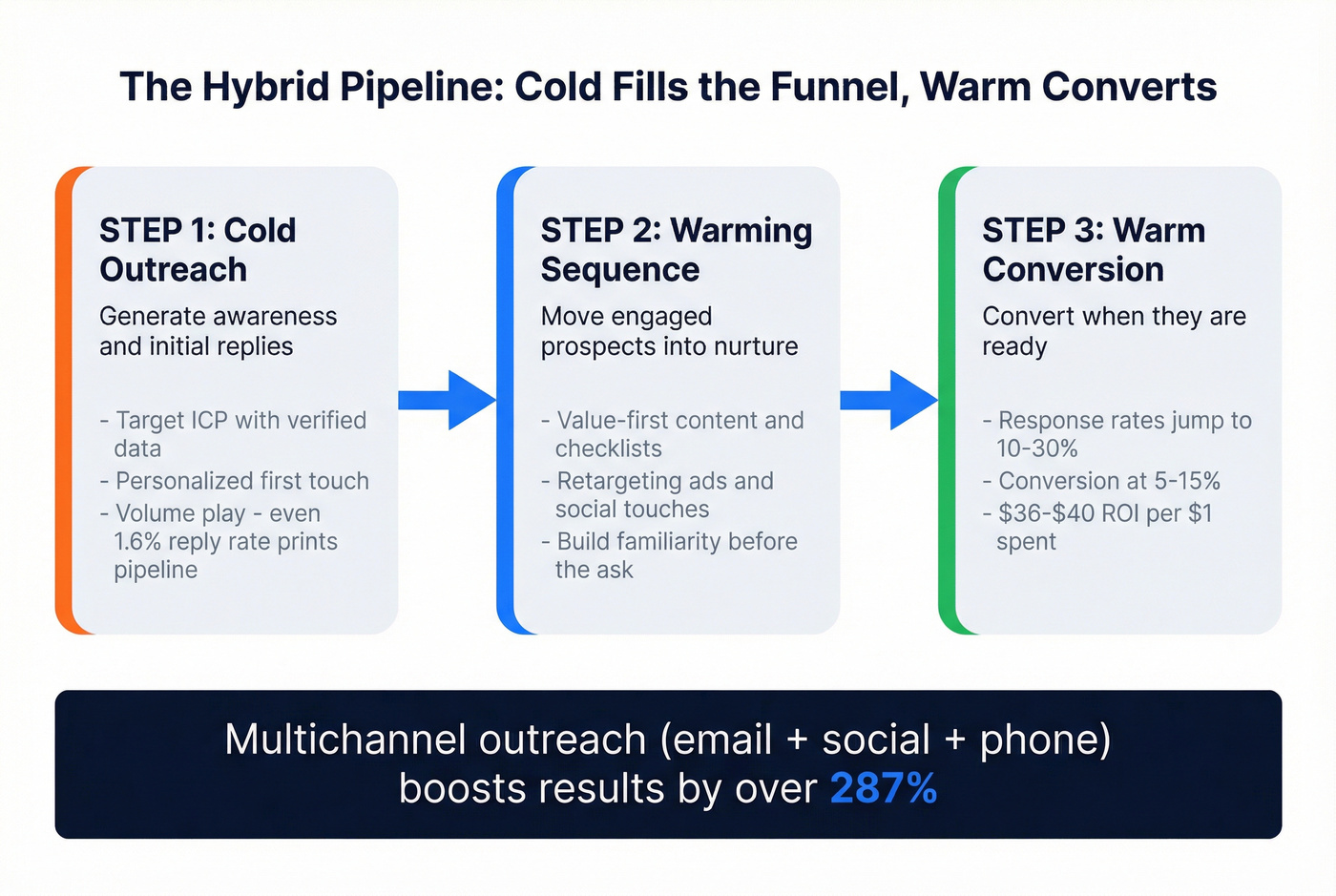
The best teams don't choose between cold and warm. They build a pipeline where cold outreach fills the top of the funnel, and warming converts those leads into buyers.
Step 1: Cold outreach generates awareness and initial replies. Step 2: Responders and engaged prospects get moved into warming sequences - value-first content, retargeting ads, social engagement. Step 3: Warm email converts them when they're ready.
We've seen this pipeline approach outperform pure cold or pure warm strategies consistently. Multichannel outreach (email + social + phone) boosts results by over 287%. Read that number again. The compounding effect of multiple touchpoints across channels is the single biggest lever most teams ignore.
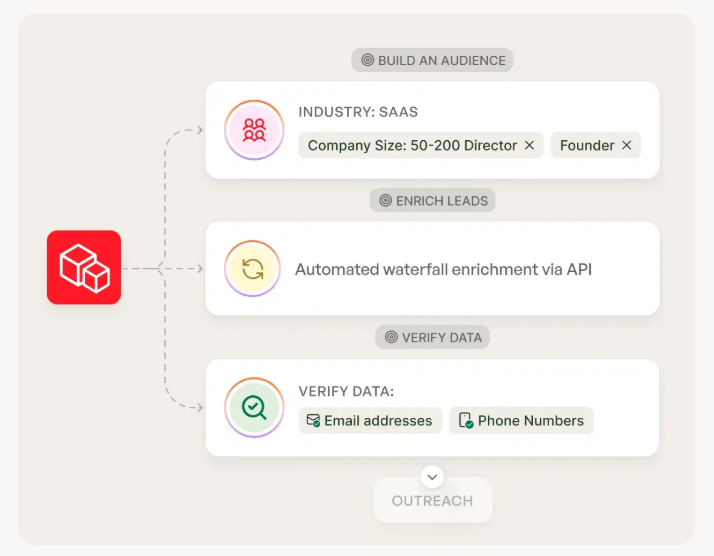
The Data Quality Problem Nobody Talks About
Stop optimizing your subject lines. Start optimizing your data.

16.9% of cold emails never reach the inbox. The average bounce rate for cold email runs 7-8%, compared to under 2% for opt-in lists. Every bounced email damages your sender reputation, which tanks deliverability for every subsequent send. It's a death spiral.
And the enforcement environment keeps tightening. Google, Yahoo, and Microsoft all enforce bulk sender rules: SPF, DKIM, and DMARC authentication are required. Spam complaints must stay under 0.3%. Bounces must stay under 2%. Break these thresholds and your domain reputation takes months to recover (here’s a deeper explainer on SPF DKIM & DMARC).
This is where most cold email campaigns actually fail. Not bad copy. Bad data. I've watched teams burn through three domains in a month because they skipped verification.
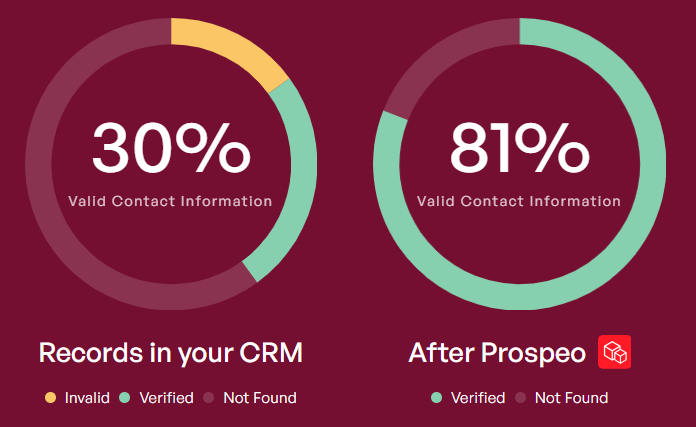
Prospeo's 5-step verification catches problems before they damage your sender reputation - catch-all handling, spam-trap removal, honeypot filtering, the stuff generic verification tools miss. The result: 98% email accuracy at ~$0.01 per verification, compared to the $0.02-$0.05 industry average. Stack Optimize built their agency to $1M ARR on that data, maintaining 94%+ deliverability and under 3% bounce across all clients. When your business model depends on sending cold email for clients, you don't gamble on data quality.
How to Turn Cold Leads Into Warm Leads
The 5-Step Warming Process
Most cold outreach fails because it tries to close too fast. The goal of the first touch isn't to sell - it's to start a conversation.
1. Target ICP matches with verified data. Before you send anything, make sure you're reaching the right person at a valid address. Prospeo's enrichment returns 50+ data points per contact with an 83% match rate - job title, company size, tech stack, intent signals - so your targeting is precise before the first email goes out.
2. Lead with a personalized entry point about them, not you. Reference their company's recent funding round, a job posting that signals a problem you solve, or a specific challenge their industry faces. If the line could be copy-pasted to anyone, it's useless.
3. Deliver value before you ask for anything. Send a relevant checklist, a short video walkthrough, or an industry-specific tip. This is the warming step most people skip - and it's the one that matters most.
4. Run a light nurture sequence that matches the tone of your first touch. Don't go from casual and helpful to corporate and salesy. Consistency builds trust.
5. Close with a clear, specific next step. Not "let me know if you're interested." Instead: "Want the intro doc?" or "Can I send the 2-minute walkthrough?" Micro-asks convert better than calendar requests.
Multichannel Warming Tactics
96% of website visitors aren't ready to buy. So don't treat every cold lead like they should be.
Run retargeting ads to cold leads on social media before your email hits their inbox. When they see your brand twice before opening your email, the "cold" label starts to melt. Short personalized video in warm emails can boost engagement further - Jostle saw measurable lifts using this approach.
Direct questions boost replies by 5x compared to "just checking in." Ask something specific: "Are you still evaluating [category]?" or "Did the report help?"
Segment your cold leads by recency, industry, and interest level (use a real framework for how to segment your email list). A one-size-fits-all nurture sequence is barely better than no nurture at all.
Templates That Actually Work
Cold Email Templates
81% of emails are now opened on mobile - another reason every template below stays under 80 words with a single CTA.
Template 1: Value-First Cold Outreach
Subject: [Their company] + [specific problem] (6-8 words)
Hi [First name],
[One sentence about their specific situation - a job posting, funding round, or industry challenge].
We help [similar companies] [specific outcome]. Quick example: [one-line proof point].
Worth a quick look?
[Your name]
Why this works: Under 80 words. Single CTA. The subject line is 6-10 words (the sweet spot for open rates). "Worth a quick look?" is a soft micro-ask that gets more replies than "Book a 30-minute call." Avoid spam trigger words like "free," "discount," and ALL CAPS in your subject line - they'll tank deliverability before anyone reads your brilliant copy.
Template 2: Follow-Up That Adds New Value
Subject: Re: [original subject]
[First name] - figured this might be useful regardless.
[Link to relevant resource, data point, or short insight about their industry].
No pitch. Just thought of you when I saw it.
[Your name]
Why this works: Framed as a reply (which outperforms formal reminders by ~30%). Adds new value instead of "just following up." 60-70% of replies come after email #3 or #4, so this follow-up isn't optional - it's where most of your results live.
Warm Email Templates
Template 1: Trial User / Content Subscriber Re-engagement
Subject: Your [resource/trial] - next step? (under 50 chars)
Hi [First name],
You [downloaded X / started a trial / attended our webinar on Y] [timeframe].
Most teams at [their company size/stage] use that as a starting point for [specific outcome]. Here's what the next step usually looks like: [one sentence or short link].
Want me to walk you through it?
[Your name]
Why this works: References their specific past interaction. Subject line under 50 characters (33% of recipients open based on subject line alone). The CTA is a micro-ask, not a calendar grab.
Template 2: Warm Lead Who Went Cold
Subject: Still thinking about [topic]?
[First name] - we talked [timeframe] about [specific topic].
Since then, [one new development - new feature, case study, or industry shift that's relevant to their original interest].
Thought it was worth flagging. Still on your radar?
[Your name]
Doesn't pretend the gap didn't happen. Adds a new reason to re-engage instead of guilt-tripping. Short, direct, human.
What Cold Email Actually Costs
The cost question is where most teams get surprised. Here's the real breakdown:
| Cost Category | Range | Notes |
|---|---|---|
| Agency retainer | $4,000-$8,000/mo | Full-service cold email |
| Setup fees | $1,500-$5,000 | One-time, domain + infra |
| List building | $0.15-$2.50/lead | Quality varies wildly |
| Tool subscriptions | $100-$400/user/mo | Sequencer + data + warmup |
| Email verification | $0.02-$0.05/address | Industry average |
| Pay-per-appointment | $500-$1,000 | Agency model |
| Hidden costs | +30-50% on base | Domains, warmup, monitoring |
For DIY cold email, expect to spend $50-$200 per booked meeting once you factor in tools, data, and time. That's competitive with most channels - but only if your data's clean and your deliverability is solid.
Warm email costs less per lead but requires a 2-4 week warming investment per batch. The tradeoff: lower marginal cost, higher upfront time. For context, email marketing overall returns $36-$40 per $1 spent - the highest ROI of any digital channel.
Mistakes That Kill Your Cold Emails
1. Writing novels instead of emails. Under 80 words. Single CTA. If it doesn't fit on one screen, it dies.
2. Fake familiarity. "Saw you liked a post about AI :)" fools nobody. If your personalization could apply to anyone, delete it.
3. Sending one email and quitting. 80% of cold email replies come after the second touch. Yet 48% of reps never send a follow-up. The sequence is the strategy, not the individual email (use a real follow up email sequence strategy).
4. Over-formatting and spam triggers. Plain text outperforms HTML in cold outreach. Heavily branded emails with logos, banners, and colored buttons scream "marketing email" and trigger spam filters. Strip it down.
5. Sending without verifying. Every bounced email damages your domain reputation. In our experience, teams that verify before sending see deliverability improvements within the first week. This isn't optional - it's the difference between 90%+ inbox placement and watching your deliverability crater (use this how to verify an email address workflow).
6. Using your primary domain. Never risk your main company domain for cold outreach. Set up secondary domains, warm them for 4-6 weeks, and cap sends at 50 per day per inbox. If something goes wrong, your primary domain stays clean.
7. Treating email as a task instead of a system. Cold email is a compounding pursuit. Deliverability isn't something you set up once and forget - it's ongoing maintenance. The teams that win are the ones running it like a machine: testing, monitoring, iterating every week.
FAQ
Is cold email still effective in 2026?
Yes. The 2026 benchmark data shows a 3.43% average reply rate across billions of emails, with the top 10% hitting 10.7%+. The key differentiators aren't copywriting tricks - they're deliverability infrastructure and list quality. Teams that nail those two fundamentals consistently outperform.
What response rate should I expect from warm emails?
Genuinely warm leads (prior interaction, content download, trial signup) produce 10-30% response rates, with opt-in campaigns seeing 42-43% open rates. If you're below 10% on warm leads, your "warm" leads probably aren't warm enough - revisit your qualification criteria.
How long does it take to warm up cold leads?
Expect 2-4 weeks of pre-email touchpoints per prospect batch - social engagement, value-first content, retargeting ads. Warming is a pipeline across multiple channels, not a single action, and it builds familiarity before the conversion email ever lands.
Can I send cold emails without risking my domain?
Use secondary domains, warm them for 4-6 weeks, and cap at 50 sends per day per inbox. Verify every address before sending. One bad batch can set you back months.
Should I use warm outreach or cold outreach for my business?
If you've got no inbound traffic, start with cold email - it's your fastest path to pipeline. If you've got leads going stale, warm email reactivation is your highest-ROI move. The best teams use both: cold generates leads, warming converts them.
At 1.6% reply rates, volume wins - but only if your addresses are real. Prospeo delivers 143M+ verified emails with 5-step verification, catch-all handling, and spam-trap removal. That's how teams send 100K+ emails a month without torching their domain.
Scale cold outreach without destroying your sender reputation.