Outbound Sales Outreach Messaging Playbook for 2026
It's Monday morning. Your SDR team sent 847 emails last week. Meetings booked: zero. The sequences looked good, the subject lines were clever, the CTAs were textbook. But the average cold email reply rate in 2026 is 3.43%, and most teams' outbound sales outreach messaging falls well below that. The problem isn't effort. It's that most outbound messaging is written for the sender, not the buyer.
Reps default to what feels right: a feature list, a company intro, a calendar link. Buyers see a wall of "me, me, me" and hit delete. The gap between average and elite outbound performance is enormous - top 10% of senders hit 10.7%+ reply rates, roughly 3x the average. That gap isn't talent. It's frameworks, data quality, and cadence discipline.
What You Need (Quick Version)
Three things separate teams that book meetings from teams that burn lists:
Data quality. Fix your data before you fix your copy. If 20-30% of your emails bounce before anyone reads them, your messaging doesn't matter. Verify every address before it enters a sequence.
A proven framework. PAS, social proof, or value-first. Pick one, write it in under 80 words, and A/B test weekly.
A multi-channel cadence. 4-7 touches across email, phone, and social. 58% of all replies come from the first email, but the other 42% come from disciplined follow-up. One email isn't a strategy.
Most teams skip straight to copywriting and wonder why nothing works. The order matters: data, then framework, then cadence. Let's break each one down.
2026 Outbound Benchmarks
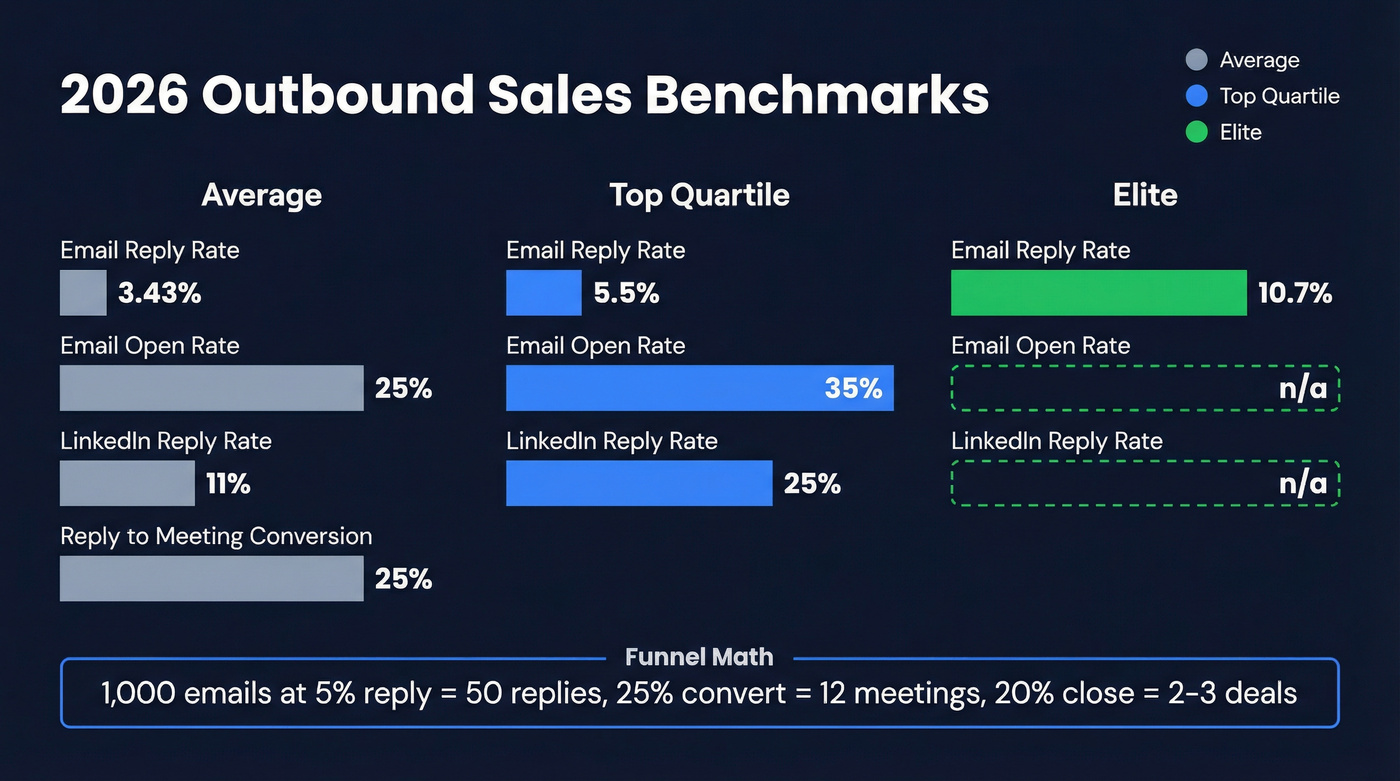
Before you rewrite a single subject line, you need to know what "good" actually looks like.
| Channel | Metric | Average | Top Quartile | Elite |
|---|---|---|---|---|
| Reply rate | 3.43% | 5.5%+ | 10.7%+ | |
| Open rate | 20-30% | 35%+ | - | |
| Reply rate | 7-15% | 25%+ | - | |
| Reply to Meeting | Conversion | 20-30% | - | - |
Here's the funnel math. You send 1,000 cold emails at a 5% reply rate - that's 50 replies. At a 25% reply-to-meeting conversion, you book 12-13 meetings. If your close rate is 20%, that's 2-3 deals from a single batch. The numbers work, but only if the emails actually land in inboxes and the messaging earns a response.
LinkedIn outbound runs higher reply rates (7-15% average, 25%+ when highly personalized) but at lower volume. The platform penalizes mass blasting, so it works best as a complement to email - not a replacement. Some teams flip this, leading with LinkedIn and using email as the fallback. That works when your ICP is active on the platform and your profile is optimized, but for most B2B teams, email-first scales better.
Three Messaging Frameworks That Work
PAS (Problem-Agitate-Solve)
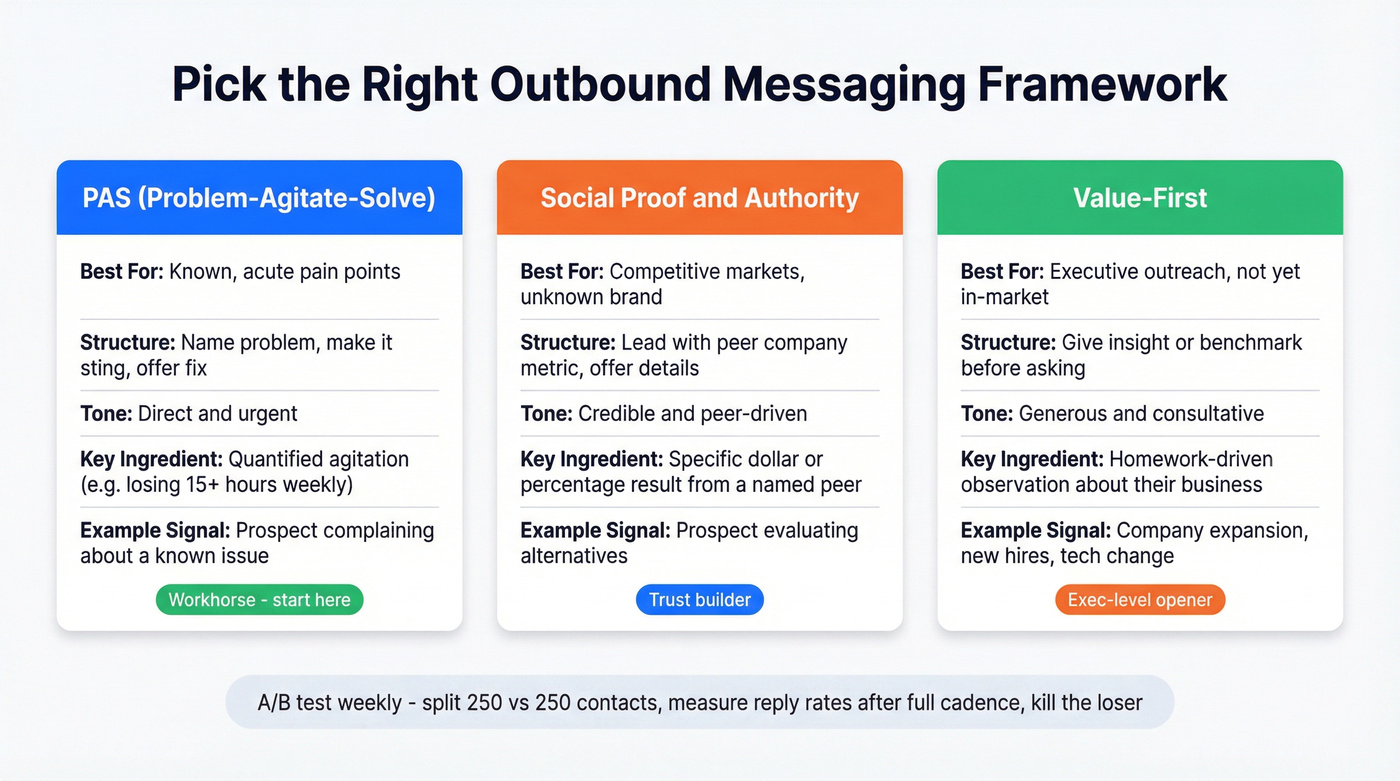
PAS is the workhorse of cold email. Three sentences: name the problem, make it sting, offer the fix.
Subject: Pipeline math isn't adding up
Hey {{firstName}},
Most {{title}}s at {{companySize}} companies are watching reply rates drop while send volume climbs. That means more burned domains, more spam complaints, and a pipeline that looks busy but doesn't close. We helped [similar company] cut bounce rates from 35% to under 4% and triple qualified pipeline in 90 days.
Worth a 15-minute look?
Problem (reply rates dropping), agitate (burned domains, fake pipeline), solve (specific result). Quantify the agitation - "losing 15+ hours weekly" hits harder than "wasting time." Use PAS when your prospect has a well-known, acute pain point and you've got a proof point to back up the solve.
Social Proof & Authority
When your prospect doesn't know you, borrowed credibility does the heavy lifting. Lead with a specific metric from a recognizable customer or peer company:
Subject: How {{peer company}} built $2M pipeline in Q3
Hey {{firstName}},
{{Peer company}} increased qualified pipeline by 28% last quarter using [specific approach]. Their team looks a lot like yours - {{similarity}}.
I put together a 2-minute breakdown of what they changed. Want me to send it over?
"$2M qualified pipeline in Q3" is credible. "Great results" is not. If you don't have customer proof points yet, use industry benchmarks as your authority anchor. This framework shines in competitive markets where your prospect is already evaluating alternatives - the peer company name stops the scroll.
Value-First
Use this for executive-level outreach where a direct pitch feels presumptuous, or when you're targeting accounts that aren't actively in-market yet. The goal is to give something useful before you ask for anything - an insight, a benchmark, a competitive observation that proves you've done homework.
Subject: Noticed something about {{company}}'s [tech stack / hiring / expansion]
Hey {{firstName}},
I saw {{company}} just [specific signal - opened a new office, posted 5 AE roles, adopted Salesforce]. Teams making that move usually run into [specific challenge].
We put together a short playbook on how [peer companies] handled it. Happy to share - no strings.
Skip this framework if your ICP is mid-market ops managers drowning in tasks. They don't want a playbook - they want a fix. Use PAS instead.
For all three frameworks, A/B test aggressively. Split 250 vs. 250 contacts with different problem statements or proof points, measure reply rates after a full cadence, and kill the loser. Weekly testing compounds fast.
The 7-Touch Cadence That Books Meetings
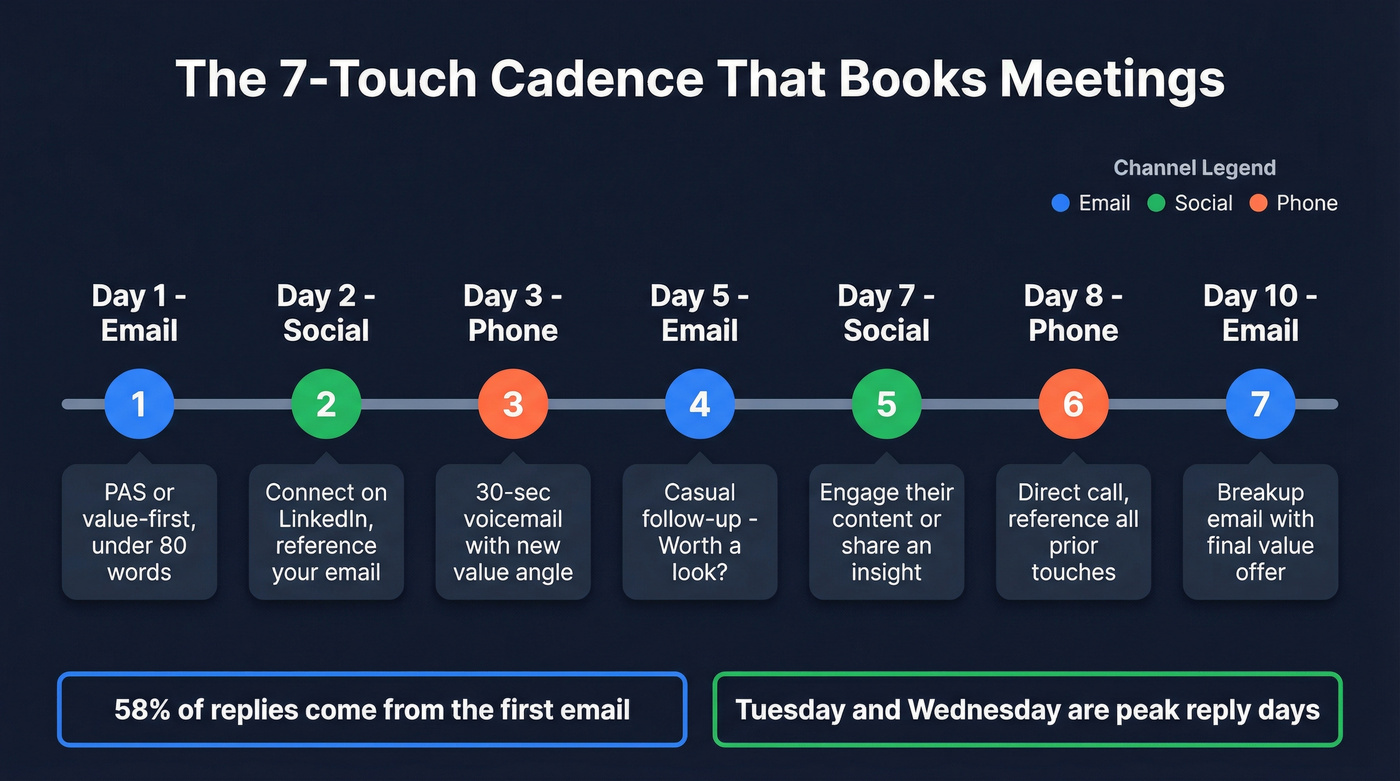
A single email isn't outreach. It's a lottery ticket. The sweet spot is 4-7 touchpoints across multiple channels, with diminishing returns beyond 7 unless each touch adds genuinely new value.
| Day | Touch | Channel | Action |
|---|---|---|---|
| 1 | 1 | PAS or value-first, under 80 words | |
| 2 | 2 | Social | Connect, reference email |
| 3 | 3 | Phone | 30-sec voicemail, new value |
| 5 | 4 | Casual follow-up ("Worth a look?") | |
| 7 | 5 | Social | Engage their content or share insight |
| 8 | 6 | Phone | Direct call, reference prior touches |
| 10 | 7 | Breakup with final value offer |
Touch 1 should stay under 80 words - the best-performing cold emails are short. Touch 4's casual one-liner ("Thoughts on this, {{firstName}}?") outperforms formal follow-ups by roughly 30%. Tuesday and Wednesday are peak reply-rate days, with Wednesday consistently highest.
The voicemail on Day 3 isn't about getting a callback. It's about making your name familiar so the Day 5 email doesn't feel cold anymore. Each touch builds on the last - reference what you've already sent, add something new, and keep the ask low-friction.

You just read that bounce rates kill outbound before messaging even gets a chance. Prospeo's 5-step email verification delivers 98% accuracy - teams like Snyk dropped bounce rates from 35% to under 5% and grew AE-sourced pipeline 180%. At $0.01 per verified email, fixing your data costs less than one wasted sequence.
Stop perfecting copy that lands in spam. Verify every contact first.
Five Mistakes Killing Your Replies
Mistake 1: Writing in a silo. One person drafts all messaging alone. The result is biased, generic, and disconnected from what buyers actually say. Fix: build a cross-functional messaging team of no more than 10 people, including reps who talk to customers daily.
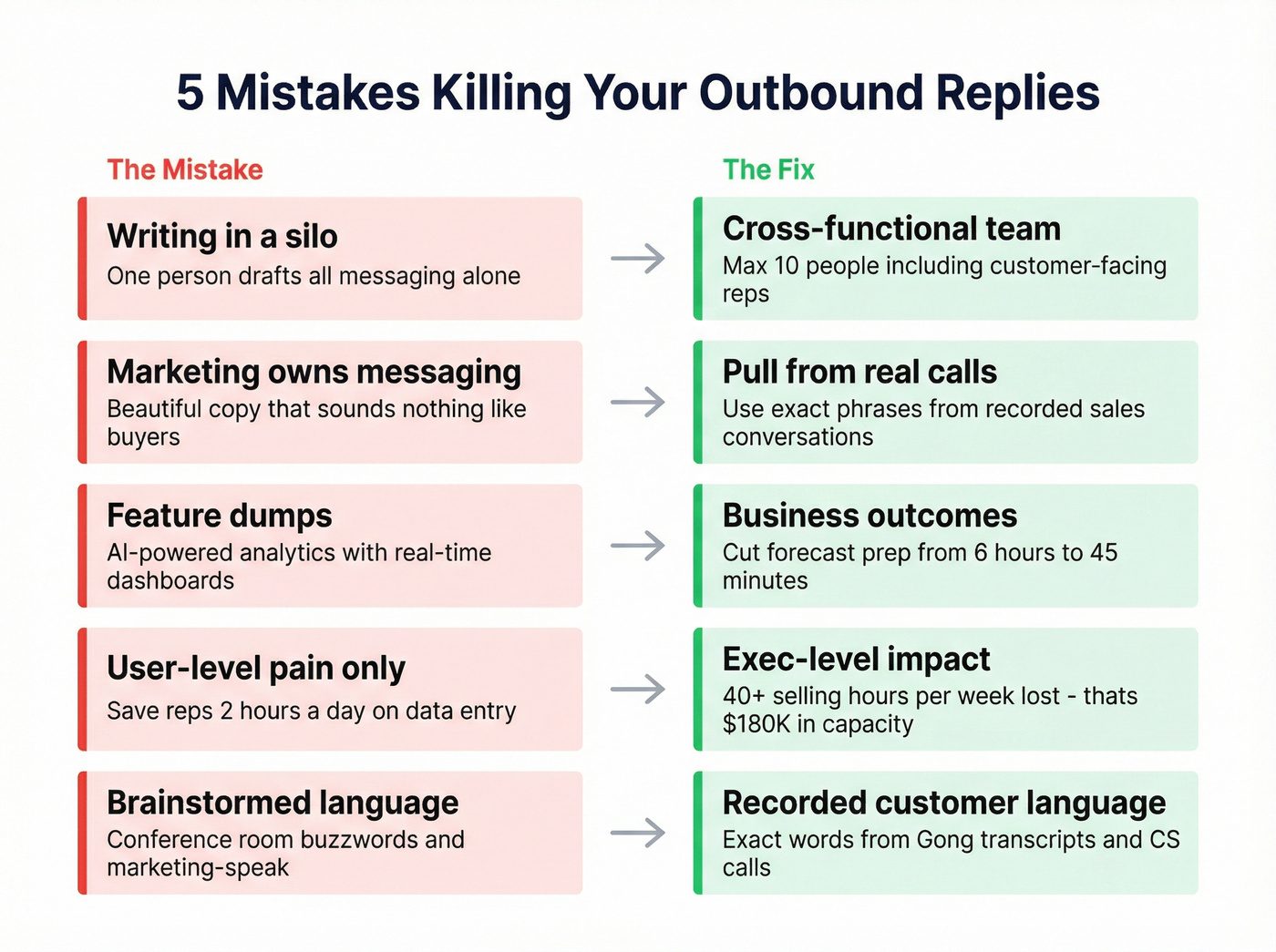
Mistake 2: Marketing owns messaging without customer conversations. PMM creates beautiful copy that sounds nothing like how buyers describe their problems. Fix: pull language directly from recorded sales calls and customer interviews. The phrases customers use are almost always better than what marketing invents.
Mistake 3: Feature dumps instead of business outcomes.
- Before: "Our platform offers AI-powered analytics with real-time dashboards and customizable reporting."
- After: "Teams using [approach] cut forecast prep from 6 hours to 45 minutes."
Outcomes beat features every time.
Mistake 4: Not chunking up to exec-level pain. If your messaging only addresses user-level frustrations, you'll get pushed to individual contributors. Executives care about revenue, risk, and competitive position.
- Before: "Save your reps 2 hours a day on data entry with automated CRM logging."
- After: "Your team is losing 40+ selling hours per week to manual CRM work - that's $180K in rep capacity going to admin instead of pipeline."
Same product, different altitude. The exec version connects to dollars and competitive risk.
Mistake 5: Ignoring recorded customer language. Your CRM has call recordings. Your CS team has renewal conversations. The exact words buyers use to describe their problems are sitting in those recordings, and they're more persuasive than anything you'll brainstorm in a conference room. We've seen teams double their reply rates just by swapping marketing-speak for phrases pulled from Gong transcripts.
Build a messaging matrix by persona and repurpose it across every email, talk track, and sequence:
| Persona | Top Priority | Current Solution | Core Problem | Business Impact | Desired Outcome |
|---|---|---|---|---|---|
| VP Sales | Pipeline predictability | ZoomInfo + Outreach | 30%+ bounce rates | Missed quota, wasted rep time | Clean data, booked meetings |
| SDR Manager | Rep productivity | Apollo + manual research | Hours lost to bad data | Low meetings/rep/week | Verified contacts, faster ramp |
| RevOps | Data integrity | Multiple point tools | Stale CRM records | Bad reporting, lost deals | Enriched, fresh CRM data |
This matrix is your messaging cheat sheet. Every email should map back to one row.
Personalization That Scales
Personalization doesn't mean "Hi {{firstName}}, I saw you went to {{university}}." That's merge-tag decoration, and buyers see through it instantly. Effective personalization answers two questions: why you and why now.
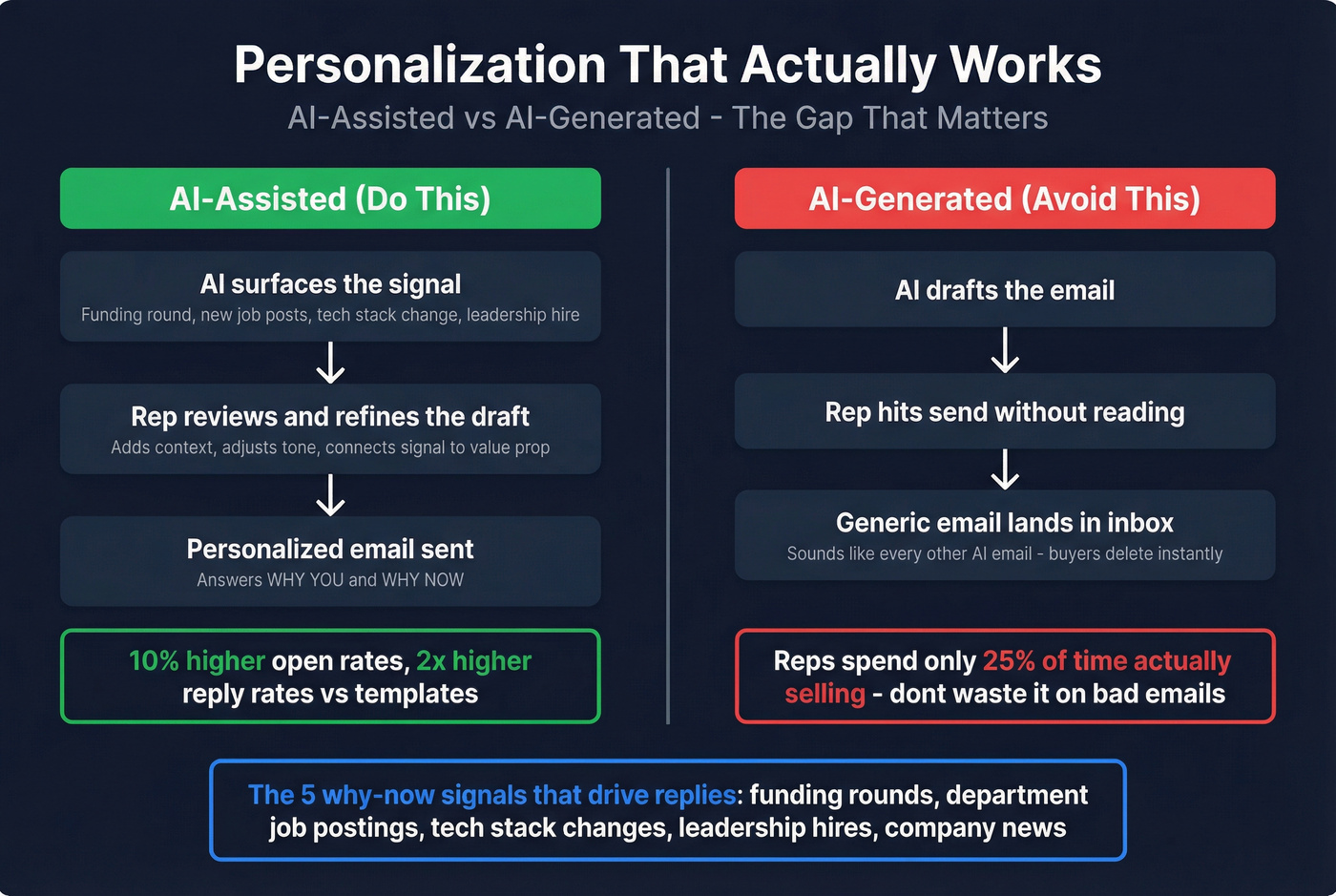
The "why now" signals that drive replies: recent funding rounds, new job postings in your buyer's department, tech stack changes, leadership hires, and company news. If you want a repeatable system for this, build around intent signals and signal-based outbound. 87% of sales organizations now use AI for tasks including email research and drafting, which makes signal detection faster. But the gap between AI-assisted and AI-generated matters enormously.
AI-assisted means the tool surfaces the signal and drafts a starting point; you review and refine. AI-generated means you hit send without reading it. Customized emails achieve 10% higher open rates and 2x higher reply rates versus templates. The second approach produces emails that sound like every other AI-generated email in the inbox. Reps spend only 25% of their time actually selling - AI-assisted personalization reclaims some of that time without sacrificing quality.
Data Quality - The Invisible Messaging Killer
You spend 45 minutes crafting the perfect cold email. You personalize the opener, nail the PAS framework, keep it under 80 words. You hit send to 200 contacts. Sixty-three bounce.
That's not a messaging problem. That's a data problem. And it's worse than wasted effort - every bounce damages your sender domain reputation, which means your next batch of emails is more likely to land in spam even if the addresses are valid. It's a compounding penalty that most teams don't notice until deliverability craters.
Here's the thing: if your average deal size is under $50K, data quality matters more than copywriting. At lower deal sizes, you need volume to work. You can't afford a 30% bounce rate eating your domain reputation and halving your effective send capacity. Fix the data first. Always.
Meritt, an outbound agency, was running a 35% bounce rate before switching their data source. After moving to Prospeo, bounces dropped to under 4% and their pipeline tripled from $100K to $300K per week. That's not a messaging change - it's a data quality change that made their existing messaging actually reach inboxes. We've seen this pattern repeat across dozens of outbound teams: the copy was fine all along, the data was the bottleneck. If you're troubleshooting bounces, start with hard bounce basics and an email deliverability checklist.
A 7-touch cadence across email, phone, and LinkedIn only works when you have accurate emails and direct dials for every contact. Prospeo gives you both - 143M+ verified emails and 125M+ verified mobile numbers with a 30% pickup rate. Data refreshed every 7 days, not 6 weeks, so your Day 1 PAS email actually reaches a real inbox.
Build multi-channel cadences on data that connects, not data that bounces.
Recommended Tool Stack
You don't need 8 tools. You need three layers that work together: data, sequencing, and sending.
Data and verification: This is the layer most teams underinvest in, and it determines whether everything downstream works. Prospeo handles it with 98% email accuracy, a 7-day data refresh cycle, and native integrations with Instantly, Smartlead, Lemlist, and Clay. If you're evaluating options, compare email checker tools and email ID validators. Free tier gets you started; paid plans run about $0.01 per email with no annual contracts.
Sequencing: Apollo (roughly $49-99/mo per user) handles prospecting and sequence management well for SMB and mid-market teams. For enterprise, Outreach or Salesloft ($100+/seat/mo range) offer more sophisticated workflow automation and analytics. If you're already on HubSpot, its built-in sequences work for low-volume outbound - but dedicated tools outperform it at scale. Pick based on your team size and CRM complexity. Don't overbuy.
Sending infrastructure: Instantly ($30-97/mo) and Smartlead ($39-94/mo) both handle multi-inbox rotation and deliverability optimization. Lemlist ($59-99/mo) combines sending with built-in personalization features if you want fewer tools. For teams sending more than a few hundred emails per day, dedicated sending infrastructure keeps your primary domain clean. If you're scaling volume, use an email sending infrastructure plan and consider automated email warmup.
The stack that books meetings in 2026: verified data into your sequencer of choice into a dedicated sender for inbox rotation. Three tools, clean data in, meetings out.
FAQ
What's the ideal cold email length?
Under 80 words. The 2026 Instantly benchmark report confirms that top-performing cold emails stay concise - short enough to read on a phone screen in under 10 seconds. Cut the company intro, skip the feature list, and lead with a single relevant pain point plus a soft CTA.
What's a good reply rate in 2026?
The average cold email reply rate is 3.43%, top quartile hits 5.5%+, and elite senders exceed 10.7%. Below 3% means your list quality or framework needs work. Between 3-5%, focus on personalization and cadence optimization to break into the top quartile.
How do I prevent email bounces from wrecking deliverability?
Verify every email address before it enters a sequence using a provider with catch-all handling and spam-trap removal. The key is never sending to unverified contacts. A clean list protects your domain reputation and ensures your outbound sales outreach messaging actually reaches inboxes.
How many follow-ups should I send?
4-7 total touches is the sweet spot, mixing email, phone, and social so each contact feels like a conversation rather than a drip campaign. Beyond 7, you hit diminishing returns unless each follow-up adds genuinely new value - a fresh case study, a relevant benchmark, or a timely trigger event.
How do I craft a strong offer for outbound emails?
Lead with a specific outcome the prospect recognizes - a benchmark, a case study result, or a resource tied to their exact challenge. The best-performing offers never open with product features; they open with what the prospect gains by replying. Pair the outcome with a low-friction CTA like "Worth a 15-minute look?" to maximize response rates.