How to Build a Phone Sales Pitch That Actually Books Meetings
It's 10:15am on a Tuesday. You've got a two-hour call block, a list of 40 prospects, and a script that sounds like it was written by committee. Half those numbers will go to voicemail. A quarter won't ring at all. The ones who pick up? You've got about 10 seconds before they decide whether to keep listening or hang up.
That's the reality of a phone sales pitch in 2026. [37% of reps] still generate most of their leads from phone calls, and 96% of prospects have already researched your company before you dial. The phone isn't dead - but lazy pitches are. Stop memorizing scripts. Memorize frameworks instead.
What to Say in the First 10 Seconds
Gong analyzed [90,380 cold calls] and tracked which openers actually led to booked meetings. The results aren't what most sales trainers teach:
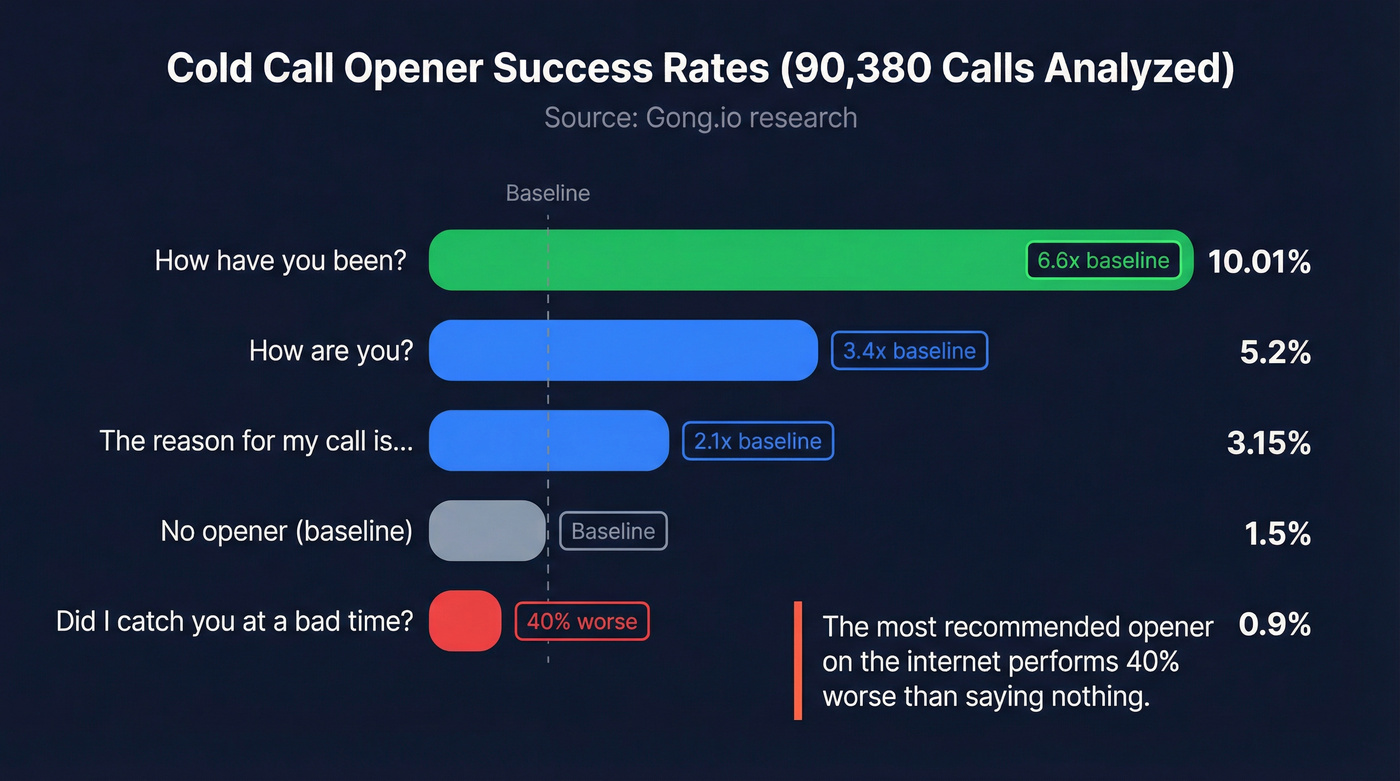
| Opening Line | Success Rate | vs. Baseline |
|---|---|---|
| "How have you been?" | 10.01% | 6.6x higher |
| "How are you?" | 5.2% | 3.4x higher |
| "The reason for my call is..." | - | 2.1x higher |
| Baseline (no opener) | 1.5% | - |
| "Did I catch you at a bad time?" | 0.9% | 40% worse |
"Did I catch you at a bad time?" - the line half the internet recommends - performs 40% worse than saying nothing at all. It hands the prospect an exit before you've said anything of value.
The winner, "How have you been?", works because it implies a prior relationship. Even on a cold call, it triggers a different mental response: warmer, more familiar. This single tweak can turn an average pitch into a conversation that actually goes somewhere. Openers like "How are you?" and jumping straight into "The reason for my call is..." also outperformed the baseline by wide margins, so you've got options depending on your style.
We tested this across our own outbound team. The words matter more than the energy. A calm, specific opener consistently beat an enthusiastic but generic one.
Cognism's State of Cold Calling report highlights Tuesday as the best day to call, with 10-11am as the peak window. Block it. Protect it. Don't let meetings eat it.
Three Scripts You Can Steal Today
These aren't scripts to memorize word-for-word. They're frameworks with branching paths. The best pitch over the phone doesn't sound like a pitch - it sounds like a conversation where the prospect talks themselves into the meeting.
Cold Call - First Touch
You: "Hey [Name], how have you been? ... Great. The reason for my call is - I noticed [company] just [trigger event: hired 3 SDRs / raised a round / expanded into EMEA], and we've been helping similar teams [specific outcome]. I'm curious - how are you handling [relevant challenge] right now?"
After you ask the question, shut up. The silence feels uncomfortable, but it's what forces the prospect to engage.
If they engage: Ask two more questions before pitching anything. Your goal is a 5-8 minute conversation, not a monologue. (If you want a deeper bank of prompts, start with these open-ended questions.)
If they push back: Move to the LARA framework below.
Follow-Up Call, 2nd or 3rd Attempt
You: "Hey [Name], we connected briefly [last week / I left you a voicemail on Tuesday]. I sent over [specific thing] - did anything in there catch your eye? ... The reason I'm calling back is [one sentence of new value]."
Voicemail - Under 30 Seconds
You: "Hey [Name], it's [Your Name] from [Company]. Quick reason for my call - [one sentence about the trigger or value]. I'll shoot you a short email with details. My number is [number]. Talk soon."
One CTA. Don't try to pitch in a voicemail - just create enough curiosity to get the email opened. (If you need more variations, use these cold call voicemail scripts.)
Handle Objections With LARA
Most objection handling is ad-hoc. Reps freeze, improvise badly, or cave immediately. The LARA framework gives you a repeatable structure: Listen, Acknowledge, Respond, Ask. Whether you're making a telecalling pitch to a warm lead or cold-calling a stranger, it adapts.
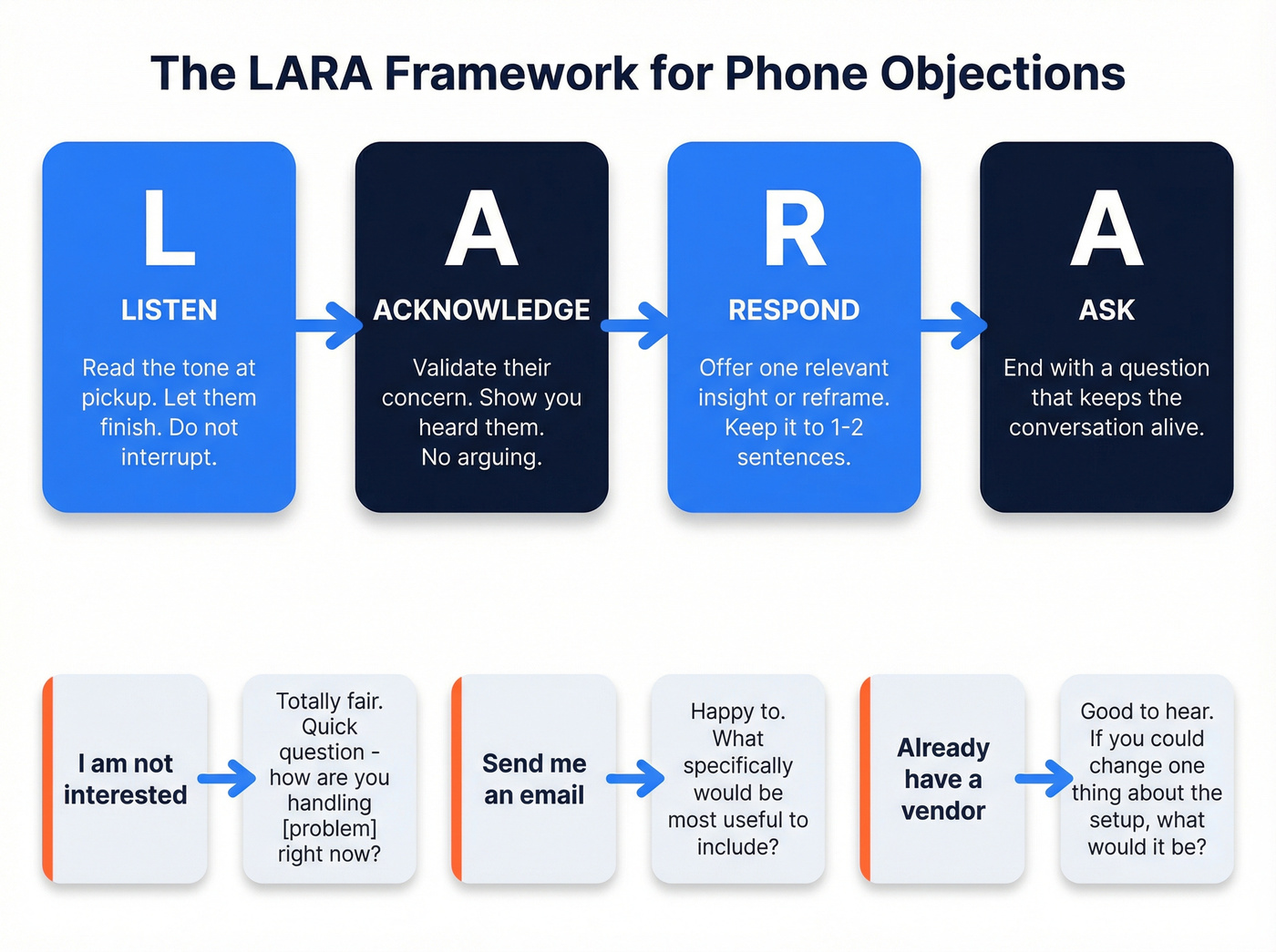
Before you respond to any objection, read the tone at pickup. Prospects telegraph resistance right away - match positive energy, but don't mirror negativity. Then distinguish real objections from fob-offs. "We don't have budget until Q3" is real. "Just send me an email" is usually a polite exit. Treat them differently. (For more patterns, see these types of objections.)
"I'm not interested." Acknowledge: "Totally fair - I called out of the blue. Quick question before I let you go: how are you currently handling [specific problem]?"
"Send me an email." This is a common brush-off - and often recoverable. Three responses by assertiveness:
- Soft: "Happy to. What specifically would be most useful to include?"
- Medium: "Absolutely. Before I do - is there a better time this week for a quick call so I can tailor it?"
- Direct: "I could, but honestly, your inbox is probably buried. Do you have 60 seconds?"
"Already have a vendor." Ask: "Good to hear. How's that going? ... If there were one thing you'd change about the setup, what would it be?"
The goal isn't to overcome every objection. It's to keep the conversation alive long enough to learn whether there's a real opportunity. (If you want a more curiosity-led approach, use this guide on handling sales objections with curiosity.)

The best phone sales pitch in the world can't book a meeting if nobody picks up. Prospeo's 125M+ verified mobile numbers refresh every 7 days and deliver a 30% pickup rate - so your two-hour call block connects you to real decision-makers, not dead lines.
Stop burning dial time. Start booking meetings with numbers that actually ring.
Five Mistakes That Kill Your Pitch
No research. Spend 2-3 minutes before each call. Check company news, recent hires, tech stack. One relevant detail beats ten generic benefits. (Use a simple pre call research checklist so reps don’t wing it.)
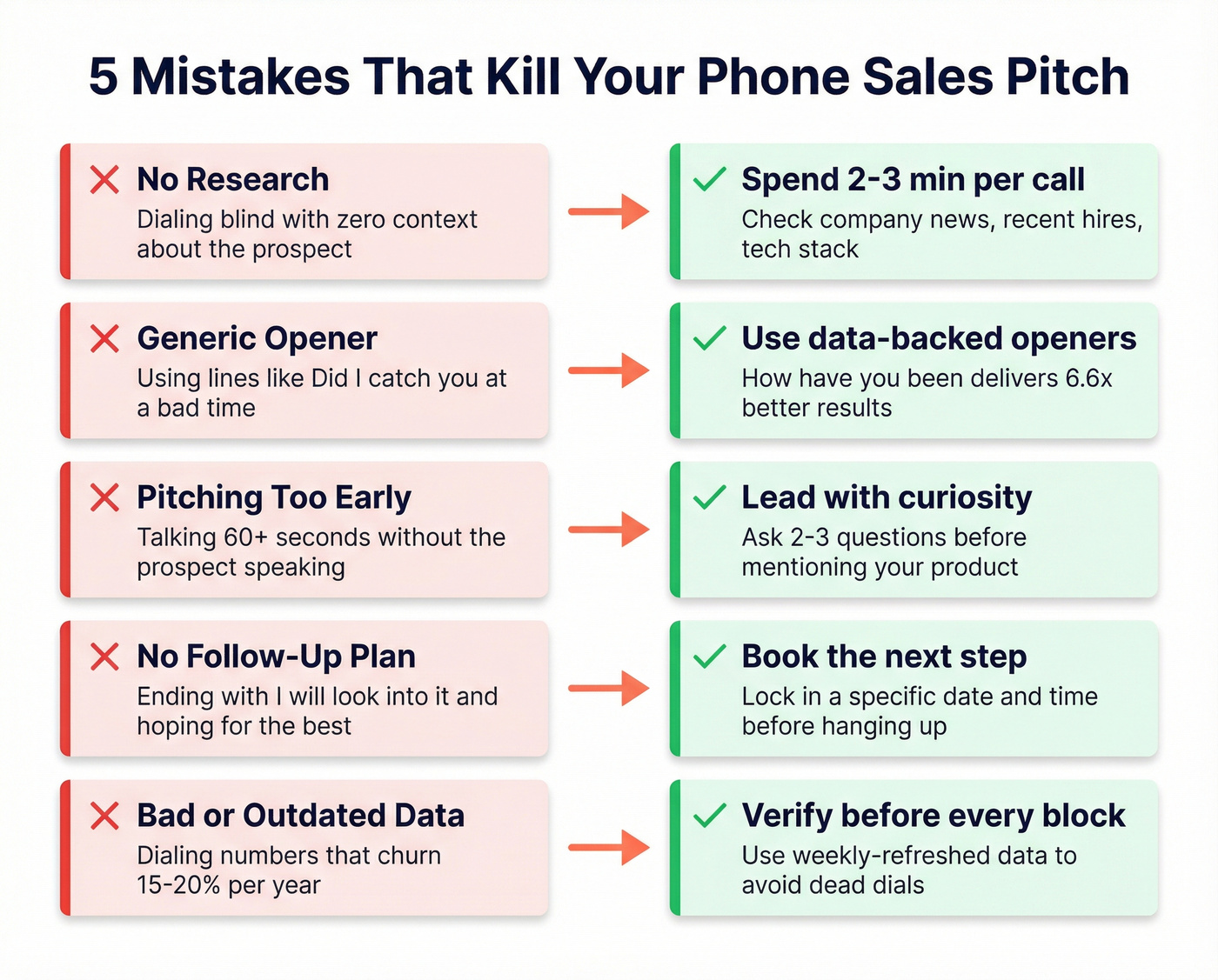
Generic opener. Use the data-backed lines from the Gong study above. "Did I catch you at a bad time?" is statistically proven to fail. (More options here: sales pitch opening lines.)
Pitching too early. Lead with curiosity questions. If you're talking for 60+ seconds without the prospect speaking, you've already lost. Here's the thing: an effective sales conversation is mostly listening. (If you want a full system, follow this B2B cold calling guide.)
No follow-up plan. Before you hang up, book the next step. "I'll look into it" is not a next step - it's where deals go to die. (Build a repeatable prospect follow up cadence.)
Bad or outdated data. Verify your numbers before every call block. Phone numbers churn 15-20% per year, and stale CRM data compounds the problem. We've seen reps burn entire two-hour blocks dialing disconnected lines, and the momentum loss is brutal. Prospeo's 125M+ verified mobiles refresh every 7 days and deliver a 30% pickup rate, so you spend dial time talking to actual humans instead of dead lines. (If you’re auditing list health, start with B2B contact data decay benchmarks.)
The Follow-Up Math Most Reps Ignore
80% of successful sales require five or more follow-up calls. Yet 48% of reps never follow up once. And 60% of customers say no four times before saying yes.
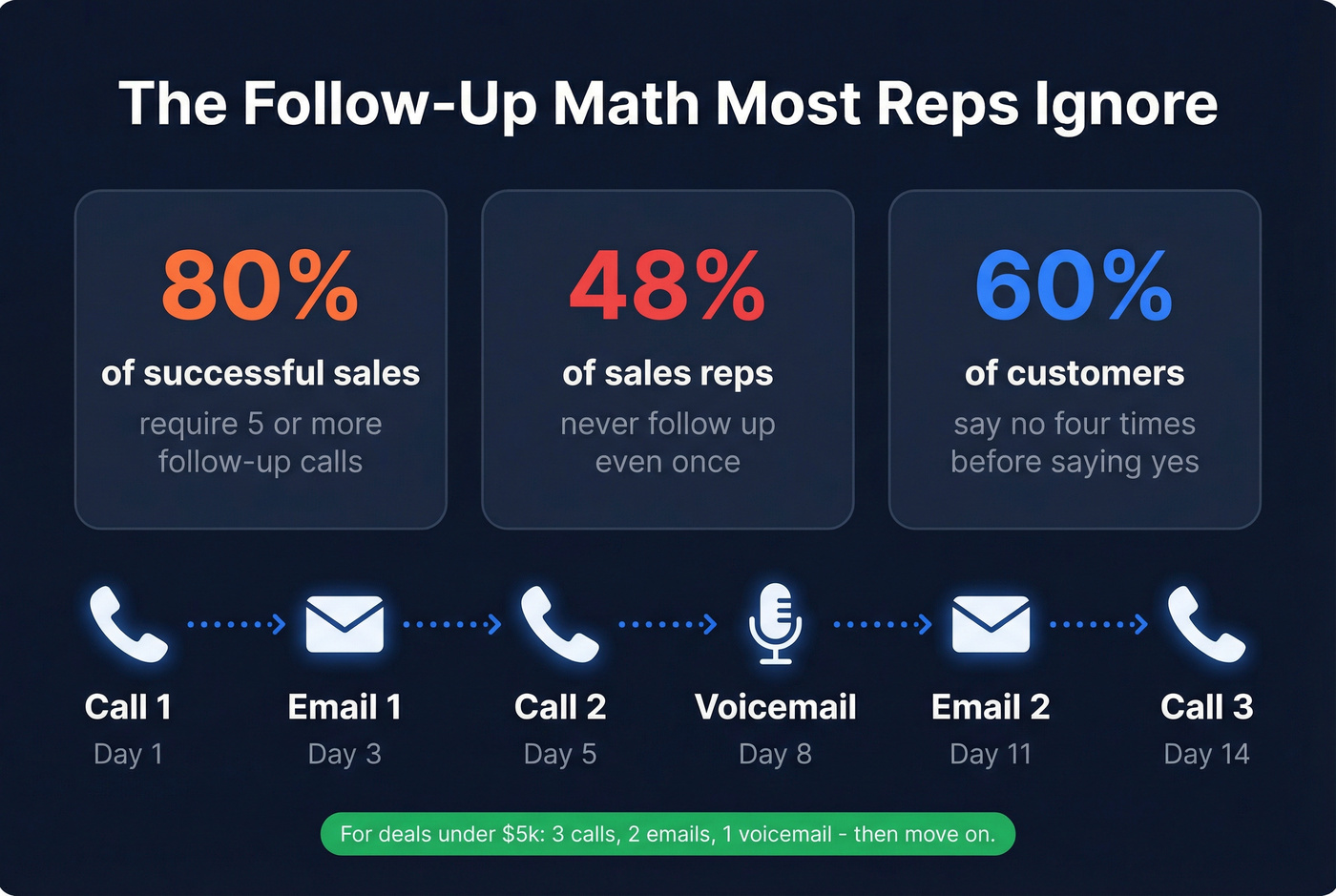
If you're in that 48%, you're not losing deals - you're forfeiting them. The reps who book the most meetings aren't more talented. They're more persistent and better prepared. Space your attempts across 2-3 weeks and mix calls with emails and voicemails.
Skip the 12-touch sequence if your average deal closes under $5k. Three calls, two emails, one voicemail - then move on. Persistence matters, but so does math. The consensus on r/sales backs this up: over-sequencing small deals just annoys prospects and burns your own energy.
What's Changed for Phone Pitching in 2026
The core of a great sales call hasn't changed much. What's changed is everything around it. Gartner predicts that by 2027, 95% of seller research workflows will begin with AI, up from under 20% in 2024. Real-time transcription, predictive call timing, and dynamic script adaptation are becoming table stakes for larger teams. (If you’re evaluating tools, start with AI cold calling.)
We're already seeing reps use AI to surface relevant case studies mid-call based on what the prospect says. But the fundamentals - a strong opener, a framework for objections, relentless follow-up - still do the heavy lifting. Technology makes a good phone sales pitch more efficient. It doesn't replace the human instincts that close meetings.
One more thing: TCPA penalties run $500-$1,500 per call. If you're using any form of auto-dialing or pre-recorded messages, make sure your legal team has signed off.
You just read that 80% of sales require 5+ follow-ups, and phone numbers churn 15-20% per year. By attempt three, half your list could be disconnected. Prospeo's 7-day data refresh means every number you dial is current - not six weeks stale like competitor data.
Fresh numbers every week at $0.01 per lead. Your follow-up math finally works.
FAQ
How long should a phone sales pitch be?
Keep the opener under 30 seconds. If the prospect engages, aim for a 5-8 minute conversation total. Once you're talking for more than 60 seconds straight without the prospect speaking, you've lost them - pause and ask a question.
What's the best time to make sales calls?
Tuesday between 10-11am delivers the highest connect rates. Avoid Monday mornings and Friday afternoons. Block dedicated 2-hour call sessions during that peak window for maximum dials.
How many follow-up calls should I make?
At least five. 80% of successful sales require five or more follow-up touches, yet nearly half of reps never follow up once. Mix calls with emails and voicemails across 2-3 weeks for the best results.
How do I avoid calling wrong numbers?
Verify your contact list before every call block. Phone numbers churn 15-20% annually, and stale CRM data compounds the problem. Using a provider with a weekly data refresh cycle - rather than the industry-standard 4-6 weeks - cuts the number of dead dials dramatically.