Sales Call Talking Points That Don't Sound Scripted (2026 Library)
Most reps don't lose deals because they "need a better pitch." They lose because they ramble, ask 20 shallow questions, and end calls without a date.
Fix those three things and your sales call talking points start doing what they're supposed to do: keep the call moving without sounding like a robot.
Steal the map + the lines below.
What you need (quick version)
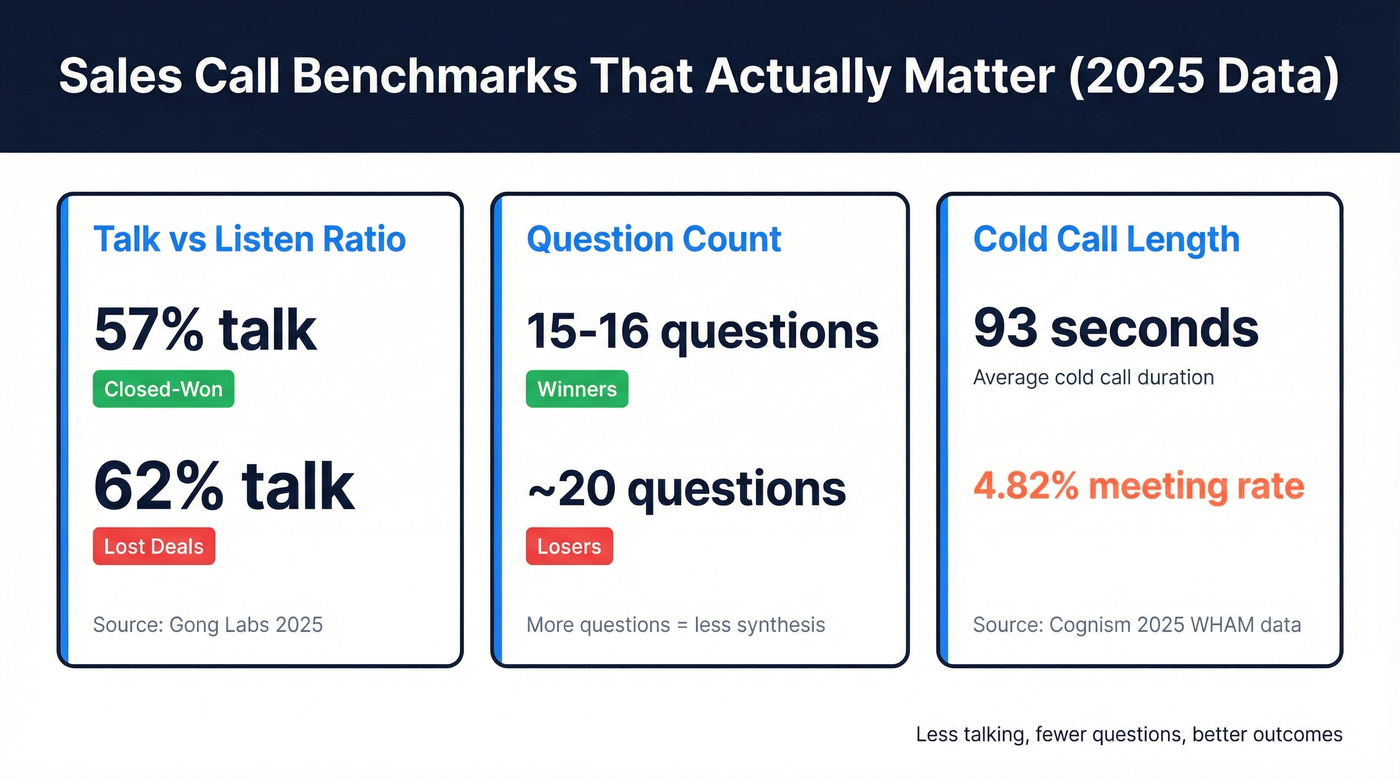
Latest published benchmarks (most widely cited datasets are still 2025):
- Talk/listen: on longer calls, closed-won averages 57% talk vs 62% talk on lost deals (Gong Labs' 2025 refresh).
- Questions: winners ask ~15-16; losers ask ~20 (Gong Labs' 2025 refresh).
- Cold calls: average length is ~93 seconds (Cognism's 2025 cold calling report using WHAM data).
4 copy/paste micro-templates
- Permission opener: "Hey {{Name}}, you weren't expecting me - can I take 30 seconds to see if this is relevant, and you can hang up if it's not?"
- Relevance hook: "I'm calling because {{trigger}} and teams like {{peer}} usually run into {{problem}}."
- One question: "How are you handling {{process}} today?"
- Micro-CTA: "If this is worth it, I'll ask 2 quick questions and we'll decide if we book time. Fair?"
One warning: if your opener needs three sentences, it's not an opener. It's a monologue.
Talking points vs scripts (and why scripts fail on real calls)
Scripts fail because calls are messy. Talking points win because they're modular, so your phone pitch can flex without falling apart when the conversation goes sideways.
Here are the failure modes I see on call reviews all the time - and the fix for each.
The late joiner derailment A decision-maker joins 6 minutes in and asks, "Sorry - what's this about?" If you're running a script, you either restart (wasting time) or keep going (losing them). Fix: keep a 12-second "reset" talk track you can drop anywhere: "Quick reset: we're talking because {{trigger}} is often tied to {{problem}}. I'm trying to learn if that's true for you - can I ask one question?"
Multi-threading (they're half on email) You deliver a perfect paragraph... to someone who heard every third word. Fix: one sentence per stage (the cue-card rule). If you can't say the point in one sentence, you don't understand it well enough to earn attention.
"Email me" at 12 seconds This isn't an objection; it's a reflex to regain control. Fix: don't argue - convert it into a choice: "Totally. So it's not generic - should the email be about {{problem A}} or {{problem B}}?"
Highspot's framing is right: modern "scripts" are talk tracks. Structure, not a recital.
Benchmarks that keep your calls from turning into a monologue
Benchmarks aren't rules. They're guardrails that keep your talk track from drifting into "and another thing..."
Talk vs listen (what Gong measured vs what teams use)
What Gong measured (Gong Labs' 2025 refresh):
- Across longer calls (10+ minutes), the average sits around 60% talk / 40% listen.
- Outcome split: closed-won averages 57% talk vs 62% talk on lost deals.
- Once you're talking more than ~65%, outcomes drop hard.
What teams use as a practical heuristic:
- Aim for ~43% talk / 57% listen on discovery-heavy calls when you can.
That heuristic works because it forces you to do the two things buyers reward: ask fewer, better questions, and summarize what you heard in plain language so the buyer feels understood instead of interviewed.
Question count (avoid the interrogation trap)
Gong's benchmark is unintuitive but real: winners ask ~15-16 questions, losers ask ~20.
More questions usually means you're not synthesizing, you're jumping topics, and the buyer feels processed.
The fix is simple: ask a solid question, then earn the follow-up with a one-sentence recap.
If you want the primary benchmark write-up, Gong's breakdown is here: Gong's talk-to-listen ratio benchmark post.

You only get 93 seconds on a cold call. Don't waste them on a wrong number. Prospeo gives you 125M+ verified mobile numbers with a 30% pickup rate - so your polished talk track reaches a real decision-maker, not a voicemail graveyard.
Nail the talk track. Let Prospeo nail the phone number.
Sales call talking points: a universal call map (any call type)
Your talking points should change based on what the buyer says. Your call map shouldn't.
Two rules make this work in real life:
- Cue-card rule: one sentence per stage (opening, discovery, value, close). If you need a paragraph, you're hiding.
- Set the promise: "If this is useful, we'll book time; if not, we'll end it." Buyers relax when they know you won't trap them.
The call map (with timeboxes that don't sound rigid)
Opening (30-60 seconds)
- Permission-based opener
- Relevance hook (one sentence)
- One question to earn the next minute Line to timebox without sounding weird: "I'll be brief - one question, then you tell me if we keep going."

Discovery (3-5 minutes)
- 3-5 open questions
- Reflect back what you heard
- Confirm priority + impact Off-track branch (when they start storytelling): "This is helpful context. To make sure I'm useful - can I ask one direct question about {{metric/process}}?"
Discovery -> Value transition (the line most reps skip)
- "Based on what you said, it sounds like the core issue is {{X}} and it's costing you {{Y}}. If that's right, I can share how teams fix it in two minutes - want that?"
Value (2-3 minutes)
- Tie their pain to a simple outcome
- One differentiator (not five)
- One proof point (short)
- Validation question: "Is that the kind of outcome you'd want?"
Value -> Close transition (so you don't demo into silence)
- "If we can agree on the next step and who needs to be involved, we'll know in a week whether this is real or not. Want to map that now?"
Objections (as needed)
- Acknowledge + explore
- Reframe to a smaller next step
Close (30-60 seconds)
- Summary in their words
- Clear next step + calendar ask
- Confirm stakeholders
Live branching: "If they say X -> do Y"
- "Just email me." -> "Totally. Before I do, what should the email be about so it's not generic?" Then ask 1 qualifying question and offer a micro-next step.

"We already have a solution." -> "Makes sense. What do you like about it - and what's the part you wish worked better?" You're not competing with the tool; you're competing with inertia.
"I'm busy." -> "I figured. Is it a bad time today, or is this just not a priority right now?" If it's timing: ask for a 20-second version + schedule.
This map works for cold calls, discovery, and follow-ups because it's built around permission -> diagnosis -> proof -> commitment, not around your product pitch.
Talking points library by call type (copy/paste)
Hot take: if your deal size is small and your cycle is short, you don't need "perfect discovery." You need crisp qualification and a date.
Most teams overcomplicate this and call it "being consultative."
Before the scripts, anchor your activity expectations.
Latest published cold-calling benchmarks (Cognism's 2025 report using WHAM data):
- Cold calling "meeting booked" success rate: 4.82%.
- Average cold call length: ~93 seconds.
- Optimum attempts: 3 attempts capture 93% of total conversations; 5 attempts gets 98.6% (WHAM dataset via Cognism).
- Best time windows: 8-11am and 4-5pm prospect local time; avoid 1pm (Revenue.io timing analysis).
- Best day: Tuesday (WHAM dataset via Cognism).
If you want the benchmark context straight from the vendors: Cognism's cold calling report and Revenue.io's timing breakdown: best time windows for cold calls.
Scenario picker (jump to what you need)
- Cold call (90 seconds)
- Discovery call (30 minutes)
- [Demo transition (pain -> proof)](#demo-transition-talking-points-from-pain - proof)
- [Follow-up / stalled deal / no-show](#follow-up - stalled-deal - no-show-talking-points)
- Gatekeeper
- Referral ask
- Re-engage a cold lead
- "Send a deck" request
- Early "price too high" deflection
Call type -> goal -> talk/listen target -> must-hit talking points
| Call type | Goal | Talk/listen target | Must-hit points |
|---|---|---|---|
| Cold call | Earn next step | 35/65 | Permission opener, trigger hook, 1 question, micro-CTA |
| Discovery | Diagnose + qualify | 43/57 | Set the promise, 3-5 deep questions, synthesis check, next step with date |
| Demo | Prove fit fast | 50/50 | Confirm success criteria, show only the path that matters, check-in, close for stakeholder step |
| Follow-up | Re-commit | 45/55 | Recap outcome, unblock decision, ask for yes/no next action + date |

Cold call talking points (90 seconds)
Use this if: you're calling a cold list and need a clean, repeatable opener. Skip this if: you can't articulate a relevance hook in one sentence - fix targeting first.

- Opener (own the interruption): "Hey {{Name}}--you weren't expecting me. Can I take 30 seconds and you tell me if I should hang up?"
- Relevance hook (choose one): "I saw {{trigger}} and it usually means {{problem}} shows up." "We work with {{peer group}} and a common issue is {{pain}}."
- One question (don't stack): "How are you handling {{process}} today?"
- Micro-CTA (two options): "If it's relevant, we can book 15 minutes--if not, I'll disappear." "Worth a quick chat Tuesday morning, or should I stop chasing this?"
Tiny upgrade that changes outcomes: after they answer, reflect it back in 7-10 words. It slows you down and signals you're listening.
Discovery call talking points (30 minutes)
Use this if: you've got a scheduled discovery and want it to feel collaborative. Skip this if: you're planning to demo anyway. Buyers notice.
Use the ACE opener (Appreciate, Confirm time, End goal):
- ACE opener: "Thanks for making time, {{Name}}." "We've got 30 minutes--still good?" "By the end, we should both know if it's worth a next step. If not, we'll end it. Sound fair?"
- Timeboxed agenda: "I'll ask a few questions about {{area}} (10-15 mins), share what we see work (5 mins), then we'll decide next steps (5 mins)."
- Deeper discovery prompts: "Help me understand what's driving that - what changed?" "When that happens, what's the downstream impact?"
- Qualification without being awkward: "If we improved {{metric}}, what would that change?" "Who else besides you cares about this outcome?"
In our experience, discovery stalls almost always trace back to one miss: nobody quantified impact, so urgency never forms.
Demo transition talking points (from pain -> proof)
Use this if: you're about to share your screen and you don't want to feature-dump. Skip this if: you haven't agreed on success criteria yet.
- Confirm the problem (in their words): "Let me make sure I've got it: {{their pain}} is causing {{impact}}."
- Define success (one sentence): "Success would look like {{metric/outcome}} within {{timeframe}}, right?"
- Permission to show (pattern break): "Want me to show you the 2-minute version of how teams solve that?"
- Check-in questions (keep them short): "Is this matching what you expected?" "Should I go deeper here, or skip ahead?"
Opinion: the best demos are boring - in the best way. They show the shortest path from problem to outcome, then they stop and ask for the next step.
Follow-up / stalled deal / no-show talking points
Use this if: you're stuck in "circling back" purgatory. Skip this if: you don't have a clear ask.
- Recap (2 lines max): "Quick recap: you said {{pain}} and the priority was {{initiative}}." "The outcome you wanted was {{success}}."
- Re-open the problem (no guilt): "Has anything changed on your side, or is this still a priority?"
- Micro-commitment (choose one): "If we can't get {{stakeholder}} in by Friday, should we pause this until next month?" "Reply with a yes/no: should I send a 3-bullet plan, or close the loop?"
- MAP prompt (Mutual Action Plan): "If we move forward, what are the steps and dates you need to see?"
Gatekeeper talking points (15 seconds)
- "Hey {{Name}}--quick one. I'm trying to reach {{Prospect}} about {{one-line reason}}. What's the best way to get 10 minutes on their calendar?"
- If blocked: "Totally fair. Are you the right person to route this, or is there someone else who handles {{area}}?"
Referral ask talking points (20 seconds)
Use when the prospect isn't the owner.
- "You might not be the right person - who owns {{problem}} on your side?"
- "If I email you a 2-sentence summary, would you forward it to {{name/role}} and copy me?"
Re-engage a cold lead talking points
Use when they went dark after interest.
- "{{Name}}, quick check - should I assume this moved down the list?"
- "If it's still alive, what's the next step and by when? If not, I'll close the loop."
Send a deck talking points
- "Happy to. To make the deck relevant - are you evaluating for {{use case A}} or {{use case B}}?"
- "If I send it today, are you open to a 10-minute walkthrough after you skim it?"
Early "price too high" talking points
Use when price comes up before value is established.
- "Totally fair to ask. Before we talk numbers - what outcome would make this a no-brainer?"
- "If we can't tie this to {{metric}} in {{timeframe}}, we shouldn't move forward anyway. Can I ask one question to see if it's even worth pricing?"
Discovery that doesn't feel like an interrogation
Discovery goes bad when you treat it like a checklist. It goes great when it feels like joint problem-solving.
Outreach's 3-level question ladder keeps flow tight:
Level 1: Foundational (context)
- "Walk me through how you handle {{process}} today."
- "Who's involved, and where does it usually break?"
Level 2: Probing (pain + friction)
- "What's the hardest part when volume spikes?"
- "Where do things slow down or slip through the cracks?"
Level 3: Strategic (impact + priority)
- "How does fixing this tie to your goals this quarter?"
- "If you solved it, what changes for the business?"
Guardrail: target ~15-16 questions total on longer discovery calls. After every 2-3 questions, do a synthesis check:
- "So the core issue is {{X}}, and it's costing you {{Y}}. Did I get that right?"
That one sentence reduces your talk time and increases trust.
Objection-handling talking points (LAER + top blocks)
Look, objections aren't a debate prompt. They're a control prompt. The buyer's asking, "Are you going to push me, or are you going to help me?"
And yes, some reps hate this part. I get it. But if you treat objections like a wrestling match, you'll lose deals you should've won.
LAER is the fastest framework to train and the easiest to coach live:
- Listen (don't interrupt)
- Acknowledge (validate the concern)
- Explore (ask a question)
- Respond (short answer + next step)
Objection -> LAER response starter -> next question
| Objection | LAER starter | Next question |
|---|---|---|
| "Email me." | "Sure - so it's useful..." | "Should it cover A or B?" |
| "Not interested." | "Got it - fair." | "Is it timing or fit?" |
| "Already have one." | "Makes sense." | "What would you improve?" |
| "Busy." | "Understood." | "Bad time or low priority?" |
| "No problem." | "Good to hear." | "How do you measure it?" |
Copy/paste talk tracks (tight, not cheesy)
"Just email me." "Happy to. So I don't send fluff - should it be about {{problem A}} or {{problem B}}?"
If they answer: "Perfect. If I send 3 bullets, are you open to a 10-minute chat if it resonates?"
"I'm not interested." "Totally fair. Quick question so I don't bother you again - are you set on {{category}}, or is it just not a priority right now?"
"We already have a solution." "Good - switching costs are real. What do you like about it, and what's the one thing you'd improve?"
"I'm busy, call back." "Understood. Better to do later today or tomorrow morning?" Then stop talking.
"We don't have that problem." "Love that. How are you handling {{process}} today?"
If they explain: "Got it - what would have to change for it to become painful?"
Adjust your talking points by persona (stop using one ratio)
The "golden ratio" is a great default, but persona changes what "natural" feels like. ExecVision's conversation style matrix adds a useful second dial: talk/listen plus interchanges per minute (pace).
These are observed ranges, not goals. Use them as guardrails.
Persona cards (use these as dials)
C-level (higher seller talk, slower pace) Give a sharp strategic prompt, then let them narrate priorities. Best move: one insight + one question.
End users (lower seller talk, faster pace) More back-and-forth. Best move: workflow questions and mirroring their language.
Technical buyers (moderate-to-higher seller talk, medium pace) They reward precision. Best move: define constraints, success criteria, and risks.
The pace lever: if the call feels flat, don't automatically talk more. Increase interchanges: shorter questions, quicker confirmations, more "did I get that right?" moments.
Pre-call prep checklist (turn research into a relevance hook)
Great talking points come from specific hypotheses, not generic personalization.
Here's a scenario I've watched play out more times than I can count: a rep opens with "Saw you're hiring, congrats!" and the buyer says "Yep," then the rep panics, starts explaining the product, and the call dies quietly because there was never a real point to the call in the first place.
5 prep inputs -> 5 talking point outputs
1) Trigger -> hypothesis -> question
- Trigger: funding, hiring, job change, new initiative, expansion
- Hypothesis: "This probably creates {{problem}}."
- Question: "How are you handling {{process}} now that {{trigger}} happened?"
2) Role -> KPI
- Role: VP Sales, RevOps, IT, Finance, CS
- KPI: pipeline coverage, cycle time, uptime, cost, retention
- Talking point: "Usually this role cares about {{KPI}}--is that true for you?"
3) Tech stack -> risk
- Stack: CRM, sequencer, data tools, BI, support desk
- Risk: duplicates, attribution gaps, compliance, deliverability, adoption
- Question: "What's the biggest risk in your current setup - data quality, workflow, or reporting?"
4) Initiative -> impact
- Initiative: ABM, outbound scale, territory redesign, consolidation
- Impact: headcount, budget, timeline, stakeholder map
- Talking point: "What does success look like by end of quarter?"
5) Mutual outcome -> next step
- Mutual outcome: "If we're a fit, we'll do {{X}}."
- Next step: meeting, pilot, stakeholder review
- Close: "If we agree it's worth it, can we hold 20 minutes Tuesday to map stakeholders and success criteria?"
Where Prospeo fits (briefly): it's "The B2B data platform built for accuracy," with 300M+ professional profiles, 143M+ verified emails, 125M+ verified mobile numbers, 30+ search filters, and a 7-day refresh cycle, which is exactly what you want when your call plan depends on triggers like hiring, job changes, and headcount growth.
At 4.82% success rate, every cold call attempt matters. Prospeo's 98% email accuracy and 7-day data refresh mean your follow-up "just email me" moments land in real inboxes - not bounce logs that torch your domain.
Stop burning attempts on stale data. Start with contacts that connect.
Close + next steps (mutual action plan language that prevents stalls)
Most deals don't die because the buyer said "no." They die because nobody agreed on what happens next - with a date.
Flowla's mutual action plan concept is the fix: make next steps a shared plan, not a seller follow-up.
A commonly cited directional baseline is 10-30% discovery-to-next-step conversion. Treat it as a range, not a law. Practically: if you're under 10%, your close language is the first thing to fix.
Next-step talking points (bullets you can say naturally)
- Calendar hold (low friction): "Let's put 15 minutes on the calendar for {{day}}. If it's not a fit after you review, we'll cancel. Fair?"
- Stakeholder add (de-risk later): "Who else will have an opinion on this? Let's invite them now so we don't redo this call."
- Success criteria doc (forces clarity): "I'll send a 1-page success criteria doc. If you reply 'yes' to it, we'll schedule the next step. Deal?"
In our call reviews, stalls almost always trace back to a missing date or a missing stakeholder. Fix those two and "circling back" mostly disappears.
Mini-template (copy/paste)
"Based on what you shared, the goal is {{outcome}} and the blocker is {{pain}}. Next step: {{meeting/pilot}} with {{stakeholders}} by {{date}}. If we miss that date, we'll pause."
What reps complain about in practice (and how to fix it)
This is the stuff that shows up in real call coaching, not in polished script libraries:
"I asked great questions and they still ghosted." You didn't earn a commitment. Fix: close every call with next action + date + who.
"They keep saying 'send info'." You're giving them an escape hatch. Fix: convert it into a choice ("Should I send A or B?") then ask for a 10-minute review slot.
"My discovery runs long and we never get to value." You're chasing interesting details. Fix: timebox discovery and use the off-track line: "To make sure I'm useful - one direct question..."
"My demo turns into a feature tour." You didn't lock success criteria. Fix: "Success looks like {{metric}} in {{timeframe}}, right?" before you share your screen.
"I talk too much when I'm nervous." You don't need confidence. You need structure. Fix: one sentence per stage + synthesis checks every few minutes.
FAQ
What's the best talk-to-listen ratio on a discovery call?
Use 57% talk (closed-won) vs 62% talk (lost) as the reality check from Gong Labs' 2025 refresh. As a practical heuristic, aim for ~43% talk / 57% listen, and avoid going over ~65% talk on longer calls.
How many discovery questions is too many?
More than ~20 questions usually feels like an interrogation if you aren't synthesizing. Gong's benchmark is ~15-16 questions for winners, so aim for 15-16 and do a one-sentence recap every 2-3 questions to keep it collaborative.
What should I say when they respond "Just email me"?
Say: "Sure - so it's actually useful, should it be about {{problem A}} or {{problem B}}?" Then ask for a micro-commitment like 10 minutes to review it together, because sending info without a scheduled follow-up usually turns into a quiet "no."
What's a good free tool to build cleaner call lists for outbound?
Prospeo's a solid choice because the free tier includes 75 emails + 100 Chrome extension credits/month, with 98% verified email accuracy and a 7-day refresh. Hunter's free tier can work for light lookup, but Prospeo's the better pick when you need verification and enrichment for real campaigns.
How long should a cold call be in 2026?
Plan for about 90 seconds on average. Cognism's 2025 report (WHAM data) puts the average cold call at ~93 seconds, which is enough time to get permission, deliver a one-line hook, ask one real question, and land a next step.
Summary: steal the structure, not the speech
The point of sales call talking points isn't to sound clever. It's to stay oriented when the call gets messy.
Use the call map (permission -> diagnosis -> proof -> commitment), keep one sentence per stage, and close every conversation with next action + date + who. That's how you stop rambling and start booking real next steps.