

Cold Calling on Weekends: What the Law Says, What the Data Shows, and What to Do Instead
It's Saturday morning. You're staring at 50 leads you couldn't reach this week. Eighty percent of your calls went to voicemail - that's not a guess, that's the industry average. Your thumb is hovering over the dialer, and you're wondering: is cold calling on weekends even worth it? More importantly, is it even legal?
The short answer: not worth it, probably not legal in your prospect's state, and almost certainly not the best use of your weekend.
What You Need to Know Before You Dial
Before you make a single weekend call, here's the three-part verdict:
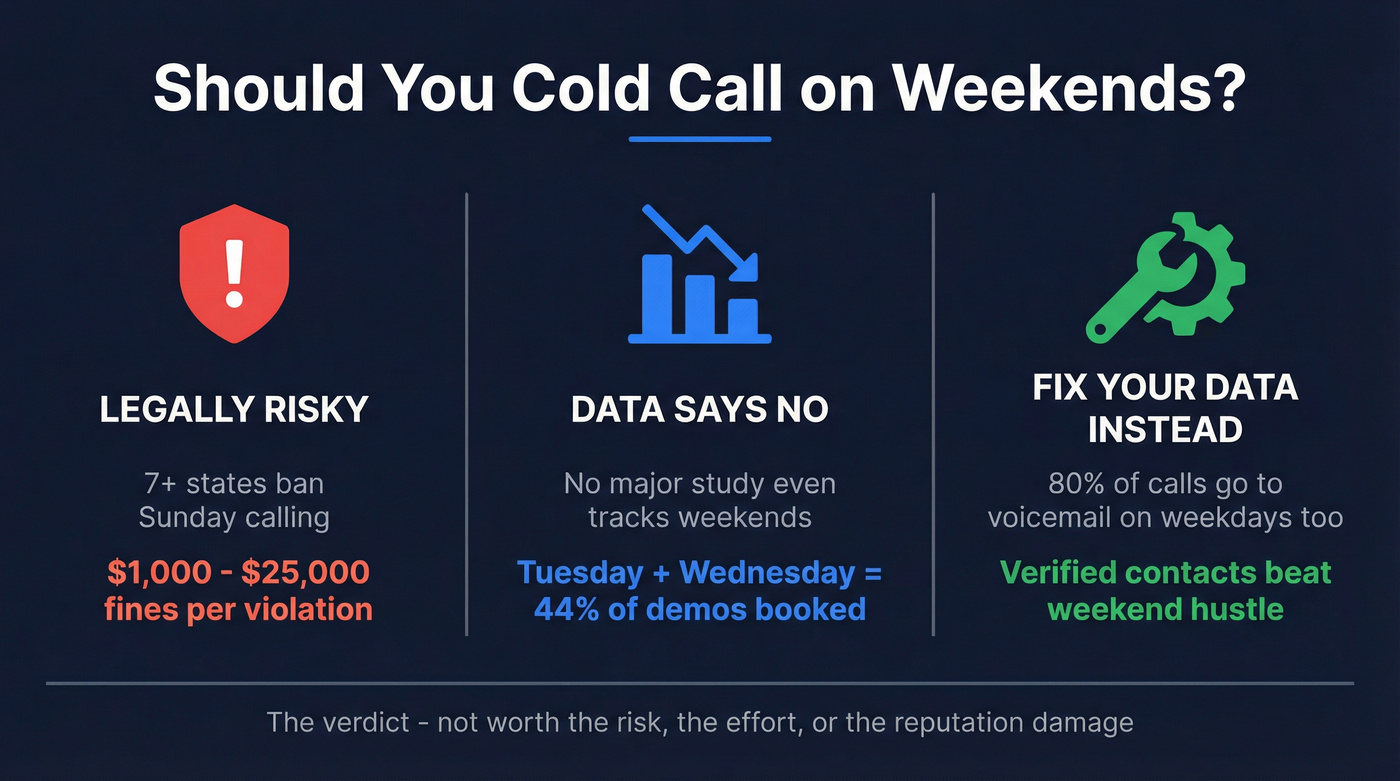
Legally: At least 7 states ban or restrict Sunday calling outright. Fines run from $1,000 to $25,000 per violation. Saturday calling is legal in most states but with tighter hour windows. Get this wrong and you're not just annoying someone - you're writing a check.
Effectively: No major cold calling study even includes weekend data. Not the 1.4 million-call analysis from ZoomInfo. Not the 450,000-call study. Not the 40,000-call breakdown. They all stop at Friday. Tuesday and Wednesday account for 44% of all demos booked. Only 2% of cold calls result in an appointment to begin with - and that's on the best days. The data doesn't suggest weekdays are better. It ignores weekends entirely.
Practically: If your weekday calls aren't connecting, the problem isn't the calendar. It's your data quality. Spend weekends building a verified prospect list so Monday's calls actually land.
Are Weekend Cold Calls Legal? State-by-State Rules
This is where most "should I call on weekends?" articles get lazy. They mention the federal rule and move on. But state laws are where the real landmines sit.
Federal Rules: The Baseline
The TCPA sets the floor: telemarketing calls are only permitted between 8:00 AM and 9:00 PM in the called party's local time zone. That applies every day, including weekends.
Violate it and you're looking at $500 per violation, or $1,500 if it's deemed willful. The Telemarketing Sales Rule goes further - up to $51,000 per call for egregious violations. And individuals can sue you directly under the TCPA. This isn't just an FTC enforcement thing; your prospects have a private right of action.
The FTC logged over 2 million DNC complaints in 2023 alone. Enforcement is active and growing. You're also required to scrub against the Do Not Call registry at least every 31 days. Miss that window and every call you make to a registered number is a separate violation.
State Weekend Restrictions
Here's the thing: the federal rule is the easy part. At least 14 states impose stricter hours, and several explicitly ban Sunday calling. This table covers every state with weekend-relevant restrictions:
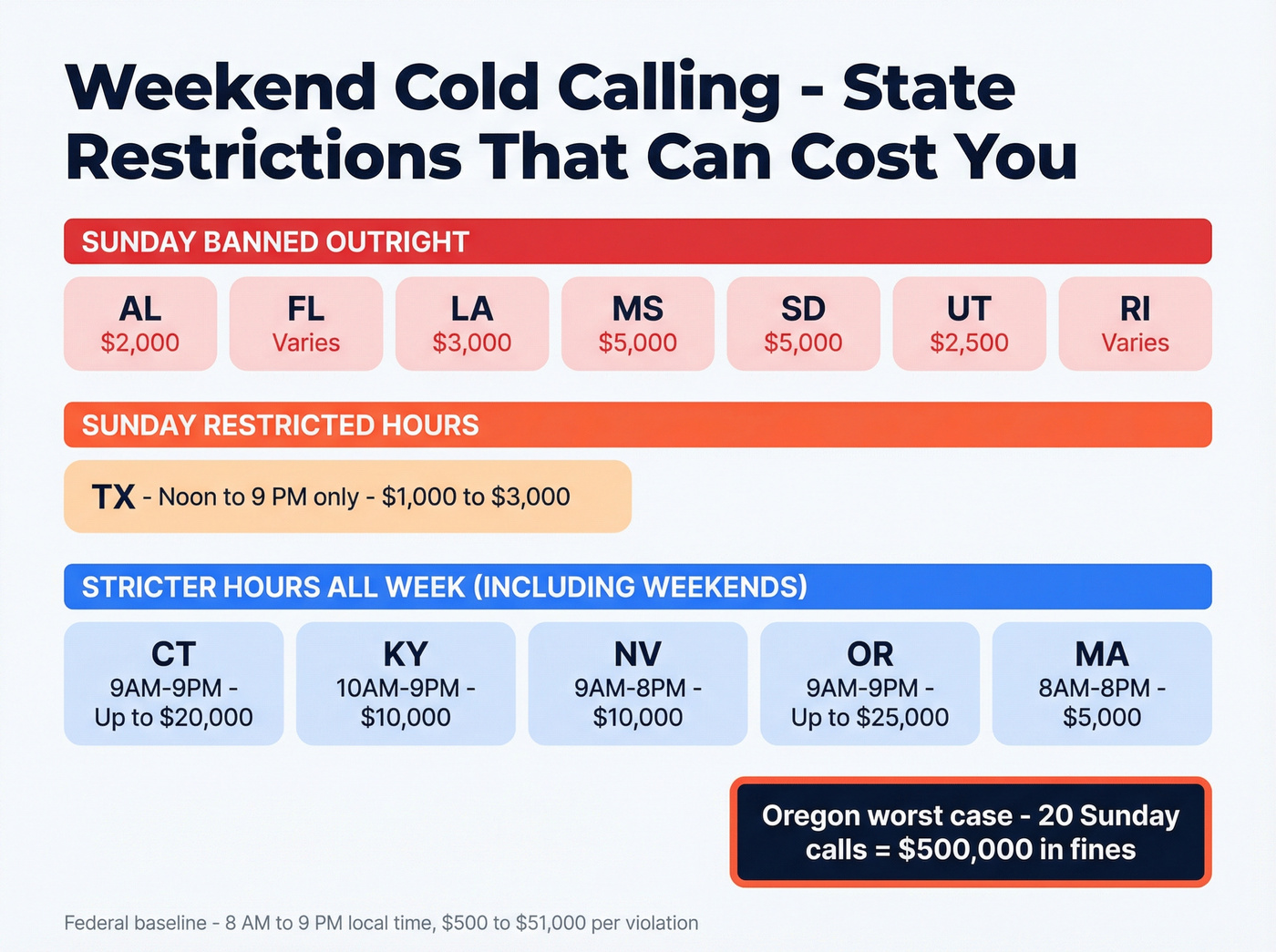
| State | Weekday Hours | Weekend Rules | Fine |
|---|---|---|---|
| Alabama | 8 AM-8 PM | No Sun/holidays | $2,000 |
| Connecticut | 9 AM-9 PM | 9 AM-9 PM all days; stricter enforcement | Up to $20,000 |
| Florida | 8 AM-9 PM | No Sunday calls | Varies |
| Kentucky | 10 AM-9 PM | 10 AM-9 PM all days; no exemptions | $10,000 |
| Louisiana | 8 AM-8 PM | No Sun/holidays | $1,500-$3,000 |
| Massachusetts | 8 AM-8 PM | 8 AM-8 PM all days | $5,000 |
| Mississippi | 8 AM-8 PM | No Sun/holidays | $5,000 |
| Nevada | 9 AM-8 PM | 9 AM-8 PM all days | $10,000 |
| Oregon | 9 AM-9 PM | 9 AM-9 PM all days; aggressive enforcement | Up to $25,000 |
| Rhode Island | 9 AM-6 PM wkday | Sat 10 AM-5 PM; No Sun | Varies |
| South Dakota | 9 AM-9 PM | No Sunday calls | $5,000 |
| Texas | 9 AM-9 PM | Sun: noon-9 PM only | $1,000-$3,000 |
| Utah | 8 AM-9 PM | No Sun/holidays | $2,500 |
| Wyoming | 8 AM-8 PM | 8 AM-8 PM all days | $2,500 |
Look at Oregon. $25,000 per infraction. That's not a typo. One Sunday afternoon calling session to 20 Oregon prospects could theoretically cost you half a million dollars. Even Texas, which allows Sunday calls, restricts them to after noon.
Rhode Island is the most granular: weekday calls end at 6 PM, Saturday calls are squeezed into a 10 AM-5 PM window, and Sunday is completely off-limits.
The B2B Loophole That Isn't
"But I'm calling businesses, not consumers."
I hear this constantly. It's the most expensive misconception in outbound sales.
If you're dialing an individual's mobile number for a sales pitch, it's treated as a consumer call - even if that person is a VP of Engineering you're trying to sell SaaS to. The DNC registry covers personal home and cell numbers, and B2B decision-makers' mobiles are personal numbers. Prior Express Written Consent is required for automated or prerecorded marketing calls to cell phones. An existing business relationship doesn't substitute for it. And pre-checked consent boxes? Invalid.
The FCC ruled that AI-generated cold calls without consent are illegal, treated the same as robocalls. And 67% of B2B buyers say they lose trust in vendors that flout compliance. So even if you dodge the fine, you're torching the relationship.

Weekend calls fail because your weekday data fails. 80% voicemail rates aren't a timing problem - they're a data quality problem. Prospeo's 143M+ verified emails and 125M+ verified mobiles refresh every 7 days, so your Tuesday 4 PM calls actually connect.
Spend your weekend relaxing. Spend Monday closing with verified contacts.
What the Data Actually Says About Weekend Connect Rates
Here's the most telling fact about calling prospects on weekends: nobody studies it.
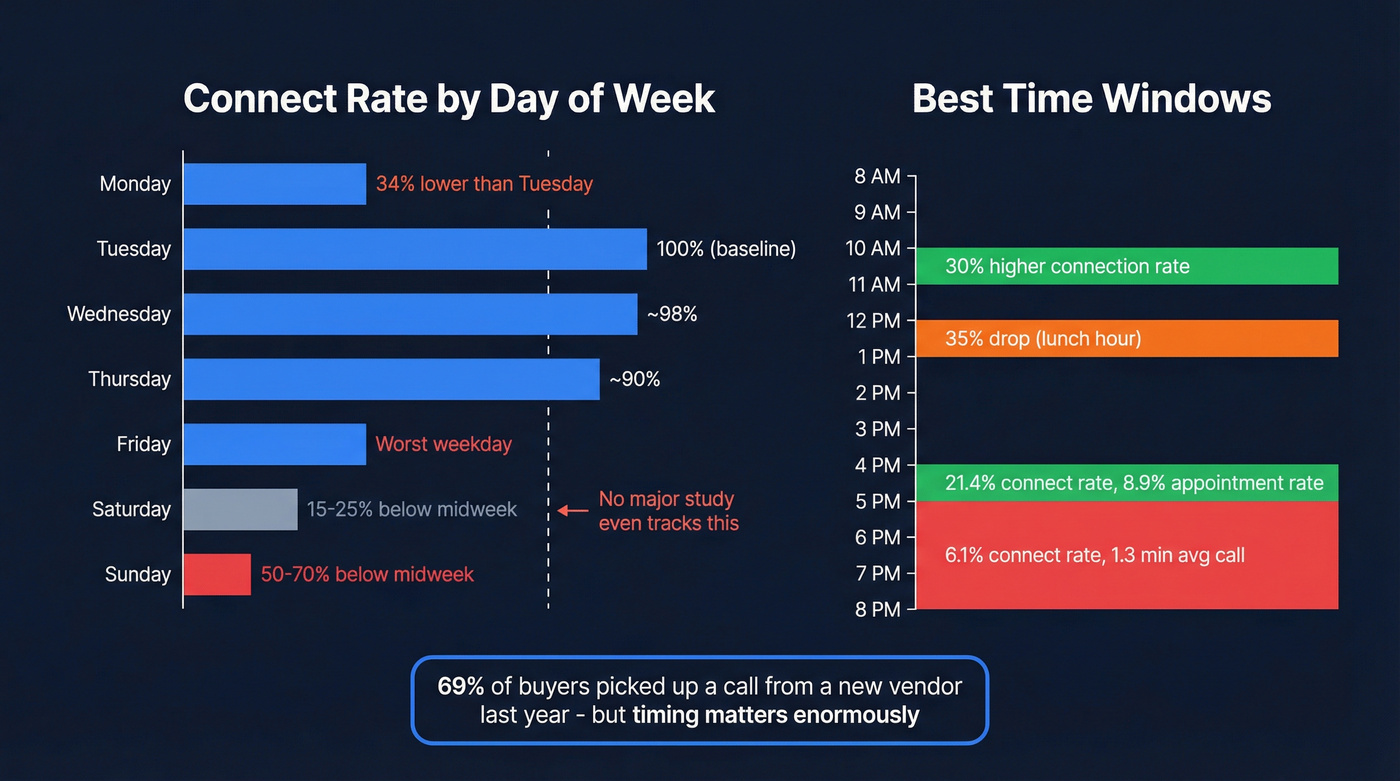
A 1.4 million-call analysis of outbound calls to new business accounts found Tuesday and Wednesday dominated, accounting for 44% of all demos booked. Friday was the worst day on every single metric - lowest volume, lowest connection rates, fewest demos. The study didn't even bother tracking Saturday or Sunday.
A separate analysis of 450,000+ cold calls found that 10-11 AM on Tuesdays yielded 30% higher connection rates than other windows. Salesloft's data showed Wednesday at 10 AM outperformed other time slots by 16%. Monday connect rates run 34% lower than Tuesdays, with voicemail abandonment 22% higher - people are digging out of their inbox, not picking up the phone.
A breakdown of 40,000 B2B calls by hour showed the 4-5 PM window hitting a 21.4% connection rate with an 8.9% appointment rate. After 5 PM? Connection rates cratered to 6.1%, with conversations averaging just 1.3 minutes. The lunch hour saw a 35% drop in answer rates.
Now extrapolate to weekends. If Friday is already the worst weekday and after-hours calls drop to 6% connection rates, weekend performance is going to be brutal. Practitioner reports consistently put Saturday connection rates at roughly 15-25% below midweek peaks, with Sunday dropping 50-70%. These aren't published studies - they're the numbers that come up when you talk to people actually making the calls.
Revenue.io's most recent data reveals something else interesting: the optimal calling window shifted post-COVID. Their earlier study showed late morning as the best window. By their latest analysis, peak engagement had moved to 4-5 PM. Remote work reshuffled when people answer - but it didn't make weekends viable.
69% of buyers picked up a call from a new vendor in the past year. The phone still works. But it works on Tuesday at 4 PM, not Saturday at 9 AM.
Saturday vs. Sunday - They're Not the Same
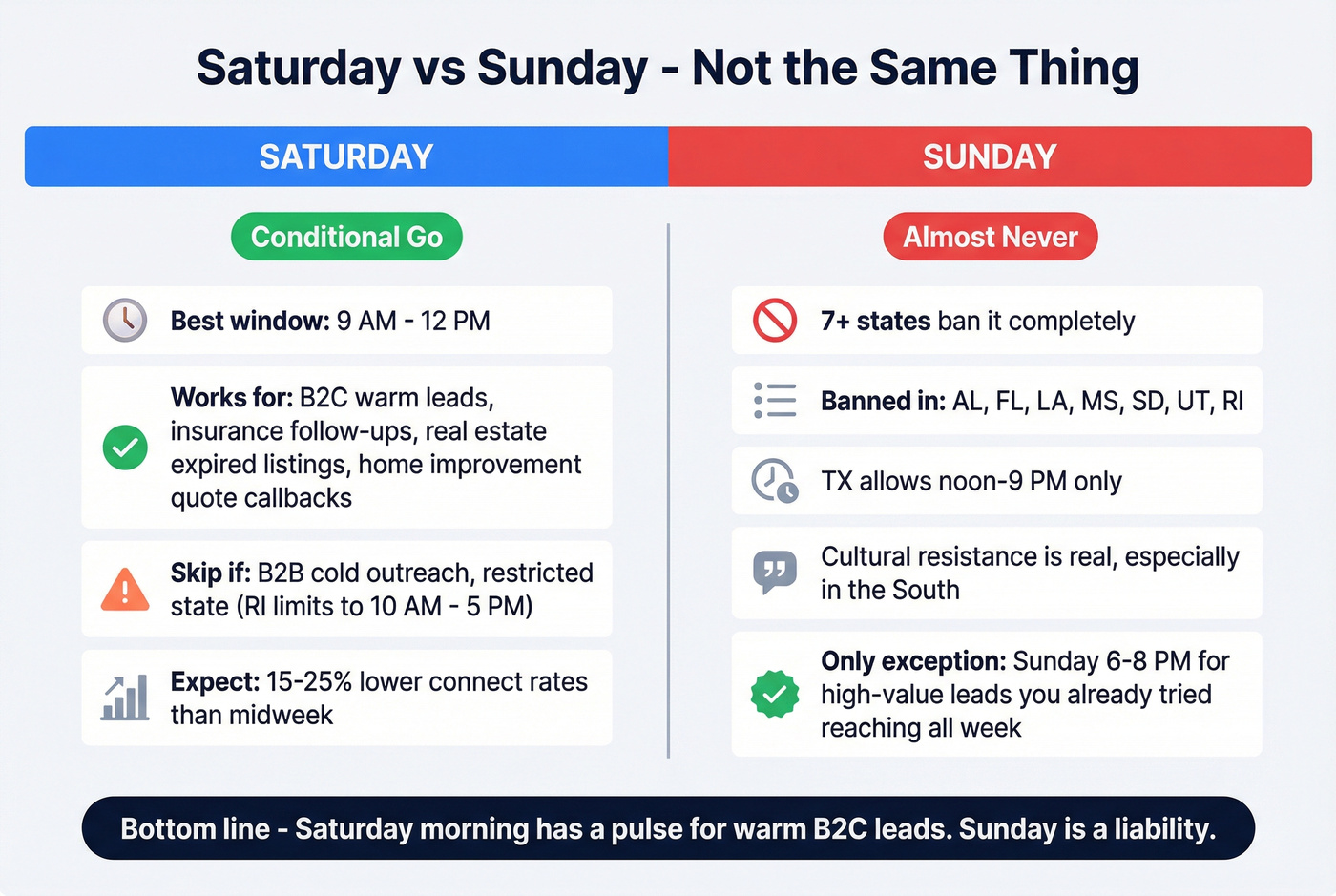
Lumping Saturday and Sunday together is a mistake I see in every competitor guide. They're completely different animals.
Best Time to Cold Call on Saturday
If you're going to pick up the phone on a Saturday at all, the 9 AM-12 PM window is your only realistic shot. Use this if you're in B2C, calling warm leads who've already expressed interest, and you're sticking to that morning slot. Insurance agents calling final expense leads, realtors following up on expired listings, home improvement companies reaching homeowners - these are the niches where Saturday morning has a pulse.
But it's follow-up territory, not cold outreach territory.
Skip Saturday if you're in B2B, calling cold prospects, or your state restricts Saturday hours. Rhode Island limits you to 10 AM-5 PM. Nevada cuts you off at 8 PM. And even where it's legal, you're competing with errands, kids' soccer games, and the general resentment of being sold to on a day off.
Sunday: Just Don't
At least 7 states ban it outright. In the South especially, Sunday calling is culturally off-limits. As one veteran Medicare agent with nearly 40,000 forum posts put it: "I don't call on Sundays. Or Saturdays. A lot of folks don't want to talk to an agent during their 'free time'. In the south especially, Sundays are off limits."
The one exception I've seen argued credibly: Sunday evening, 6-8 PM, for high-commission leads you've already tried to reach multiple times during the week. One insurance agent frames it as, "I called several times during the week but could not reach them." That's a last-resort play for hard-to-reach, high-value leads - not a strategy.
The post-COVID remote work shift hasn't changed this. Decision-makers answer their phones at 4 PM on a Wednesday now instead of 9 AM, but they're still protecting their weekends.
B2B vs. B2C - Different Rules, Different Answers
B2B Weekend Calling: The Short Answer Is Don't
Offices are closed. Direct lines ring into the void. The 51% of B2B decision-makers who appreciate a direct phone call? They appreciate it during business hours, when they're in work mode and can actually act on what you're proposing.

We've seen teams try weekend B2B calling because "everyone's too busy during the week." That's a data quality problem disguised as a timing problem. If you can't reach a VP of Sales on a Tuesday at 10 AM, calling their mobile on a Saturday at 9 AM isn't going to fix it - it's going to annoy them.
There's a fascinating disconnect I've watched play out in financial services: brokers want to call on weekends because they're commission-hungry, but the principals and compliance officers shut it down. The brokers see lost opportunity; the principals see lawsuit risk. The principals are right.
Even with remote and hybrid work blurring the lines, near-zero ROI on B2B weekend calls is the consistent pattern. Your prospect might technically be reachable on their mobile, but the context is wrong. They're at brunch. They're with their kids. They're not thinking about your platform migration proposal.
B2C Weekend Calling: When It Actually Works
Certain B2C niches have carved out legitimate Saturday morning windows:
Insurance (final expense, Medicare): Agents calling warm leads - people who filled out a card or responded to a mailer - report decent Saturday morning pickup rates. The key word is warm. Cold Sunday calling in insurance is a fast way to get complaints.
Real estate: Realtors calling expired listings on Saturday mornings catch homeowners who are home and thinking about their unsold property. One Reddit poster - a realtor with a full-time day job - asked about weekend calling because weekdays were impossible. That's a real constraint, and Saturday 9-12 is the answer.
Home improvement: Homeowners are literally looking at the project on Saturday morning. Roofing, HVAC, remodeling - if someone requested a quote, Saturday follow-up makes sense.
The common thread: warm leads, Saturday morning only, B2C context. One B2C seller calculated it as "12 extra hours per month of phone time" by adding a Saturday slot. That math works if you're disciplined about who you're calling.
If You Do Call on a Weekend - Five Non-Negotiable Rules
Check your prospect's state laws first. Not your state - theirs. Reference the table above. One call to an Alabama number on a Sunday is a $2,000 mistake.
Saturday only, warm leads only. Cold outreach on weekends is a losing proposition legally, statistically, and relationally. If they haven't heard of you, don't call them on their day off.
Keep it under 2 minutes. On a weekend, aim for the short end of the 2-5 minute sweet spot. Sixty seconds for intro and value, sixty seconds for a qualifying question, sixty seconds to book the meeting.
Don't ask "Did I catch you at a good time?" That gives them an easy out and signals your call isn't important. Instead: "I know it's the weekend, so I'll be quick - I'm calling because [one sentence of value]." Acknowledge the weekend explicitly. It shows awareness.
Sell the meeting, not the product. Weekend calls are for booking a Monday or Tuesday conversation. That's it. Don't pitch features. Don't send a proposal. Get 15 minutes on their calendar and hang up.
What to Do on Weekends Instead of Calling
Real talk: if your deal sizes are under $50k, you don't have a timing problem - you have a data problem. Every guide about cold calling timing obsesses over when to dial. The real question is whether you're dialing the right number. The best thing you can do on a weekend is prepare to dominate Monday through Thursday.
Build and Verify Your Prospect List
This is the highest-ROI weekend activity, and it's not close.
Pull a targeted list using a B2B data platform like Prospeo - filter by job title, industry, company size, and buyer intent signals. Every email is verified in real-time with 98% accuracy, the database refreshes every 7 days, and you get access to 125M+ verified mobile numbers with a 30% pickup rate. When you dial on Tuesday morning, you're reaching real people at current numbers. That's a better use of your Saturday than leaving voicemails nobody will return.

Draft Email Sequences and Prep Your Monday Call Block
- Review each prospect's recent company news, job postings, and tech stack
- Write personalized openers - not "I saw your company is growing" but "I noticed you posted three SDR roles last month, which usually means outbound is working but you need more pipeline"
- Pre-load your CRM with enriched contacts
- Build a prioritized call list sorted by intent signals - who's actively researching solutions in your category right now gets called first Monday morning
If you want a tighter system for the email side, build your messaging around a B2B cold email sequence and keep it consistent with your SDR cadence best practices.
Clean Your CRM
Sales reps spend only 33% of their time actively selling. The rest is admin, data entry, and hunting for information that should already be in the system. One hour of Sunday evening CRM cleanup - removing duplicates, updating stale records, enriching missing direct dials and verified emails - saves three hours of dead-end weekday calls.
If you want this to actually stick, implement a lightweight keep CRM data clean process and watch your B2B contact data decay rate like a KPI.
Make Monday about dialing, not data entry.
You're risking $25,000 fines per call because your weekday list didn't convert. Prospeo delivers 98% email accuracy and a 30% mobile pickup rate - so you book demos on Tuesday instead of gambling on Sunday.
Replace risky weekend dials with data that connects on the first try.
FAQ
Can you legally cold call on Saturdays?
Yes, in most states - but at least 7 states restrict Saturday hours significantly. Rhode Island limits Saturday calls to 10 AM-5 PM, and Nevada cuts off at 8 PM. Always check your prospect's state laws before dialing, not your own state's rules.
Is it illegal to cold call on Sundays?
In at least 7 states - Alabama, Florida, Louisiana, Mississippi, Rhode Island, South Dakota, and Utah - yes. Texas allows Sunday calls only after noon. Fines range from $1,000 to $25,000 per violation, and individuals can sue you directly under the TCPA.
What's the best day and time to cold call?
Tuesday and Wednesday between 10-11 AM or 4-5 PM consistently outperform every other window. A 1.4 million-call study found these two days account for 44% of all demos booked. Friday is the worst weekday on every metric.
What should I do on weekends instead of cold calling?
Build and verify your prospect list, draft personalized email sequences, clean your CRM, and prep a prioritized Monday call block. One hour of weekend research - pulling verified mobiles and enriching contacts - saves three hours of dead-end weekday calls.
Does remote work make weekend cold calls more effective?
No. Post-COVID data shows peak engagement shifted from morning to late afternoon on weekdays, but decision-makers still guard their personal time. Sunday connection rates drop an estimated 50-70% versus midweek peaks, regardless of where people work.