

What Is a Point of Contact - and Why Most Teams Get It Wrong
You've been bounced between four people at a vendor, repeating your problem each time, and nobody owns the resolution. That frustration isn't rare - 70% of customers expect any employee they reach to have full context on their situation. Understanding what a point of contact is and how to designate the right one closes that gap.
Let's break down how the POC role works across industries and how to find the right one at any company.
What Is a Point of Contact (POC)?
A point of contact is the designated person - or sometimes a department - responsible for handling communication between two parties. In sales, that's the person at a target account who coordinates internally on your behalf. In support, it's whoever owns your case from first touch to resolution. In project management, it's the single interface between teams.
A POC isn't the same as a touchpoint. Touchpoints are individual interactions; the POC is the person who owns those interactions.
One acronym warning: in product and engineering circles, POC typically means proof of concept - completely different. Context tells you which one someone means, but the collision trips people up constantly.
Why a Designated POC Matters
The numbers make the case. 83% of customers expect to interact with someone immediately when they contact a company. Without a clear POC, that expectation dies on arrival - customers get routed, re-routed, and eventually frustrated enough to churn.
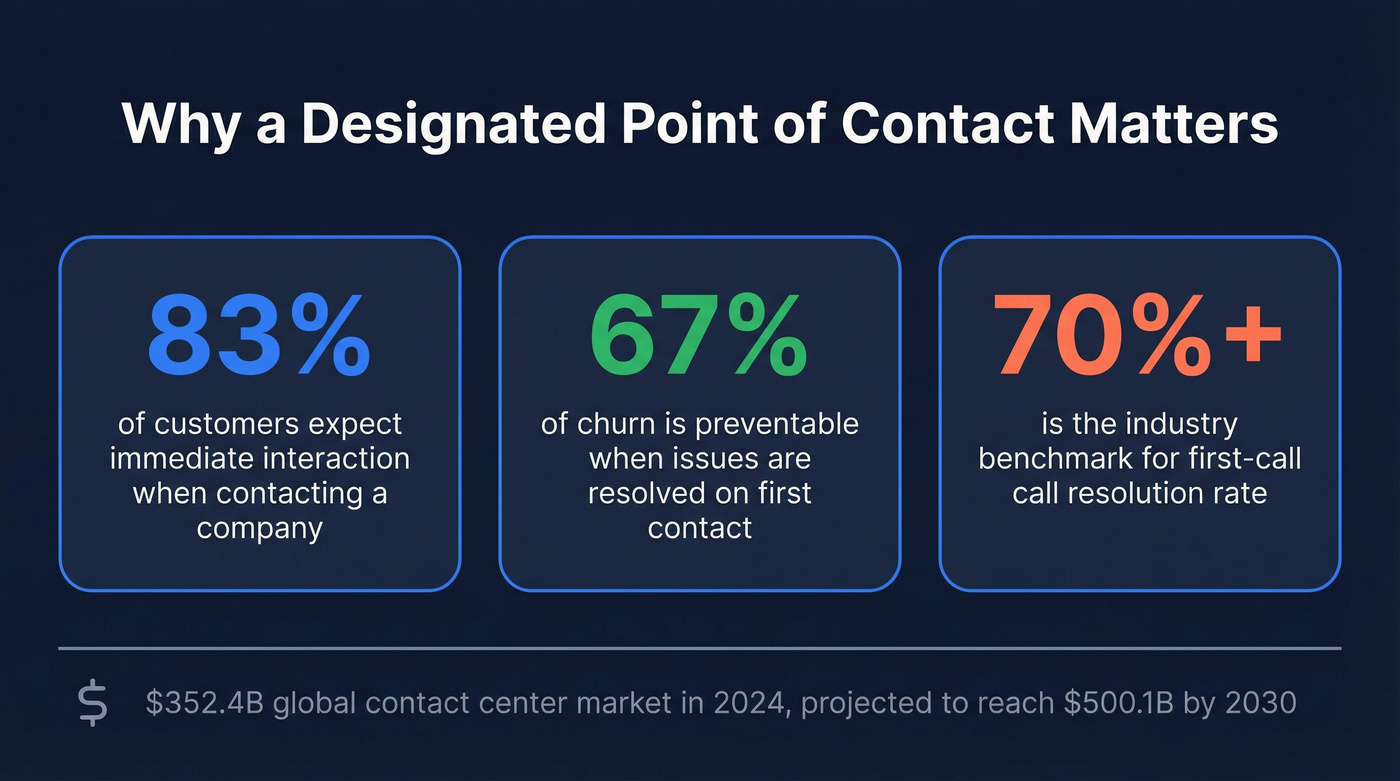
Here's the thing: 67% of churn is preventable when issues get resolved on first contact. The industry benchmark for first-call resolution sits above 70%, and companies that consistently hit it share one trait - clear ownership of who talks to the customer and when. The global contact center market was valued at $352.4B in 2024 and is projected to reach $500.1B by 2030, and much of that spend goes toward solving a single problem: getting the right person into the right conversation at the right time.
POC Across Different Contexts
B2B Sales
In B2B, your point of contact is rarely the only person who matters - but they're the one who makes everything else possible. A typical buying group involves 6-10 decision makers, and buyers spend only about 17% of their total buying time with potential suppliers. The rest of the time, your POC is your proxy inside the account.
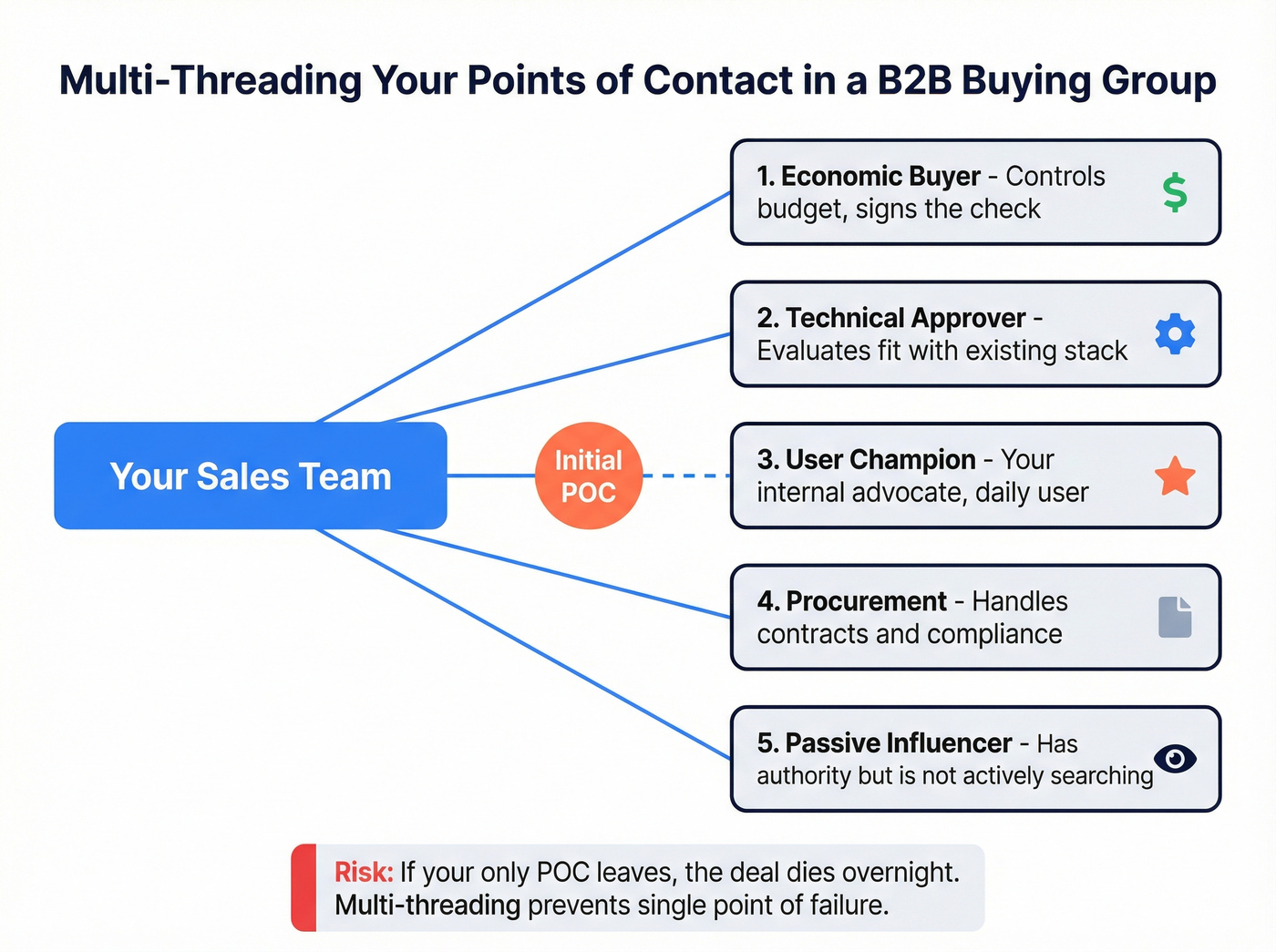
Best-in-class sales teams don't rely on a single POC. They multi-thread by segmenting contacts across roles: economic buyer, technical approver, user champion, procurement. Your initial contact gets you in the door. Multi-threading keeps you from getting locked out when that person changes roles or goes dark.
The most common POC failure we hear about from sales teams? A single champion leaves mid-deal, and nobody else at the account knows you exist. We've seen it kill six-figure opportunities overnight.
Not every contact carries the same weight, either. Some are active evaluators driving the deal forward, while others are passive buyers - people with influence or budget authority who aren't actively searching for a solution but can still tip the outcome. Knowing the difference helps you tailor how you engage each POC.
Customer Support
In support, the POC is whoever owns context continuity. 70% of customers expect any agent they reach to already know their history - previous tickets, account setup, frustrations. When that doesn't happen, satisfaction craters.
Effective support orgs solve this with smart channel routing: the customer's issue type, severity, and history determine which specialist team picks up the conversation. The designated contact isn't always the same person, but the context should follow the customer regardless.
Government and Military
In federal contexts, "point of contact" carries legal weight. 32 CFR SS 3.4 defines an agency POC as the individual identified by a military department or defense agency for prototype Other Transactions agreements. The TPOC (Technical Point of Contact) isn't the acquisitions officer - they're the subject-matter expert, often the person who wrote the topic.
Government POC responsibilities get granular. In CISA's GETS/WPS program, the designated POC must enroll eligible personnel, distribute GETS cards, review monthly usage reports, update subscriber lists as personnel change, and familiarize new subscribers with program procedures.
If you're interacting with a government TPOC, do your homework first. Ask informed questions, skip the sales pitch, and never offer gifts - ethics rules are strict.

B2B contact data decays up to 70% annually - which means the POC you identified last quarter may already be gone. Prospeo refreshes 300M+ profiles every 7 days (not the 6-week industry average), so you always reach the person who's actually in the seat. 30+ filters let you pinpoint contacts by title, department, seniority, and buyer intent across 6-10 person buying committees.
Stop losing deals because your champion's data is six weeks stale.
SPOC vs. MPOC - Which Model Fits?
| SPOC (Single) | MPOC (Multiple) | |
|---|---|---|
| Strength | Clear ownership, consistency | Scalability, specialist access |
| Risk | Bottleneck, single point of failure | Inconsistency, bouncing |
| Best for | Teams under 20 | Teams over 20 with routing rules |
| Failure mode | POC goes on vacation, everything stalls | Customer repeats their problem 3x |
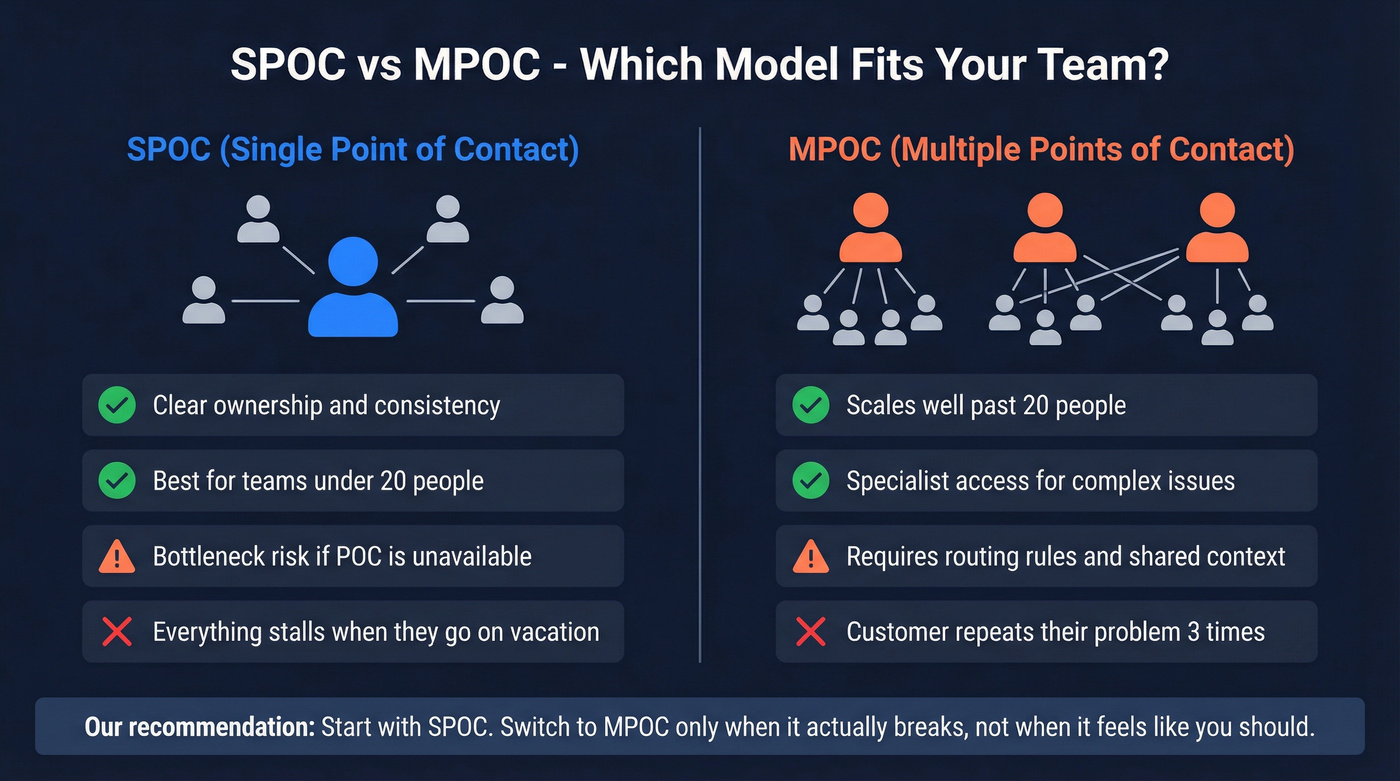
In our experience, the SPOC model breaks down around the 20-person mark. Below that threshold, SPOC wins - the accountability and consistency outweigh the bottleneck risk, especially with a documented backup plan. Past 20 people or in high-volume support, MPOC becomes necessary, but only if you invest in routing rules and shared context systems. Without those, MPOC just means the customer gets bounced around.
Most teams default to MPOC too early because it feels more "scalable." In practice, premature MPOC is the number-one reason customers end up repeating themselves to three different reps. Pick SPOC until it actually breaks.
POC vs. Account Manager vs. Stakeholder
These roles overlap but aren't interchangeable:
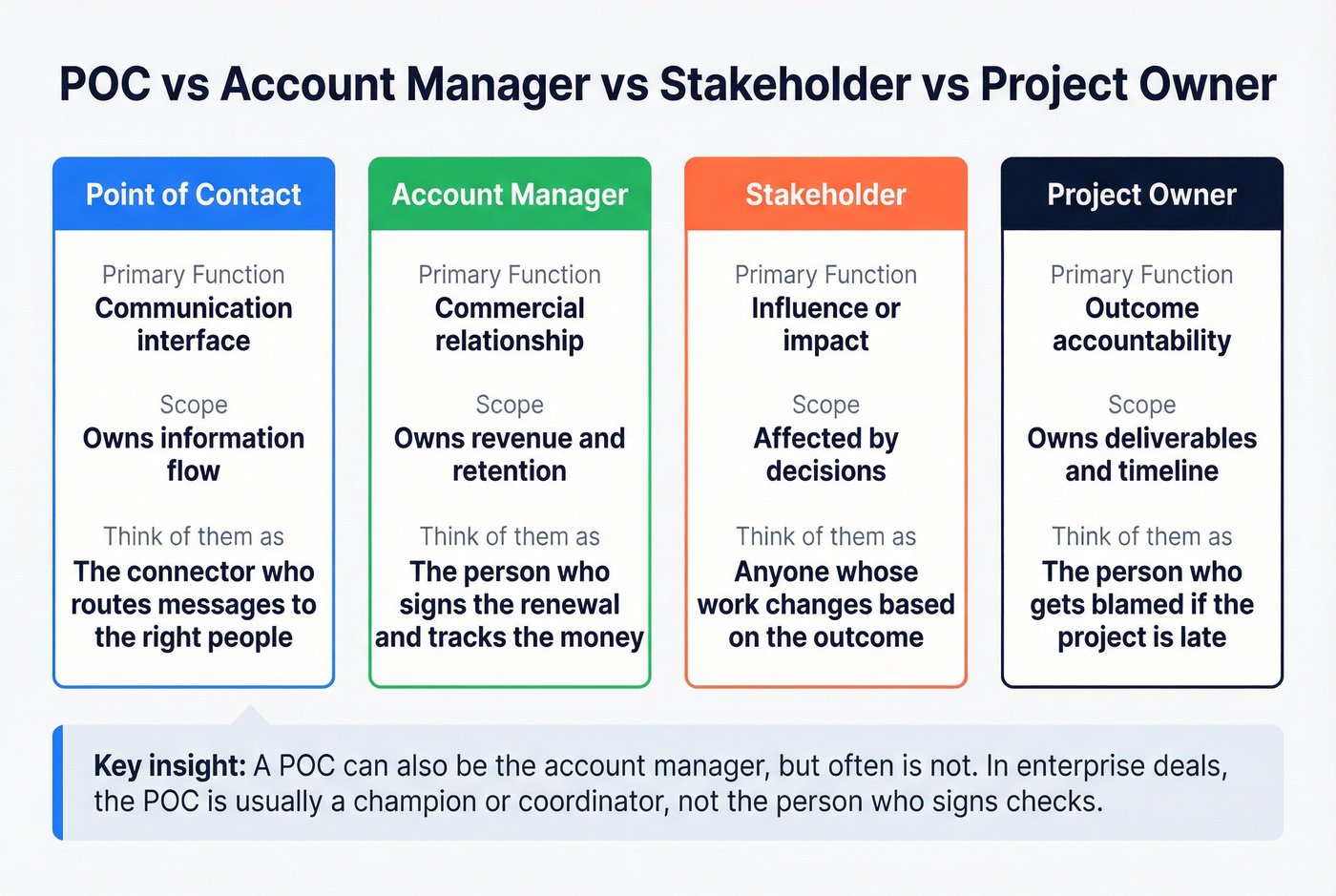
| Role | Primary Function | Scope |
|---|---|---|
| Point of Contact | Communication interface | Owns information flow |
| Account Manager | Commercial relationship | Owns revenue and retention |
| Stakeholder | Influence or impact | Affected by decisions |
| Project Owner | Outcome accountability | Owns deliverables and timeline |
A POC can also be the account manager, but often isn't. In enterprise deals, the POC is frequently a champion or internal coordinator - someone who connects the dots, not someone who signs checks.
How to Find the Right POC at Any Company
B2B contact data decays at a brutal rate - somewhere between 30% and 70% annually. People change roles, switch companies, and update titles faster than most databases keep up. We've watched teams waste weeks chasing contacts who left months ago.
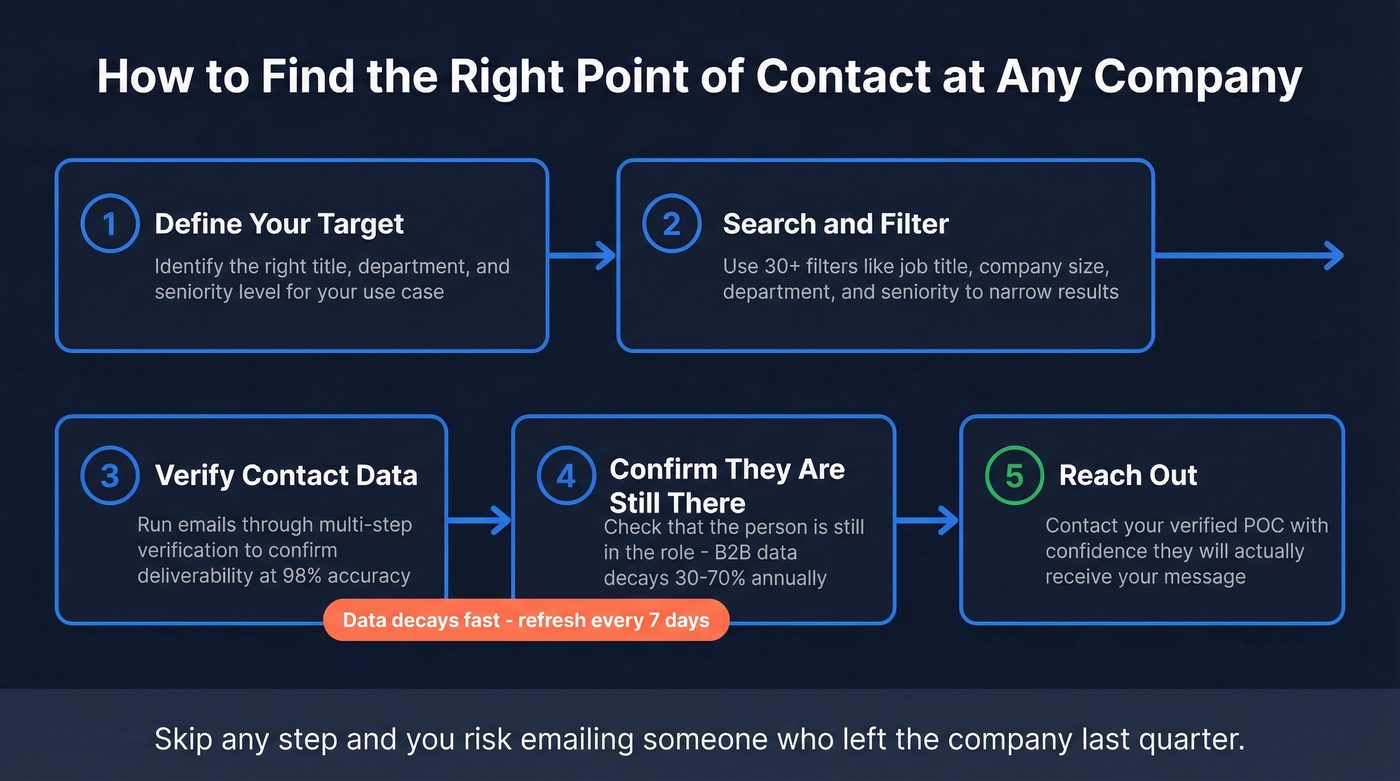
The practical workflow looks like this: identify the right person by title, department, and seniority, then verify their contact data is current, then confirm they're still in that role before reaching out. This is especially critical when you're trying to reach a potential client for the first time - a wrong or outdated POC means your outreach never lands with someone who can act on it.
Prospeo's B2B database makes this straightforward. Search across 300M+ professional profiles using 30+ filters - job title, department, seniority, company size - to zero in on the right POC. Every email runs through a 5-step verification process at 98% accuracy, and the entire database refreshes every 7 days. That means you're not emailing someone who left the company last quarter. The free tier gives you 75 verified emails per month plus 100 Chrome extension credits, so you can test it without commitment.

Tire Kickers vs. Real Prospects
Not every person who engages with your sales team is worth routing to a senior POC.
A tire kicker asks lots of questions, requests demos, and consumes your team's time - but has no real intention or authority to buy. Learning to spot this behavior early protects your team's bandwidth and keeps your designated contact focused on conversations that actually move deals forward.
The telltale signs: they dodge questions about budget, can't articulate a timeline, and loop in new stakeholders without clear purpose. Compare that to a passive buyer, who may seem disengaged but actually holds latent budget authority and can convert when the right trigger appears. The distinction matters because your POC strategy should differ for each. Tire kickers get qualified out quickly. Passive buyers get nurtured with relevant content until timing aligns.
Look - if your reps are spending 40% of their time on contacts who'll never buy, the problem isn't effort. It's routing. A well-defined POC strategy paired with early qualification questions (budget, authority, timeline) fixes this faster than any new tool or process. If you want a tighter system for that, start with account qualification and a clear lead qualification framework, then operationalize it with AI lead qualification and RevOps lead scoring.
Multi-threading across a buying group only works when every contact is real. Prospeo's 5-step verification delivers 98% email accuracy and 125M+ verified mobile numbers - so when your single POC goes dark, you have direct lines to the economic buyer, technical approver, and user champion already loaded. At $0.01 per email, mapping an entire account costs less than a cup of coffee.
Never lose a six-figure deal to a single point of failure again.
FAQ
What does point of contact mean in business?
A point of contact is the designated person or department responsible for managing communication in a specific relationship or project. In B2B sales, the POC coordinates between your team and the buying group. In engineering, POC can also mean "proof of concept" - context always clarifies which meaning applies.
What's the difference between SPOC and MPOC?
A SPOC (single point of contact) means one person owns all communication - simpler and more accountable, but risky if they're unavailable. An MPOC distributes responsibility across specialists, scaling better past 20 people but requiring clear routing rules to prevent customers from getting bounced.
How do I keep POC contact data accurate?
B2B contact data loses 30-70% of its accuracy every year as people change jobs. Use a data platform with frequent refresh cycles and re-verify your contacts quarterly at minimum. Stale data wastes time and damages sender reputation when emails bounce.
What is a tire kicker in sales?
A tire kicker is someone who engages with your sales process - attending demos, asking detailed questions - without genuine intent or authority to purchase. They consume POC time and pipeline resources without progressing toward a decision, which is why early qualification with budget and timeline questions matters so much.