

Elevator Speech for Sales Representatives: A Data-Backed Guide With Scripts
You've read five elevator speech articles and none gave you a script you could actually use on your next cold call. Most rehash the same goldfish-attention-span myth and tell you to "keep it short." That's lazy advice. A study of 90,380 cold calls found that the best-performing opener - "How have you been?" - hits a 6.6x success rate, and 96% of B2B buyers research a company before engaging with a sales rep. Your elevator speech doesn't need to be shorter. It needs to be smarter.
What Actually Works in the First 10 Seconds
"How have you been?" - even on a first interaction - keeps people talking out of habit. It buys you the seconds you need to deliver substance.
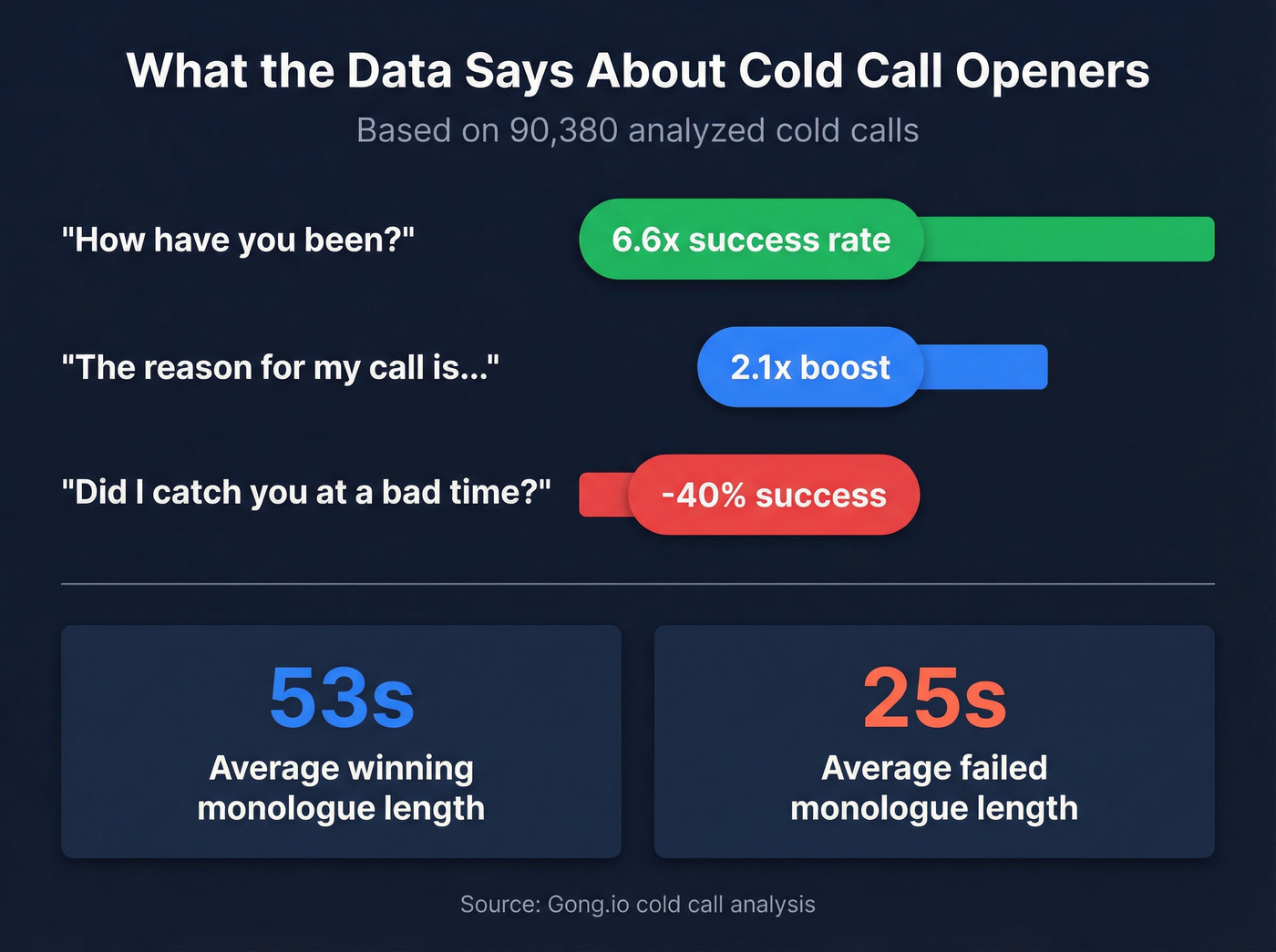
The landmine: "Did I catch you at a bad time?" tanks your odds by 40%. Instead, bridge with "The reason for my call is..." - that phrase alone boosts success rates 2.1x.
Here's what most pitch guides get wrong: brevity isn't the goal. Successful cold call monologues average 53 seconds. Failed ones? Just 25 seconds. Winning reps also use 65% more "we" language, framing the conversation as collaborative rather than transactional. Your pitch doesn't fail because it's too long - it fails because it's too generic. We've watched SDR teams burn through 50 dials on dead numbers before lunch, then blame the script. The script wasn't the problem.
The 5-Part Sales Pitch Framework
Cognitive load theory explains why the best pitches stick to one problem and one outcome - the brain can't process a feature dump in under a minute. Based on Monday.com's template research and validated by the 53-second monologue data, here's the structure:
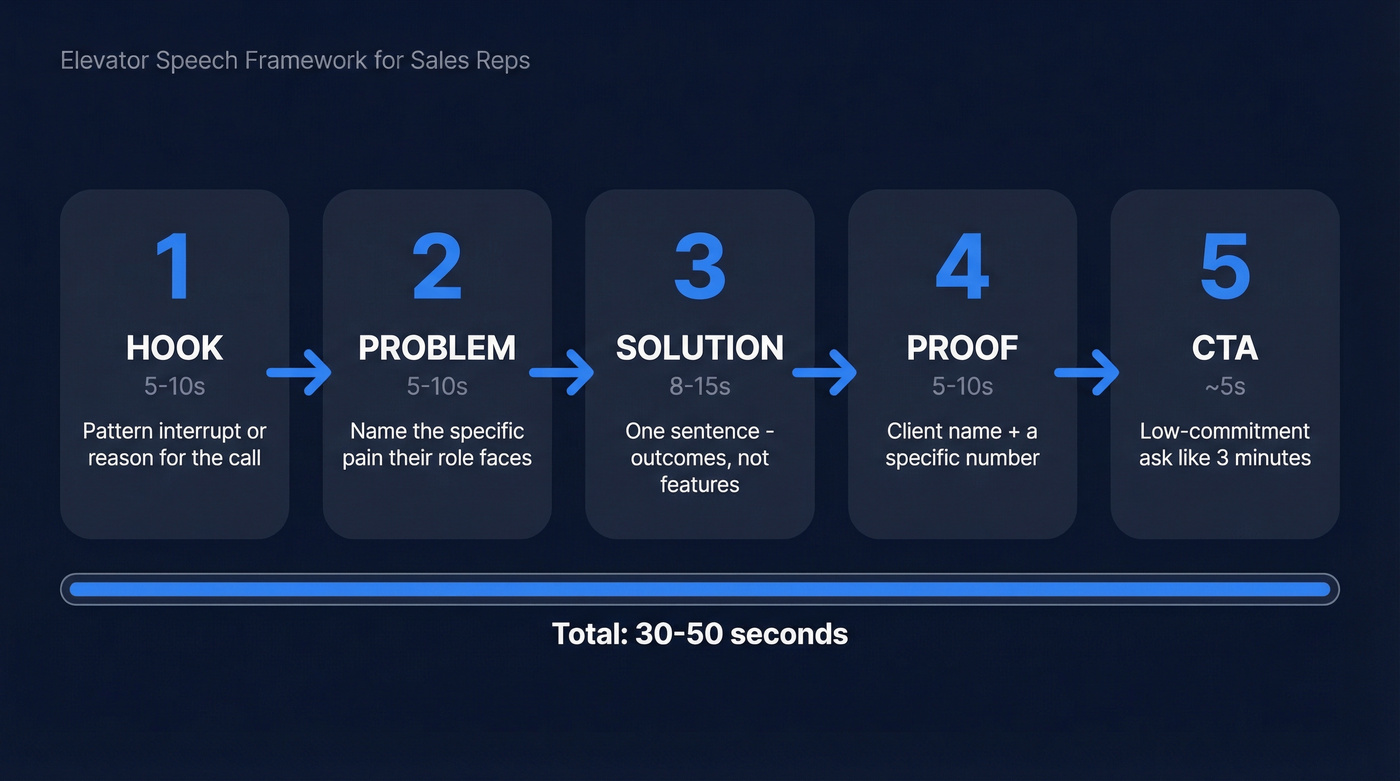
- Hook (5-10s) - Pattern interrupt or reason for the call.
- Problem (5-10s) - Name the specific pain their role and industry face.
- Solution (8-15s) - One sentence. Outcomes, not features.
- Proof (5-10s) - A client name and a specific number.
- CTA (~5s) - Low-commitment ask. "Three minutes" signals you respect their time.
Fill-in-the-blank template:
"Hi [Name], [Hook]. A lot of [role/industry] teams are dealing with [Problem]. At [Company], we [Solution]. [Client] saw [Proof]. Would it make sense to [CTA]?"
Track which version books more meetings and iterate weekly.
6 Industry Scripts You Can Steal
Company names and results below are illustrative - swap in your own. These follow the 5-part framework but vary in approach so you can see different entry points.
SaaS / B2B Tech
"Hi Sarah, the reason for my call - a lot of VP Sales at Series B SaaS companies tell us pipeline gen takes twice the effort it did 18 months ago. At Acme, we automate top-of-funnel research that eats your SDRs' mornings. Datadog's team cut list-building time by 60% in the first month. Could I walk you through how in 10 minutes this week?"
Insurance
"Hi Mark, how have you been? Independent agencies like yours are losing renewals to direct carriers who undercut on price. We help agencies retain 15-20% more policies by flagging at-risk accounts 90 days before renewal. Midwest Insurance Group kept $2.3M in premiums last year. Worth a quick look?"
Real Estate
Have you noticed listings in the Dallas market sitting 40+ days? That's the opening. Then: "We match properties to pre-qualified buyer pools before they hit the MLS. One agent in Frisco sold three listings in under 14 days last quarter. I'll send over the case study - if it's relevant, we can talk for 10 minutes."
This version leads with a question instead of a statement. It works well in markets where the prospect already feels the pain.
Medical Device / Healthcare
"Cleveland Clinic's ortho department cut case cancellations by 30% in one quarter - here's why that matters for you. Supply chain delays are pushing cancellations up 12-15% at surgery centers like yours. At MedFlow, we give procurement teams real-time inventory visibility across distributors. Would three minutes to walk through the dashboard make sense?"
Leading with the proof point works when your case study is strong enough to earn attention on its own.
Staffing / Recruiting
"Hi Amanda, how have you been? Staffing firms in light industrial are telling us time-to-fill is creeping past 21 days, and clients are threatening to split vendors. We automate candidate matching so recruiters close instead of source. ProStaff cut average fill time to 11 days within 60 days. Can I show you the workflow?"
Financial Services
"Hi David, the reason for my call - RIAs managing $50-200M AUM are losing wallet share because clients expect digital-first reporting and they're getting PDFs. We build client portals that increase engagement by 40%. Meridian Wealth saw $12M in new assets within six months. I'll send a two-minute demo link - if it resonates, let's talk."
This version ends with a statement CTA instead of a question. It works when you want to reduce friction and avoid putting the prospect on the spot.

You just built a killer elevator speech. Now stop wasting it on dead numbers and gatekeepers. Prospeo gives you 98% accurate emails and 125M+ verified mobile direct dials - so your 53-second pitch lands with the actual decision-maker, not their voicemail.
Stop perfecting your pitch for the wrong phone number.
Adapt Your Pitch by Channel
80% of B2B interactions now happen through digital channels, and 80% of sales require five or more follow-ups. Your elevator speech for a sales representative needs to flex across touchpoints, not just the first one.
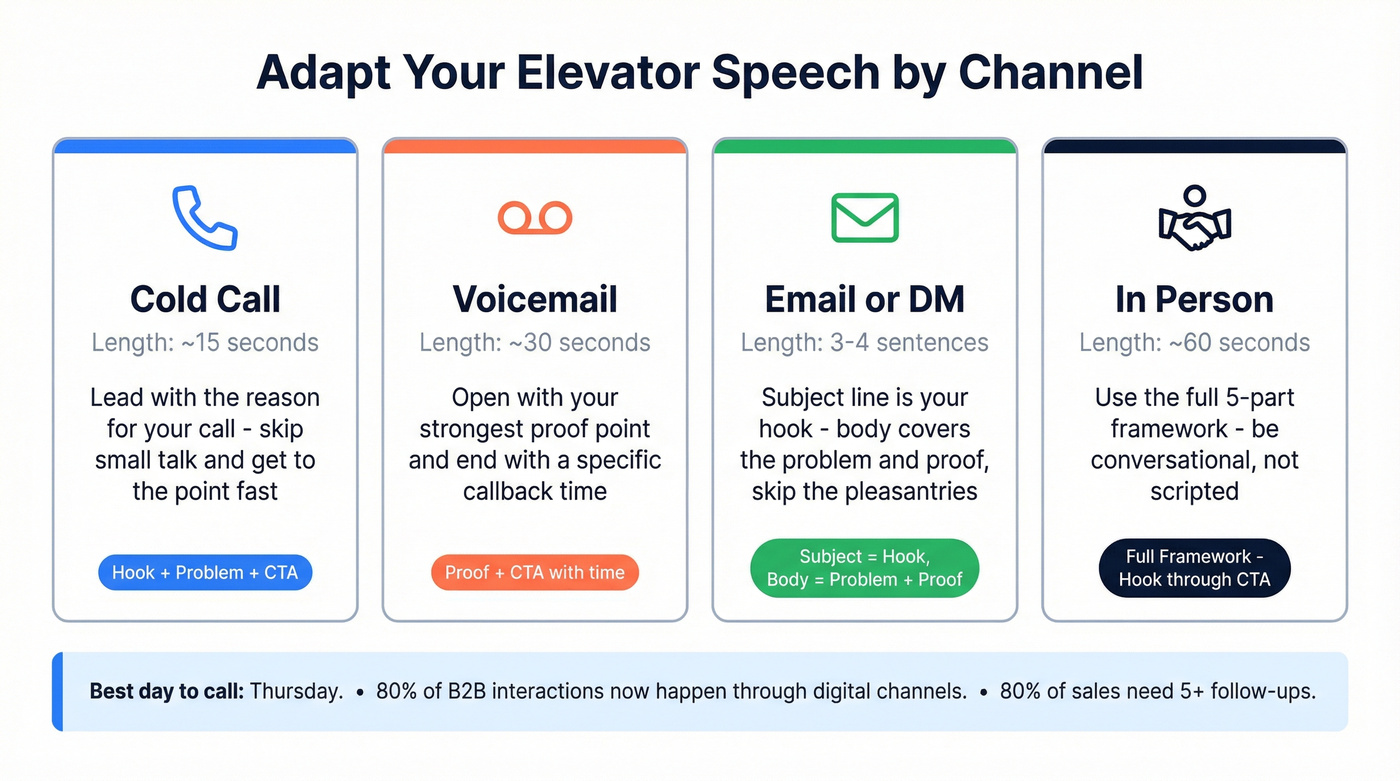
| Channel | Length | Key Adjustment |
|---|---|---|
| Cold call | ~15s | Lead with reason for the call as the hook |
| Voicemail | ~30s | Proof point + callback CTA |
| Email / DM | 3-4 sentences | Subject = hook, body = problem + proof |
| In-person | ~60s | Full 5-part framework, conversational |
On cold calls, go straight to "The reason for my call is..." For voicemail, lead with your proof point and end with a specific callback time. For email, your subject line is the hook - skip "I hope this finds you well."
One timing insight worth knowing: an analysis of 110,000+ B2B calls found Thursday is the most reliable day for meaningful conversations. Pacing matters too - slow down on your proof point, speed up slightly on the hook.
Tailor by Audience Seniority
59% of buyers say reps don't understand their specific needs. A generic pitch proves them right.
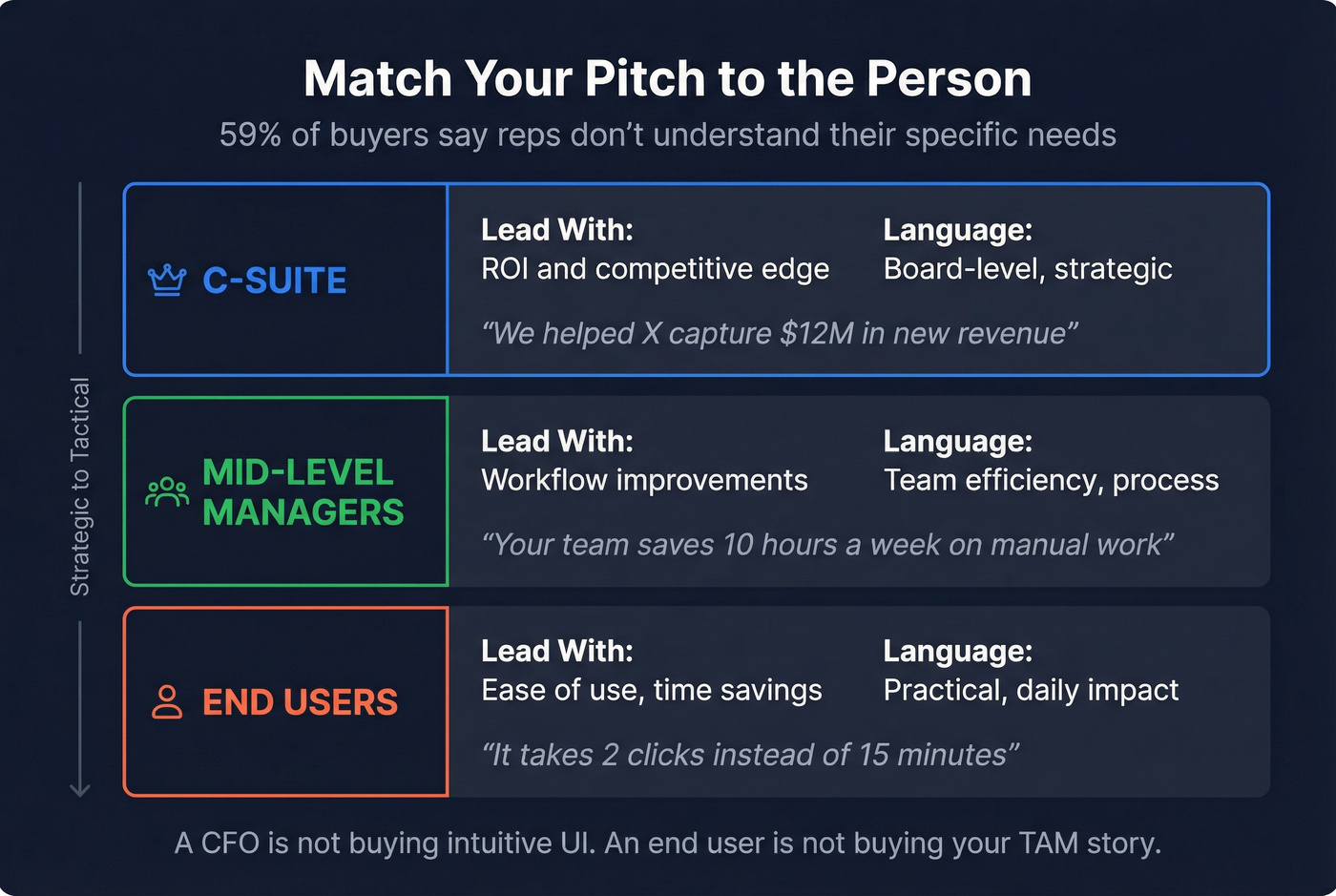
| Audience | Lead With | Language |
|---|---|---|
| C-suite | ROI, competitive edge | Board-level, strategic |
| Mid-level managers | Workflow improvements | Team efficiency, process |
| End-users | Ease of use, time savings | Practical, daily impact |
A CFO isn't buying "intuitive UI." An end-user isn't buying your TAM story. Match the pitch to the person. This same principle applies when founders sell directly - the pitch should lean on vision and strategic outcomes rather than feature specs.
Before You Pitch: Reach the Right Person
Let's be honest - this is the step every pitch guide skips. Reps spend only 30% of their time actually selling, and quota attainment sits at 43.5%. A big chunk of that waste? Calling disconnected numbers and emailing dead inboxes. People debate openers endlessly, but the real conversion killer is delivering a great pitch to a bad number.
Your elevator speech is useless if it never gets delivered. We use Prospeo for this - 98% email accuracy, 125M+ verified mobile numbers with a 30% pickup rate, and a free tier to get started. Upload a CSV, verify in bulk, and push clean contacts straight to your sequencer via native integrations with Salesforce, HubSpot, or Instantly. It takes minutes, and it's the difference between a pitch that lands and one that bounces.
Mistakes That Kill Your Pitch
- "Did I catch you at a bad time?" - 40% less likely to book a meeting.
- Feature-dumping - Nobody cares about your 47 integrations in the first 30 seconds.
- Vague CTA - "Let me know if you're interested" isn't a CTA. "Can I send a 2-minute case study?" is.
- Zero personalization - If you could swap the prospect's name for anyone else and the pitch still works, it's too generic.
- Reading verbatim - Scripts are frameworks, not teleprompter copy. If you sound like you're reading, you've already lost.
- Monologuing past 60 seconds - After ~53 seconds, ask something.
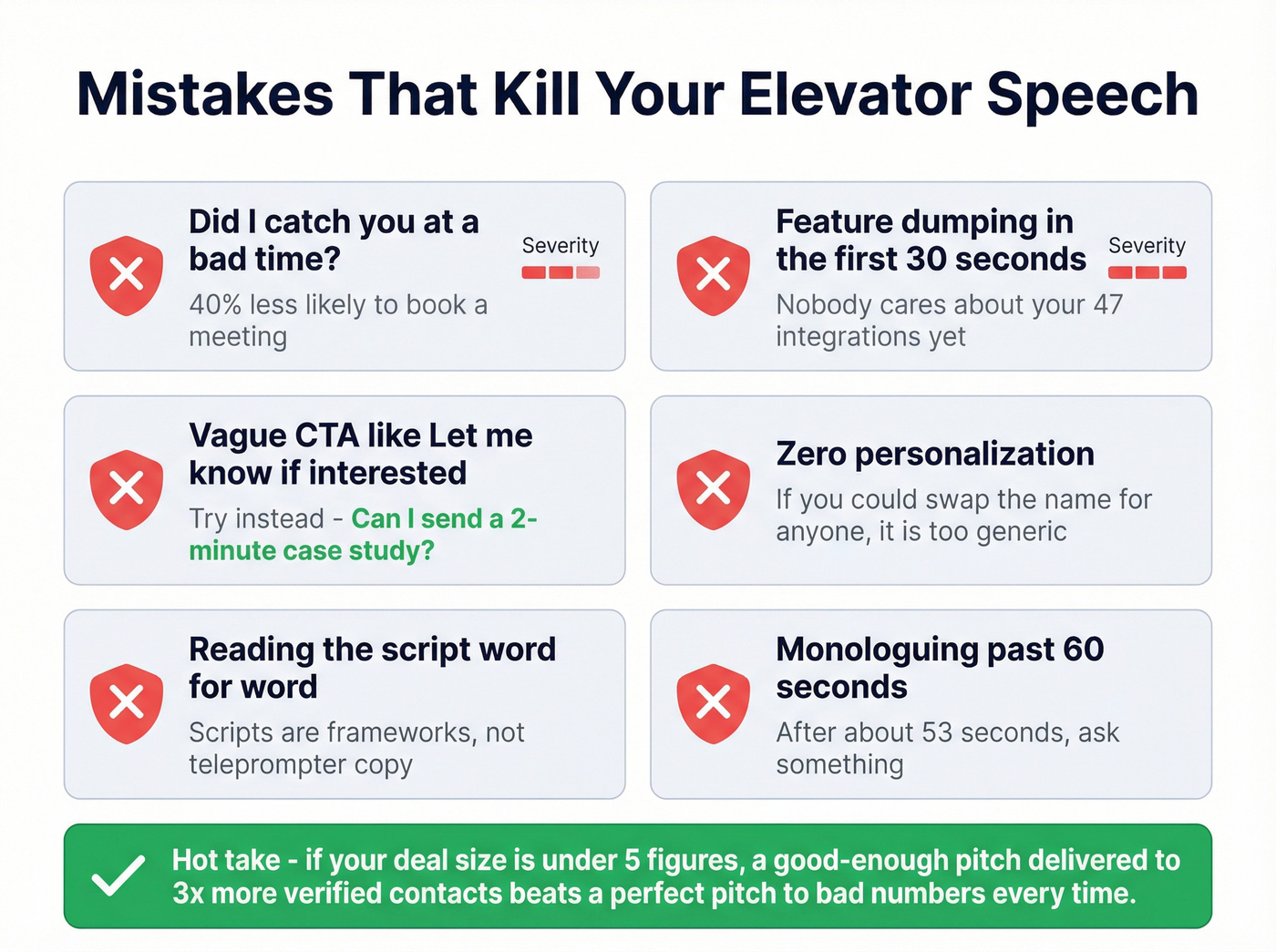
Hot take: if your average deal size is under five figures, you don't need a perfect elevator speech. You need a good-enough one delivered to 3x more verified contacts. Most reps over-optimize the script and under-invest in reaching the right person. In our experience, the teams that fix their data first see bigger jumps in pipeline than the teams that workshop their opener for the tenth time.
The framework is simple: hook, problem, solution, proof, ask. The hard part isn't writing the pitch - it's making sure your elevator speech reaches someone who can say yes.
Reps spend 70% of their time not selling - mostly hunting for contact data. Prospeo's 300M+ profile database with 30+ filters lets you build targeted lists in minutes, not hours. One SDR team cut list-building from 15 hours to under 3 per week.
Spend your time pitching, not prospecting for numbers that don't connect.
FAQ
How long should a sales elevator speech be?
30-60 seconds in person, about 15 seconds for cold call openers. Successful cold call monologues average 53 seconds - long enough for substance, short enough to hold attention. Aim for under 90 words spoken aloud.
What's the best opening line for a cold call pitch?
"How have you been?" performs at 6.6x the baseline success rate across a 90,380-call study. Follow it with "The reason for my call is..." for another 2.1x boost. Avoid "Did I catch you at a bad time?" - it drops success by 40%.
How do I make sure my pitch reaches the right prospects?
Start with verified contact data before you dial. Tools like Prospeo verify emails and mobile numbers in real time with 98% accuracy and refresh records every 7 days. The best sales pitch in the world fails if it never gets delivered - verify first, pitch second.
Should I use the same elevator speech on every channel?
No. Adapt length and structure per channel: ~15 seconds on cold calls, 3-4 sentences in email, and the full 5-part framework in person. The core message stays the same, but the hook and CTA shift - voicemails lead with proof, emails lead with the problem.