

Open-Ended Questions for Sales Calls: The Data, the Frameworks, and 20 Questions That Close
Every article on this topic gives you 55 questions in a bulleted list and calls it a day. That's not helpful - it's a crutch. An analysis of 326,000 sales calls shows won deals average 15-16 questions, while lost deals average around 20. More questions doesn't mean better discovery. It means you're interrogating, not conversing.
The best discovery calls feel like conversations, not interviews. You don't need 55 open-ended questions for sales calls. You need the SPIN framework, a solid probing ladder, and fewer, better questions that get prospects talking about what actually matters.
What the Data Says
The "70/30 rule" - talk 30%, listen 70% - gets repeated everywhere. It's wrong.
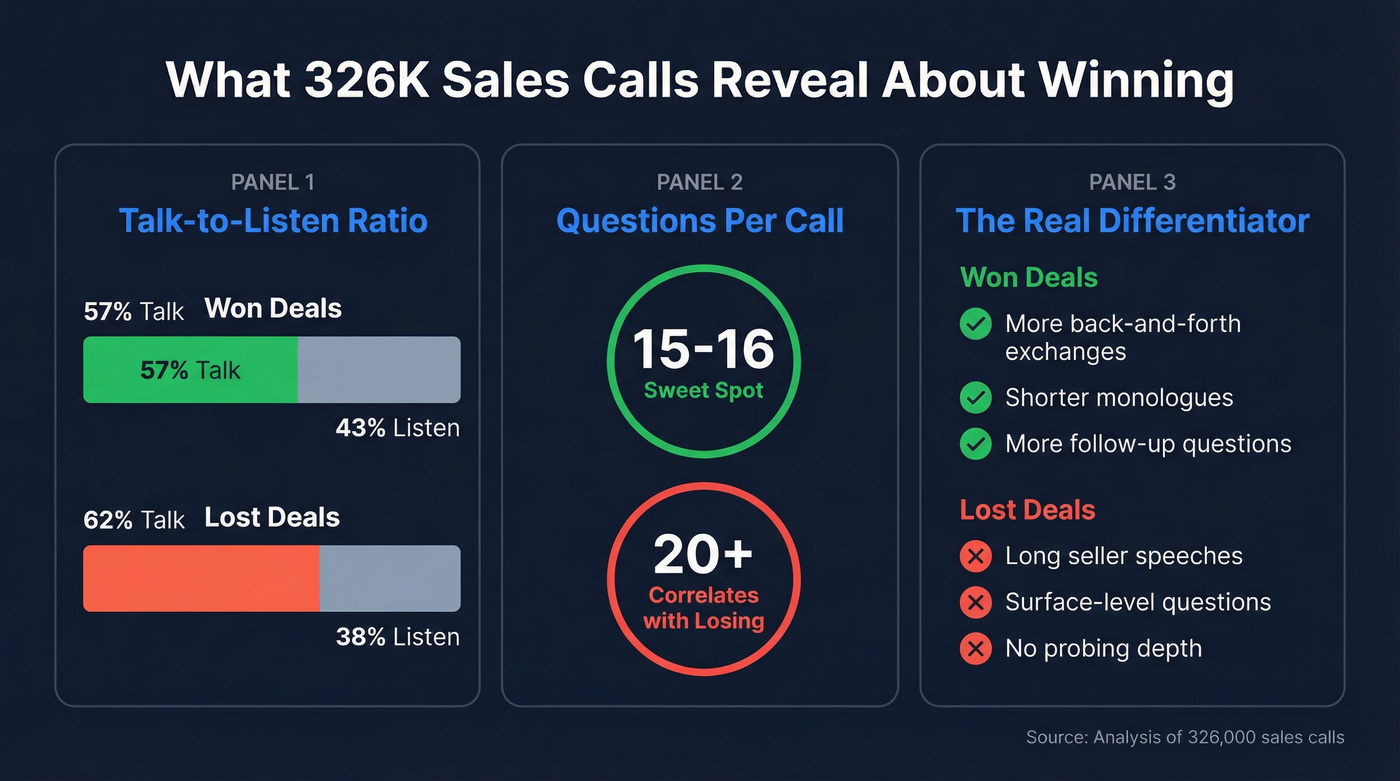
The 326K-call dataset tells a different story: the average talk-to-listen ratio across all calls is 60/40, and closed-won deals come in at 57% talk / 43% listen while lost deals sit at 62/38. That gap looks small, but it compounds - the real differentiator isn't silence, it's interactivity. Won deals have more back-and-forth exchanges, shorter monologues, and more follow-up questions. Lost deals feature long seller speeches and surface-level questions that never dig into pain.
Asking 20+ questions per call actually correlates with losing. The sweet spot is 15-16 well-placed questions with genuine follow-up probing.
The SPIN Framework
Neil Rackham's SPIN Selling came from 35,000 sales calls analyzed over 12 years. It's still the best mental model for structuring discovery questions.
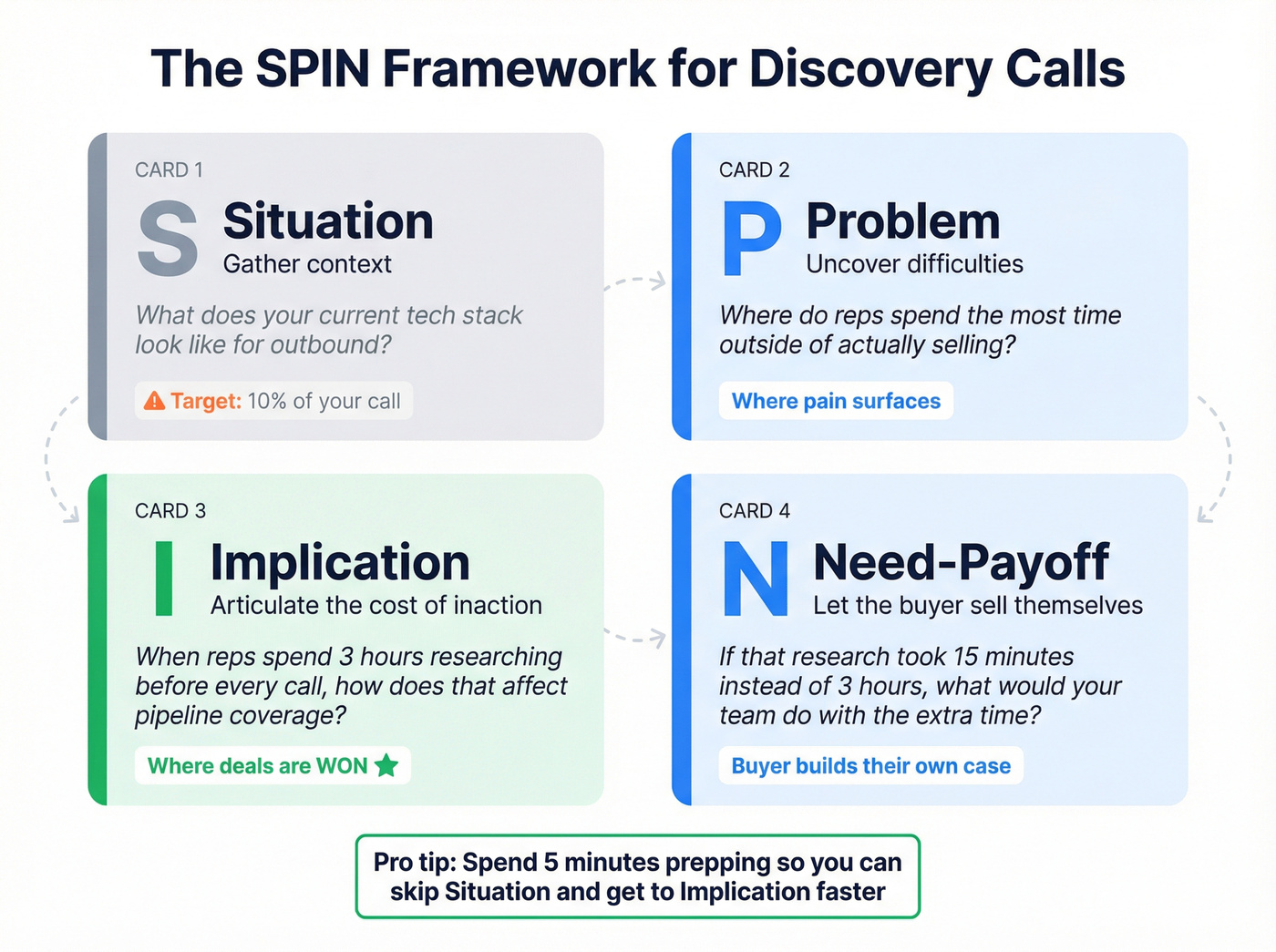
Situation questions gather context ("What does your current tech stack look like for outbound?"). They're necessary but low-value. Don't burn half a discovery call on questions you could answer with a few minutes of pre-call research.
Problem questions uncover difficulties ("Where do reps spend the most time outside of actually selling?").
Implication questions are where deals are won ("When reps spend three hours researching before every call, how does that affect pipeline coverage?"). They force the buyer to articulate the cost of inaction.
Need-payoff questions let the buyer sell themselves ("If that research took 15 minutes instead of three hours, what would your team do with the extra time?").
Let's be honest: Situation questions should be 10% of your call, not 35%. In our experience, reps who spend five minutes prepping - pulling verified contact data, checking technographics, scanning recent funding - ask fewer Situation questions and get to pain faster.
20 Examples by Call Stage
Rapport
- "What's been keeping your team busy this quarter?" - priorities and pressure points.
- "How did you end up in this role?" - career trajectory, what they care about.
- "What's the biggest change in your market over the last year?" - external forces shaping decisions.
Discovery and Pain
- "Walk me through how your team handles [specific process] today." - manual steps, workarounds, frustration.
- "What's the most time-consuming part of that workflow?" - the pain they've normalized.
Here's where most reps stop. Don't. The next question is the one that wins deals:
"When that breaks down, what happens downstream?" This is an Implication question. A rep we worked with asked this to a VP of Sales who'd just described a broken handoff process. The VP paused for eight seconds, then said, "Honestly, we lose about 30% of qualified leads in that gap." That pause - and the number that followed - became the entire business case.
"What prompted you to take this meeting now?" - the trigger event reveals urgency.
"If nothing changes in the next 12 months, what does that cost you?" - whether they've quantified the problem.
Qualification and Stakeholders
Closed-won deals have roughly 2x as many buyer contacts as lost deals. Multi-threading boosts win rates by 130% in deals over $50K, and the average B2B buying committee is 6-10 decision-makers. You need to ask about stakeholders early (and understand what multithreading is).
- "Who else would need to weigh in on a decision like this?" - names, titles, political dynamics.
- "How does your team typically evaluate and approve new tools?" - the process, not just the people.
- "What would need to be true for this to get budget approved?" - real criteria, not stated ones.
- "What's happened with similar initiatives in the past?" - organizational scar tissue.
Objection Handling
Instead of listing questions here, try reframing. The bad version: "Do you have any concerns?" That's closed-ended and easy to dodge. The good version: "What concerns would you want addressed before moving forward?" Same intent, completely different response quality.
- "How does this compare to other approaches you've considered?" - competitive intel and decision criteria.
- "What would make this a no for you?" - they'll tell you exactly how to lose the deal.
Closing and Next Steps
- "Based on what we've discussed, what feels like the right next step?" - let them own the momentum.
- "What would you need to see in a pilot to feel confident?" - success criteria you can deliver on.
- "Who should be in the room for the next conversation?" - always be expanding the thread.
- "What's your timeline for making a change here?" - real urgency vs. polite interest.

The article says it: reps who spend 5 minutes prepping ask fewer Situation questions and get to pain faster. Prospeo gives you verified emails, technographics, funding data, and buyer intent signals across 15,000 topics - so you walk into every discovery call ready to skip straight to Implication questions.
Spend less time asking context questions and more time closing deals.
The Probing Ladder
Nearly 25% of sellers say discovery questions are a top weakness. The gap isn't asking the first question - it's following up when the answer is vague. This mirrors Sandler's pain-funnel sequencing, a structured approach that helped TDIndustries improve conversion from 5% to 50% over three years.
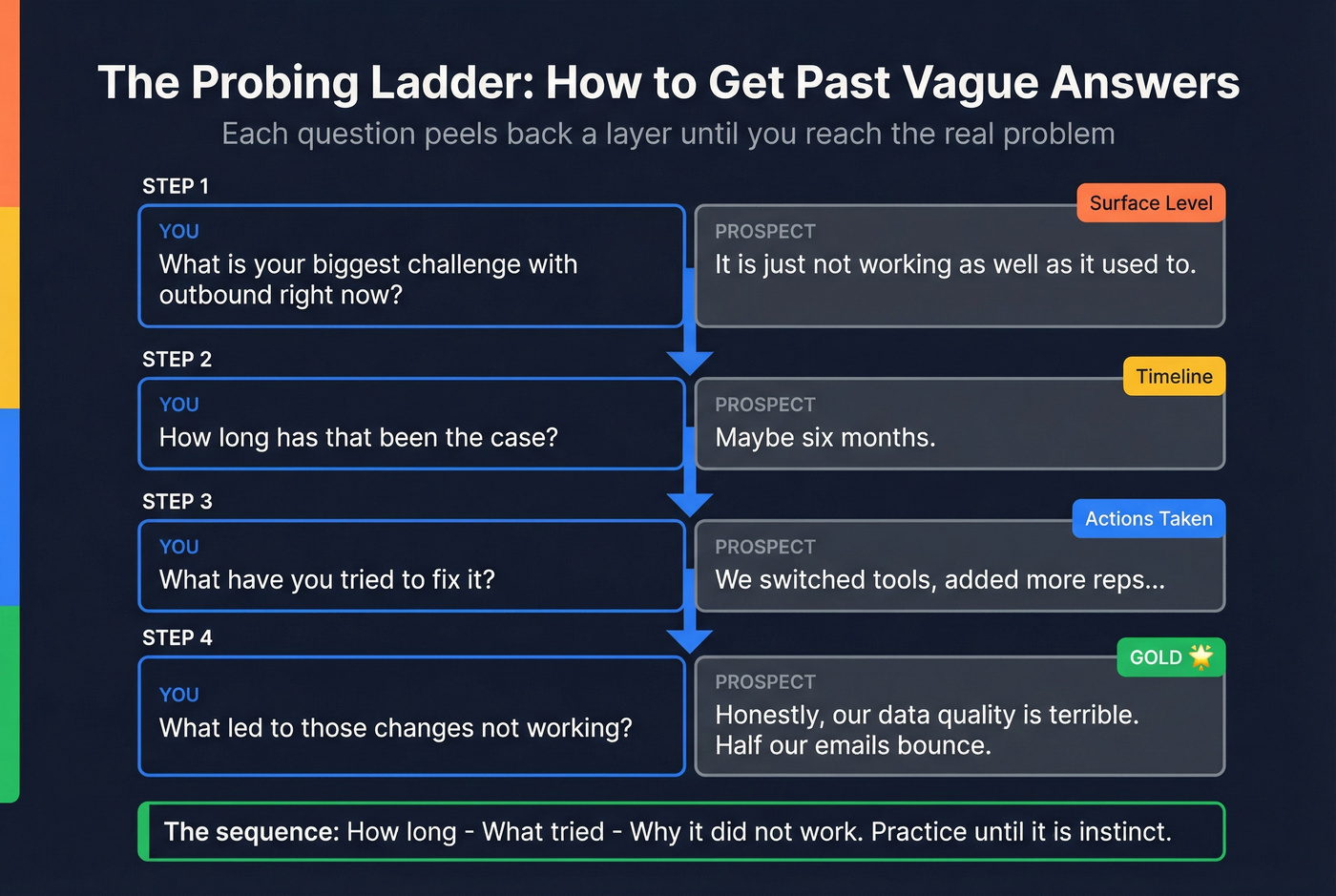
Here's what it looks like in practice:
You: "What's your biggest challenge with outbound right now?" Prospect: "It's just not working as well as it used to." You: "How long has that been the case?" Prospect: "Maybe six months." You: "What have you tried to fix it?" Prospect: "We switched tools, added more reps..." You: "What led to those changes not working?" Prospect: "Honestly, our data quality is terrible. Half our emails bounce."
That last answer is gold - you'd never get there without the ladder: How long -> What tried -> Why didn't work. Each question peels back a layer. Practice this sequence until it's instinct, because the probing ladder is the single most effective technique to get prospects talking about the real problems hiding beneath polite, surface-level answers.
Cold Call vs. Discovery Call
Different rules entirely. On a cold call, you're selling the meeting, not the product.
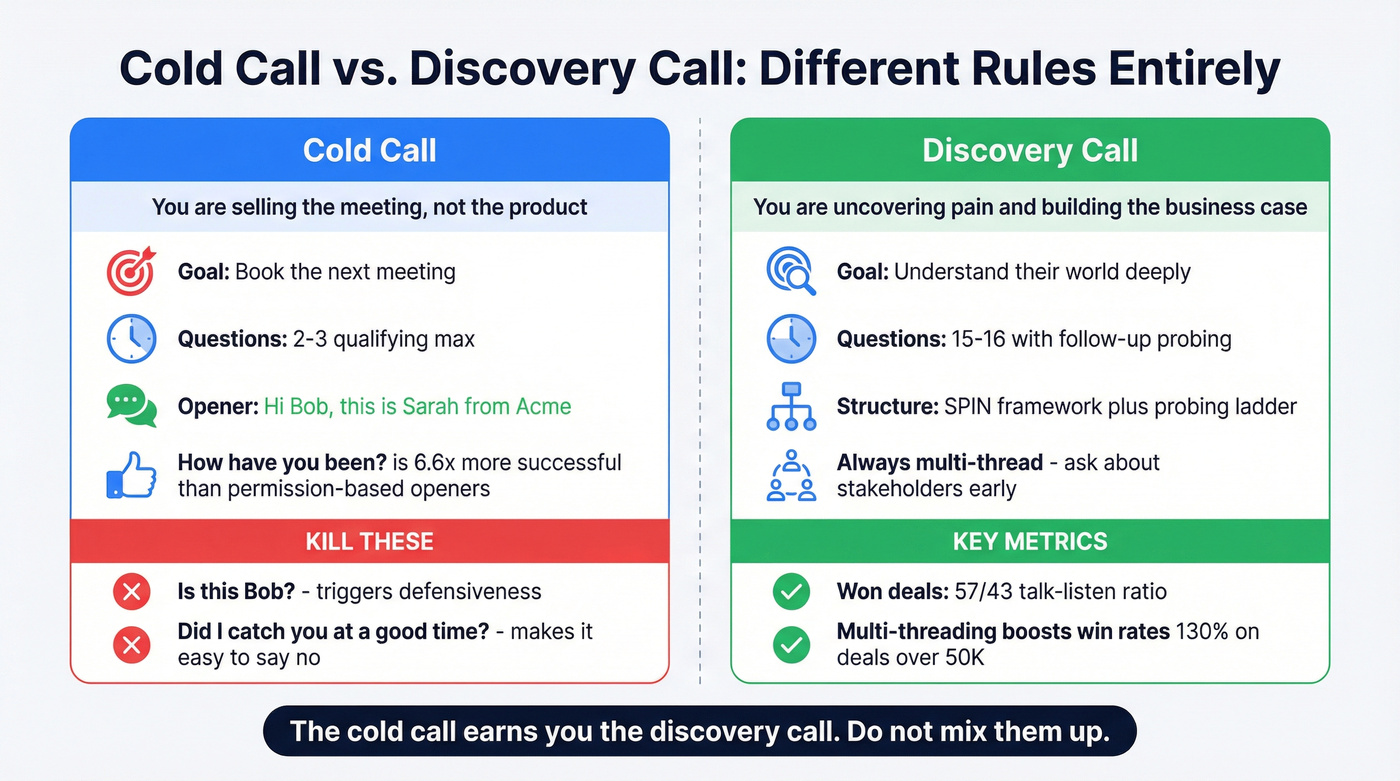
Data from Gong's analysis of cold calls shows "How've you been?" is 6.6x more successful as an opener than permission-based alternatives, and placing your reason for calling after that opener yields 2.1x higher success in booking the first meeting.
Kill these openers immediately: "Is this Bob?" triggers defensiveness - use "Hi Bob, this is Sarah from Acme" instead. "Did I catch you at a good time?" makes it easy to say no. Replace it with "I know you're busy, so I'll be brief." (If you're building a full calling motion, start with an outbound calling strategy.)
On cold calls, aim for two or three qualifying questions max, then book the next step. Save the deep discovery for the meeting you just earned.
Mistakes That Kill Conversations
Asking too many questions. The data is clear: 20+ correlates with losing. Past 16, you're interrogating.
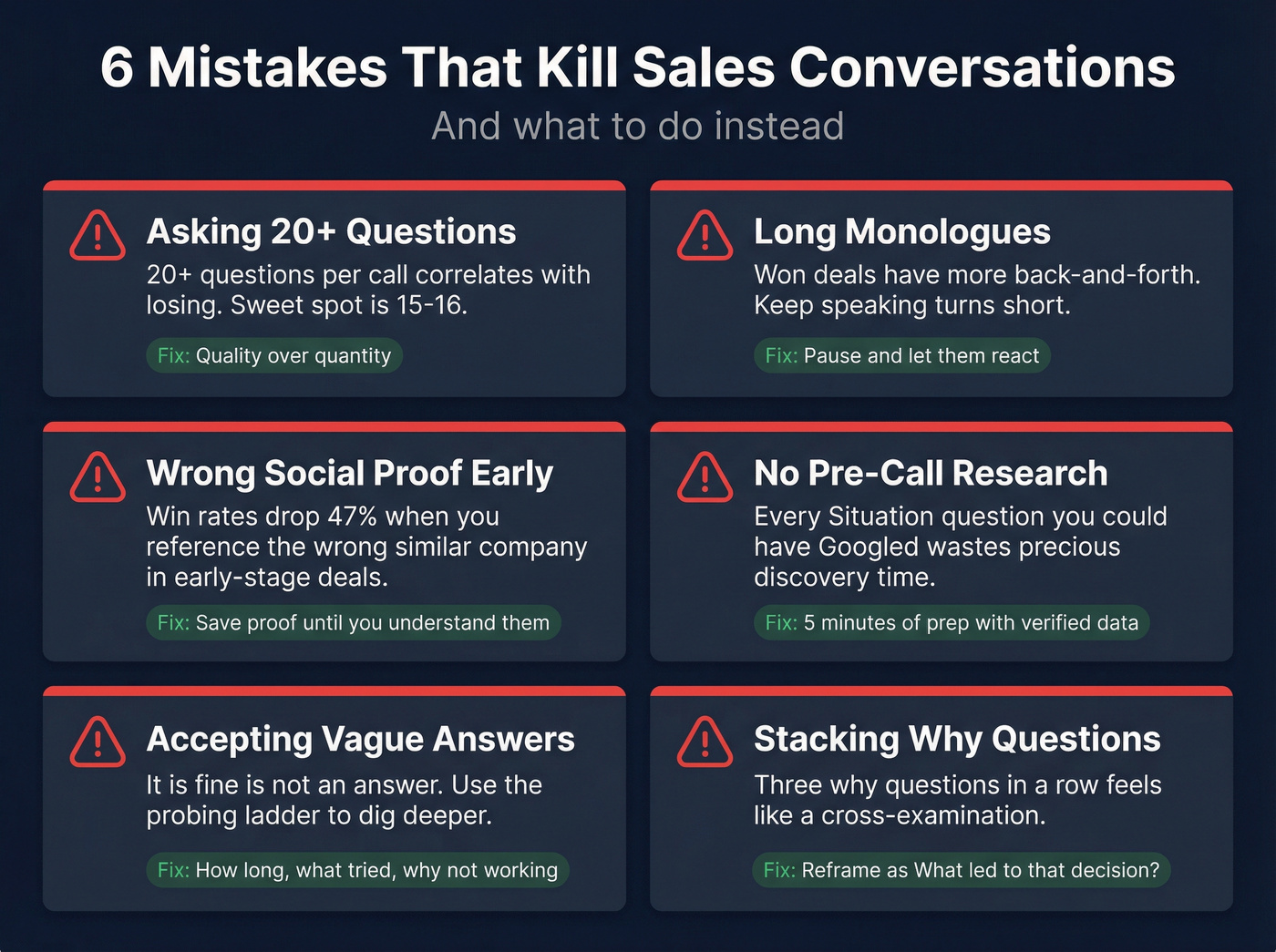
Talking too long without pausing. Long monologues kill interactivity. Keep speaking turns short and give the prospect room to react.
Using misaligned social proof early. Win rates drop 47% when you reference the wrong "similar company" in early-stage deals. Save social proof until you understand their situation - the Harvard Business Review has covered how premature pitching erodes trust.
Not doing pre-call research. Every Situation question you could've Googled wastes precious discovery time. Five minutes of prep with a tool like Prospeo's database helps you walk in with verified contact data and cleaner context so you can skip straight to Problem questions. (If you're cleaning lists at scale, use an email checker tool and keep an eye on B2B contact data decay.)
Accepting vague answers. "It's fine" isn't an answer. Use the probing ladder.
Overusing "why" questions. They sound accusatory. Reframe: "What led to that decision?" lands better than "Why did you do that?" I've watched reps lose rapport in seconds by stacking three "why" questions in a row - it feels like a cross-examination.
Multi-threading boosts win rates by 130%, but you need real contact data to reach the full buying committee. Prospeo's 300M+ profiles with 98% email accuracy and 125M+ verified mobiles let you map every stakeholder before the call - so 'Who else would need to weigh in?' becomes a confirmation, not a cold ask.
Find every decision-maker's verified email and direct dial for $0.01 per contact.
FAQ
How many questions should I ask per sales call?
Aim for 15-16 well-placed questions with genuine follow-ups. The 326K-call study shows 20+ questions correlates with lower win rates. Focus on quality probing that uncovers real pain, not a checklist you power through.
What's the difference between open-ended and closed-ended questions in sales?
Open-ended questions (what, how, walk me through) invite detailed responses that reveal pain and priorities. Closed-ended questions get yes/no. Use open-ended for discovery and closed-ended for confirmation and next-step commitments.
How do I find the right person to call before discovery?
Skip this if you already have a verified contact list. If you don't, use a B2B data platform to verify emails and direct dials before the call. The consensus on r/sales is that bad contact data wastes more selling time than bad technique - and that's hard to argue with.
How do I ask questions without sounding scripted?
Internalize the SPIN framework and the probing ladder rather than memorizing specific lines. When you understand the purpose behind each question type, your delivery sounds natural and conversational - which is exactly what gets prospects to open up. Record yourself on a practice call. If it sounds like you're reading, you haven't internalized it yet.