

The Puppy Dog Close: Science, Scripts & Data (2026)
You walk into a pet store with your kids "just to look." The owner says, "Why don't you take him home for the weekend? If it doesn't work out, bring him back Monday." You both know that puppy isn't coming back.
That's the puppy dog close - and it's backed by Nobel Prize-winning behavioral science, not folksy sales wisdom.
What Is the Puppy Dog Close?
The puppy dog close is a sales technique where you let the prospect use your product or service before they commit to buying it. The name comes from that pet store scenario: once someone holds the puppy, emotional attachment does the heavy lifting. You'll also hear it called the try-before-you-buy close - same principle, different label.
The underlying bet is simple. If your product is genuinely good, possession creates preference. The prospect stops evaluating whether to buy and starts imagining life without the thing they already have. That psychological shift - from consideration to loss prevention - is what makes this close work everywhere from car dealerships to SaaS platforms.
It's not a trick. It's confidence in your product, expressed as risk reversal.
The Short Version
This technique works because of the endowment effect - once someone uses your product, giving it up feels like a loss. The data backs this up: opt-out trials convert at roughly 49%, while opt-in trials convert at about 18%. Freemium models? Just 2.6-2.8%. Below you'll find the research behind it, real scripts you can steal, a five-touch follow-up cadence, and the failure scenarios nobody else covers.
Why the Endowment Effect Powers This Close
In 1990, Daniel Kahneman, Jack Knetsch, and Richard Thaler ran their famous "mug" experiments showing that once people own something, they demand roughly 2x more to give it up than non-owners would pay to get it.
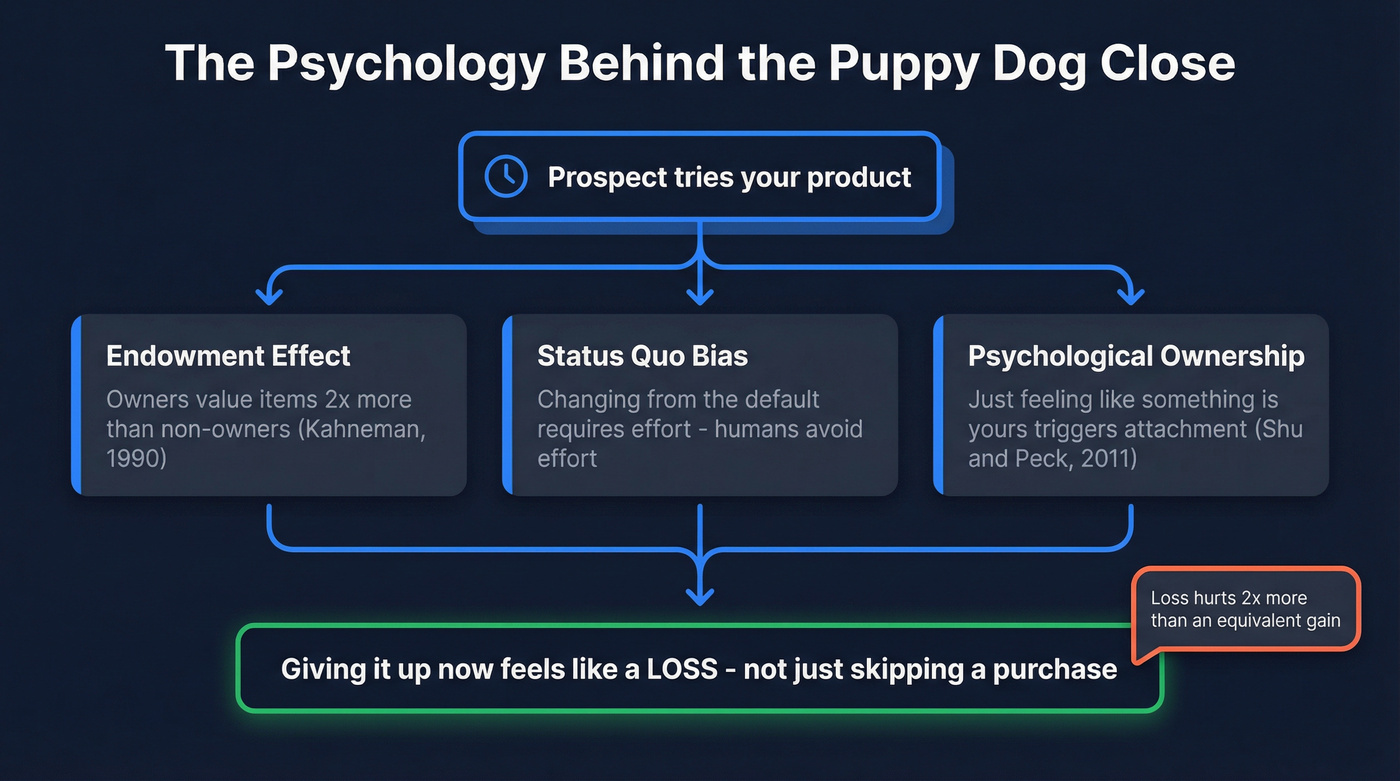
That's the endowment effect, a term Richard Thaler coined in 1980. The mechanism underneath is loss aversion - a core finding from Kahneman and Tversky's prospect theory. Losing something you have hurts about twice as much as gaining something equivalent feels good.
Two reinforcing forces make the technique even stickier. First, status quo bias: once the product is part of someone's workflow, the default is to keep it. Changing requires effort, and humans avoid effort. Second, Shu and Peck's 2011 research showed that even psychological ownership - just feeling like something is yours - triggers emotional attachment and increases willingness to pay.
Here's the thing: the technique works brilliantly for products with fast time-to-value, but falls flat when onboarding takes weeks. The faster someone feels ownership, the harder it is to let go.
Trial Conversion Benchmarks
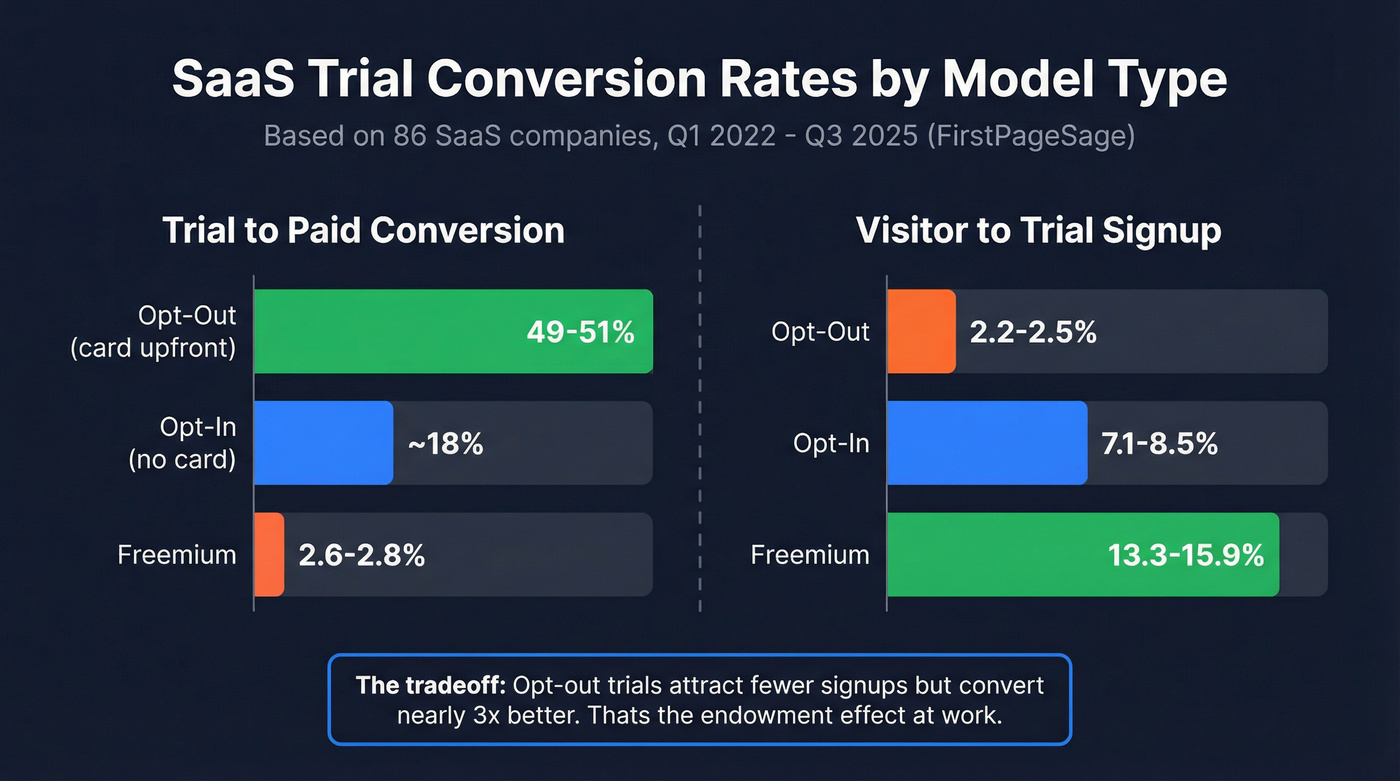
A FirstPageSage study across 86 SaaS companies (Q1 2022-Q3 2025) tracked trial-to-paid conversion by model type:
| Trial Model | Trial to Paid | Visitor to Trial |
|---|---|---|
| Opt-out (card upfront) | 49-51% | 2.2-2.5% |
| Opt-in (no card) | ~18% | 7.1-8.5% |
| Freemium | 2.6-2.8% | 13.3-15.9% |
The tradeoff is clear. Opt-out trials attract fewer signups but convert nearly 3x better. That's the endowment effect at work - once someone enters payment info and starts using the product, inertia and loss aversion keep them.
Industry-specific benchmarks tell a similar story:
| Industry | Trial to Paid |
|---|---|
| CRM | 29.0% |
| IoT | 25.2% |
| Healthcare/Medtech | 21.5% |
| Enterprise | 18.6% |
CRM tools convert best because they become embedded in daily workflows fast. Enterprise lags because adoption requires team buy-in, not just individual enthusiasm. In our experience, if your product doesn't become part of someone's daily routine within a week, no amount of follow-up saves the deal.

The puppy dog close only works when the product delivers. Prospeo gives you 75 free verified emails every month - no credit card, no commitment. With 98% email accuracy and a 7-day data refresh cycle, teams don't leave because the data actually connects them to real buyers.
Experience the endowment effect yourself - 75 free emails, zero risk.
Real-World Examples
The puppy dog close isn't a SaaS invention. It shows up everywhere a seller is confident enough to let the product speak for itself.
| Industry | Implementation | Why It Works |
|---|---|---|
| Eyewear (Warby Parker) | Ship 5 frames home free | Physical possession + social feedback |
| Car dealerships | Overnight or weekend test drives | Lifestyle integration over 24-48 hrs |
| Area rugs | Home delivery, return if unwanted | Rug "belongs" in the room visually |
| Jewelry (online) | 3 cubic zirconia replicas, 10-day trial | Low-cost proxy creates attachment |
| Grocery (Costco) | In-store taste testing | Micro-ownership through consumption |
| SaaS (Slack, HubSpot) | Free tiers or free trials | Teams build workflows before paying |
| B2B Data (Prospeo) | 75 free verified emails/month, no card | 98% accuracy - teams stay |
Car dealerships pioneered the test drive close long before SaaS existed. An overnight or weekend loaner lets the buyer park it in their driveway, show the neighbors, and mentally register it as "my car." By Monday morning, returning the keys feels like a loss - the same psychology that powers every try-before-you-buy offer.
The diamond replica example is particularly clever. The merchant sends cubic zirconia versions of up to three ring designs with free return shipping. The customer wears the ring for 10 days, shows friends, gets compliments. By day seven, they're not evaluating a purchase. They're preventing a loss.
How to Run a Puppy Dog Close
Qualify First
Not every prospect deserves a trial. Handing out free access to anyone who asks dilutes your pipeline and inflates support costs. Define your ICP criteria before offering: right company size, right use case, right decision-making authority. A trial offer means nothing if it never reaches the buyer.
Design the Trial
For most SaaS products, 14-30 days hits the sweet spot - long enough to experience value, short enough to create urgency. For enterprise deals, skip the self-serve trial entirely and run a structured pilot with defined success criteria and an executive sponsor.
Opt-out trials (credit card upfront) convert at ~49% but attract fewer signups. Opt-in (no card) gets about 3x more people in the door but converts at ~18%. Pick based on your sales motion. High-touch teams can afford opt-in because they'll follow up personally. Self-serve products need the opt-out friction to filter serious buyers.
Make the Offer
Here's a script adapted from Topo.io's research:
"Why don't we set you up with a free 14-day trial, no credit card required? Use it with your team, and if you love it, we'll get you on a full plan. If not, no hard feelings."
The key phrase is "no hard feelings." It signals confidence and lowers the awkwardness of saying no.
Onboard and Close
The trial is the starting gun, not the finish line. Your prospect needs to experience core value within the first 48 hours, or the endowment effect never kicks in. That means guided onboarding: a quick-start resource, a check-in call, a pre-built template they can use immediately. We've seen trials die on the vine simply because nobody showed the prospect where to click first.
Post-Trial Follow-Up Cadence
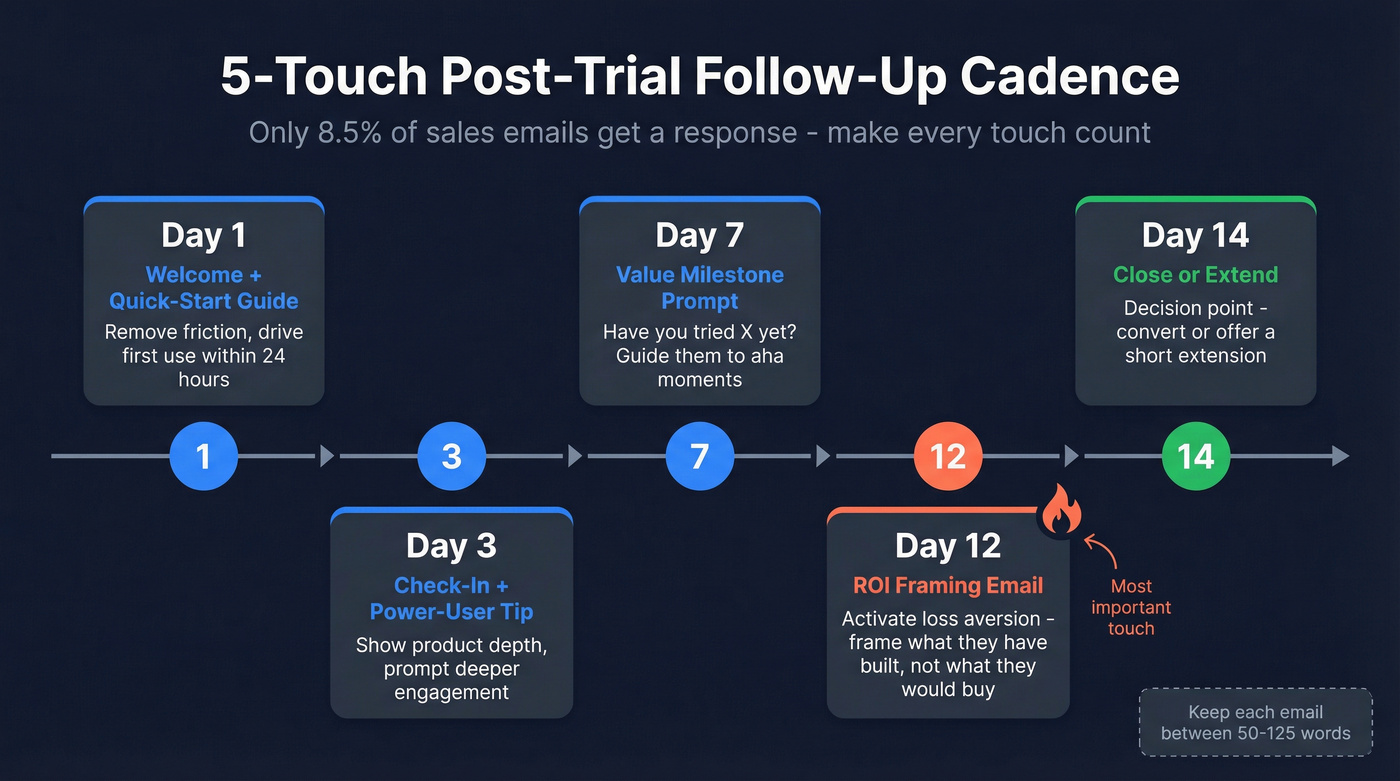
Only 8.5% of sales outreach emails get a response. Your follow-up sequence needs to be tight, valuable, and persistent without being annoying.
| Day | Action | Purpose |
|---|---|---|
| Day 1 | Welcome email + quick-start guide | Remove friction, drive first use |
| Day 3 | Check-in + power-user tip | Show depth, prompt engagement |
| Day 7 | Value milestone prompt | "Have you tried X yet?" |
| Day 12 | ROI framing email | Quantify what they'd lose |
| Day 14 | Close or extend offer | Decision point |
The Day 12 email is the most important one in the sequence. This is where you activate loss aversion explicitly - frame it around what they've built, not what they'd buy: "You've already verified 200 contacts and added 45 to your pipeline. Want to keep that momentum going?"
A follow-up template adapted from Zendesk's sales playbook:
Subject: Looking for more information?
Hi [Name], I noticed you signed up for [product] a few days ago. I wanted to share a quick resource that'll help you get the most out of your trial: [link]. If you have questions or want a walkthrough, I'm here. - [Your name]
Keep follow-ups between 50-125 words. Anything longer gets skimmed or skipped.
When This Technique Fails
The endowment effect isn't universal. Knowing when it weakens saves you from wasting trials on dead-end prospects.
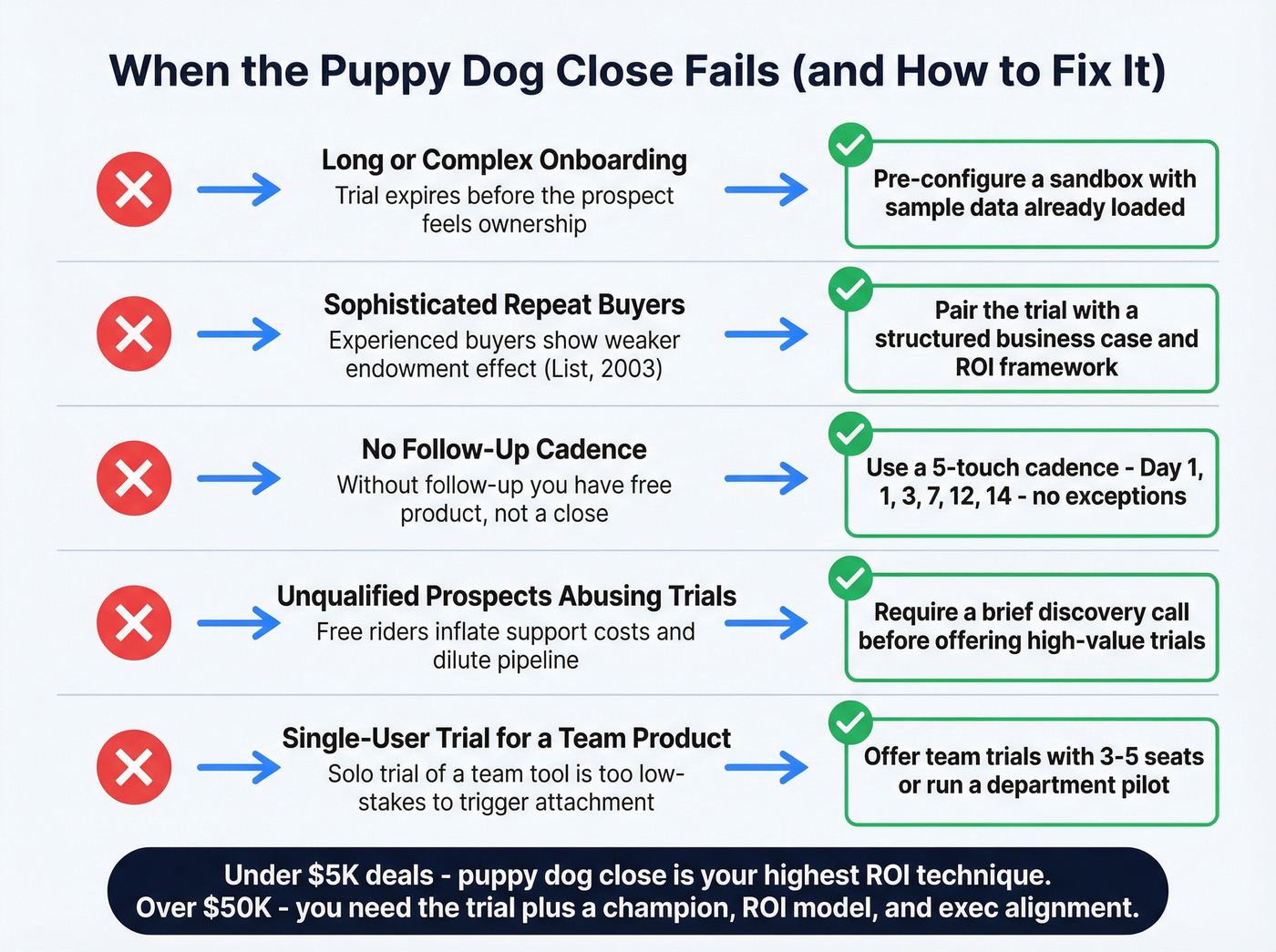
Long or complex onboarding. If your product takes weeks to configure, the trial expires before the prospect feels ownership. Pre-configure the environment - give them a sandbox with sample data already loaded.
Sophisticated repeat buyers. John List's 2003 research found that experienced market participants show a weaker endowment effect. Your seasoned procurement director has seen a hundred trials and isn't getting emotionally attached. Pair the trial with a structured business case and ROI framework, not just product access.
No follow-up cadence. Without one, you don't have a close - you have free product. Use the five-touch cadence above. No exceptions.
Unqualified prospects abusing trials. Skip this problem entirely by requiring a brief discovery call for high-value trials. Qualify before offering.
Single-user trial for a team product. If your product requires team adoption, a single-seat trial won't generate enough value to trigger attachment. Plott and Zeiler's 2005 research showed the endowment effect diminishes in low-stakes environments - and a solo trial of a team tool is exactly that. Offer team trials with 3-5 seats, or run a pilot with a specific department.
Let's be honest about deal size. If your average deal is under $5K, the puppy dog close is probably your single highest-ROI sales technique. Above $50K, it's necessary but insufficient - you need the trial plus a champion, an ROI model, and executive alignment. The technique scales down beautifully but needs scaffolding to scale up. The consensus on r/sales tends to agree: for SMB deals, just get the product in their hands and let it sell itself.
Opt-in trials convert at 18% when the product earns it. Prospeo's free tier puts 300M+ verified profiles, 30+ search filters, and 98% accurate emails in your hands - no card upfront. Once your team builds pipeline on data this clean, giving it up feels like a loss.
Let the data close itself. Sign up in 30 seconds.
FAQ
Is the puppy dog close manipulative?
No - it's risk reversal. You're giving the buyer power to walk away with zero cost. Manipulation removes choice; this technique adds it. It only works if your product genuinely delivers value. Transparency about terms and what happens post-trial separates a legitimate close from a dark pattern.
Does it work in B2B enterprise sales?
Yes, but the "trial" looks different. Enterprise buyers expect structured pilots with defined success criteria and executive sponsors - not a self-serve signup. Pair product access with ROI data and a business case. The principle is the same: get the product into their workflow so removing it feels like a step backward.
What's the difference between a free trial and a puppy dog close?
A free trial is the mechanism. The puppy dog close is the strategy - qualification before offering, active onboarding, a structured follow-up cadence, and a deliberate conversion conversation at the end. Handing someone a login and hoping they convert isn't a close. It's wishful thinking.
How does the test drive close relate to this technique?
The test drive close is the puppy dog close applied to high-consideration physical products. Whether it's a car, equipment, or an enterprise software pilot, the principle is identical: let the prospect experience ownership so returning the product feels like a loss. The only difference is the medium - a steering wheel instead of a login screen.