B2B SaaS Meaning: Definition, Examples, and the Industry in 2026
You joined a B2B SaaS startup and your non-tech friends keep asking what your company actually does. "It's software... but on the internet... that we sell to other companies... on a subscription." Their eyes glaze over. The B2B SaaS meaning is simpler than the jargon suggests, but most explainers still lean on outdated market context and skip the parts that actually matter. Let's fix that.
Quick Version
- B2B SaaS = cloud software sold on subscription to other businesses
- The market hit $315.68B in 2025 and is growing at 18.7% CAGR
- The business model runs on recurring revenue, measured by ARR, churn, NRR, CAC payback, and gross margin
- B2B deals average $5K-$100K+/year vs $50-$300/year for consumer SaaS
- There are roughly 17,000 SaaS companies in the US alone
For the full picture - pricing models, real examples, key metrics, and where the industry's heading - keep reading.
What Does B2B SaaS Mean?
B2B stands for business-to-business: one company selling to another company. SaaS stands for Software as a Service: software hosted in the cloud, accessed through a browser, and billed on a subscription instead of a one-time license.
Put them together and you get cloud-hosted software sold on a recurring subscription to other businesses. That's the featured-snippet version.
The "as a Service" part changed everything. Before SaaS, buying enterprise software meant big upfront license fees, lengthy on-premise installation, and an IT team dedicated to keeping it running. SaaS flipped that model. The vendor hosts the software, manages the infrastructure, pushes updates automatically, and charges monthly or annually. The customer just logs in and uses it.
This isn't a niche category. There are around 17,000 SaaS companies in the United States alone, and the model has become the default way businesses buy software. If you've used Salesforce, Slack, HubSpot, or even Google Workspace at work, you've used B2B SaaS. You probably just didn't call it that.
How the Delivery Model Works
A SaaS vendor hosts and maintains the software and the underlying environment - the operating system, middleware, and application layer. The customer's job is simpler: use the software and manage their own data within it.
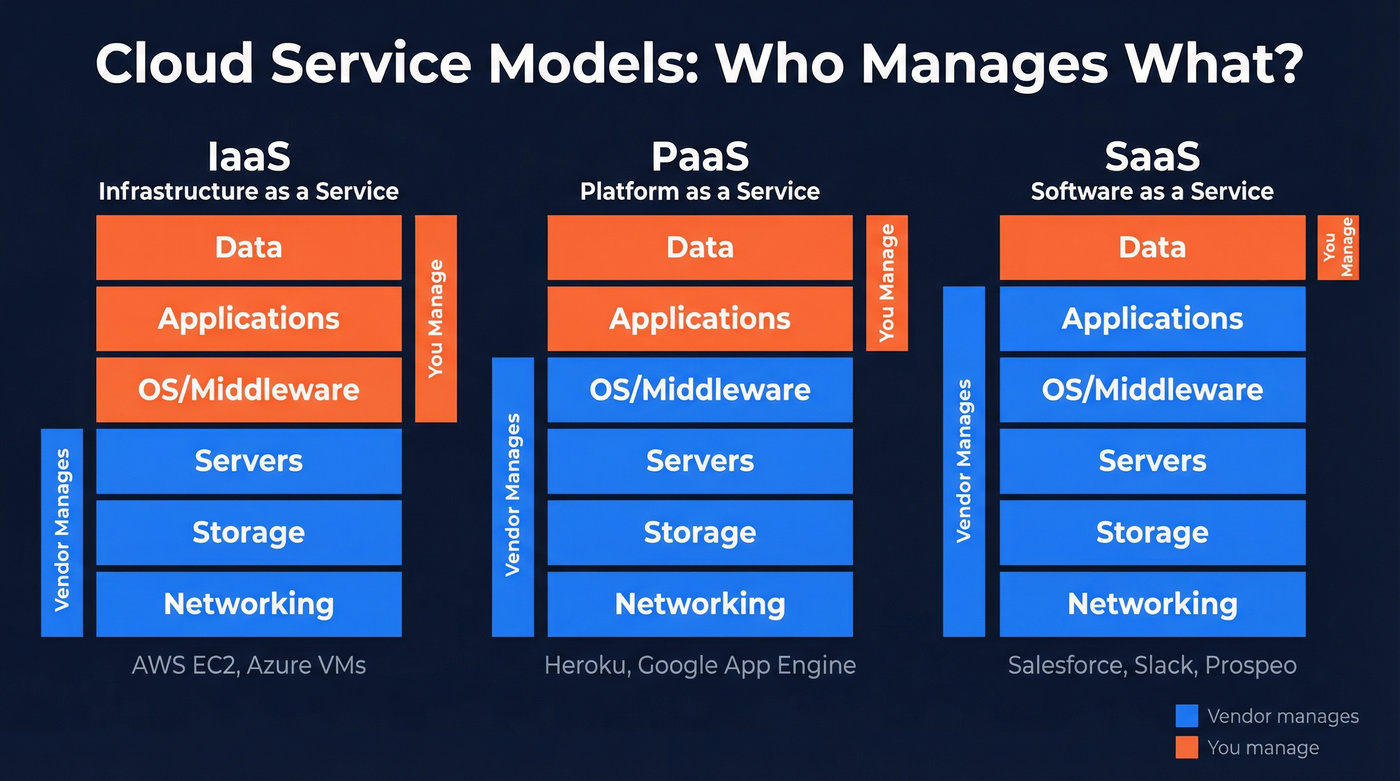
Here's what separates SaaS from the other cloud service models:
| SaaS | PaaS | IaaS | |
|---|---|---|---|
| You manage | Your data + settings | Your apps + data | Apps, data, OS, middleware |
| Vendor manages | Everything else | Servers, storage, OS, tools | Servers, storage, networking |
| Example | Salesforce, Slack | Heroku, Google App Engine | AWS EC2, Azure VMs |
| Best for | End users | Developers | IT teams |
SaaS sits at the top of the stack. You get the least control but also the least headache. The tradeoff is limited customization - you're mostly working within the settings and configurations the vendor provides, plus whatever add-ons or integrations they support. For most business users, that's a perfectly fine deal.
Billing is subscription-based: monthly, annual, or increasingly, usage-based. The vendor handles updates, security patches, and uptime. You pay, you log in, you work.
B2B SaaS vs B2C SaaS
The line between B2B and B2C SaaS isn't always clean - Slack, Zoom, and Dropbox serve both audiences - but the business models are fundamentally different.
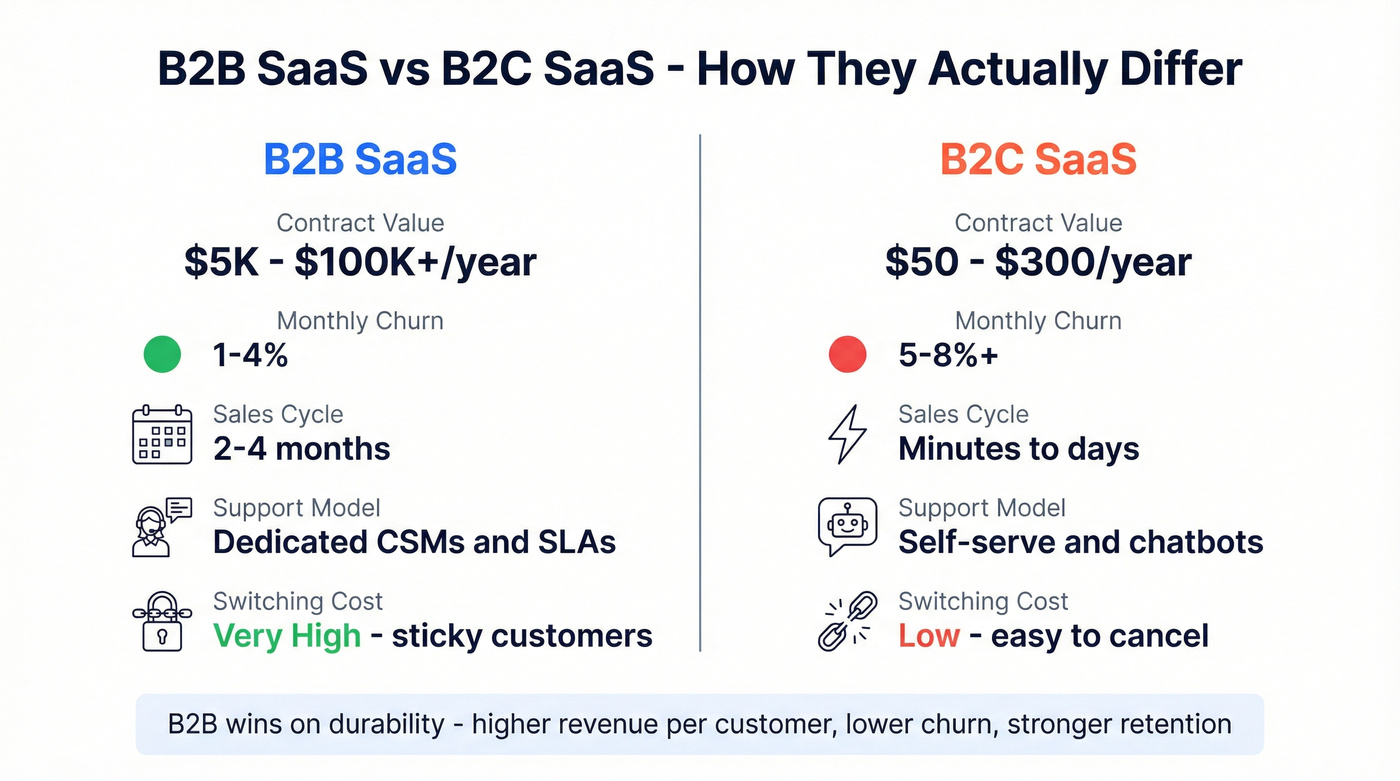
| B2B SaaS | B2C SaaS | |
|---|---|---|
| Avg contract value | $5K-$100K+/year | $50-$300/year |
| Monthly churn | 1-4% | 5-8%+ |
| Sales cycle | 2-4 months | Minutes to days |
| Support model | Dedicated CSMs, SLAs | Self-serve, chatbots |
| Product complexity | Higher (permissions, workflows) | Lower (intuitive, minimal setup) |
The biggest difference is how money moves. B2C SaaS is a volume game - millions of users paying small amounts, acquired through self-serve funnels and app stores. B2B SaaS is a relationship game - fewer customers paying significantly more, acquired through sales teams, demos, and multi-stakeholder buying committees.
In practice, B2B is usually the more durable model. Higher ACVs, lower churn, stickier customers. When a company's paying $50K/year and has 200 employees trained on your platform, switching costs are enormous. When a consumer's paying $9.99/month for a music app, they'll cancel the moment a competitor runs a promo.
The blurry-line products - Slack, Zoom, Dropbox - often start as B2C-feeling tools that grow into B2B revenue machines. Dropbox serves users in 180 countries, but it also sells business and enterprise plans with admin controls and security features that drive the real revenue.

B2B SaaS runs on recurring revenue, but revenue starts with reaching the right buyers. Prospeo gives you 300M+ profiles, 143M+ verified emails at 98% accuracy, and 125M+ mobile numbers - all on credit-based pricing starting at $0.01/email. No contracts, no sales calls. The B2B SaaS model you just read about? This is it in action.
Stop reading about B2B SaaS and start using the model to grow pipeline.
B2B SaaS Examples by Category
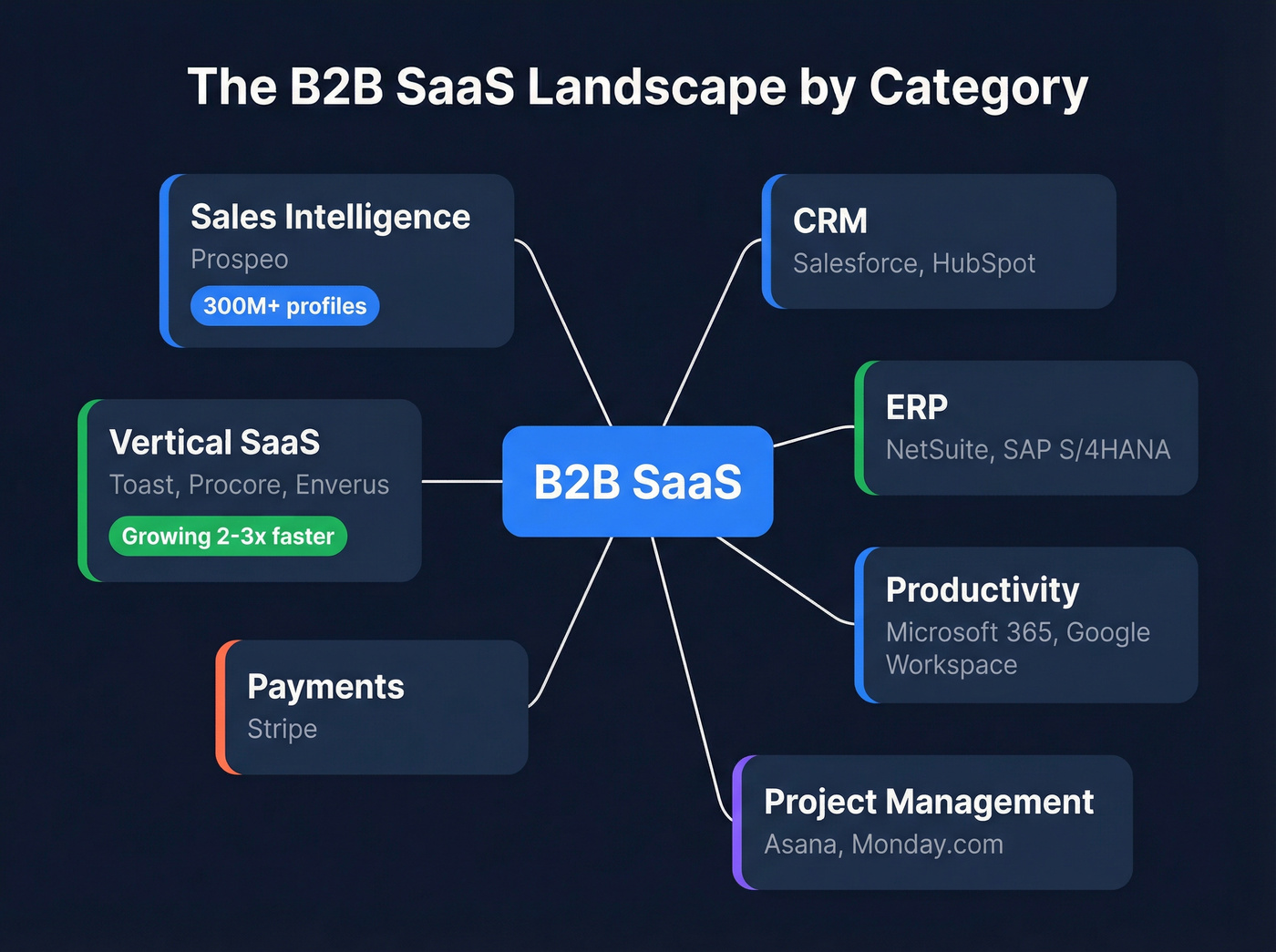
The best way to understand the industry is to see it everywhere. Here are the major categories with companies you'll recognize - and a few you should.
CRM
Salesforce is the textbook B2B SaaS company: cloud-based CRM, subscription billing, massive ecosystem. HubSpot took the same model and made it accessible to smaller teams with a generous free tier that pulls companies into paid plans as they grow. (If you're comparing CRMs, see HubSpot vs Salesforce.)
ERP
NetSuite (owned by Oracle) and SAP S/4HANA Cloud handle the back-office complexity - finance, supply chain, HR, procurement. These are the big-ticket contracts, often six figures annually with multi-year commitments.
Productivity & Communication
Microsoft 365 and Google Workspace are the two giants. A huge share of knowledge workers use one of them daily, all on per-user pricing, cloud-hosted, subscription-billed. Slack and Zoom became household names during the pandemic, but their revenue engines are B2B - enterprise plans with SSO, compliance features, and admin controls drive their expansion.
Project Management
Asana, Monday.com, and similar tools handle workflow coordination for teams. Classic per-seat pricing, tiered plans, self-serve onboarding that scales into enterprise deals.
Payments
Stripe processes billions in annual transaction volume for other businesses. It's SaaS with usage-based pricing - you pay a percentage of each transaction rather than a flat subscription. This model is increasingly common.
Vertical SaaS
This is where things get interesting. Vertical SaaS companies build software for a specific industry rather than a broad horizontal market. Toast dominates restaurant management, Procore runs construction project management, and Enverus serves 6,000+ customers across 50 countries in the energy sector. Artera's patient communication platform operates in 700+ healthcare systems and federal agencies. Vertical SaaS is growing 2-3x faster than horizontal SaaS right now, and we'll dig into why in the trends section.
Sales Intelligence

Sales intelligence tools are a clean example of how modern B2B SaaS works in practice. Prospeo, for instance, offers 300M+ professional profiles, 143M+ verified emails at 98% accuracy, and 125M+ verified mobile numbers - all on credit-based pricing starting with a free tier. No contracts, no sales calls required. You search, you export, you pay per credit. It's the opposite of the legacy enterprise approach where you'd need multiple demos and a procurement cycle just to see the product. (If you're building a stack, compare options in our guide to sales prospecting platforms.)
Benefits of B2B SaaS
For Buyers
Lower upfront costs are the obvious win - you're paying monthly instead of dropping a massive one-time license fee. But the deeper benefits matter more. Scalability means you add seats as you grow instead of re-architecting. Automatic updates keep you on the latest version without an IT project. Your team works from anywhere with a browser. And you've got zero infrastructure burden - no servers to maintain, no patches to deploy.
For Vendors
Predictable recurring revenue is the holy grail. Instead of lumpy one-time sales, you've got a revenue stream you can forecast and build on. Distribution costs drop dramatically - no physical media, no installation teams, no regional offices. And continuous product improvement becomes possible because you're watching how thousands of customers actually use the software in real time. Understanding what a B2B SaaS company is from the vendor side comes down to this: you're building a product once and delivering it continuously to many customers from a single codebase.
The Tradeoffs
SaaS isn't free of downsides. Limited customization frustrates companies with unique workflows. Vendor lock-in is real - migrating off a SaaS platform you've used for five years is painful and expensive. And the ongoing subscription cost can exceed what a perpetual license would've cost over the same period. Most companies accept these tradeoffs happily, but they exist.
B2B SaaS Pricing Models
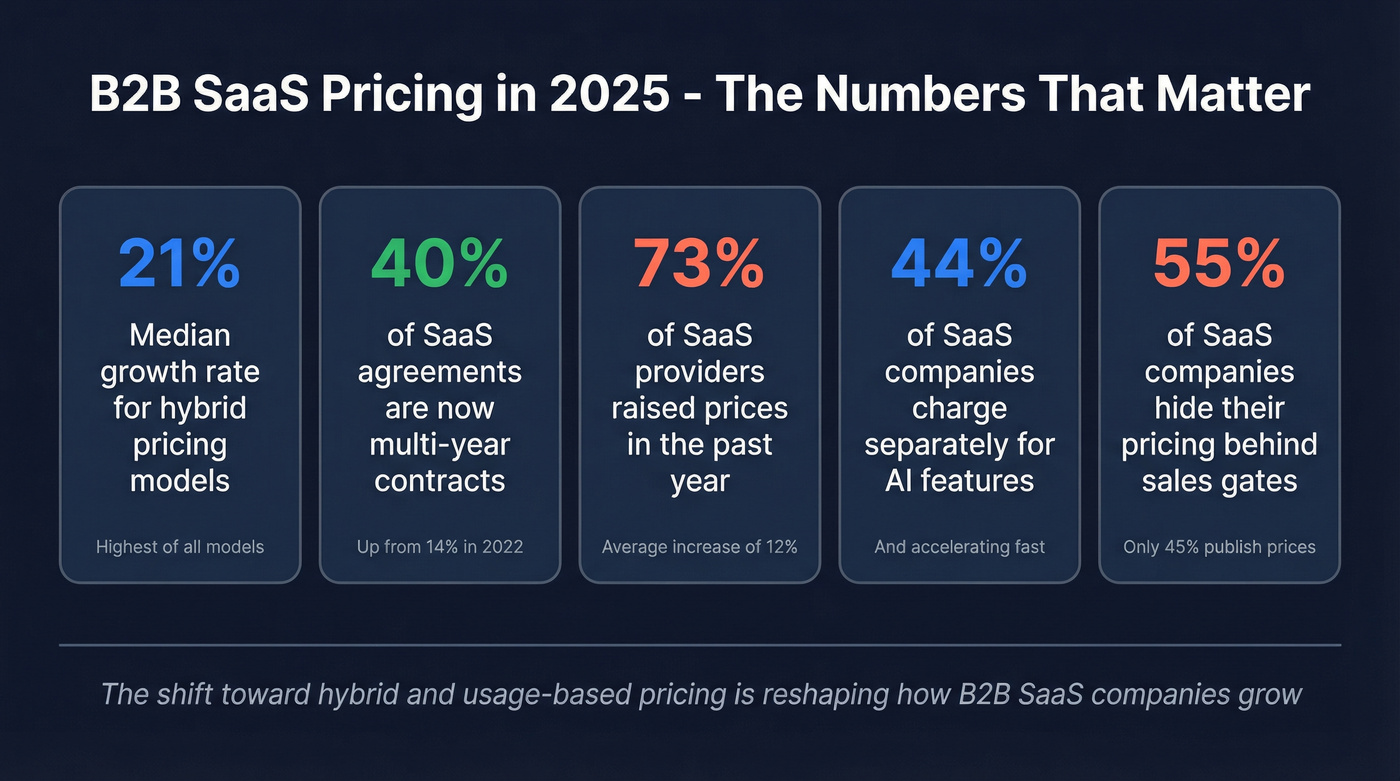
Here's the thing about SaaS pricing: only 45% of SaaS companies publish their pricing. The other 55% hide behind "talk to sales" gates. If a company won't publish its pricing, that tells you something about who their target buyer is - and it's probably not you if you're Googling it.
Here are the dominant models:
| Model | How it works | Example |
|---|---|---|
| Per-user | Fixed price per seat/month | Salesforce, HubSpot |
| Tiered | Feature bundles at price points | Asana, Slack |
| Usage-based | Pay for what you consume | Stripe, AWS |
| Hybrid | Subscription + usage overages | Snowflake, Twilio |
| Freemium | Free tier, paid upgrades | Prospeo, Zoom |
The big shift right now is toward hybrid pricing. According to Maxio's 2025 pricing report, hybrid models show the highest median growth rate at 21%. Multi-year contracts now represent 40% of SaaS agreements, up from just 14% in 2022. And 44% of SaaS companies are already charging separately for AI-powered features - a trend that's only accelerating. Another telling data point: 43% of SaaS companies now bill more frequently than monthly, reflecting the shift toward consumption-based models.
Pricing pressure is real, too. Between August 2022 and August 2023, 73% of SaaS providers raised prices by an average of 12% - and the trend hasn't reversed. That's pushed buyers toward tools with transparent, published pricing where you can see exactly what you'll pay before you sign up.
Five Metrics That Actually Matter
You don't need 47 SaaS metrics. You need five. Everything else is a supporting character.
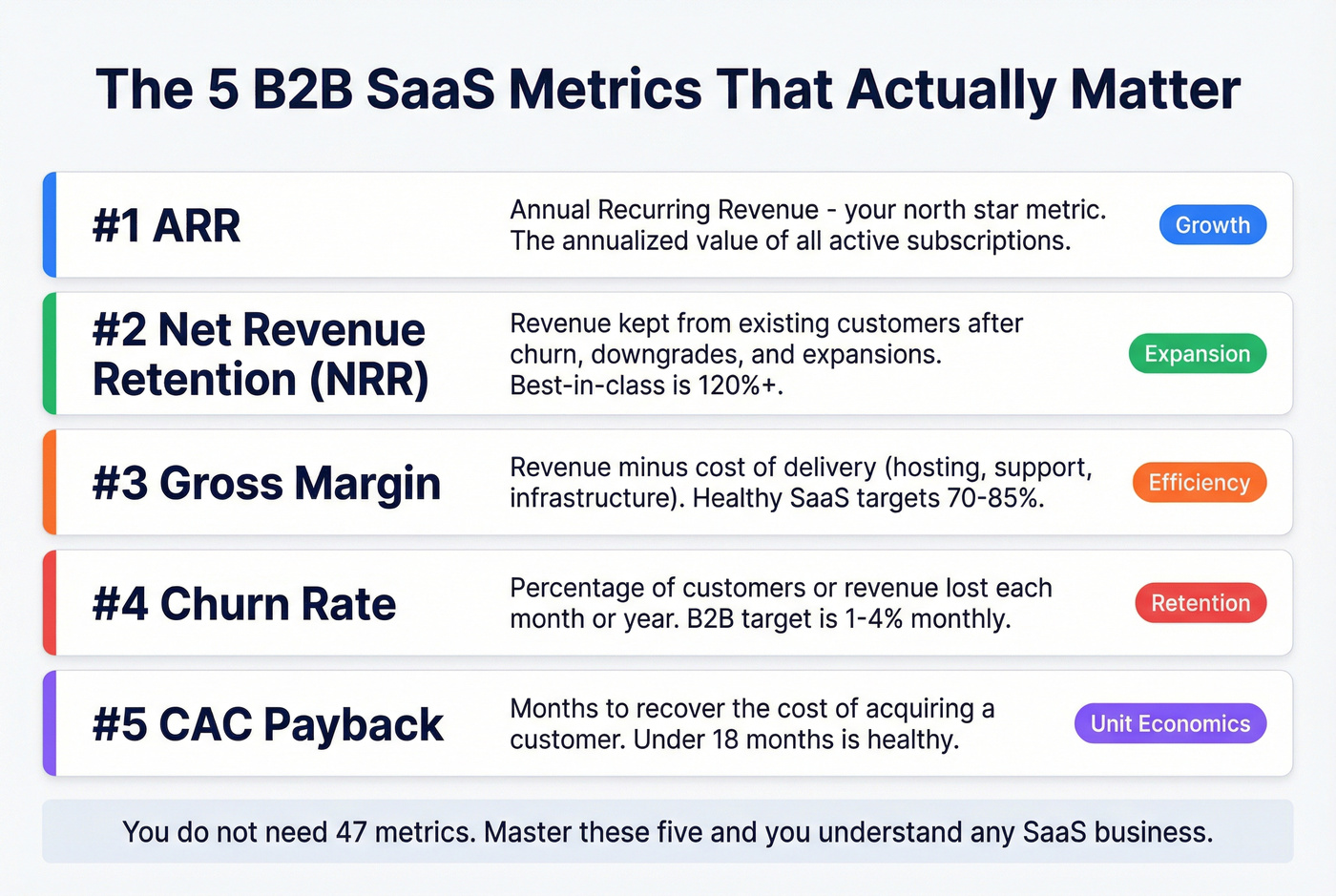
1. ARR (Annual Recurring Revenue) - The north star. ARR is the annualized value of your recurring subscription revenue. It's the number investors ask about first, the number boards track quarterly, and the number that determines your valuation multiple. If you only track one metric, track this one. (If you're pressure-testing unit economics, start with CAC LTV ratio.)
2. Churn Rate - How fast you're losing customers or revenue. Benchmarks run 1-4% monthly churn. Above 5% monthly and you've got a leaky bucket that no amount of new sales can fill. Revenue churn matters more than logo churn - losing a $500/month customer hurts less than losing a $50K/year one.
3. Net Revenue Retention (NRR) - This tells you whether existing customers are spending more or less over time. Good companies hit 110%+ NRR, meaning expansion revenue from upsells and cross-sells more than offsets churn. The best run 130%+. Below 100% means you're shrinking from within.
4. CAC Payback Period - How many months it takes to recoup the cost of acquiring a customer. Target under 18 months. Under 12 is excellent. Over 24 and you're burning cash faster than you're building a business.
5. Gross Margin - Healthy B2B SaaS runs 70%+ gross margins. That's the structural advantage of the model - once the software's built, the marginal cost of serving another customer is minimal. If your gross margin is below 60%, something's off with your infrastructure costs or your service delivery model.
Market Size and 2026 Trends
The global SaaS market was valued at $315.68B in 2025, projected to hit $375.57B in 2026, and forecasted to reach $1,482.44B by 2034. That's an 18.7% CAGR. North America accounts for 46.9% of the market. For context, 73% of organizations were already using SaaS applications by 2023 - this isn't an emerging trend, it's the established default.
Here's what's actually driving growth in 2026:
Vertical SaaS is eating horizontal SaaS alive. Industry-specific platforms are growing 2-3x faster than general-purpose tools. The logic is simple: a construction company would rather use software built for construction than adapt a generic project management tool. A common prediction in the space is that 50% of horizontal productivity apps will be acquired or pivot by 2026. In our experience, the vertical SaaS companies winning right now are the ones that embed deeply into industry-specific workflows rather than just skinning a horizontal product.
Usage-based pricing is becoming the standard mix. 85% of companies have adopted some form of usage-based pricing. Pure per-seat models are fading as the only lever. Buyers want to pay for what they use, and vendors are realizing that usage-based components expand naturally as customers grow.
SaaS sprawl is triggering consolidation. The average enterprise now uses 112+ SaaS applications. That's created a management nightmare - redundant tools, security gaps, budget bloat. Consolidation pressure is real, and it favors platforms that do one thing exceptionally well over tools that do everything mediocrely.
AI is reshaping the entire stack. By 2026, 80%+ of companies are expected to have deployed AI-enabled applications, up from just 5% in 2023. In SaaS specifically, 44% of companies are already monetizing AI features separately. This isn't a future trend - it's happening now, and it's creating an entirely new pricing dimension that didn't exist two years ago.
The era of "growth at all costs" is over. We're in the efficient growth phase now, where retention, profitability, and NRR matter more than top-line revenue growth. The B2B SaaS companies that win in 2026 are the ones that can grow efficiently while keeping existing customers happy. If your annual contract sits below $15K, you probably don't need the bloated enterprise tools that dominated the last decade - you need focused, self-serve software that delivers value before the first sales call. (For pipeline, see B2B SaaS lead generation benchmarks and a 90-day plan.)
How to Evaluate a B2B SaaS Tool
Before you buy, run through these four checks:
- Does it publish pricing? Transparent pricing signals confidence and alignment with your buyer profile. "Talk to sales" gates often mean enterprise-only.
- Can you test it before committing? Free tiers and trials separate confident products from vaporware. If you can't see the product without a demo, ask why.
- What's the switching cost? Check data export options, API access, and integration depth. The easier it is to leave, the harder the vendor will work to keep you.
- Does it solve your specific problem? A vertical SaaS tool built for your industry will almost always outperform a horizontal tool you have to customize. Skip the all-in-one platforms if you only need one function done well. (If you're mapping the buying motion, use these B2B sales best practices.)
Every B2B SaaS company in the examples above needs one thing: qualified pipeline. Prospeo's 30+ search filters - buyer intent, technographics, funding, headcount growth - let you find decision-makers at exactly the companies that match your ICP. Data refreshes every 7 days, not the 6-week industry average. Teams using Prospeo book 26% more meetings than ZoomInfo users.
Build your B2B SaaS pipeline with data that actually connects you to buyers.
FAQ
What does B2B SaaS mean?
B2B SaaS means cloud-hosted, subscription-billed software sold by one business to another. The vendor handles hosting, updates, security, and infrastructure while the customer accesses the application through a browser. Traditional software required one-time license purchases and local installation - SaaS shifts that entire operational burden to the vendor.
Is Salesforce a B2B SaaS company?
Yes - Salesforce is the most cited example in existence. It's a cloud-based CRM platform sold on subscription to businesses of all sizes and helped pioneer the modern model when it launched in 1999 with the "no software" positioning.
How do B2B SaaS companies make money?
Recurring subscriptions are the foundation - monthly or annual billing that creates predictable revenue. On top of that, usage-based fees for consumption and expansion revenue from upselling existing customers into higher tiers. The best companies generate more revenue from existing customers each year than they lose to churn (110%+ NRR).
What's a good free B2B SaaS tool for sales teams?
Prospeo offers 75 free email credits and 100 Chrome extension credits per month with no contract - enough to run real outbound campaigns. HubSpot CRM has a generous free tier for pipeline management. Slack's free plan covers basic team communication. Most strong B2B SaaS products offer a free tier so you can evaluate before committing budget.