15 Lead Generation Examples That Actually Show the Numbers
50% of marketers rank lead generation as their top priority. The average website converts qualified leads at just 2.9% - based on 100M+ data points across 14 industries. That gap between "priority" and "performance" is where most teams live, and where the right examples can close it.
The problem isn't tactics. It's the absence of numbers attached to those tactics. Every guide says "try webinars" or "use email marketing" without telling you what conversion rate to expect, what CPL to budget for, or how the channel actually stacks up against alternatives. Here are 15 examples, each tied to a real metric, organized by funnel stage.
The Starter Stack
You don't need 15 channels. You need 2-3 executed better than your competitors.
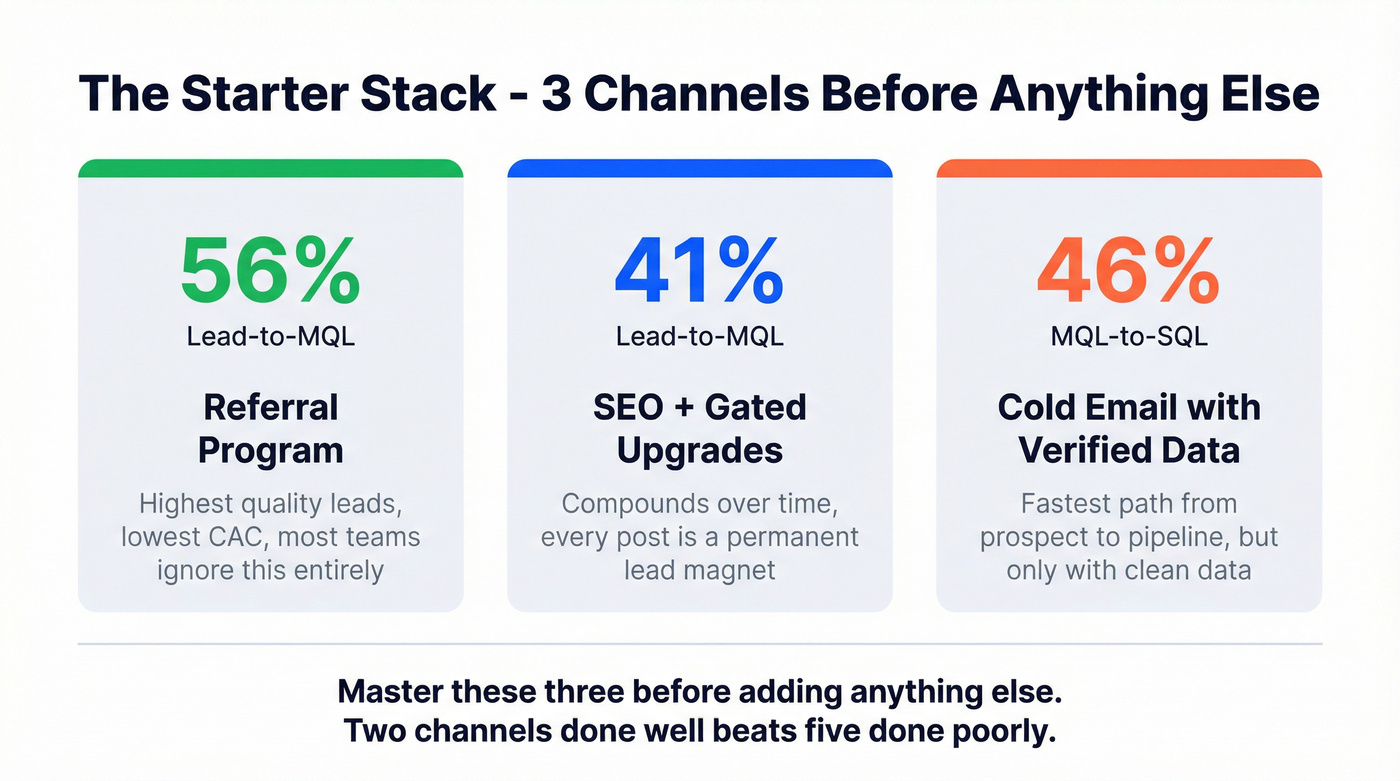
- Referral program - 56% lead-to-MQL, the highest of any channel
- SEO content with gated upgrades - 41% lead-to-MQL, compounding returns over time
- Cold email with verified data - 46% MQL-to-SQL, the fastest path from prospect to pipeline
Master these three before adding anything else. Every additional channel you bolt on before nailing the fundamentals just dilutes your focus.
Here's our honest take: if your average deal size is under $10K, you probably don't need a 15-channel lead gen machine. Two channels done ruthlessly well will outperform a scattered five-channel approach every single quarter.
How We Organized These Examples
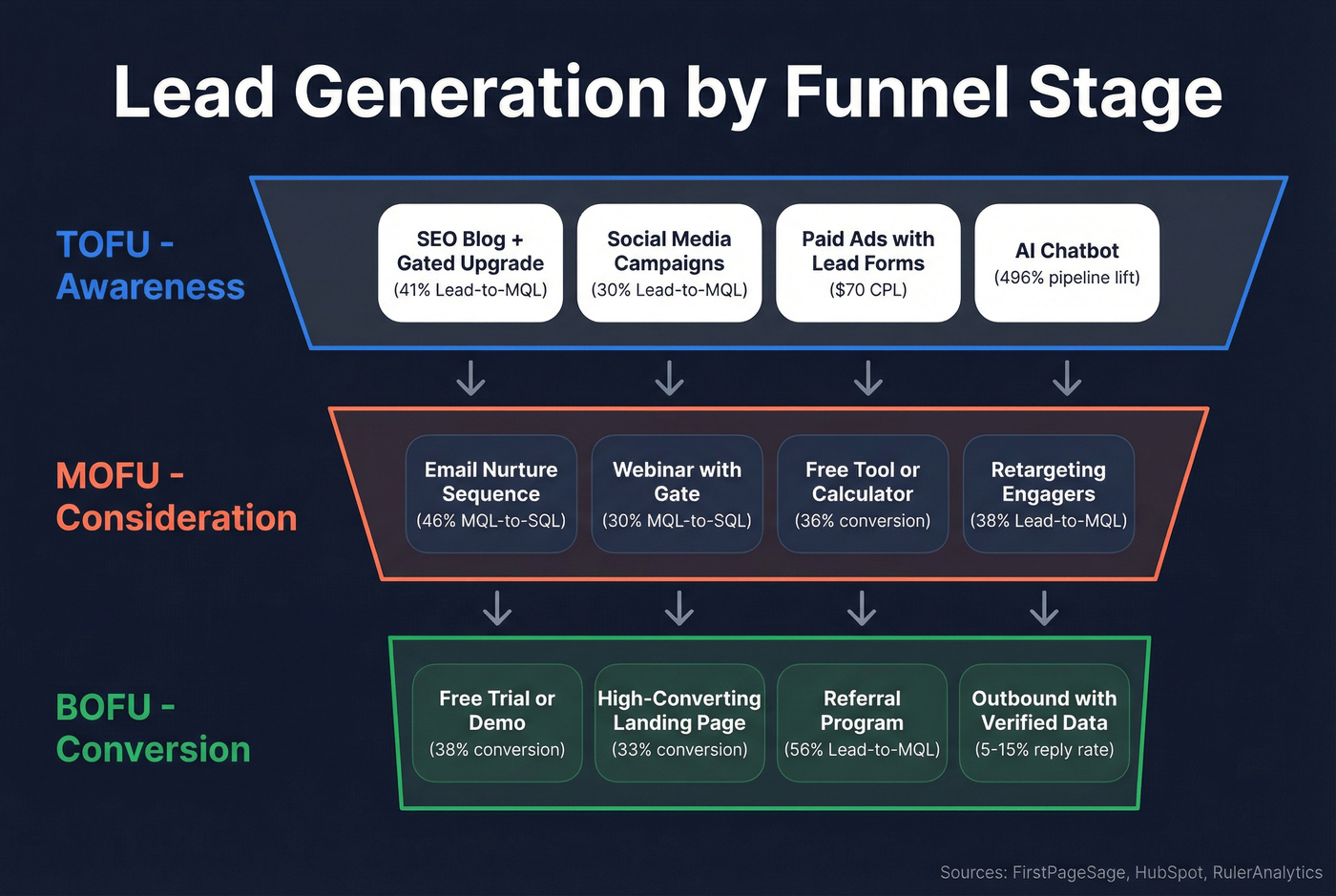
Every example maps to a funnel stage: TOFU (awareness), MOFU (consideration), or BOFU (conversion). TOFU fills the top with volume. MOFU qualifies and nurtures. BOFU turns interest into pipeline. Every example includes a metric - no "try content marketing" without a conversion rate, no "run paid ads" without a CPL benchmark.
Top-of-Funnel Lead Generation Examples
1. SEO Blog With a Gated Upgrade
Write a blog post targeting a commercial-intent keyword. Embed a content upgrade - a checklist, template, or mini-guide - behind an email gate. Lead-to-MQL conversion: 41%. Thought leadership posts run at 30%.
Target keywords where the reader has a problem to solve, not vanity traffic. A post ranking for "cold email deliverability checklist" converts better than one ranking for "what is email." The intent gap is everything. We've seen teams pour months into high-volume keywords that drive thousands of sessions and zero pipeline - don't be that team.
2. Social Media Lead Gen Campaign
Lead-to-MQL: 30%. Not the highest-converting channel, but 68% of marketers say social media has helped them generate more leads. The volume is real.
The tactic working right now on LinkedIn and Instagram: comment-to-DM automation. Post a value hook, ask people to comment a keyword, auto-send the resource via DM. It sidesteps the algorithm's suppression of outbound links and captures intent in a single interaction. B2B practitioners on r/sales consistently report this outperforms traditional lead form ads for engagement, though the leads tend to need more nurturing downstream.
3. Paid Ads With Lead Forms
Google Ads CPL: $70.11. LinkedIn runs around $110. Lead-to-MQL: 29% - one of the lowest-converting channels in these benchmarks.
You get faster volume, but conversion quality drops compared to organic and referral channels. For B2B SaaS, expect a blended CPL around $237. Cybersecurity teams pay $406. If your LTV:CAC ratio holds at 3:1 or better, paid still works. Below that, you're buying expensive noise.
4. AI Chatbot for Website Visitors
In one B2B implementation, chatbots drove a 496% increase in pipeline and 454% growth in bookings. They handle 80% of routine queries, so your human reps only touch high-intent conversations.
Skip this if your monthly traffic is under 5,000 sessions - you won't have enough volume to justify the setup cost. But for sites with real traffic, the best implementations qualify visitors in real time and route hot leads directly to sales. It's a conversion layer, not a standalone channel.

Cold email hit 46% MQL-to-SQL in these benchmarks - the highest of any channel. But that number collapses if your emails bounce. Prospeo's 98% verified email accuracy and 7-day data refresh keep bounce rates under 4%, so every campaign you build from these examples actually reaches real inboxes.
Stop studying lead gen examples and start filling your pipeline.
Mid-Funnel Campaign Examples
5. Email Nurture Sequence
MQL-to-SQL: 46%. Lead-to-MQL: 38%. The structure that works is a 5-email sequence over 14 days. Emails 1 and 2 deliver pure value. Email 3 introduces a soft CTA. Email 4 shares a case study. Email 5 makes the ask. If you want a tighter system, build it like a lead nurture sequence.
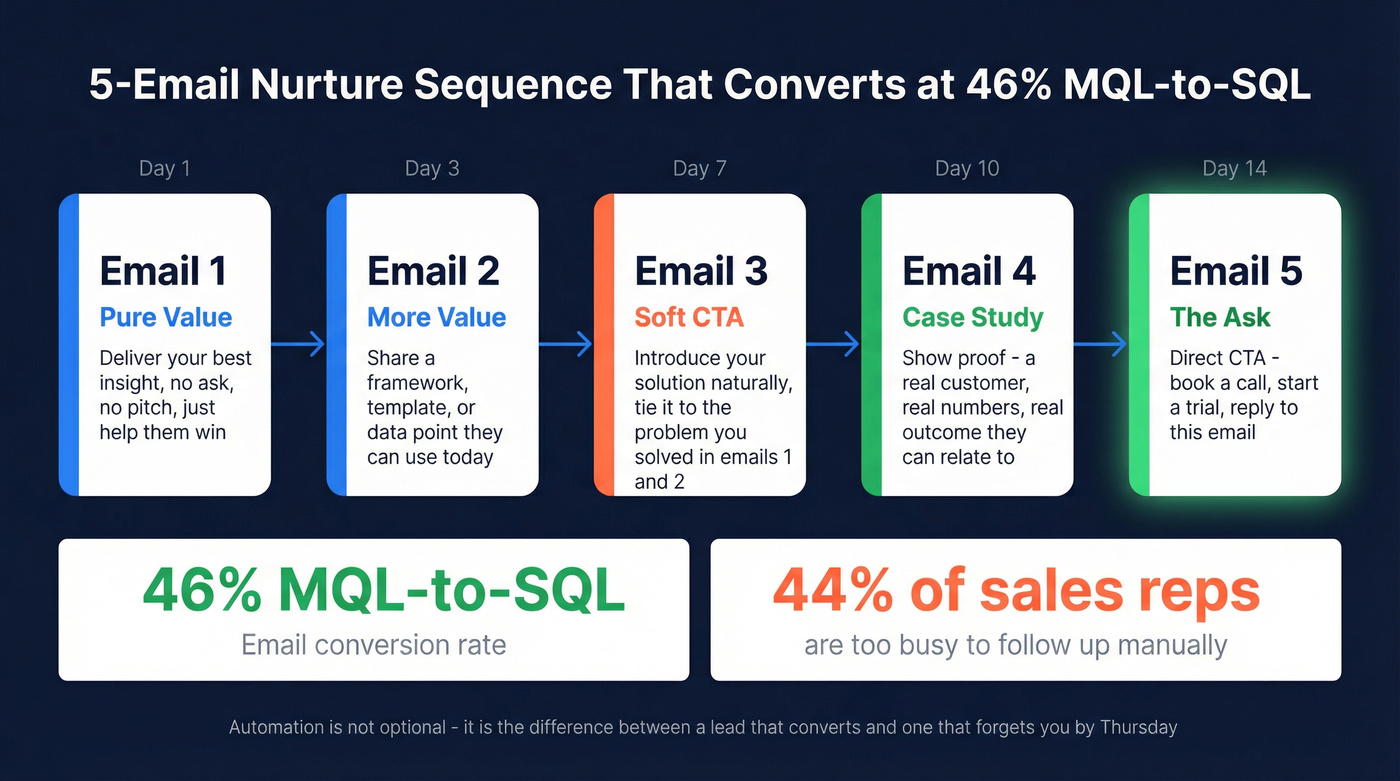
Look - 44% of sales reps are too busy to follow up with leads. That stat is maddening, but it's real. Automation isn't optional. It's the difference between a lead that converts and one that forgets you exist by Thursday.
6. Webinar With Registration Gate
MQL-to-SQL: 30%. Lead-to-MQL: 19% - lower than email, but attendees who show up are significantly higher intent. They've blocked 45 minutes on their calendar for your topic. That's a signal you can't buy with ad spend.
Best for complex products where the buyer needs to understand a workflow or see a demo before taking a meeting. For teams selling something simple and transactional, webinars are overkill.
7. Free Tool or Calculator
Application landing pages convert at 36%. An ROI calculator that asks for company size, industry, and current spend captures an email and qualifies the lead simultaneously - you know their budget range before your SDR ever picks up the phone. Interactive content outperforms static PDFs because the exchange feels fair: the prospect gets a personalized output, and you get their data.
8. Retargeting to Content Engagers
Re-engage blog readers and webinar attendees who didn't convert. CPL runs significantly lower than cold paid because these people already know your brand. Pair retargeting with gated MOFU content - a white paper (38% lead-to-MQL) or a case study (29%). They already trust you. A new asset gives them a reason to hand over their email.
Bottom-of-Funnel Lead Generation Examples
9. Free Trial or Product Demo
Product landing pages convert at 38%. The "try before you buy" model works because 67% of customers prefer self-service over speaking to a representative.
Reduce friction: no credit card required, instant access, guided onboarding. We've seen teams overthink this endlessly. The best free trial pages have one CTA, one value proposition, and social proof from a recognizable logo. That's it.
10. High-Converting Landing Page
Service landing pages convert at 33%. Industry-specific pages hit 35%. The pattern is consistent: single CTA, specific outcome promise, proof you've delivered before. If you want to systematize this, use a set of sales funnel tools to track each step.
A prospect who clicks a LinkedIn ad about "reducing bounce rates for outbound teams" should land on a page about reducing bounce rates - not your homepage. Match the message to the moment. Every mismatch between ad copy and landing page bleeds conversion rate.
11. Referral Program
Lead-to-MQL: 56% - the highest of any channel. Yet most B2B companies treat referrals as an afterthought. No formal program, no incentive structure, no tracking. A simple referral introduction email can make this repeatable.
Give existing customers a reason to refer - credits, extended features, or cash. Your CAC on referred leads is essentially zero, and they convert at nearly double the rate of your next-best channel. If you aren't running a referral program, you're leaving the easiest pipeline on the table.
12. Outbound Prospecting With Verified Data
Cold calling is effectively dead - 97% of people ignore cold calls. Cold email with verified data is a different story. Well-targeted outbound campaigns see 5-15% reply rates and 30-60% connection acceptance rates. If you're building this motion, start with an outbound email campaign playbook.

The bottleneck isn't the outreach tool - it's the data feeding it. When Snyk deployed 50 AEs using Prospeo's database of 300M+ professional profiles with 98% email accuracy, AE-sourced pipeline jumped 180% and bounce rates dropped from 35% to under 5%. That's the difference between outbound that builds pipeline and outbound that burns your domain.
The Data Quality Multiplier
Let's be honest about something most lead gen guides skip entirely: every tactic on this list fails if the underlying data is bad. If you want to operationalize this, treat it as a data quality problem, not a copy problem.
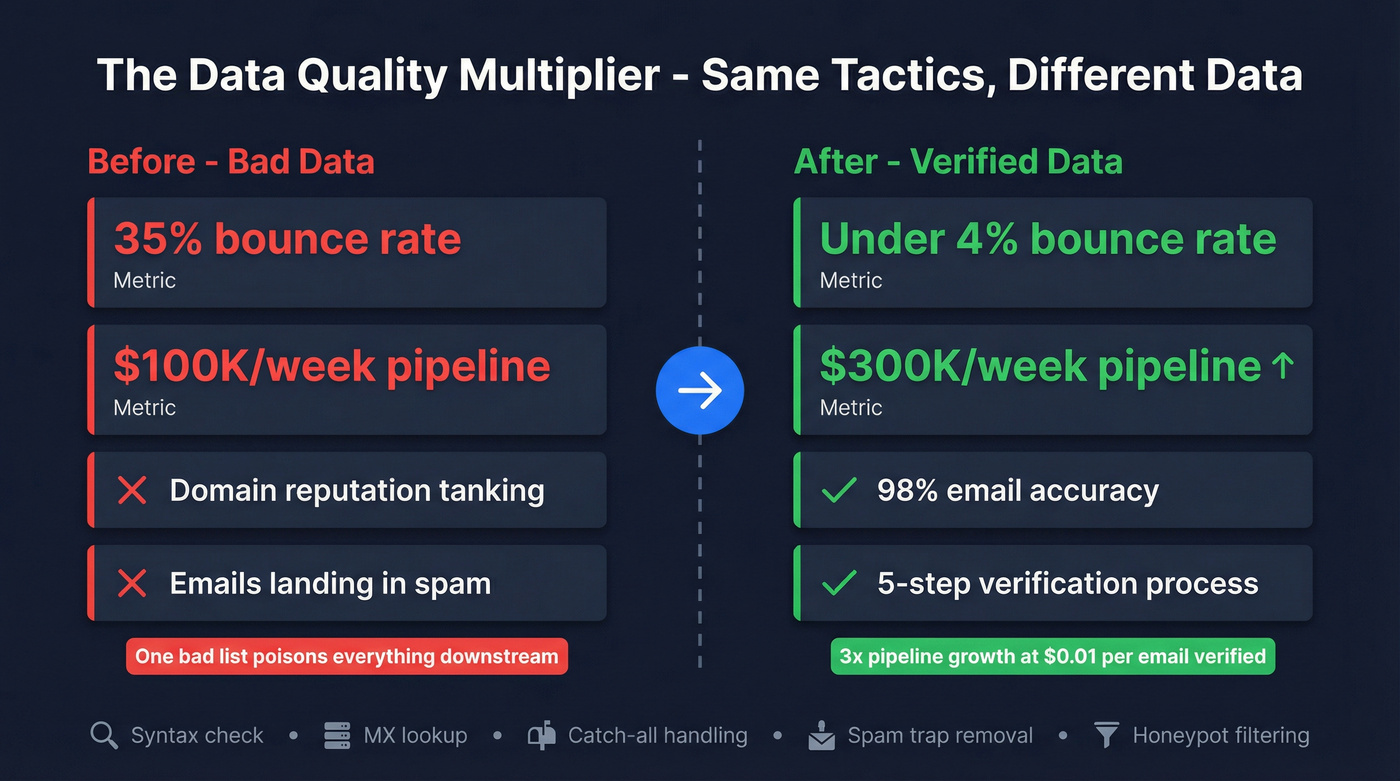
Here's a scenario we see constantly. You launch a cold email campaign to 5,000 contacts. 800 bounce. 200 hit spam traps. Your domain reputation tanks, and now even your emails to warm leads land in spam. One bad list poisons everything downstream. If you're seeing this, start with a hard bounce audit.
Meritt experienced this firsthand - bounce rates at 35%, pipeline stuck at $100K/week. After switching to verified data with 5-step verification, catch-all handling, spam-trap removal, and honeypot filtering, bounce rates dropped under 4% and pipeline tripled to $300K/week. At $0.01 per email verified, the ROI math isn't even close. (If you need a stack comparison, see our picks for an email ID validator.)

Every example above assumes one thing: you have accurate contact data. Bad emails kill nurture sequences, tank retargeting ROI, and torch your domain reputation. Prospeo gives you 300M+ verified profiles with 30+ filters - buyer intent, technographics, job changes - so the leads entering your funnel are real buyers, not dead ends.
Get verified emails at $0.01 each and make these examples work for you.
Benchmarks at a Glance
Two tables to bookmark. These are the numbers you should be measuring against.
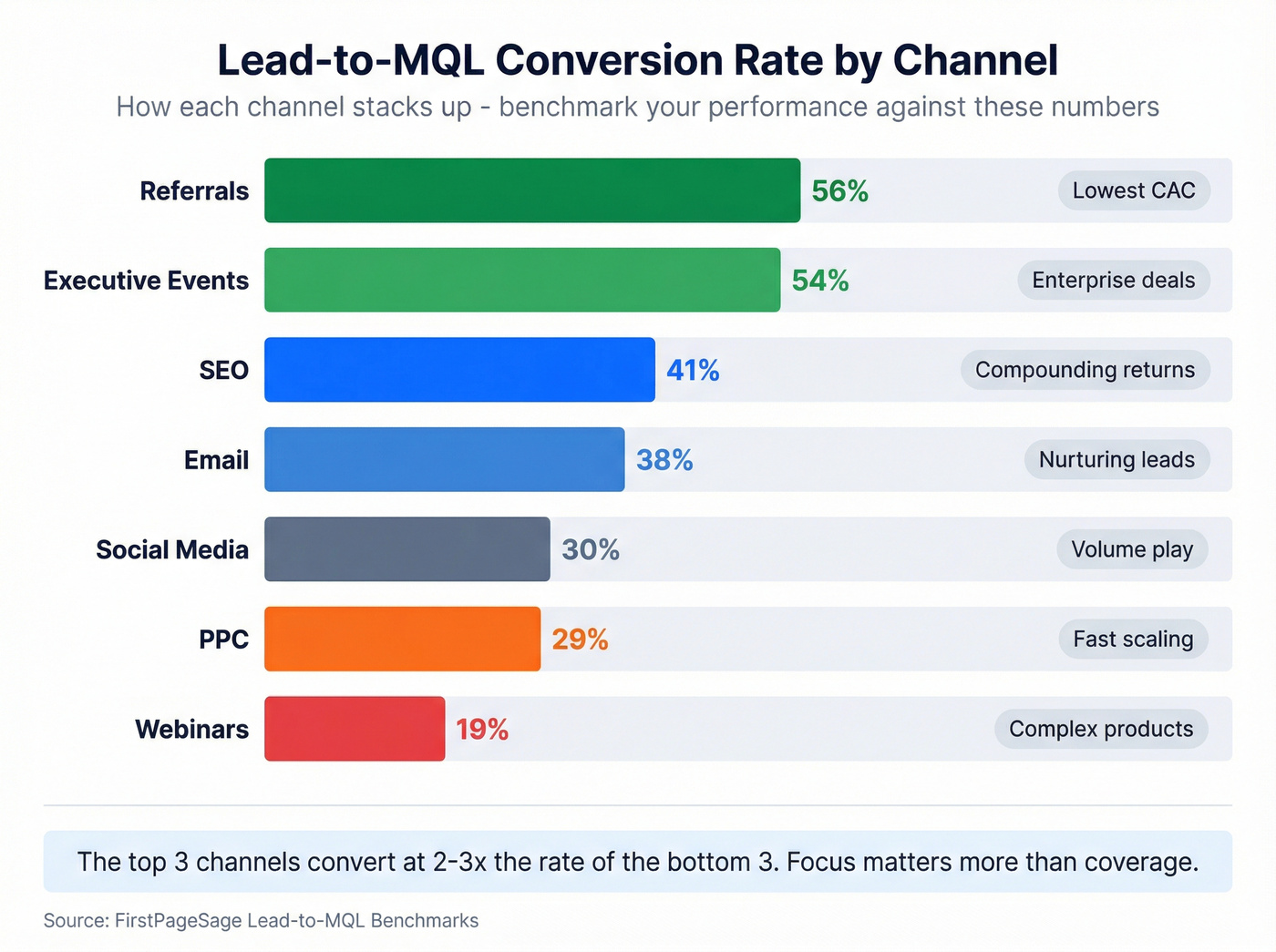
Lead-to-MQL by Channel
| Channel | Lead-to-MQL | Best For |
|---|---|---|
| Referrals | 56% | Highest quality, lowest CAC |
| Executive events | 54% | Enterprise deals, relationship-driven sales |
| SEO | 41% | Compounding volume over time |
| 38% | Nurturing existing leads | |
| Social | 30% | Top-of-funnel volume |
| PPC | 29% | Fast volume when budget allows |
| Webinars | 19% | Complex product education |
MQL-to-SQL by Channel
| Channel | MQL-to-SQL | Best For |
|---|---|---|
| SEO | 51% | High-intent organic traffic |
| 46% | Automated nurture sequences | |
| Webinars | 30% | Engaged, high-intent attendees |
| PPC | 26% | Scaling with budget |
| Events | 24% | In-person relationship building |
CPL context: the average B2B CPL is $84 across all channels. B2B SaaS companies pay $237 blended. Cybersecurity runs $406. If your LTV:CAC ratio is 3:1 or better, your lead gen economics are healthy. Below that, you're spending more to acquire customers than they're worth. (If you need the math, use a CAC LTV ratio framework.)
Real talk: if your lead-to-MQL rate is below 31% - the cross-industry average - the problem isn't your channel mix. It's your targeting or qualification criteria. Tighten your account qualification before you scale.
FAQ
What are the most effective lead generation examples?
Client referrals convert leads to MQLs at 56%, the highest of any channel. Executive events follow at 54%, then SEO at 41%. Best results come from running referrals for quality and SEO for compounding volume simultaneously.
What's a good cost per lead in B2B?
The average B2B CPL is $84 across all channels. SaaS companies pay $237 blended. A healthy LTV:CAC ratio is 3:1 or better - if you're below that threshold, optimize conversion rates before increasing spend.
How do I know if my lead generation is working?
Track lead-to-MQL and MQL-to-SQL conversion rates by channel. If your lead-to-MQL rate is below 31%, your targeting or qualification criteria need work before you scale volume.
What's the difference between inbound and outbound lead generation?
Inbound attracts leads through content, SEO, and ads - they come to you. Outbound finds and contacts prospects directly via email, calls, or social outreach. Most teams need both: inbound builds long-term pipeline while outbound drives near-term revenue.