The 9 Best Lead Sourcing Software Tools for 2026
Salesforce published a list of 23 "lead generation tools" that includes CRMs, chatbots, and webinar platforms. That's not lead sourcing software - that's a junk drawer. If you need a database that gives you verified emails and direct dials for people who match your ICP, most of those tools are irrelevant.
Here are the nine that aren't.
Our Picks (TL;DR)
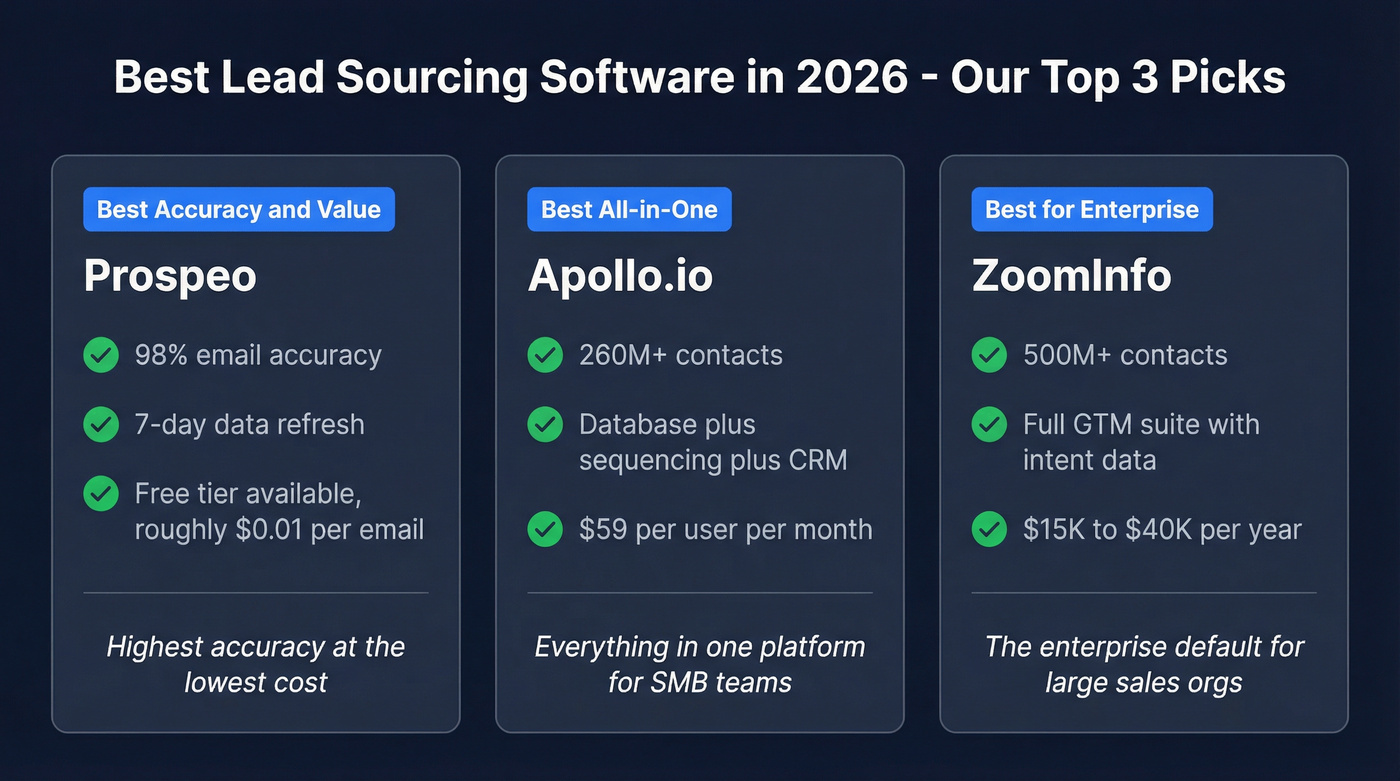
| Pick | Tool | One-Line Verdict | Starting Price |
|---|---|---|---|
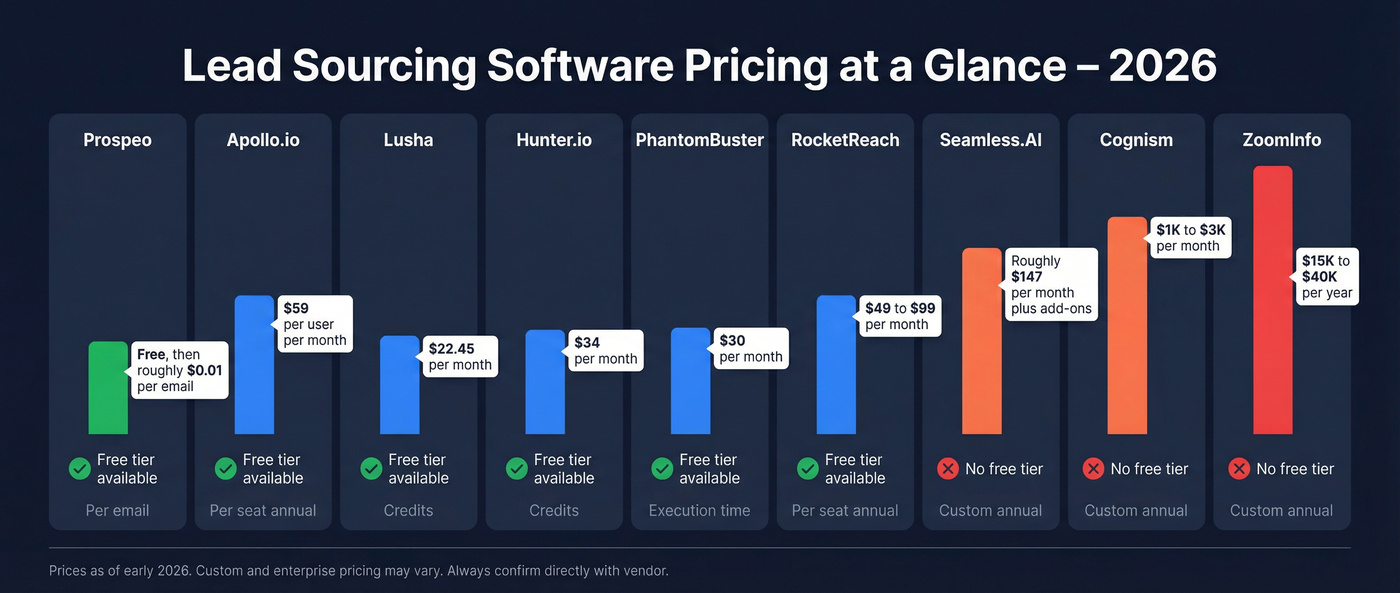
| Best accuracy & value | Prospeo | 98% verified emails, 7-day refresh | Free / ~$0.01/email |
| Best all-in-one | Apollo.io | Database + sequencing + CRM | Free / $59/mo/user |
| Best for enterprise | ZoomInfo | 500M+ contacts, full GTM suite | ~$15K-$40K/year |
The 9 Best Lead Finding Tools
Prospeo
Prospeo's database covers 300M+ professional profiles, 143M+ verified emails, and 125M+ verified mobile numbers - all refreshed on a 7-day cycle. The industry average refresh is roughly six weeks. That gap matters: stale data means bounced emails, burned domains, and wasted rep time.
A proprietary 5-step email verification process handles catch-all domains, strips spam traps, and filters honeypots - all without relying on third-party email providers. The result is 98% email accuracy. Verified mobile numbers see a 30% pickup rate. When Snyk deployed Prospeo across 50 AEs, their bounce rate dropped from 35-40% to under 5%, and AE-sourced pipeline climbed 180%.
Search filters go 30+ deep: buyer intent powered by Bombora across 15,000 topics , technographics, job changes, headcount growth, funding, and revenue. The Chrome extension with 40K+ users pulls verified contacts from any website or CRM. Native integrations push contacts into Salesforce, HubSpot, Smartlead, Instantly, Lemlist, Clay, Zapier, and Make - with a 92% API match rate for CRM enrichment.
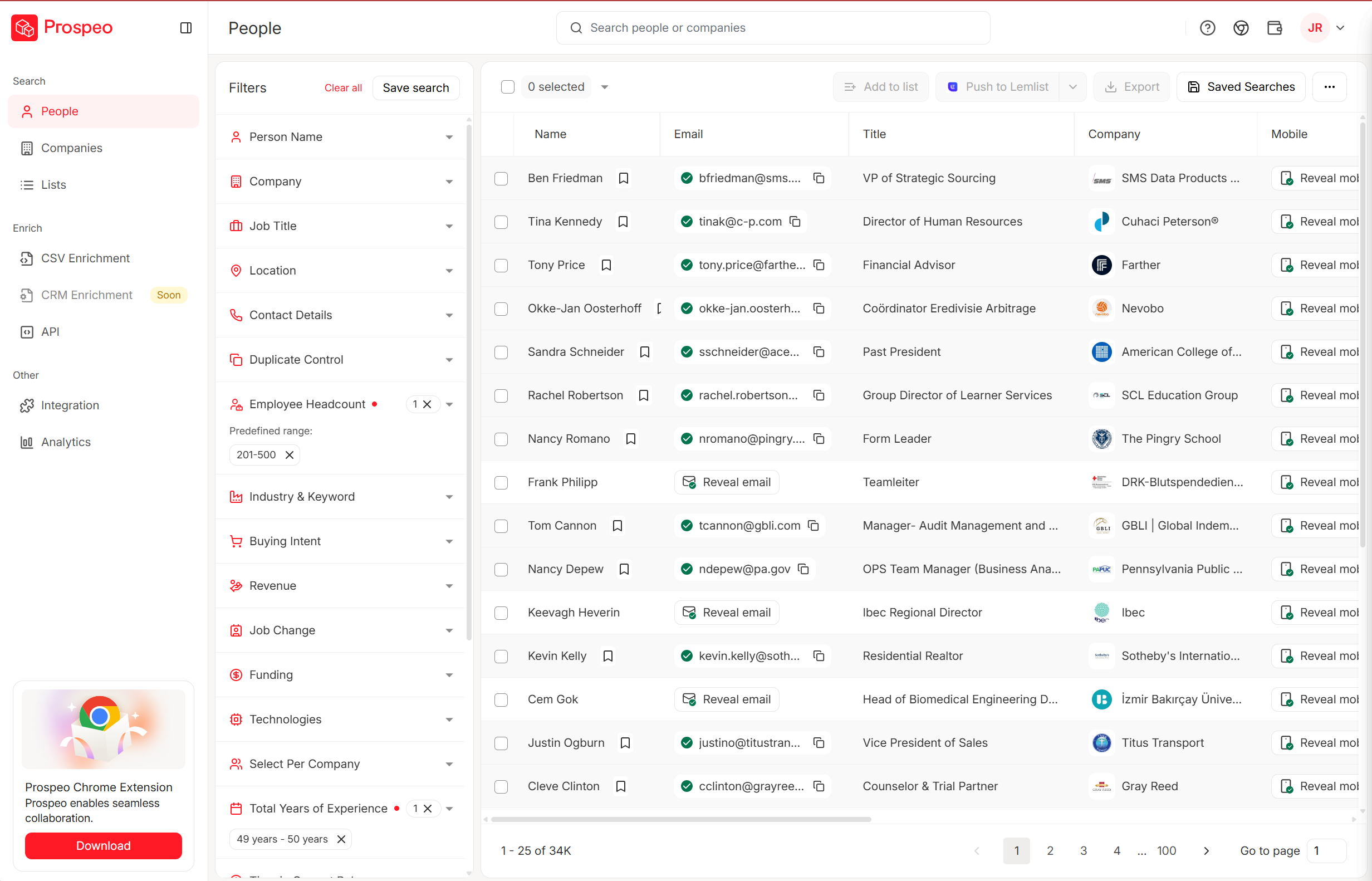
Use it if you've been burned by bad data and need verified contacts you can actually reach. The free tier (75 emails + 100 Chrome extension credits/month) lets you test before committing, and paid plans run ~$0.01/email with no contracts.
Skip it if you need a built-in email sequencer - pair with Smartlead or Instantly for that.
Apollo.io
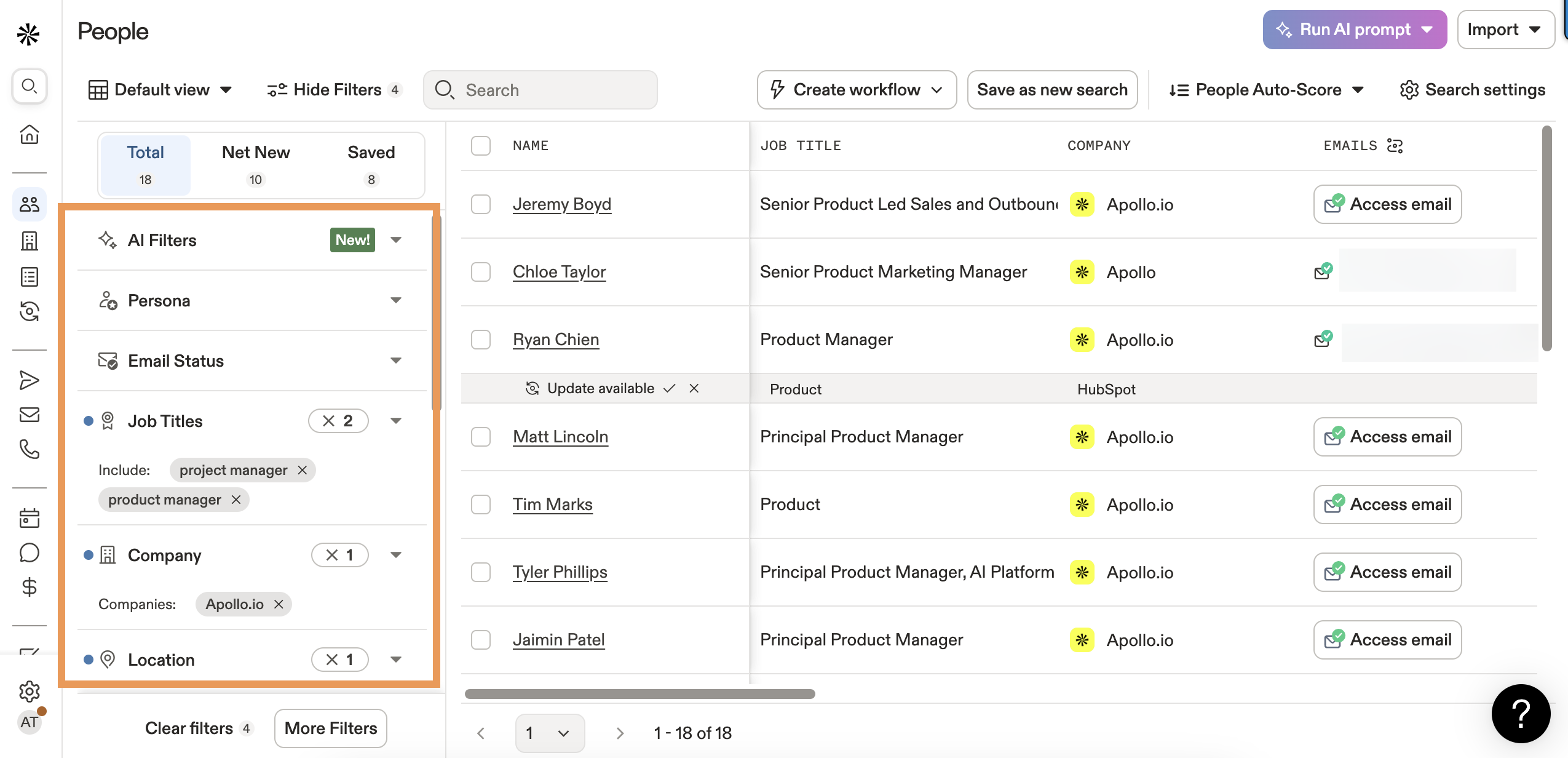
Apollo is the obvious starting point for SMB teams that want everything in one place. Database, email sequencing, basic CRM, meeting scheduler - it's all there. The 4.7/5 rating from 9,423 G2 reviews reflects genuine breadth.
The free tier is generous: unlimited email credits, 5 mobile credits/month, and 10 export credits. Paid plans run $59/user/month for Basic, $99 for Professional, and $149 for Organization. For a team of five, you're looking at $3,540-$8,940/year - a fraction of ZoomInfo's price tag.
Here's the tradeoff: benchmark tests put Apollo's email accuracy at around 72%. G2 reviewers back that up - 538 mentions of "Inaccurate Data" and 685 of "Missing Features" tell the story. If you're doing high-volume outbound, that accuracy gap turns into bounces and deliverability headaches fast.
Use it if you want one platform for prospecting and outreach and you're willing to layer a verification tool on top.
Skip it if data accuracy is your top priority or you're running high-volume outbound where bounce rates above 5% will tank your domain.
ZoomInfo
ZoomInfo is the enterprise default for a reason. 500M+ contacts, 100M company profiles, 1B+ monthly buying signals, SOC 2 Type II certification, GDPR and CCPA compliance-- the works. If you're a 200-person sales org running ABM, intent-driven outbound, and territory management from one platform, ZoomInfo can handle all of it.
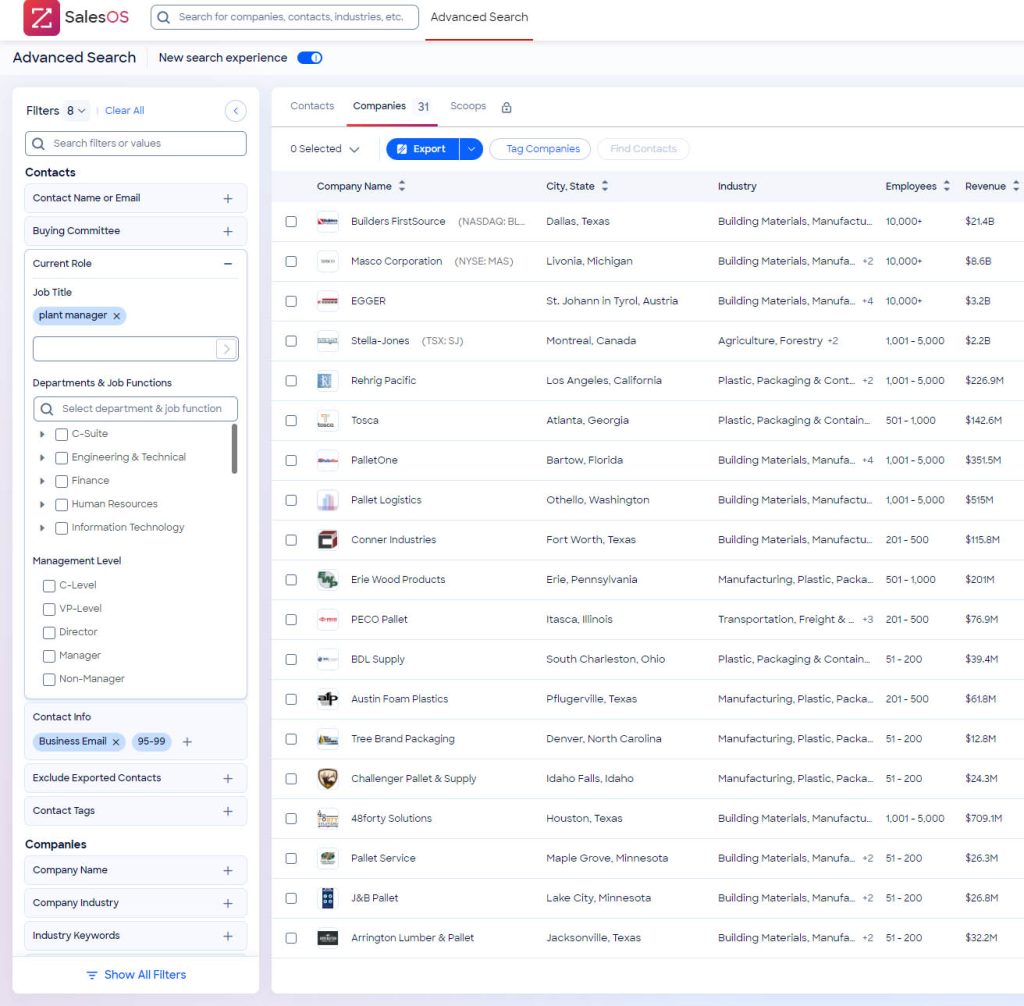
The price tag reflects the scope. A mid-market contract typically runs $15K-$40K/year depending on seats and modules, with annual commitments and no public pricing page. In benchmark testing, ZoomInfo's email accuracy came in at 78% - solid but not exceptional given what you're paying. The consensus on r/sales is that you end up paying for modules you never activate.
Use it if you have the budget, need intent data at scale, and want a single vendor for your entire GTM data stack.
Skip it if you're a team under 20 reps. You'll overpay for features you won't touch.
Lusha
Lusha is the tool you grab when you need a handful of contacts fast and don't want to sit through a demo. The Chrome extension is clean, the UI requires zero training, and Pro runs around $22.45/month - the cheapest paid entry point on this list. A free tier lets you kick the tires.
The catch is scale. Credit-based pricing means costs climb quickly once you move past solo prospecting. Team tiers typically land in the $50-$100/user/month range depending on credits, and the database doesn't match Apollo or ZoomInfo's depth for US contacts. Workflow and sequencing features are minimal. Best for solo reps or small teams pulling a few dozen contacts per week.
Seamless.AI
Pros:
- AI-powered search that surfaces contacts in real time
- Free tier with 50 credits to test
- Strong positioning for reps who want a "search engine for leads"
Cons:
- Pricing opacity is a genuine red flag - Basic is commonly estimated around $147/month on annual billing for 250 monthly credits per user, but add-ons stack up fast
- 60-day cancellation notice required before renewal
- Credit limits create surprise costs mid-quarter
Here's the thing: the add-on pricing model means your actual spend can be 2-3x the base price. Read the contract line by line.
Cognism
Cognism is a strong option for teams that need serious coverage in Europe and care about compliance. It's widely used for EMEA prospecting and outbound, with a compliance-forward positioning that matters if you're building pipeline across multiple regions.
Pricing is custom and annual. For small teams, expect around $1,000-$3,000/month depending on seats and package. There's no free tier, so you're committing before you test. For US-only teams, it's harder to justify. For anyone with a European pipeline, it's top-tier.
RocketReach
4.4/5 on G2 from 1,203 reviews - users praise speed and simplicity. A free tier gives you 5 lookups/month, and paid plans run ~$49-$99/month. The interface is clean for quick individual lookups.
The flip side: 125 G2 mentions of "Outdated Contacts" and 118 of "Inaccurate Data." It isn't built for high-volume prospecting or team workflows, and there's no sequencing or engagement layer. A solid supplementary tool for one-off lookups, not a primary sourcing database for a team running outbound at scale.
Hunter.io
Hunter is an email finder and verifier, not a full sourcing database. It won't build prospect lists from scratch, but it's useful for verifying emails you've gathered elsewhere. Free tier available, paid plans $34-$149/month. Benchmark tests put accuracy at 68% - below the threshold where we'd trust it as a primary source. Best paired with a database tool.
PhantomBuster
PhantomBuster is an automation and scraping tool, not a contact database. It runs 100+ automations across platforms, starting at $30/month with execution-time pricing and a 14-day trial. The risk: aggressive scraping can trigger account restrictions on the platforms you're pulling from. Use it for workflow automation, not as your primary prospect sourcing engine.
Pricing Compared
| Tool | Free Tier | Starting Paid | Pricing Model | Watch Out For |
|---|---|---|---|---|
| Apollo.io | Unlimited emails | $59/user/mo | Per seat, annual | Accuracy gaps |
| ZoomInfo | No | ~$15K-$40K/yr | Per seat + modules, annual | Module bloat, auto-renewal |
| Lusha | Yes | $22.45/mo | Seat + credits, no contract | Credit costs at scale |
| Seamless.AI | 50 credits | ~$147/mo | Credits + add-ons, annual | 60-day cancel notice |
| Cognism | No | ~$1K-$3K/mo | Custom, annual | No free tier |
| RocketReach | 5 lookups/mo | ~$49/mo | Per seat, monthly/annual | Stale data |
| Hunter.io | Yes | $34/mo | Credits, monthly | Low accuracy at 68% |
| PhantomBuster | 14-day trial | $30/mo | Execution time, monthly | Platform bans |

Most lead sourcing software refreshes data every 6 weeks. Prospeo refreshes every 7 days - with 98% email accuracy, 125M+ verified mobiles, and 30+ ICP filters. Snyk's 50 AEs cut bounce rates from 40% to under 5%.
Stop sourcing leads that bounce. Start with data that connects.
Data Accuracy Benchmarks
Accuracy is the single metric that separates sourcing tools that generate pipeline from ones that burn your sender reputation. A bounced email isn't just a missed contact - it's a signal to inbox providers that you're sending to bad lists. Stack enough bounces and your domain ends up in spam folders for everyone, including valid addresses.

A benchmark test of 1,000+ contacts across multiple providers produced these numbers:
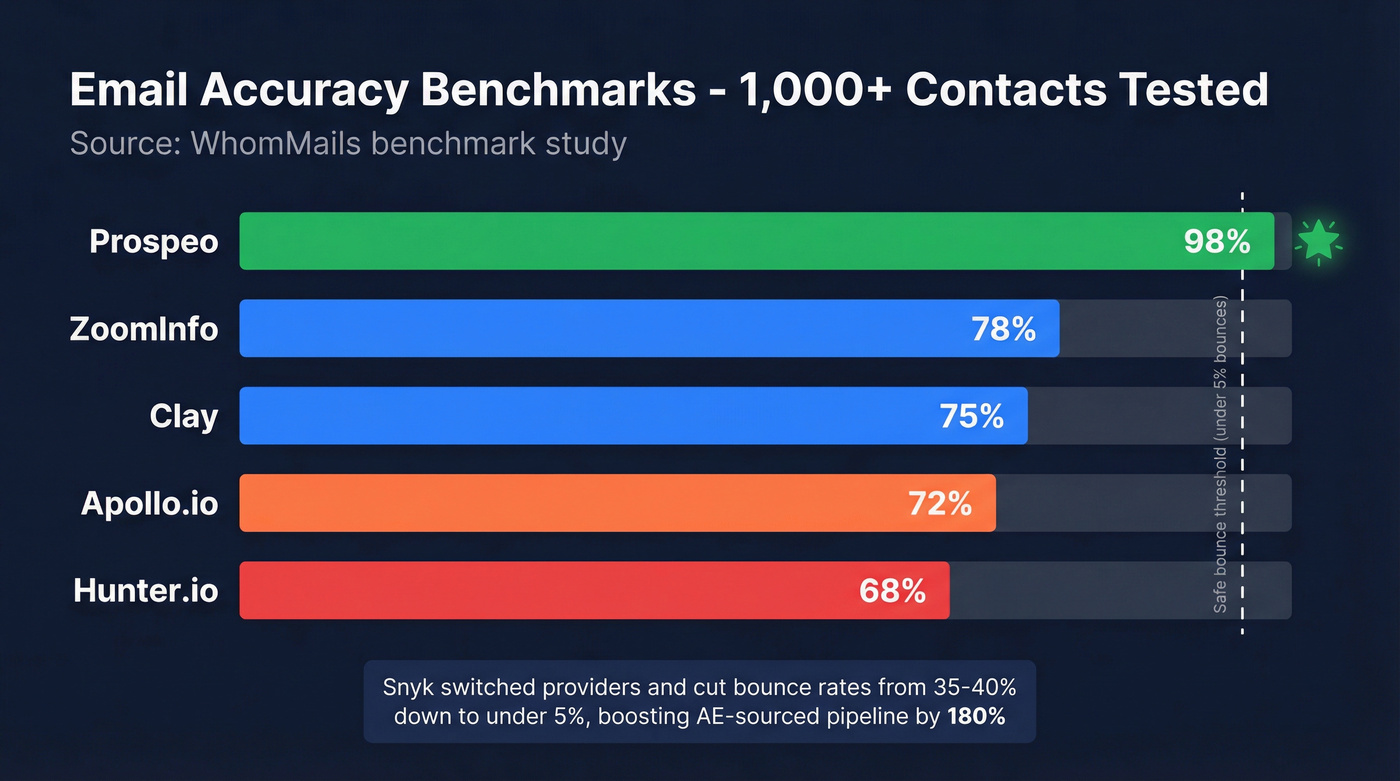
| Tool | Email Accuracy | Notes |
|---|---|---|
| ZoomInfo | 78% | Largest database, moderate accuracy |
| Clay | 75% | Waterfall model, varies by source |
| Apollo.io | 72% | Broad database, accuracy tradeoff |
| Hunter.io | 68% | Finder/verifier, not a full database |
The Snyk case is instructive. Fifty AEs were prospecting 4-6 hours per week with bounce rates of 35-40%. After switching providers, bounces dropped below 5% and AE-sourced pipeline jumped 180%. That's the difference accuracy makes at scale - and it's why we keep hammering this point.
Let's be honest: ZoomInfo is still the most complete all-in-one platform. But most teams don't need all-in-one. They need accurate data piped into the tools they already use. If your average deal size is under $15K, you're almost certainly better off with a specialized sourcing tool and a separate sequencer than paying for a bundled suite you'll use 30% of.
Hidden Costs to Watch
Before you sign anything, check for these traps:
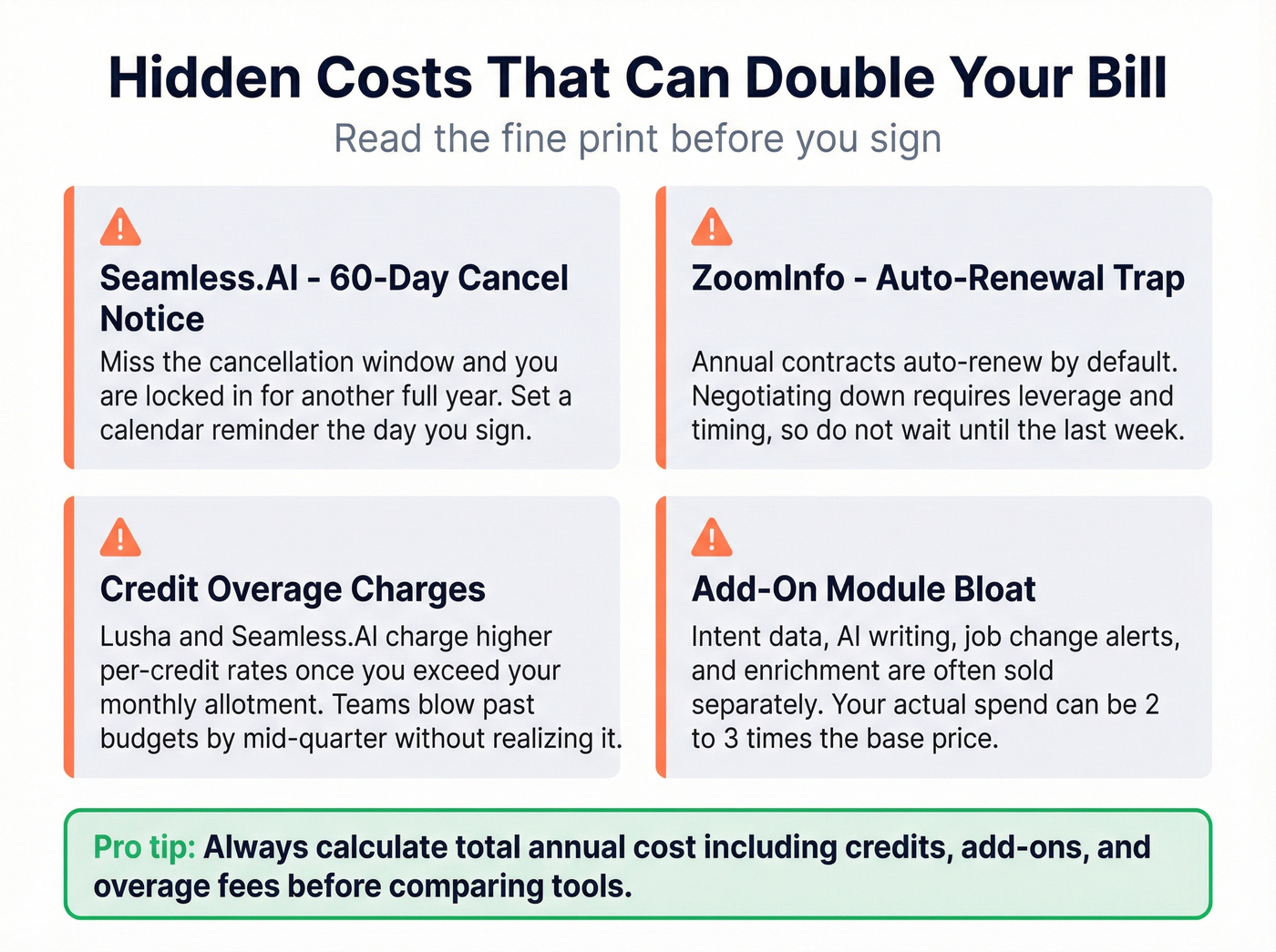
Seamless.AI's 60-day cancellation notice. Miss the window and you're locked in for another year. Set a calendar reminder the day you sign.
ZoomInfo's annual contracts with auto-renewal. Negotiating down is possible but requires leverage and timing. Don't wait until the last week.
Credit overage charges. Lusha and Seamless.AI both use credit models where exceeding your monthly allotment triggers per-credit charges at higher rates. We've seen teams blow past their budget by mid-quarter without realizing it.
Add-on costs that double your bill. Intent data, AI writing features, job change alerts, and enrichment modules are often sold separately. Seamless.AI is the worst offender here - Cognism's breakdown of their pricing confirms the stacking effect.
How to Choose the Right Tool
With the global average cost per lead at roughly $198, even a modest improvement in contact accuracy pays for most lead sourcing software within a month.
| Your Situation | Recommended Tool | Why |
|---|---|---|
| Solo founder / startup | Prospeo or Lusha free tier | Zero cost, enough credits to validate your ICP |
| 50+ reps, enterprise | ZoomInfo or Cognism | Scale, intent data, compliance infrastructure |
| EMEA-focused sales | Cognism | Strong European coverage + compliance posture |
| Tight budget, high volume | Apollo free + a verification layer | Free database + paid verification on top |
The decision comes down to how much you value data quality versus feature breadth - and how much you're willing to pay for the difference.
You just read through 9 lead sourcing tools. The difference comes down to accuracy and price. Prospeo delivers 98% verified emails at ~$0.01 each - 90% cheaper than ZoomInfo with a higher accuracy rate than every tool on this list.
Test 75 free emails and see the accuracy gap for yourself.
FAQ
What's the Difference Between Lead Sourcing and Lead Generation Software?
Lead sourcing software finds prospect contact data - verified emails, phone numbers, company information. Lead generation is the broader category that includes CRMs, chatbots, landing pages, and ad platforms. This article covers sourcing databases only.
How Accurate Is B2B Contact Data in 2026?
Benchmark tests show accuracy ranges from 68% to 78% across major providers. Prospeo leads at 98% verified email accuracy through a proprietary 5-step verification process with a 7-day data refresh cycle. The gap between 72% and 98% translates directly to bounce rates and domain reputation.
Are Free Tiers Enough for Real Prospecting?
For initial testing, absolutely - Apollo offers unlimited email credits and Prospeo gives 75 verified emails plus 100 Chrome extension credits monthly. But free plans cap exports and features, so most teams running serious outbound outgrow them within a month. Start free, validate your workflow, then upgrade when volume demands it.
Does GDPR Apply to Lead Sourcing Tools?
Yes, and ignoring it is expensive. GDPR fines can reach EUR 20M or 4% of global annual turnover. Choose tools with explicit GDPR compliance, SOC 2 certification, and opt-out enforcement. Don't assume compliance - verify it before you buy.
Should I Use One Tool for Sourcing and Sequencing?
Apollo is the strongest all-in-one option with built-in sequencing, but most teams get better results pairing a dedicated contact database with a purpose-built sequencer like Smartlead, Instantly, or Lemlist. In our experience, specialization tends to outperform bundled features at each individual task.