How to Get Clients for Digital Marketing in 2026
Figuring out how to get clients for digital marketing shouldn't require a PhD in platitudes. "Define your ICP." "Network more." "Provide value." Cool - none of that pays rent.
The reason most agencies stall at client acquisition isn't a lack of strategy. It's a lack of specifics. No scripts, no benchmarks, no sequences - just vague advice dressed up as expertise. Everything below comes with numbers, dollar figures, and playbooks you can run this week.
What Actually Works (Quick Version)
If you're short on time, here are the three moves that matter most:
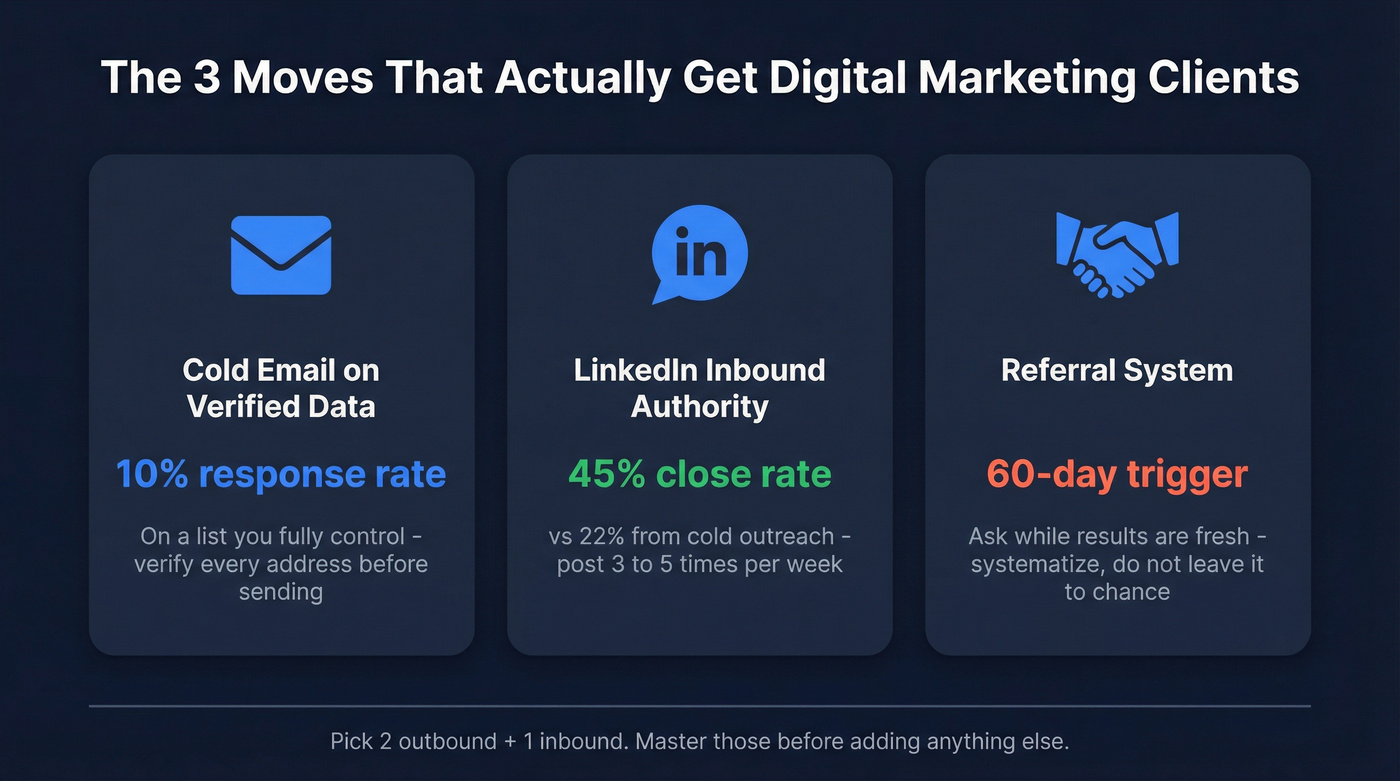
- Cold email on clean, verified data. Response rates cap around 10%, but that's 10% of a list you control. Verify every address before you send - a bad list can wreck your deliverability and sender reputation fast. (If you need a tighter playbook, start with cold email.)
- LinkedIn inbound authority. Post 3-5x/week using a four-pillar content framework. Agencies doing this report 45% close rates on inbound leads versus 22% from cold outreach. That's not a rounding error. (More examples: inbound channels.)
- Referral system with a 60-day trigger. Ask your happiest clients for referrals while results are still fresh - within the first 60 days of working together. (Use a repeatable referral introduction email.)
Everything else in this article is a multiplier on those three. Pick two outbound and one inbound. Master those before adding anything else.
Get Your Foundation Right First
Before you run a single campaign, nail three things. First, define a niche tight enough that your cold email subject line makes the recipient think "this person gets my business." "We help ecommerce brands doing $1-5M in revenue fix their email marketing" beats "full-service digital marketing agency" every time.
Second, productize your offer. Package your services into clear tiers with outcome-based pricing. "$3,500/month for an SEO audit plus 90-day implementation" is buyable. "Custom SEO solutions" is not. We've seen agencies double their close rates just by switching from custom quotes to productized packages.
Third, set up a CRM - even HubSpot's free plan works. If you aren't tracking where leads come from and where they stall, you're guessing. Guessing doesn't scale. (If you want to do this properly, set up lead source tracking.)

You just read that a 35% bounce rate can tank your sender reputation for months. Prospeo's 5-step verification delivers 98% email accuracy on a 7-day refresh cycle - so every cold email you send actually lands. Start with 75 free verified emails per month and native integrations with Instantly and Smartlead.
Your cold outreach is only as good as your data. Fix that first.
7 Channels to Find Digital Marketing Clients
Cold Email That Gets Replies
Use this if: You need pipeline now, you have a clear niche, and you're willing to invest in list quality.
Skip this if: You don't have a dedicated sending domain, your offer isn't specific, or you're planning to blast 10,000 generic emails and pray.
Build a targeted list of 200-500 contacts per campaign, not thousands. Emails to large untargeted lists get 67% fewer replies than smaller targeted groups. Before you write a single subject line, verify your list. A 35% bounce rate doesn't just kill that campaign - it can tank your sender reputation for months. (If you're scaling, follow outbound volume best practices.)
Tools like Prospeo run 98% verified email accuracy on a 7-day refresh cycle, so you aren't working off stale data. The free tier gives you 75 verified emails per month plus 100 Chrome extension credits, and it integrates natively with Instantly and Smartlead. (For comparisons, see email ID validators.)
Here's the actual script. Steal this and adapt it: (Or pull more options from these outreach email templates.)
Subject: [First name], quick question about [specific pain point]
Hey [First name],
Noticed [company] is running Google Ads but your landing pages don't have any conversion tracking set up. You're likely wasting spend and losing conversions you can't see.
We fixed this exact problem for [similar company] and cut their cost-per-lead significantly in ~60 days.
Worth a 15-minute call to see if we can do the same?
Keep it short. One CTA. Lead with a calibrated question or a specific observation - something that proves you actually looked at their business.
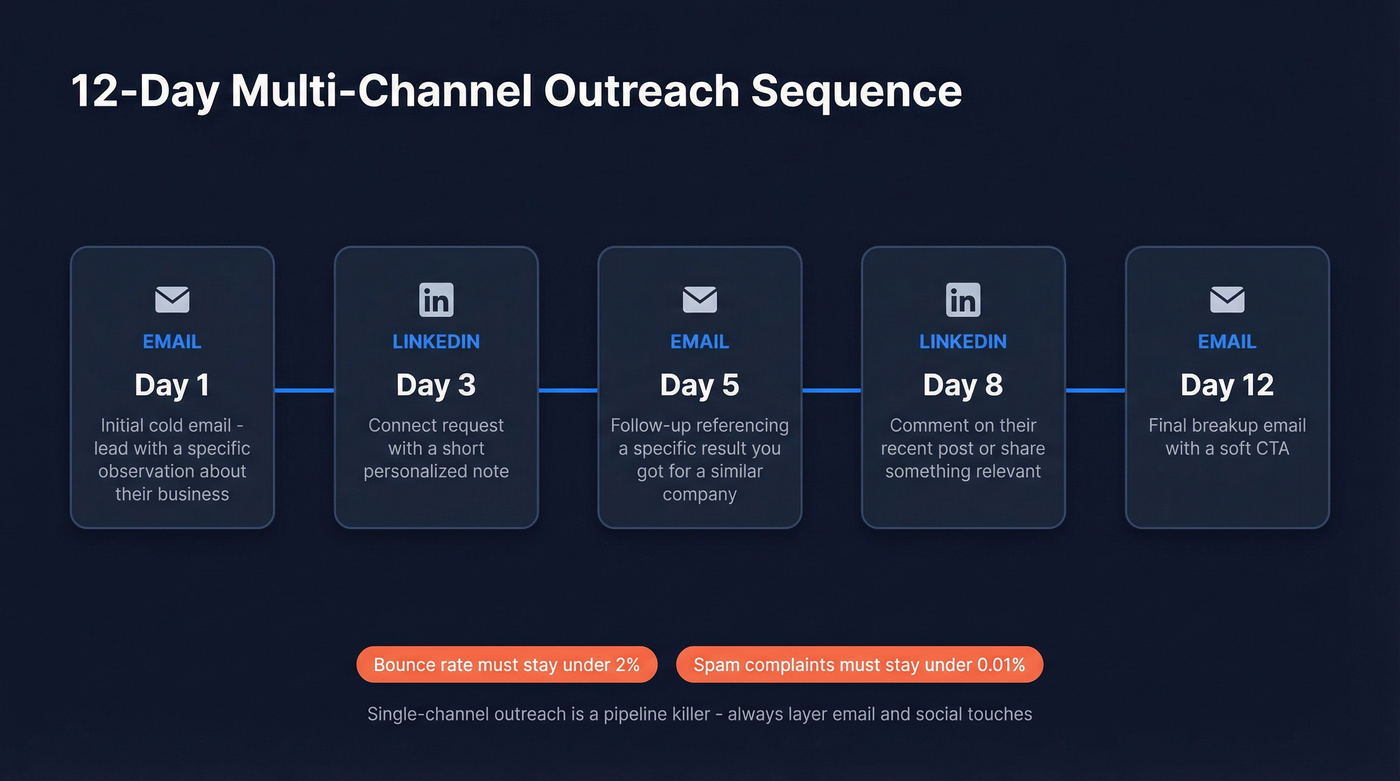
The follow-up sequence:
| Day | Channel | Action |
|---|---|---|
| 1 | Send initial cold email (above) | |
| 3 | Connect request with a short personalized note | |
| 5 | Follow-up referencing a specific result | |
| 8 | Comment on their recent post or share relevant content | |
| 12 | Final breakup email with a soft CTA |
Single-channel outreach is a pipeline killer. Layer email and social touches for the best results. (If you want a system, use an outbound email campaign.)
Your deliverability guardrails: bounce rate under 2%, spam complaint rate under 0.01%. Anything above those thresholds damages your sender reputation. (Full checklist: email deliverability checklist.)
LinkedIn Inbound Authority
LinkedIn is one of the highest-converting inbound channels for agencies. One documented $380K in LinkedIn-sourced revenue over 12 months with a 45% close rate on inbound leads. Compare that to 22% from cold outreach. (If you want to layer it with outbound, use social selling.)
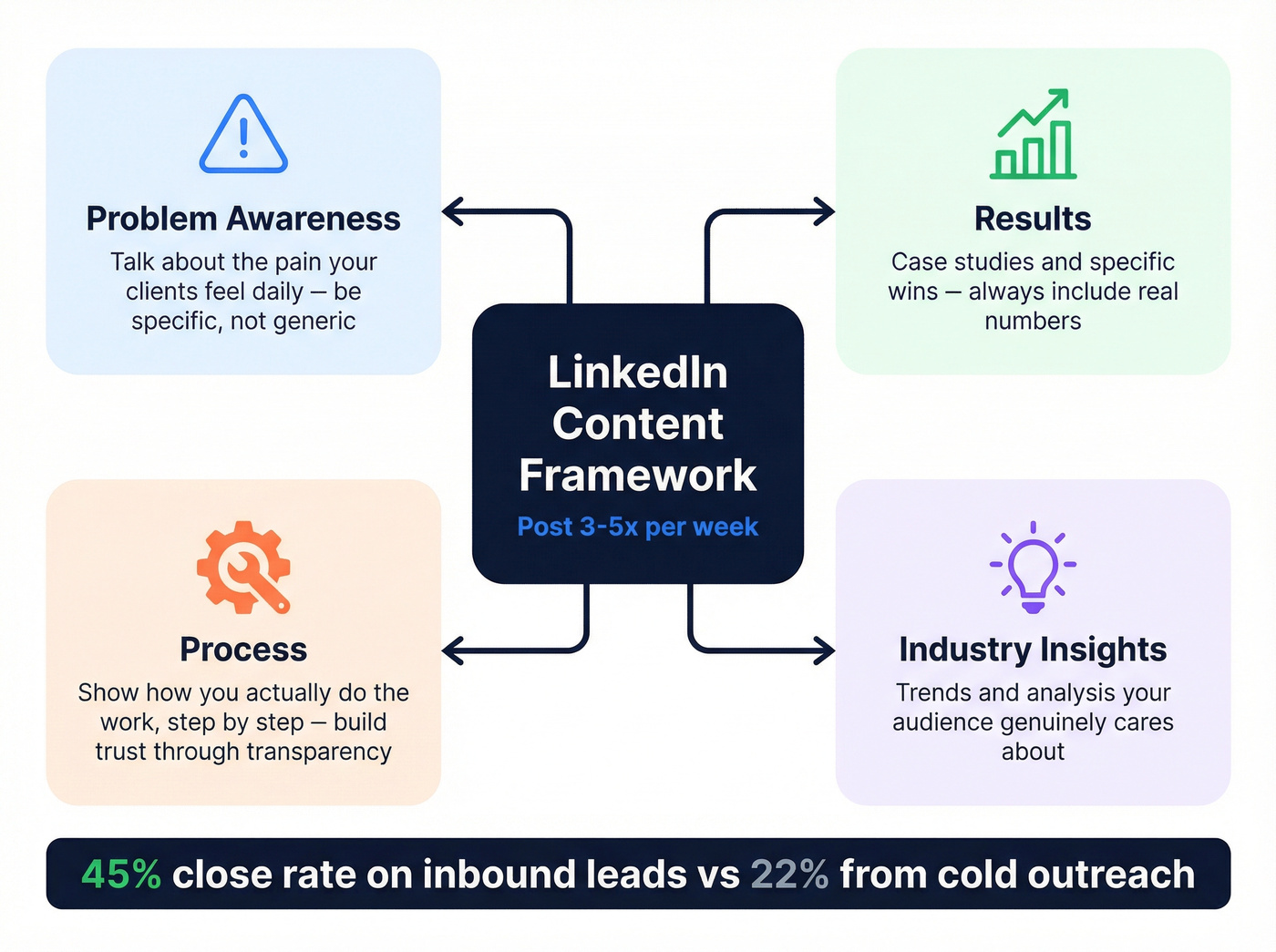
Post 3-5 times per week across four content pillars:
- Problem awareness - the pain your clients feel daily
- Results - case studies and specific wins with numbers
- Process - how you actually do the work, step by step
- Industry insights - trends your audience cares about
Your profile needs a sharp positioning statement. Use this formula: "We help [audience] achieve [outcome] through [method]." Nobody hires "full-service." They hire someone who solves a specific problem they have right now.
LinkedIn also limits spammy outbound behavior - connection request caps, message throttling - which pushes everyone toward authority-based inbound. Lean into that instead of fighting it.
Build a Referral Machine
Referrals convert better than any other channel, but most agencies treat them as happy accidents. In our experience, the 60-day window is everything - ask while results are fresh and enthusiasm is high. Wait six months and the excitement has faded.
Don't just ask on calls. Place the referral ask on invoices, onboarding emails, quarterly business review decks, and project wrap-up calls. If a client sees your referral ask only once, they'll forget. Better yet, formally launch a referral program: send a dedicated email announcing it, put it on your website, mention it in your newsletter. A systematized program outperforms ad-hoc asks every time.
Reduce friction by letting clients share via their own email or a simple link. Don't make them fill out a form. Match incentives to the relationship - a $50 gift card for a small retainer client, a co-branded case study for a larger account.
Freelance Marketplaces
Here's the contrarian take on Upwork: it's not a race to the bottom. It's a lead source - if you use it right.
Filter for higher-budget, longer-term posts. Skip the "$500 for a full website redesign" listings and look for businesses posting recurring needs with realistic budgets. These clients exist on the platform; they're just buried under the noise. When you write proposals, lead with results, not credentials. "We increased organic traffic 340% for a B2B SaaS company in 6 months" beats "We have 10 years of experience in digital marketing." Upwork takes a service fee (often around 10% depending on the contract), which stings - but if you're landing $3,000+/month retainer clients, that's a reasonable acquisition cost. Think of it as a paid channel with performance-based pricing.
Content + SEO + GEO
If your agency isn't optimizing for AI answer engines right now, you're building on a shrinking foundation. Gartner predicts traditional search volume is dropping 25% as buyers shift to AI tools. ChatGPT has 800M weekly users. Google AI Overviews serve 2B+ monthly users. The agencies that figure out Generative Engine Optimization early will own the next wave of inbound leads.
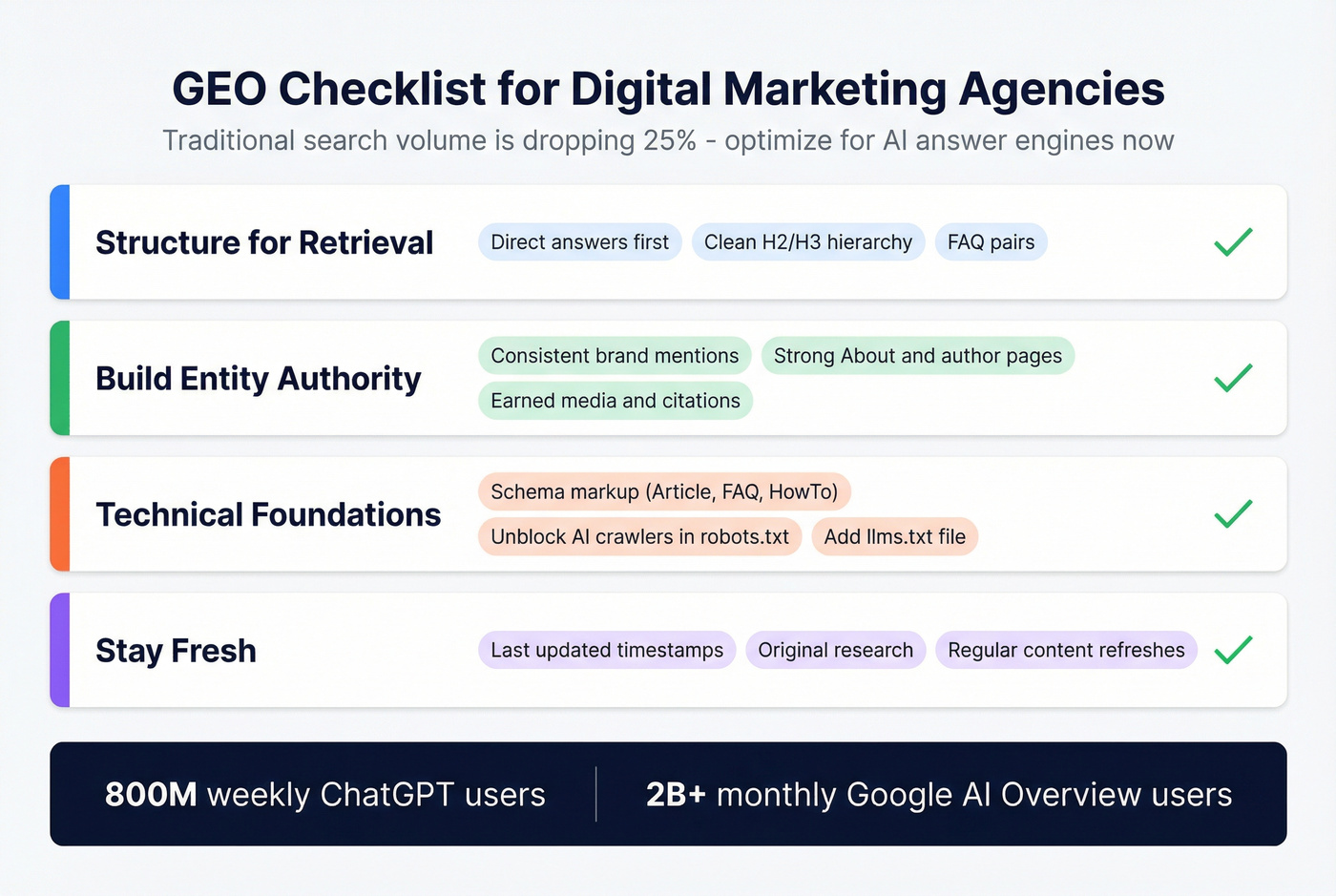
GEO means structuring your content and digital presence so AI platforms can retrieve, cite, and recommend your brand. Here's what to focus on:
Structure for retrieval. Direct answers first, clean H2/H3 hierarchy, FAQ pairs. AI models pull from well-structured content.
Build entity authority. Consistent brand mentions across the web, strong About and author pages, earned media. AI tools trust brands they can verify.
Technical foundations. Schema markup (Article, Organization, FAQ, HowTo), make sure AI crawlers aren't blocked in robots.txt, consider adding an llms.txt file.
Stay fresh. "Last updated" timestamps, original research, and regular content refreshes. Stale content gets deprioritized by both search engines and AI models.
Paid Ads on a Budget
Use this if: You have $500-$2,000/month to test, you're targeting high-intent keywords ("SEO agency for dentists," not "digital marketing"), and you're willing to iterate for 60-90 days.
Skip this if: Your budget is under $500/month. Running cold traffic on Facebook to convert strangers into retainer clients rarely works for agency services.
Google Ads for high-intent keywords is the play. Someone searching "ecommerce email marketing agency" is ready to buy - meet them there. Retargeting is the highest-ROI paid tactic: pixel your website visitors and serve them ads across Meta and Google Display. You aren't convincing cold audiences; you're staying top-of-mind with people who already showed interest.
Webinars and Free Audits
The free audit is the most underrated conversion mechanism in agency sales. Give away the diagnosis, sell the treatment.
Run a 15-minute audit of a prospect's Google Ads account, SEO performance, or email marketing setup. Show them exactly what's broken. Then offer to fix it. I saw a three-person agency land four retainer clients in a single month by offering free "revenue leak" audits to ecommerce brands. They spent zero on ads - just posted the offer on LinkedIn and in two Slack communities.
Webinars work the same way at scale. Pick a specific topic, deliver genuine value for 45 minutes, and close with an offer. Anyone who sits through a webinar on "email deliverability for ecommerce brands" is a warm lead for your email marketing services.
What Client Acquisition Actually Costs
Let's be honest - acquiring a new retainer client through outbound typically runs $500-$1,500 when you factor in tooling, time, and send volume. Referrals cost significantly less, sometimes just the price of a gift card and a well-timed ask. (To pressure-test your numbers, use a cost to acquire customer model.)
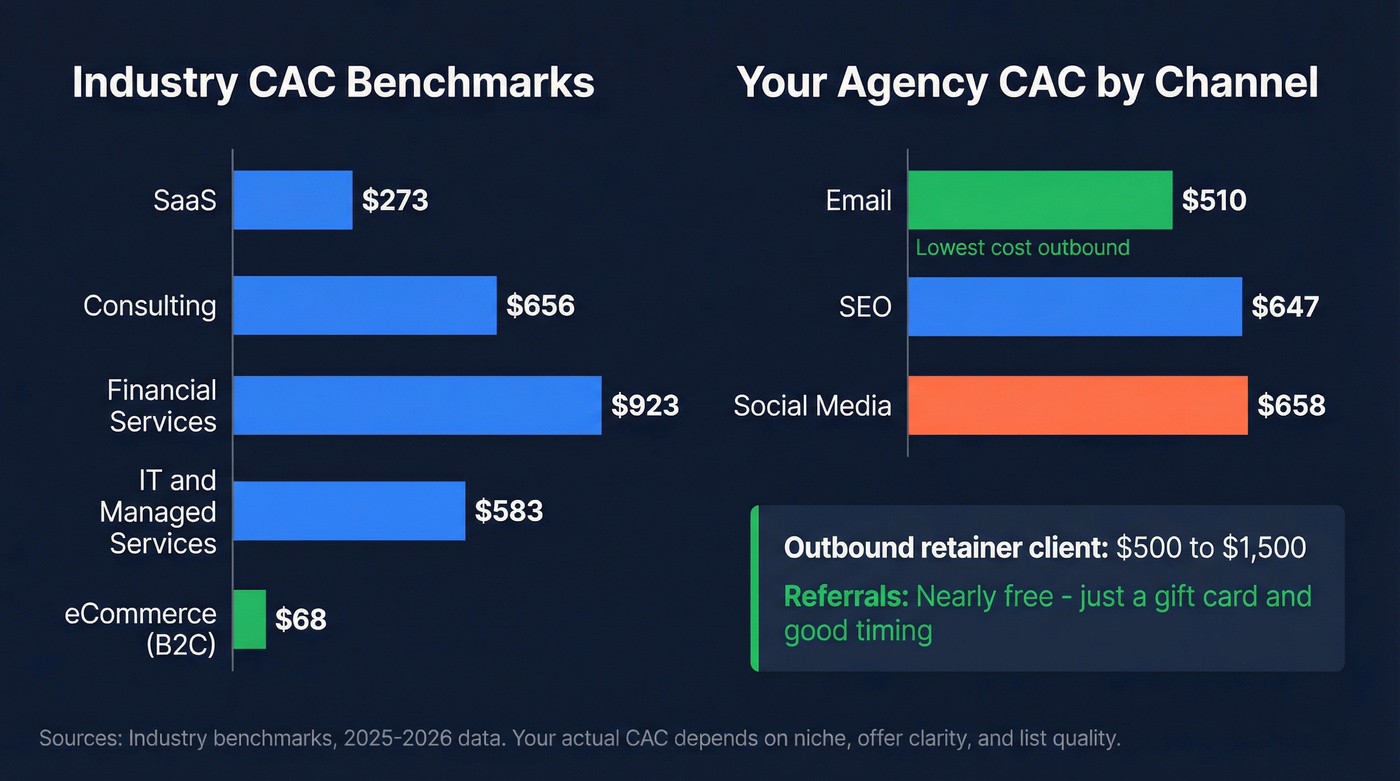
For context, here are industry CAC benchmarks your clients are dealing with:
| Industry | Avg B2B CAC | Avg B2C CAC |
|---|---|---|
| SaaS | $273 | $166 |
| Consulting | $656 | - |
| Financial Services | $923 | $173 |
| eCommerce | - | $68 |
| IT & Managed Services | $583 | - |
And here's what the low-CAC channels look like:
| Channel | B2B CAC | B2C CAC |
|---|---|---|
| $510 | $287 | |
| SEO | $647 | $298 |
| Social Media | $658 | $212 |
| Webinars | $603 | $251 |
Email and social are your cheapest acquisition channels. SEO takes longer but compounds. Paid ads are the fastest but most expensive per client acquired.
Mistakes That Kill Your Pipeline
Untargeted lists. Blasting 5,000 generic contacts feels productive. It's not. Emails to untargeted lists generate 67% fewer replies. Build lists of 200-500 contacts that match your exact ICP.
No segmentation. Segmented campaigns get 14.31% higher open rates and 10% higher click-through rates than generic blasts. Epsilon research found that 80% of consumers are more likely to do business with companies that personalize their outreach. Group your prospects by industry, company size, or pain point - then write different copy for each segment. (If you want a framework, use behavioral segmentation.)
Ignoring deliverability. Your bounce rate needs to stay under 2%. Spam complaint rate under 0.01%. One agency built from $0 to $1M ARR while keeping client deliverability at 94%+, bounce under 3%, and zero domain flags across all clients. Bad data is the fastest way to destroy a sending domain.

Single-channel outreach. Email alone isn't enough. The best-performing sequences layer email, social touches, and retargeting. Prospects who see you across multiple channels are far more likely to respond than those who get a single cold email. (Build a repeatable prospecting workflow.)
Compliance blindness. GDPR fines run up to EUR 20M or 4% of global annual revenue - whichever is higher. CAN-SPAM requires a physical address and unsubscribe link in every email. SPF, DKIM, and DMARC authentication aren't optional anymore. If you're sending outbound without these basics, you're playing with fire. (Start with GDPR for sales and marketing.)
Building a 200-500 contact list per campaign means every record matters. Prospeo gives you 30+ search filters - industry, headcount, revenue, tech stack, buyer intent - so you can target exactly the niche you just productized. At roughly $0.01 per email, a full campaign list costs less than a coffee.
Find your next 10 digital marketing clients for the price of a latte.
FAQ
How long does it take to land your first client?
Expect 2-8 weeks with consistent outbound - 50+ personalized emails per week plus social follow-ups. Inbound strategies like LinkedIn content and SEO take 60-90 days to compound. The tighter your niche, the faster you'll close.
How do agencies acquire new clients?
Top-performing agencies layer two to three channels: cold email for immediate pipeline, LinkedIn content for inbound authority, and a referral system for low-cost, high-trust leads. Agencies targeting a defined niche close at roughly double the rate of generalists.
How much does client acquisition cost?
Outbound acquisition typically costs $500-$1,500 per retainer client when you factor in tooling and time. Referrals cost significantly less. B2B SaaS CAC averages $273 and consulting averages $656 - your agency's CAC should fall in that range.
Is cold email still effective in 2026?
Yes, but response rates rarely exceed 10%. Data quality and personalization separate a 1% reply rate from an 8% reply rate. Verify every email before sending, keep messages short, and include one clear CTA.
What tools do I need to start?
A verified prospect list (Prospeo's free tier gives you 75 emails/month), a cold email sender like Instantly or Smartlead (~$30-$100/month), and a CRM like HubSpot's free plan. Total startup cost: often under $150/month.