

How to Increase Pipeline as an AE in 2026
It's Wednesday. You've made 40 dials, sent 60 emails, and booked zero meetings. Pipeline review is Friday, and your manager's already pinging you about coverage ratios. The instinct is to dial harder, but that's a hamster wheel - not a strategy. The AEs who consistently self-source 30%+ of their pipeline don't out-dial everyone. They out-target everyone. If you want to increase pipeline as an AE, the answer starts with smarter systems, not more sweat.
Start Here: Pipeline Math
Self-sourcing pipeline isn't about more dials. It's about better targeting, cleaner data, and a repeatable daily system. Get the math right first, then fix your data, then build the daily habit.
The Bad Data Tax
Here's a scenario every AE has lived: you pull 200 contacts from your database. 38 emails bounce. 15 have wrong titles. 22 phone numbers are disconnected. You just burned two hours building a list that's 37% garbage - and the bounced emails are quietly torching your domain reputation.

The chain reaction is brutal. Bad data leads to bounced emails, which trigger spam complaints, which tank deliverability, which kill replies, which starve your pipeline. It's not a prospecting problem. It's a data problem wearing a prospecting costume.
We've watched reps go from zero self-sourced pipeline to 35%+ in a single quarter just by cleaning up their contact data before touching a sequencer.
Reverse-Engineer Your Numbers
Most AEs skip this step entirely. They prospect when pipeline feels thin and stop when it feels full. That's emotional, not strategic.
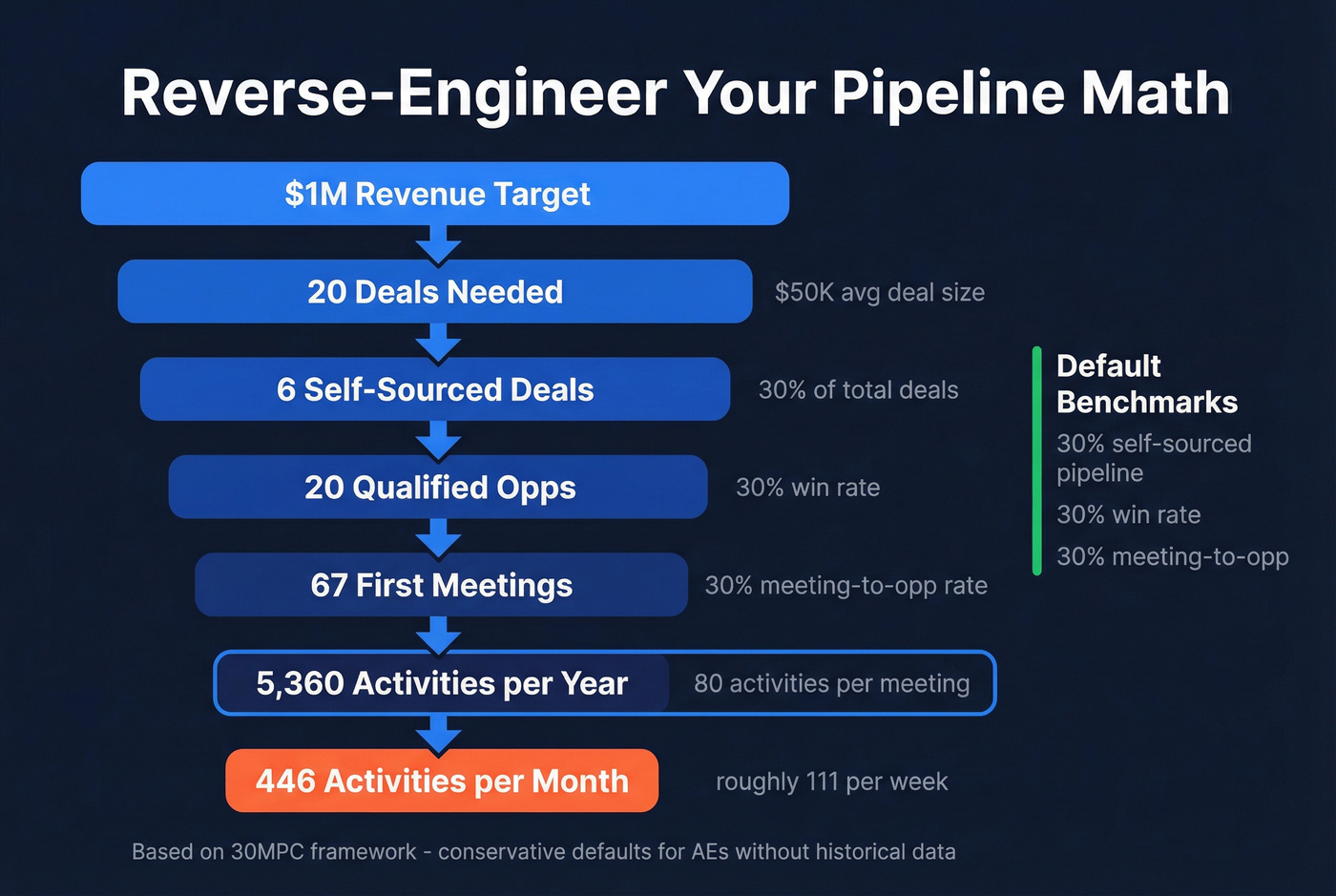
The 30MPC framework lays out the formula cleanly. Work backwards from your revenue target:
Revenue target → deals to close → self-sourced deals → qualified opps → first meetings → outbound activities.
Here's a worked example for a $1M annual target:
| Step | Calculation | Result |
|---|---|---|
| Revenue target | - | $1M |
| Avg deal size | $50K ASP | 20 deals needed |
| Self-sourced (30%) | 20 x 0.30 | 6 deals |
| Win rate (30%) | 6 / 0.30 | 20 qualified opps |
| Meeting-to-opp (30%) | 20 / 0.30 | 67 first meetings |
| Activities/meeting (80) | 67 x 80 | 5,360/year |
| Monthly activities | 5,360 / 12 | 446/month |
That's roughly 111 activities per week - calls, emails, social touches combined. Not 111 dials. Activities. When you don't have historical conversion data, use these benchmark defaults: 30% self-sourced pipeline, 30% win rate, 30% meeting-to-opportunity conversion. They're conservative enough to be safe and aggressive enough to be useful.
One critical segment note: SMB AEs need higher volume because deal sizes are smaller. Enterprise AEs need fewer accounts but deeper multi-threading - you're working 5-8 contacts per account instead of 1-2. A 3-4x pipeline coverage ratio is the target regardless of segment. Teams that nail this math consistently aren't doing anything magical. They're just disciplined about the inputs.
Pick 30-50 Accounts, Ignore the Rest
Your company gave you 500 accounts and told you to "go prospect." No ICP refinement. No intent data. No prioritization. That's not enablement - that's abandonment.
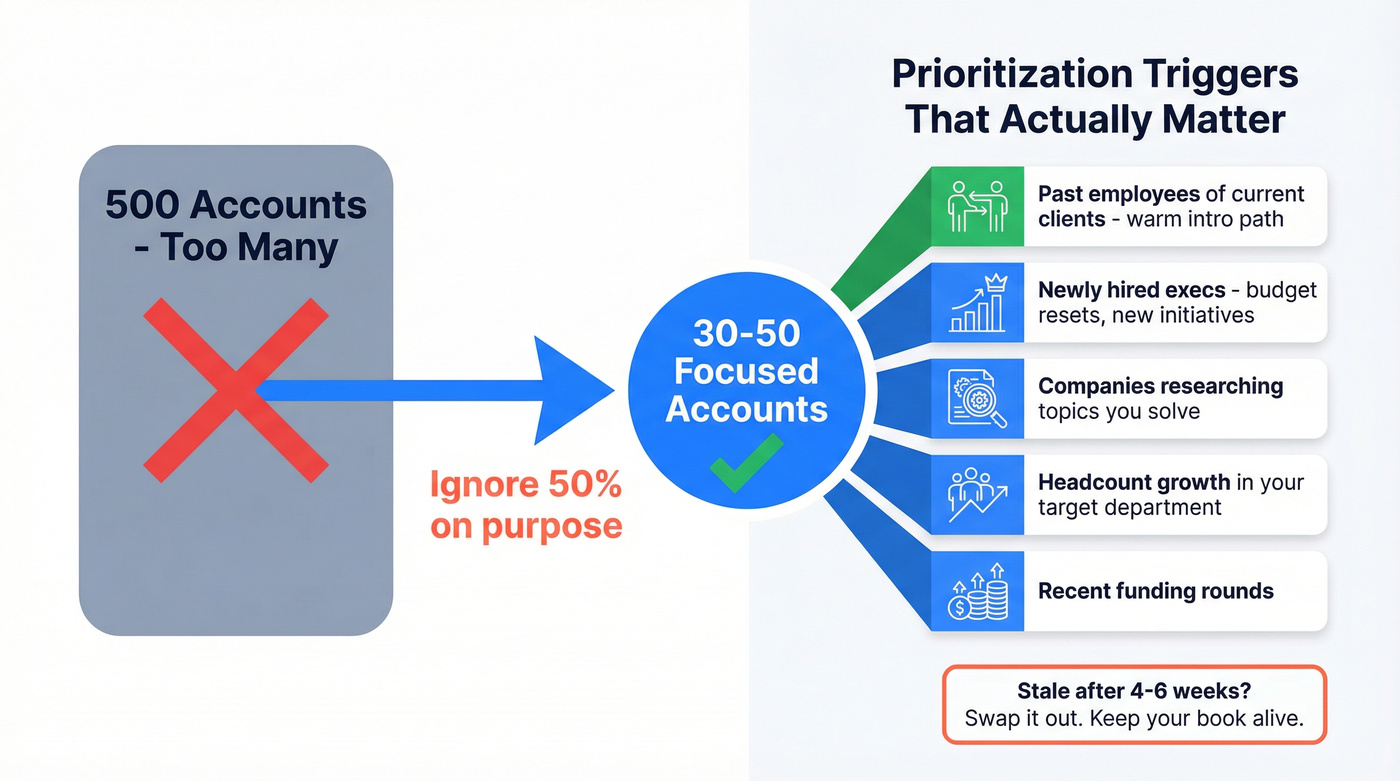
Here's the contrarian move: ignore 50% of your accounts on purpose.
The Gradient Works "small books" concept gets this right. Give yourself a focused book of 30-50 high-potential accounts. Work them deeply. When an account goes stale after 4-6 weeks of no engagement, swap it out for a fresh one. Dynamic replacement keeps your book alive instead of letting dead accounts clog your CRM like plaque in an artery.
Prioritization triggers that actually matter:
- Past employees of your current clients (warm intro path)
- Newly hired execs (budget resets, new initiatives)
- Companies actively researching topics related to your solution
- Headcount growth in the department you sell into
- Recent funding rounds
Layer intent signals on top of firmographic fit and you've got a prioritized list worth your time. This kind of focused targeting is also the foundation of any sound sales strategy during a downturn - when budgets tighten, precision matters more than volume.

That 37% garbage rate? Prospeo's 98% email accuracy and 7-day data refresh eliminate the bad data tax killing your pipeline. AEs at Snyk cut bounce rates from 35% to under 5% and grew AE-sourced pipeline 180%.
Fix your data before you touch another sequencer.
Build Your Daily Prospecting System
Consistency beats intensity every time. The AEs generating their own pipeline reliably don't have marathon prospecting days. They have a non-negotiable daily block.
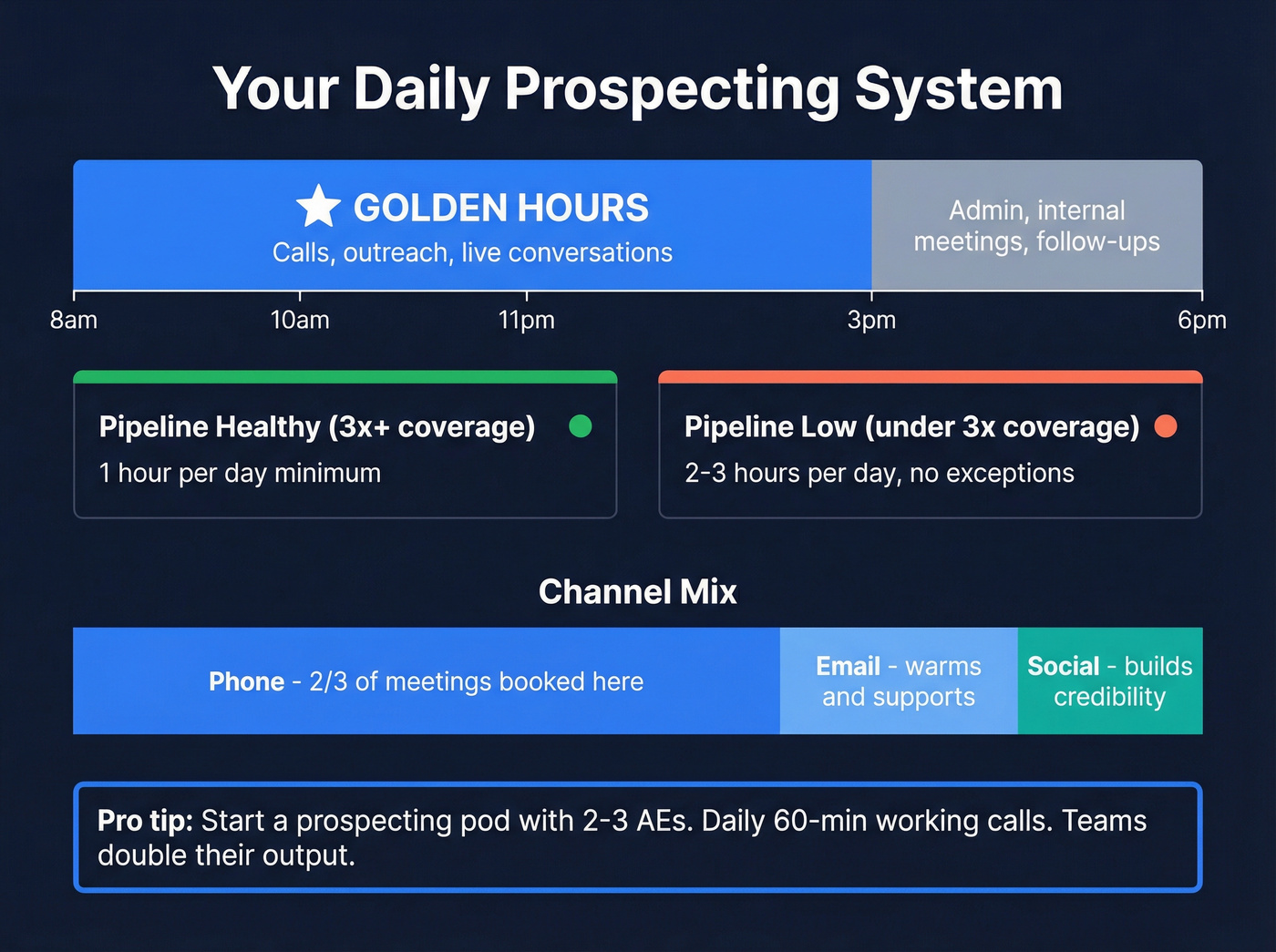
Golden hours: 8am-3pm. This is when prospects pick up phones and read emails. Reserve this window for calls, outreach, and live conversations. Push admin, internal meetings, and follow-ups to after 3pm.
Minimum commitment: 1 hour/day when pipeline is healthy. When your coverage ratio drops below 3x, increase to 2-3 hours/day. No exceptions.
Prospecting pods are underrated. Grab 2-3 AEs, hop on a working call, and prospect together for 60 minutes. The accountability and competitive energy are real. We've seen teams double their prospecting output just by adding a daily pod session - it sounds gimmicky until you try it and realize you just made 40 more dials than you would have alone.
Channel mix matters. Phone is still king - roughly two-thirds of outbound meetings are booked by phone. Email supports and warms. Social builds credibility and opens doors. Weight your time toward the phone, but don't abandon any channel.
For teams with SDR support, coordinate - don't duplicate. The SDR handles initial outreach and top-of-funnel sequences; you take over once there's engagement. Full-cycle? You own the whole sequence.
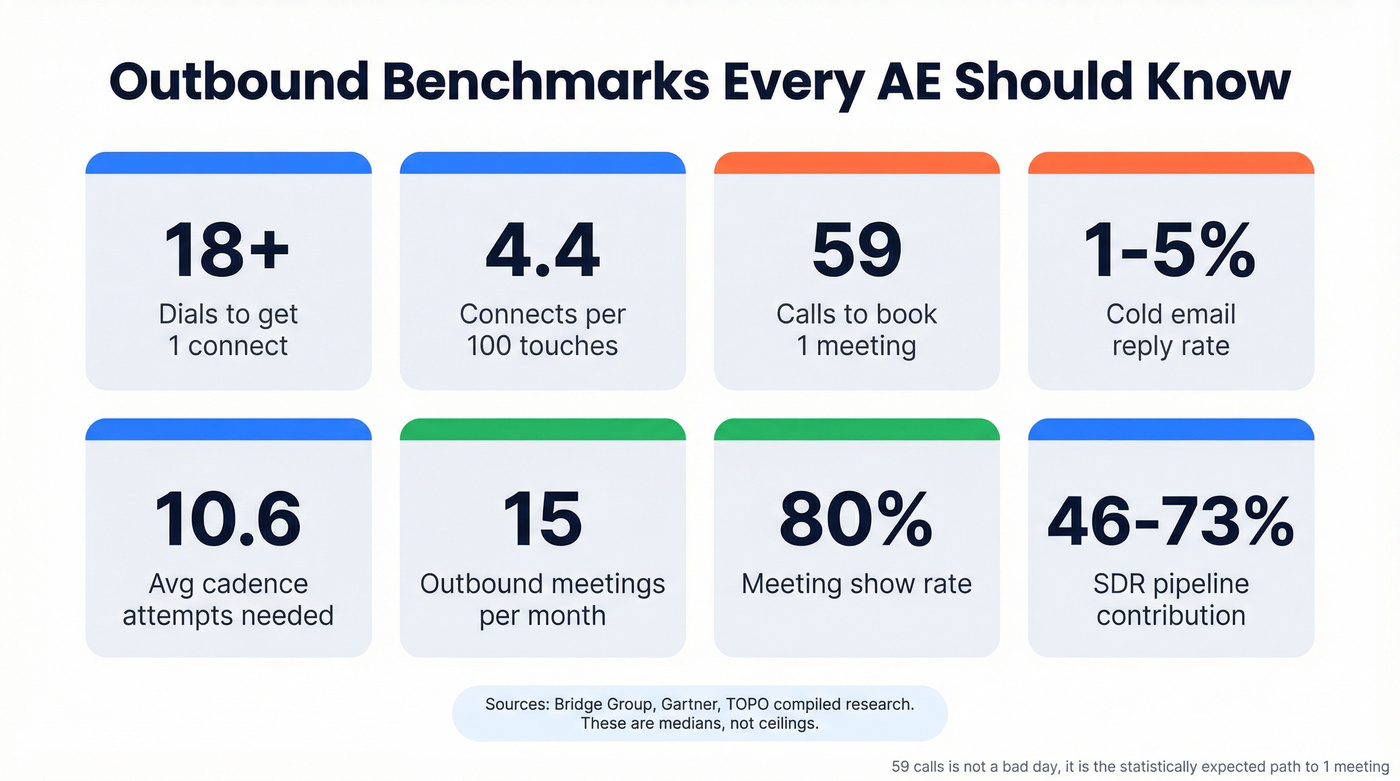
Outbound Benchmarks Every AE Should Know
Before you set activity targets, calibrate your expectations. These numbers come from compiled research across Bridge Group, Gartner, and TOPO:
| Metric | Benchmark |
|---|---|
| Dials to connect | 18+ |
| Connects per 100 touches | 4.4 |
| Calls to book 1 meeting | 59 |
| Cold email reply rate | 1-5% |
| Cadence attempts (avg) | 10.6 |
| Outbound meetings/month | 15 |
| Meeting show rate | 80% |
| SDR pipeline contribution | 46-73% |
That 1-in-59 calls-to-meeting ratio looks brutal. But it means 59 calls isn't a bad day - it's a statistically expected path to one meeting. When you know the numbers, rejection stops feeling personal and starts feeling like progress.
Here's the thing: if your average deal is under $15K, you probably don't need a $30K/year data platform. A lean stack with verified data and a parallel dialer will outperform an enterprise suite you only use at 20% capacity.
Cold Email That Actually Lands
This is where most AEs lose pipeline without realizing it. You can write the perfect cold email, but if it lands in spam, it doesn't exist.
Deliverability First
Under the bulk sender rules now fully enforced by Google, Yahoo, and Outlook.com, the bar is higher than ever. SPF, DKIM, and DMARC authentication are table stakes. Add RFC 8058 one-click unsubscribe headers to every outbound email.
The thresholds that matter:
- Spam complaints under 0.3%
- Bounce rate under 2%
- Inbox placement at or above 80% on seed tests before you scale
On a new domain, start with 5-10 emails/day and ramp over 4-6 weeks. Set up a custom tracking domain via branded CNAME. Monitor Postmaster metrics weekly. Skip this warmup and you'll spend months recovering what took weeks to destroy.
Verify Before You Send
Let's be honest - the AEs who complain about not having enough pipeline are usually the same ones who skip list verification. Before you send a single cold email, verify your list.
Prospeo's 5-step verification catches spam traps, honeypots, and catch-all domains with 98% email accuracy. That 7-day data refresh cycle matters because contact data decays fast - an email valid six weeks ago might bounce today. Pull your list, run it through verification, remove anything flagged, then load into your sequencer. Five minutes of verification saves weeks of deliverability recovery.
Phone and Social as Force Multipliers
Phone: High Stakes, High Reward
Phone converts better than any other channel. Period. The challenge is connect rates - at 4.4 connects per 100 touches, you need volume.
Use phone for sales, marketing, and C-suite targets. Block 30-60 minute call sessions during golden hours. Parallel dialers like Nooks and Orum solve the volume problem by dialing multiple numbers simultaneously and connecting you only when someone picks up. They run roughly $500-1,500/mo per team, and for most AEs the ROI is obvious within the first week.
Skip phone if you're selling into roles that genuinely don't answer - some engineering and product teams live in Slack, not on their phones. And don't wait for callbacks. At under 1% callback rate, it's wasted hope.
Social: Play the Long Game
The play on social is dual: inbound content that builds credibility and outbound connection requests that open conversations. Don't pitch in the connection request. Provide context, reference something specific, keep it human. Best timing is Tuesday-Thursday mornings.
Use social if you're selling into tech-savvy buyers who live on the platform. Skip it as a primary channel if your ICP is in industries with low social adoption - you'll burn hours crafting posts that nobody in your target market will ever see.
Your AE Outbound Tool Stack
You don't need 15 tools. You need 4-5 that connect cleanly across the workflow: intent signals, contact data, sequencing, CRM. If your enrichment tool doesn't talk to your sequencer, you're copying and pasting CSVs like it's 2019.
| Workflow Stage | Tool | Approx. Pricing |
|---|---|---|
| Intent signals | Prospeo (Bombora-powered), Bombora | From ~$0.01/lead; custom |
| Contact data + verification | Prospeo | Free tier (75 emails/mo), paid ~$0.01/email |
| Enrichment/waterfall | Clay | Free tier, from $149/mo |
| Sequencing (email) | Smartlead / Instantly | From $39/mo / $30/mo |
| Sequencing (multi-channel) | Outreach / Salesloft | ~$100-150/mo per user |
| Parallel dialing | Nooks / Orum | ~$500-1,500/mo per team |
| CRM | HubSpot / Salesforce | Free CRM / from $25/mo |
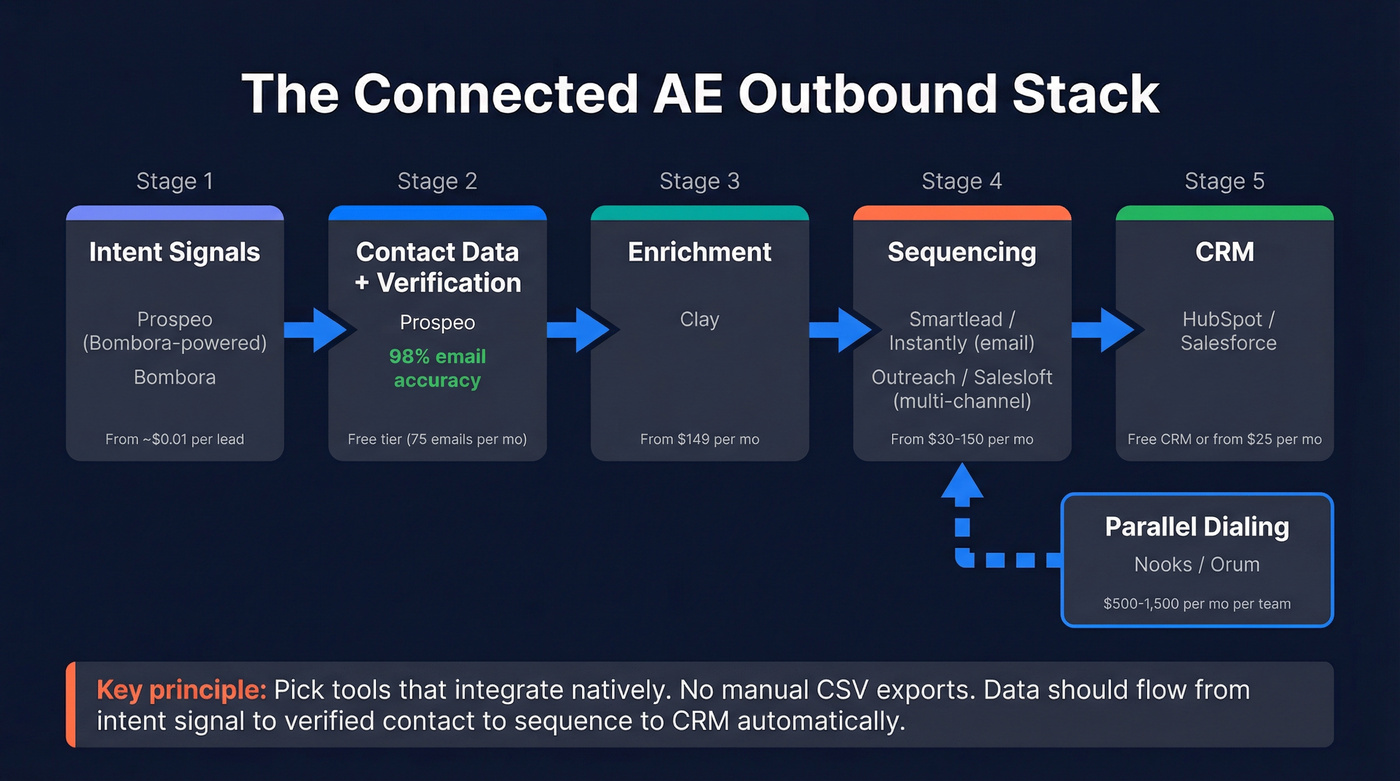
The connected stack approach matters more than any individual tool. Pick tools that integrate natively and let the data flow - from intent signal to verified contact to sequenced outreach to CRM, without manual exports at any step. The consensus on r/sales is that most AEs are over-tooled and under-integrated, and in our experience that's exactly right.
If you're rebuilding your workflow, start with a clean prospecting workflow and a simple outbound sales engine before you add more tools.
Layering intent signals on 30-50 focused accounts is the move - but only if you have the data to back it. Prospeo tracks 15,000 intent topics, flags job changes and headcount growth, and delivers verified emails and direct dials so every activity in your daily block actually connects.
Turn your 446 monthly activities into meetings, not bounces.
FAQ
How many hours a day should an AE prospect?
Minimum 1 hour per day when pipeline is healthy, increasing to 2-3 hours when coverage drops below 3x. Block golden hours (8am-3pm) for calls and outreach, push admin to after 3pm. Consistency matters more than marathon sessions - a daily 60-minute block beats a random 4-hour Thursday blitz every time.
What's a good self-sourced pipeline percentage?
Top-performing AEs self-source 30% or more of their total pipeline. If you're below 15%, you're over-reliant on inbound and SDRs - a risky position when marketing budgets get cut. Use the pipeline math framework above to reverse-engineer your specific activity targets.
How do I fix bad contact data before it kills my domain?
Verify every list before sending - no exceptions. Keep bounce rates under 2% and spam complaints under 0.3%. If your current bounce rate is above 5%, stop sending immediately, clean your list, and rebuild before scaling again. The damage from a torched domain takes months to undo, and some ESPs won't forgive you at all.
Can AEs self-source pipeline without SDR support?
Yes - full-cycle AEs routinely self-source 30-50% of pipeline using a daily prospecting block and a lean tool stack. The key is verified data (to avoid wasting time on bad contacts) and disciplined account prioritization. A sequencer, a parallel dialer, and a reliable data source give solo AEs enterprise-level prospecting infrastructure for under $200/month.