

Cold Calling Advice: One Framework, Three Scripts, Verified Numbers
It's 9:15 AM on a Tuesday. You've made 30 dials. Eight numbers were disconnected. Three went to someone who hasn't worked at that company in two years. You've had exactly one real conversation, and it lasted 14 seconds before "not interested, thanks."
That's not a calling problem - that's a data problem. Most cold calling advice skips the prerequisite that determines whether anything else matters: whether you're actually reaching real people at real numbers.
What You Need (Quick Version)
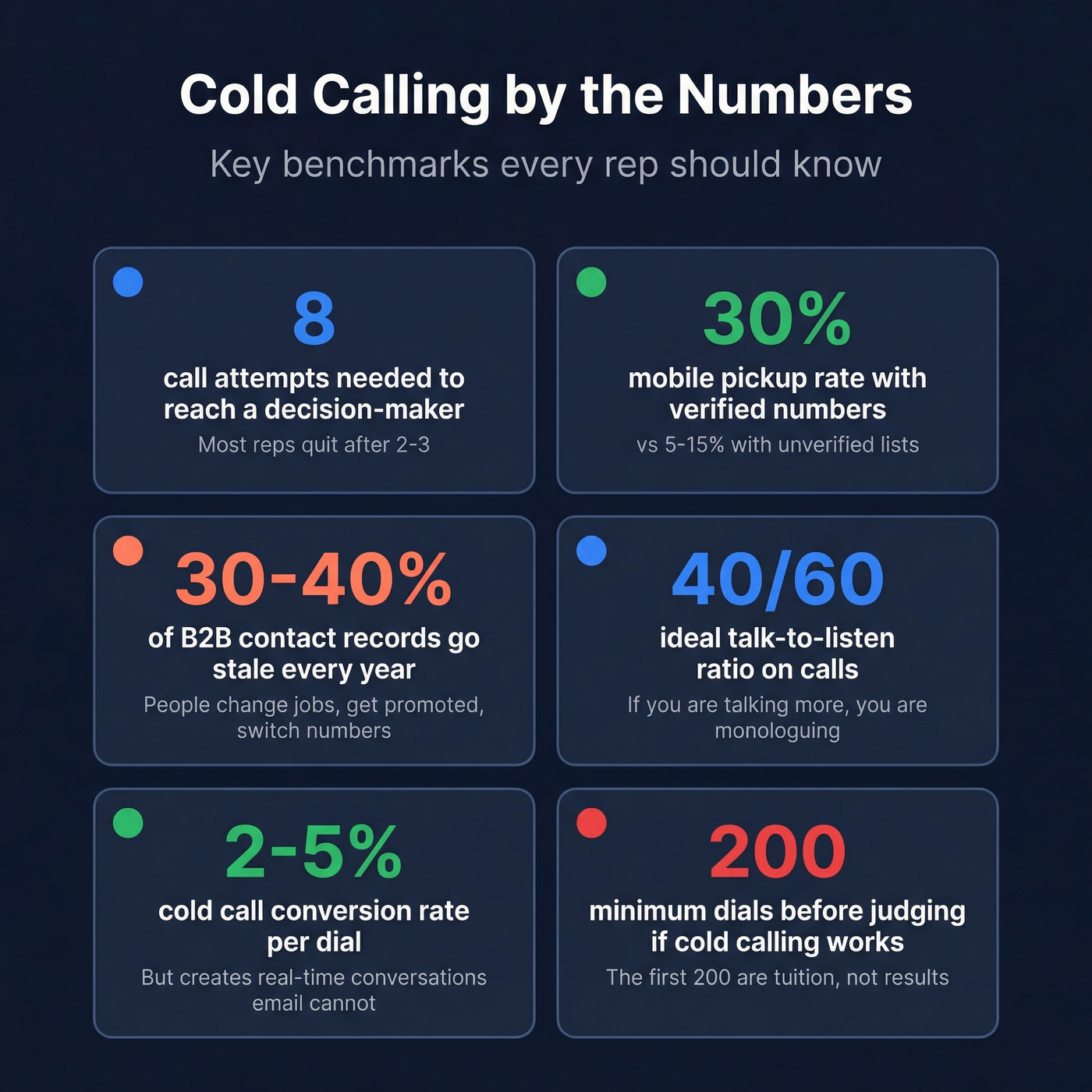
- Fix your data first. Bad numbers waste around 30% of your calling time. Verify mobiles before you dial.
- Use one framework, not 25 tips. Structure beats volume every time.
- Commit to 200 dials before you judge whether cold calling "works." The channel rewards reps and punishes tourists.
Cold calling converts at roughly 2-5% per dial, while cold email pulls 4-8% reply rates. But calls create real-time conversations that email can't replicate - and for complex B2B deals, that two-way exchange is where pipeline actually gets built. (If you're weighing channels, see cold email pulls 4-8% reply rates.)
Fix Your Data Before You Dial
B2B contact records go stale at around 30-40% per year. People change jobs, get promoted, switch numbers. If you're pulling a list from a database that refreshes every six weeks - or longer - you're burning roughly a third of your call block on dead numbers before you open your mouth. (More on benchmarks and fixes in go stale at around 30-40% per year.)
When Meritt switched to Prospeo's verified mobile database, their connect rate tripled to 20-25% and their bounce rate dropped from 35% to under 4%. That's not a marginal improvement - it's the difference between a productive call block and an hour of listening to "the number you've dialed is no longer in service."
A 30% mobile pickup rate means about one in three dials actually rings a human. Compare that to the 5-15% connect rates teams often see with unverified lists. You don't need better scripts if nobody's picking up the phone. (If you're troubleshooting list issues, start with unverified lists.)
Best Days and Times to Call
Not all hours are created equal. ZoomInfo analyzed 1.4M+ outbound calls and the patterns are clear.
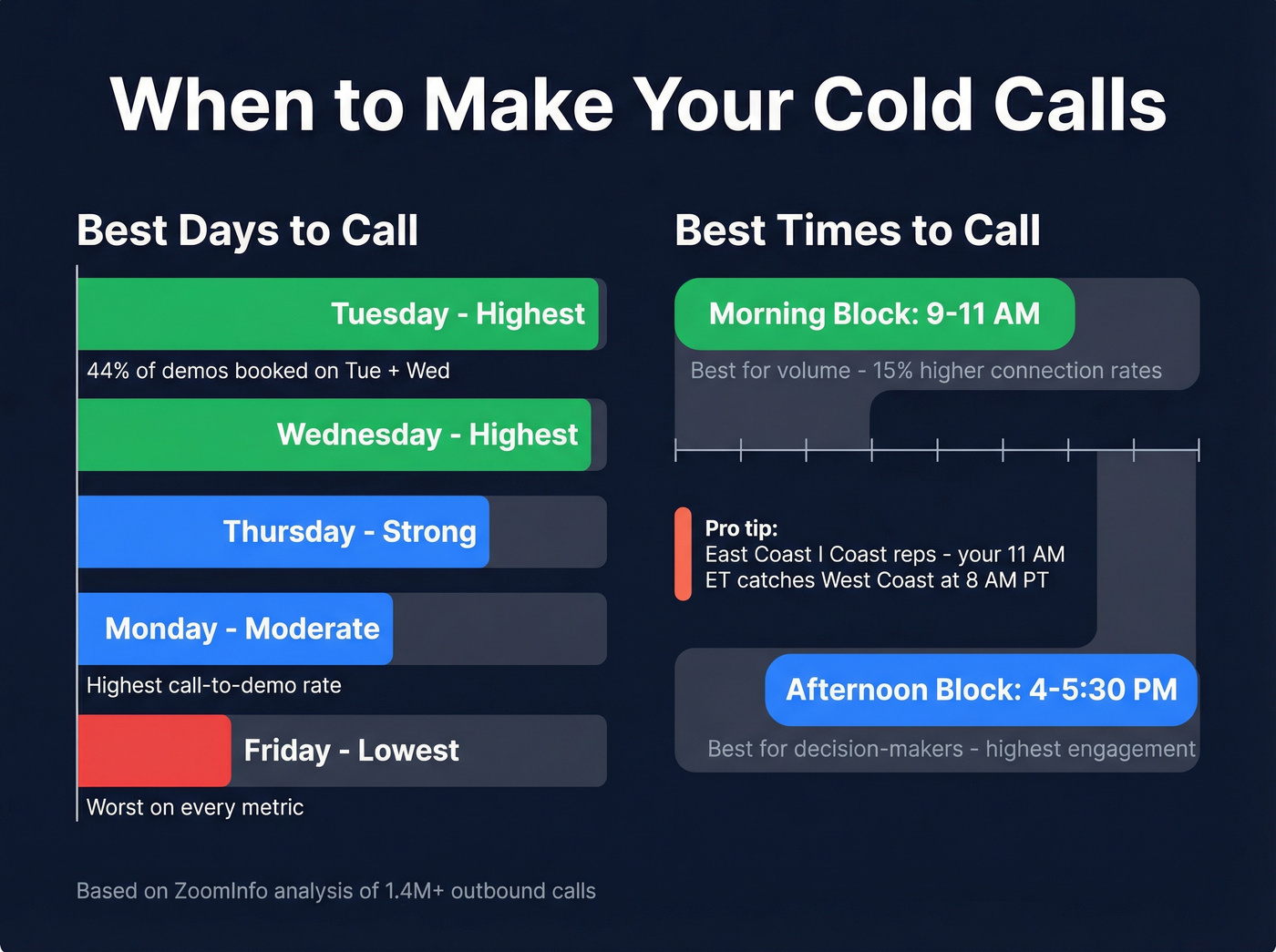
| Day | Relative Performance | Notes |
|---|---|---|
| Tuesday | Highest | Best overall volume + demos |
| Wednesday | Highest | Tied with Tuesday |
| Thursday | Strong | Slightly lower conversion |
| Monday | Moderate | Highest call-to-demo rate |
| Friday | Lowest | Worst on every metric |
Tuesday and Wednesday together drive roughly 44% of total demos booked. Friday performs worst on every metric - connection rate, demo volume, positive call rate. If you're making Friday your heavy dial day, stop. Save it for admin and follow-ups.
For time-of-day, the data splits into two camps. Revenue.io's analysis found that 8-11 AM in the prospect's local time boosts connection rates by about 15%. But their own internal 90-day study showed decision-makers were most likely to engage between 4-5 PM.
Here's what we recommend: run two call blocks. Morning block from 9-11 AM for volume, late-afternoon block from 4-5:30 PM for decision-makers who've cleared their calendars. If you're East Coast calling West Coast, your 11 AM ET start catches them at 8 AM PT - right in the sweet spot. For afternoon blocks, start around 4 PM ET to reach them at 1 PM PT.
The 5-Stage Cold Call Framework
You don't need 25 tips. You need a repeatable framework that works in under three minutes. (If you want a step-by-step version, use this repeatable framework.)
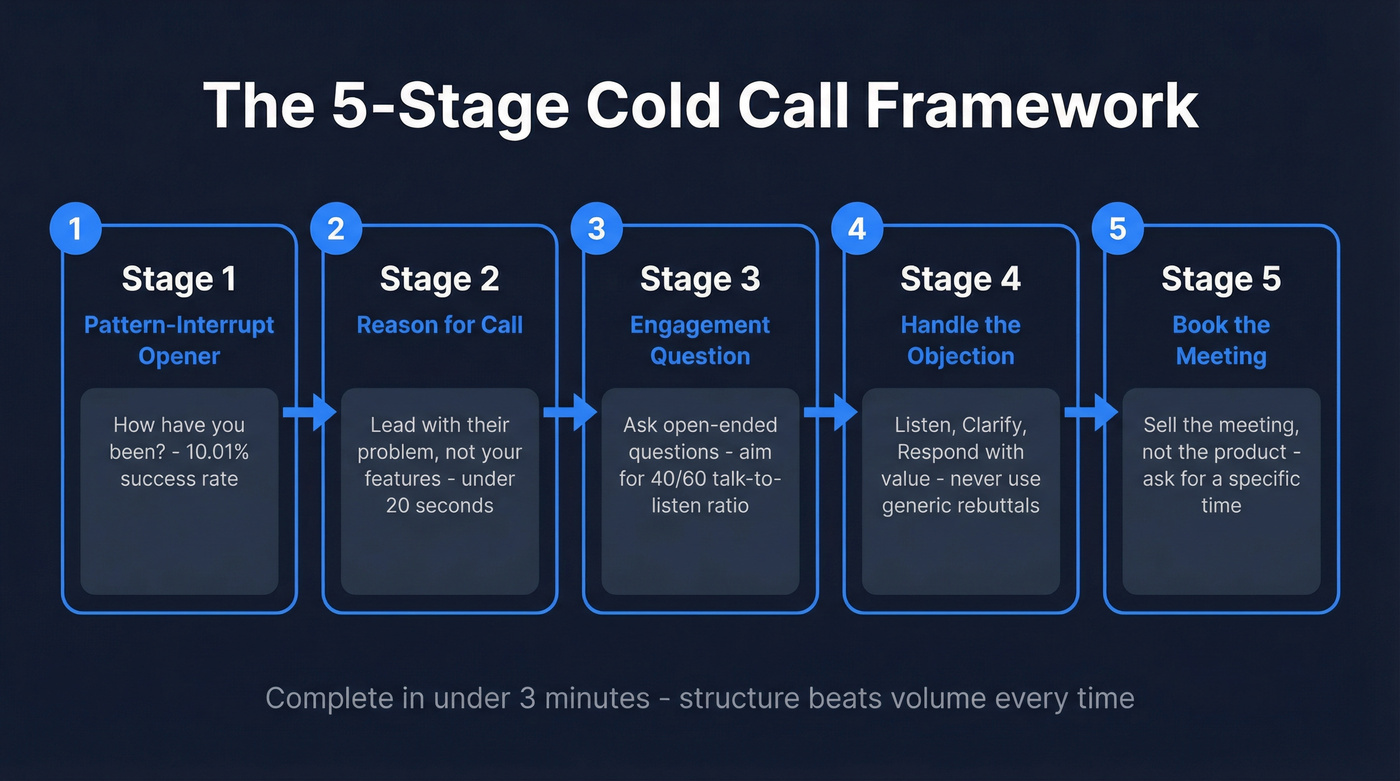
Stage 1: Pattern-Interrupt Opener
The first five seconds determine everything. Gong's analysis of 90,380 cold calls found that "How have you been?" delivered a 10.01% success rate - 6.6x higher than baseline - even on first-time interactions. It breaks the pattern. The prospect expects "Hi, this is Jake from SaaS Corp, do you have a minute?" and instead gets something that sounds like a conversation between people who've already met.
Try this: "Hey [First Name], it's [Your Name] with [Company]. How've you been?"
Or borrow Allego's pattern-interrupt approach: "Can I have 27 seconds to explain why I've decided to call today?" The oddly precise number signals confidence and earns curiosity.
Avoid at all costs: "Did I catch you at a bad time?" That one clocked a 0.9% success rate. It's 40% less likely to book a meeting than saying almost anything else.
Stage 2: Reason for Call
Once you've bought a few seconds of attention, give them a problem-led reason for calling - not a feature dump. Lead with a problem the prospect recognizes, then bridge to how you help.
"The reason I'm calling - we're working with companies like [theirs] who were spending [X hours/dollars] on [problem]. I wanted to see if that's on your radar too."
Keep it under 20 seconds. You're earning the right to ask a question, not delivering a pitch.
Stage 3: Engagement Question
This is where most reps fail. They pitch instead of asking. Aim for a 40/60 talk-to-listen ratio - you talk less than 40% of the time. Ask an open-ended question that gets the prospect talking about their situation: "How are you currently handling [that process]?" or "What's your biggest challenge with [area] right now?" (For a swipe file, use these open-ended question.)
If they're talking, you're winning. If you're talking, you're losing.
Stage 4: Handle the Objection
Objections aren't rejection - they're engagement. Use a three-step response: Listen (let them finish), Clarify (paraphrase to confirm you understood), Respond with value (address the concern, not a generic rebuttal). (More examples in Objections.)
After "We're not looking right now": "Totally fair. Just so I understand - is the timing off, or is [that area] not a priority this quarter?"
The clarifying question shows respect and often reveals the real objection hiding behind the polite one.
Stage 5: Book the Meeting
Sell the meeting, not the product. You're not closing a deal on a cold call - you're earning 20 minutes on their calendar. (If you want more meeting-ask variations, see Book the Meeting.)
"Would Thursday at 2 PM work for a quick 20-minute call to walk through how we helped [similar company] with this?"
Ask for a defined time, not a vague "sometime next week." It converts better because it reduces decision fatigue - the prospect says yes or suggests an alternative, and either way you're moving forward.

Your cold calling framework won't matter if 30% of your numbers are dead. Prospeo's 125M+ verified mobile database refreshes every 7 days - not every 6 weeks - so you reach real people at real numbers. Teams using Prospeo see 30% pickup rates and bounce rates under 4%.
Stop burning call blocks on disconnected numbers. Fix your data first.
Scripts for Every Scenario
Decision-Maker Opener
"Hey [First Name], it's [Your Name] with [Company]. How've you been? [Pause] The reason I'm calling - we've been helping [2-3 similar companies] cut their [metric] by [result]. I wanted to see if [problem] is something your team's dealing with too."
Keep the pause after the opener. Let them respond. Don't steamroll into your pitch.
Gatekeeper Script
Gatekeepers aren't obstacles - they're allies if you treat them right. Pipedrive's approach works: ask for help, learn their name, collaborate. (If you need more language options, see Gatekeepers.)
"Hi, this is [Your Name] with [Company]. I'm trying to reach [Decision Maker] - could you help me figure out the best way to make that happen?"
Learn the gatekeeper's name and use it. "Thanks, Sarah - I appreciate the help" goes further than any clever trick. Better yet, pull verified direct dials before the call and bypass the switchboard entirely.
The 30-Second Voicemail
If it takes longer than 30 seconds, you've lost them. State your name, one clear reason tied to their role, and your callback number - twice. (More options here: 30-Second Voicemail.)
"Hi [First Name], it's [Your Name] with [Company], [phone number]. I'm calling because [one-sentence reason]. I'll try you again [day] - or reach me at [phone number]. Again, [phone number]."
Think of this like a cold email: short, relevant, actionable.
Turning "Send Me an Email" Into a Conversation
This is the polite brush-off. Don't fight it - pivot.
Before (dead end): "Sure, what's your email?" You send a generic PDF. Silence forever.
After (qualifying pivot): "Absolutely, I'll send that over. Before I do - quick question so I can make it relevant: are you currently using [competitor/process] for [function], or handling it differently?"
You've just turned a dead end into a qualifying conversation. Even a five-word answer gives you intel for the follow-up email.
Opener Success Rates
Here's what Gong's 90,380-call dataset tells us about openers.
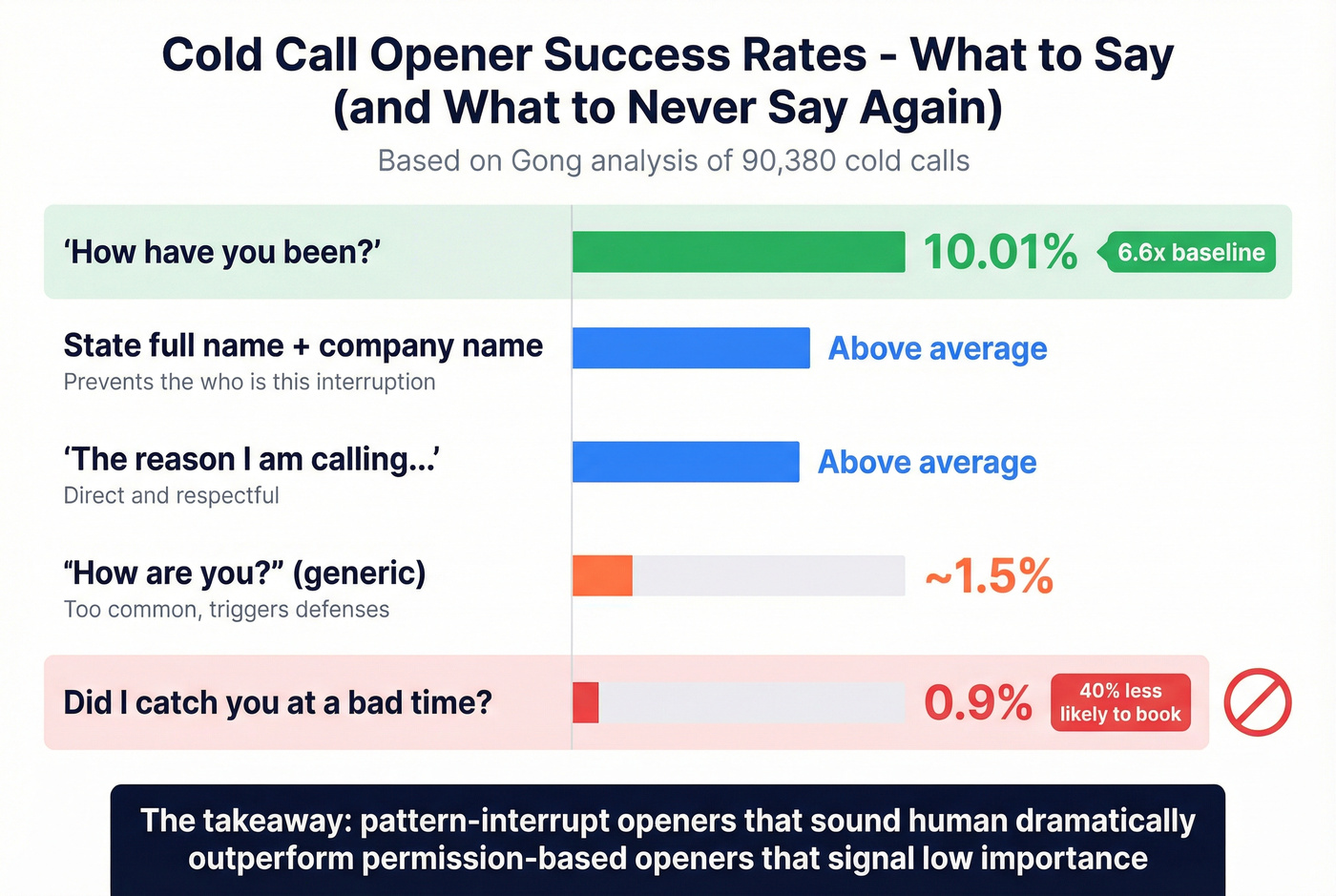
| Opener | Success Rate | Notes |
|---|---|---|
| "How have you been?" | 10.01% | 6.6x baseline |
| State full name + company | Above average | Maintains call control |
| "The reason I'm calling..." | Above average | Direct, respectful |
| Generic "How are you?" | ~1.5% | Too common, triggers defenses |
| "Did I catch you at a bad time?" | 0.9% | 40% less likely to book |
The data is unambiguous. Permission-based openers signal low importance and give the prospect an easy exit. Stating your full name and company early prevents the "who is this?" interruption that immediately puts you on the defensive.
Let's be honest: "Did I catch you at a bad time?" needs to die. Every rep who uses it is actively sabotaging their own numbers.
Lessons From the First 200 Dials
The first 200 dials are tuition, not results. We've seen this pattern repeatedly - reps who quit before 200 dials never get past the learning curve. Here's what separates the reps who survive from the ones who don't. (If you're building a full system, start with first 200 dials.)
Skipping pre-call research. Spend five minutes per prospect before you dial. Check their company news, recent role changes, and tech stack. Five minutes of research beats five minutes of fumbling through a generic pitch. Hyperbound's framework calls this the "5-minute research rule," and it's the single easiest way to improve your conversations. (Use this five minutes per prospect.)
Pitching too early. You haven't earned the right to pitch in the first 30 seconds. Lead with a problem, not a product. The prospect needs to recognize their own pain before your solution means anything.
Talking more than listening. If you're above a 40/60 talk-to-listen ratio, you're monologuing, not selling. Ask questions. Let silence do the work.
Giving up too soon. It takes roughly 8 call attempts to reach a decision-maker. Most reps quit after 2-3. Persistence wins.
Mistaking politeness for interest. "That sounds interesting, send me some info" isn't interest. It's a polite exit. Qualify before you celebrate.
The Objection Handling Playbook
Every objection follows three steps: listen, clarify, respond with value. Memorize the framework, not the scripts.
"Not interested." Don't argue - redirect. "Totally understand. Could I get 90 seconds to share one thing we helped [similar company] with? If it's not relevant, I'll hang up."
"No budget." Acknowledge, then reframe. "Makes sense - most teams we work with didn't have budget allocated either. They found it after they saw [ROI metric]. Would 15 minutes be worth exploring the numbers?"
"We already use [competitor]." Curiosity beats confrontation. "How's that working for you? [Pause] A lot of teams using [competitor] have told us [gap]. Have you run into that?"
"Call me back later." Pin it down. "Absolutely. Would next Tuesday at 10 AM work, or is Thursday afternoon better?" Vague "later" means never.
"I'm not the right person." Turn it into a referral. "No problem. Who on your team handles [area]? I want to make sure I'm reaching the right person."
After the Call: Follow-Up That Converts
The call ended. Now what?
Follow up within 24 hours. Call, then email the same day, then call again two days later. The prospect will forget you by Wednesday if you called on Monday.
Log every disposition in your CRM. Connected, voicemail, wrong number, callback scheduled. This data is how you optimize over time. (If your data is messy, fix it with your CRM.)
Scrub for compliance. If you're calling into the US, respect TCPA rules and check DNC lists. For EMEA prospects, GDPR applies - follow your legal team's guidance and document your lawful basis.
Here's a frustration I hear constantly from SDR managers: their team is making 100+ dials a day with garbage data, then wondering why pipeline isn't moving. If your average deal size is under $15K, you probably don't need 100 dials a day. You need 40 dials to verified numbers with strong pre-call research. Volume-first dialing is a strategy for teams with cheap data and expensive time. Flip that equation - invest in accurate data, reduce dials, increase conversations - and the ROI math changes completely.
Meritt tripled their connect rate to 20-25% and grew pipeline from $100K to $300K/week after switching to Prospeo's verified mobiles. At $0.10 per number, you pay only when a verified mobile is found. No contracts, no sales calls - just numbers that actually ring.
One in three dials reaches a human. Start dialing numbers worth your time.
FAQ
How many cold calls should I make per day?
Full-time SDRs should target 60-100 dials per day - enough volume for meaningful conversations while leaving time for research and follow-up. Once your connect rate exceeds 10%, shift toward quality: better pre-call research, tighter scripts, more personalized openers.
What's a good cold call connect rate?
Industry average sits at 5-15%. Above 20% means your data is strong. Below 5%, list quality is the bottleneck - not technique.
Is cold calling still effective in 2026?
Yes. Roughly 2-5% of cold calls convert to meetings, and the channel rewards preparation and clean data disproportionately. Teams with verified numbers and structured frameworks consistently outperform the averages. Bad calling is dead; disciplined outreach is thriving.
Should I use a script or wing it?
Use a framework with flexible scripts. Never read verbatim - prospects can hear it. Never improvise without structure - you'll ramble and lose control. The five-stage framework above gives you guardrails without a straitjacket.
What's the best day to cold call?
Tuesday and Wednesday drive roughly 44% of demos per ZoomInfo's 1.4M-call study. Thursday is solid. Monday has the highest call-to-demo efficiency but lower volume. Friday is worst on every metric - save it for admin and follow-ups.