Cold Call Voicemail Scripts That Actually Work (According to 300M+ Calls)
You just left your fifteenth voicemail today - the same one you used yesterday. Nobody called back. Here's the thing: that's not a script problem. It's a strategy problem. A 300M+ cold call analysis from Gong found something most reps get wrong: voicemails don't generate callbacks. They double your email reply rates. Once you internalize that shift, everything about your cold call voicemail script changes.
The Quick Version
Here's the entire playbook:
- Two voicemail scripts - first touch at 15 seconds, second touch at 30 seconds
- Stop at two voicemails per prospect (three or more actually hurts you)
- Queue a follow-up email within 60 seconds of every voicemail you leave
- Verified phone numbers - leaving messages on disconnected lines is dead time (see phone data accuracy)
That's it. The rest of this article is the data behind it, the script examples, and the mistakes that'll tank your results.
Why Voicemails Work (But Not How You Think)
Roughly 80% of cold dials hit voicemail. That's not a bug - it's the reality of outbound in 2026. And 75% of Americans won't pick up if they don't recognize the number.
Fighting that reality wastes time. Working with it is where the results are.
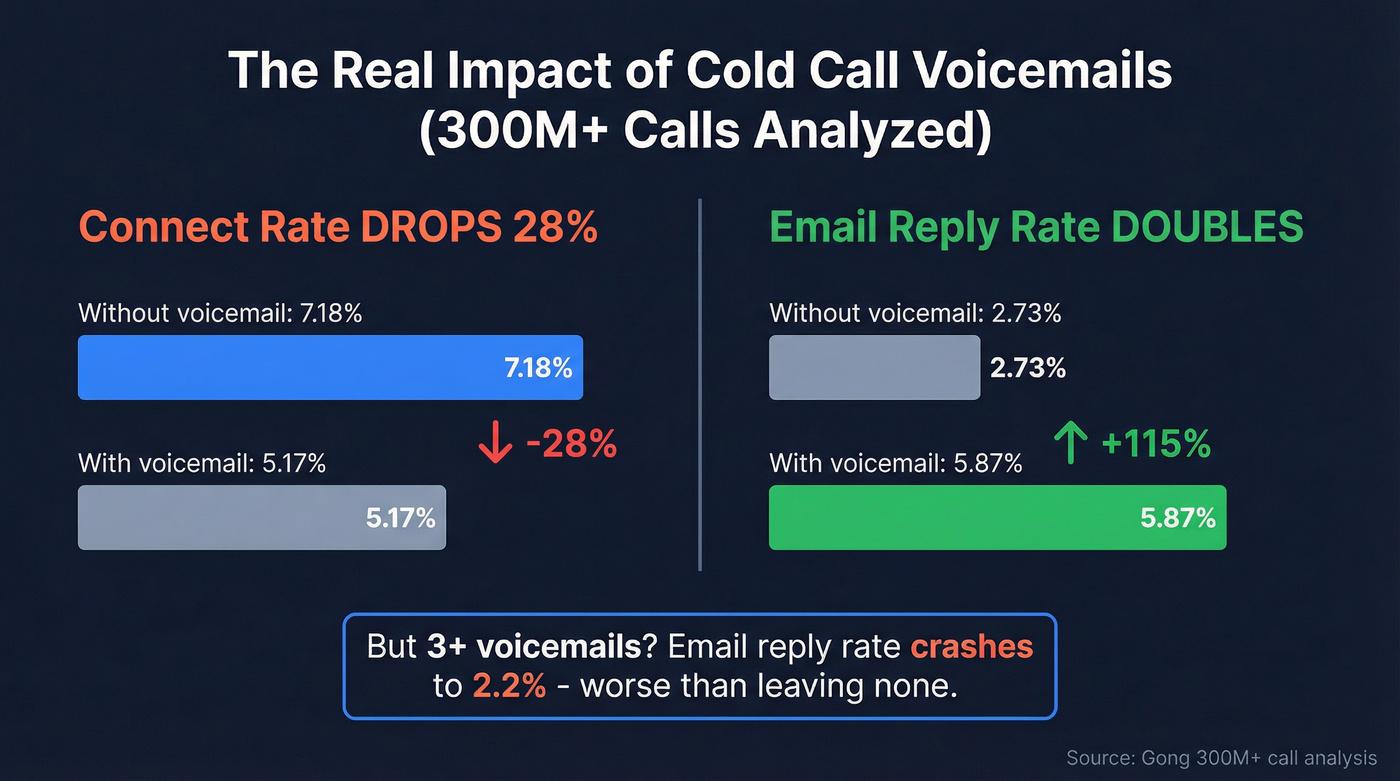
The 300M-call dataset tells the real story. Leaving a voicemail actually reduced future connect rates by 28% (5.17% vs. 7.18% without voicemails). But it more than doubled email reply rates - from 2.73% to 5.87%. The voicemail primes the prospect to recognize your name when your email lands. That's the mechanism, and it matters more at the top of the org chart: 57% of C-level executives and VPs prefer phone contact, so even if they don't pick up, they're listening.
Here's the catch: this only works with one or two voicemails. Three or more drops your email reply rate to 2.2% - worse than leaving none at all. And in the time it takes to leave a voicemail, you could make 25% more dials. Every message you leave needs to earn its spot.
Six Cold Call Voicemail Scripts for Every Scenario
First Touch (15 Seconds)
"Hi [Name], it's [Your Name] from [Company]. I'm reaching out because [one-line reason tied to their role or company]. I'm sending you an email about [specific topic] - take a look when you get a chance."
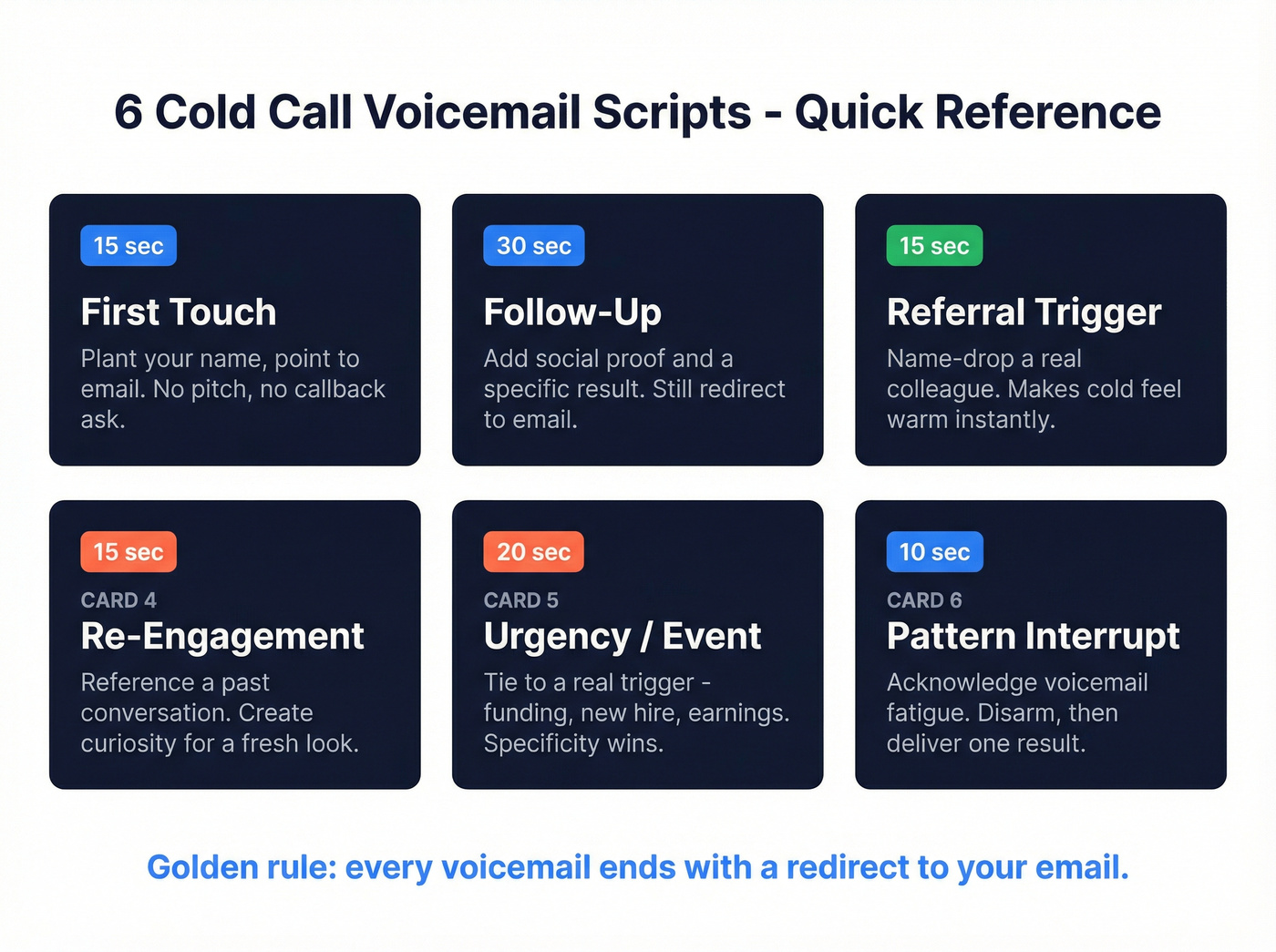
No pitch. No callback request. Your only job is to plant your name and point them to the email. Fifteen seconds, then hang up. (If you need the bigger picture, start with a full B2B cold calling guide.)
Follow-Up (30 Seconds)
"Hey [Name], [Your Name] from [Company] again. We helped [similar company or role] [specific result - e.g., cut their bounce rate from 35% to under 4%]. I sent you an email last [day] with some details on how that'd work for [their company]. Worth a quick look - I'll follow up there."
This one earns the extra fifteen seconds by adding social proof. Still no ask for a callback. The email does the heavy lifting (and your sales email structure matters more than most reps think).
Referral Trigger
"Hi [Name], [Your Name] from [Company]. [Colleague's name] on your team suggested I reach out - I'm sending you a quick email with context. Appreciate a look when you have a minute."
Name-dropping a real colleague is one of the fastest ways to make a cold message feel warm. Keep it short, redirect to email. (You can also pair this with a referral introduction email.)
Re-Engagement
"Hey [Name], [Your Name] from [Company]. We spoke back in [month] about [topic]. Things have changed on our end - I'm sending a quick update to your inbox. Worth a fresh look."
Reference the previous interaction immediately. Don't rehash the whole conversation. Just create enough curiosity to drive an email open (use these re-engagement email subject lines to boost opens).
Urgency / Event-Based
"Hi [Name], [Your Name] from [Company]. Saw [trigger - e.g., your Series B announcement / the new VP Sales hire / Q3 earnings]. That usually means [relevant implication]. Sending you a short email on it - timely for this week."
Trigger-based voicemails work because they signal you've done homework. We've found that tying urgency to something real and time-bound - a funding round, a leadership change, a product launch - outperforms generic "just checking in" messages by a wide margin. Specificity beats vague every time. (If you want a system for this, build around signal-based outbound.)
The Pattern Interrupt
"Hey [Name], [Your Name] from [Company]. I know - another voicemail. I'll keep it to ten seconds. [One sentence about a specific result you drove for a similar company.] Details in your inbox."
Acknowledging the voicemail fatigue disarms the prospect. Keep it tight, then push them to the email.

You just read it: teams waste 30%+ of dial time on disconnected lines. Prospeo gives you 125M+ verified mobile numbers with a 30% pickup rate - so every voicemail you leave actually reaches a real person's inbox. At $0.10 per mobile, you pay only when a number is found.
Stop leaving voicemails on dead lines. Start with verified direct dials.
Mistakes That Kill Your Results
Pitching in the voicemail. The moment you start describing features, you've lost them. The voicemail is a trailer, not the movie. Save the pitch for the email or the live conversation (avoid the classic pitch slap).
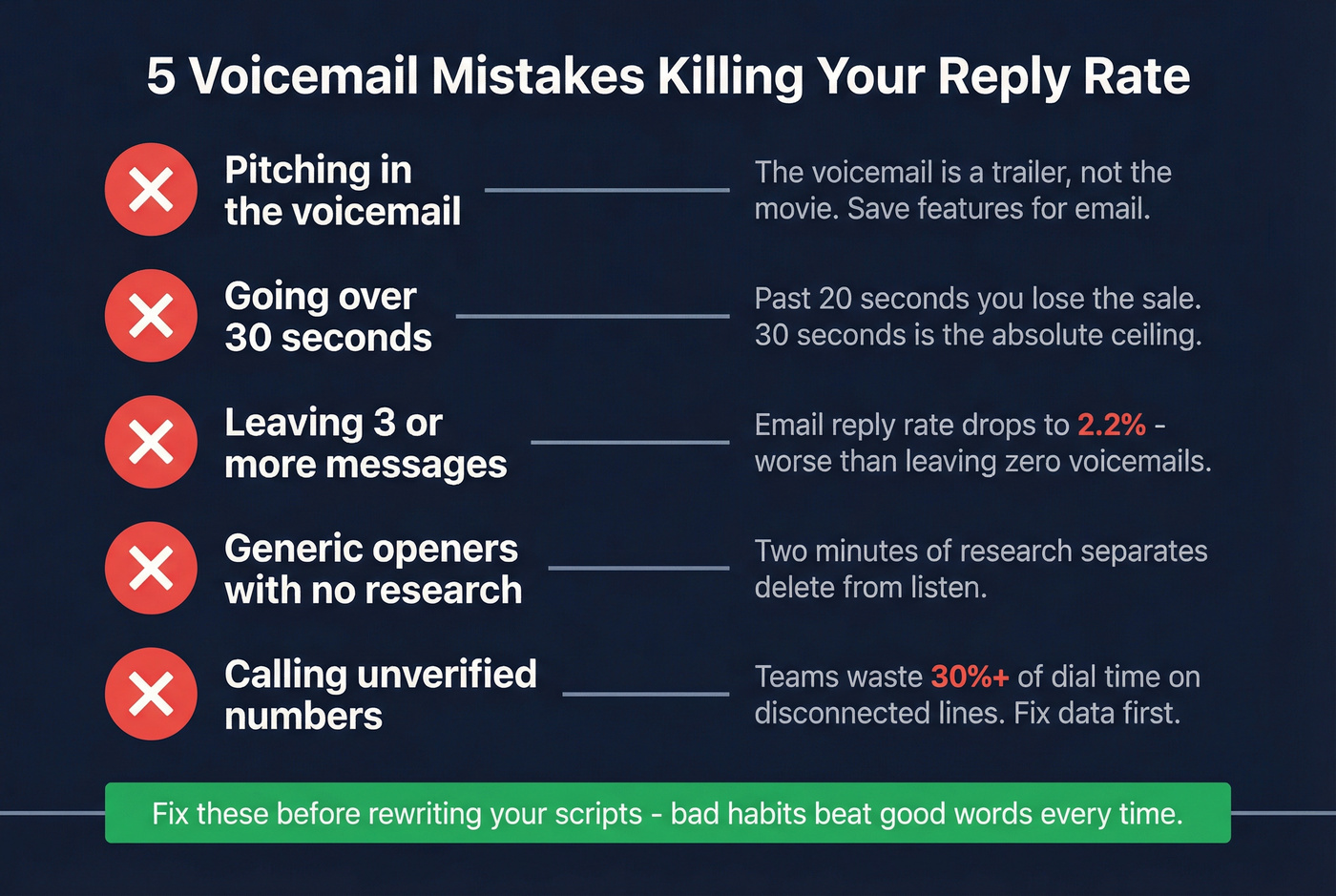
Going over 30 seconds. Cognism's guidance is blunt: keep your message under 20 seconds, and past that you lose the sale. Even on your second voicemail, cap it at 30 seconds absolute max.
Leaving three or more messages. Your email reply rate drops to 2.2% - worse than never leaving a voicemail. The 300M-call study is unambiguous on this. Two is the ceiling. Period.
Generic openers with no research. "I'm calling because I think we could help your business" tells the prospect you know nothing about them. Two minutes of research - their role, a recent company trigger, a mutual connection - separates delete from listen (use a pre call research checklist).
Calling unverified numbers. Look, your scripts don't matter if the number is wrong. In our experience, teams waste 30% or more of their dial time on disconnected lines. Bad phone data is the silent killer of outbound productivity - fix it before you fix your scripts. (Start with what a direct dial actually is and how teams source it.)
Best Practices for 2026
Write for the eye, not just the ear. iOS 26's live voicemail transcription means prospects read your message in real time before deciding whether to pick up. Speak clearly, use short sentences, and front-load your name and reason for calling.
Dial Tuesday through Thursday. Late morning and late afternoon windows consistently outperform other time slots. Monday is priority-setting day; Friday is checkout day.
Use a framework, not a word-for-word script. Robotic delivery kills trust. Know your structure - name, reason, redirect to email - but let the words flow naturally each time. A/B test two variations for a week, then kill the loser. (If you want to go deeper, dial in cold call tonality.)
Send your email within 60 seconds of hanging up. The double tap works because the voicemail and email arrive as a pair. If your email lands three hours later, the priming effect is gone (this is also why SDR follow-up strategy matters).
Consider voicemail drops for scale. Pre-recorded voicemail drop tools let you one-click deploy your message, cutting per-voicemail time to seconds. Test whether your prospects respond differently to drops vs. live voicemails - authenticity matters, but so does volume.
Where Voicemail Fits in Your Cadence
Voicemail isn't a standalone tactic - it's one touch inside a 15-21 day cadence that includes 3-5 call attempts, emails, and social touches. Multi-channel outreach drives results up to 287% higher than single-channel campaigns.
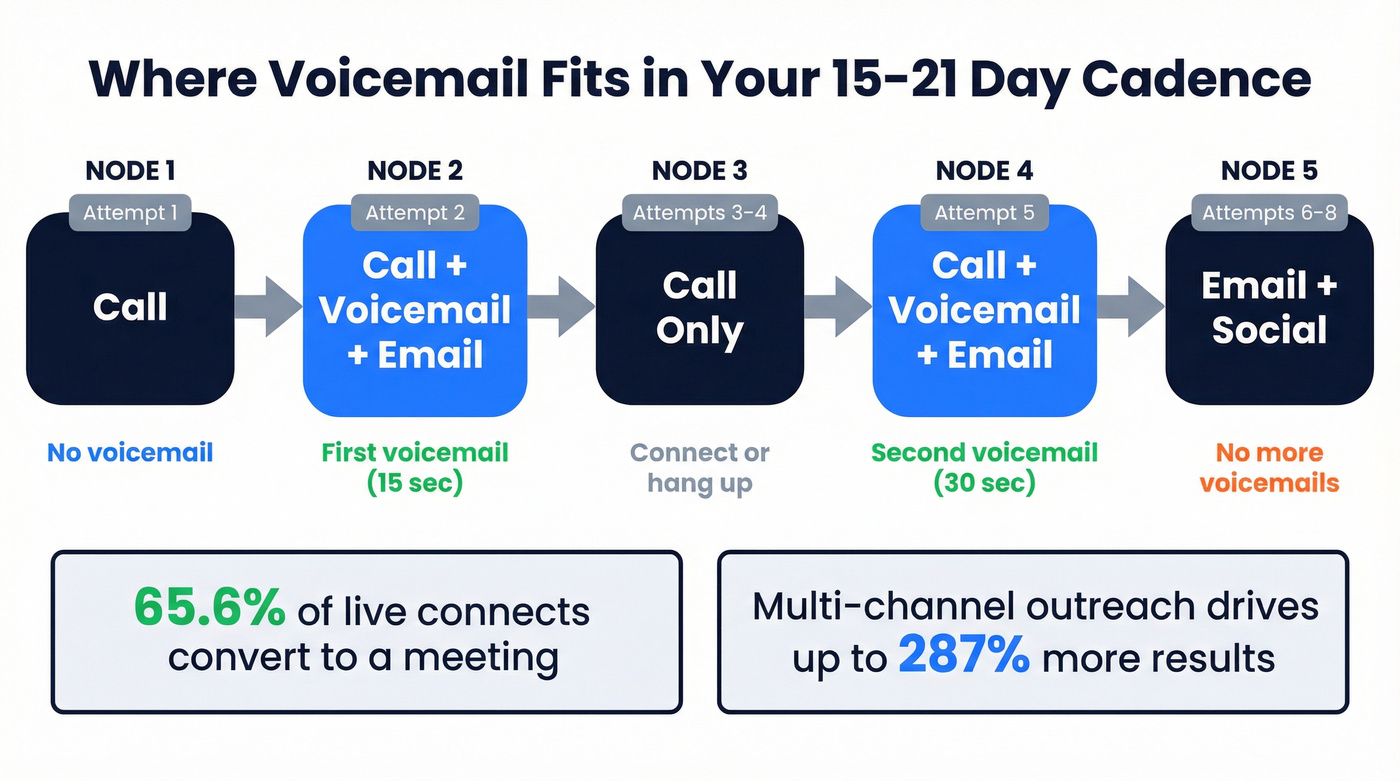
The cadence math is simple. Aim for 6-8 total touches across channels:
- Attempt #1: Call, no voicemail
- Attempt #2: Call + voicemail + email
- Attempt #5: Call + voicemail + email
Everything else is calls where you either connect live or hang up and move on. When you do connect, 65.6% of those conversations convert to a meeting or meaningful next step - which is why the cadence math matters so much.
Let's be honest: most teams over-invest in perfecting their cold call voicemail script and under-invest in the data feeding their dialer. If your connect rate is below 5%, the problem isn't your words - it's your numbers. One of our team members ran an experiment last quarter where they swapped nothing but the phone data source for a mid-market SDR team. Same reps, same scripts, same cadence. Connect rate went from 4.8% to 14%. The scripts were never the bottleneck.
TCPA Compliance in 2026
TCPA litigation is up nearly 95% year-over-year. One violation in Connecticut can cost $20,000.
The basics: call only between 8 AM-9 PM local time (Connecticut restricts to 9 AM-8 PM), honor text opt-outs immediately, and never use AI-generated voices without prior written consent. Virginia SB 1339 requires honoring text opt-outs for 10 years, and cross-channel revocation effects took full effect in April 2026. Build your calling windows into your dialer settings and keep opt-out lists current. Skip this section at your own risk - the fines aren't theoretical anymore.
The double tap only works if your follow-up email lands. Prospeo's 98% email accuracy means your voicemail-to-email sequence hits real inboxes - not bounces that torch your domain. 143M+ verified emails, refreshed every 7 days.
Nail the voicemail. Nail the email. Never bounce again.
FAQ
How long should a cold call voicemail be?
First voicemail: 15 seconds max - your name, company, reason, and "check your email." Second voicemail: up to 30 seconds with social proof added. The 300M-call study found these lengths maximize the email reply rate that voicemails are actually designed to drive.
How many voicemails should you leave one prospect?
Two, maximum. One to two voicemails double email reply rates (2.73% to 5.87%), but three or more drops the rate to 2.2% - worse than leaving none. After two, switch to email and social touches only.
What should you say in a voicemail to a C-level executive?
Lead with their name and a specific trigger - a recent earnings call, a new hire, a funding round. C-level buyers prefer phone contact but they're the most time-pressed. Keep it under 15 seconds, skip the pitch entirely, and redirect to a concise email. The referral trigger script works especially well here: mentioning someone on their team by name gets past the mental spam filter fast.
How do you avoid calling bad numbers?
Use a verified mobile database before loading numbers into your dialer. Bad data wastes 30%+ of dial time, and fixing it has a bigger impact than rewriting your scripts. Look for providers that refresh data weekly rather than monthly - stale numbers are almost as bad as wrong ones.