
BriteVerify vs ZeroBounce: Which Email Verifier Is Worth It?
Two verification tools, both offering bulk upload, API access, and real-time checks. On the surface they look interchangeable. They're not.
We've spent time digging into both platforms - testing features, comparing pricing structures, and reading through hundreds of user reviews - and the gap between BriteVerify and ZeroBounce is wider than most people expect. Let's break it down.
30-Second Verdict
Pick ZeroBounce if you need catch-all scoring, a deliverability toolkit (warmup, DMARC, blacklist monitoring), and a free tier to test with. It's the more complete product.
Pick BriteVerify if you're embedded in the Validity ecosystem and want dead-simple verification at the point of entry - web forms, landing pages, mobile devices, POS systems.
Skip both if your real problem is finding contacts, not just verifying ones you already have. Prospeo finds and verifies emails in a single workflow, solving the upstream problem neither tool touches.
ZeroBounce carries a 4.7/5 on G2 from 1,361 reviews. BriteVerify sits at 4.2/5 from 74. That's not a rounding error.
Feature Comparison
| Feature | BriteVerify | ZeroBounce |
|---|---|---|
| Parent Company | Validity | ZeroBounce |
| G2 Rating | 4.2/5 (74 reviews) | 4.7/5 (1,361 reviews) |
| TrustRadius | 8.0/10 | 9.0/10 |
| Catch-All Handling | Domain-level "Accept All" flag | AI Scoring (QS 0-10) |
| Spam Trap / Risk Intel | No | Yes (scoring + deliverability tooling) |
| Free Tier | None | 100 credits/mo |
| Credit Expiry | 1 year | Never |
| Email Warmup | No | Yes (ZeroBounce ONE) |
| DMARC Monitoring | No | Yes (ZeroBounce ONE) |
| Email Finder | No | Yes (included; usage limits apply) |
| API | Simple; one reviewer notes "only 4 responses" | Validation + add-ons like AI Scoring |
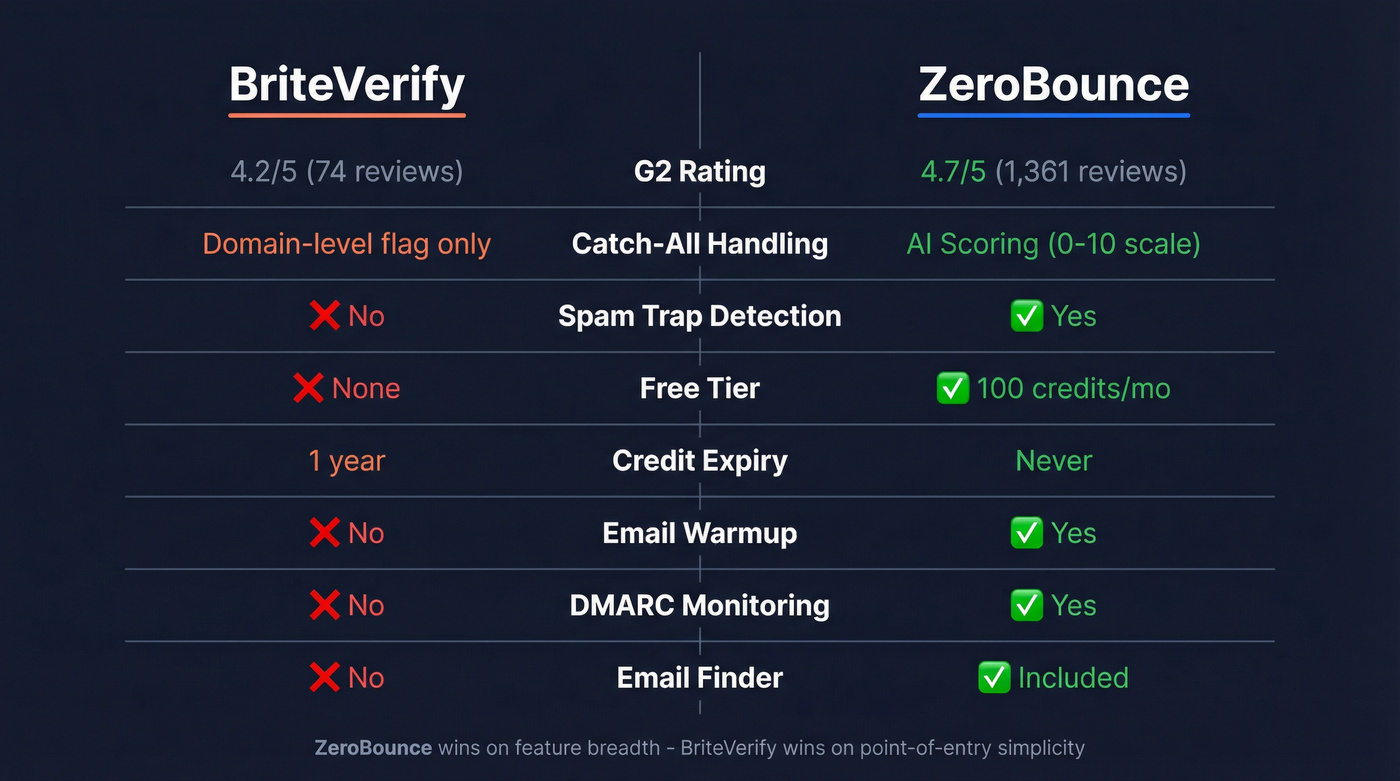
ZeroBounce wins on feature breadth. BriteVerify wins on point-of-entry simplicity - it's built to plug into data-collection points so you can block bad emails before they hit your CRM.
One detail worth flagging: ZeroBounce skews heavily toward small business users (69.1% of G2 reviews), while BriteVerify is at 53.4%. If you're an SMB, ZeroBounce is the more battle-tested option for companies your size.
Pricing
| BriteVerify | ZeroBounce (PAYG) | ZeroBounce ONE | |
|---|---|---|---|
| Cost / 10k emails | $80-$100 | $60-$80 | ~$40 per 10k (based on $99/mo for 25k credits) |
| Free tier | None | 100/mo | N/A |
| Credit expiry | 1 year | Never | Never |
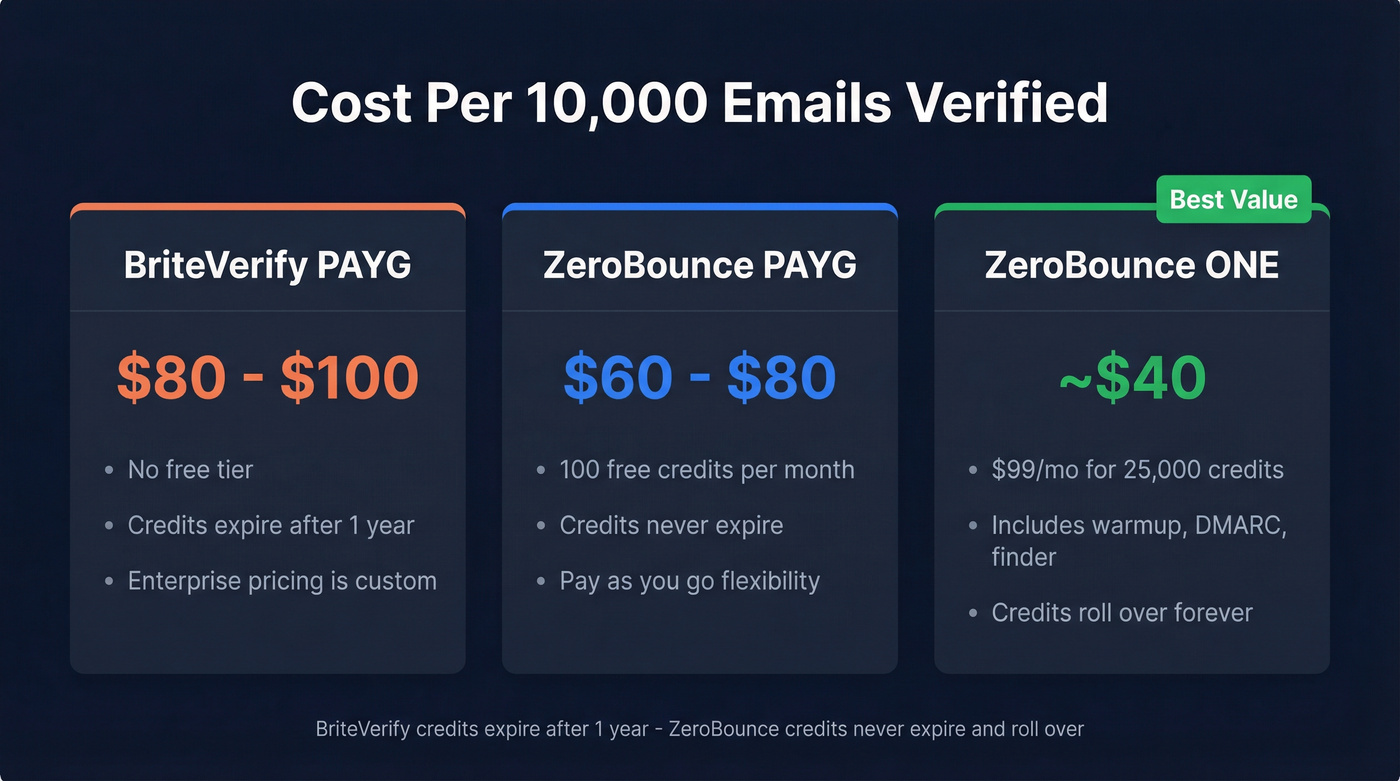
BriteVerify's pay-as-you-go runs $0.008-$0.01 per email, putting 10,000 verifications in the $80-$100 range. Enterprise pricing is custom.
ZeroBounce ONE is the better deal for teams verifying consistently. At $99/mo (or $79/mo annually), you get 25,000 validation credits plus warmup, DMARC monitoring, blacklist monitoring, inbox placement testing, email server testing, and an Email Finder with monthly quotas including 10,000 domain searches. Before this bundle existed, 25,000 credits alone cost $175/mo.
Here's the thing: BriteVerify credits expire after one year. ZeroBounce credits never expire and roll over. If your team verifies in bursts - cleaning a list before a quarterly campaign, say - that expiry policy quietly burns budget.
Catch-All Handling
This is where ZeroBounce pulls ahead in a way that matters day-to-day. Catch-all domains accept mail for any address, valid or not, which means standard SMTP checks can't tell you whether john@catchall-domain.com is a real person or a black hole.

BriteVerify returns a domain-level "Accept All" flag. You know the domain is catch-all, but you don't get a strong mailbox-level signal on whether that specific address is safe to email. TrustRadius feedback highlights this as a real limitation - Accept-All doesn't give you a definitive valid/invalid for mailbox existence.
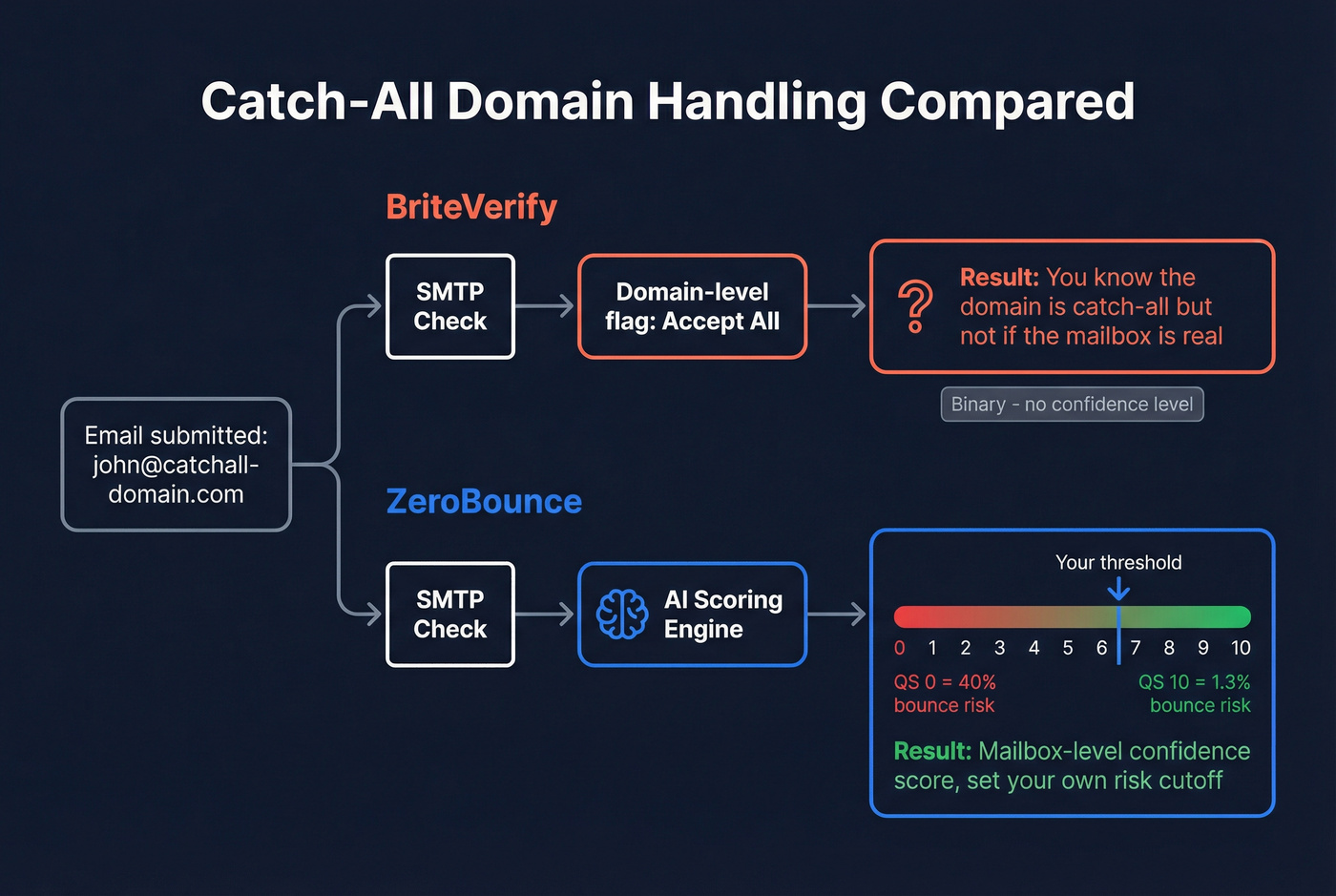
ZeroBounce takes it further with AI Scoring, assigning a Quality Score from 0 to 10 after validation. A QS of 0 maps to roughly 40% bounce risk; a QS of 10 drops to about 1.3%. You set your own risk threshold - email everything above QS 7, quarantine the rest. That's a meaningful step beyond binary flagging, especially for B2B teams where 30-40% of domains are catch-all.

Catch-all handling shouldn't require a separate scoring tool. Prospeo's 5-step verification includes catch-all detection, spam-trap removal, and honeypot filtering - built into every email it finds across 300M+ profiles. At $0.01 per email with a 7-day data refresh, you skip the verification debate entirely.
Find verified emails instead of re-verifying stale ones.
Accuracy Reality Check
ZeroBounce claims 99% accuracy. Independent benchmarks tell a more nuanced story.
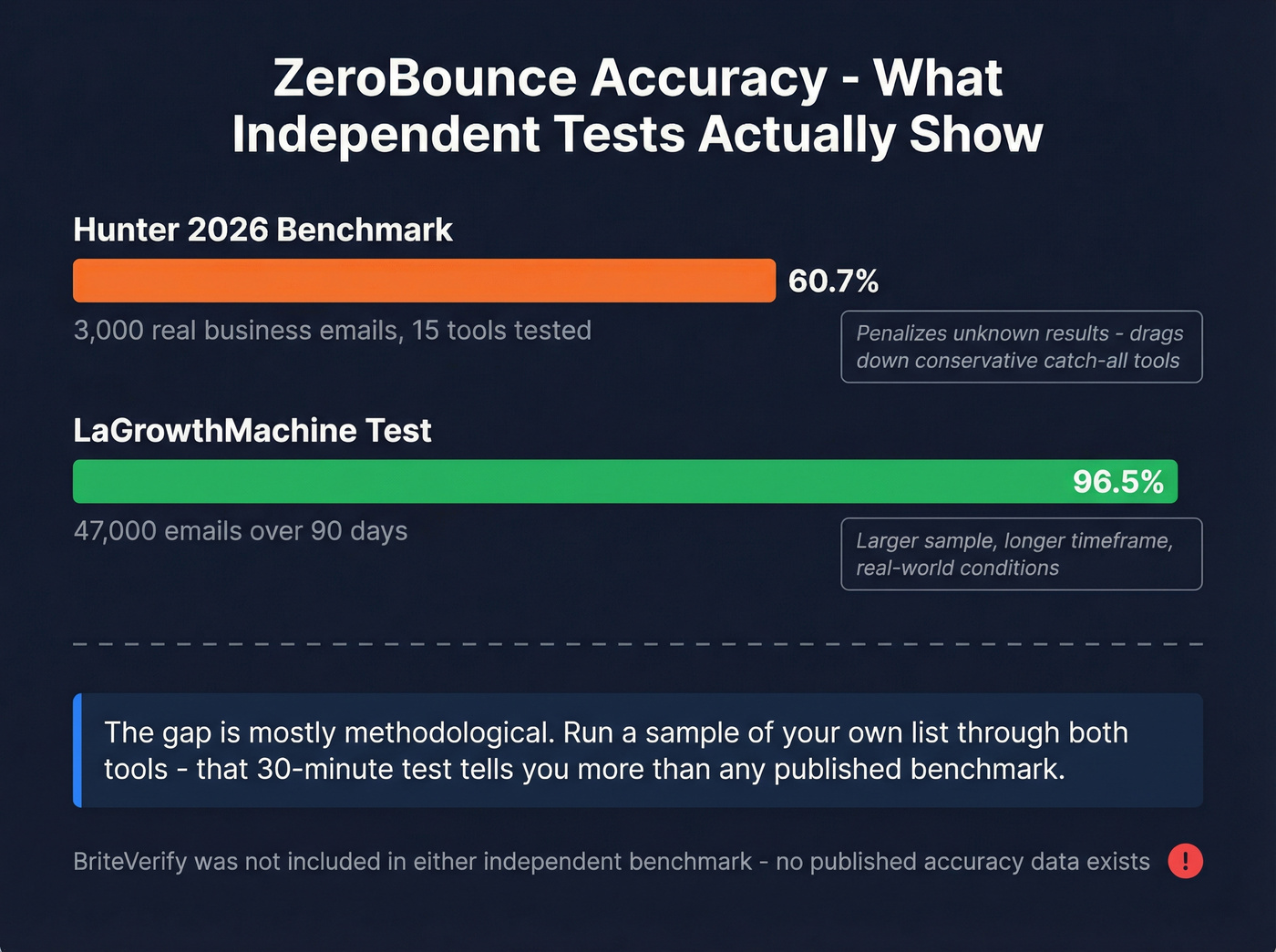
Hunter's 2026 benchmark tested 15 verifiers against 3,000 real business emails and scored ZeroBounce at 60.7% overall - but Hunter's methodology penalizes "unknown" results, which drags down scores for tools that return conservative catch-all classifications. A LaGrowthMachine test of 47,000 emails over 90 days put ZeroBounce at 96.5%. The gap is mostly methodological.
BriteVerify wasn't included in either benchmark. We don't have independent accuracy data for it, which makes a direct comparison impossible. That absence is itself a data point.
Look - accuracy benchmarks are only as good as the test dataset. We recommend running a sample of your own list through both tools and comparing bounce rates against your actual sending infrastructure. That 30-minute test will tell you more than any published benchmark.
What Practitioners Say
BriteVerify users on TrustRadius praise the API's simplicity - one reviewer highlighted the "quick API call" and that it's easy to implement with only four responses, making integration straightforward for dev teams. But reviewers also flag the accept-all limitation as a real operational gap when dealing with B2B domains.
ZeroBounce users praise responsive support and catch-all separation as standout features. On the developer side, reviewers have requested higher API rate limits and richer callback properties like MailboxProvider - worth checking if you're building high-volume integrations.
The G2 sentiment breakdown reinforces this: "Accuracy" appears in 299 ZeroBounce pros, while "Expensive" shows up in 106 cons. BriteVerify's 74-review pool is too small to draw reliable sentiment patterns from, which tells its own story about market adoption.
Beyond Verification: Finding Emails
Both BriteVerify and ZeroBounce assume you already have a list. If your real challenge is building one, you're solving the wrong problem with either tool.
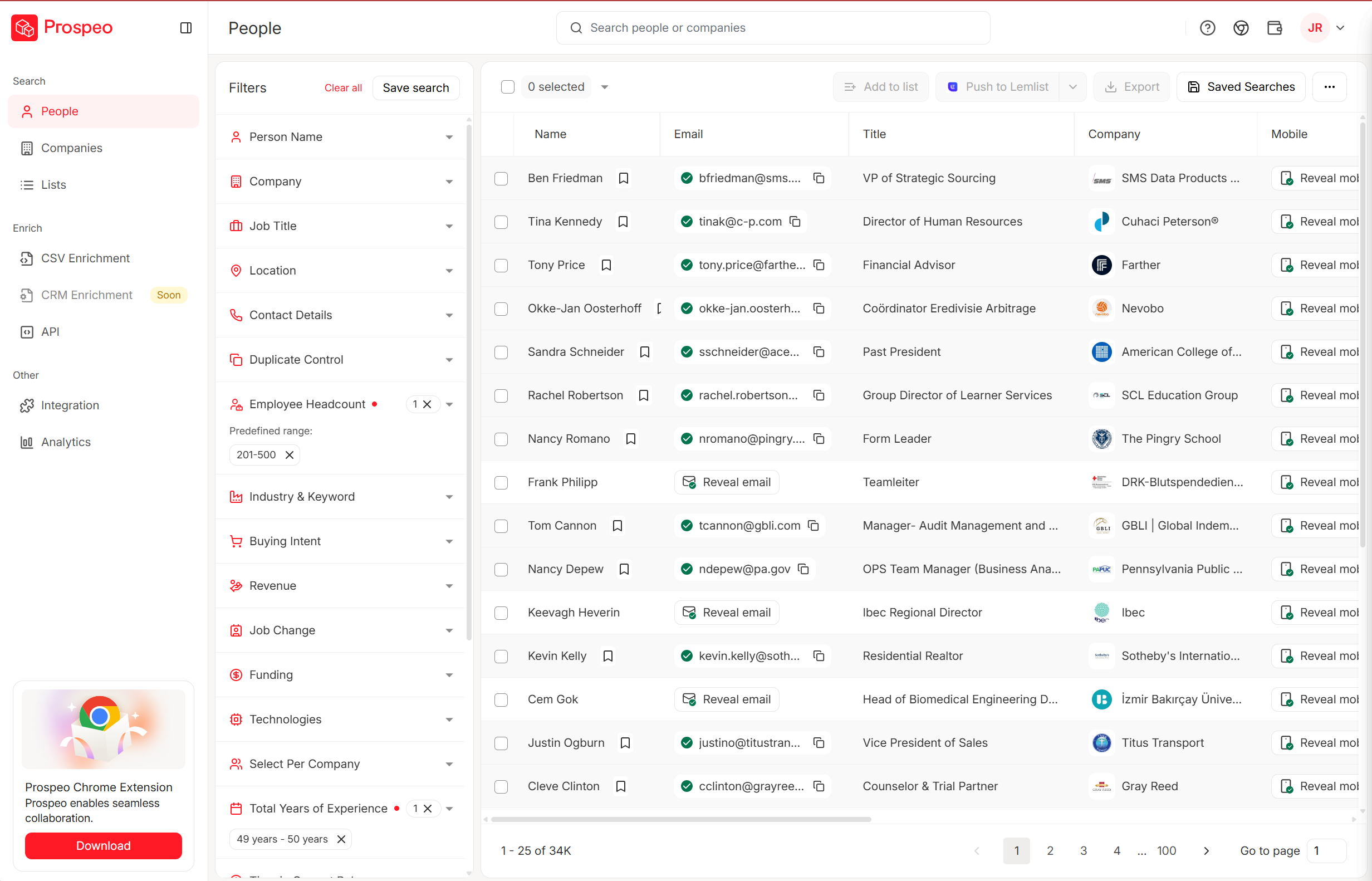
Prospeo combines email finding and verification in a single workflow - search across 300M+ professional profiles using 30+ filters, and every email comes back verified at 98% accuracy with a 7-day data refresh cycle. You also get access to 125M+ verified mobile numbers with a 30% pickup rate, a capability neither BriteVerify nor ZeroBounce provides. The 5-step verification process includes catch-all handling, spam-trap removal, and honeypot filtering - the same verification problems these standalone tools solve, baked into the prospecting layer. The free tier gives you 75 emails and 100 Chrome extension credits per month, no credit card required.
BriteVerify and ZeroBounce both assume you already have a list worth cleaning. Prospeo builds the list and verifies it in one workflow - 98% email accuracy, 125M+ verified mobiles, and 30+ search filters to target the right buyers. No credit expiry, no annual contracts.
Verification is step two. Finding the right contacts is step one.
The Verdict
When weighing BriteVerify vs ZeroBounce, the right choice depends on your workflow:
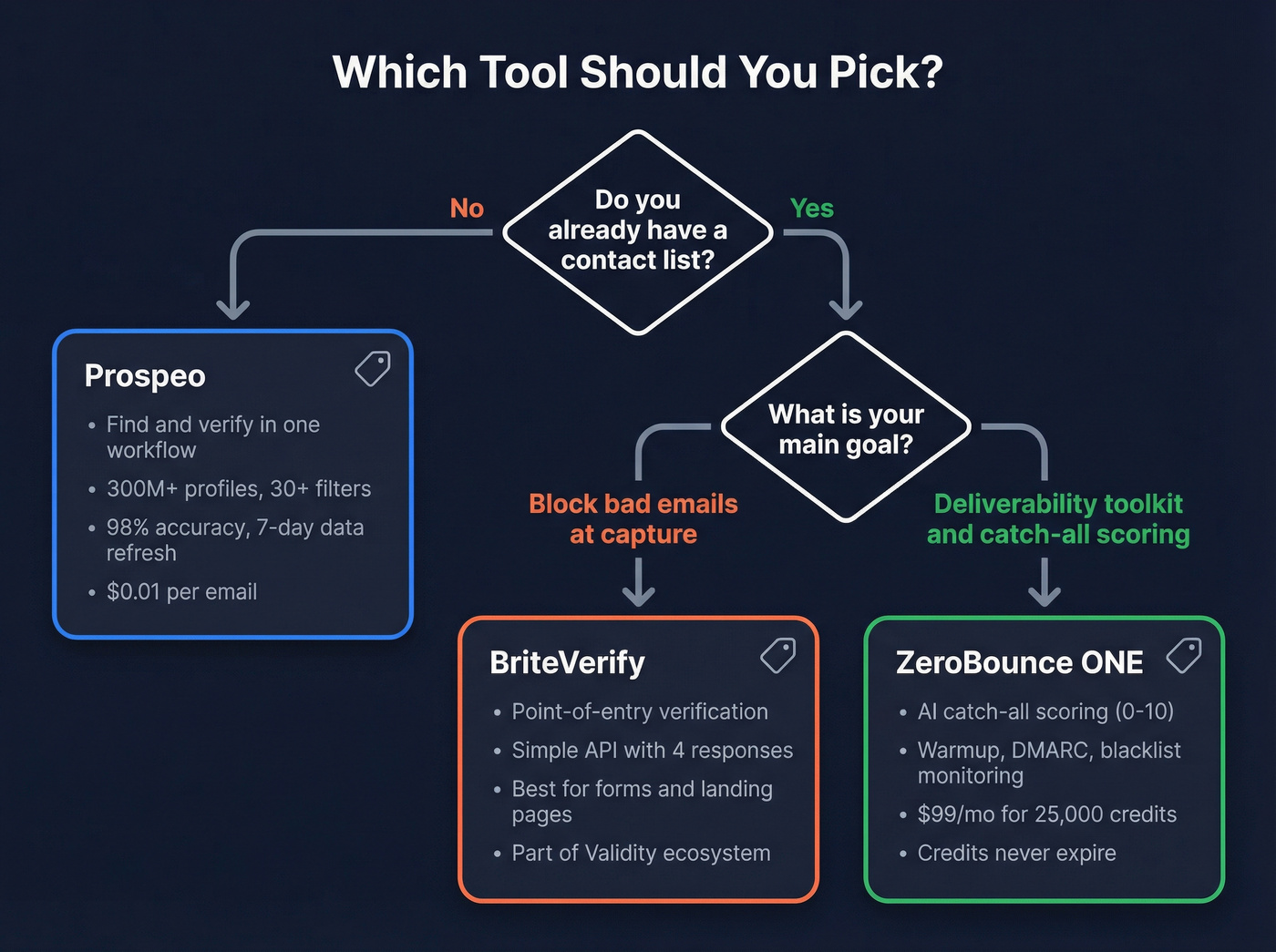
Point-of-entry verification teams who just need to stop bad emails at capture: BriteVerify is hard to beat for simplicity. It does one thing and does it cleanly.
Deliverability-focused teams who want catch-all scoring, warmup, and monitoring in one subscription: ZeroBounce ONE at $99/mo is the clear pick. The feature density at that price point is tough to argue with.
Teams building prospect lists from scratch: verifying emails you can't find in the first place doesn't solve anything. That's a different problem entirely.
If neither BriteVerify nor ZeroBounce fits, NeverBounce is a commonly mentioned alternative by users of both tools.
FAQ
Which is more accurate - BriteVerify or ZeroBounce?
ZeroBounce has more independent benchmark data, with results ranging from 60.7% to 96.5% depending on methodology and how "unknown" results are scored. BriteVerify lacks published independent benchmarks. ZeroBounce's AI catch-all scoring gives it a practical edge on the ambiguous addresses that matter most.
Do BriteVerify credits expire?
Yes. BriteVerify credits expire after one year, while ZeroBounce credits never expire and roll over indefinitely. If you verify in irregular bursts - quarterly list cleans, for example - ZeroBounce's policy saves you from losing unused credits.
Is there a free email verification tool worth using?
ZeroBounce offers 100 free credits per month for verification only. Prospeo offers 75 free emails plus 100 Chrome extension credits monthly and includes email finding - not just verification - making it the stronger free option for teams that need to build lists, not just clean them. BriteVerify doesn't offer a free tier.
Can I use ZeroBounce or BriteVerify for catch-all domains?
ZeroBounce handles catch-all domains with AI-powered Quality Scoring on a 0-10 scale, letting you set custom risk thresholds per campaign. BriteVerify returns a domain-level "Accept All" flag without mailbox-level confidence - less actionable for B2B teams where a huge chunk of domains are catch-all.