

Cold Emailing vs Cold Calling: What 26.5 Million Data Points Reveal
Your SDR team logged 2,400 activities last week. Half were calls that went to voicemail. The other half were emails that landed in spam. The activity report looks great. The pipeline doesn't.
Here's the thing: the cold emailing vs cold calling debate misses the point entirely. The real variable isn't the channel - it's whether your contact data is any good. We broke down benchmarks from 16.5 million cold emails and a cold-calling dataset covering 10 million calls to figure out what actually moves the needle.
The 30-Second Verdict
| Cold Email | Cold Call | |
|---|---|---|
| Best for | Volume, awareness | High-value deals |
| Cost/meeting | ~$36.63 | ~$44.50 |
| Reply/connect | 5.8% reply rate | 1% appointment rate |
| Scalability | High | Low |
| Compliance risk | Moderate (CAN-SPAM/GDPR) | High (TCPA/DNC) |
| Time to first result | 24-72 hours | Same day |
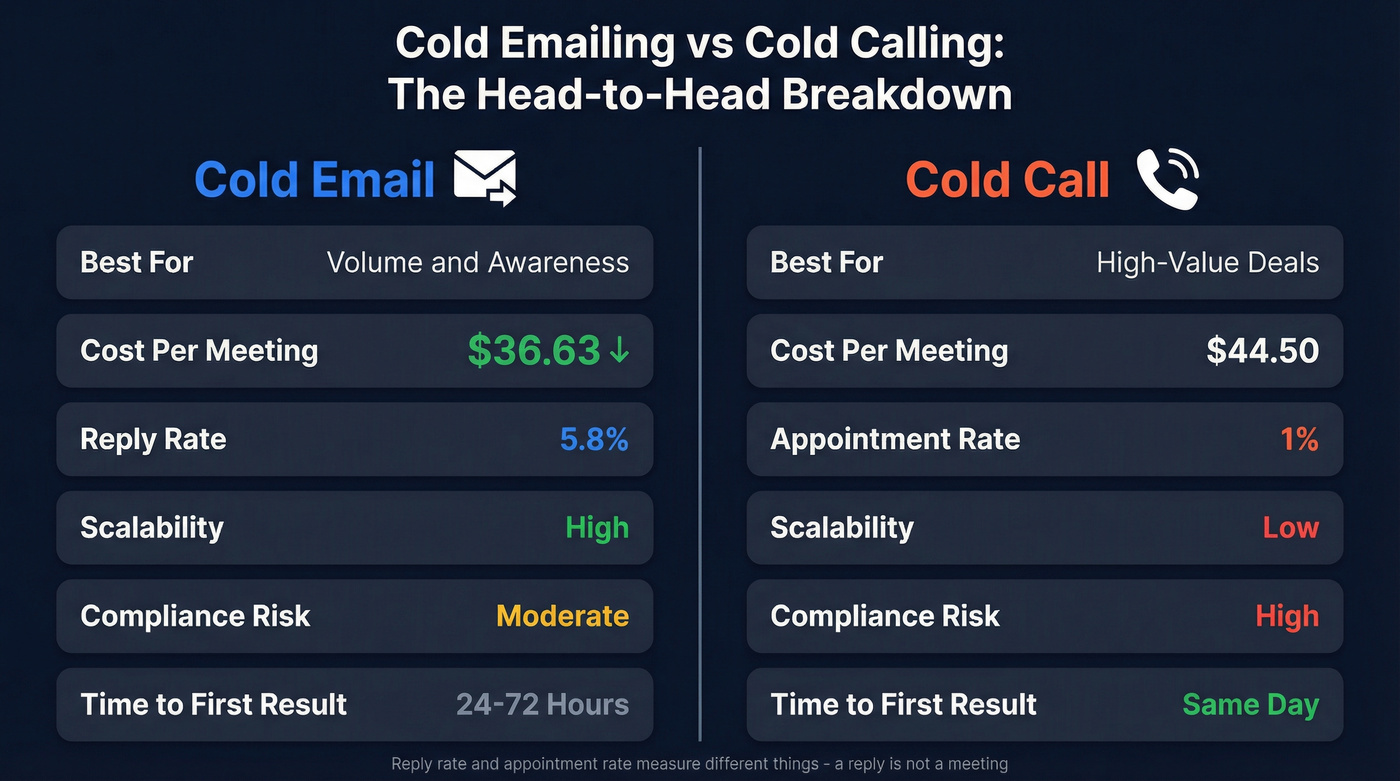
Reply rate and appointment rate measure different things - a reply isn't a meeting. The cost-per-meeting model later in this piece normalizes the comparison.
Email is cheaper per meeting. Calling produces more total meetings if you have the headcount. Neither channel works when 22.5% of your contact data has decayed over the last year. Fix the data first, then optimize the channel.
What 16.5M Emails Tell Us
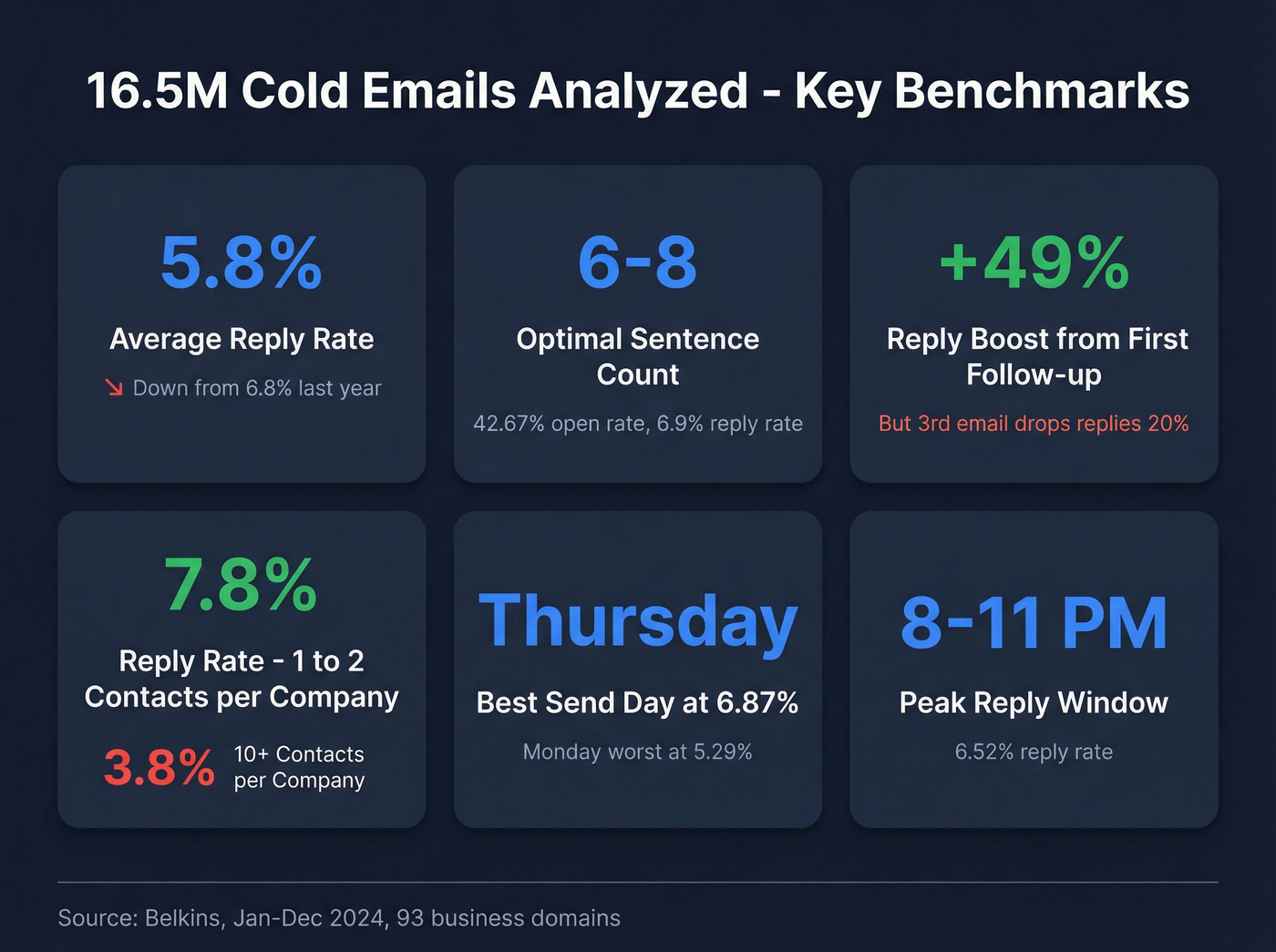
Belkins analyzed 16.5 million cold emails across 93 business domains from January through December 2024. The headline: average reply rates dropped to 5.8%, down from 6.8% the year before - a 15% year-over-year decline. Open rates climbed to 46% early in the year, then fell to 31-32% as stricter bulk sender requirements rolled out.
That mid-year drop wasn't random. Google and Yahoo now require SPF, DKIM, and DMARC authentication for anyone sending over 5,000 emails per day. Spam complaint rates above 0.3% trigger throttling or blocking. If your deliverability infrastructure isn't locked down, your subject line doesn't matter.

The data on email length is unambiguous. Emails between 6-8 sentences correlated with a 42.67% open rate and 6.9% reply rate. Under 200 words consistently outperformed longer messages. Nobody's reading your three-paragraph value prop.
Follow-up sequencing is where most teams get it wrong. The first follow-up boosts reply rates by up to 49% - that's massive. But adding a third email drops replies by 20%, and spam complaints escalate from 0.5% on the first email to 1.6% by the fourth. Unsubscribe rates jump from 0.1% to 2% over the same stretch. More emails doesn't mean more meetings. It means more spam complaints.
Targeting breadth matters more than most reps realize. Emailing 1-2 contacts per company produced a 7.8% reply rate. Blasting 10+ contacts at the same company? 3.8%. Precision beats volume every time.
Thursday is the best send day at 6.87% reply rate, while Monday lags at 5.29%. The evening window between 8-11 PM hits a 6.52% reply rate peak - likely because prospects read emails after the day's meetings clear out.
What 10M Cold Calls Reveal
The calling numbers are harder to love. A cold-calling stats roundup based on 10 million calls made between 2024 and early 2025 lands on a core reality: 1% of cold calls result in an appointment. That's roughly 209 calls per booked meeting.
The friction starts before anyone picks up. Across datasets attributed to InsideView and RAIN Group, 72% of cold calls don't reach a human, and 80% go straight to voicemail. Your reps aren't selling - they're leaving messages into a void.
When someone does answer, the conversation dynamics matter enormously. Successful cold calls average 5 minutes 50 seconds versus 3 minutes 14 seconds for failed ones. Explaining why you're calling produces a 2.1x higher success rate. And asking "Is this a bad time?" - a phrase half the sales floor still uses - decreases meeting bookings by 40%.
Here's the stat that should keep every sales leader up at night: reps lose 27.3% of their calling time to bad contact data. Over a quarter of every call block, wasted on wrong numbers, disconnected lines, and people who left the company six months ago.
The Real Cost Per Meeting
Let's break down the economics using a worked model from Datablist. These aren't gospel - they're transparent assumptions you can adjust for your team. But understanding performance at the unit-economics level is the only way to allocate budget rationally.
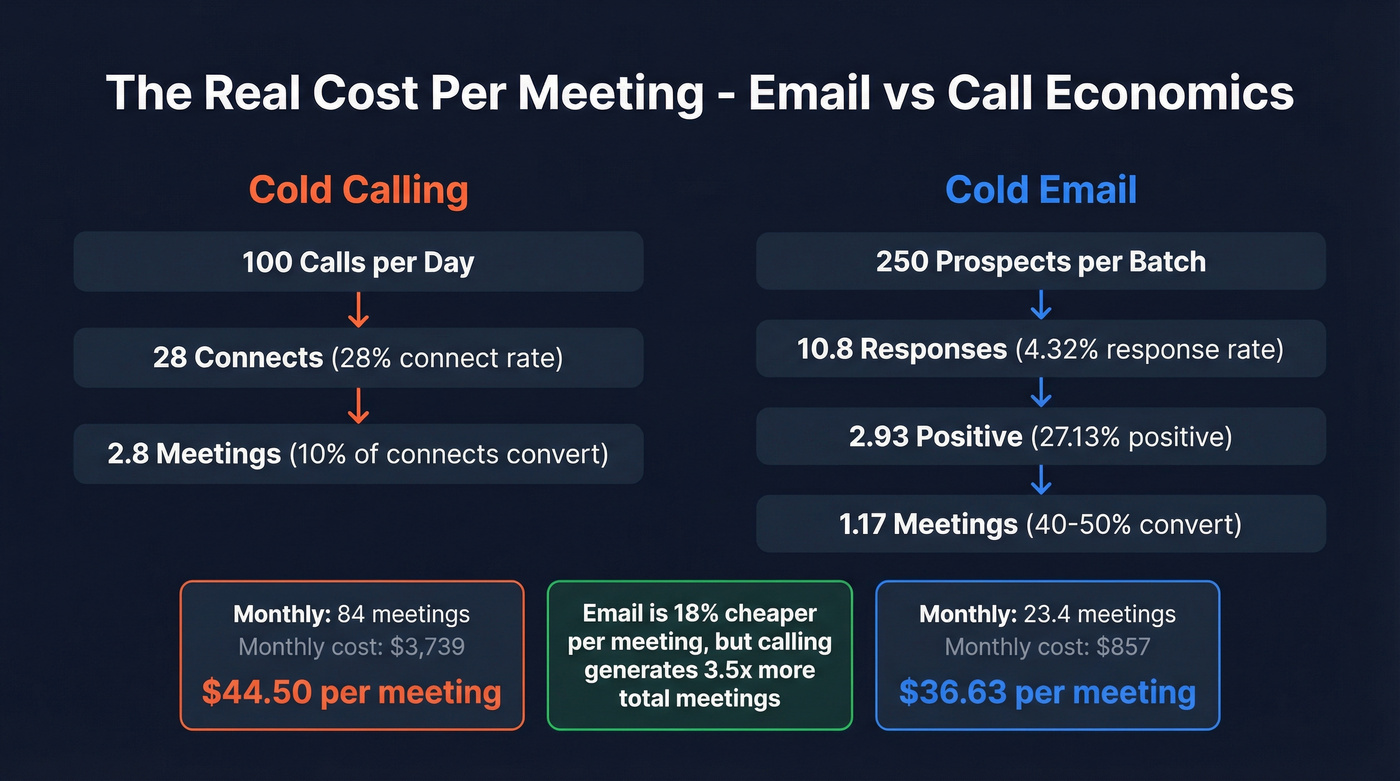
Cold calling model: 100 calls per day, 28% connect rate, 10% of connects convert to meetings. That's roughly 2.8 meetings per 100 calls. At a fully loaded monthly cost of $3,739 covering rep time, dialer, and data, a team producing 84 meetings per month pays about $44.50 per meeting.
Cold email model: 250 prospects per batch, 4.32% response rate, 27.13% of responses positive, 40-50% of positive replies convert. That's roughly 1.17 meetings per 250 prospects. Monthly cost of $857 for tooling, domains, and rep time yields 23.4 meetings at about $36.63 per meeting.
| Cold Call | Cold Email | |
|---|---|---|
| Monthly cost | ~$3,739 | ~$857 |
| Meetings/month | ~84 | ~23.4 |
| Cost/meeting | $44.50 | $36.63 |
Email is cheaper - but cheaper doesn't mean better for your pipeline. Calling generates 3.5x more total meetings if you have the budget and headcount. If your average deal size is under $10k, email-heavy cadences will almost certainly give you better unit economics. Above $25k, the phone pays for itself.

Reps lose 27.3% of calling time to bad numbers. Emails bounce into spam from stale addresses. Prospeo's 7-day refresh cycle, 98% email accuracy, and 125M+ verified mobiles mean your outbound actually reaches humans - whether you dial or send.
Stop wasting a quarter of every call block on dead data.
When to Call vs When to Email
Every article on this topic says "use both." None of them tell you when to use which. The choice comes down to deal size, prospect seniority, and the complexity of your ask.
Pick up the phone when:
- The deal is worth $25k+ and you need real-time qualification
- You're reaching a C-suite or VP-level buyer who won't reply to cold email
- The ask is strong - you want a demo or meeting, not a content download
- You need to disqualify fast and move on
- The product is complex enough that a conversation beats a paragraph
Send the email when:
- You need to reach 500+ prospects this week and you don't have 10 SDRs
- The ask is soft - sharing a case study, offering a resource, making an introduction
- The prospect is in a different timezone and scheduling a call is impractical
- You need a paper trail for regulated industries or procurement processes
- You're running early-stage awareness before a harder ask
The consensus across practitioners - and our own experience running outbound - is that multichannel cadences outperform single-channel by a wide margin. An email warms the name before the call. A call after an email open converts at a higher rate than a cold dial. The teams still asking which channel is more effective are usually the ones running only one.
The Variable Nobody Talks About
B2B contact data decays at 2.1% per month. That's roughly 22.5% of your database going stale every year - people change jobs, get promoted, switch companies, retire. If you bought a list six months ago and haven't refreshed it, nearly one in eight contacts is wrong.
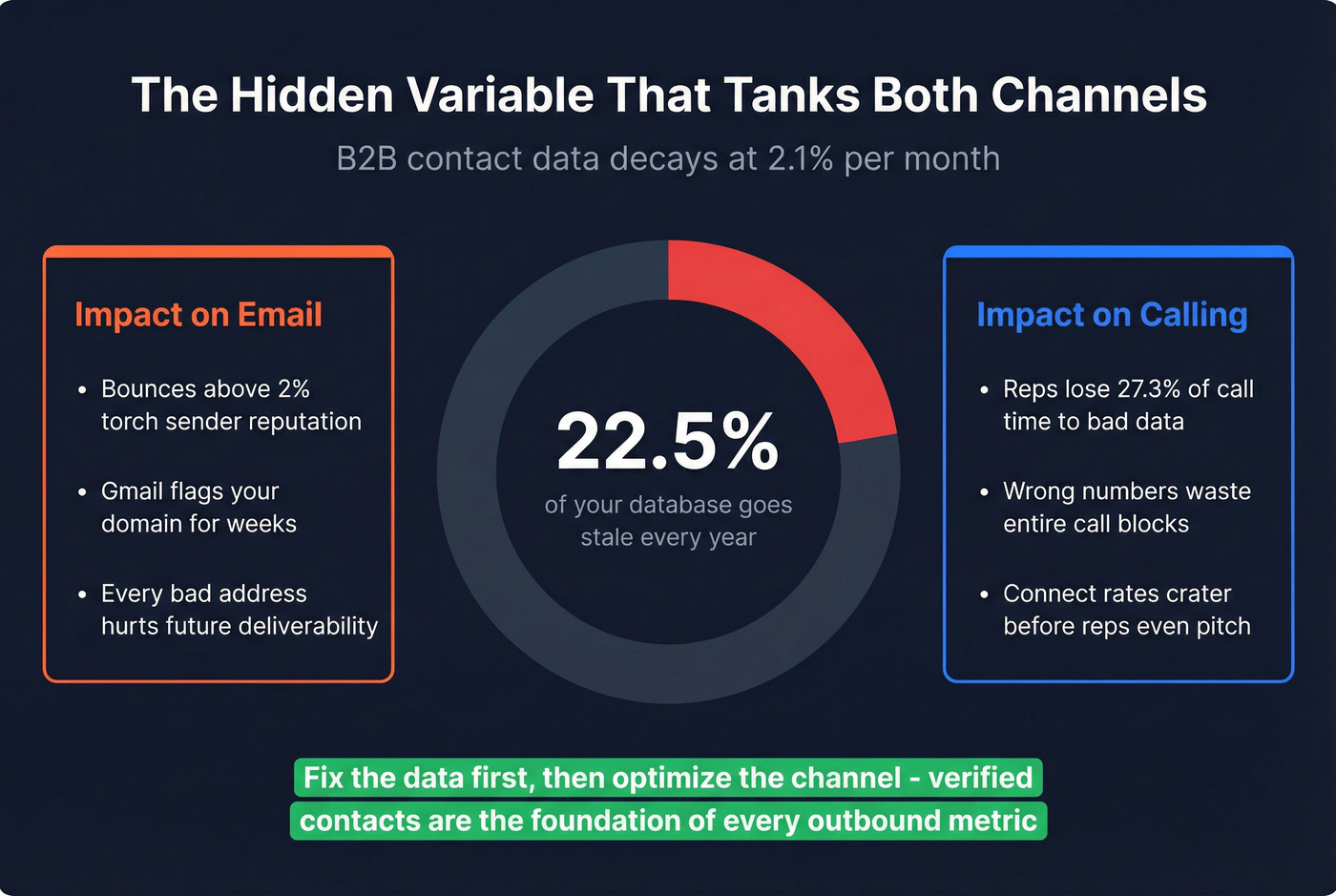
This is where both channels fail silently. Email bounces above 2% torch your sender reputation, and once Gmail flags your domain, you're sending to spam for weeks. Wrong phone numbers waste entire call blocks - and reps lose 27.3% of their time to bad data before they even get to pitch. When people debate cold email vs cold call effectiveness, they rarely account for the fact that bad data tanks both channels equally.
We've seen teams triple their connect rates just by switching to verified direct dials. Before you optimize subject lines or call scripts, verify your data. Prospeo runs a 7-day refresh cycle on 300M+ professional profiles and delivers 98% email accuracy, keeping your bounce rate well under that 2% danger zone.
The proof points tell the story. Meritt went from a 35% bounce rate to under 4%, tripled their pipeline from $100K to $300K per week, and saw connect rates jump 3x to 20-25%. Snyk's 50 AEs cut bounce rates from 35-40% to under 5%, grew AE-sourced pipeline 180%, and generated 200+ new opportunities per month.
Your cost-per-meeting math breaks the moment bounce rates spike or connect rates crater. Prospeo delivers 98% accurate emails and mobile numbers with a 30% pickup rate - so your $36 email meetings and $44 call meetings actually show up in pipeline.
Make every channel profitable. Start with data that's 7 days fresh.
Compliance Risks You Can't Ignore
This is the section every "email vs call" article skips. It shouldn't be optional - the penalties are real.
| Cold Calling | Cold Email | |
|---|---|---|
| Key law (US) | TCPA + DNC Registry | CAN-SPAM |
| Key law (EU) | PECR + GDPR | GDPR + ePrivacy |
| Consent model | Varies (DNC opt-out) | Opt-out (US) / Opt-in (EU) |
| Penalty per violation | $500-$1,500/call | Up to $50,120/email |
| Request processing | 10 business days (internal DNC) | 10 business days (unsubscribe) |
TCPA requires calls between 8 AM and 9 PM local time, honoring internal DNC requests within 10 business days, and maintaining suppression lists for at least 4 years. Violations run $500-$1,500 per call, with willful violations at the higher end.
CAN-SPAM operates on an opt-out model - you can email cold, but you must include honest headers, a physical address, and a functioning unsubscribe link. GDPR is stricter: it operates on an opt-in or legitimate-interest basis, with mandatory data source disclosure. Total GDPR enforcement has hit EUR 5.88B across 2,245 actions.
The enforcement isn't theoretical. Italy's DPA fined TIM EUR 27.8M for unsolicited calls. The UK's ICO levied GBP 100,000 for 614,342 unsolicited calls to TPS-registered numbers. And the CCPA/CPRA B2B exemption expired January 1, 2023 - California prospects now have full consumer-level data rights.
A Multichannel Cadence That Works
Everyone says "use both channels." Here's an actual day-by-day sequence built from the benchmark data above. Cap email touches at 2-3 - remember, the third email drops replies 20% and triples spam complaints.
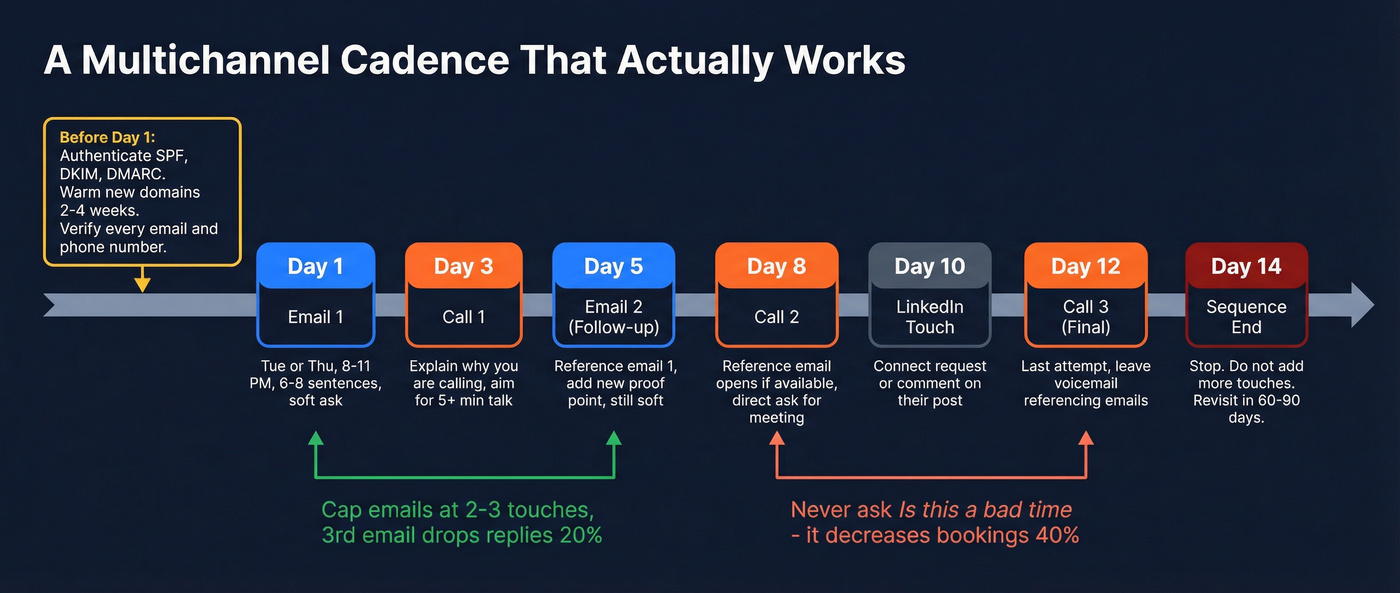
Before Day 1, handle the prerequisites: authenticate your sending domains with SPF, DKIM, and DMARC. Warm any new domains for 2-4 weeks. Verify every email address and phone number in the sequence. One bad bounce or disconnected number doesn't just waste a touch - it damages your infrastructure.
- Day 1 (Tuesday or Thursday, 8-11 PM): First email. 6-8 sentences, under 200 words. Soft ask - a relevant insight or question, not a demo request.
- Day 3: Call + voicemail. Reference the email. Explain why you're calling - that 2.1x success rate is real. Keep the voicemail under 30 seconds.
- Day 5: Follow-up email. This is your highest-leverage touch - first follow-ups boost replies by 49%. Add new value, don't just "bump."
- Day 8: Second call attempt. Different time of day than Day 3. If you connect, you've got context from two emails.
- Day 10: Engage on a professional network. Comment on their content or share something relevant. Low-effort, high-signal.
- Day 12-14: Final email. Breakup framing - "closing the loop" or "last note." Keep it short.
That's 5-6 touches over two weeks. Enough to be persistent without triggering spam complaints. In our experience, the third follow-up email is where most teams cross from persistent to annoying - which is exactly why this cadence caps email at two and leans on calls and social for the remaining touches.
Tools to Run Both Channels
You don't need a $40k platform to execute this.
Contact data and verification: Prospeo - 300M+ profiles, 98% email accuracy, 125M+ verified mobile numbers with a 30% pickup rate. Free tier gives you 75 email verifications per month plus 100 Chrome extension credits. Paid plans start around $0.01/email. Integrates natively with Smartlead, Instantly, HubSpot, and Salesforce.
Cold email sending: Smartlead ($39-$94/mo) handles multi-inbox rotation and warmup well. Instantly ($30-$77.6/mo) offers similar functionality with a cleaner UI for smaller teams. If you're comparing platforms, start with our list of cold email marketing tools.
Cold calling/dialer: Aircall ($30-$50/user/mo) is the pick for teams that want tight CRM integration without complexity. PhoneBurner ($124-$169/user/mo) is built for power dialing at volume - skip this if your team makes fewer than 50 calls per day.
Multichannel orchestration: Outreach.io (~$100-150/user/mo) for enterprise-grade sequencing across email, call, and social. HubSpot Sales Hub (free CRM; Pro from $90/user/mo) for teams already in the HubSpot ecosystem who don't want to manage another vendor.
FAQ
Is cold calling dead in 2026?
No - but connect rates are brutal. 72% of calls don't reach a human, and 80% go to voicemail. Calling still works best when paired with email in a multichannel cadence, especially for deals above $25k where real-time conversation drives faster qualification.
What's a good cold email reply rate?
The 2024 benchmark across 16.5 million emails was 5.8%. Anything above 8% is strong. Below 3% usually signals a data quality or deliverability problem - check your bounce rate and sender reputation before rewriting subject lines.
How many cold calls to book one meeting?
About 209 on average. That number drops significantly with verified direct dials and a 30% pickup rate, compared to the 12% industry average. Bad phone data is the single biggest time sink for calling teams.
Is cold emailing legal?
Yes, in most jurisdictions with proper compliance. CAN-SPAM requires opt-out links, honest headers, and a physical address. GDPR requires legitimate interest or consent plus data source disclosure. Penalties reach $50,120 per email under CAN-SPAM or a percentage of global revenue under GDPR.
Which wins for lead generation - email or phone?
Neither channel wins in isolation. Cold email delivers cheaper cost per meeting (~$36.63) and scales without headcount, making it ideal for high-volume prospecting under $10k ACV. Cold calling generates 3.5x more total meetings and lets you qualify in real time, which matters for enterprise deals. Combining both in a structured cadence consistently outperforms either alone.