

What Is a Demand Generation Marketer - and What Does the Role Actually Look Like?
The job title says "marketer," but the expectations say "revenue owner." A demand generation marketer is the person your CEO blames when pipeline is thin and your CRO thanks when deals are flowing. It's one of the highest-leverage roles in B2B - and one of the most misunderstood.
The Short Version
A demand generation marketer builds predictable pipeline. Not just campaigns, not just leads - pipeline that sales can actually close.
On comp: specialists typically earn $51K-$90K, managers $89K-$126,250, and director roles commonly land in the $135K-$160K range, with plenty of variance by company, market, and scope. The role has evolved from tactical campaign runner to strategic growth driver who owns revenue math, sales alignment, and full-funnel measurement.
What Does a Demand Generation Marketer Do?
This is a revenue-centric marketing professional responsible for generating demand through both inbound and outbound channels. But that definition undersells the reality.
The distinction that matters is person versus practice. Demand generation is the practice - the system of campaigns, content, events, and nurture sequences that create awareness and move buyers through a funnel. The marketer is the person accountable for making that system produce measurable pipeline. They don't just run campaigns. They own the math: cost per lead, MQL-to-SQL conversion, CAC by channel, pipeline velocity.
Today's demand gen professional isn't executing a playbook - they're building one, iterating on it weekly, and defending it in front of leadership with dashboards, not vibes. They function as the bridge between marketing and sales, maintaining a zoomed-out view across the entire customer experience that neither team has on its own. The best people in this role are equal parts analyst and storyteller, comfortable in a spreadsheet at 9am and defending a creative brief at 2pm.
How the Role Has Evolved
Not long ago, a demand gen marketer could run webinars, manage a paid search budget, and hand MQLs to sales. The job was execution-heavy.
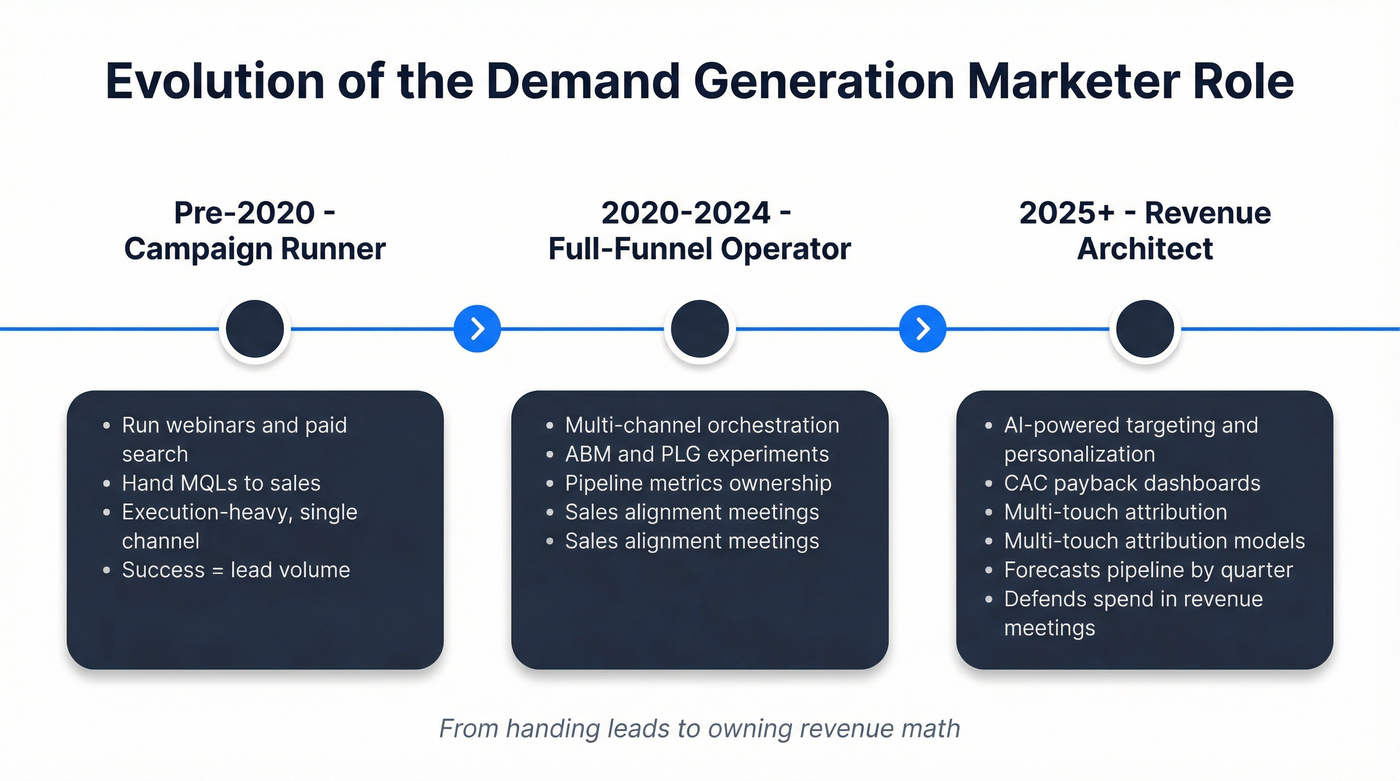
That version of the role is dead. Modern practitioners run integrated cross-channel campaigns across paid search, webinars, SEO, content syndication, social media, and events - while also owning ABM motions, experimenting with PLG strategies, and deploying AI-powered targeting. The analytics bar has jumped too. CAC payback dashboards, multi-touch attribution models, and funnel conversion rates by segment are table stakes now.
Marketing leaders increasingly cite pipeline as their top priority, which means demand gen isn't a support function anymore. These marketers sit in revenue meetings, defend spend, and forecast pipeline contribution by quarter.
Roles and Responsibilities
The day-to-day mixes strategic planning with operational grind.
Planning and budgeting. Building the demand gen plan aligned to quarterly revenue targets, allocating budget across channels, and developing the metrics framework. This isn't a once-a-quarter exercise - it's a rolling process that shifts as pipeline data comes in.
Campaign execution. Running paid search, managing content syndication, coordinating webinars, overseeing SEO and inbound initiatives, and planning event sponsorships. The best demand gen marketers don't do all of this themselves - they orchestrate specialists and agencies - but they own the outcomes.
Sales collaboration. This is where the role gets political. You define lead qualification criteria with sales, manage the MQL-to-SAL handoff, and build enablement programs. When sales says "these leads are garbage," you diagnose whether that's a targeting problem, a timing problem, or a follow-up problem.
Nurture ownership. Designing personalized touchpoints - email sequences, retargeting, conversational marketing, content recommendations - that keep prospects engaged between first touch and hand-raise.
Reporting and optimization. Weekly pipeline reviews, channel performance analysis, A/B test results, attribution reporting. Rinse, repeat.
Demand Gen vs. Adjacent Roles
The lines between demand gen, growth marketing, and performance marketing blur constantly. Here's how we think about them:
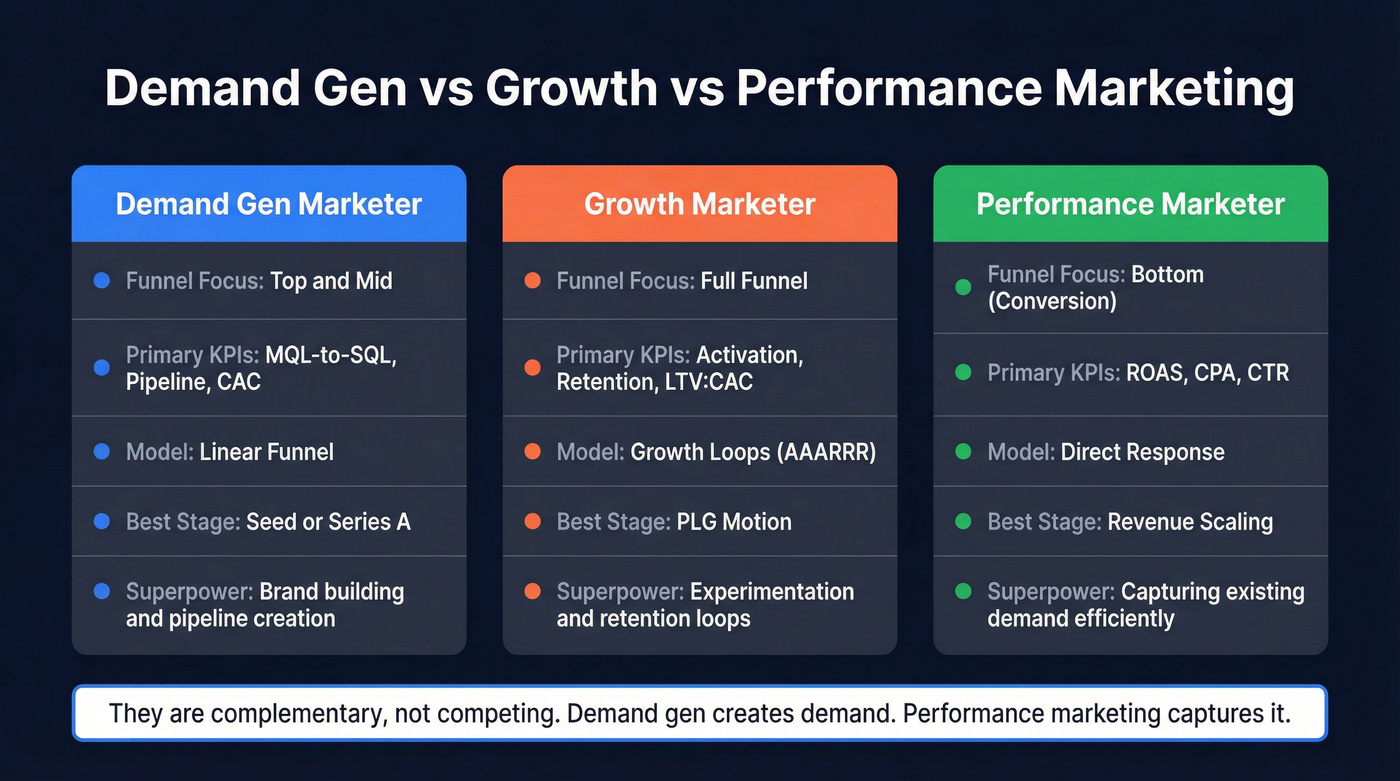
| Dimension | Demand Gen Marketer | Growth Marketer | Performance Marketer |
|---|---|---|---|
| Funnel focus | Top/mid | Full funnel | Bottom (conversion) |
| Primary KPIs | MQL-to-SQL, pipeline, CAC | Activation, retention, LTV:CAC | ROAS, CPA, CTR |
| Model | Linear funnel | Growth loops (AAARRR) | Direct response |
| Best for stage | Seed / Series A | PLG motion | Revenue scaling |
At seed or pre-PMF, prioritize demand gen to validate your ICP and generate initial pipeline. Running a PLG motion? Bring in growth marketing earlier because activation and retention are survival metrics. By Series C+, you need both functions operating together.
Here's the thing: framing these as either/or is a mistake. Demand gen builds the brand and creates demand. Performance marketing captures it. They're complementary, not competing. If your average deal size sits below $10K, you probably don't need a dedicated demand gen person at all - a growth generalist will serve you better until deal sizes justify the specialization.
Core Skills
The skill set breaks into two categories, and you need both.
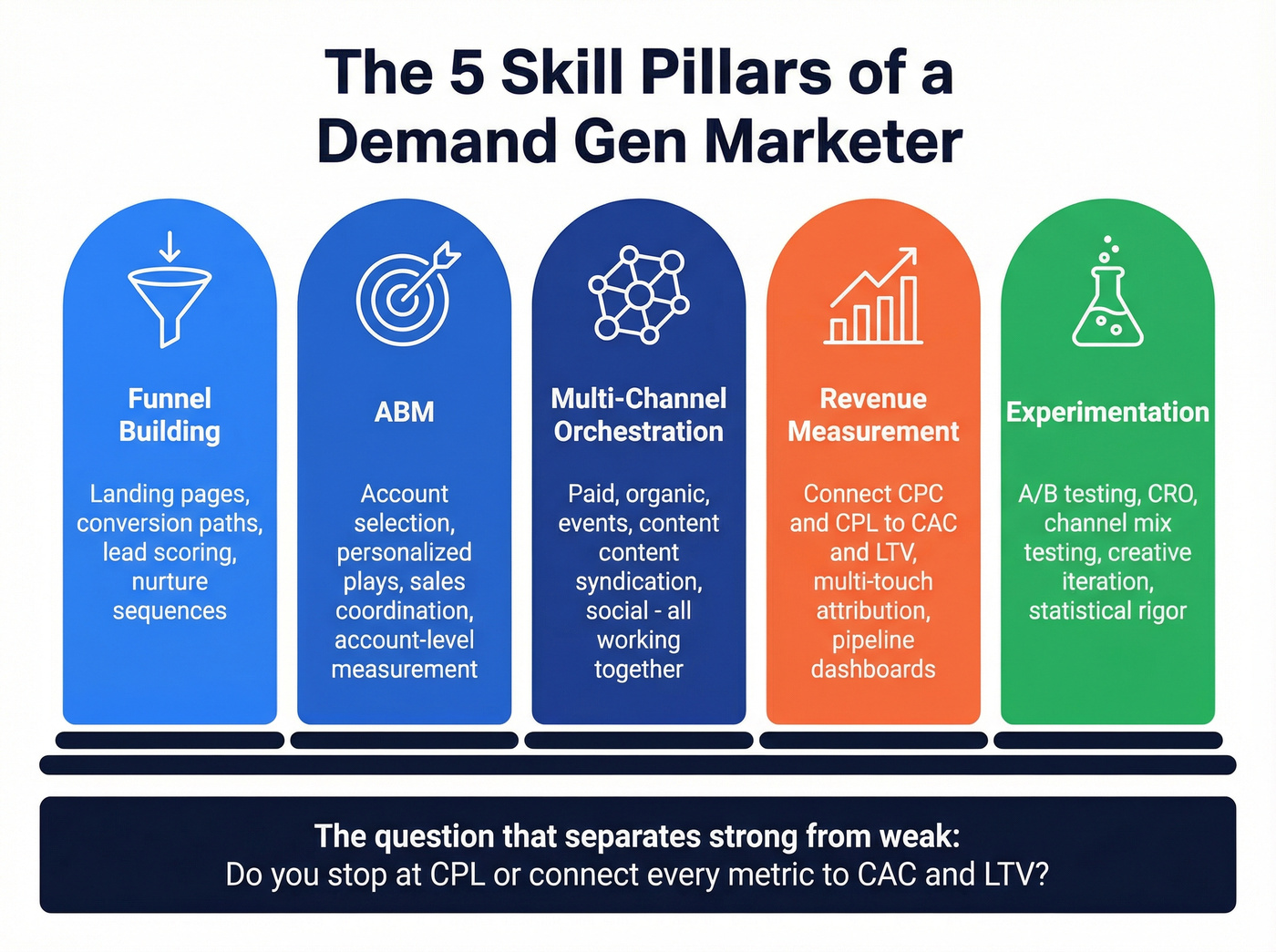
Hard skills: funnel building and landing page optimization, ABM strategy and execution, multi-channel campaign orchestration across paid, organic, events, and content, revenue and pipeline measurement connecting CPC and CPL to CAC and LTV, experimentation and CRO, platform fluency in Salesforce, HubSpot, or Marketo, and data analysis that goes well beyond vanity metrics.
Soft skills: Cross-functional communication, especially with sales leadership. Budget defense - explaining why a channel that looks expensive on a CPL basis is actually your most efficient pipeline source. Storytelling with data. Vendor management. And honestly, patience. Feedback loops in demand gen are long, and you'll spend months building programs before pipeline impact shows up.
Five skill pillars to self-assess against: funnel building, ABM, multi-channel orchestration, revenue measurement, and experimentation. If you're weak in any of those, that's your development priority. In our experience interviewing candidates, the question that separates strong from weak is simple: do you stop at CTR, CPL, or MQL volume, or do you connect every metric to CAC and LTV?

You can't own pipeline math if your contact data is wrong. Prospeo gives demand gen marketers 300M+ profiles with 98% email accuracy, 30+ filters including buyer intent and technographics, and a 7-day data refresh cycle - so every campaign launches on verified contacts, not stale lists.
Stop blaming campaigns when the real problem is bad data.
The Tech Stack
Most demand gen tech stacks are bloated. You need 5-7 tools, not 15. Start with a CRM, a data platform for verified contacts, and one marketing automation tool. Add intent data and conversation intelligence once pipeline is flowing.
| Category | Recommended Tool | Starting Price |
|---|---|---|
| Data enrichment | Prospeo | Free tier; ~$0.01/email |
| CRM | HubSpot / Salesforce | Free tier / paid plans vary |
| Marketing automation | Marketo / HubSpot | $1,000-$3,000+/mo |
| Conversation intel | Gong | ~$100-$200/user/mo |
| Intent data | Bombora | $25K-$50K+/yr standalone |
| Message testing | Wynter | ~$500+/test |
| Interactive demos | Storylane | ~$40-$100/user/mo |
| Scheduling | Chili Piper | ~$20-$30/user/mo |
| Behavior analytics | Hotjar | Free plan available |
The data enrichment layer is where most demand gen programs break first. You're accountable for pipeline quality, not just volume. When your bounce rate creeps above ~5%, every downstream metric suffers - deliverability tanks, sender reputation degrades, and sales stops trusting the leads you send them.
Prospeo covers 300M+ professional profiles with 98% email accuracy and a 7-day data refresh cycle. You can search by 30+ filters including buyer intent, technographics, and job changes, then export verified contacts into your CRM and outbound tools. One team we've worked with tested a matched audience approach and increased CTR from 0.54% to 1.04% without changing creative, copy, or CTA. They didn't need a better ad - they needed a better audience.
Your tech stack doesn't need 15 tools - it needs one data platform that actually works. Prospeo combines verified emails, 125M+ direct dials, intent data across 15,000 Bombora topics, and CRM enrichment returning 50+ data points per contact. All starting at $0.01/email with no contracts.
Replace your bloated data stack with one platform that delivers pipeline.
Salary and Compensation
Let's be honest: the expectations-to-compensation gap at the specialist level is brutal. Every listing asks for ABM, PLG, paid media, SEO, content strategy, email marketing, event marketing, and analytics - for $75K. That's a lot of hats for a salary that barely clears the median household income in most major metros.
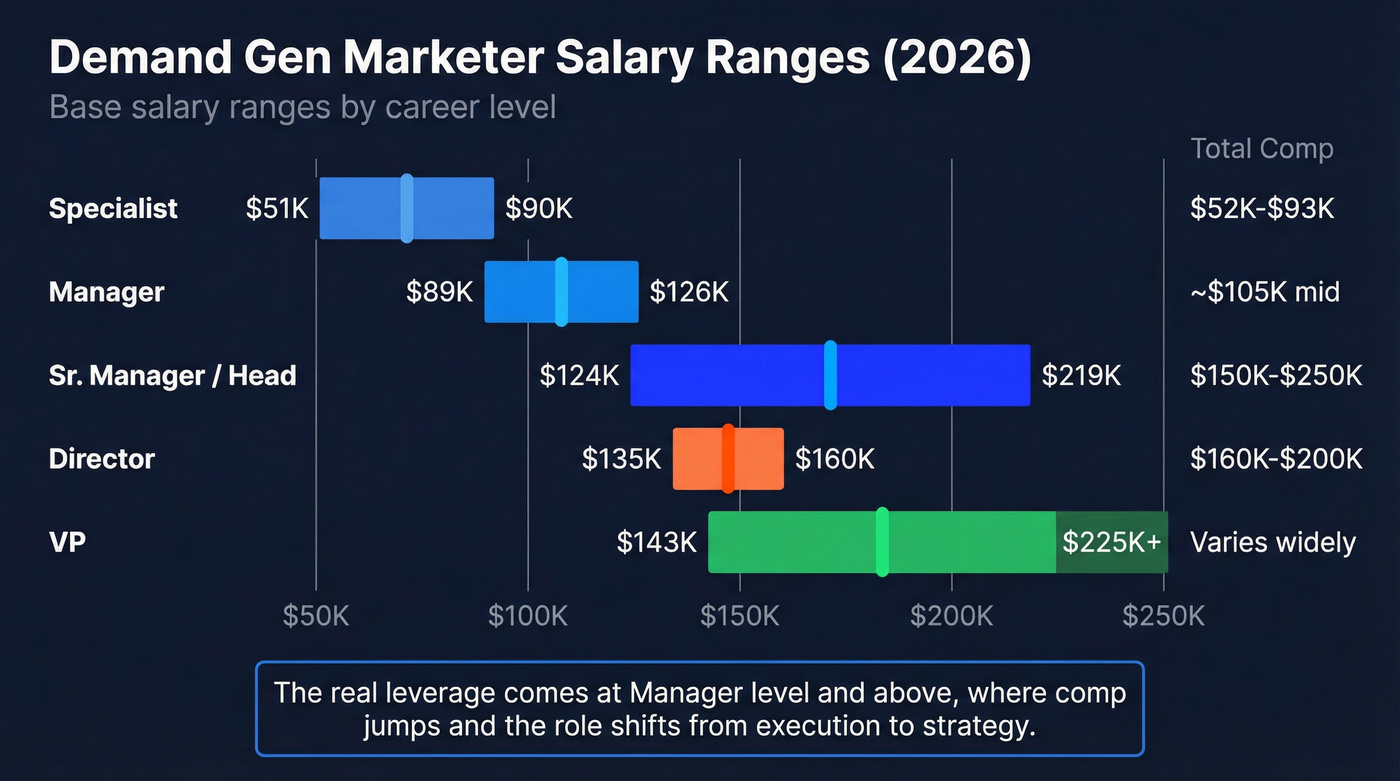
| Level | Base Range | Total Comp |
|---|---|---|
| Specialist | $51K-$90K | $52K-$93K |
| Manager | $89K-$126,250 | ~$105K midpoint |
| Sr. Manager / Head | $124K-$219K | ~$150K-$250K |
| Director | $135K-$160K | ~$160K-$200K |
| VP | $143K-$225K+ | Varies widely |
Glassdoor's broader data (182 salaries) shows a median total pay of $120K, with a most likely range of $90K-$163K. The 90th percentile hits $213K.
The real leverage comes at the manager level and above, where comp jumps meaningfully and the role shifts from execution to strategy. Bonus and variable comp become more significant as you move up - expect $1K-$7K in bonuses at the specialist level, scaling from there.
Career Path
The progression follows a Strategy, Specialization, then Pivot/Lead arc. You build broad strategic skills, specialize in a motion like ABM, PLG, or enterprise, then either pivot to an adjacent role or lead a team.
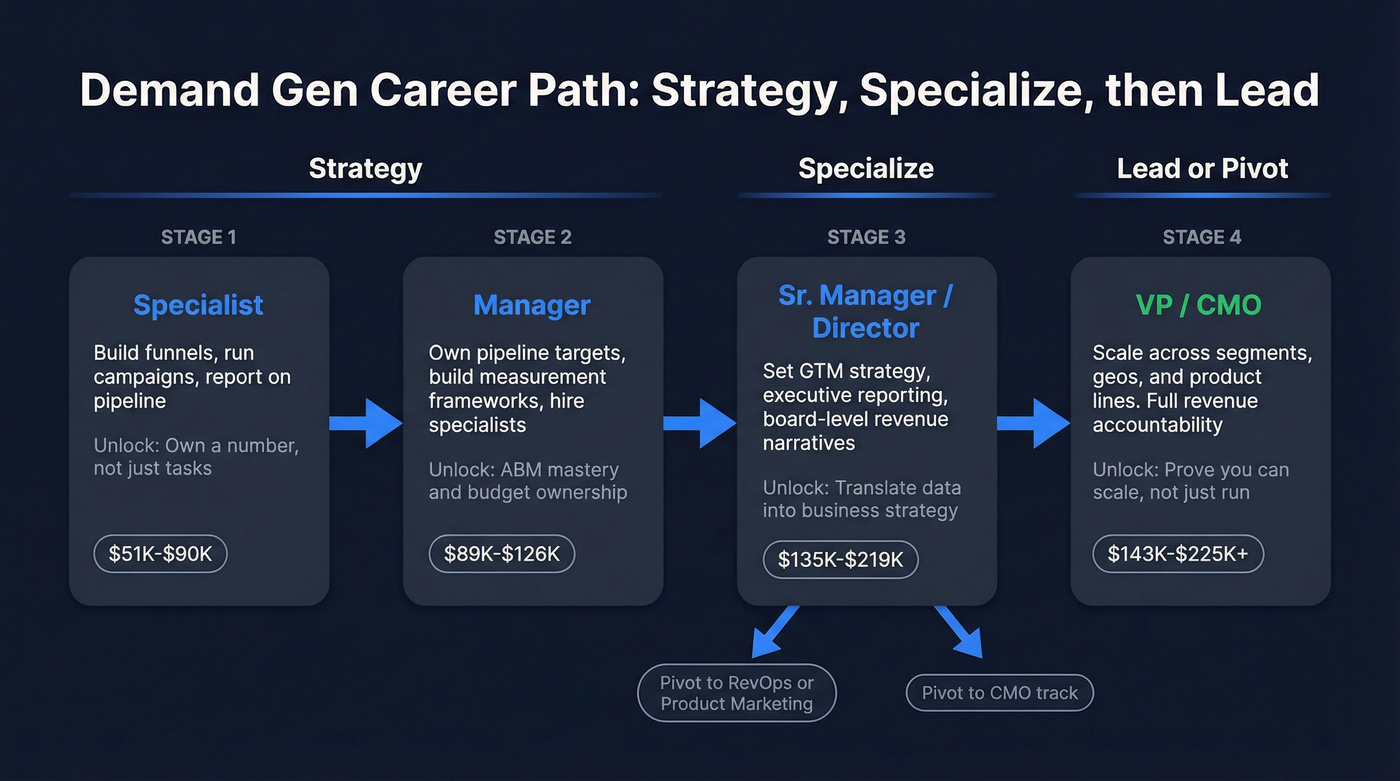
Specialist to Manager. You prove you can build funnels, run multi-channel campaigns, and report on pipeline contribution. The unlock: moving from "I execute campaigns" to "I own a number." When you can say "my programs sourced $2.3M in pipeline this quarter at a $47 CPL," you're ready.
Manager to Senior Manager. ABM mastery becomes critical. You're designing GTM motions for specific segments, coordinating with sales on account selection, and building measurement frameworks. Budget ownership expands. You're also likely building a team beneath you - hiring specialists, defining workflows, setting the operating cadence.
Senior Manager to Director. GTM ownership. You're setting strategy, not executing it. Executive reporting becomes a core competency - translating campaign data into board-level narratives about where revenue is coming from and where it's going.
Director to VP. This is the hardest jump. You need to prove you can scale demand gen across multiple segments, geographies, or product lines. Scaling from a handful of specialists to a cross-functional team with dedicated channel owners, ops support, and analytics is the challenge that separates directors from VPs. You're managing seven-figure budgets and influencing company strategy. Director listings already ask for 7-10 years of progressive B2B experience; VP roles want 10+.
KPIs That Matter
The metrics a demand generation marketer owns fall into two buckets: the ones your dashboard tracks and the ones it can't.
Trackable KPIs:
- Pipeline sourced and influenced
- MQL-to-SQL conversion rate
- SQL-to-opportunity conversion
- CAC by channel (Total Sales & Marketing Spend / New Customers Acquired)
- Pipeline velocity (Qualified Opportunities x Average Deal Size x Win Rate / Sales Cycle Length)
- Average deal size
- Revenue attributed to marketing programs
- Accounts engaged in ABM motions
- CPL by channel (Total Channel Spend / Leads Generated)
The dark funnel. Attribution is broken and every good demand gen marketer knows it. Slack communities, word of mouth, private chats, podcast mentions - these drive buying decisions no tool can track. A practical heuristic: if your company generates 2,000+ branded searches per month, your demand gen efforts are working even if your attribution model can't prove it.
The consensus on r/demandgeneration and r/sales mirrors what we've seen across teams: marketers who obsess over perfect attribution end up optimizing for what's measurable rather than what's effective. The best practitioners track everything they can, acknowledge what they can't, and use directional signals - branded search volume, inbound demo requests, "how did you hear about us" responses - to fill the gaps.
How to Get Hired
Connect metrics to revenue. Don't stop at CTR, CPL, or MQL volume. "We ran a content syndication program at $38 CPL that produced SQLs at $420 each - 30% below our target CAC for that segment." That's the answer that gets you hired.
Know when ABM isn't the answer. The best response to "should we do ABM?" starts with "it depends." It depends on your ICP concentration, ACV, sales cycle length, and whether you have the budget and sales alignment to execute properly. Defaulting to "yes" reveals shallow thinking.
Be honest about attribution. The real answer acknowledges that attribution is imperfect, the dark funnel exists, and you use a combination of tracked metrics and directional signals. Anyone who claims they've "solved" attribution is either lying or selling attribution software.
Expect a take-home. Many processes include a small assignment - ad headlines, a campaign brief, or funnel analysis. Skip the process if a company asks for a full campaign strategy as a "take-home." That's a red flag about how they value your time.
Common Mistakes
Undefined ICP. If you can't describe your ideal customer in two sentences with specific firmographic and behavioral criteria, every dollar you spend reaches the wrong people.
Sales-marketing misalignment. Shared pipeline goals, agreed-upon lead qualification criteria, and a documented handoff process aren't optional. Without them, the "these leads are garbage" / "sales isn't following up" cycle never ends.
Neglecting nurture. Most B2B buyers aren't ready to talk to sales on first touch. No nurture program means leaking pipeline constantly.
Poor data quality. If your bounce rate is over ~5%, your data provider is the problem. This is the single fastest fix for any underperforming demand gen program - clean data improves every metric downstream. If you're troubleshooting list health, start with data quality and a proper email verification workflow.
No measurement framework. Can't tell your CEO which channels produce pipeline and at what cost? You'll lose budget next cycle.
Failure to test. The first version of any campaign is a hypothesis. Treat it that way.
FAQ
Is demand generation the same as lead generation?
No. Lead gen captures known interest through forms and gated content. Demand gen creates awareness and desire before someone is ready to fill out a form - it's the full-funnel engine that feeds lead gen. Think of demand gen as building the appetite, and lead gen as taking the order.
What tools should a demand generation marketer know?
At minimum: a CRM (HubSpot or Salesforce), marketing automation (Marketo or HubSpot), and a data enrichment platform for verified contacts. Add intent data and conversation intelligence tools as you scale past initial pipeline targets.
Is demand generation a good career in 2026?
Yes. Median total comp is $120K, reaching $225K+ at VP level. The role is increasingly strategic and central to B2B growth. Companies are actively building dedicated demand gen teams as a core function rather than treating it as a side project within marketing.
How is demand gen performance measured?
Pipeline sourced, MQL-to-SQL conversion rate, CAC by channel, pipeline velocity, and revenue influenced are the core KPIs. Smart teams also track branded search volume as a dark-funnel proxy - 2,000+ branded searches per month signals strong demand creation even when attribution can't prove it.