

Average Bounce Rate for Email Campaigns: 2026 Benchmarks
Your bounce rate just spiked and you're wondering whether the average bounce rate for email campaigns is 2% or 10%. Here's the short answer: a healthy bounce rate for opt-in campaigns is under 2%, under 1% is ideal, and the inflated "8-12% average" numbers floating around the internet are misleading garbage that conflates cold outreach, purchased lists, and neglected databases into one useless figure.
If your rate is climbing, the problem is almost always data quality.
What Email Bounce Rate Actually Means
Bounce rate is the percentage of emails that couldn't be delivered out of the total number sent: (bounced emails / total sent) x 100. Send 10,000 emails, get 150 bounces, and you're at 1.5%.
The distinction that matters is hard vs. soft.
- A hard bounce is permanent - the address doesn't exist, the domain is dead, or you've been blocked. Hard bounces need immediate removal. (If you want the deeper breakdown, see hard bounce.)
- A soft bounce is temporary - full inbox, server downtime, message too large. Soft bounces get a few retry attempts before you cut them loose.
A Mailreach summary of Mailchimp benchmark data puts hard bounces between 0.33% and 2.62%, with soft bounces between 0.34% and 2.82%. That's a wide range, which is exactly why industry-level averages are so misleading without context.
What's a Good Bounce Rate?
You've probably seen numbers like 8-12% cited as the "average email bounce rate across all industries." Those figures lump together well-maintained opt-in lists, scraped cold outreach databases, and lists that haven't been cleaned since 2023. They tell you nothing about what your bounce rate should be.
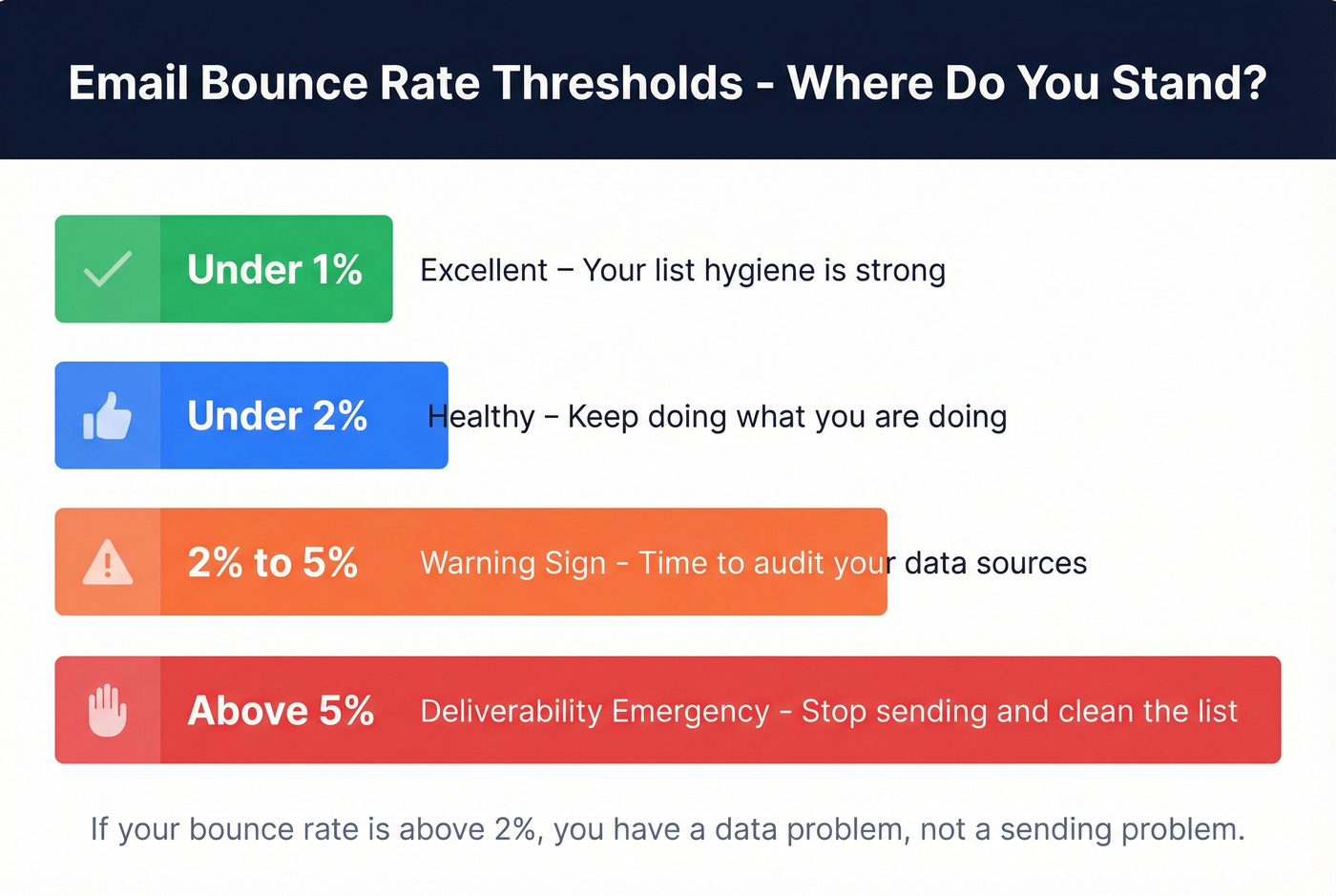
Here's the threshold ladder we use:
- Under 1% - Excellent. Your list hygiene is strong.
- Under 2% - Healthy. Keep doing what you're doing.
- 2-5% - Warning sign. Time to audit your data sources.
- Above 5% - Deliverability emergency. Stop sending until you clean the list.
If your bounce rate is above 2%, you have a data problem, not a sending problem. Full stop.

If your bounce rate is above 2%, the fix isn't sending less - it's better data. Prospeo's 5-step verification catches bad addresses, spam traps, and catch-all black holes before they torch your sender reputation. Snyk dropped from 35-40% to under 5%. Stack Optimize holds under 3% with zero domain flags.
Stop guessing which emails are real. Verify at 98% accuracy for $0.01 each.
Bounce Rates by Industry
Not all lists are created equal. Opt-in marketing campaigns in stable industries run remarkably low bounce rates, while B2B cold outreach sits in a different universe entirely - and comparing the two is like comparing apples to engine parts.
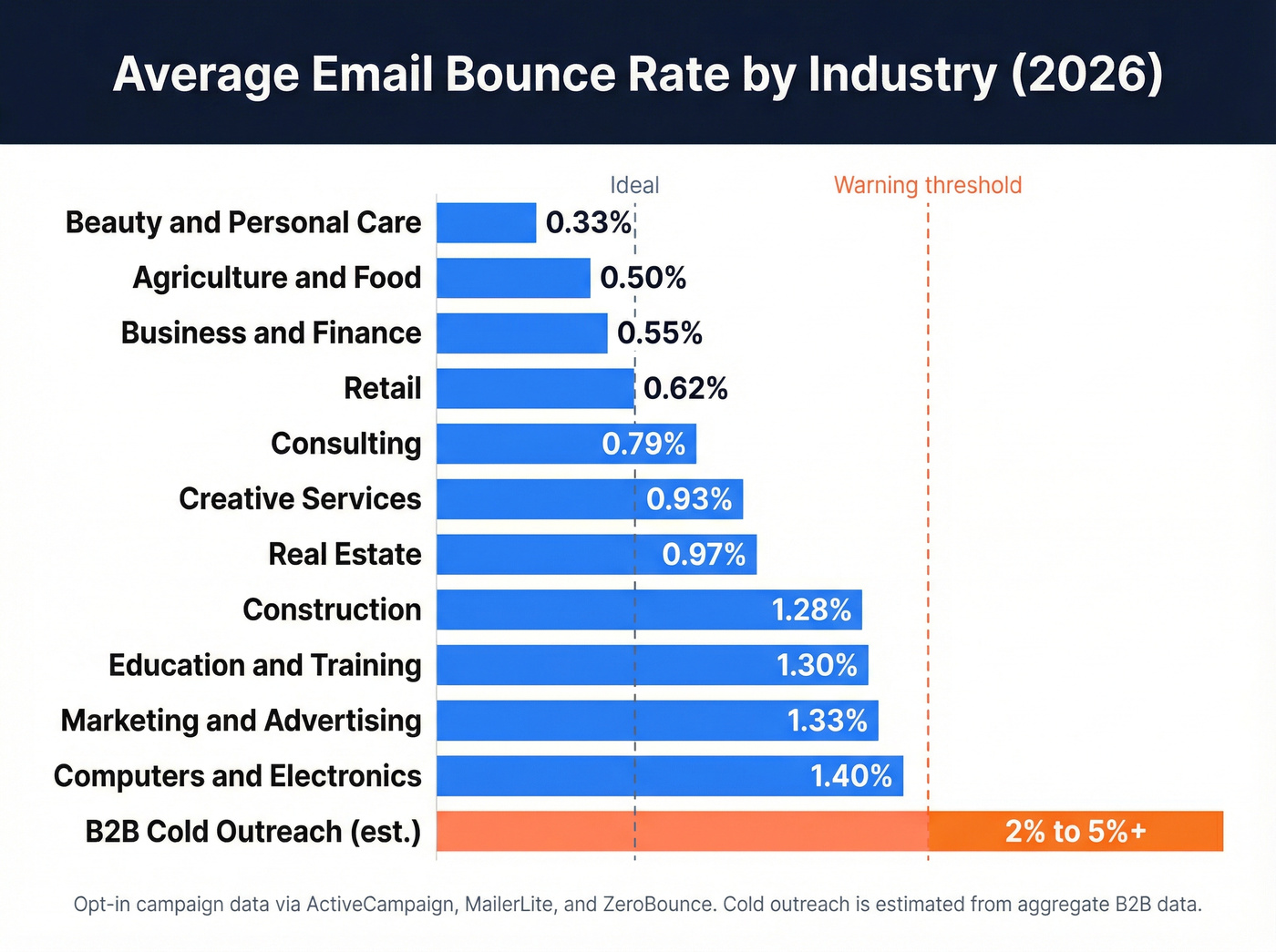
| Industry | Avg. Bounce Rate |
|---|---|
| Beauty & Personal Care | 0.33% |
| Agriculture & Food | 0.50% |
| Business & Finance | 0.55% |
| Consulting | 0.79% |
| Creative Services | 0.93% |
| Retail | 0.62% |
| Real Estate | 0.97% |
| Construction | 1.28% |
| Education & Training | 1.30% |
| Marketing & Advertising | 1.33% |
| Computers & Electronics | 1.40% |
| B2B Cold Outreach (est.) | 2-5%+ |
Opt-in campaign benchmarks via ActiveCampaign and MailerLite industry data, plus Mailchimp-by-industry figures summarized by ZeroBounce. Cold outreach is an estimate based on aggregate B2B data.
The gap between opt-in and cold outreach exists because B2B contact data decays at roughly 22.5% per year. People change jobs, companies rebrand domains, inboxes get deactivated. A list that was clean in January can bounce 5%+ by October if you're not actively maintaining it (more detail: B2B contact data decay).
Why Your Bounce Rate Keeps Climbing
Email data rots faster than most teams realize. ZeroBounce's analysis of 11 billion+ emails verified in 2025 found that at least 23% of any email list degrades annually - down from 28% the prior year, but still roughly a quarter of your database going stale every twelve months. B2B is worse: contact data invalidates at approximately 2.1% per month, and in tech startups, decay hits 30-40%.
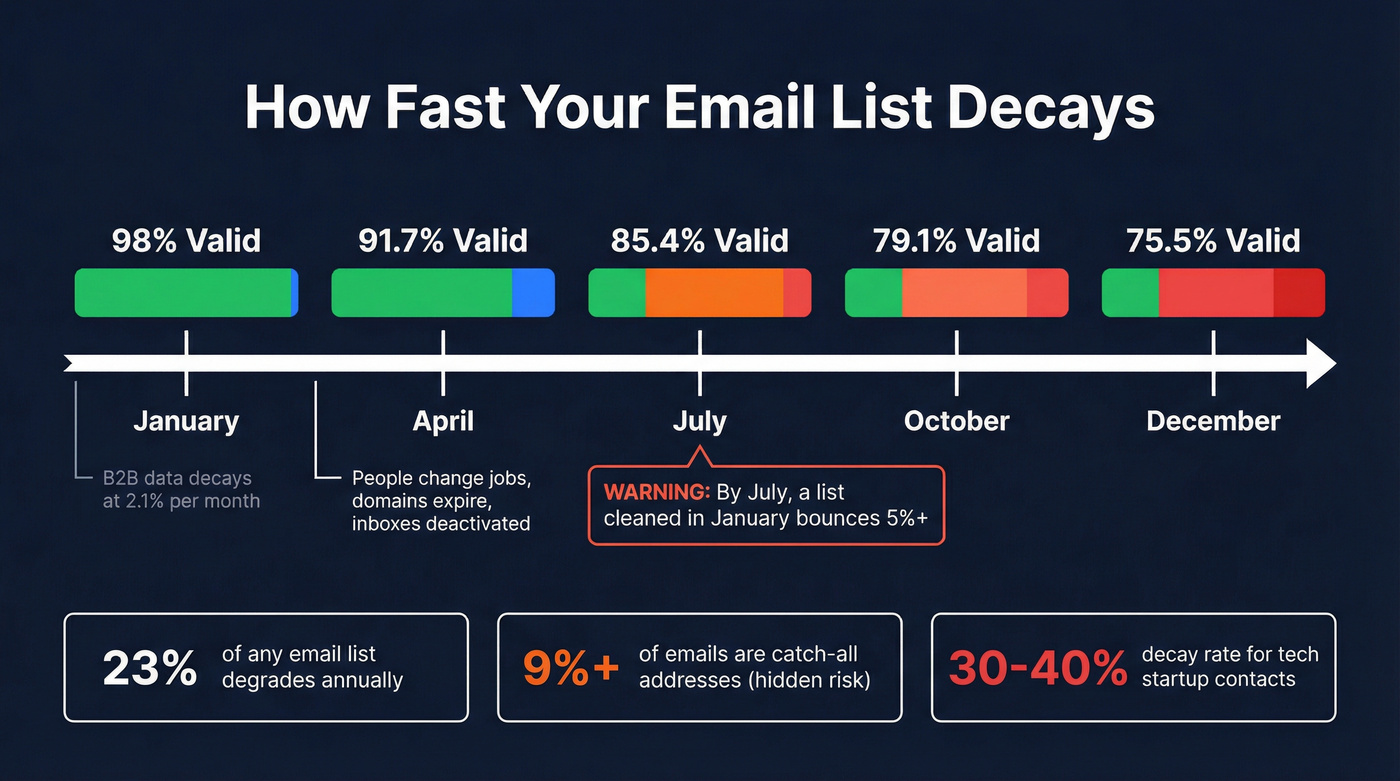
Here's a number most people miss: over 9% of emails verified were catch-all addresses. They accept everything but silently discard your message, making them a hidden risk that doesn't show up until your deliverability tanks. We've watched teams celebrate a "low bounce rate" while half their emails were landing in catch-all black holes.
Global inbox placement averages around 84% according to Validity/Litmus benchmarks, but that masks provider-level gaps: Gmail delivers 87.2% to the inbox while Microsoft sits at 75.6%. High bounce rates accelerate the slide toward spam folders across all providers, and the damage compounds with every campaign you send to an uncleaned list. (If you're troubleshooting the full picture, use an email deliverability checklist.)
How to Fix a High Bounce Rate
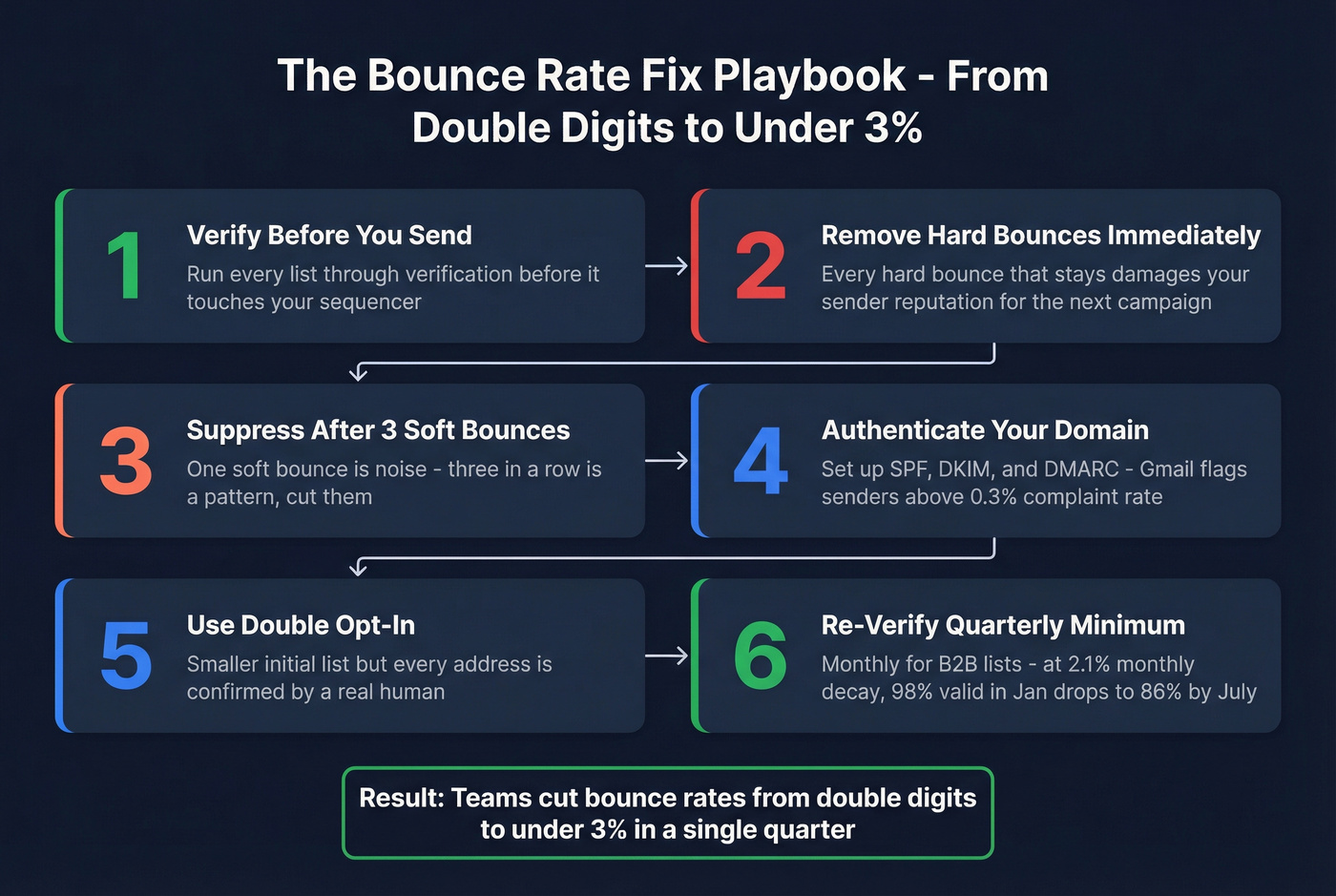
If you're above 2%, here's the playbook. We've seen teams cut bounce rates from double digits to under 3% in a single quarter by following these steps in order.
Verify Before You Send
This is the single highest-impact action you can take. Run every list through a verification tool before it touches your sequencer. Prospeo's 5-step verification - including catch-all handling, spam-trap removal, and honeypot filtering - delivers 98% email accuracy at roughly $0.01 per email. Snyk cut their bounce rate from 35-40% to under 5% after switching, and Stack Optimize maintains under 3% bounce with zero domain flags across all clients. (Tooling options: email ID validators and email checker tools.)
Remove Hard Bounces Immediately
Every hard bounce that stays on your list damages your sender reputation for the next campaign. Most ESPs flag these automatically - make sure the suppression is actually working and not just logging the bounce without removing the address. (If you're cleaning inside your CRM, start with CRM verify.)
Suppress After Three Consecutive Soft Bounces
A single soft bounce is noise. Three in a row is a pattern. Cut them.
Authenticate Your Domain
SPF, DKIM, and DMARC aren't optional anymore. Gmail deliverability is highly sensitive once spam complaint rates creep above 0.3%, and high bounce rates accelerate the path to those thresholds. If you haven't set up DMARC yet, that's your weekend project. (Full setup guide: SPF, DKIM, DMARC explained.)
Use Double Opt-In for Marketing Lists
It typically reduces initial list size but dramatically improves data quality. Every address on your list has been confirmed by a real human clicking a real link.
Re-Verify Quarterly at Minimum
Monthly is better for B2B lists. At 2.1% monthly decay, a list that was 98% valid in January drops to about 86% validity by July if you do nothing. That's not a slow leak - it's a burst pipe.
Let's be honest: if your average deal size is under $10k, you probably don't need to obsess over bounce rates below 2%. The ROI on chasing perfection from 1.8% to 0.5% is negligible compared to writing better emails. Fix the data floor, then focus on copy (use these outreach email templates if you need a baseline).
FAQ
What's a good bounce rate for email?
Under 2% for opt-in campaigns, under 1% is excellent. For cold outreach, aim for under 3% - anything above 5% signals a data quality emergency that risks your sender reputation and can get your domain blacklisted.
What causes a sudden bounce rate spike?
A stale list is the most common culprit. Email lists degrade at ~23% per year, so if you haven't cleaned your database in 3+ months, start there. Less common causes include domain authentication failures like broken SPF/DKIM records, or your ESP's shared IP reputation dropping because another sender on the same IP got flagged.
How often should I clean my email list?
Quarterly at minimum, monthly for B2B lists where data decays at 2.1% per month. Tools with frequent data refresh cycles - Prospeo refreshes every 7 days, for instance - mean you're validating against current records rather than month-old snapshots that are already going stale.
Does a high bounce rate affect deliverability?
Yes - directly and quickly. ISPs like Gmail and Microsoft track sender reputation at the domain level. Sustained bounce rates above 5% push your future sends toward spam folders, even for valid addresses. The damage compounds with every campaign you send to an uncleaned list, and recovering a burned domain reputation can take months.
B2B contact data decays at 2.1% per month. A list that was clean in January bounces 5%+ by summer. Prospeo refreshes all 300M+ profiles every 7 days - not the 6-week industry average - so your data stays valid between cleans.
Kill bounce rate creep with data that refreshes weekly, not monthly.