

B2B Product Positioning: From Strategy to Cold Email in One Framework
Your CEO just came back from a board meeting and said "nobody understands what we do." Sales describes the product one way, marketing another, and the product page reads like it was written by a third company entirely. Buyers spend only 17% of their purchase time with any vendor - every confused touchpoint burns a slot you can't get back.
That's a positioning problem. And it's the most expensive kind because it masquerades as a dozen other issues - low conversion, long sales cycles, discounting, stalled inbound - before anyone traces it to the root cause.
The Three-Question Diagnostic
Can your team answer these in one sentence each?
- Who do you help?
- What problem do you solve?
- How does your product work?
Ask your CEO, your head of product, and your newest SDR. If you get three different answers, you have a positioning problem. Most teams do.
The fix isn't a two-day offsite or a $30k brand workshop. Skip the brand workshop - it's a delay tactic disguised as strategy. It's April Dunford's framework applied in a focused afternoon, then pressure-tested across every touchpoint: homepage, sales deck, cold email, AI discovery. You need a small room, the right people, and a willingness to make choices that exclude some buyers to resonate deeply with others.
What B2B Positioning Actually Means
Positioning is the internal strategic decision about where your product fits in a buyer's mind relative to alternatives. It's not a tagline. It's not a homepage headline. It's not messaging. Those are all outputs of positioning - they're how the decision gets expressed externally.
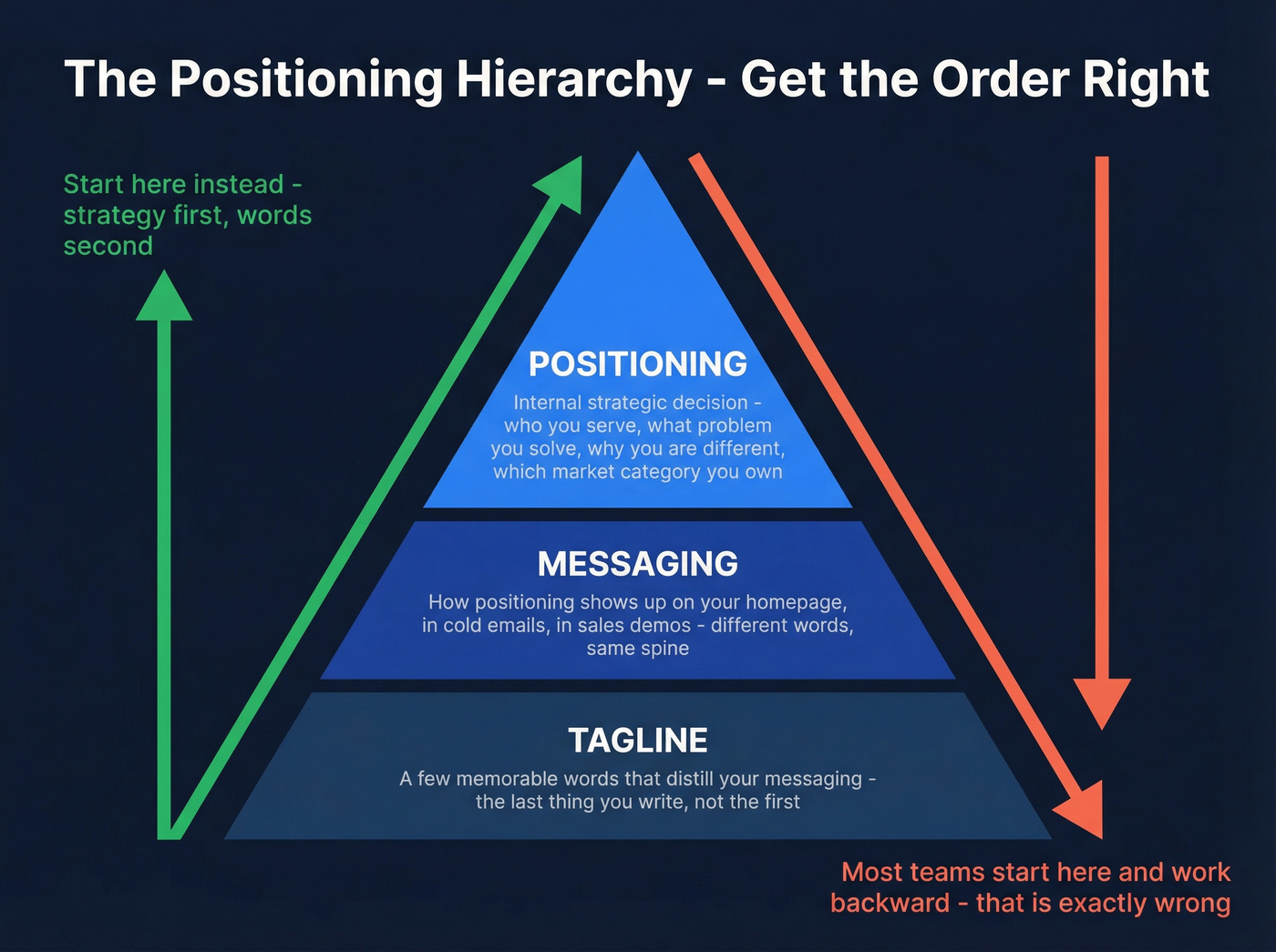
This distinction trips up even experienced product marketers. A thread on Dunford's Substack captures the confusion well: does positioning become a single one-liner used everywhere, or is it an internal anchor that manifests differently across channels? Treat it as an internal anchor. Positioning is the strategic spine, and messaging is how that spine shows up on your homepage versus in a cold email versus in a sales demo.
Think of it as a hierarchy. Positioning sits at the top: who you serve, what problem you solve, why you're different, and which market category you compete in. Messaging translates that into language for specific audiences and channels. A tagline distills messaging into a few memorable words. Most teams start at the tagline and work backward - that's exactly wrong.
Positioning as a GTM Multiplier
In a $32.11 trillion global B2B eCommerce market, the companies that win aren't the ones with the best product. They're the ones buyers understand fastest.
With buyers spending just 17% of their purchase journey with any vendor, and 87% of B2B purchases involving four or more stakeholders, your positioning needs to survive being relayed to a buying committee where half the people have never visited your website. If your champion can't explain what you do in 15 seconds, you lose the deal in a meeting you weren't invited to.
Clearer positioning typically improves website conversion and sales qualification efficiency by 10-30%. Here's the math: if your pipeline generates 100 qualified opportunities per quarter and better positioning moves your win rate from 20% to 25%, that's five extra closed deals with zero additional demand gen spend. Positioning is the highest-leverage element of any B2B product marketing strategy because it compounds across every channel without requiring incremental budget.
How to Diagnose a Positioning Gap
Start with the Powered By Search positioning canvas: Who do you help? What problem do you solve? How does your product work? Ask five people across product, sales, and marketing. Five different answers means you've found your problem.
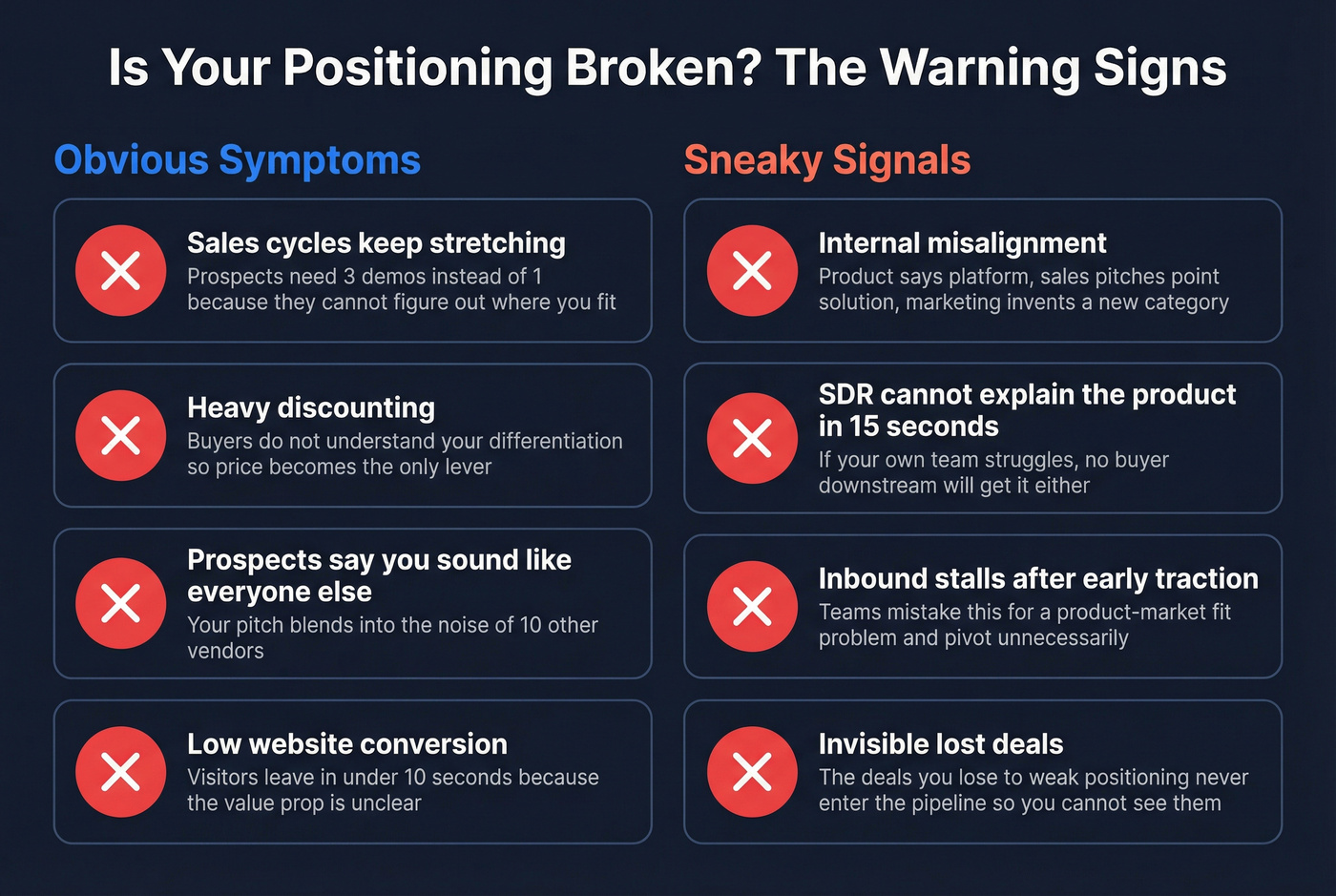
Here's the thing - the symptoms are usually hiding in plain sight. Sales cycles keep stretching because prospects need three demos instead of one. They can't figure out where you fit. Heavy discounting creeps in because when buyers don't understand your differentiation, price becomes the only lever. Prospects tell you "you sound like everyone else."
Then there are the subtler signals. Internal misalignment is the big one: product describes a platform, sales pitches a point solution, marketing writes about a category that doesn't exist yet. If your SDR can't explain the product in 15 seconds, nobody downstream will either - and that person is sending 200 cold emails a day. The sneakiest signal is when inbound stalls after early traction. Teams mistake this for a product-market fit problem, leading to unnecessary pivots when the real issue is that the market doesn't understand what they're buying. The deals you lose to weak positioning never enter the pipeline, so you can't see them.

You just nailed your positioning. Now your SDR sends 200 cold emails and 35% bounce. That's not a messaging problem - it's a data problem. Prospeo's 98% email accuracy and 7-day data refresh mean your positioning actually reaches the buyers it was built for.
Don't let bad data undo great positioning. Start with 75 free emails.
The B2B Positioning Framework
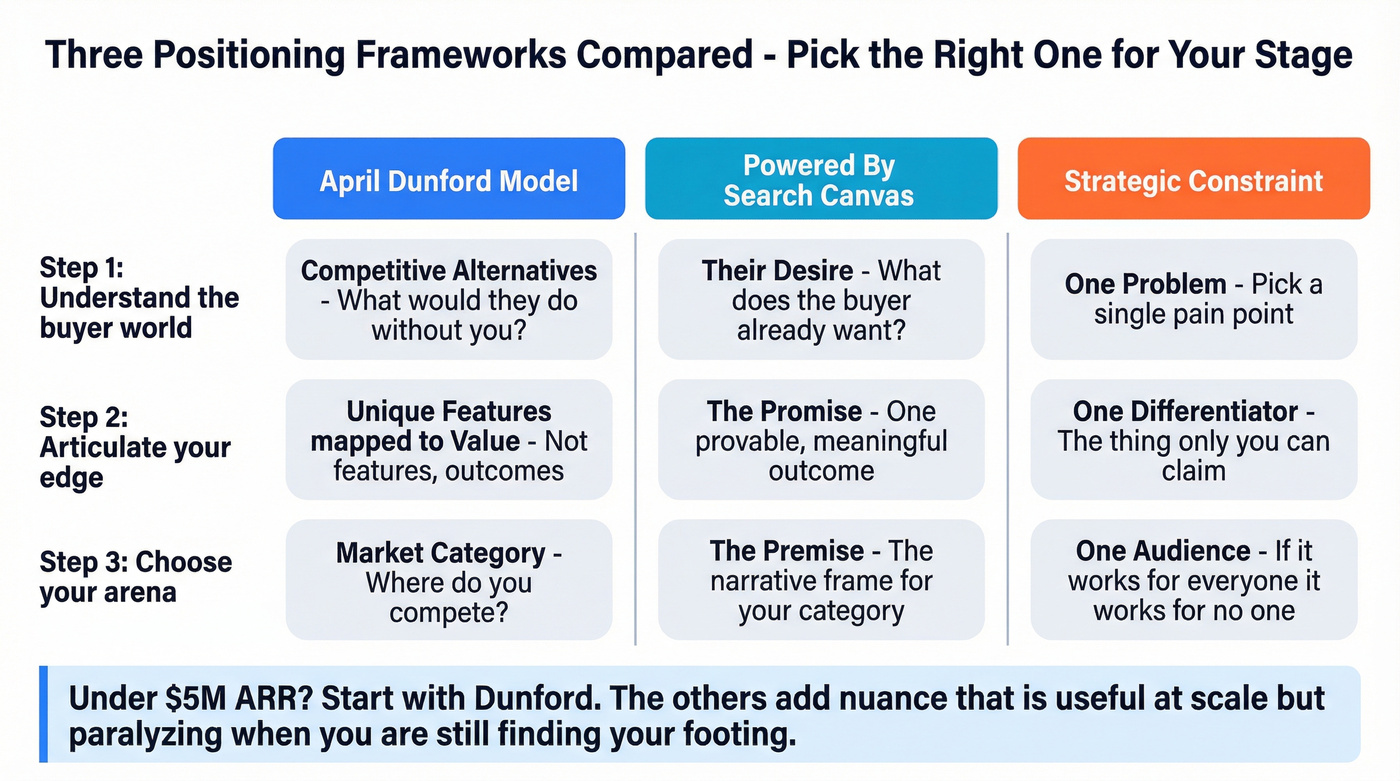
There's no shortage of positioning frameworks. Dunford's approach, Powered By Search's SaaS canvas with its "Their Desire → The Promise → The Premise" structure, the strategic constraint approach - they all work. We've synthesized a version that borrows the strongest elements from each.
What Would They Do Without You?
Don't start with your product. Start with what your customers would do if you didn't exist - a direct competitor, a spreadsheet, an intern, or doing nothing at all. List every realistic alternative, not just the ones you want to compete against. In the Powered By Search canvas, this maps to "Their Desire": what does the buyer already want, and how are they currently trying to get it? This grounds your positioning in the buyer's reality, not your internal narrative.
Map Features to Value
For each competitive alternative, identify what you do that they can't. Then translate those unique features into the value they create for a specific buyer. "We have real-time data sync" is a feature. "Your reps never call a prospect who already bought from a competitor" is value. Big difference.
This is where you build "The Promise" from the Powered By Search model: the specific, defensible outcome you deliver. Focus on one claim that's both provable and meaningful to your target buyer - not three vague benefits that could describe any competitor.
Define Your Market Category
This is where most teams either play it too safe or get too creative. You're either entering an existing category and competing head-to-head with established players, or creating a new one, which requires significantly more education spend. The strategic constraint model is blunt: pick one problem, one moment in the buyer's journey, and one audience. If your positioning statement works for "any company that wants to grow," it works for no one.
Hot take: If you're under $5M ARR, Dunford's framework is the only one worth your time. The others add nuance that's useful at scale but paralyzing when you're still finding your footing.
| Step | Dunford's Model | Powered By Search Canvas | Strategic Constraint |
|---|---|---|---|
| 1. Understand the buyer's world | Competitive Alternatives | Their Desire | One problem |
| 2. Articulate your edge | Unique Features → Value | The Promise | One differentiator |
| 3. Choose your arena | Market Category | The Premise | One audience |
Validate With Research Inputs
Positioning without market data is just opinion. ZoomInfo's GTM strategy templates provide a solid TAM/SAM/SOM calculation using top-down, bottom-up, and value theory methods. In mature markets, your serviceable obtainable market is typically 1-5% of SAM - a useful reality check on how narrow your positioning should be.
Build persona templates alongside this: map each target buyer's role in the decision, budget authority, evaluation criteria, information sources, and the proof points they need to say yes. Layer in competitive scoring across target market, product strength, pricing model, and GTM strategy. This isn't academic busywork - it's the evidence that tells you whether your positioning is defensible or aspirational.
How AI Discovery Changes Positioning
Most positioning guides haven't caught up to this: LLMs are now the first interpreter of your brand for a growing share of B2B buyers.
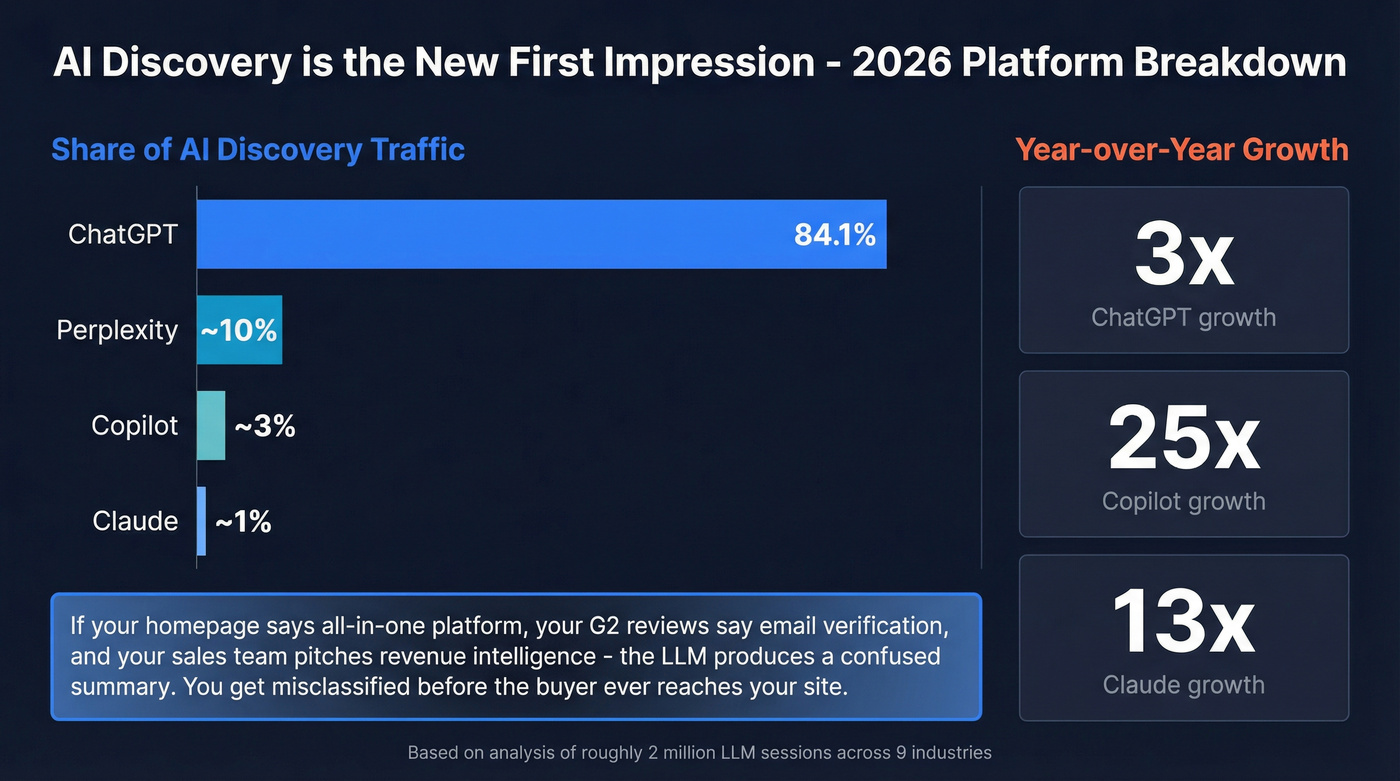
According to a 2026 analysis of ~2 million LLM sessions across nine industries, ChatGPT commands 84.1% of trackable AI discovery traffic. The growth rates have been staggering - ChatGPT grew 3x, Copilot 25x, and Claude 13x. When a VP of Engineering asks ChatGPT "what's the best tool for X," the answer gets synthesized from every piece of content, review, and documentation that mentions your brand.
If your positioning is inconsistent - your homepage says "all-in-one platform," your G2 reviews say "great for email verification," and your sales team pitches "revenue intelligence" - the LLM produces a confused summary. You get misclassified before the buyer ever reaches your website.
The fix: lead with positioning before tactics. Build topic depth over content volume - LLMs reward authority and coherence over keyword-stuffed blog posts. Unify language across every team and touchpoint. When marketing says "operational efficiency" and sales says "process improvements," you're training AI models to be confused about what you actually do. Consistent language across your website, sales enablement, and third-party profiles ensures AI models represent you accurately. Discovery is also fragmenting by platform - Perplexity holds 24% share in finance, while Copilot is strongest where work happens inside the Microsoft ecosystem. A multi-platform positioning strategy isn't optional anymore.
From Positioning to Execution
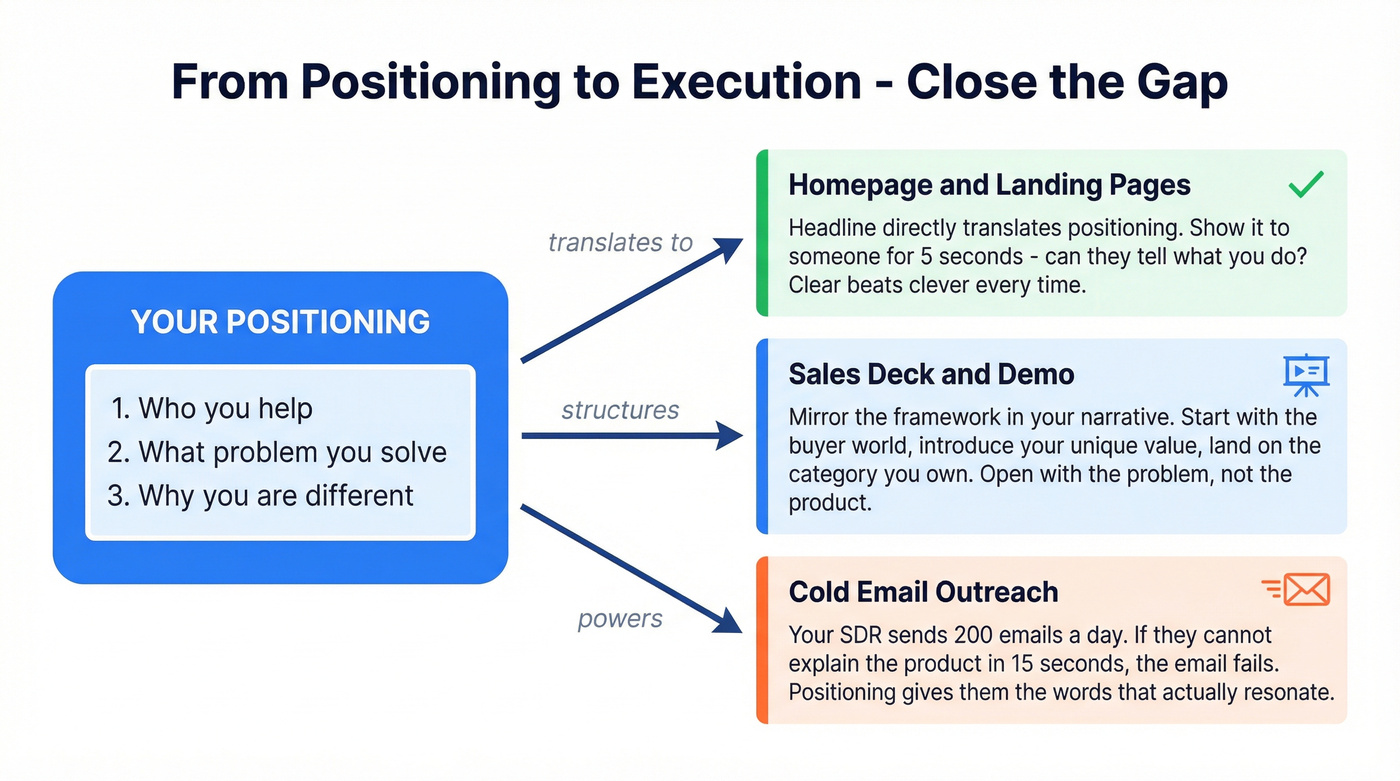
Most positioning guides end with "write a positioning statement." That's like ending a cooking class with "now make dinner." Let's close the execution gap.
Homepage and Landing Pages
Your homepage headline should directly translate your positioning - who you help, what problem you solve, and a hint at how. Not a clever tagline. A clear statement that makes the right buyer think "this is for me" within three seconds. Test it by showing the page to someone outside your company for five seconds, then asking what the product does.
Sales Deck and Demo
Mirror the positioning framework in your narrative: start with the buyer's world, introduce your unique value, and land on the market category you own. Every demo should open with the problem, not the product. We've seen teams cut their average sales cycle by weeks just by restructuring the first five minutes of their demo around positioning instead of features.
Cold Email and Outbound
This is where positioning lives or dies at scale. Your SDR sends 500 cold emails this week. Reply rate is 0.5%. The opening line sounds like every other vendor in the inbox.
That's not a copywriting problem - it's a positioning problem.
But positioning is theoretical until you can reach the right person with accurate data. You've defined your ICP through the framework above - now you need to find those people. Prospeo covers 300M+ professional profiles with 98% email accuracy and a 7-day data refresh cycle, with 30+ search filters including buyer intent data tracking 15,000 topics. The worst thing that can happen to great positioning is sending it to the wrong person at a bounced email address.

Positioning tells you who to target. Prospeo helps you find them. Use 30+ filters - buyer intent, technographics, headcount growth, funding - to build lists that match your ideal customer profile exactly. Then reach them with verified emails at $0.01 each.
Turn your positioning framework into pipeline today.
Common Positioning Mistakes
Confusing positioning with a tagline. A tagline is five words. Positioning is a strategic framework that informs everything from product roadmap to sales enablement. If your "positioning exercise" produced a sentence and nothing else, you did messaging, not positioning.
The "all-in-one platform" trap. Unless you have HubSpot's budget or Salesforce's install base, positioning as an all-in-one means you compete with everyone and resonate with no one. The strongest positioning is a strategic constraint - one problem, one audience, one differentiator. Every experienced product marketer we've talked to agrees on this, yet teams keep making the mistake because "all-in-one" feels safer.
Imagine you're a Series B startup selling to mid-market finance teams. You position as "the all-in-one finance platform." Now you're competing with Netsuite, Brex, Ramp, and a dozen others simultaneously. Narrow to "real-time cash flow visibility for multi-entity finance teams" and suddenly you own a conversation nobody else is having.
Internal misalignment left unchecked. Product says one thing, sales another, marketing a third. This was always a problem. Now AI amplifies it - every inconsistent touchpoint trains LLMs to misrepresent you. A quarterly positioning sync across teams isn't bureaucracy. It's hygiene.
Treating positioning as a one-time exercise. Markets shift. Competitors enter. Your product evolves. Positioning that was perfect 18 months ago might be actively hurting you today. The consensus on r/ProductMarketing is that annual reviews are the bare minimum, with quarterly check-ins for fast-moving categories.
FAQ
What's the difference between positioning and messaging?
Positioning is the internal strategic decision about who you serve, what problem you solve, and why you're different from alternatives. Messaging translates that decision into channel-specific language - your homepage, cold emails, and sales decks each express the same strategic spine differently. A tagline is one output of messaging, not positioning itself.
How often should you revisit positioning?
Revisit when you enter a new segment, launch a major feature, see sustained win-rate drops below 15%, or notice internal teams describing the product differently. A quarterly 30-minute alignment check works for most B2B companies - anything less frequent risks drift.
What's the biggest positioning mistake B2B companies make?
Positioning as an "all-in-one platform" when you lack the budget to educate an entire category. The strongest B2B positioning is a strategic constraint - one problem, one audience, one differentiator. Narrow positioning feels risky but consistently outperforms broad claims in win rate and sales cycle length.
How do you test whether your positioning is working?
Run a 15-second test: can your newest SDR explain what you do and get a prospect to say "tell me more"? Then validate with real outbound - target your exact ICP, pull verified contacts, run a sequence, and measure reply rates. If the right people respond at 3%+ reply rates, your positioning is landing.