

Spintax Generator: Syntax, Strategy & What Actually Works in 2026
You're spinning 64 variations of your cold email, feeling clever about deliverability - and your bounce rate is still 30%. That's because no spintax generator fixes the wrong problem first. An analysis of 44 million emails found reply rates of 1.09% with spintax versus 1.28% without - a rounding error. Meanwhile, 71% of decision-makers say the real issue with cold emails is lack of relevance.
Spintax is a useful layer in your deliverability stack, but it's not the layer most teams should obsess over. Fix your list and your message before you fix your syntax.
Here's the thing: most teams would get more ROI spending that same hour verifying their contact list. Spintax keeps you out of spam. Clean data and relevant messaging get you replies.
The Short Version
- Syntax in one line:
{option1|option2|option3}- curly braces, pipe separators, one option selected at random per send. - How many variations: Aim for 8-12 per email. Three spintax blocks with four options each produce 64 unique combinations.
- The data: 44M emails analyzed - spintax didn't improve reply rates in that dataset.
- The bigger lever: Verified data and message relevance move the needle far more than spinning synonyms.
What Is Spintax?
Spintax - short for "spinning syntax" - is a markup format that lets you define multiple text variations inside a single email template. The sending tool randomly selects one option per block, so each recipient gets a slightly different message. A spintax generator automates this process, producing the curly-brace-and-pipe markup for you instead of requiring you to write it by hand. Generator tools are useful when you need dozens of email variations fast, but understanding the syntax yourself gives you far more control over tone and quality.
The format is straightforward: wrap your options in curly braces and separate them with pipes. {Glad to connect|Nice to meet you|Thanks for your time} becomes one of those three phrases per send. One important gotcha: single curly braces { } are standard spintax syntax, while double curly braces {{ }} are typically reserved for personalization variables on most platforms. Mix them up and your template breaks.
Without spintax, every prospect gets the identical sentence: "I'd love to show you how we help teams like yours." With spintax: {I'd love to show you|Let me walk you through|Happy to share} how we help {teams like yours|companies in your space|organizations facing similar challenges}. That single line now produces nine unique combinations.
Syntax Guide
Basic Format
Curly braces define the block, pipes separate the options:
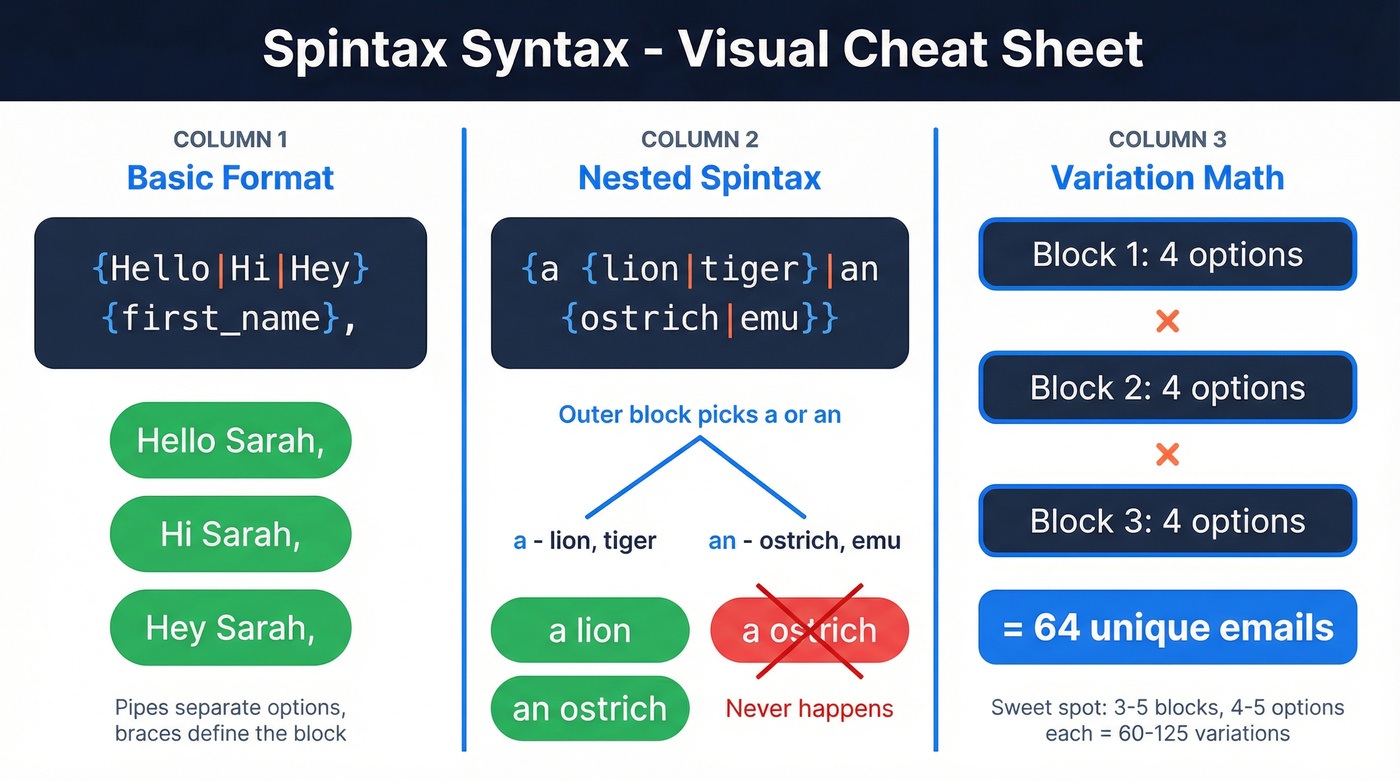
{Hello|Hi|Hey} {first_name},
The sending tool picks one option from each block at random. Every block operates independently, so two blocks with three options each yield nine combinations. The pipe character | is the separator - no spaces before or after unless you want them in the output.
Special characters: If your email text needs a literal {, |, or }, spintax parsing can get messy depending on the platform. The safest workaround is to avoid these characters in your copy entirely. Test your template in your specific platform before sending at scale.
Nested Spintax
Nesting is where spintax gets genuinely useful. You place one spintax block inside another to keep grammatically dependent words together. The classic example from Postmaker's guide handles article agreement:
Would you like {a {lion|tiger|zebra}|an {ostrich|emu|iguana}}?
The outer block chooses between the "a" group and the "an" group. The inner block then picks the specific animal. Every output is grammatically correct - you'll never get "a ostrich" or "an tiger." This same principle applies to verb conjugation, pronoun agreement, and any scenario where swapping one word requires changing another.
How Many Variations?
The math is simple multiplication. Three spintax blocks with four options each gives you 4 x 4 x 4 = 64 unique combinations from a single template. Ditlead recommends 8-12 strategic variations per email, which matches what we've found in our own campaigns.
Don't overdo it. Twenty options per block sounds impressive, but it creates maintenance headaches and increases the odds of tone drift - where one combination sounds professional and another sounds like a different person wrote it. Three to five well-crafted blocks with four to five options each gives you 60-125 unique versions, more than enough for any campaign.
Does Spintax Actually Improve Results?
The 44-million-email analysis showed reply rates of 1.09% with spintax versus 1.28% without. That's not a win for spintax. It's a wash.
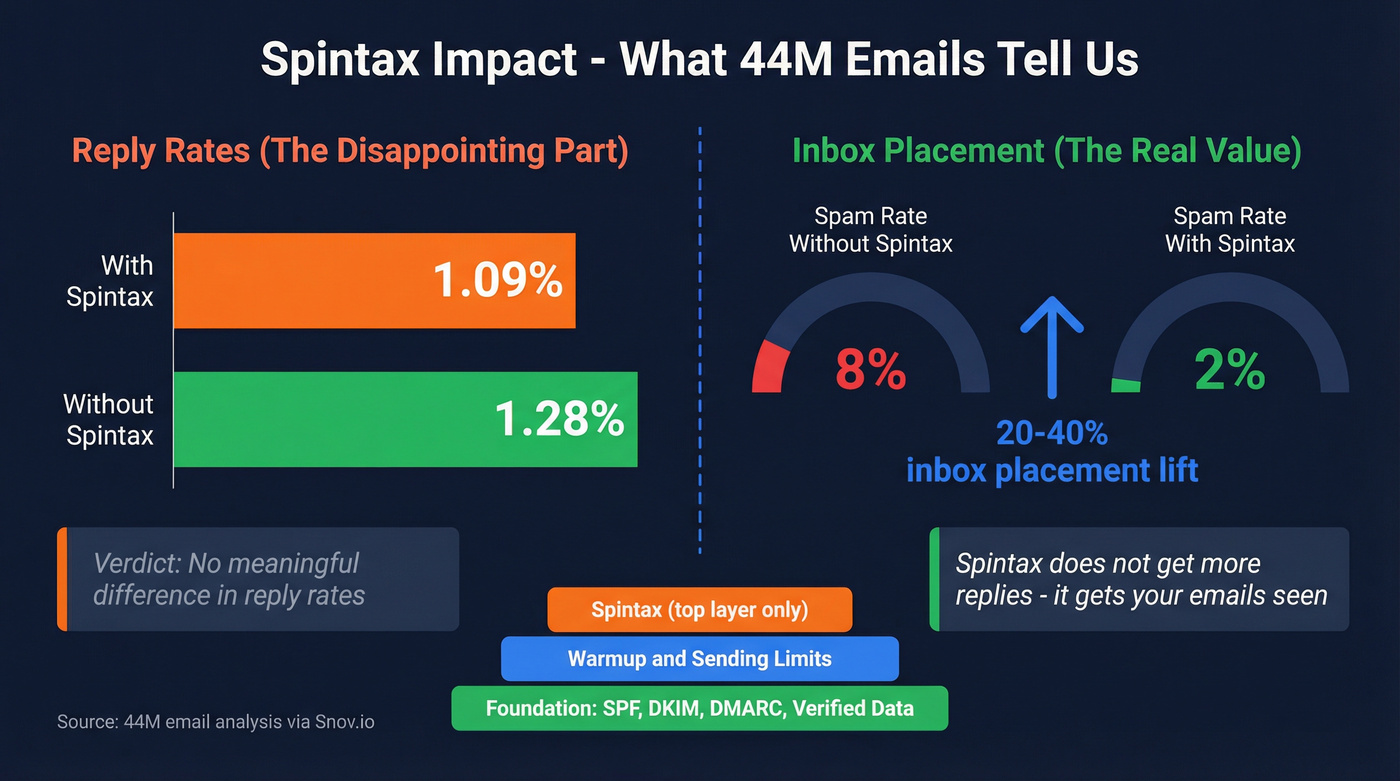
But reply rate isn't the whole story. Spintax's real value is upstream: inbox placement. When you send 5,000 identical emails, ESPs flag the pattern fast. Spintax breaks that template fingerprint. DitLead's benchmarks put inbox placement lift around 20-40% in spintax-heavy campaigns, with spam rates dropping from 8% to 2%.
Cold email benchmarks help frame expectations. Open rates can reach up to 60% in well-targeted campaigns, with typical response rates landing between 1-5%. Spinning copy won't transform a 1% reply rate into a 5% reply rate. What it does is make sure your emails land in the primary inbox instead of spam, giving your copy a chance to perform.
Let's be honest about the hierarchy here. Spintax is the top layer of a deliverability stack, not the foundation. The foundation is domain authentication (SPF, DKIM, DMARC), proper warmup, and verified contact data. Skip the foundation and no amount of spinning saves your campaign.

The article says it clearly: spintax is the top layer, not the foundation. The foundation is verified contact data. Prospeo's 5-step email verification delivers 98% accuracy and under 4% bounce rates - so your spintax variations actually reach real inboxes.
Stop spinning emails into spam folders. Verify your list first.
Best Practices for Cold Email Spintax
Spin at the section level, not the word level. Swapping individual words ("great" vs "awesome") creates awkward tone shifts. Swap entire clauses or sentences instead - the output reads naturally and ESPs have a harder time detecting patterns.
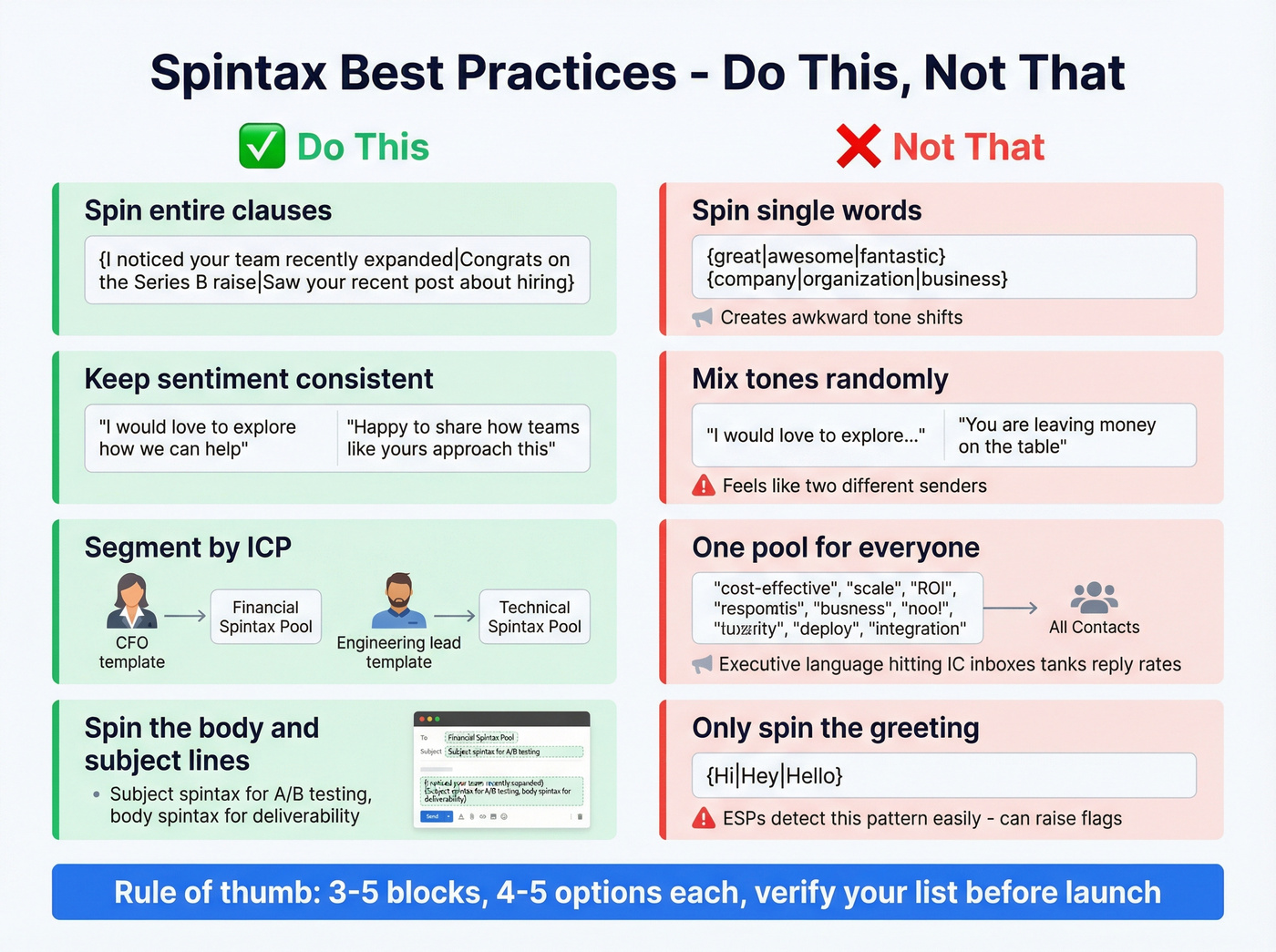
Keep sentiment consistent across variants. If one variant is consultative ("I'd love to explore how we can help), don't pair it with an aggressive alternative ("You're leaving money on the table"). Every combination should feel like it came from the same person.
Segment spintax pools by ICP. A block written for CFOs shouldn't randomly appear in emails to engineering leads. Create separate templates - or at minimum separate variation pools - for each persona. We've seen teams tank reply rates by mixing executive-level language with individual-contributor messaging in the same spintax pool.
Don't rely on greeting-level spins. Instantly warns that modern ESPs detect obvious patterns, and simple {Hi|Hey|Hello} swaps can actually raise flags rather than help. Spin the body, not just the greeting.
Use subject line spintax for A/B testing and body spintax for deliverability. They serve different purposes - use both, but know which lever you're pulling. And verify your list before launching any campaign. Spinning 64 variations is pointless if 30% of your emails bounce.
Bad Data Kills Campaigns First
Here's a pattern we see constantly: a team spends hours crafting clever spintax variations, launches the campaign, and watches their sender reputation crater because a third of the list bounced. A 35% bounce rate destroys domain reputation faster than sending identical emails ever would. Spam filters don't care how unique your copy is if you're hitting dead addresses.
Prospeo's email verification runs a 5-step process with catch-all handling, spam-trap removal, and honeypot filtering - delivering 98% email accuracy on a 7-day refresh cycle. That refresh cadence matters because people change jobs constantly; data that was valid last month bounces today. Meritt switched to Prospeo and saw their bounce rate drop from 35% to under 4%, with pipeline tripling from $100K to $300K per week.
The free tier gives you 75 verified emails per month - enough to test the difference clean data makes before you commit.
Which Cold Email Tools Support Spintax?
Here's what each platform supports, useful context if you're evaluating the right tool for your workflow:
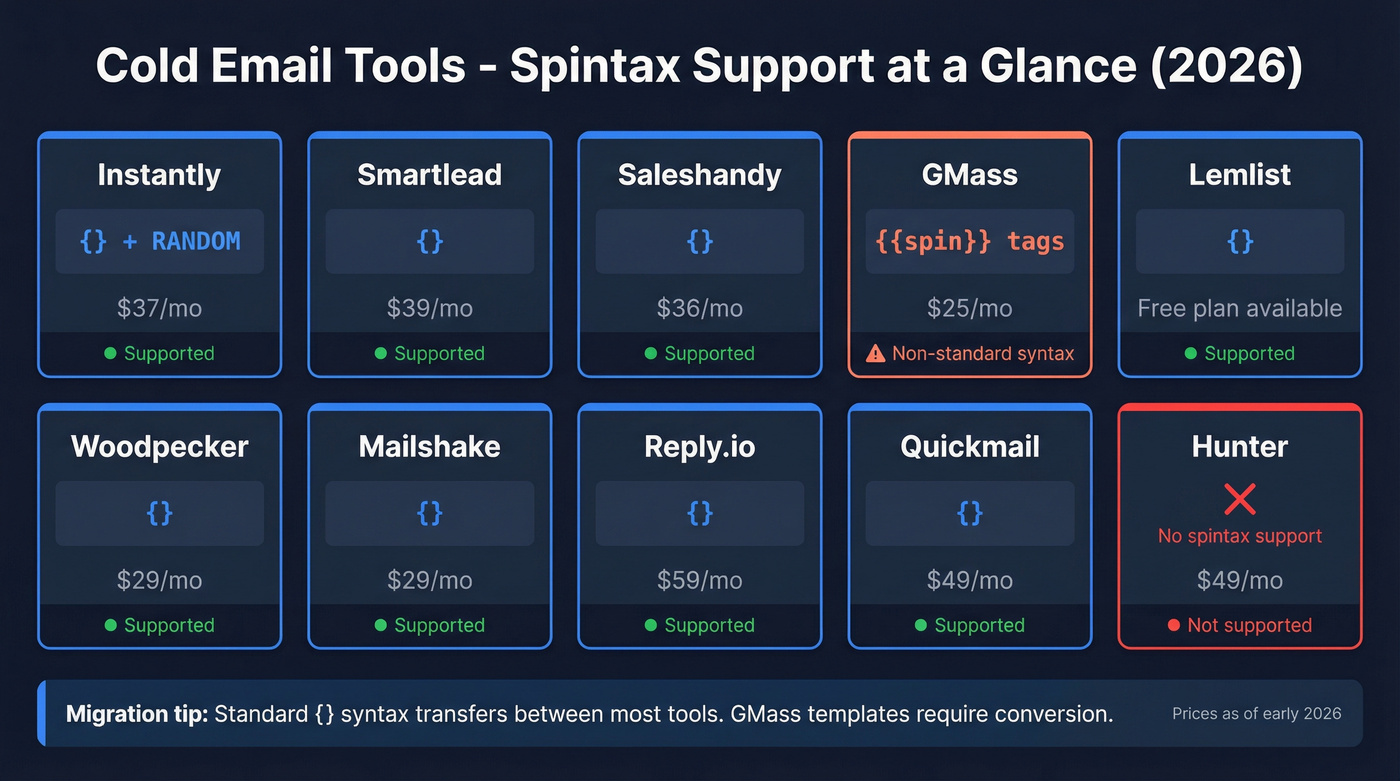
| Tool | Spintax | Syntax Notes | Price |
|---|---|---|---|
| Instantly | Yes | Standard {} + RANDOM |
$37/mo |
| Smartlead | Yes | Standard {} |
$39/mo |
| Saleshandy | Yes | Standard {} |
$36/mo |
| GMass | Yes | {{spin}} tags (non-standard) |
$25/mo |
| Lemlist | Yes | Standard {} |
Free plan available; paid from ~$39/mo |
| Woodpecker | Yes | Standard {} |
$29/mo |
| Mailshake | Yes | Standard {} |
$29/mo |
| Reply.io | Yes | Standard {} |
$59/mo |
| Quickmail | Yes | Standard {} |
$49/mo |
| Hunter | No | No spintax support | $49/mo |
GMass uses non-standard notation - you wrap variations in {{spin}} and {{end spin}} tags, with {{variation}} as the separator instead of pipes. GMass also has a "Maximize spintax randomization" account setting; with it off, GMass selects variations sequentially rather than randomly, which defeats the purpose. If you enable A/B testing in GMass, it overrides maximum randomization.
GMass also offers a Spam Solver deliverability tool that tests whether your variants land in Inbox vs. Promotions vs. Spam - worth using before you launch.
Instantly's RANDOM keyword placed before options improves distribution behavior across sends. Hunter Sequences explicitly lacks spintax along with A/B testing - if copy variation matters to your workflow, skip Hunter for sequencing.
For dedicated text-spinning tools rather than full outreach platforms, Salesforge and Folderly both offer standalone generators. They're useful for quick variation drafting, but you'll still paste the output into your sending platform. For most teams, the built-in support in tools like Instantly or Smartlead is sufficient.
One practical note: if you migrate between platforms, GMass templates won't work in Instantly and vice versa. Standard {} syntax transfers between most other tools without changes.
AI-Powered Spinning vs. Manual Personalization
The industry is moving past manual spintax toward per-recipient AI rewrites. Snov.io, Instantly, and others are building AI engines that generate unique copy for each contact based on ICP data, company signals, and persona context. GMass already offers ChatGPT integration that generates variations inside the composer. An AI-powered spintax generator can produce dozens of contextually relevant alternatives in seconds - a task that'd take a human writer an hour or more.
Think of it as complementary rather than competitive. Spintax handles deliverability hygiene - making sure ESPs don't cluster your sends as identical. AI personalization handles relevance - making sure the message actually resonates with the person reading it.
If you're still manually writing {Hi|Hey|Hello} blocks in 2026, you're solving a 2020 problem. Use a spinning tool to handle template-level uniqueness, then layer AI or manual personalization for the sentences that actually drive replies.
FAQ
Is spintax the same as article spinning?
Same syntax, completely different purpose. Article spinning rewrites content to create "unique" pages for SEO - a practice Google actively penalizes. Spintax in cold email creates minor copy variations to reduce template fingerprinting by spam filters. The technique is identical, but the use case and ethics are worlds apart.
Can email providers detect spintax?
Modern ESPs are getting smarter at pattern recognition. Instantly warns that obvious patterns - especially greeting-level spins like {Hi|Hey|Hello} - raise flags rather than help. Spin at the clause or sentence level, and always pair it with proper domain authentication (SPF, DKIM, DMARC).
How many variations do I actually need?
Aim for 8-12 strategic variations per email. Three blocks with four options each produce 64 unique combinations - more than enough for most campaigns. But variations mean nothing if your list isn't verified. A 98% accuracy verification tool with a weekly refresh cycle keeps bounce rates under 4%, so your spun emails actually reach real inboxes.
What's the best free option for generating spintax?
Salesforge, Postly, and Folderly all offer free browser-based tools that convert plain text into spintax markup. They're fine for quick drafts. But if you're already using Instantly, Smartlead, or Lemlist, spintax is built in - write your variations directly in the composer and skip the extra step.
You just learned that 44M emails showed no reply rate lift from spintax alone. The teams booking 26% more meetings use Prospeo's 300M+ verified contacts with 7-day data refresh - because relevant outreach to real people beats 64 synonym variations every time.
Spend less time spinning copy and more time closing deals.