

GTM Intelligence: What It Actually Is, What It Costs, and Where to Start
Your VP came back from a conference buzzing about "GTM intelligence." Now there's a Slack thread, a vendor demo on the calendar, and zero alignment on what the term even means. You're not alone - 95% of new products fail, and a big chunk of that failure traces back to go-to-market confusion, not product quality.
The Short Version
Go-to-market intelligence isn't a single product you buy. It's a capability you build from three layers: a verified data foundation, one intent signal source, and a workflow connecting signals to actions. You don't need a $50K platform to start.
What Is GTM Intelligence, Really?
ZoomInfo defines GTM intelligence as the fusion of high-quality B2B data, buying signals, and AI-fueled insights that recommend workflows and messaging. That's a decent starting point, but it undersells how the concept differs from the categories it absorbs. ZoomInfo reports its users see 32% more pipeline and 21% shorter sales cycles - vendor numbers, but they show the scale of outcomes teams are chasing.
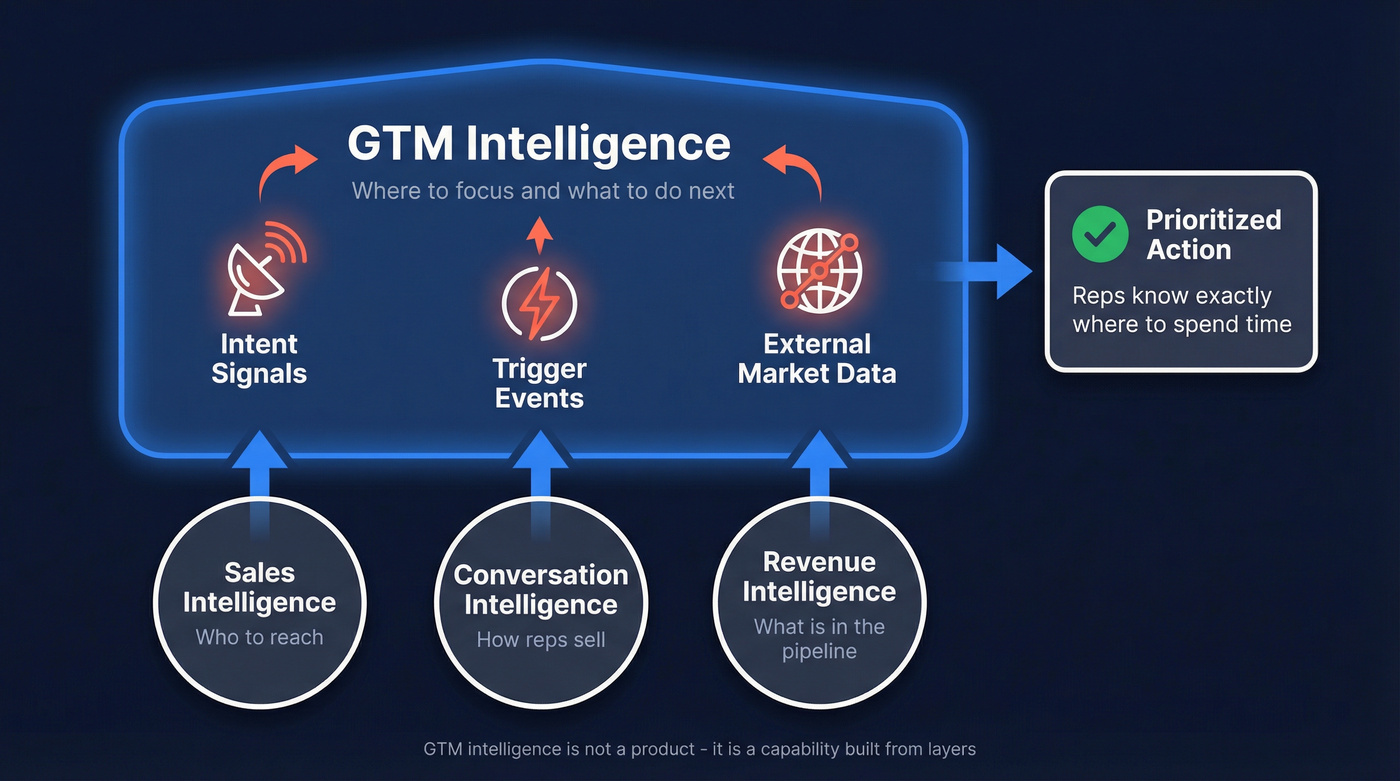
The prevailing take in RevOps communities is blunter: this is mostly a rebrand of sales + revenue intelligence, and the real differentiator is data quality, not AI features. They're not entirely wrong. But the taxonomy from Jiminny shows where the rebrand argument breaks down:
| Category | What It Answers | Example Tools |
|---|---|---|
| Sales Intelligence | Who to reach | ZoomInfo, Apollo |
| Conversation Intelligence | How reps sell | Gong, Chorus |
| Revenue Intelligence | What's in the pipeline | Clari, BoostUp |
| GTM Intelligence | Where to play | Combines all + intent + external signals |
Sales intelligence tells you who. Revenue intelligence tells you what's happening. A true go-to-market intelligence layer tells you where to focus by combining external market signals, buyer intent, and internal data into a prioritization engine. Don't confuse it with market research, which is periodic surveys and historical analysis. GTM intelligence adds the operational layer - it doesn't just inform, it directs action.
Signals That Power the Framework
A GTM intelligence framework runs on six signal types:
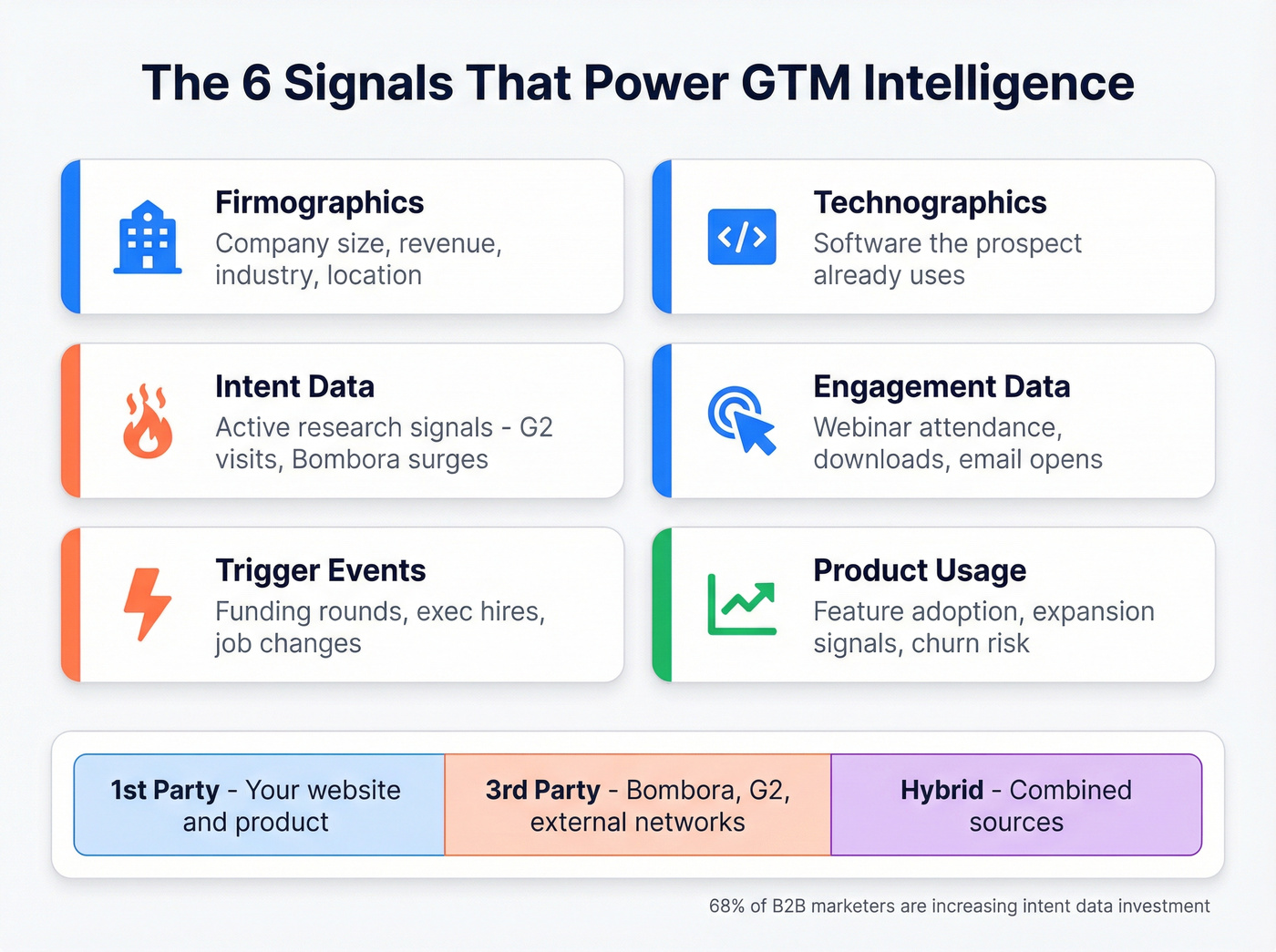
- Firmographics - company size, revenue, industry, location
- Technographics - what software a prospect already uses
- Intent data - behavioral signals showing active research like G2 visits or Bombora topic surges
- Engagement data - webinar attendance, content downloads, email opens
- Trigger events - funding rounds, executive hires, job changes
- Product usage - feature adoption, expansion signals, churn risk
These signals split into first-party signals from your own website and product data, third-party signals from external networks like Bombora or G2, and hybrid combinations. 68% of B2B marketers are ramping up investment in intent data specifically, because timing is the one variable that separates a warm lead from a cold one.
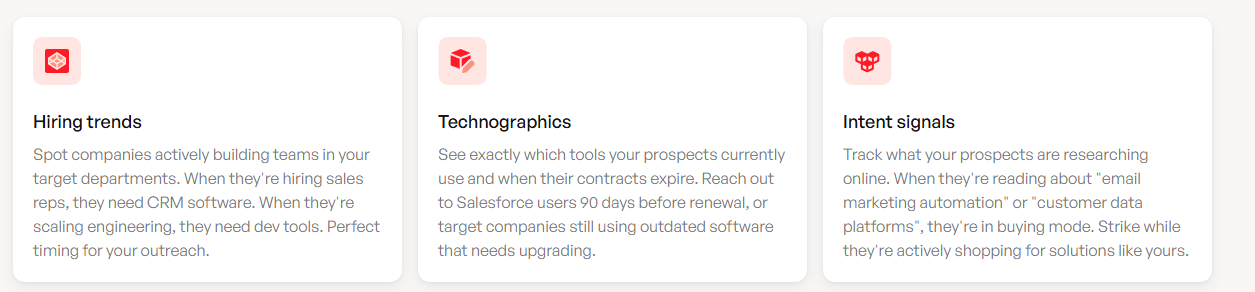
Here's the thing: the real challenge isn't collecting signals. It's filtering them. Signal fatigue is genuine - when every account lights up as "high intent," nothing is actually prioritized, and your reps end up chasing the same noise they were chasing before you spent a dime on intent data.
Why Data Quality Is the Bottleneck
None of these signals matter if your underlying data is garbage. 90% of CRM data is incomplete, and poor data quality costs companies up to 25% of annual revenue. Worse, 60% of companies don't even measure what bad data costs them.
We've seen this play out dozens of times. A team buys an intent platform, routes "high-intent" accounts to SDRs, and then half the emails bounce and a quarter of the phone numbers are disconnected. The intent signal was real. The contact data wasn't. That's not a strategy failure - it's a data foundation failure.
This is where the stack has to start. Prospeo's B2B database runs 300M+ profiles with 98% email accuracy and a 7-day refresh cycle, versus the 4-6 week refresh common at competitors. Its 5-step verification process - including catch-all handling, spam-trap removal, and honeypot filtering - means the contacts downstream systems act on are actually reachable. Unsexy? Sure. But it's the foundation that makes everything downstream work.
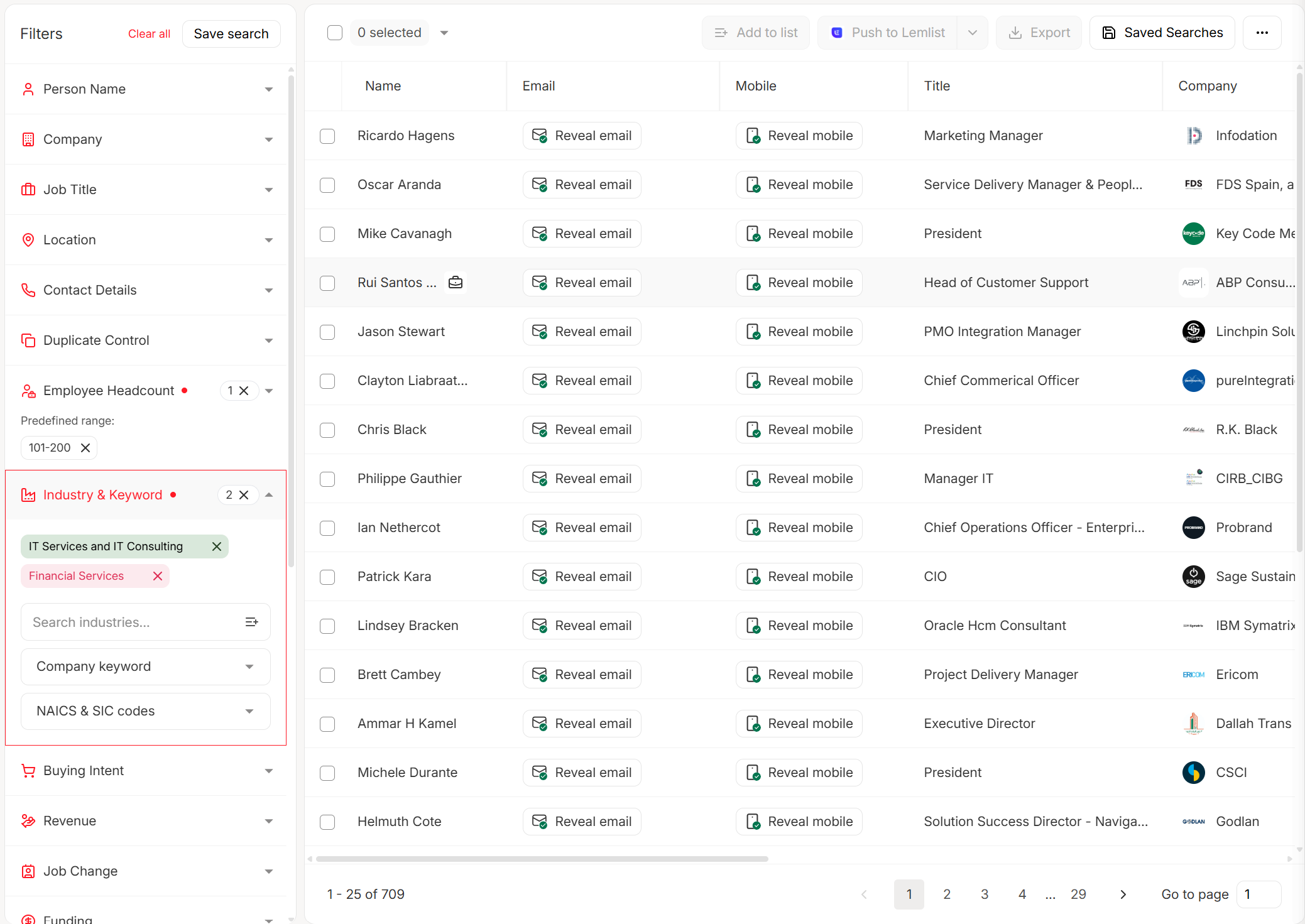

Your GTM intelligence layer is only as good as the data underneath it. Prospeo's 300M+ profiles refresh every 7 days - not every 6 weeks - with 98% email accuracy and 5-step verification that eliminates bounces before they torch your domain.
Fix the data foundation before you stack intent signals on top.
Choosing a Platform
No single vendor covers everything well. Here's who does what:
| Function | Tools | Starting Price | Watch Out For |
|---|---|---|---|
| Data Platforms | Prospeo, ZoomInfo, Apollo | Free-~$40K/yr | Annual contracts; Apollo ~79% email accuracy |
| Intent / ABM | 6sense, Demandbase, Bombora | ~$25K-$100K+/yr | False positives; long contracts |
| Analytics | HockeyStack, CaliberMind | ~$1K-$5K/mo | 48-72hr ad data sync delays |
| Predictive Intel | Crunchbase | ~$49/mo (Pro) | Limited to funding/growth signals |
| Workflow Orchestration | Clay | ~$149/mo | Steep learning curve; credit burn |
At roughly $0.01/email versus $1/email at ZoomInfo - with higher email accuracy - Prospeo has the strongest accuracy-to-cost ratio in the data layer, with self-serve pricing and no annual lock-in. For intent and ABM, 6sense and Demandbase are the enterprise defaults, but expect integration complexity and a $30-100K+/year commitment.
Let's be honest: if your average deal size is under $15K, you almost certainly don't need a six-figure platform. A composable stack will outperform it because you'll actually use every piece.
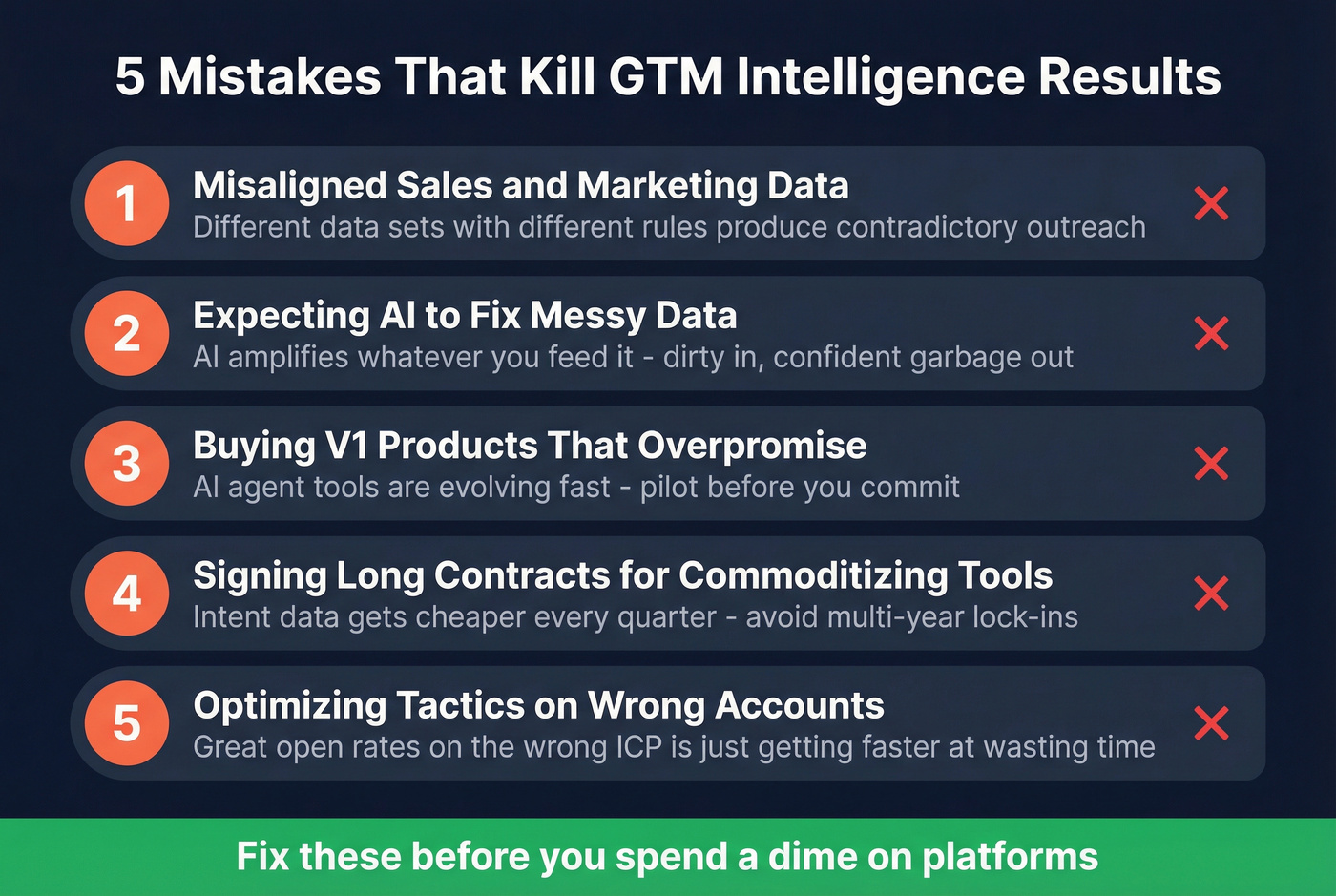
Five Mistakes That Kill Results
- Misaligned sales and marketing data. Different data sets with different rules produce contradictory outreach. Unify the data first.
- Expecting AI to fix messy data. AI amplifies whatever you feed it. Dirty inputs produce confident-sounding garbage at scale.
- Buying V1 products that overpromise. AI agent tools are evolving quickly. Pilot before you commit.
- Signing long contracts for commoditizing tools. Intent data and enrichment are getting cheaper every quarter. Avoid multi-year lock-ins.
- Optimizing tactics while targeting wrong accounts. Great open rates on the wrong ICP is just getting faster at wasting time.
Skip this if you've already nailed your ICP and have bounce rates under 5% - you're past the foundation stage and can jump straight to intent layering.
How to Start Building
Organizations with a documented GTM framework see 3x revenue growth versus those without one. We've tested composable stacks against monolithic platforms, and the composable approach wins for teams under 50 reps - it's faster to deploy, cheaper to maintain, and easier to swap pieces when something better comes along. Here's the build order:
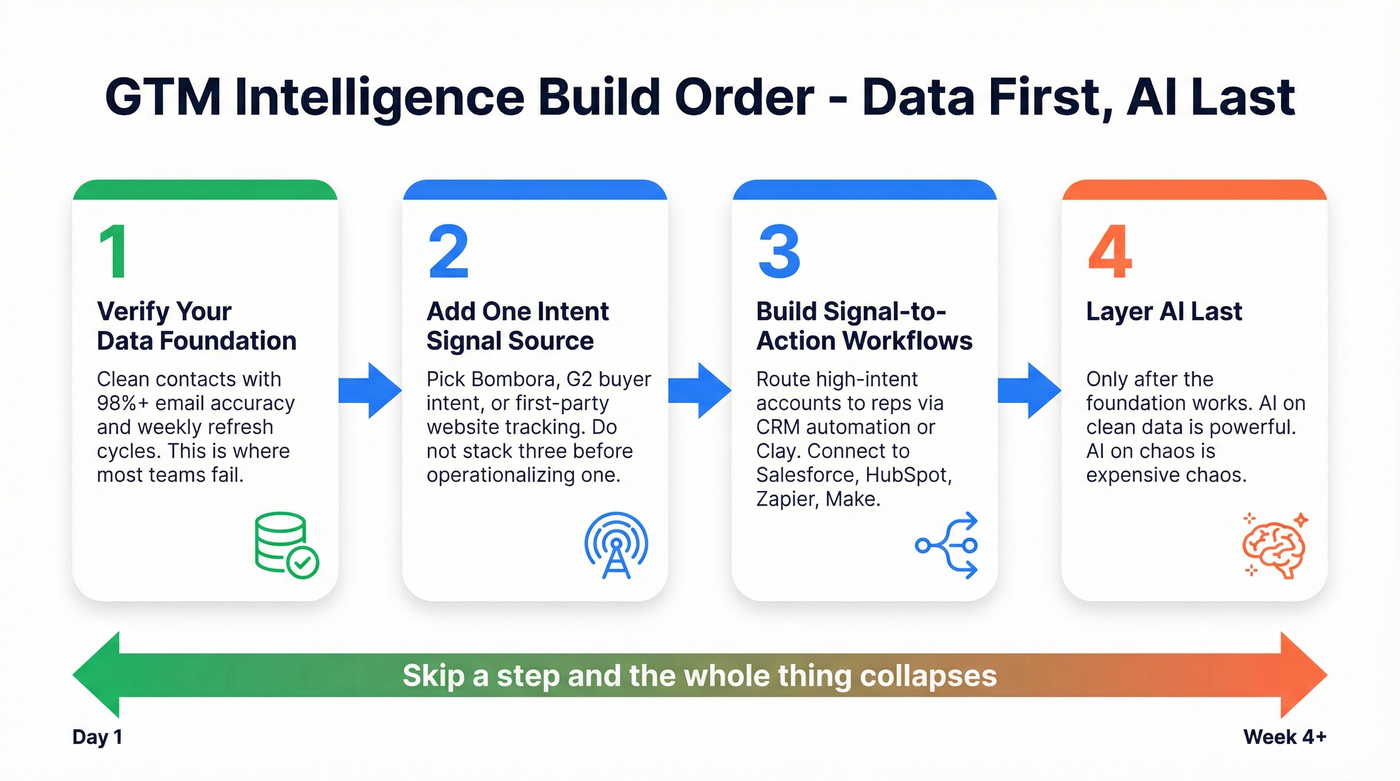
Step 2: Add one intent signal source. Bombora, G2 buyer intent, or first-party website tracking. Don't stack three before operationalizing one.
Step 3: Build signal-to-action workflows. Route high-intent accounts to reps via CRM automation or Clay. Native integrations with Salesforce, HubSpot, Zapier, and Make keep this simple.
Step 4: Layer AI last. Only after the foundation works. AI on clean data is powerful. AI on chaos is expensive chaos.
Data first, signals second, automation third, AI fourth. Skip a step and the whole thing collapses.
You don't need a $50K platform to build GTM intelligence. Prospeo gives you 30+ search filters - intent data, technographics, job changes, funding signals - at roughly $0.01/email with no annual contract. Teams using Prospeo book 26% more meetings than ZoomInfo users.
Build a composable GTM stack that actually connects reps to real buyers.
GTM Intelligence FAQ
What is GTM intelligence?
GTM intelligence is the practice of combining verified B2B data, buyer intent signals, and workflow automation to tell revenue teams which accounts deserve attention right now. Unlike sales intelligence that answers "who to contact," it layers external market signals on top of internal pipeline data to prioritize where reps spend their time.
How much does a go-to-market intelligence stack cost?
A composable stack runs under $500/month for small teams - Prospeo for data at roughly $0.01/email, Bombora or G2 for intent, and Clay for orchestration. Enterprise platforms like ZoomInfo ($15-40K/yr) or 6sense ($30-100K+/yr) bundle everything but require annual contracts.
How long does implementation take?
A self-serve data foundation can be live in one day. Adding intent signals and CRM workflows takes 2-4 weeks for a small-team stack. Full enterprise rollouts with platforms like 6sense or Demandbase typically run 2-6 months.
Do I need a dedicated platform?
Most teams under $50M revenue get better ROI from a focused stack - verified data, one intent source, and CRM-native workflows - than from a monolithic platform that takes months to deploy. Start composable, consolidate only when complexity demands it.