How to Cold Call as a Financial Advisor: Scripts, Compliance, and Funnel Math
It's Monday morning. You've got 200 names on a spreadsheet, a phone, and no system. You know cold calling works - Kitces Research found it ranks second only to referrals for generating new business - but only 4% of advisors actually do it. The ones who do aren't winging it. They've built a process, a script, and realistic expectations: roughly 2.3% of cold calls result in a booked meeting. That sounds low until you run the math.
Before you dial, you need three things: a compliant, verified prospect list with working phone numbers, a 60-second permission-based script, and a voicemail template for the 80% of calls that'll hit voicemail. Everything else is optimization.
Know Your Funnel Numbers
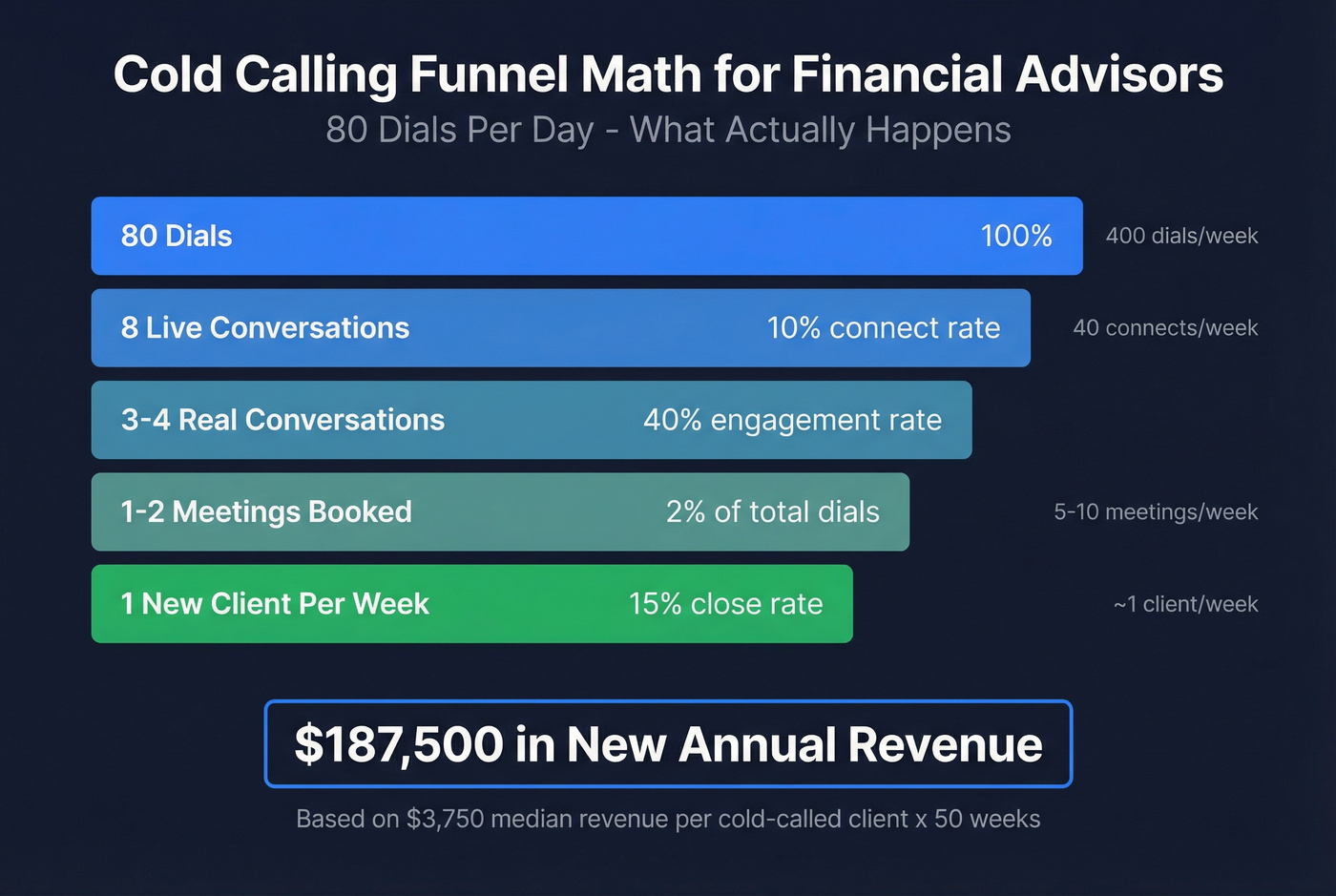
Cold calling without funnel math is just dialing and hoping. Here are realistic benchmarks for financial advisors:
| Stage | Benchmark |
|---|---|
| Connect rate (live answer) | 8-15% of dials |
| Real conversation | 30-55% of connects |
| Meeting booked per dial | 1-3% |
| Meeting held rate | 60-80% |
| New client rate | 10-25% of held meetings |
Let's make it concrete. Say you dial 80 prospects a day - a sustainable pace that leaves time for actual advising. At a 10% connect rate, that's 8 live conversations. At a 2% meeting-per-dial rate, you're booking 1-2 meetings daily. Over a five-day week, that's 5-10 meetings. Even if only 70% show and 15% become clients, you're adding roughly one new client per week.
Kitces pegs median revenue per cold-called client at $3,750. One new client per week times $3,750 times 50 weeks = $187,500 in new annual revenue from cold calling alone. That's lower per-client than referrals, but the volume is entirely in your control. Referrals are passive. Cold calling is a lever you can pull harder whenever pipeline gets thin.
If your average client value is above $3K and you're not picking up the phone, you're leaving six figures on the table every year because the activity feels uncomfortable. That's an expensive feeling.
Compliance Before You Dial
Financial advisors operate under stricter telemarketing rules than most industries. If you're affiliated with a broker-dealer, FINRA Rule 3230 is your governing telemarketing rule - and in practice you also need to follow the standard compliance guardrails around calling hours, do-not-call processes, identification, training, and written procedures.
A practical compliance checklist:
- Calling hours: 8 a.m. to 9 p.m. in the prospect's local time zone. No exceptions.
- Do-Not-Call list: Maintain an internal DNC list. If someone says "don't call me again," add them immediately. Scrub against the national DNC registry as part of your campaign process.
- Caller identification: State your name, your firm's name, and provide a phone number and address where you can be reached.
- Penalties: Up to $500 per violation. $1,500 per violation if deemed intentional. State attorneys general can pile on separately.
Your firm also needs documented cold calling procedures and DNC training for anyone making calls. If you're independent, write a policy anyway - it protects you. The established business relationship exemption exists, but don't lean on it. If someone isn't a current client, treat them as a cold prospect and follow every rule.
Build a High-Quality Prospect List
The best script in the world can't save a bad list.
Life-event segmentation is where smart advisors start: pre-retirees within five years of 65, business owners approaching an exit, recent inheritance recipients, people who just changed jobs and have a 401(k) rollover decision to make, and recently widowed or divorced individuals navigating sudden financial independence. These aren't cold leads - they're people with an active financial question, which changes the entire dynamic of the call.
The problem is getting verified contact data without paying enterprise prices. A ZoomInfo contract runs $15K-$40K/year depending on seats and modules, which makes zero sense for an independent advisor or small RIA. Prospeo offers 125M+ verified mobile numbers with a 30% pickup rate, plus 98% email accuracy for the follow-up cadence you'll build around your calls. The free tier gives you 75 emails a month to test plus 100 Chrome extension credits, no contracts required. Bad numbers destroy morale faster than rejection does - verified data keeps you dialing instead of troubleshooting disconnected lines.
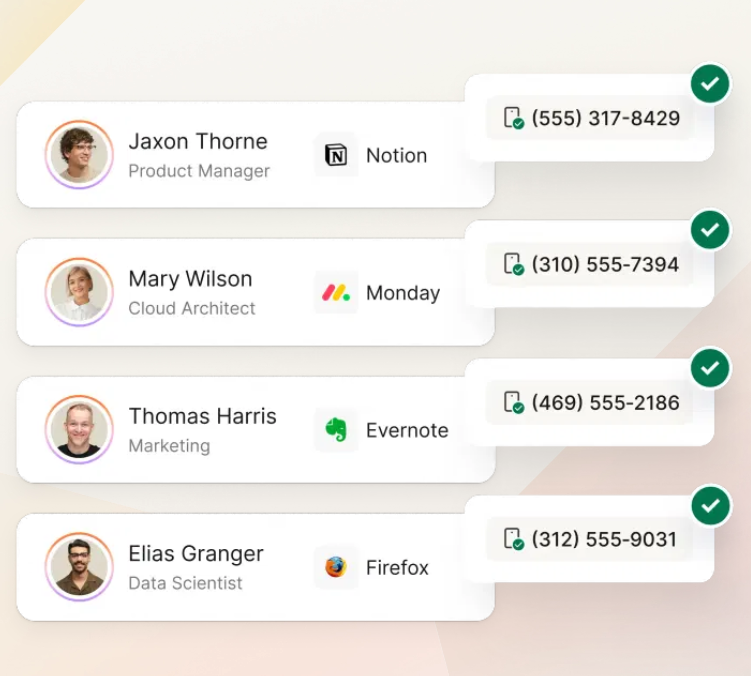

Your cold calling math breaks down the moment you hit disconnected numbers. Prospeo gives financial advisors access to 125M+ verified mobile numbers with a 30% pickup rate - turning your 80 dials/day into real conversations instead of dead air. At ~$0.01 per contact, one new client covers a year of data.
Bad numbers kill more pipelines than bad scripts ever will.
The Permission-Based Script
We've seen advisors overthink this. The HERO framework keeps it simple: Hook, Empathy, Result, Offer.
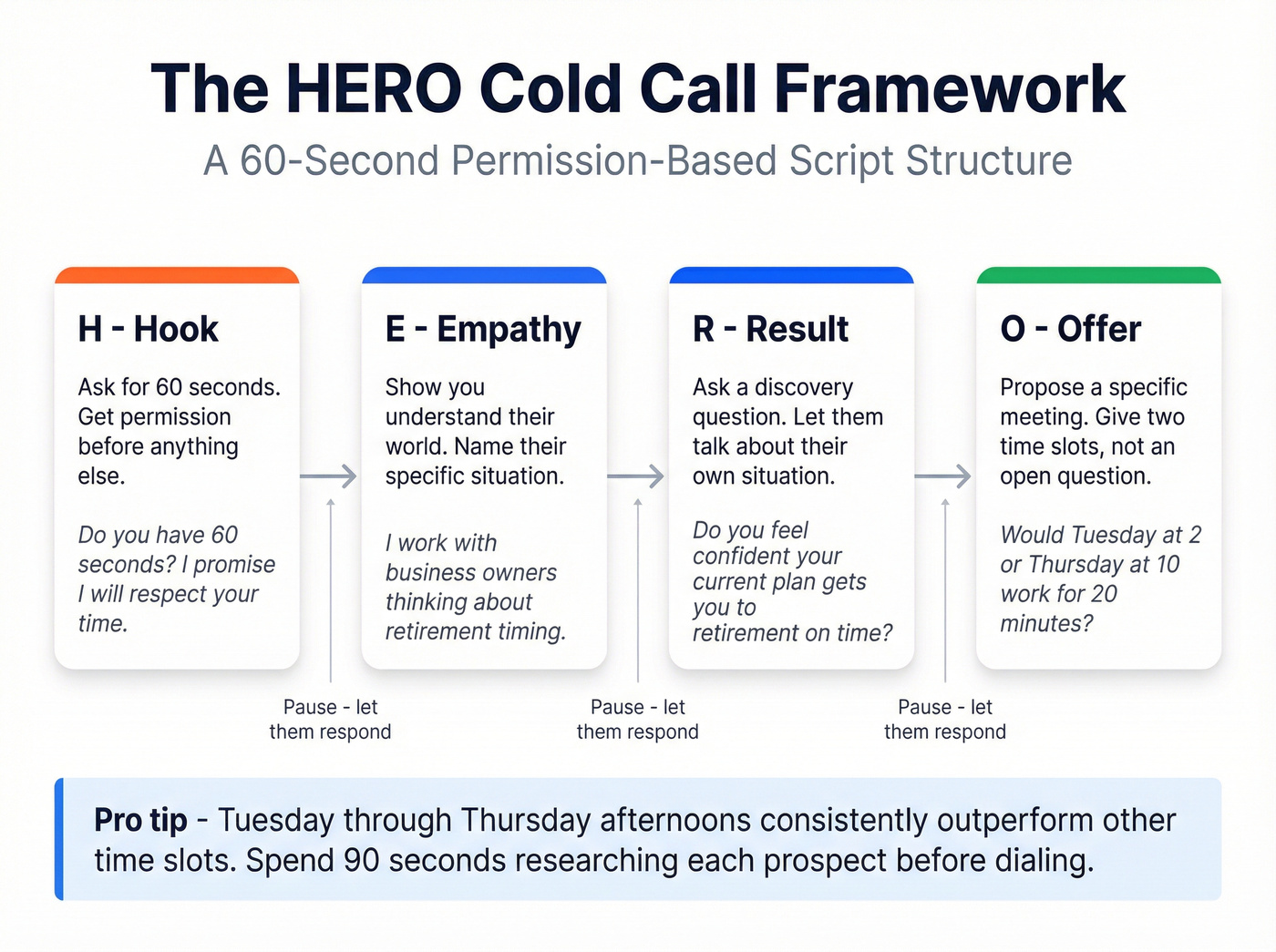
Use this as your starting point:
You: "Hi [First Name], this is [Your Name] with [Firm]. Do you have 60 seconds? I promise I'll respect your time."
Pause. Wait for permission.
You: "I work with [specific segment - e.g., business owners in the Dallas area] who are thinking about retirement timing but aren't sure if their current plan actually gets them there. That's a conversation I have almost every day."
Pause. Let them react.
You: "Quick question - do you feel confident your current plan gets you to retirement on the timeline you want?"
Pause. Let them answer. This is where the real conversation starts.
You: "Would it make sense to grab 20 minutes this week - say Tuesday at 2 or Thursday at 10 - just to see if there's a fit?"
Four things make this work. The permission-based opener reduces immediate hang-ups. The empathy line signals you understand their world, not just your product. The discovery question gets them talking about their own situation instead of evaluating yours. And the two-time-slot close is far more effective than "when works for you?" - it gives them a decision to make, not an open-ended question to dodge.
Timing matters too. Tuesday through Thursday afternoons consistently outperform other time slots. Spend 90 seconds researching each prospect before dialing - check their firm, role, and any recent life events. That tiny investment turns a cold call into a warm one (use a simple pre call research routine so it stays fast).
Handling the Five Most Common Objections
Here's the thing about objections - they're not rejections. They're the prospect telling you they need a different angle.
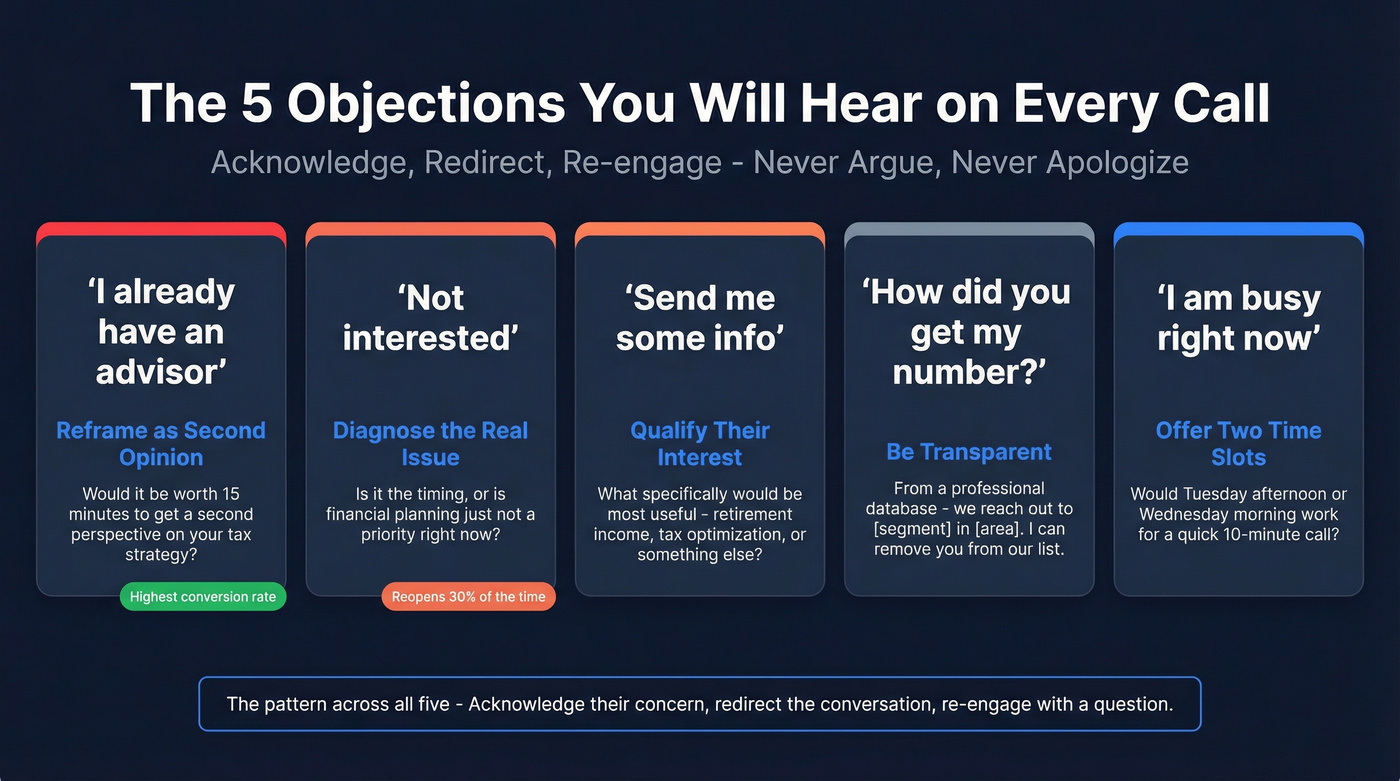
"I already have an advisor." "That's great - most of the people I talk to do. I'm not asking you to switch. Would it be worth 15 minutes to get a second perspective on your tax strategy heading into retirement?"
In our experience, this objection converts at the highest rate when you reframe it as a second opinion rather than a replacement.
"Not interested." "Totally fair. Can I ask - is it the timing, or is financial planning just not a priority right now?" This reopens the conversation about 30% of the time.
"Send me some info." "Happy to. What specifically would be most useful - retirement income planning, tax optimization, or something else?" If they push back, try the direct version: "Honestly, that email will probably end up buried. Can I take 90 seconds right now to see if this is even relevant to you?"
"How did you get my number?" "From a professional database - we reach out to [segment] in [area] because that's who we specialize in helping. I can absolutely remove you from our list if you'd prefer."
"I'm busy right now." "Completely understand. Would Tuesday afternoon or Wednesday morning work better for a quick 10-minute call?"
The pattern across all five: acknowledge, redirect, re-engage. Never argue. Never apologize for calling. (If you want a deeper framework, see cold call rejection and handling sales objections with curiosity.)
Voicemail Strategy That Earns Callbacks
80% of your calls will hit voicemail. That's not a failure - it's a channel. A strong voicemail script can lift callbacks by up to 22%, and leaving at least three voicemails across your cadence significantly improves response odds.
We've tested both 15-second and 30-second voicemails. Shorter wins every time. With iOS 26's live voicemail transcription, prospects now read your voicemail before deciding whether to call back, which makes every single word count more than it used to.
"Hi [First Name], it's [Your Name] with [Firm]. I work with [segment] in [area] on [specific outcome - e.g., building a retirement income plan that doesn't run out]. I'll try you again [day], but if you'd like to chat sooner, I'm at [number]. Thanks."
No pitch. No "I'd love to." Just enough to spark curiosity and establish you as someone who respects their time. The goal isn't to close on voicemail - it's to make the next call feel familiar instead of cold. (More templates: cold call voicemail script and sales voicemail tips.)
The Full Multi-Touch Cadence
One call isn't a strategy. It typically takes 5-6 attempts before you reach or disqualify a prospect. Here's a two-week sequence that works:
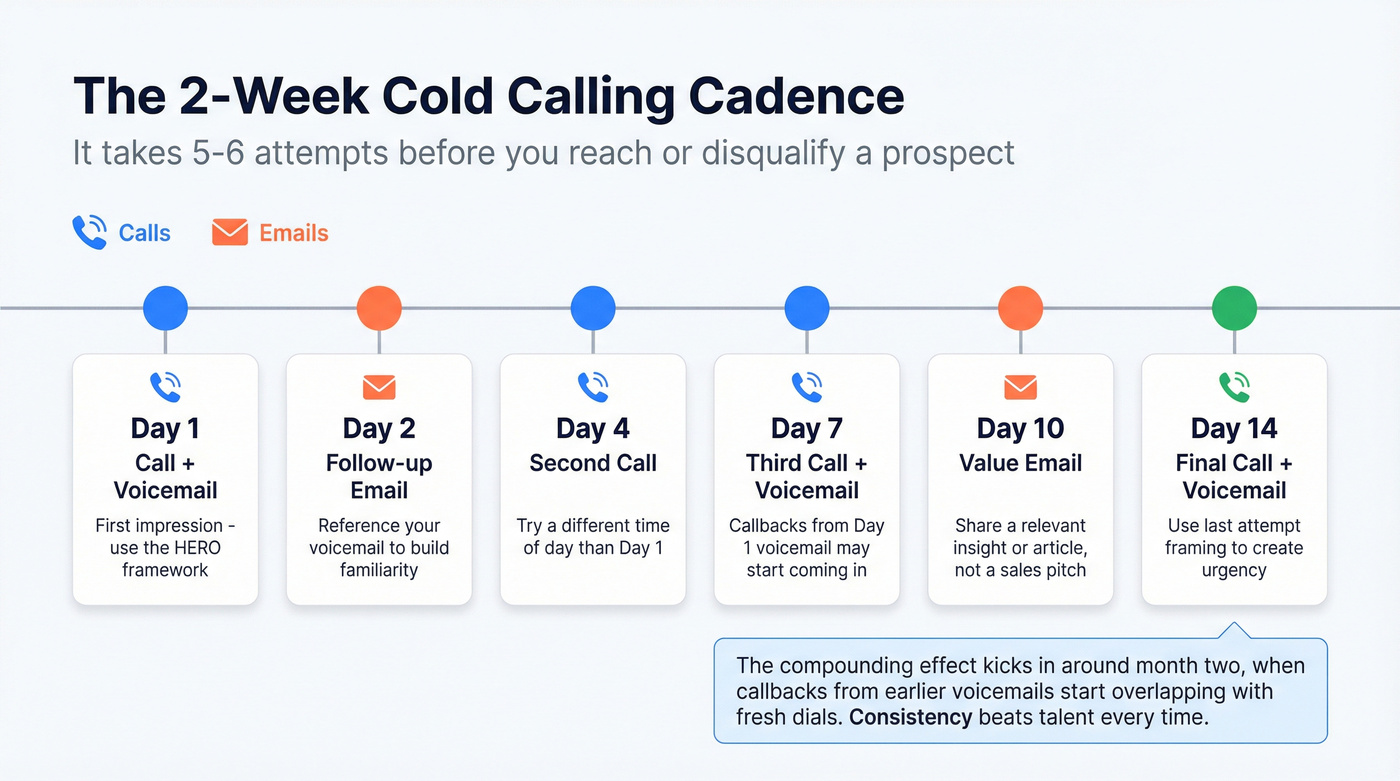
- Day 1: Call + voicemail if no answer
- Day 2: Follow-up email referencing the voicemail
- Day 4: Second call attempt at a different time of day
- Day 7: Third call + second voicemail
- Day 10: Email with a relevant insight or article
- Day 14: Final call + voicemail with "last attempt" framing
The email touches aren't optional. They reinforce your name so that when you do connect live, the prospect already has context. Pair verified emails from your data provider with a simple, personal message - not a marketing blast (a lightweight outbound email campaign structure helps). The FTC's Telemarketing Sales Rule covers the regulatory side of multi-touch outreach, so make sure your email content stays compliant too.
Real talk: the first 30 days of cold calling are brutal. The rejection rate feels personal until you internalize the math. Stick with the cadence. The advisors who quit after two weeks never see the compounding effect that kicks in around month two, when callbacks from earlier voicemails start overlapping with fresh dials. The consensus on r/financialplanning threads is the same - consistency beats talent every time in outbound prospecting (and the cold calling mindset shift is what keeps you consistent).
The article math is clear: 80 dials × verified contacts × 2% booking rate = $187K in new annual revenue. But that funnel only works when your list has real, working phone numbers. Prospeo's 7-day data refresh means you're never calling someone who left their firm six weeks ago. 98% email accuracy powers your follow-up cadence after every call.
Build your advisor prospect list in minutes, not hours - free tier included.
FAQ
Is cold calling legal for financial advisors?
Yes - it's legal with proper compliance guardrails. FINRA Rule 3230 and TCPA/FCC requirements govern calling hours (8 a.m.-9 p.m. local time), DNC list maintenance, and caller identification. Violations carry fines up to $1,500 per intentional offense, and state attorneys general can pursue additional penalties.
How many dials should an advisor make per day?
80-100 dials is a sustainable daily target that leaves room for client work. At a 1-3% meeting-per-dial rate, that yields 1-3 booked meetings daily - enough to add roughly one new client per week if you sustain the effort across months.
Where do financial advisors get prospect phone numbers?
Life-event-based lists - pre-retirees, business owners, job changers, inheritance recipients - from B2B data providers. Skip the enterprise contracts that run $15K+/year unless you're a large firm. Self-serve platforms with verified mobile numbers and pay-as-you-go pricing are a much better fit for independent advisors and small RIAs.
What's the best time to cold call prospects?
Tuesday through Thursday, between 2 p.m. and 5 p.m. in the prospect's local time zone, consistently produces the highest connect rates. Monday mornings and Friday afternoons are the worst - prospects are either catching up or mentally checked out.