

Cold Call Rejection: The Scripts, Stats, and Fixes That Actually Work
You just finished your 40th dial of the morning. Three voicemails, two hangups, one "we're all set," and a guy who thought you were his dentist's office. Everyone tells you to "embrace cold call rejection." That's half-right. You should also be preventing avoidable rejection - and we've watched reps burn through 200 dials a day on lists that were 20% stale. That's not a rejection problem. That's a data problem.
Three things reduce rejection on cold calls, in order:
- Better data - stop dialing dead numbers and wrong titles.
- Better openers - "reason for my call" delivers 2.1x success; "is this a bad time?" kills meeting chances by 40%.
- Better follow-up - 44% of reps quit after one follow-up attempt.
Rejection Rates by the Numbers
Cold calling isn't broken - it's a low-conversion channel by design. Understanding the funnel math keeps you sane.
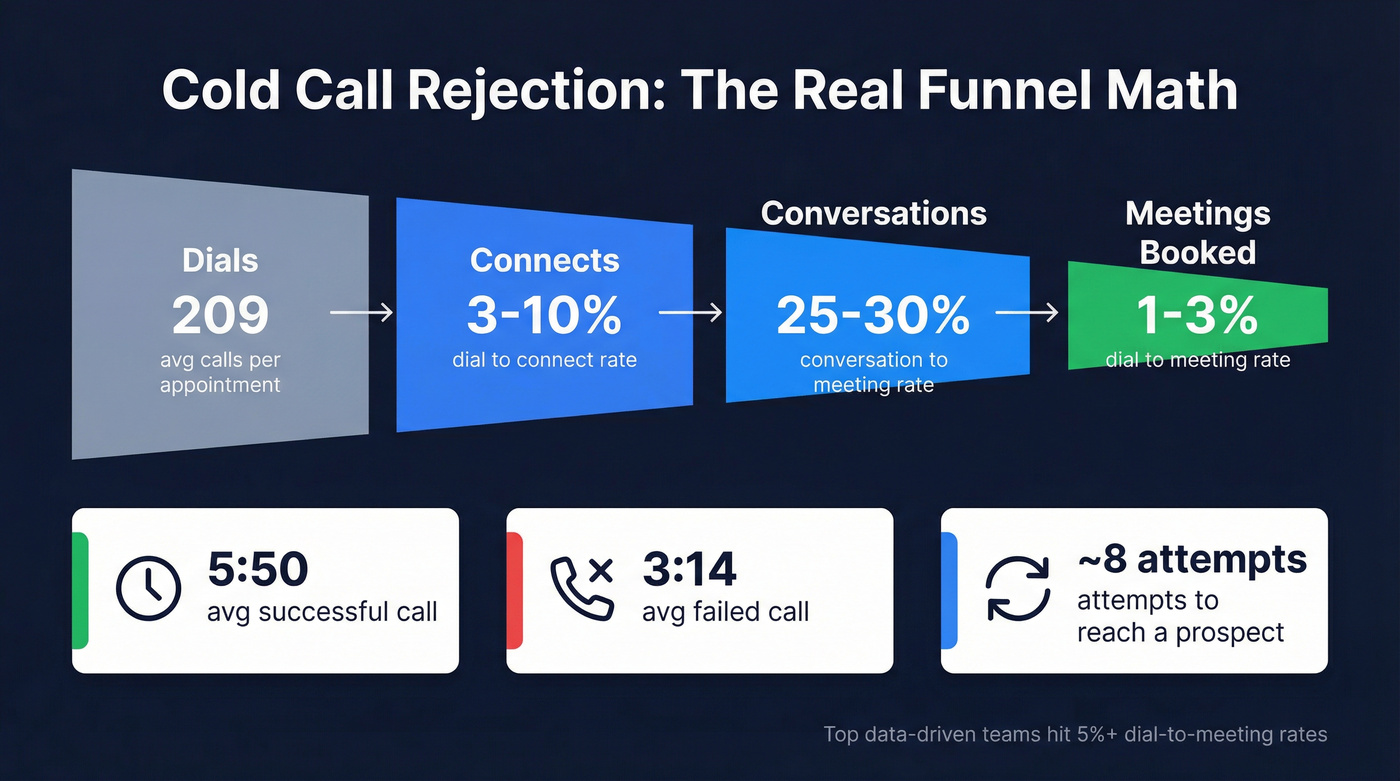
| Metric | Benchmark |
|---|---|
| Dial to Connect | 3-10% (up to 16.6% with quality data) |
| Conversation to Meeting | 25-30% |
| Dial to Meeting | 1-3% (top teams 5%+) |
| Avg. attempts to reach | ~8 |
| Successful call length | 5:50 |
| Failed call length | 3:14 |
It takes roughly 209 calls to book one appointment - about 7.5 hours of dialing. The average dial-to-meeting success rate sits around 2.3%, though data-driven teams push north of 5%. In HubSpot's survey of 379 sales pros, 52% adapt their script on the fly rather than reading verbatim. Rigid scripts don't work.
Successful calls average 5:50, nearly double the 3:14 of failed ones. That gap tells you something important: the calls that convert are the ones where you earn enough time for a real conversation, not the ones where you talk faster.
Why Prospects Say No
Most rejection isn't about you. 77% of B2B buyers describe their last purchase as complex or difficult. Buying groups have grown from 6 to 12 stakeholders. Only 13% of customers believe a salesperson understands their needs.
Your prospect isn't just screening your call - they're drowning in vendor noise and internal politics.
Here's the thing: most "no's" aren't real objections. They're brush-offs. A real objection contains specifics - "we're locked into a contract until Q3." A brush-off is vague - "we're all set," "not interested." Once you learn to tell the difference, you stop wasting energy arguing with someone who just wants you off the phone and start investing it in the prospects who gave you a real reason to follow up later.
Openers That Trigger Rejection
Your first 10 seconds determine whether you get three minutes or three seconds.
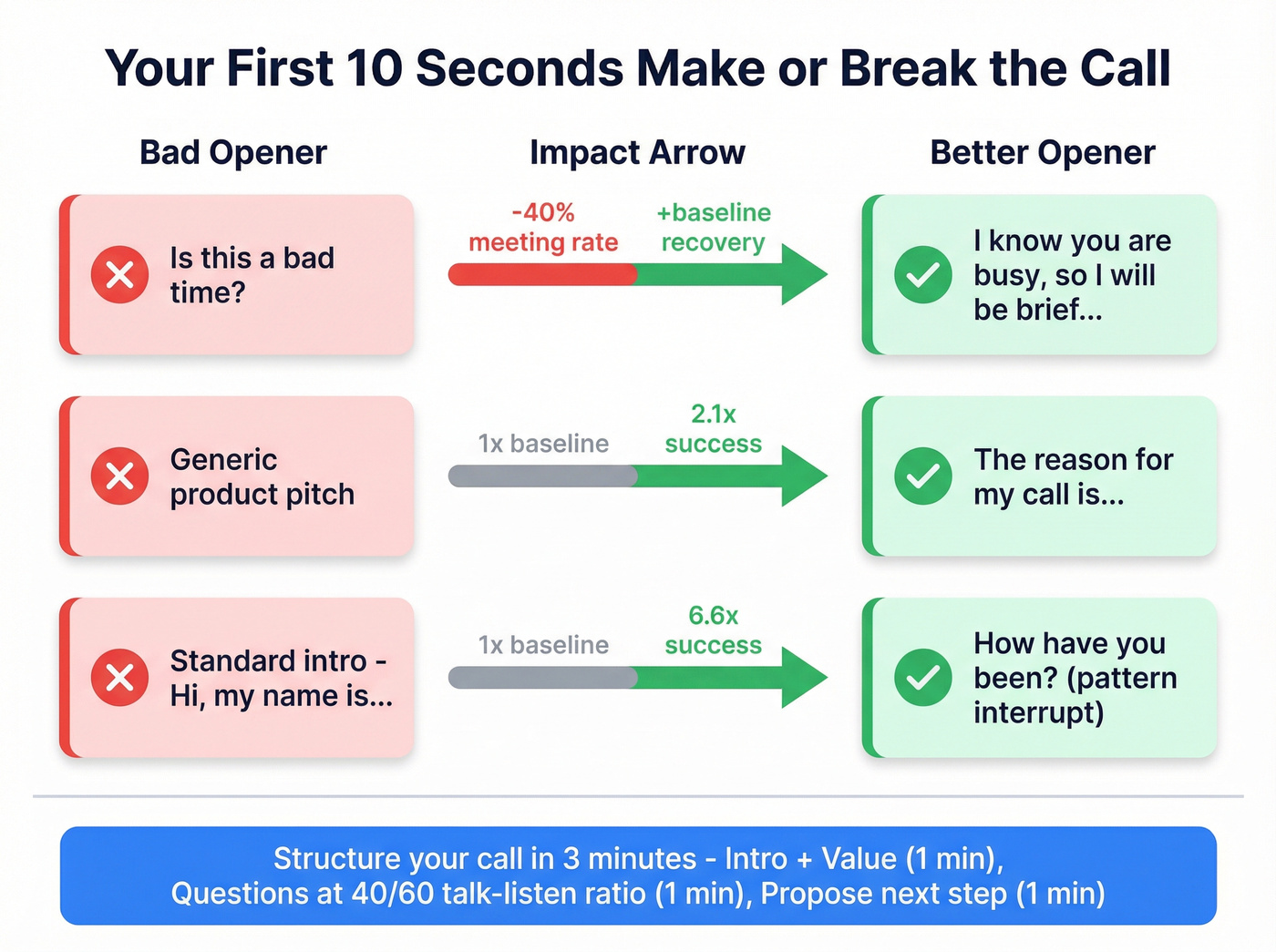
| Bad Opener | Better Opener | Impact |
|---|---|---|
| "Is this a bad time?" | "I know you're busy, so I'll be brief..." | -40% to baseline |
| Generic pitch | "The reason for my call is..." | 2.1x success rate |
| Standard intro | "How have you been?" (pattern interrupt) | 6.6x success rate |
Structure your call in three minutes. Minute one: intro plus a specific value prop. Minute two: qualifying questions - aim for a 40/60 talk-to-listen ratio. Minute three: propose a next step with a specific time. If you can't articulate your value prop in one sentence, you're not ready to dial.
If you want a full framework, start with a cold call checklist and tighten your opener with cold call tonality.

Your opener doesn't matter if the person on the other end left the company six months ago. Prospeo's 125M+ verified mobile numbers refresh every 7 days and hit a 30% pickup rate - that's 3x the industry average. Fewer dead dials, more real conversations.
Stop rehearsing rebuttals for people who don't work there anymore.
How to Handle Rejection: Scripts for Common Objections
Brush-offs get curiosity. Real objections get specifics. Let's break down the five you'll hear most often.
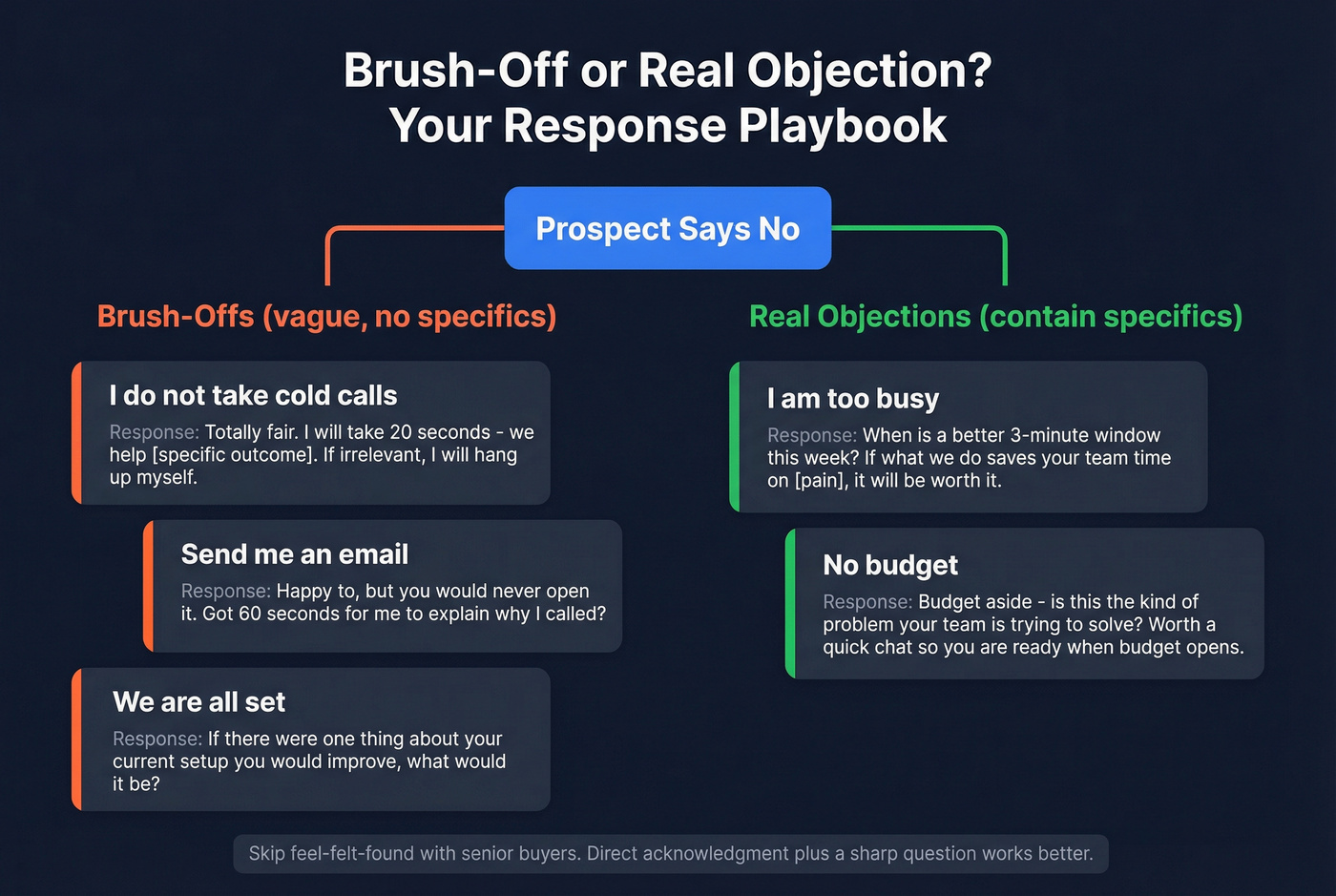
"I don't take cold calls." "Totally fair. I'll take 20 seconds: we help [specific outcome] for companies like yours. If it's irrelevant, I'll hang up myself."
"I'm too busy." "Respect that. When's a better 3-minute window this week? If what we do saves your team time on [specific pain], it'll be worth it."
"We're all set." "Glad to hear it. If there were one thing about your current setup you'd improve, what would it be?" This surfaces the crack without being combative. We've seen reps book more meetings off this single question than from any other rebuttal in their playbook.
"Send me an email." That email is never getting opened. Try: "Happy to, but you'd never open it. Got 60 seconds for me to explain why I called? If it's not relevant, I'll send nothing."
"No budget." "Understood. Budget aside - is this the kind of problem your team is trying to solve? If so, worth a quick conversation so you're ready when budget opens up."
Skip the "feel, felt, found" framework if you're selling to senior buyers. It sounds coached. Direct acknowledgment plus a sharp question works better. For more patterns, see handling sales objections with curiosity and the broader breakdown of types of objections.
What to Do After a Prospect Says No
44% of reps quit after one follow-up attempt. Over 30% of leads never receive a follow-up call at all. Persistence alone beats nearly half the competition.
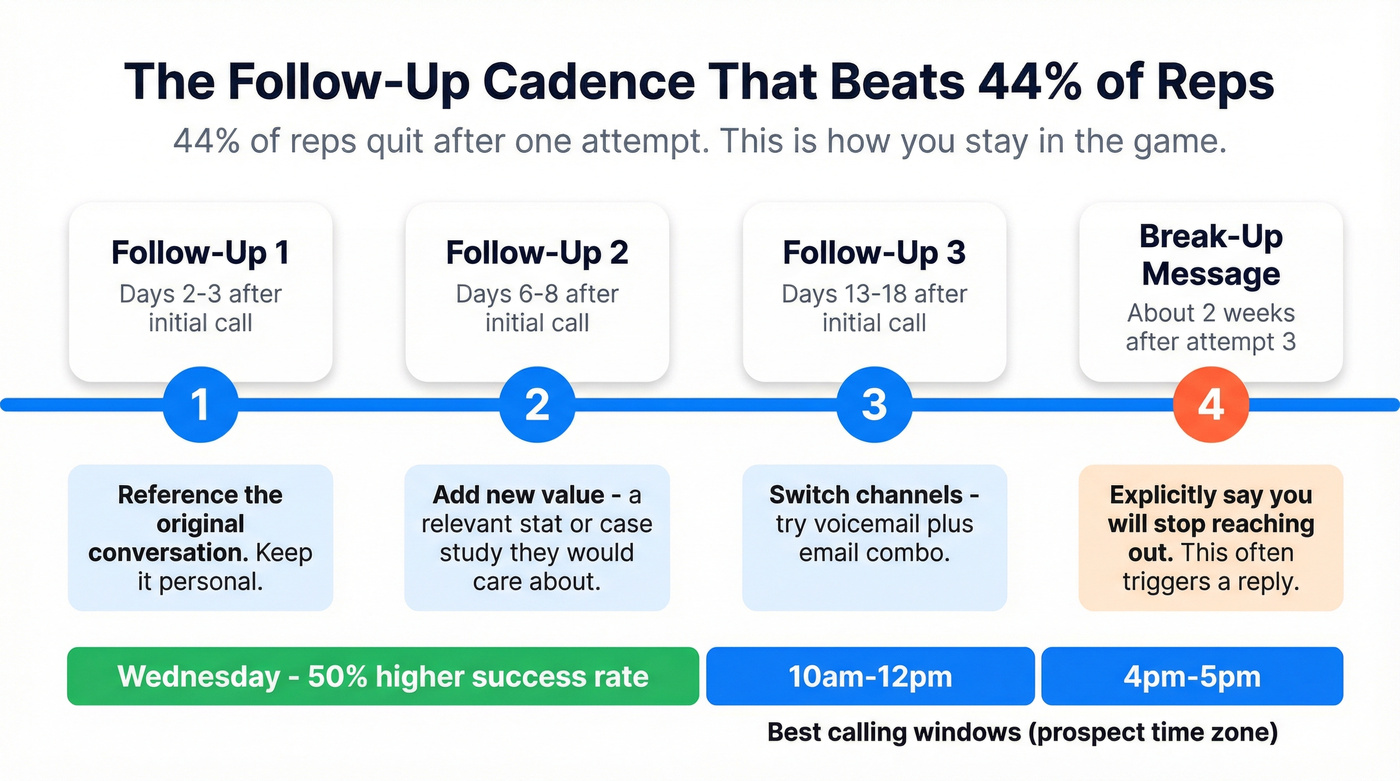
- First follow-up: 2-3 days later. Reference the original conversation.
- Second: 4-5 days after that. Add new value - a relevant stat or case study.
- Third: 7-10 days later. Try a different channel like voicemail plus email.
- Break-up message: 2 weeks after the third attempt. Explicitly say you'll stop reaching out.
Wednesday delivers roughly 50% higher success rates than other weekdays. Best windows are 10am-12pm and 4pm-5pm in the prospect's time zone.
What about when someone hangs up mid-sentence? Don't call back immediately - that feels aggressive. Send a brief, friendly email within the hour: "Looks like we got disconnected. Here's the one-liner on why I called." It reframes the hangup as a dropped call and gives the prospect a low-pressure way to re-engage. The consensus on r/sales is that this move alone recovers a surprising number of conversations.
To systematize this, build a sales cadence and borrow a few proven outreach email templates.
The Data Fix Nobody Talks About
Everyone focuses on scripts and mindset. Almost nobody talks about the most fixable variable: your contact data.
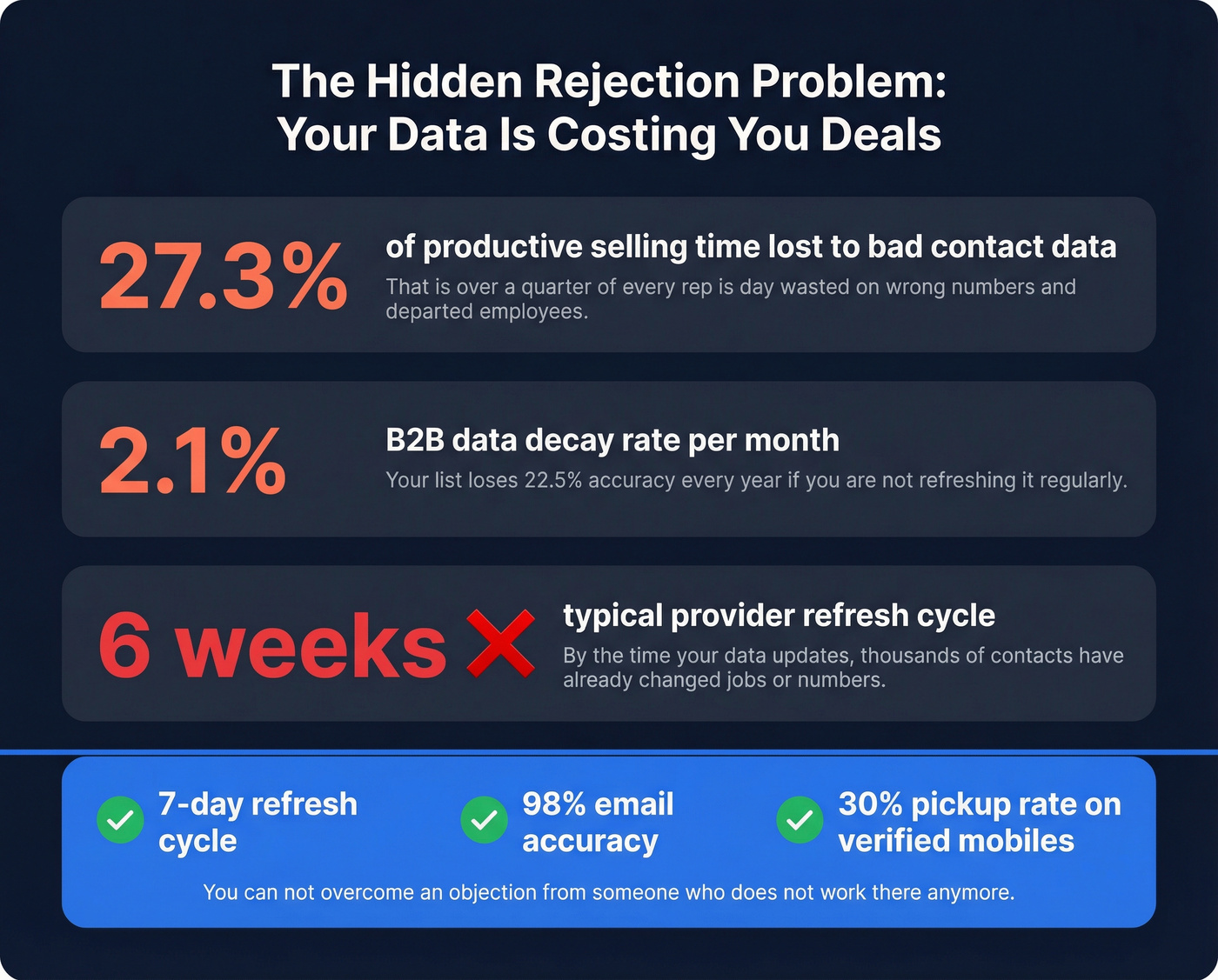
Sales reps lose 27.3% of productive time to bad contact data. B2B data decays roughly 2.1% per month - that's 22.5% of your list going stale every year. If a big chunk of your "rejections" are wrong numbers and departed employees, you don't have a closing problem. You have a list problem. In our experience, the reps who fix their data first see the biggest drop in rejection rates before they change a single word of their script.
If you want the benchmarks and fixes, start with B2B contact data decay and a practical CRM hygiene process.

Look - most reps don't need better scripts. They need to stop dialing numbers that go nowhere because their data provider refreshes contacts every six weeks. Prospeo refreshes every 7 days, delivers 98% email accuracy, and its 125M+ verified mobile numbers hit a 30% pickup rate. You can't overcome an objection from someone who doesn't work there anymore.
If you're rebuilding lists, it helps to understand what a direct dial is and how to find phone numbers without tanking accuracy.
B2B data decays 2.1% per month. Most providers refresh every 6 weeks. Prospeo refreshes every 7 days with 98% email accuracy and verified mobiles at $0.01 per lead. The fastest way to cut your rejection rate isn't a new script - it's a list where every number actually rings.
Replace 200 wasted dials with 50 real conversations. Free tier included.
FAQ
What's the average cold call rejection rate?
Dial-to-meeting rates average 1-3%, meaning 97%+ of dials don't convert to a booked meeting. Top teams with clean data and structured openers consistently hit 5%+, cutting avoidable rejections by more than half.
How do you handle rejection in cold calling?
Separate brush-offs from real objections. Brush-offs like "not interested" get a curiosity-driven follow-up; real objections like "we're in a contract until Q3" get specifics and a timeline. Stay calm, acknowledge the prospect's position, and earn a few more seconds rather than pushing through resistance.
How many times should you follow up after being told no?
At least 3-4 times over 2-3 weeks. 44% of reps quit after one attempt - persistence alone puts you ahead of half the competition. Vary channels between calls, emails, and voicemails.
Can bad data cause more cold call rejections?
Absolutely. Reps lose 27.3% of productive time to outdated records, and B2B data decays about 2.1% per month. Tools that refresh on a weekly cycle keep lists current - fixing data freshness is the single highest-leverage change most teams can make.