Are AI SDRs Worth It? The Data Behind the Hype
A Series B SaaS company we advise ran an AI SDR pilot last quarter. Six weeks in, the tool had booked 47 meetings. Sounds great - until only 4 converted to opportunities, and the primary domain's sender score dropped from 95 to 72. The meetings were cheap. The damage wasn't.
So are AI SDRs worth it? VC funding has topped $400M+ into AI SDR startups in the last two years, and a Topo.io survey found 22% of sales teams have fully replaced human SDRs with AI. But adoption and value aren't the same thing. Here's when AI SDRs actually pay off - and when they're an expensive way to burn your domain.
The 30-Second Answer
AI SDRs deliver ROI if - and only if - these conditions line up:
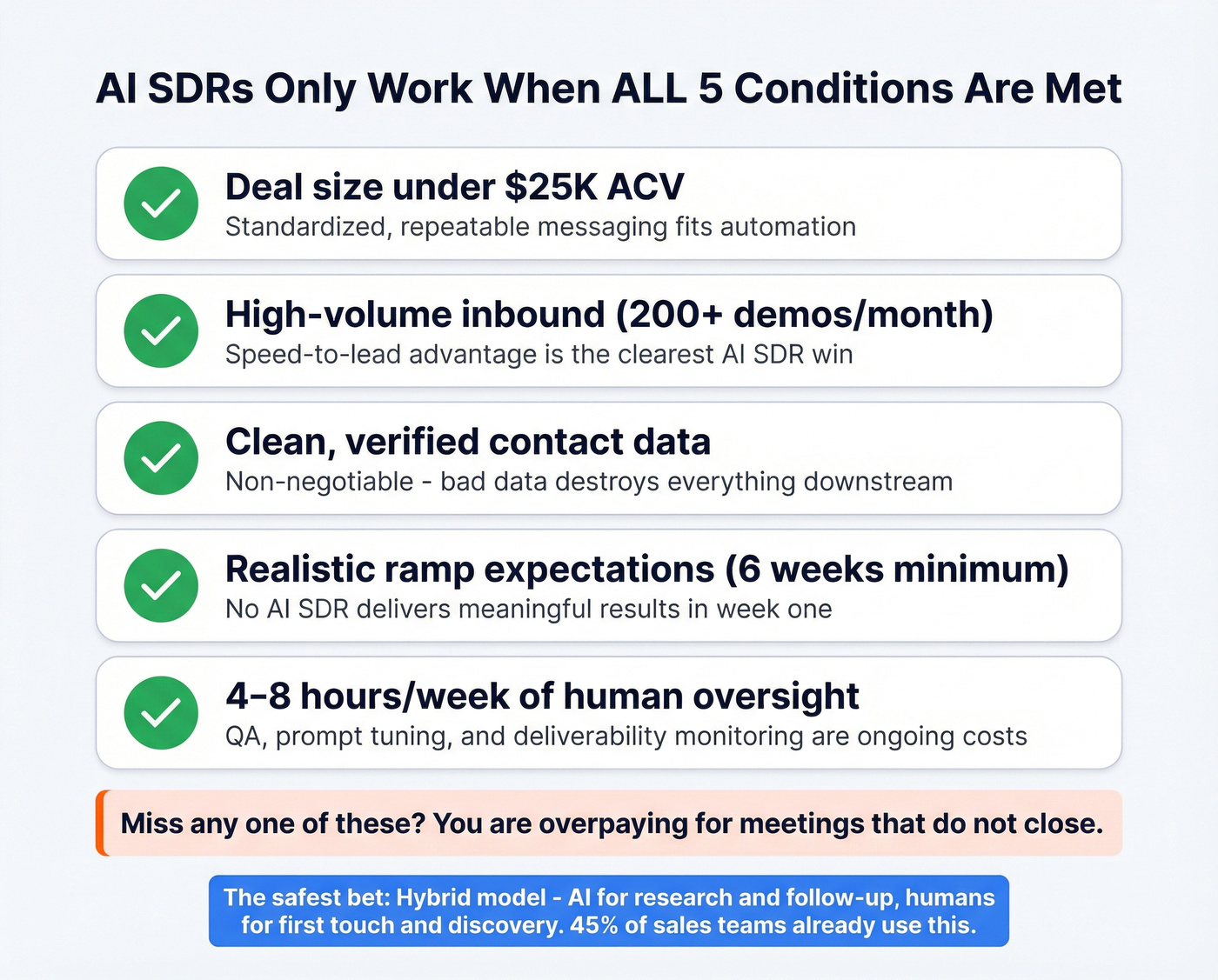
- Deal size under $25K ACV with standardized, repeatable messaging
- High-volume inbound exceeding 200 demo requests/month where speed-to-lead matters (inbound vs outbound)
- Clean, verified contact data feeding the system (non-negotiable) (email verification)
- Realistic ramp expectations: 6 weeks minimum before meaningful results
- 4-8 hours/week of human oversight budgeted for QA, prompt tuning, and deliverability monitoring (email deliverability)
Outside those lanes, you're overpaying for meetings that don't close. The hybrid model - AI for research and follow-up, humans for first-touch and discovery - is the most reliable approach across deal sizes. About 45% of sales teams already use some version of it.
What AI SDRs Actually Do
An AI SDR is software that automates outbound prospecting: identifying leads, writing personalized emails, sending sequences, handling replies, and booking meetings. The best ones run 24/7, respond to inbound inquiries in seconds, and scale to thousands of touches per day without hiring.
The speed-to-lead advantage is real. When a prospect fills out a demo form at 11pm, an AI SDR can respond in under a minute. A human SDR often responds hours later - or next business day - if they remember at all. That's one of the clearest wins: eliminating response lag on high-intent leads before competitors get there.
What AI SDRs can't do: build genuine relationships, navigate complex multi-stakeholder objections, or read the room on a discovery call. SignalFire's analysis found that AI cold calls still hit an "uncanny valley" - fake-sounding audio, noticeable lag, and prospects who hang up the moment they sense automation. The best use case they identified was AI handling repetitive dials and transferring to a human when interest appears.
The Real Cost Math
AI SDRs aren't as cheap as the pitch decks suggest once you factor in the full picture.
| Model | Annual Cost | What You Get |
|---|---|---|
| Human SDR (loaded) | $100K-$150K/yr | Relationship building, judgment |
| AiSDR Explore | ~$8,640/yr | 1,200 messages/mo, ~3 meetings/mo |
| AiSDR Grow | ~$24,000/yr | 4,500 messages/mo, ~11 meetings/mo |
| Artisan Ava | ~$36K-$120K/yr | Custom by lead volume |
| Qualified + Piper | ~$30K-$250K+/yr | Inbound AI + website chat |
| Generic AI SDR | $12K-$60K/yr | Basic sequencing, limited personalization |
Artisan and Qualified pricing are estimates based on market ranges; both require contacting sales for exact quotes. (If you want a deeper breakdown, see AiSDR pricing and Artisan pricing.)
The sticker price is just the start. Hidden costs include 30-60 days of email warmup, a 6-week ramp before meaningful results, and 4-8 hours per week of ongoing human oversight. At roughly $75/hour fully loaded, that oversight alone runs about $15K-$30K/year in team time.
Here's the thing most vendors won't tell you: if your average cost-per-lead from an AI SDR is around $39 versus $262 from a human SDR, the AI looks like a no-brainer. But cost-per-lead is a vanity metric. Cost-per-closed-deal is what actually matters - and that's where the math flips. A human SDR at $125K/year books meetings that convert. An AI SDR at $24K/year books meetings where show rates hover at 40-60%, and the rest rarely close.
Meeting Quality: Where the Numbers Get Ugly
Human SDRs book meetings with show rates of 70-85%. AI SDRs hit 40-60%.
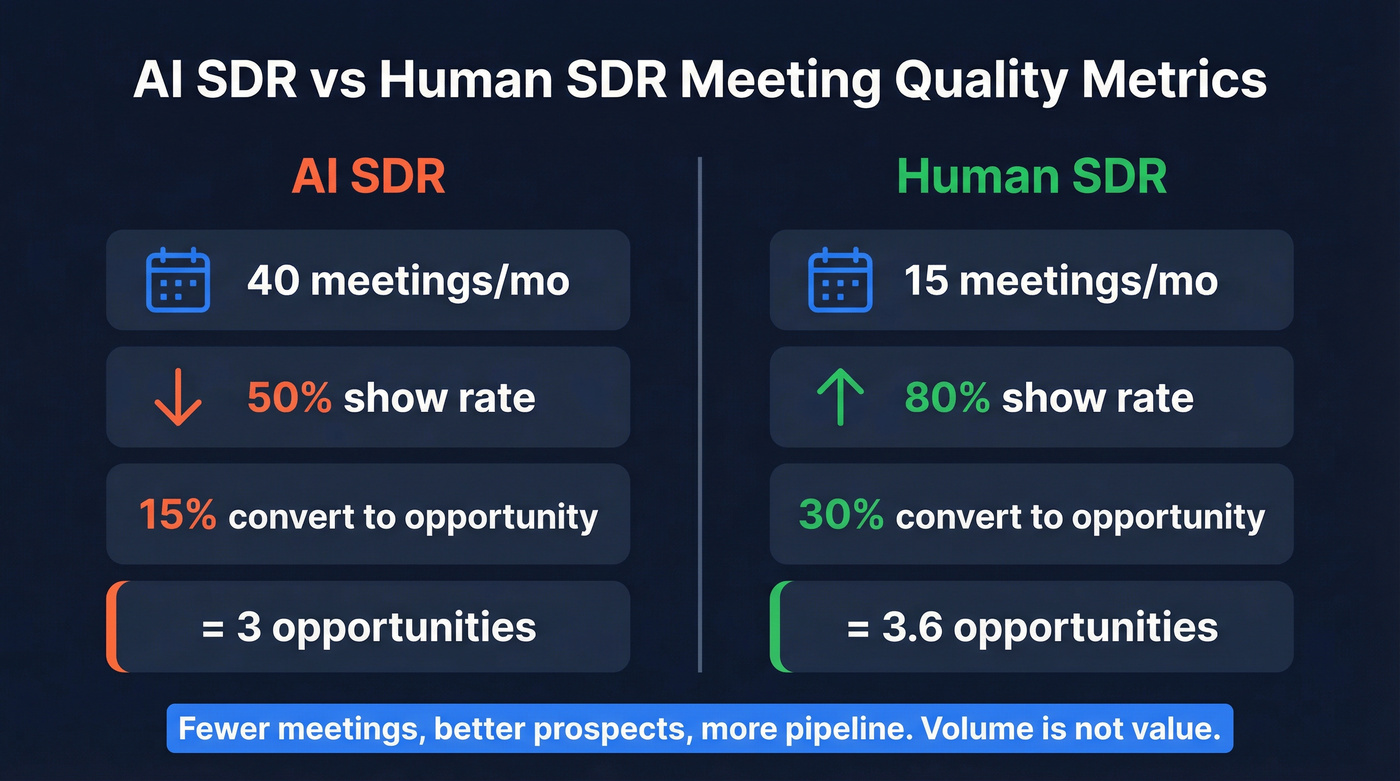
Meeting-to-opportunity conversion is even starker: humans convert 25-40% of meetings to pipeline, while AI-booked meetings convert at 10-20%. We've watched teams celebrate a 3x increase in meetings booked, only to realize their pipeline didn't budge.
Let's run the math. An AI SDR books 40 meetings/month at a 50% show rate and 15% conversion: that's 3 opportunities. A human SDR books 15 meetings/month at an 80% show rate and 30% conversion: 3.6 opportunities - from fewer meetings, with better-qualified prospects more likely to close.
Outreach's data backs this up: deals that close within 50 days carry a 47% win rate, while deals past that threshold drop to 20% or lower. AI-booked meetings enter the pipeline cooler and take longer to progress. The volume looks impressive in a dashboard. The revenue doesn't.

Your AI SDR is only as good as the data feeding it. Bad emails mean bounced sequences, torched sender scores, and meetings that never convert. Prospeo's 98% email accuracy and 7-day refresh cycle mean every contact your AI SDR touches is real - so you get pipeline, not domain damage.
Fix the data before you automate the outreach.
The Deliverability Tax
The #1 way AI SDRs destroy value isn't bad meetings - it's domain reputation damage. Almost nobody talks about this during the sales process.
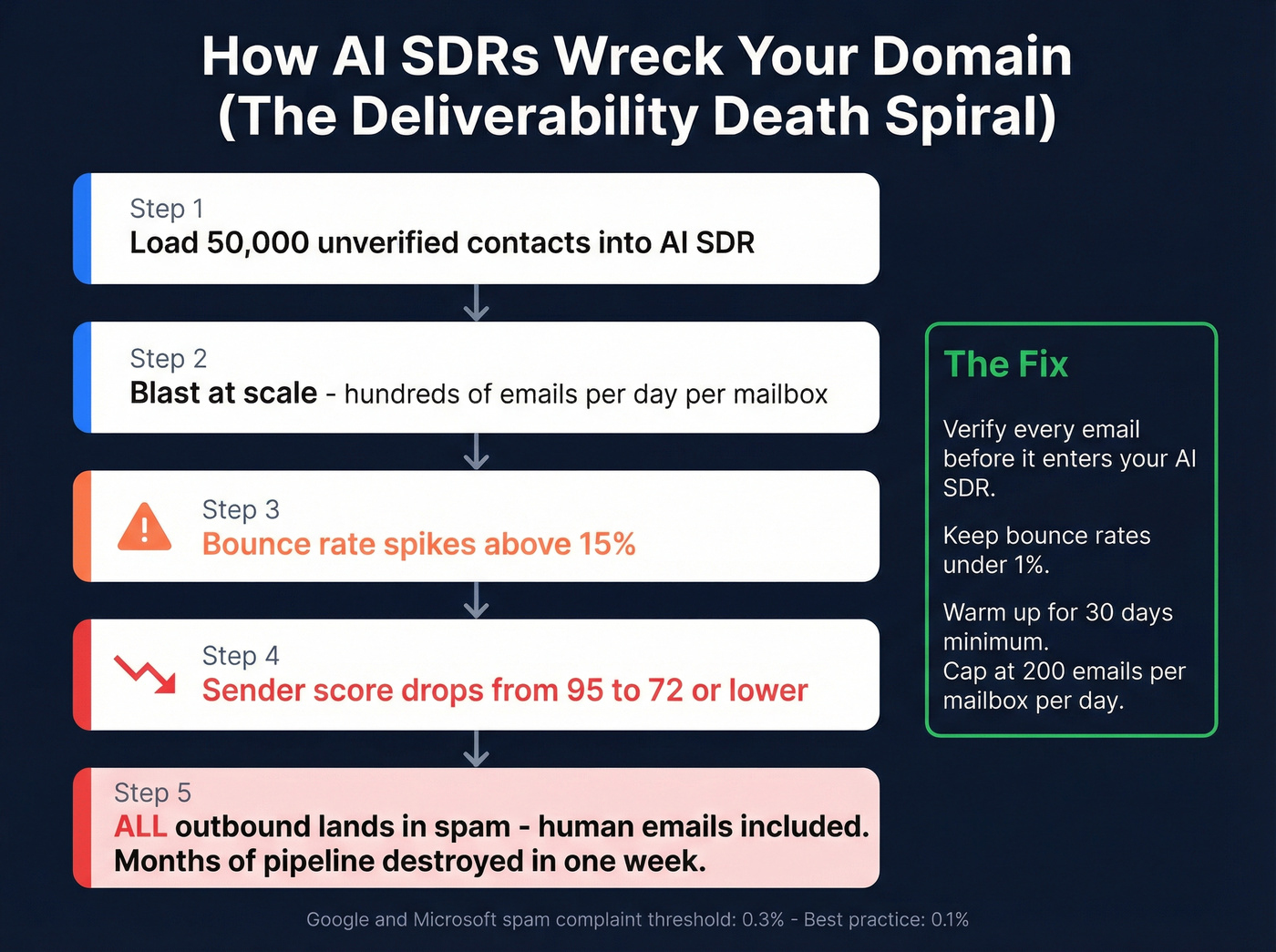
Google and Microsoft enforce a spam complaint threshold of 0.3%, with best practice at 0.1%. Hard bounces need to stay under 1%. SPF, DKIM, and DMARC authentication are mandatory. The safe ceiling is roughly 200 emails per SDR mailbox per day, and warmup takes 30 days minimum starting at 5-10 emails/day. (If you need the setup details, use this SPF, DKIM, DMARC guide and the full email deliverability checklist.)
What happens when teams skip these steps: they load 50,000 contacts into an AI SDR, blast at scale, hit 15%+ bounce rates, and watch their sender score crater. Now their regular outbound - the stuff human reps send - lands in spam too. We've seen this pattern destroy months of pipeline in a single week. It's genuinely infuriating to watch, because it's entirely preventable.
Your AI SDR is only as good as the emails it sends to. Prospeo verifies emails at 98% accuracy on a 7-day refresh cycle, compared to the 6-week industry average. Snyk cut bounce rates from 35-40% to under 5% after switching, and their AE-sourced pipeline jumped 180%. Before you spend a dollar on an AI SDR, verify your list. It's the single highest-ROI step in the entire workflow. (More on why lists rot: B2B contact data decay.)

Snyk cut bounce rates from 35-40% to under 5% and grew AE-sourced pipeline 180% - not by switching AI SDR vendors, but by switching to verified data. At ~$0.01/email with no contracts, Prospeo is the cheapest insurance policy your outbound stack will ever have.
Stop letting bad data sabotage your AI SDR investment.
The Vendor Trust Problem
The AI SDR category has a credibility issue, and 11x is the cautionary tale.
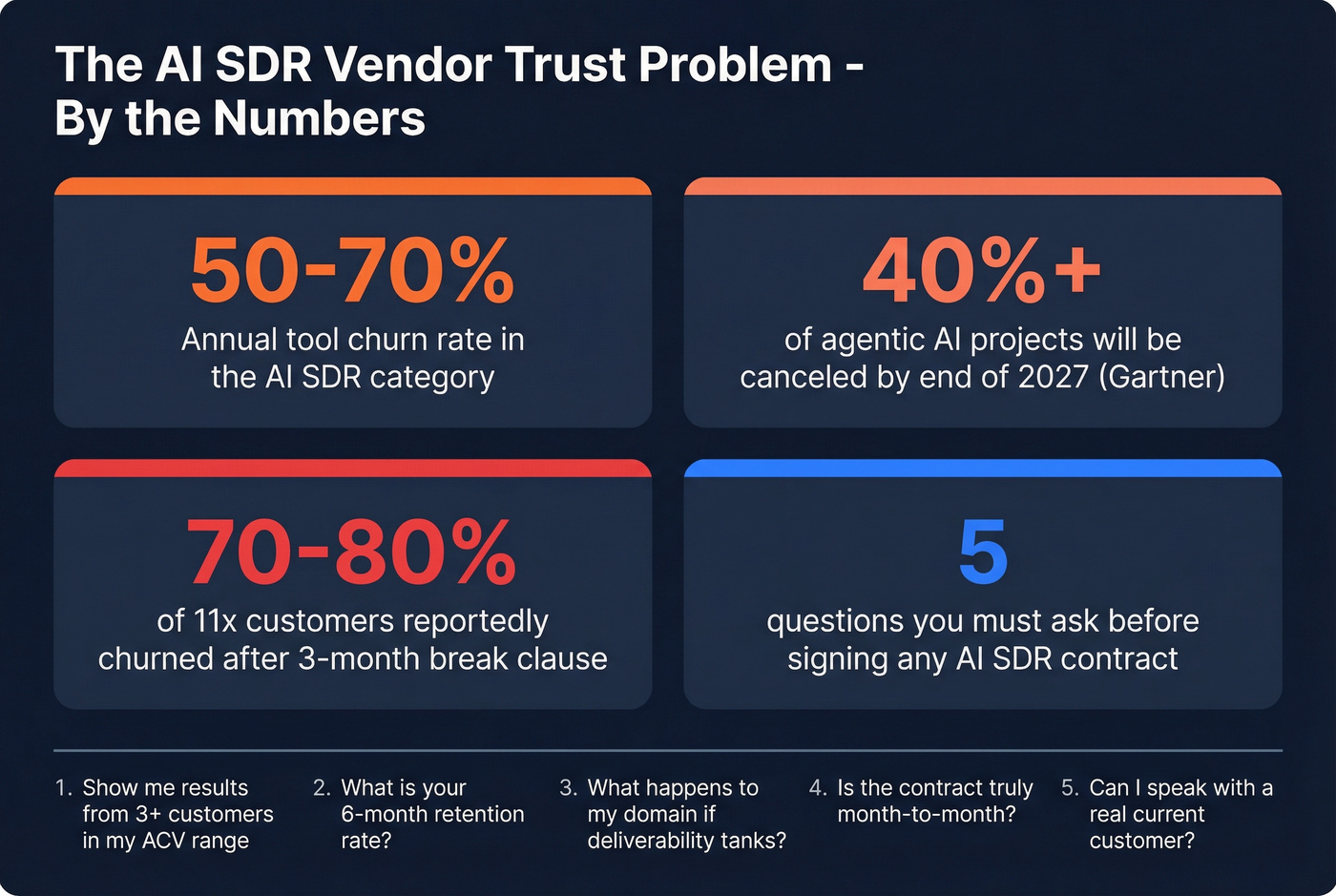
TechCrunch reported that 11x displayed customer logos without permission - ZoomInfo and Airtable both confirmed they weren't customers. ZoomInfo ran a one-month trial and walked away, with their spokesperson saying the product "performed significantly worse than our SDR employees." Former employees alleged 11x reported contracted ARR as actual revenue, even when 70-80% of customers churned after a 3-month break clause.
This isn't isolated. Gartner predicts over 40% of agentic AI projects will be canceled by end of 2027. Annual tool churn in the AI SDR category runs 50-70%. The consensus on r/sales echoes this - threads about AI SDR tools are full of people sharing stories about inflated demos, locked-in contracts, and results that evaporated after the first month.
Before you sign, ask these five questions:
- Can I see anonymized results from 3+ customers in my industry and ACV range?
- What's the average customer retention rate after 6 months?
- What happens to my domain reputation if deliverability degrades?
- Is the contract month-to-month, or am I locked into an annual with a break clause disguised as a trial?
- Can I talk to a current customer - a real person, not a case study?
If a vendor dodges any of these, walk.
A Decision Framework by Deal Size
Under $25K ACV, high volume: AI SDRs can work. Standardized messaging, large TAM, speed matters more than personalization. This is where the ROI math is most favorable.
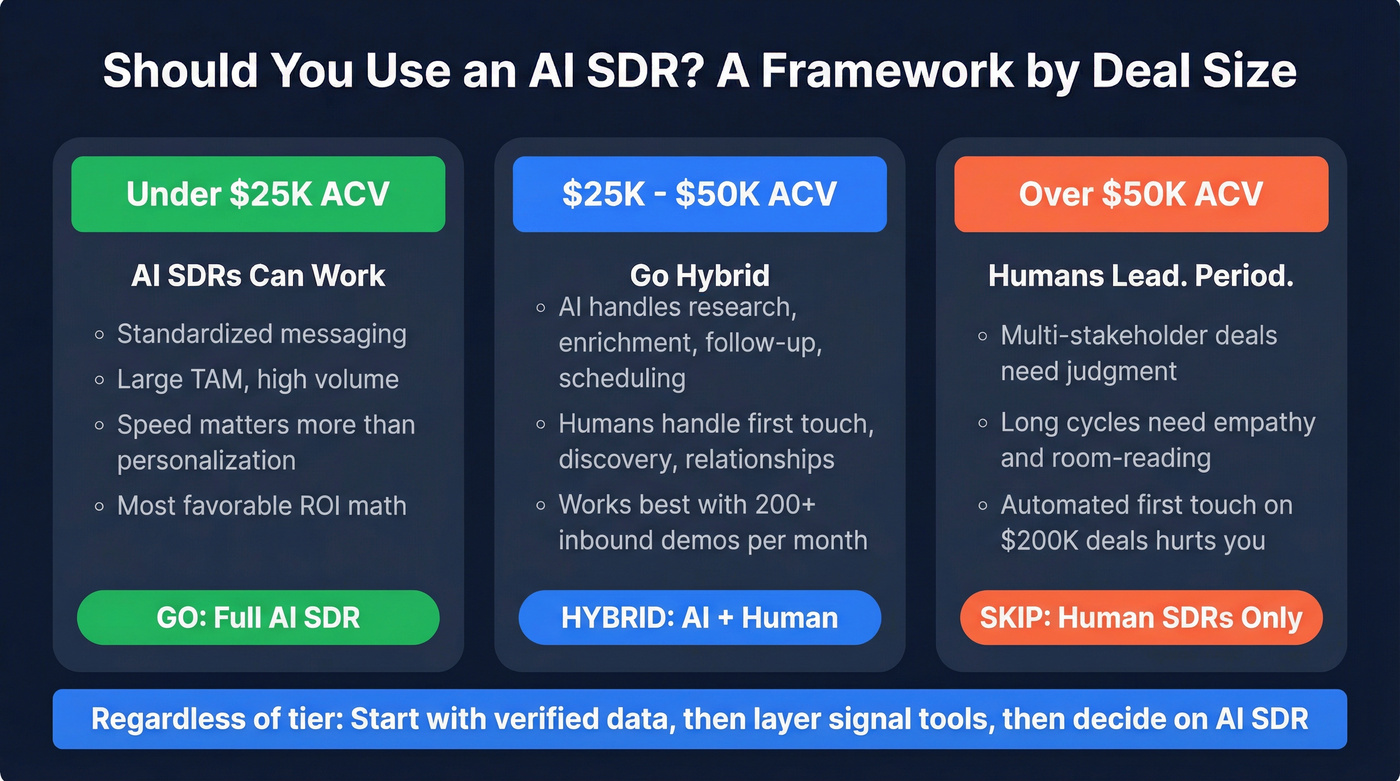
$25K-$50K ACV: Go hybrid. AI handles research, enrichment, follow-up sequences, and scheduling. Humans handle first-touch outreach, discovery calls, and relationship building. Namrata Ram from Together AI puts it simply: if you're processing over 200 inbound demo requests per month and AI can lift connect-to-show rates by ~5%, it pays for itself.
Over $50K ACV: Humans lead. Period. Multi-stakeholder deals with long cycles need judgment, empathy, and the ability to read a room. A bot isn't closing a six-figure deal, and the prospect who gets a clearly automated first touch on a $200K purchase isn't going to be impressed.
Regardless of which lane you're in, the foundation stack matters more than the AI layer. Start with verified data, layer signal-based research tools like Clay or Unify for context, then decide if an AI SDR adds value on top. Most teams that skip the data quality step end up blaming the AI SDR for problems that started upstream. (If you're building the full motion, use a B2B sales stack blueprint.)
Skip AI SDRs entirely if your bounce rates are already above 5%, your domain reputation is shaky, or your ACV is high enough that every first impression counts. Fix the foundation first.
The Bottom Line
AI SDRs aren't a yes-or-no question. They're a "yes, for this specific slice of your pipeline" answer. The teams getting value treat them as a channel, not a replacement. The teams getting burned treat them as a magic button.
Whether they're worth the investment comes down to three things: data quality, use case fit, and ongoing human oversight. Get all three right and you'll see real ROI. Miss any one of them and you'll spend six months wondering why your pipeline is worse than before you started.
FAQ
How much do AI SDRs cost per month?
Entry-level platforms start around $900/month. Mid-tier runs $2,500-$5,000/month. Enterprise solutions like Qualified land at $30K-$250K+/year, with add-ons like Piper often tacking on another $25K-$50K/year. Factor in 30-60 days of warmup before you see any results.
Can AI SDRs fully replace human reps?
For deals under $25K ACV with standardized messaging and large TAMs, yes - they can handle the full outbound cycle. For complex deals above $50K, human SDRs still outperform on show rates (70-85% vs 40-60%) and pipeline conversion. Most teams land somewhere in between with a hybrid approach.
What's the biggest risk of using an AI SDR?
Domain reputation damage from bad contact data. If 15%+ of your emails bounce, your sender score tanks and all outbound - including human-sent emails - starts landing in spam. Verify every list before sending a single AI-generated email. Prospeo's 98% accuracy and 7-day refresh cycle exists specifically to prevent this.
What's the hybrid AI SDR model?
AI handles research, enrichment, follow-ups, and inbound qualification. Humans handle first-touch outreach and discovery calls. About 45% of sales teams already run some version of it, capturing speed and scale without sacrificing the relationship-driven selling that closes complex deals.