What Are Qualifying Questions (and Why Most Reps Ask the Wrong Ones)?
67% of lost sales trace back to reps who didn't properly qualify before running a full sales cycle. That's not a pipeline problem - it's a qualifying questions problem.
So what are qualifying questions, exactly? They're the specific questions sales reps ask to determine whether a prospect has the need, budget, authority, and timeline to buy. They separate real opportunities from time-wasters. Nearly a quarter of sellers say discovery call questions are a top weakness, and the gap between reps who qualify well and those who don't shows up directly in close rates. While qualification also matters in hiring, retail, and market research, this guide focuses on B2B sales - where the stakes per bad call are highest.
The Short Version
You don't need 101 questions. You need 5-7 great ones, a framework to organize them, and the discipline to listen more than you talk.
- A framework pick - BANT, CHAMP, MEDDIC, or SPICED, matched to your deal complexity
- 8-10 sequenced questions that move from pain to close, with follow-ups for vague answers
- The mistakes that silently kill your pipeline, including one most reps never think about
Pick the Right Qualification Framework
Frameworks exist so you don't wing it. The right one depends on your deal size and how many people sign off.
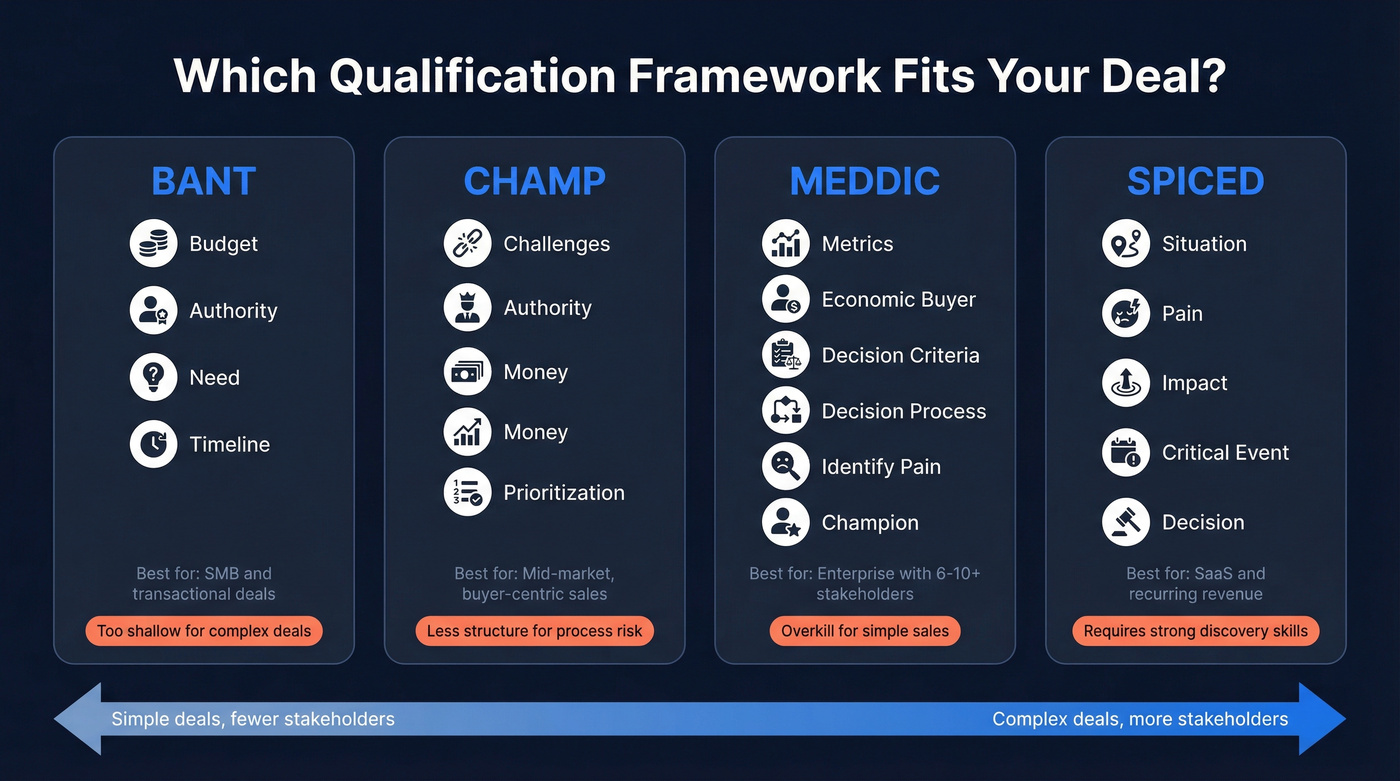
| Framework | Stands For | Best For | Weakness |
|---|---|---|---|
| BANT | Budget, Authority, Need, Timeline | SMB / transactional | Too shallow for complex deals |
| CHAMP | Challenges, Authority, Money, Prioritization | Mid-market / buyer-centric | Less structure for process risk |
| MEDDIC | Metrics, Economic Buyer, Decision Criteria, Decision Process, Identify Pain, Champion | Enterprise / 6-10+ stakeholders | Overkill for simple sales |
| SPICED | Situation, Pain, Impact, Critical Event, Decision | SaaS / recurring revenue | Requires strong discovery skills |
IBM popularized BANT in the late 1980s, and it still works for straightforward deals. But 87% of B2B buying groups now include 4+ stakeholders, and in complex deals it's common to see buying groups reach 6-10+ people. On top of that, 60-70% of the buyer's journey happens before a rep ever gets involved. Leading with "What's your budget?" is tone-deaf when the prospect has already done half their homework without you.
We've seen teams waste months implementing MEDDIC when BANT would've been fine for their deal size. Here's the simple rule: BANT works for simple deals. Selling into multi-stakeholder decisions with real process risk? Graduate to MEDDIC or SPICED. Winning by Design created SPICED specifically for recurring-revenue models where diagnosing impact matters more than checking budget boxes.
If your average deal is a quick, low-five-figure close, you probably don't need a framework at all - you need three sharp questions and a faster sales cycle.

The best qualifying framework won't help if you're calling the wrong people. Prospeo gives you 300M+ profiles with 30+ filters - including buyer intent, job changes, and headcount growth - so you qualify prospects who actually match your ICP before the first question.
Stop qualifying dead leads. Start with verified decision-makers.
Sales Qualifying Questions That Actually Work
Sequence matters as much as the questions themselves. Start open, close narrow. And adapt on the fly - if a prospect reveals budget constraints early, skip the budget question and dig into pain instead.
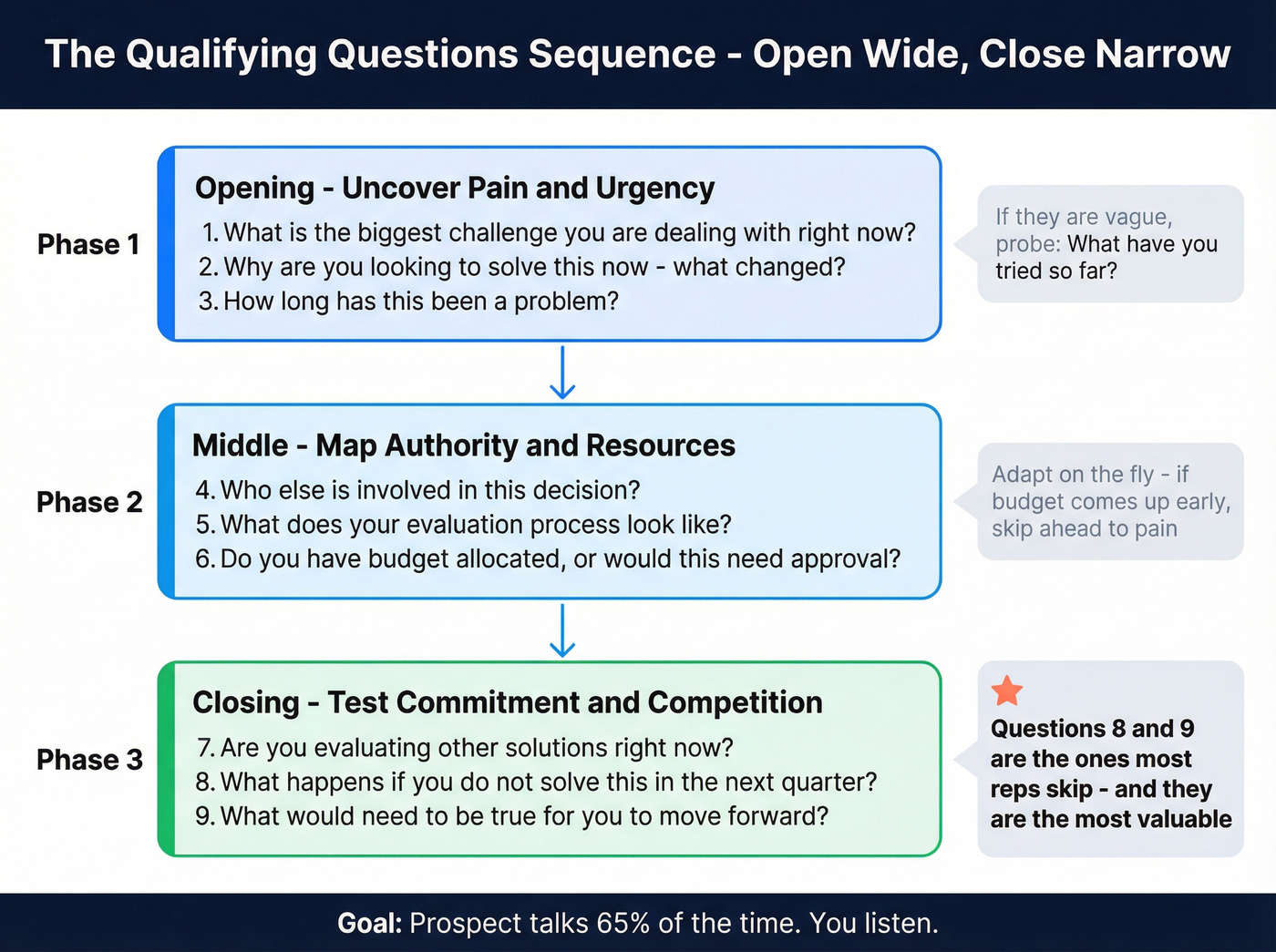
Opening - Uncover Pain and Urgency
- What's the biggest challenge you're dealing with right now?
- Why are you looking to solve this now - what changed?
- How long has this been a problem?
You want the prospect talking, not giving yes/no answers. If they're vague, probe: "What have you tried so far?"
Middle - Map Authority and Resources
- Who else is involved in this decision?
- What does your evaluation process look like?
- Do you have budget allocated, or would this need approval?
Closing - Test Commitment and Competition
- Are you evaluating other solutions right now?
- What happens if you don't solve this in the next quarter?
- What would need to be true for you to move forward?
Questions 8 and 9 are the ones most reps skip - and they're the most valuable. Consequences of inaction reveal urgency better than any timeline question. "What would need to be true" surfaces hidden objections before they derail your deal two months from now, when you've already invested a dozen hours in demos and proposals.
Industry-Specific Variants
The core framework stays the same, but the language shifts by industry.
In SaaS, lead with data: "We helped [similar company] cut onboarding time by 37% - is that the kind of improvement that would matter to your team?" SaaS buyers are skeptical. Quantified outcomes earn the next question.
Insurance is different. Trust drives everything: "If you had to file a claim tomorrow, do you feel confident you'd be fully covered?" This reframes qualification as genuine concern rather than a sales checklist. In commercial real estate, timing is king - "When does your current lease come up?" If the timeline doesn't fit, nothing else matters. Skip this section if you're selling a standard SaaS product; the general lead qualification framework above will serve you better than forced industry customization.
Mistakes That Kill Qualification
An analysis of 63 discovery meetings found that insufficient preparation was the number-one failure mode. Not bad questions - no plan at all. Reps who master discovery execution close up to 30% more deals.
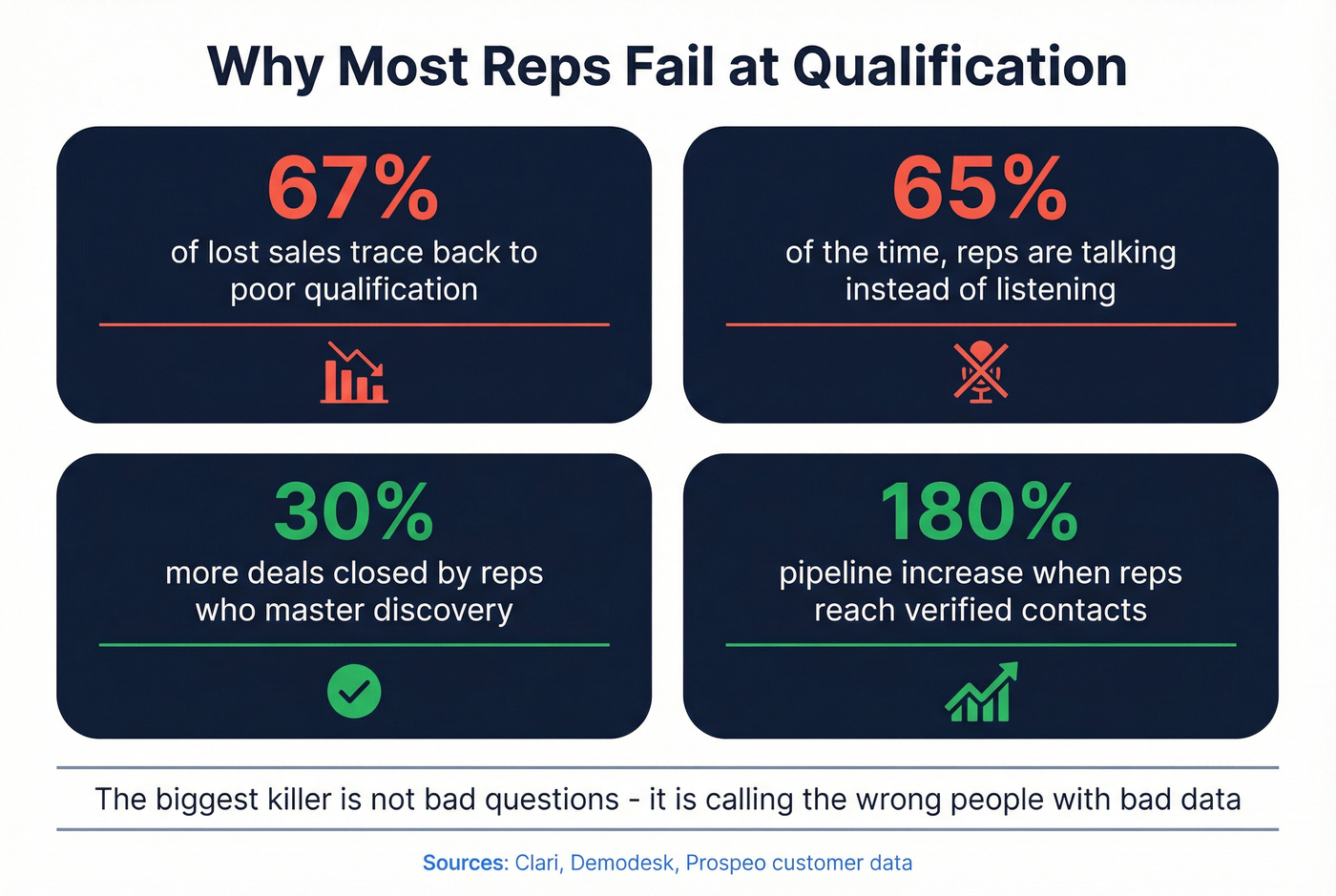
Here's the thing: call analysis shows reps talk 65% of the time and listen 35%. That ratio should be flipped. We've all sat through the 30-minute discovery call that felt great - then the prospect says "I'll need to run this by my boss." That's not discovery. That's a monologue with a stranger who can't sign anything.
But the biggest qualification killer isn't asking the wrong questions. It's calling the wrong people with bad data. If your prospect's phone number is disconnected or their email bounces, your carefully sequenced questions never get asked. One of our customers, Snyk, had bounce rates of 35-40% before switching to verified contact data - their AE-sourced pipeline jumped 180% once reps could actually reach the people they were trying to qualify. Tools like Prospeo refresh records every 7 days and verify emails at 98% accuracy, so your qualifying questions reach the right person instead of a dead inbox.
If you're seeing bounces climb, it's usually a B2B contact data decay problem - and it shows up fast in your prospect data accuracy metrics.
Snyk's reps had 35-40% bounce rates - their qualifying questions never reached real buyers. After switching to Prospeo's 98% accurate emails and 7-day refresh cycle, AE-sourced pipeline jumped 180%. Your discovery calls can't convert if your data is stale.
Verify every contact for $0.01 before your next discovery call.
FAQ
How many qualifying questions should I ask per call?
Five to seven focused questions beat a 20-question checklist. Prioritize pain, authority, and timeline, then dig deeper with follow-ups based on what you hear. Most calls run 25-30 minutes - budget accordingly.
What's the difference between qualifying and discovery questions?
Discovery questions explore the prospect's world broadly. Qualifying questions determine whether they're a fit to buy - specifically testing budget, authority, need, and timeline. Most calls need both, but they serve different purposes. Let's put it this way: discovery tells you what's going on, qualification tells you whether it's worth your time.
How do I prepare before asking qualifying questions?
Verify your prospect's contact data, research their company, and set a call agenda. Ten minutes of prep beats thirty minutes of winging it - and prevents wasted calls to outdated numbers. The consensus on r/sales is that pre-call research is the single highest-ROI activity a rep can do, and we'd agree.