

B2B Sales Meaning: Definition, Process, and Real Benchmarks
You just got promoted to your first B2B sales role - or you're a founder who needs to sell to other businesses and realized nobody actually explained what that means in practical terms. Either way, you're staring at a pipeline spreadsheet, a CRM you barely understand, and a quota that feels arbitrary.
The global B2B eCommerce market is worth $32.11 trillion. The median conversion rate across B2B? Just 2.9%. That gap between "massive opportunity" and "almost nobody converts" is where the real skill lives.
The Short Version
B2B sales is the process of selling products or services from one business to another. Three numbers define the space right now: the global B2B eCommerce market sits at $32.11 trillion, the median conversion rate is 2.9%, and the average sales cycle runs 60-120 days.
The single most important takeaway? This is a precision game, not a volume game. Blasting 10,000 cold emails won't save a bad targeting strategy, but reaching the right 200 people with the right message absolutely will.
What Is B2B in Sales?
B2B sales - business-to-business sales - is the process of selling products, services, or solutions from one company to another. The buyer isn't a consumer scrolling social media. It's a procurement team, a VP evaluating vendors, or a founder comparing three options on a spreadsheet.
The market is enormous and growing fast. Global B2B eCommerce alone hit an estimated $13.68 trillion in 2025, and projections put it at $60.62 trillion by 2034 at an 18.04% CAGR. B2B buyers include other businesses, government agencies, nonprofits, and educational institutions - if you're selling to an organization rather than an individual consumer, you're in this space.
What makes it distinct isn't just the buyer type. It's the buying behavior. Multiple stakeholders, longer evaluation periods, and decisions driven by ROI rather than impulse. That changes everything about how you sell.
B2B vs B2C - What's Actually Different
The differences go deeper than "longer cycles." They're structural, and they shape every part of your strategy.
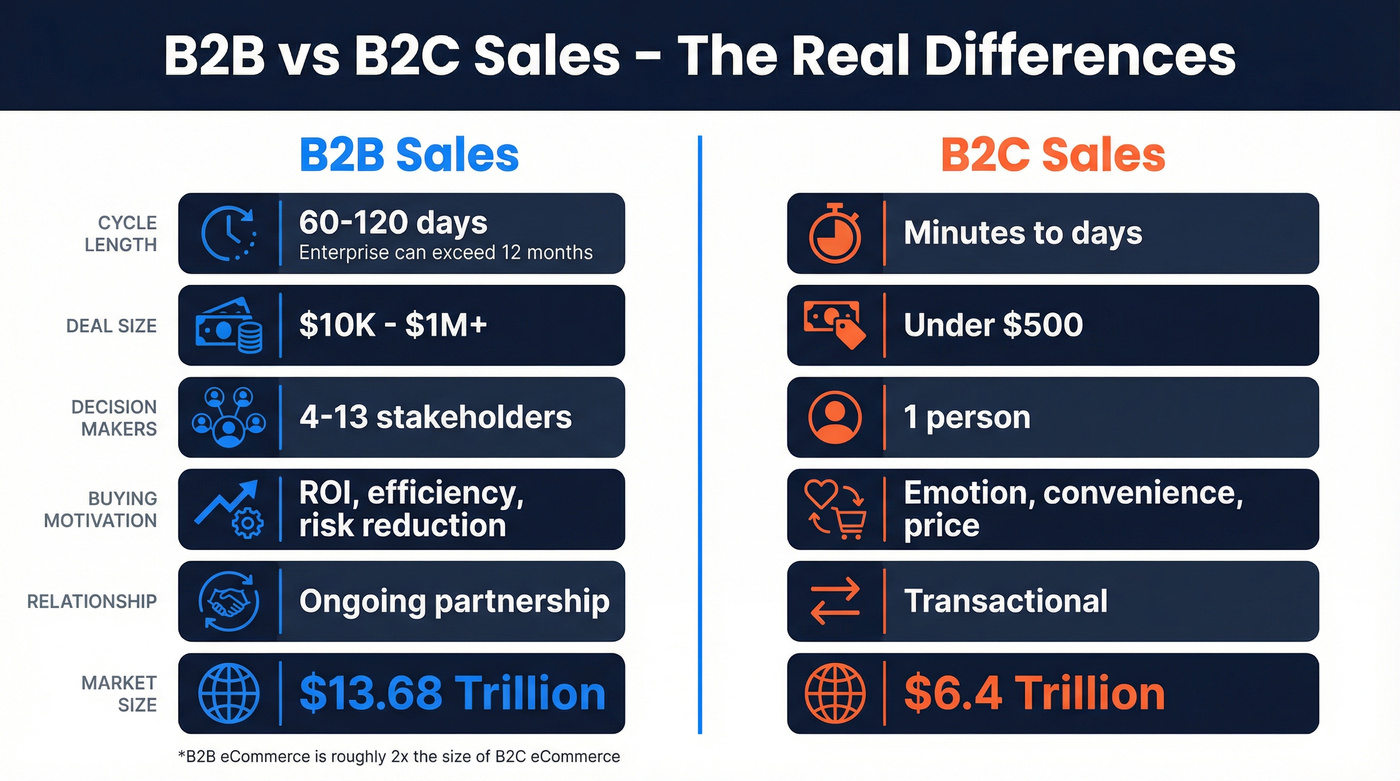
| Dimension | B2B Sales | B2C Sales |
|---|---|---|
| Cycle length | 60-120 days (12+ mo enterprise) | Minutes to days |
| Deal size | Often six or seven figures | Typically under $500 |
| Decision-makers | 4+ stakeholders is common; enterprise can reach ~13 | Usually one person |
| Buying motivation | ROI, efficiency, risk reduction | Emotion, convenience, price |
| Relationship type | Ongoing partnership | Transactional |
| Market size | ~$13.68T (B2B eCommerce, 2025) | ~$6.4T (B2C eCommerce, 2024) |
The deal-size gap drives everything else. When a contract routinely runs six or seven figures, nobody's making that decision on a whim. You're building consensus across a buying committee, navigating procurement workflows, and proving ROI before a signature happens.
Here's the thing: B2B relationships are partnerships, not transactions. Losing a single enterprise client can materially damage your revenue. That's why sellers invest so heavily in account management and expansion - the cost of churn is brutal compared to B2C, where losing one customer barely registers.
B2B eCommerce is also roughly twice the size of B2C eCommerce. That surprises people, but it makes sense when you think about it - every consumer product on a shelf got there through a chain of business-to-business transactions: manufacturing, logistics, distribution, software, services.
Types of B2B Sales
B2B sales isn't monolithic. The way you sell office supplies looks nothing like the way you sell enterprise software.
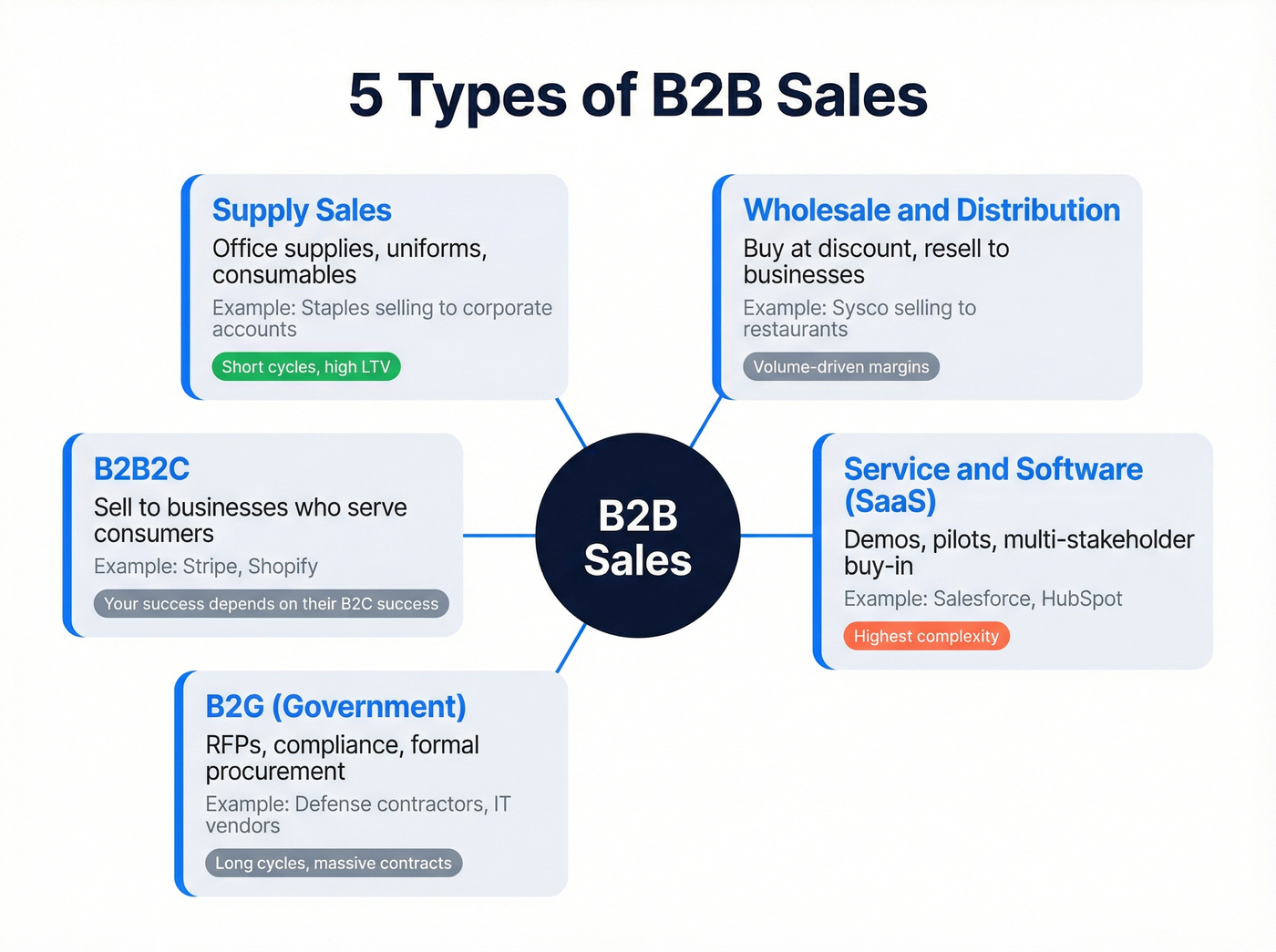
Supply sales cover the consumables businesses need to operate - office supplies, uniforms, cleaning materials. Think Staples selling to corporate accounts or Cintas providing uniforms to restaurant chains. These are repeat purchases with shorter cycles and lower deal values, but high lifetime value through recurring orders.
Wholesale and distribution is the intermediary model. A company like Sysco buys food products at a discount and resells to restaurants and institutional kitchens. The margin is in volume and logistics efficiency, not in the product itself.
Service and software sales is where most of the complexity lives. SaaS platforms, consulting engagements, cybersecurity solutions - these deals require demos, pilots, and multi-stakeholder buy-in. This is the segment most people picture when they hear "B2B sales."
B2G involves selling to government agencies through formal procurement processes, RFPs, and compliance requirements. The cycles are long and the paperwork is heavy, but the contracts can be massive and multi-year.
B2B2C covers businesses that sell to other businesses who then serve consumers. Stripe processes payments for businesses that sell to consumers. Shopify provides the platform that powers storefronts. You're selling B2B, but your buyer's success depends on B2C dynamics.
B2B Sales Benchmarks for 2026
Let's make this concrete. Here's what the funnel actually looks like, stage by stage:
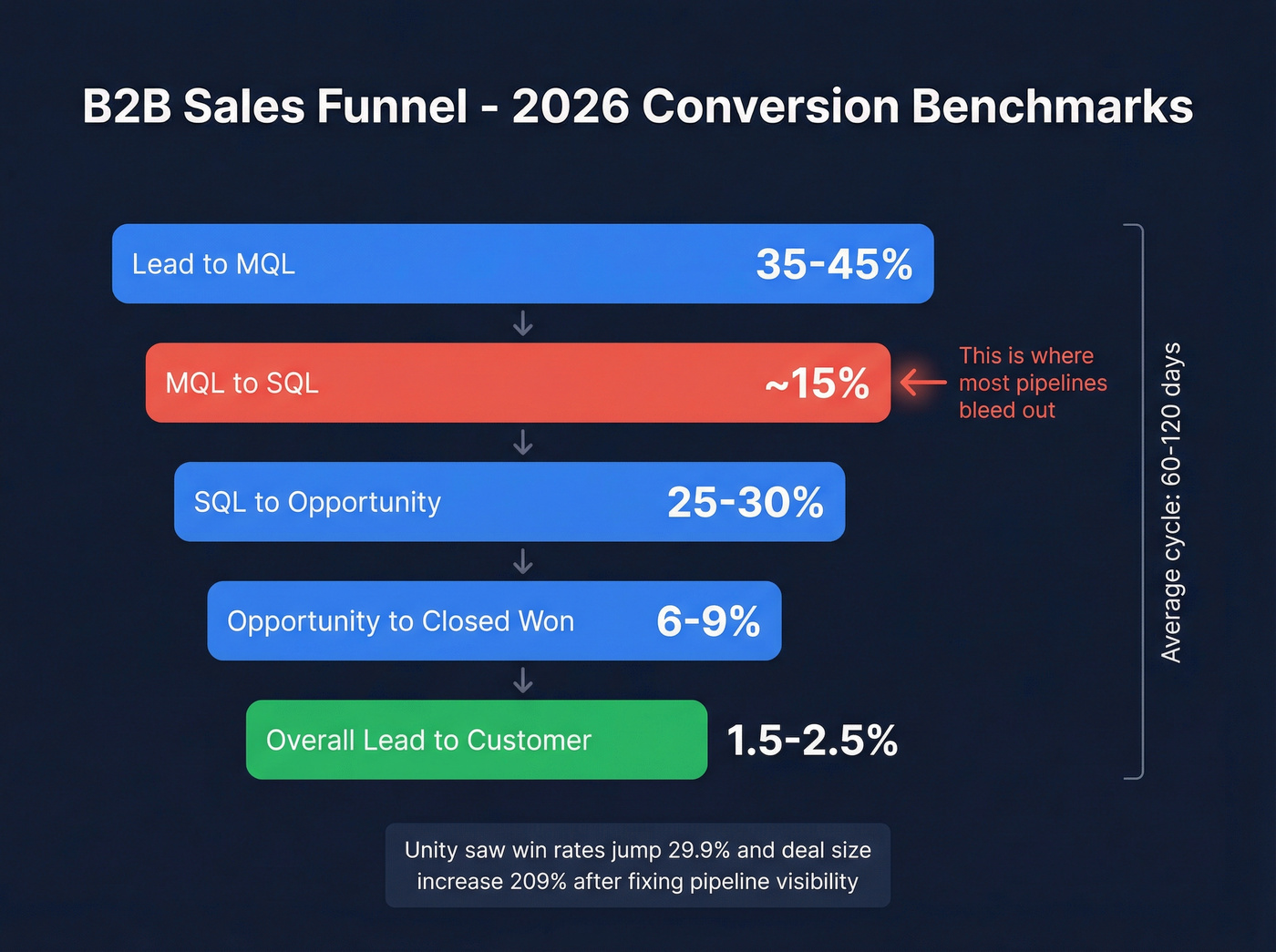
| Funnel Stage | Conversion Rate |
|---|---|
| Lead to MQL | 35-45% |
| MQL to SQL | ~15% |
| SQL to Opportunity | 25-30% |
| Opportunity to Closed-Won | 6-9% |
| Overall Lead to Customer | 1.5-2.5% |
The MQL-to-SQL drop is where most pipelines bleed out. You go from 35-45% of leads qualifying as marketing-qualified down to roughly 15% making it to sales-qualified. That's the qualification gap - where bad targeting, weak lead scoring, and misaligned marketing-sales handoffs do the most damage. (If you want a tighter system, start with lead scoring and account qualification.)
These benchmarks aren't theoretical. When Unity implemented Clari's revenue operations platform, they saw win rates jump 29.9% and average deal size increase 209%. That kind of lift is possible when you fix pipeline visibility and forecasting accuracy, and it illustrates why the tools and processes around your funnel matter as much as the reps working it.
Cycle length varies dramatically by segment. SMB deals average 1-3 months. Mid-market runs 3-6 months. Enterprise sales cycles often exceed 12 months once you factor in legal review, procurement, and security assessments. The 60-120 day average is useful as a baseline, but your actual number depends on deal size and buyer complexity. (More on cycle mechanics in sales cycle acceleration.)
Stakeholder complexity is the other variable that makes B2B fundamentally different from consumer selling. 87% of B2B deals involve four or more stakeholders, and enterprise deals can involve around 13. Multi-threading - building relationships with multiple contacts inside an account - isn't optional anymore. If you haven't operationalized it, read what is multithreading in sales.
Reps don't spend most of their time selling, either. Salesforce's State of Sales data shows reps spend just 28-34% of their time on actual selling activities. The rest goes to admin, CRM updates, internal meetings, and prospecting research.
Industry conversion rates vary widely: legal services convert at 7.4%, SaaS ranges from 1.1% to 7.0% depending on the segment, and B2B eCommerce sits around 1.8%. Know your industry's baseline before you set targets. If you're trying to move the needle, use a structured approach to improve sales conversion rate.

That MQL-to-SQL drop you just read about? Bad data is the #1 cause. Prospeo's 300M+ profiles are refreshed every 7 days - not every 6 weeks - so your reps reach real buyers with 98% verified emails. Stop bleeding pipeline at the qualification stage.
Fix your funnel where it actually breaks - at the data layer.
The B2B Sales Process
The average sales cycle runs 60-120 days. Here's how those days break down into a repeatable process.
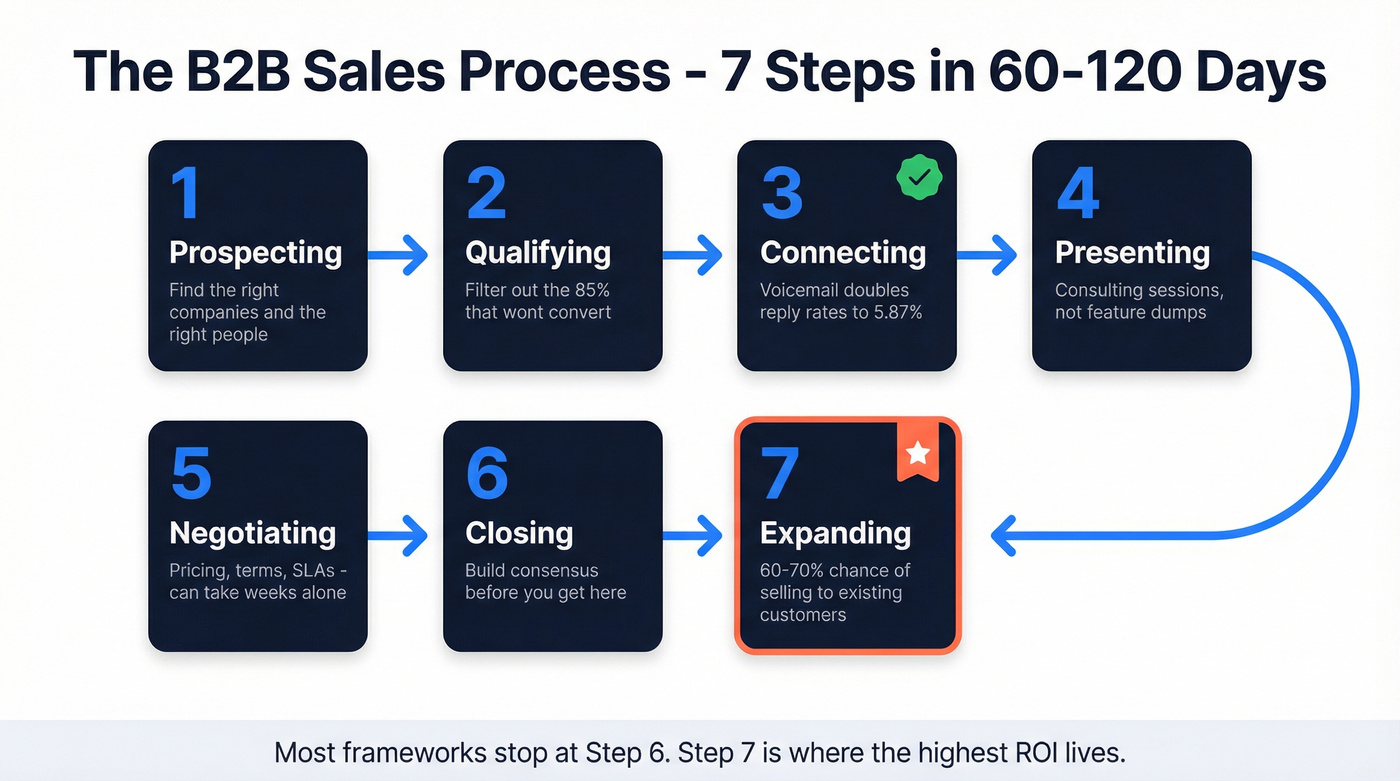
1. Prospecting. You identify potential buyers who match your ideal customer profile - the right companies and the right people within those companies. This means verified emails and direct dials for actual decision-makers, not generic info@ addresses. Tools like Prospeo let you target by intent signals, technographics, and job changes across 300M+ professional profiles. If you need a repeatable system, use this prospecting workflow.
2. Qualifying. Not every prospect is worth pursuing. You assess fit based on budget, authority, need, and timeline. The goal is to filter out about 85% of MQLs that won't convert to SQL before you invest serious time.
3. Connecting - and the voicemail trick most reps skip. First meaningful contact, whether that's a cold email, a warm intro, or a phone call. Gong's research found that leaving a voicemail more than doubles your reply rate, from 2.73% to 5.87%. Most reps treat voicemail as a dead channel. It's not. (If you're building a calling motion, start with the benefits of cold calling and a tight cold call checklist.)
4. Presenting. You demonstrate how your solution solves their specific problem. The best presentations feel like consulting sessions, not feature dumps. I've watched reps lose six-figure deals by spending 40 minutes on a product tour when the buyer wanted a 10-minute conversation about their three biggest pain points.
5. Negotiating. Pricing, terms, implementation timelines, SLAs. In enterprise deals, this stage alone can take weeks as procurement and legal get involved.
6. Closing. Getting the signature. The best closers have already built consensus across the buying committee before this stage arrives - they're not convincing anyone at the finish line.
7. Expanding. Most sales process frameworks stop at closing. That's a mistake. The probability of selling to an existing customer is 60-70%, compared to just 5-20% for a new prospect. Land-and-expand isn't a buzzword - it's the highest-ROI motion in B2B.
How B2B Buying Decisions Get Made
Here's what most sellers miss: the buying process doesn't mirror your sales process. Buyers have their own framework, and understanding it changes how you sell.
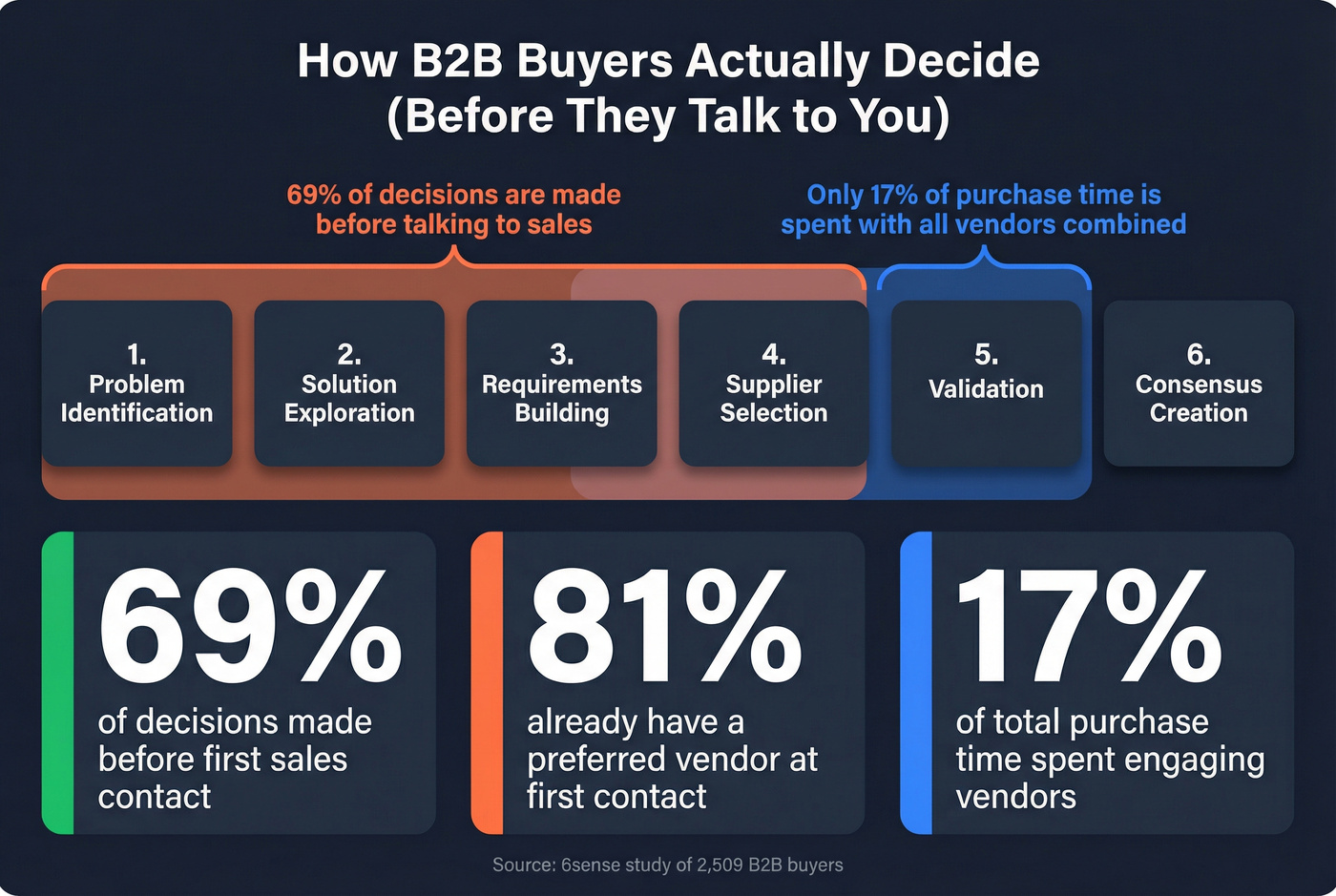
There are six "buying jobs" that every B2B purchase committee works through: Problem Identification, Solution Exploration, Requirements Building, Supplier Selection, Validation, and Consensus Creation. Each one happens partly or entirely without you in the room.
The numbers tell the story. A 6sense study of 2,509 B2B buyers found that 69% of purchasing decisions are effectively made before a buyer ever talks to a sales rep. Even more striking: 81% already have a preferred vendor at first contact. Buyers spend only about 17% of their total purchase time engaging with all vendors combined.
Look - if your deal size is under $25K, you probably don't need a complex enterprise sales motion. But you absolutely need to be present during Problem Identification and Solution Exploration through content, thought leadership, and brand presence. If you're not influencing the process during those early stages, you're showing up after the deal was already half-decided.
Strategies That Work in 2026
Not every strategy fits every team. Here are four that consistently produce results, along with when to skip them.
Account-Based Selling works when you're targeting enterprise accounts with deal sizes above $50K and long sales cycles. ABM lets you concentrate resources on 50-200 high-value accounts instead of spreading thin across thousands. Skip this if you're selling a $500/month SaaS product to SMBs - the unit economics don't justify the per-account investment. If you're implementing it, start with an ABM account plan.
Social Selling delivers 42% response rates, nearly double what email gets. Use this if your buyers are active on professional networks and your reps can build genuine authority. Skip this if your target buyers aren't digitally active - some manufacturing and government segments still run on trade shows and phone calls. For the system, see how to do social selling.
Methodology matters more than most teams realize. We've tested these across different deal sizes, and the pattern is consistent:
| Deal Size | Best Methodology |
|---|---|
| Enterprise ($100K+) | MEDDIC |
| Mid-market ($25-100K) | Challenger |
| SMB (under $25K) | Solution selling with fast demos |
Data-Driven Prospecting is non-negotiable for outbound at any scale. The days of buying a generic list and blasting it are over. Modern prospecting means layering intent signals, technographic data, and job-change triggers to find buyers who are actively in-market. Referrals still convert at roughly 26%, but you can't build a pipeline on referrals alone - data-driven outbound fills the gap. (If you're building this motion, start with intent signals.)
Mistakes That Kill Deals
We've seen these patterns destroy pipeline over and over.
Talking to the wrong stakeholders is the most expensive mistake you can make. You spend three months building a relationship with a mid-level manager who loves your product but can't sign a check. When enterprise deals involve around 13 stakeholders, mapping the buying committee early - identifying the economic buyer, the champion, and the potential blockers - isn't just good practice. It's survival.
Neglecting existing customers. The probability of selling to an existing customer is 60-70%. For a new prospect, it's 5-20%. Yet most sales teams pour 90% of their energy into new logos.
Rushing prospects through the cycle is tempting when you're behind on quota, but enterprise buyers have their own timeline. Pushing for a close before they've completed their internal consensus-building process doesn't accelerate the deal - it kills it.
Ignoring data quality. Your SDR team sent 2,000 emails. 400 bounced. 1,200 went to the wrong persona. 12 booked meetings. The fix isn't sending more emails - it's verifying your list before you hit send. The consensus on r/sales is pretty clear: bad data is the silent killer of outbound campaigns, and most teams don't realize how much pipeline they're leaving on the table until they actually audit their bounce rates. If you want the operational fix, start with data quality.
Feature-dumping instead of solving problems. Nobody cares that your platform has 47 features. They care about the three that solve their specific pain.
Single-channel outreach. Email alone isn't enough. Phone alone isn't enough. The teams that consistently hit quota combine email, phone, social, and sometimes direct mail into coordinated multi-touch sequences.
No follow-up system. 92% of salespeople quit after the fourth follow-up attempt. Most deals require more touches than that.
Trends Shaping 2026
AI is table stakes. 89% of revenue organizations are already using AI, and 92% plan to increase their investment. This isn't about replacing reps - it's about automating the 66-72% of their time currently spent on non-selling activities. But Forrester warns that enterprises have already lost over $10 billion in value from deploying untested generative AI in sales workflows. The teams winning with AI are the ones applying it to specific, measurable tasks - research, email drafting, call summarization - not the ones handing their entire pipeline to a chatbot.
Self-serve is expanding fast. 40% of sales teams have expanded self-serve tools: pricing pages, ROI calculators, customer stories, and product tours that let buyers educate themselves. The best B2B companies now treat their website as a sales rep that works 24/7.
Buyers engage sellers later than ever. Nearly two out of three B2B buyers now prefer engaging vendor salespeople only in later stages of their journey, a shift of +17 percentage points year-over-year per 6sense's buyer experience report. By the time a buyer books a demo, they've already formed an opinion.
Change fatigue is real. Employee willingness to support organizational change dropped from 74% to 44% according to Gartner's research. That means even when a buyer wants your solution, getting internal buy-in is harder than ever. Sellers who help champions build internal business cases - not just pitch decks - will close more deals.
Essential Tools for B2B Sales
You don't need 10 tools. You need three: a CRM, a data platform, and a sequencing tool. Everything else is a nice-to-have until you've nailed those fundamentals.
CRM. Salesforce and HubSpot are the two most common choices. Pick one and actually use it - the best CRM is the one your reps will update.
Data & Prospecting. This is where we're biased, but the numbers back it up. Prospeo covers 300M+ professional profiles, 143M+ verified emails, and 125M+ verified mobile numbers at 98% email accuracy on a 7-day refresh cycle - the industry average is six weeks. Pricing runs about $0.01 per email, and there's a free tier with 75 emails/month, no contracts, and self-serve onboarding so you're pulling verified contacts in minutes.

Sales Engagement. Sequencing tools like Outreach, Salesloft, Instantly, or Lemlist handle multi-touch cadences. Pick one that integrates with your CRM and data platform. If you're choosing a platform, use this guide on how to choose a sales engagement platform.
Conversation Intelligence. Gong records and analyzes sales calls to identify what top reps do differently. Worth it once you have 5+ reps and enough call volume to generate patterns.
Intent Data. 6sense, Demandbase, and Bombora help you identify which accounts are actively researching solutions like yours. Enterprise pricing typically runs $30-100K+/year.
Reps spend just 28-34% of their time selling. Prospeo gives them verified emails and direct dials from 300M+ profiles with 30+ filters - so they prospect in minutes, not hours. Snyk's 50 AEs grew their sourced pipeline 180% after switching.
Give your reps back their selling time for $0.01 per lead.
FAQ
What does B2B sales mean?
B2B sales means selling products or services from one business to another, covering a $32.11 trillion global market that spans SaaS platforms, office supplies, enterprise consulting, and government contracts. The buyer is always an organization - not an individual consumer - and purchases are driven by ROI rather than impulse.
What's a B2B sales role like?
A B2B sales role involves prospecting, qualifying leads, running demos, negotiating contracts, and managing ongoing client relationships. Reps typically spend only 28-34% of their time on actual selling, with the rest going to research, admin, and internal coordination. Success requires patience and the ability to navigate complex buying committees.
Is B2B sales hard?
It involves longer cycles (60-120 days average), more stakeholders (4+ is common, enterprise can reach ~13), and complex decision-making processes. The tradeoff is significant: higher deal values, stronger earning potential, and long-term client relationships that compound over time.
How long is a typical B2B sales cycle?
The average cycle runs 60-120 days. SMB deals close in 1-3 months, mid-market takes 3-6 months, and enterprise deals often exceed 12 months once procurement, legal, and security reviews get involved. Deal size is the strongest predictor of cycle length.
What tools do you need to get started?
Three core tools: a CRM (Salesforce or HubSpot), a data platform for verified contacts, and a sequencing tool for multi-touch outreach. Add conversation intelligence and intent data once your team scales past five reps.