

How to Handle the "Not Interested" Objection - Scripts, Frameworks, and Prevention Tactics Backed by 300M+ Calls
It's 9:07 AM on a Tuesday. You've got your coffee, your headset, and a list of 40 dials to make before lunch. The first prospect picks up - a minor miracle, since 72% of cold calls don't reach a human. You get three words into your opener.
"Not interested." Click.
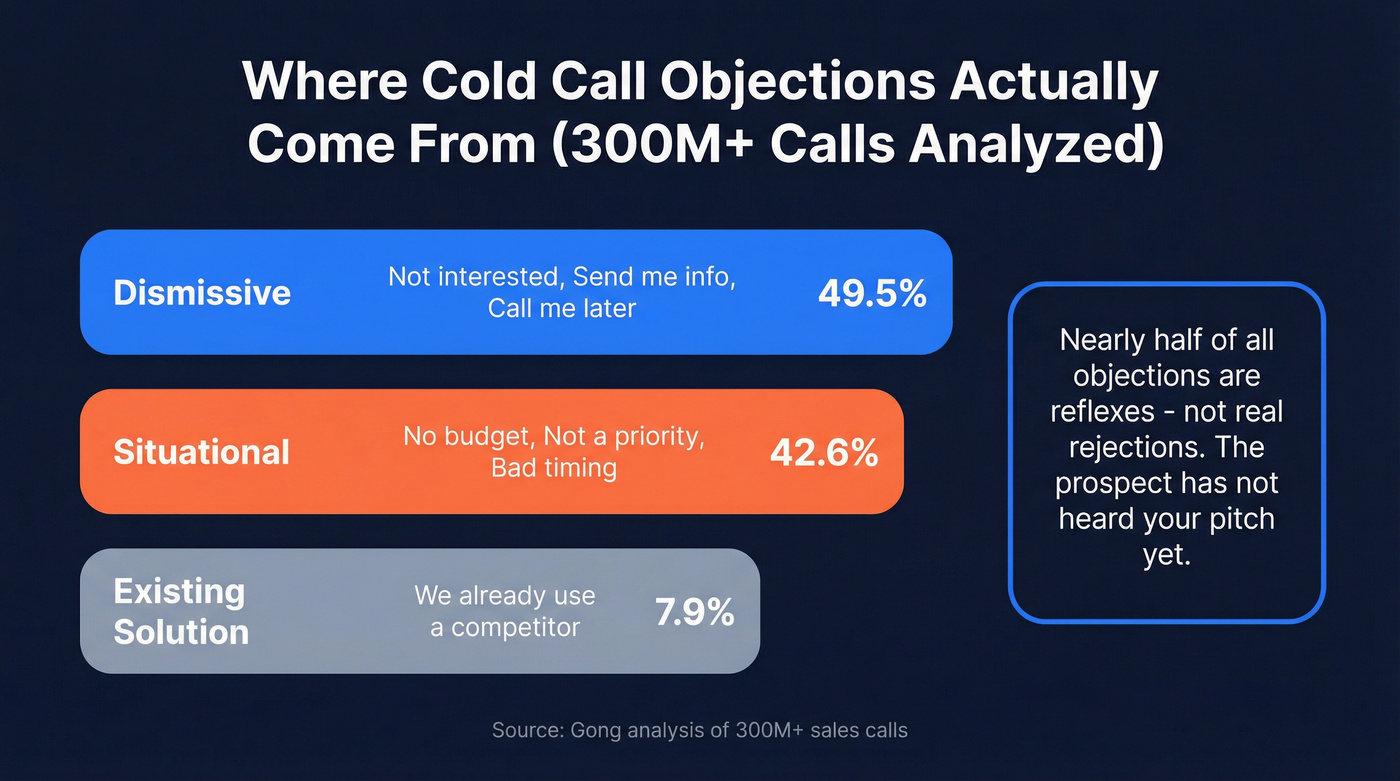
That call lasted 12 seconds. The average cold call runs 93 seconds, and only 10% make it past two minutes. The not interested objection handling challenge you just experienced isn't really about an objection at all. It's a reflex. Gong's analysis of 300M+ sales calls found that dismissive objections like "not interested," "send me info," and "call me in 6 months" account for 49.5% of all cold call objections. Half the pushback you face every day has nothing to do with your product, your price, or your timing. It's about the fact that you're a stranger interrupting someone's morning.
The dismissive objection turnaround is the single highest-ROI skill in outbound sales. Top-quartile cold callers book 3x more meetings than average peers, and a huge part of that gap is how they handle the first 10 seconds after a brush-off. The difference isn't talent. It's preparation: knowing why the reflex happens, how to prevent it, and exactly what to say when it does. And here's the stat that should keep you motivated - 82% of buyers accept meetings from proactive outreach. The problem isn't that prospects don't want to talk. It's that most reps lose them before they've said anything worth hearing.
What You Need (Quick Version)
If you're short on time, here's the playbook in 60 seconds:
- "Not interested" is a reflex, not a verdict. 49.5% of all cold call objections are dismissive. The prospect hasn't heard your pitch yet - they're swatting away an interruption.
- Your opener causes more brush-offs than your product does. Permission-based openers succeed at 11.18%. "Did I catch you at a bad time?" lands at 2.15%. That's a 5x gap before you even get to your value prop. (If you want more openers, see our B2B cold calling guide.)
- Use a framework, not instinct. Validate the objection, label the emotion, make a secondary ask. Winging it leads to awkward silence or desperate pitching. (More examples in our objection handling scripts.)
- If you're hearing it on 40%+ of calls, your data is the problem. Bad contacts trigger reflexive rejection before you even pitch. Wrong person, outdated title, dead number - none of that is fixable with a better script. (Use a simple data quality scorecard.)
Why Prospects Say "Not Interested" (It's Not About Your Product)
The Psychology Behind the Dismissive Sales Objection
The average decision-maker gets 100+ emails and a dozen calls daily. Their default response to anything unsolicited is "no" - not because they've evaluated your offer, but because saying no is the fastest way to protect their time.
Four psychological drivers power the reflex:
- Fear of the unknown. You're a stranger. They don't know what you want, how long it'll take, or what they're committing to by listening. The safest move is to shut it down.
- Loss aversion. They're not worried about missing your offer - they're worried about losing 10 minutes they can't get back. The potential loss of time outweighs any potential gain from your pitch.
- Status quo bias. Whatever they're doing right now feels safe. Change requires effort, consensus, and risk. "Not interested" keeps everything exactly as it is.
- Need for control. A cold call is an interruption they didn't choose. Saying "not interested" restores their sense of agency.
Layer on the buying environment: 77% of B2B buyers describe their last purchase as complex or difficult, the average buying group has grown to 12 stakeholders, and only 13% of customers believe a salesperson can understand their requirements. Your prospect isn't just busy - they're skeptical that any cold caller can actually help. (This is where B2B decision making gets messy fast.)
Fob-Offs vs. Real Objections
Not all "not interested" responses are created equal. Data from 300M+ analyzed calls breaks objections into three categories:
| Type | % of Objections | Examples | Your Move |
|---|---|---|---|
| Dismissive | 49.5% | "Not interested," "Send info" | Pattern interrupt, micro-commitment, curiosity pivot |
| Situational | 42.6% | "No budget," "Not a priority" | Address specific concern, reframe value |
| Existing solution | 7.9% | "We use [competitor]" | Differentiate, plant seeds, set follow-up |
If someone says "we're in a contract until March," that's a real objection. It's specific, it's legitimate, and it tells you something useful.
If someone says "not interested" three seconds into your call, that's a fob-off. They haven't heard enough to form an actual opinion. The distinction matters because each requires a completely different response strategy. Real objections need specific answers. Fob-offs need you to earn 30 more seconds of attention.

You can't script your way out of bad data. If your prospect list is full of wrong titles, dead numbers, and outdated contacts, you'll hear "not interested" before you finish your opener. Prospeo's 300M+ profiles are refreshed every 7 days with 98% email accuracy - so you reach the right person, every time.
Stop perfecting your script. Start fixing your contact list.
How to Prevent "Not Interested" Before It Happens
The Best Cold Call Openers (Backed by 300M+ Calls)
The fastest way to reduce dismissive objections is to stop triggering them with your opener. The gaps between common openers are staggering:

| Opener | Success Rate |
|---|---|
| "Did I catch you at a bad time?" | 2.15% |
| "How's your day going?" | 7.6% |
| Permission-based ("I know I'm calling out of the blue...") | 11.18% |
| "Heard the name tossed around?" | 11.24% |
| "The reason for my call is..." | 2.1x baseline |
| "How have you been?" | 6.6x baseline |
All data from Gong's analysis of 300M+ sales calls.
Look at that spread. "Did I catch you at a bad time?" - the opener half of sales floors still use - performs at 2.15%. Permission-based openers hit 11.18%. That's a 5x difference, and it happens before you've said a single word about your product.
The pattern is clear: openers that acknowledge the interruption and give the prospect a sense of control outperform openers that either ignore the awkwardness or hand the prospect an easy exit. Leading with "the reason for my call is..." makes you 2.1x more likely to book a meeting because it signals respect for their time and gives them a reason to keep listening. (More options in sales pitch opening research.)
Mistakes That Trigger the Objection
Five mistakes that practically guarantee a reflexive brush-off:
"Is this Bob?" Signals you don't know who you're calling. Use an assumptive opener: "Hi Bob, this is [name] from [company]."
"Did I catch you at a good time?" Gives them a free exit. Try: "I know you're busy, so I'll be brief."
Generic pitch with zero research. Prospects spot it instantly. Spend 5 minutes on their company before dialing. Recent news, role changes, anything specific. (Use a pre call research checklist.)
Talking too much. Aim for a 40/60 talk-to-listen ratio. If you're monologuing, you've already lost.
Pitching the product instead of the meeting. Don't try to sell on a cold call. Sell the appointment. Minute 1 is intro + value, Minute 2 is qualifying questions, Minute 3 is next step. (Try these cold call qualifying questions.)
And one that's entirely preventable: calling the wrong person. If your prospect list hasn't been verified recently, you're dialing outdated titles and dead numbers. You can't overcome a dismissive objection when the person genuinely isn't the right contact. (Here’s how to ask for the right contact person.)
The Framework for Handling "Not Interested" Objections
Gong's Miyagi Method
Gong's recommended framework for dismissive objections has three steps:

- Agree with the objection. Don't fight it. "Totally fair - I called you out of the blue."
- Incentivize the conversation. Give them a reason to stay on the line for 20 more seconds. A specific pain point, a relevant company name, a surprising stat.
- Sell the test drive, not the product. You're not asking them to buy. You're asking them to listen for half a minute.
Here's what it sounds like in practice:
Prospect: "I'm not interested." You: "That's fair - I'd be surprised if you were, since I haven't told you anything yet. We just helped [similar company] cut their [specific metric] by 30%. Mind if I take 20 seconds to explain how?"
The key insight: "The more ridiculous their reaction, the more ridiculous your opposite counter-reaction should be." Match their energy with transparency and a touch of humor. Don't grovel. Don't get defensive. Stay light.
The 3-Point Validate-Label-Ask Method
A complementary framework that works especially well when the prospect sounds stressed or rushed:

- Validate the objection. "I completely understand." No buts. No pivots. Just acknowledgment.
- Label the emotion. "It seems like you're overwhelmed with calls today." This is a Chris Voss technique - naming the emotion defuses it.
- Follow up with a secondary ask. "When would be a better time to connect?" or "Can you point me to who handles [X]?"
The secondary ask is critical. You're not pushing for a meeting - you're asking for something smaller. A better time. A referral. A 30-second window. Once you've earned a few more seconds, let the prospect talk 70% of the time. The more they talk, the more you learn, and the harder it becomes for them to hang up.
One more thing: reading scripts isn't enough. Record yourself delivering each one. The first time you say "Just 27 seconds" should not be on a live call.
8 Best Sales Rebuttals for "Not Interested" (and When to Use Each)
1. The Permission Micro-Commitment
Use when: The prospect cuts you off in the first 10 seconds.

"All I'm asking for is 30 seconds. In that 30 seconds, I'll explain what we do. If it's not relevant, you can hang up on me. Does that sound fair?"
This is Morgan J. Ingram's go-to. Most prospects don't want to seem unfair, so they'll say yes. You've just bought yourself half a minute - which is an eternity on a cold call.
2. The Curiosity Pivot
Use when: The prospect sounds annoyed but hasn't hung up yet.
"Out of curiosity, is it the timing or the offer that doesn't feel right?"
In my experience, this works best when the prospect sounds frustrated rather than indifferent - their frustration means they're still engaged. Instead of defending their "no," they're now thinking about why they said no. That's a completely different conversation. And half the time, the answer is "it's just bad timing" - which opens the door to a callback.
3. The Pattern Interrupt
Use when: You fumbled the opener and know it.
"Sounds like I butchered that opener. Fair enough - can I try one more time in 15 seconds?"
Humor and self-deprecation disarm. The prospect was expecting you to push harder. Instead, you acknowledged the awkwardness. That's unexpected enough to earn a second chance.
4. The Chris Voss Mirror
Here's the thing: 90% of reps get mirroring wrong because they mirror and then immediately pitch. That kills the technique.
The prospect gives a flat, emotionless "not interested." You respond:
"You're not interested?" (Repeat their last 2-3 words with an upward inflection. Then silence.)
Silence creates discomfort. The prospect fills the gap - and what they say next is almost always more honest than "not interested." Maybe it's "well, we just signed with [competitor]." Maybe it's "I don't even know what you do." Either way, you've got something real to work with. Hold the conversation after the mirror. Build rapport first. Don't pitch.
5. The Sara Uy Reframe
Use when: The prospect sounds uncertain rather than hostile.
"You don't have to be interested right now - most of my clients weren't at first. Can I quickly share why I'm calling, and you can let me know if it's relevant?"
Sara Uy, a Cognism SDR, uses this to normalize the objection. "Not interested" stops feeling like a wall and starts feeling like a perfectly normal part of the conversation. The implicit message: everyone says this. The good ones still listen.
6. The Specific-27-Seconds Commitment
Why 27 and not 30? Because odd numbers signal authenticity. "30 seconds" sounds like a sales cliche. "27 seconds" sounds like you've actually timed your pitch. Small detail, real difference.
"Just 27 seconds to tell you how we can help you [solve X]. Then if you're still not interested, you can hang up - no hard feelings."
7. The Social Proof Pivot
Picture this: you've spent 20 minutes researching this company. You know their competitor just switched providers. You know they're hiring for the exact role your product supports. Then they hit you with "not interested."
"That makes sense - I have called out of the blue. We wouldn't be speaking if I hadn't done my research and truly believe we can help like we did with [similar company]."
Dropping a known company name creates instant credibility. Mentioning a mutual connection increases meeting chances by 70%. The prospect goes from "who is this person?" to "oh, they work with [company I respect]." This only works if the reference is genuinely relevant - same industry, similar size, recognizable name.
8. The Disarmingly Blunt Response
Use when: The prospect says "not interested" before you've said anything of substance.
"I'd be worried if you were interested - I haven't told you anything yet. Mind if I take 20 seconds to change that?"
This matches the absurdity of the situation with humor and transparency. It works because it's honest. And honesty is disarming.
Bonus: The No-Decision Disarm
Use when: The prospect sounds guarded, like they're afraid you'll trap them into something.
"I'm not asking you to decide anything right now - just to hear one idea that's helped companies like yours. Fair?"
This removes the pressure entirely. The prospect's guard drops because you've explicitly taken the commitment off the table. Once they agree to "just hear one idea," you've got your opening.
What to Say After the Turnaround - The Missing 60 Seconds
Every article about "not interested" covers the turnaround. Almost none cover what happens next.
You've earned 30 more seconds. Now what?
Don't immediately pitch features. The worst thing you can do after a successful turnaround is launch into a product demo. You haven't earned that yet. Instead, ask a qualifying question. Morgan Ingram recommends open-ended questions like: "What's the biggest challenge your team is facing right now?" or "What takes up the most time in your day?" These show you care about their situation and give you intel to tailor your pitch.
Use interest CTAs, not specific CTAs. Data from 300M+ calls shows that "Does it make sense for me to give you more detail?" outperforms "Are you available Tuesday at 4?" on cold calls. Interest CTAs let the prospect opt in gradually instead of committing to a calendar slot.
Think in three minutes. Minute 1 is your intro and value statement. Minute 2 is qualifying questions - this is where you listen. Minute 3 is the next step. Successful cold calls last 5 minutes and 50 seconds on average. Failed calls last 3:14. You earn those extra minutes by asking good questions and actually listening to the answers.
I've seen reps nail the turnaround and then immediately blow it by talking for 90 seconds straight about features. The prospect gave you a second chance. Don't waste it on a monologue.
Handling "Not Interested" Over Email (and LinkedIn)
Why Email "Not Interested" Is Actually Good News
Think about what had to happen for someone to reply "not interested" to your cold email. They avoided your message going to spam. They didn't delete it. They read it. And then they took the time to type a response and hit send.
That's engagement.
Most cold emails get ignored entirely - the average reply rate sits under 2%. Someone who writes back "not interested" is more engaged than 98% of your list. Samuel Carmichael at OpenText puts it well: "Those people forgot who you are by week six, and stay in rotation. So many 'never call me agains' turned into 'Hi Sam.'"
Study every word in the rejection. "Probably not interested" signals uncertainty. "Not interested right now" signals timing. A definitive "no" with no qualifiers is different from a soft brush-off. Each one gets a different response.
Email Response Templates That Re-Engage
The mistake most reps make: responding to "not interested" with another pitch. Instead, provoke curiosity.
Template 1 - The Curiosity Question:
"Totally fair. Out of curiosity, what would need to change for this to be worth a quick conversation?"
Non-biased, open-ended, and impossible to answer with "no."
Template 2 - The Soft Reframe:
"Appreciate the honesty. We just helped [similar company] solve [specific problem] - thought it'd be relevant given [something specific about their situation]. Happy to share the details if it ever makes sense."
Template 3 - The Long Game:
"No worries at all. I'll check back in [specific timeframe] in case anything changes. In the meantime, here's a [resource] that might be useful regardless - no strings attached."
You're not pushing. You're planting a seed and giving them something valuable. Six weeks later, when their current solution falls short, you're the rep who sent that helpful article instead of another pitch.
Keep every response readable in 15 seconds. Prove your research in the first sentence. And don't forget: cold calling doubles email reply rate (3.44% vs 1.81%), and leaving voicemails increases email reply rate from 2.73% to 5.87%. A "not interested" email is your cue to pick up the phone, not send another email. (If bounces are part of the problem, start with email verification list hygiene.)
A Quick Note on LinkedIn
On LinkedIn, the same principles apply with one advantage: the informal tone lets you be even more direct. A simple "Fair enough - what would make this worth revisiting?" works better on LinkedIn than in email because the platform's conversational nature makes it feel less salesy. Keep it short, keep it human, and don't send a connection request with a 200-word pitch attached.
When to Walk Away - and When Your Data Is the Problem
Disqualification Criteria
Not every "not interested" is worth fighting. Skip the turnaround when:
- They can't articulate any pain points - even after good questions, there's nothing there.
- No decision-maker access - you're talking to someone who can't say yes.
- 12+ month timeline - nurture, don't push.
- Already evaluating 3+ vendors - you're late to the party.
- Explicit, repeated "take me off your list" - respect it. Immediately.
About 10% of prospects are ready to buy right now. Focus your energy on the 30% who aren't actively thinking about it yet - they're the ones where a good turnaround actually moves the needle.
Fix Your Data Before You Fix Your Script
Here's my hot take: if your deal sizes are under $10k, your biggest cold calling problem isn't objection handling - it's data quality.
Enterprise reps can afford to spend 20 minutes researching each account and crafting a perfect opener. High-velocity teams dialing 50+ calls a day can't. For them, every ghost record and outdated title compounds into a morale problem that no script library can fix.
We've seen this pattern constantly: a team invests in objection handling training, buys script libraries, runs role-play sessions - and dismissal rates barely budge. The problem isn't the script. It's the list. Sales reps lose 27.3% of their time to bad contact data. B2B data decays at 2.1% per month - that's 22.5% of your database going stale every year. It takes an average of 209 calls to generate one appointment. (Track decay and refresh with a BDR contact data workflow.)
Bad data makes that number worse.
You pull up the next contact in your CRM. The title says "VP of Marketing." You dial. A confused intern answers - the VP left five months ago. That's not a cold call objection you can overcome with a better script. That's a ghost record wasting your time. Tools like Prospeo verify contacts on a 7-day refresh cycle with 98% email accuracy, so you're at least dialing people who still work where your CRM says they do. (If you’re building lists, start with an email lookup workflow.)
80% of cold calls go to voicemail. 72% don't reach a human at all. You can't afford to make those numbers worse by dialing outdated contacts. Fix the data first. Then fix the script.
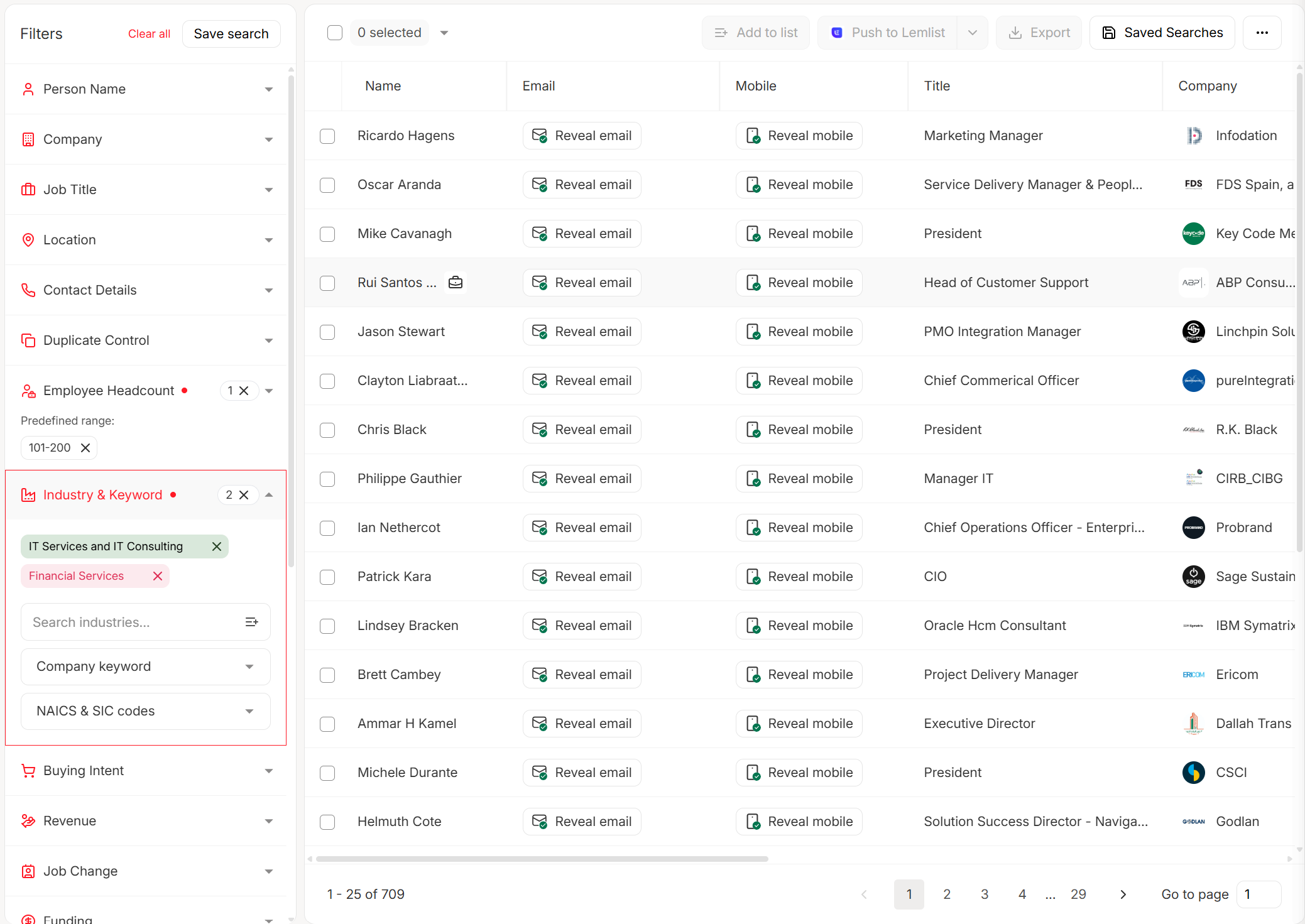
The article says it clearly: if 40%+ of your calls get a reflexive brush-off, your data is the problem. Prospeo gives you 30+ filters - buyer intent, job changes, headcount growth - so you call prospects who actually match your ICP. At $0.01 per email, bad data is a choice.
Reach decision-makers who pick up. Book meetings that stick.
FAQ
What percentage of cold call objections are "not interested"?
Dismissive objections - including "not interested," "send me info," and "call me in 6 months" - account for 49.5% of all cold call objections across 300M+ analyzed sales calls. The top 5 objections alone represent 74% of all pushback reps face.
Should you push back when a prospect says "not interested"?
Yes, but with a light touch. "I'm not interested" said three seconds into a call is a reflex, not a decision. Use a micro-commitment ("Just 27 seconds - if it's not relevant, hang up on me") or a curiosity question ("Is it the timing or the topic?"). If they repeat it firmly after your pivot, respect it and move on.
What's the best cold call opener to prevent "not interested"?
Permission-based openers ("I know I'm calling out of the blue...") succeed at 11.18%, while "Did I catch you at a bad time?" drops to 2.15%. Leading with "The reason for my call is..." makes you 2.1x more likely to book a meeting. Acknowledge the interruption and give the prospect control.
How do you handle "not interested" in a cold email?
An email reply - even a negative one - means they read your message and engaged. Respond with curiosity, not another pitch: "Out of curiosity, what would need to change for this to be worth a conversation?" Then follow up with a call - voicemails increase email reply rates from 2.73% to 5.87%.
How does bad data cause more "not interested" responses?
When your list has outdated titles or contacts who left the company, you're reaching people who genuinely aren't the right person - and no script fixes that. B2B data decays at 2.1% per month, so a list that's three months old already has ~6% dead records dragging down your connect rates and inflating your dismissal numbers before you even pitch.