

AI for B2B Outreach: Data, Deliverability, and the Tools That Actually Work
You sent 2,000 AI-personalized emails last Tuesday. 340 bounced. Your domain reputation dropped. The "personalization" your AI SDR generated referenced a prospect's company blog post from 2019. Now you're wondering whether AI for B2B outreach is actually worth the hype - or whether you just automated a mess.
Here's the reality: 81% of sales teams already use or experiment with AI for outreach, and AI-using teams are 1.3x more likely to see revenue growth. The technology works. But it only works when the inputs are clean, the signals are fresh, and the infrastructure is ready. Most teams skip those steps, then blame the AI.
This is the playbook for doing it right.
What You Need (Quick Version)
If you're short on time, here's the three-part stack that matters:
- Fix your data first. Verify every email before it enters a workflow - 98% accuracy at roughly $0.01/email keeps bounces under 1%. Bad data is the #1 reason automated outreach fails. (If you want a deeper breakdown, start with email verification.)
- Pick an AI tool. AiSDR ($900/mo) or Reply.io's Jason AI ($500/mo) for full-cycle AI SDR automation. Under 10 reps and budget-conscious? Instantly ($30/mo) plus ChatGPT handles the basics.
- Respect deliverability. 30-day warmup, 1% or lower bounces, SPF/DKIM/DMARC configured before you send a single AI-generated email.
One contrarian note before we go deeper: you might not need an AI SDR at all. You might just need clean data and a decent sequencer. The AI component is only valuable when the foundation is solid.
Three Levels of AI in B2B Outbound
Not every team needs a fully autonomous AI agent. BCG's framework for AI in B2B sales breaks this into three maturity levels, and it's the clearest way to figure out where you actually sit.
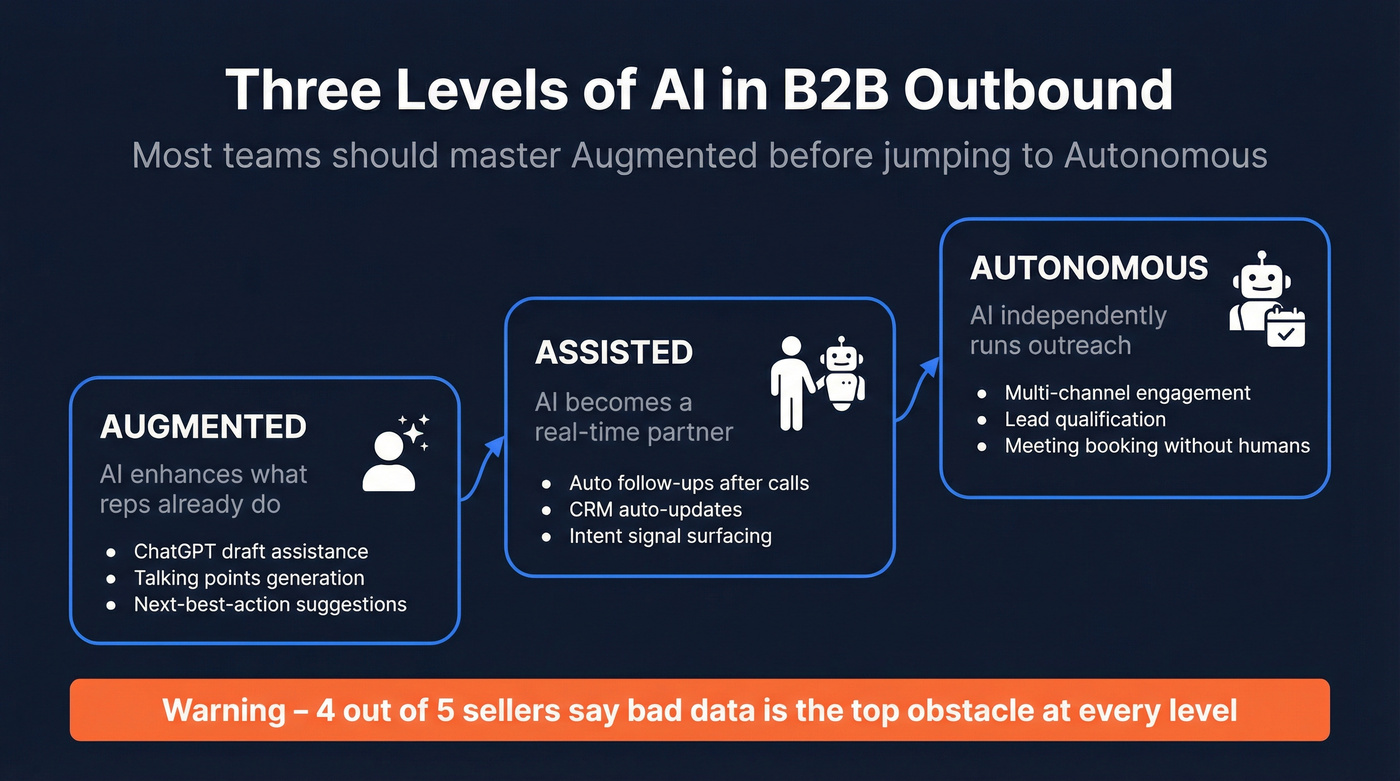
Augmented is where most teams start. AI enhances what reps already do - generating talking points, personalizing email drafts, suggesting next-best actions. Think ChatGPT plus your sequencer. The rep still drives every decision. (If you're building this layer, AI in sales cadences is a useful reference.)
Assisted is the next step. AI becomes a real-time partner: drafting follow-ups after calls, updating CRM records, surfacing intent signals mid-conversation. The rep is still in the loop, but AI handles the grunt work between touches. Tools here include Outreach's AI features, Gong, and Clari.
Autonomous is the frontier. AI independently engages prospects across channels, qualifies inbound, nurtures cold leads, and books meetings without human intervention. This is where AI SDR platforms like AiSDR, Reply.io's Jason AI, and 11x.ai operate. (If you're evaluating this category, see autonomous SDR software.)
The honest reality? More than 4 out of 5 sellers cite inaccuracy and poor data integration as the primary obstacle to AI adoption. The most common frustration in sales ops communities - including threads on r/sales and r/salestechnology - isn't about AI quality. It's about feeding AI bad data and getting bad results at 10x the speed. Before you jump to autonomous, make sure your augmented setup actually works.
Data Quality: The Foundation Nobody Talks About
Every AI outreach article talks about personalization, sequencing, and reply handling. Almost none talk about what happens when your contact database is 15% stale. We've seen it repeatedly: a team buys an AI SDR, feeds it a list from a six-week-old database, and watches their bounce rate climb past 5%. The AI did exactly what it was told. The data was garbage. (This is exactly what B2B contact data decay looks like in practice.)
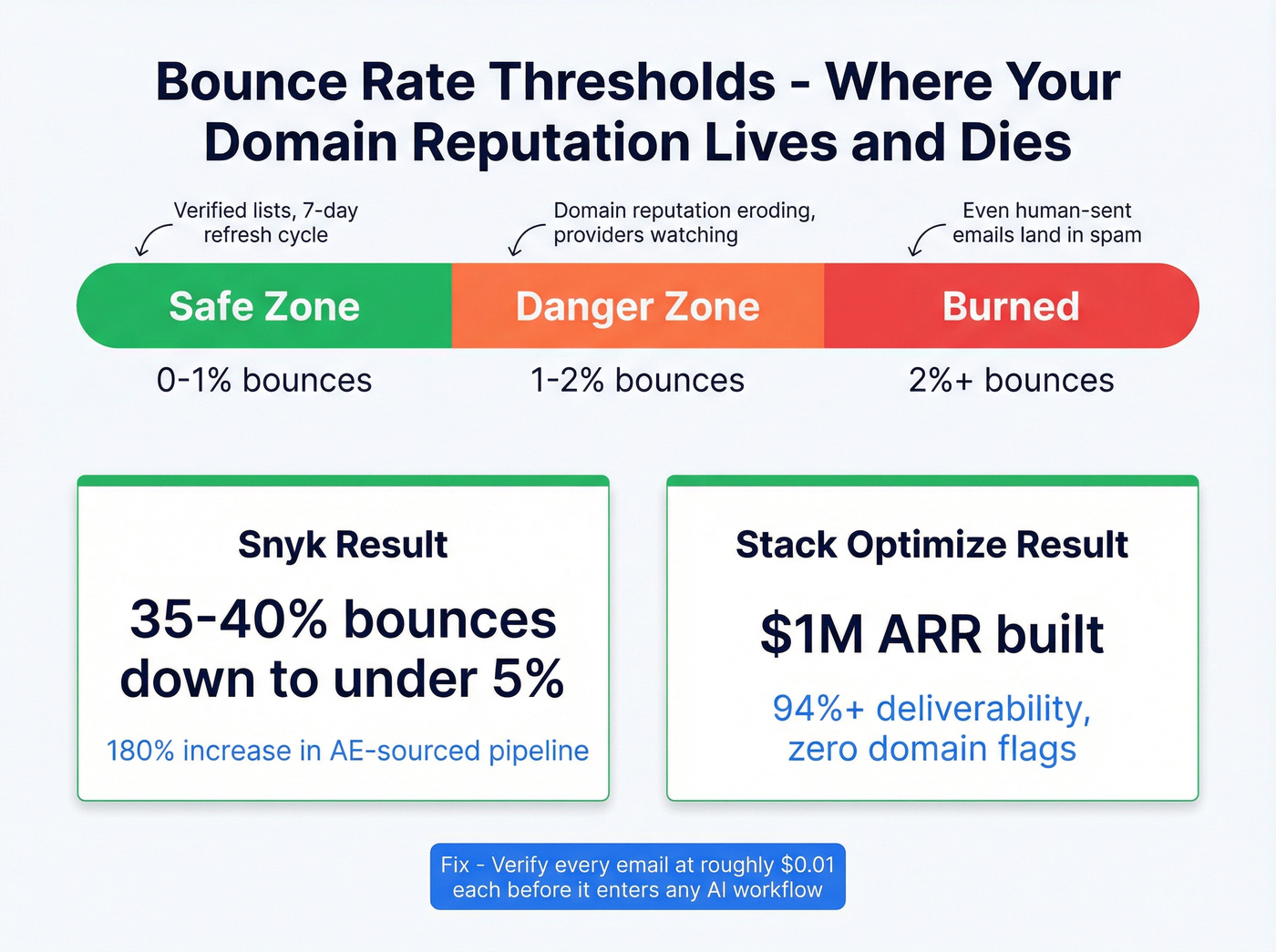
The thresholds are unforgiving. Hard bounces need to stay at or below 1%. Anything above 2% signals poor list hygiene to email providers, and your domain reputation starts eroding. Once that happens, even your human-sent emails land in spam. (If you need the mechanics, start with hard bounce.)
This is where email verification fits into the workflow. Prospeo's 5-step verification process - including catch-all domain handling, spam-trap removal, and honeypot filtering - delivers 98% email accuracy across 143M+ verified emails. The database refreshes every 7 days, compared to the 6-week industry average. That difference matters when you're running AI sequences that fire hundreds of emails daily.
Real results back this up. When Snyk's 50-person AE team switched to verified data, their bounce rate dropped from 35-40% to under 5%, and AE-sourced pipeline jumped 180%. Stack Optimize built to $1M ARR with client deliverability consistently above 94% and zero domain flags. These aren't edge cases - they're what happens when you fix the data before adding AI on top.
The fix is straightforward: verify every email before it enters any AI workflow. Upload a CSV, run it through verification, export only the valid addresses. At ~$0.01 per email with a free tier, there's no reason to skip this step. (For tool comparisons, see email checker tools.)
Signal-Based Outreach Beats Generic Personalization
Generic cold email averages a 3-5% reply rate. Signal-personalized outreach - where the AI references a specific trigger like a funding round, a job change, or an active intent signal - hits 15-25% reply rates. That's not a marginal improvement. That's a fundamentally different motion. (If you want the full system, use signal-based outbound.)
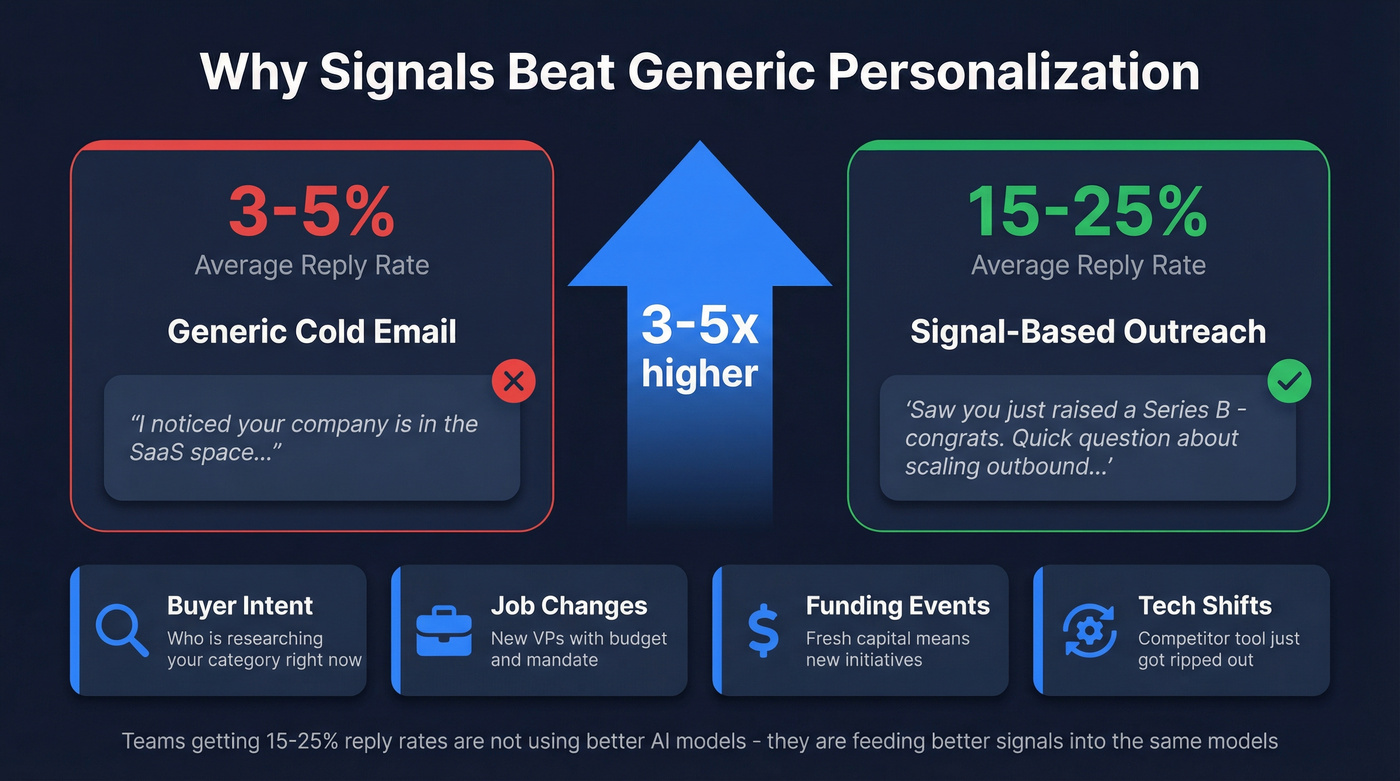
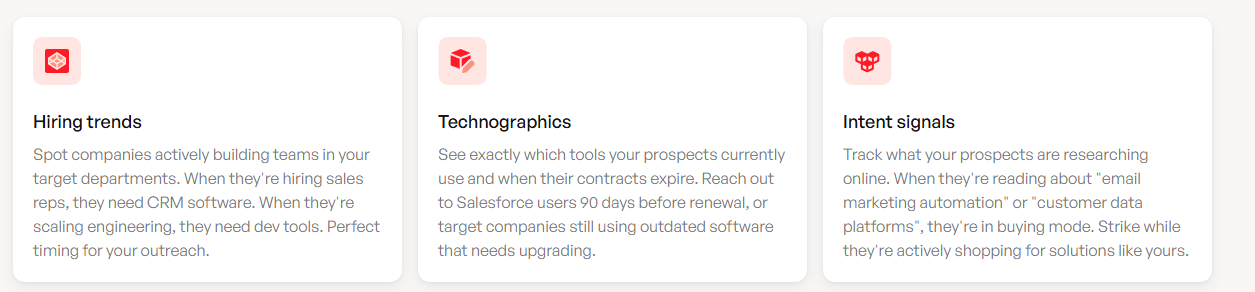
The signals that matter most fall into four categories. Buyer intent data reveals who's actively researching your category. Job changes surface new VPs who have budget and mandate. Funding events mean fresh capital and new initiatives. Technographic shifts tell you when a competitor's tool just got ripped out. Feed these into your AI-driven prospect workflows and the personalization becomes genuinely relevant, not just "I noticed your company is in the SaaS space." (More on intent signals.)
The teams getting 15-25% reply rates aren't using better AI models. They're feeding better signals into the same models everyone else uses.
Deliverability Rules AI Can't Break
Your AI SDR can write perfect emails. If your sending infrastructure isn't ready, those emails hit spam. No amount of personalization fixes a burned domain. (If you're rebuilding after issues, follow how to prevent email blacklisting.)
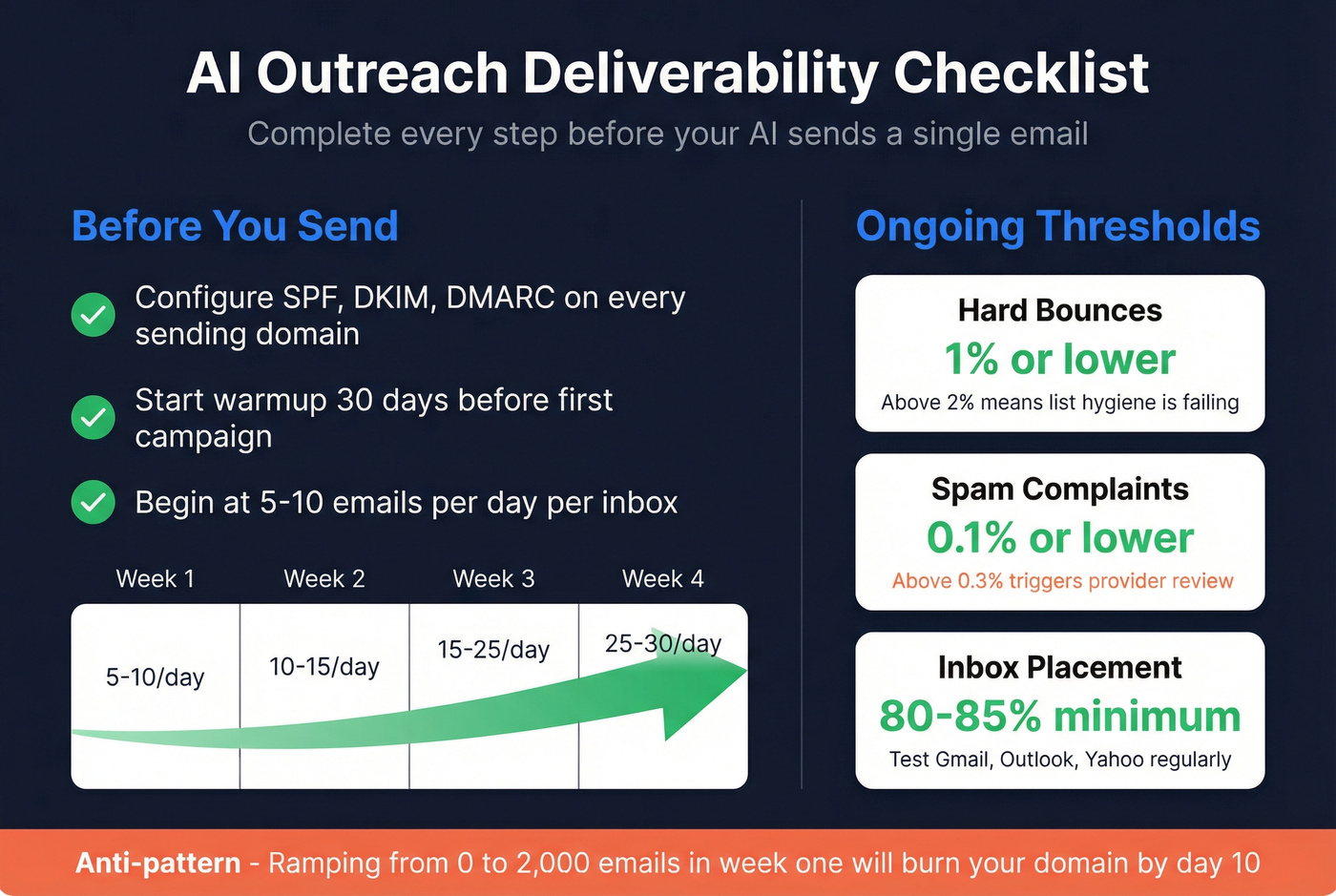
Here's the operational checklist that matters:
Before you send anything:
- Configure SPF, DKIM, and DMARC on every sending domain. Non-negotiable.
- Start warmup 30 days before your first campaign. Begin at 5-10 emails per day per inbox, ramping to ~30/day over 4 weeks.
- Never jump from 10 emails/day to 500. Volume spikes are the fastest way to trigger provider review.
Ongoing thresholds:
- Hard bounces: 1% or lower. Above 2% means your list hygiene is failing.
- Spam complaints: 0.1% or lower. Above 0.3% triggers automated review from providers.
- Inbox placement: target 80-85% minimum. Test across Gmail, Outlook, and Yahoo regularly.
The anti-pattern we see most often: a team signs up for an AI SDR, gets excited about the volume capabilities, and ramps from 0 to 2,000 emails in the first week. By day 10, their primary domain is flagged. By day 20, they're buying new domains and starting over.
Look - AI makes it trivially easy to send at scale. That's exactly why deliverability discipline matters more than ever. The tools won't throttle themselves. You have to build the guardrails.

AI outreach at scale demands flawless data - one bad list tanks your domain. Prospeo's 5-step verification delivers 98% email accuracy across 143M+ contacts, refreshed every 7 days. At ~$0.01/email, cleaning your list costs less than a single bounced sequence.
Verify every email before your AI sends a single message.
Making AI Outreach Sound Human
Here's a stat that should shape your entire approach: 67% of decision-makers don't mind if AI wrote the email. But 47% of B2B professionals say they'd be less likely to reply if they detect it's AI-written. The takeaway isn't "don't use AI." It's "don't sound like AI."
The anti-patterns that give it away are predictable. Formulaic openers like "I hope this email finds you well" or "I came across your profile and was impressed by..." Stiff personalization that reads like a template with a merge field. Over-formal language that no human would use in a cold email. Recipients spot these tells instantly - even if they can't articulate why the email feels off. (If you want better openers, see "I hope this email finds you well".)
The fix is a three-part framework. First, feed your AI real signals - not just the prospect's name and company, but a specific trigger that explains why you're reaching out now. Second, set the tone to conversational. Most AI defaults to formal. Override it. "Saw you just raised a Series B - congrats. Quick question about how you're scaling outbound..." beats "I noticed your recent funding announcement and wanted to explore potential synergies." Third, add human review. Not on every email - that defeats the purpose. But spot-check 10-15% of outgoing messages weekly. Tools like Lavender can score your AI drafts for tone before sending. Catch the patterns before they calcify.
The goal isn't to hide that AI helped. It's to make the email worth replying to regardless of who wrote it.
AI SDR vs. Human SDR: The Real Math
Let's put actual numbers on this, because the "AI replaces SDRs" narrative oversimplifies a real tradeoff. (If you're deciding whether to buy, are AI SDRs worth it goes deeper.)
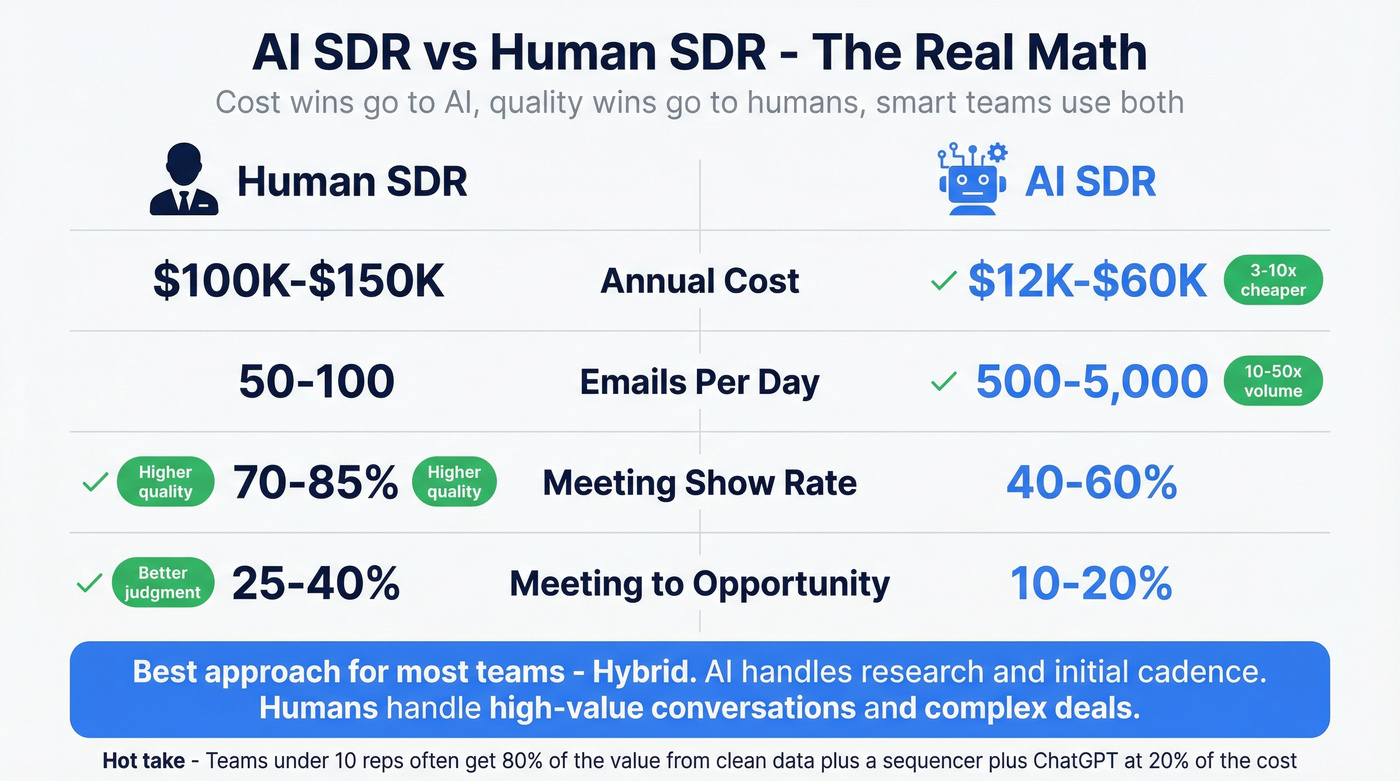
| Metric | Human SDR | AI SDR | Winner |
|---|---|---|---|
| Annual cost | $100K-$150K | $12K-$60K | AI SDR (3-10x cheaper) |
| Emails/day | 50-100 | 500-5,000 | AI SDR (10-50x volume) |
| Meeting show rate | 70-85% | 40-60% | Human SDR (higher quality) |
| Meeting-to-opp rate | 25-40% | 10-20% | Human SDR (better judgment) |
The cost advantage is obvious. An AI SDR platform runs $12K-$60K/year versus $100K-$150K fully loaded for a human rep. The volume advantage is even more dramatic - 10-50x more daily touches.
But look at the quality metrics. Human SDRs convert meetings to opportunities at 25-40%, while AI SDRs land at 10-20%. The meetings AI books are lower quality, on average, because the qualification happens through pattern matching rather than judgment.
The right answer for most teams is hybrid. AI handles research, monitoring, initial cadence execution, and follow-up sequencing. Humans step in for high-value conversations, complex objection handling, and accounts where the deal size justifies personal attention.
Hot take for teams under 10 reps: full AI SDRs are often overkill. If your average deal is in the low five figures, a clean database, a solid sequencer, and ChatGPT for draft assistance gets you 80% of the value at 20% of the cost. Save the AI SDR budget for when you've proven the motion works manually and need to scale it.
Best AI Sales Outreach Tools in 2026
Data and Verification
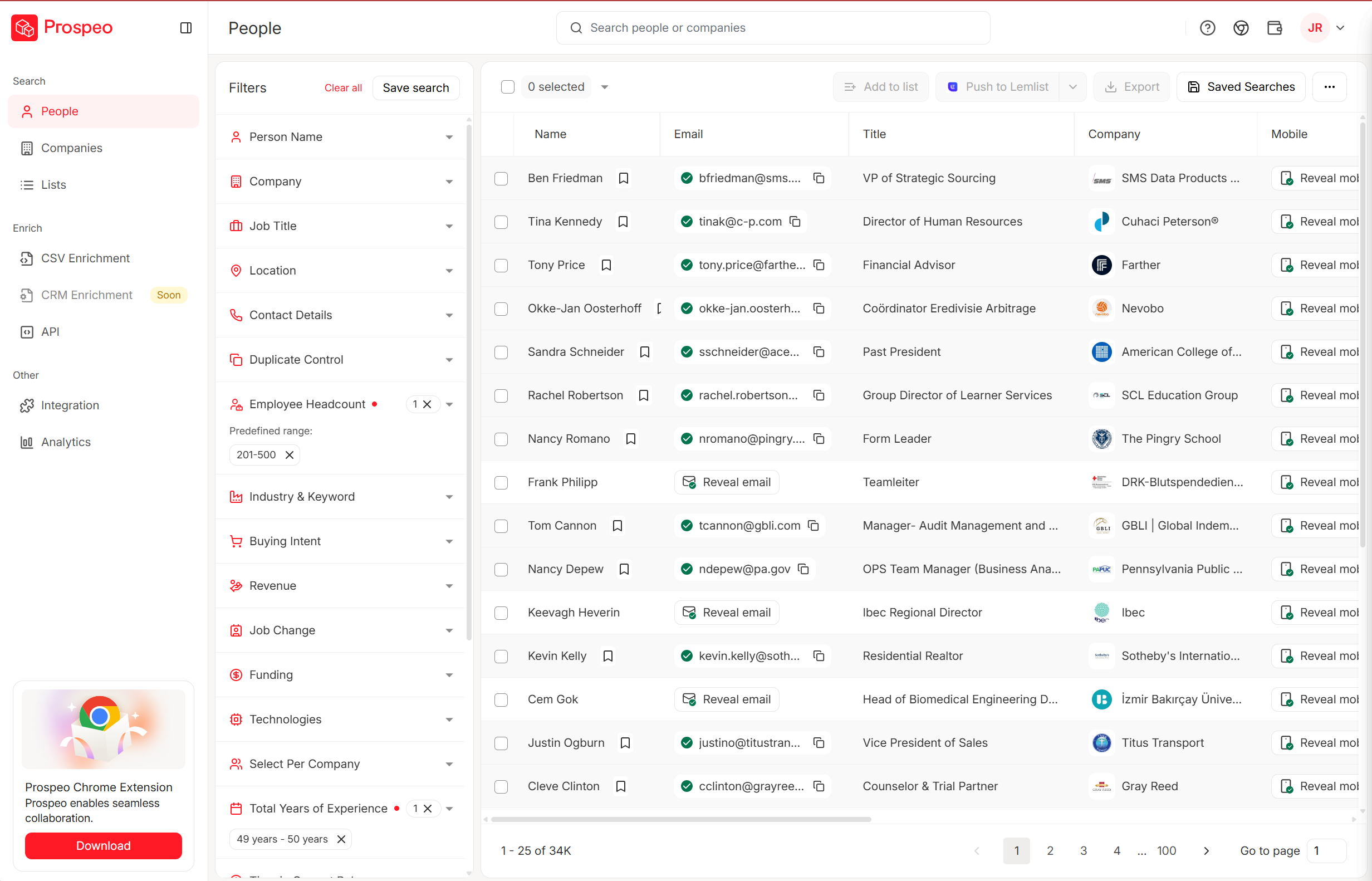
Prospeo is the data foundation for any AI outreach workflow. The database covers 300M+ professional profiles with 143M+ verified emails and 125M+ verified mobile numbers, and mobile pickup rates hit 30% across all regions. Thirty-plus search filters - including buyer intent powered by Bombora across 15,000 topics, technographics, job changes, headcount growth, and funding signals - let you build hyper-targeted lists before any AI touches them. The verification infrastructure is proprietary, which is why the 98% accuracy rate holds up in practice. Native integrations with Instantly, Lemlist, HubSpot, Salesforce, Smartlead, and Clay mean verified contacts flow directly into your outreach tools without manual exports. Credit-based pricing starts at roughly $0.01/email with a free tier of 75 emails + 100 Chrome extension credits/month. No contracts, no sales calls required.
Cognism is worth considering if you sell heavily into EMEA and need phone-verified mobile numbers with GDPR compliance baked in. Pricing starts around $1,000+/mo for small teams. The US database is thinner than competitors.
Apollo remains the budget all-in-one option - free tier available, paid plans from ~$49/user/mo. The database is massive but email accuracy runs at 79%, so you'll want to verify through a separate tool before feeding contacts into AI sequences.
AI SDR Platforms
Reply.io's Jason AI is the most complete mid-market AI SDR right now. It handles multichannel automation across email, phone, and social - with AI personalization, autopilot/copilot modes, unlimited mailboxes, and built-in warmup. The AI SDR Starter plan begins at $500/mo (annual) for 1,000 active contacts, scaling to $1,000/mo for 3,000 contacts. Growth plans run $1,500-$3,000/mo for 5,000-10,000 contacts. The onboarding includes a dedicated CSM, which matters when you're configuring AI playbooks for the first time. If you don't need the full AI SDR, Reply.io's standard Sales Outreach plans start at $49/user/mo.
AiSDR wins on speed-to-launch. Their day-by-day onboarding takes you from sign-up to live campaigns in 7 days - Day 1 is ICP definition, Day 3 warmup begins, Day 7 you're sending. The Explore plan runs $900/mo (billed quarterly) with 1,200 lead search credits and 1,200 AI messages per month, estimating ~3 meetings/month. The Grow plan at $2,500/mo bumps that to 4,500 credits and ~11 meetings/month. (If you're comparing plans, see AiSDR pricing.)
B2B Rocket is the budget entry point. The Starter plan runs $59/mo (annual) with 1,200 email and phone exports, 5 connected mailboxes, and AI auto-reply. Growth ($99/mo) and Scale ($149/mo) tiers unlock more capacity and multichannel sequences. Useful if you want to test AI agents without committing $500+/mo.
Salesforge + Agent Frank combines an email-first AI SDR (Agent Frank) with Salesforge's deliverability infrastructure. Agent Frank is $416/mo, plus a Salesforge plan that typically runs $40-$80/mo depending on tier, so expect roughly $456-$496/mo combined. The deliverability focus is the differentiator - if you've burned domains before, this setup is designed to prevent that. Skip this if you need phone channel automation.
Artisan's Ava is an AI BDR that handles prospecting and outreach across email and social channels. Pricing runs ~$800+/mo on custom plans. I haven't tested Ava deeply enough to recommend it confidently, but it's on our radar for teams wanting a more autonomous BDR agent.
11x.ai's Alice targets enterprise-scale autonomous outreach. Pricing starts around $5,000+/mo on custom contracts. This is for large sales orgs that want to replace headcount, not augment it.
AI Email Automation and Sales Engagement
Outreach isn't an AI SDR - it's an enterprise sales engagement platform adding AI features on top. If your team already runs Outreach, the AI capabilities integrate naturally. If you don't, the ~$100-$200+/user/mo price tag with annual commitment makes it a tough sell just for AI-powered prospecting. Skip this if you're building a new workflow from scratch.
Instantly is sending infrastructure, not an AI SDR. At ~$30/mo, it handles email warmup, inbox rotation, and deliverability monitoring. Pair it with ChatGPT for AI-generated copy and a verified contact database, and you've got a lean outreach setup for under $100/mo total.
Pricing Comparison
| Tool | Category | Starting Price | Best For |
|---|---|---|---|
| Prospeo | Data & Verification | ~$0.01/email (free tier) | Verified emails + mobiles before every campaign |
| Reply.io (Jason AI) | AI SDR | $500/mo (annual) | Multichannel AI SDR with CSM onboarding |
| AiSDR | AI SDR | $900/mo (quarterly) | Fast 7-day launch to prove ROI |
| B2B Rocket | AI SDR | $59/mo (annual) | Budget AI agent testing |
| Salesforge + Frank | AI SDR | ~$456-$496/mo combined | Teams who've burned domains before |
| Outreach | Sales Engagement | ~$100-$200+/user/mo | Enterprise teams already on Outreach |
| Instantly | Sending Infra | ~$30/mo | Warmup + inbox rotation |
| Cognism | Sales Intelligence | ~$1,000+/mo | EMEA data + phone-verified mobiles |
| Apollo | Sales Intelligence | ~$49/user/mo (free tier) | Budget all-in-one prospecting |
| Artisan (Ava) | AI BDR | ~$800+/mo (custom) | Autonomous BDR-style outreach |
| 11x.ai (Alice) | Enterprise AI SDR | ~$5,000+/mo (custom) | Enterprise headcount replacement |
Quick picks by use case:
- Under $100/mo budget? Instantly + Prospeo + ChatGPT.
- Mid-market team wanting full automation? Reply.io Jason AI.
- Need to prove ROI in 7 days? AiSDR.
- Enterprise replacing headcount? 11x.ai.
Your 60-Day Rollout Plan
Don't try to launch everything at once. Here's the timeline that produces pipeline within 30-60 days. (If you want a more detailed build, use a prospecting workflow.)
Week 1: ICP + Data Hygiene. Define your ideal customer profile with specificity - not "SaaS companies" but "B2B SaaS, 50-200 employees, Series A-B, using HubSpot, VP Sales or Head of Growth." Build your first list using intent and technographic filters, verify every email, and export only valid contacts. This step alone prevents 80% of downstream problems.
Weeks 2-3: Pilot One Workflow. Pick a single end-to-end sequence: sourcing, enrichment, personalized first touch, automated follow-ups, reply handling, meeting booking, CRM logging. Don't run three campaigns simultaneously. Run one, measure it, and fix what breaks. AiSDR's 7-day onboarding timeline is a useful benchmark - if your pilot takes longer than two weeks to go live, you're overcomplicating it.
Days 30-60: Scale + Compliance Hardening. Expand to additional segments and channels. Add suppression lists, consent tracking, and regional compliance rules for GDPR and CAN-SPAM. Teams following this timeline typically see 60-80% reduction in manual prospecting time and measurable pipeline impact within the 60-day window.
Here's the thing: three in four sellers feel under-supported in AI adoption. Don't make training a one-time event. Build weekly review sessions into the rollout where reps share what's working and flag AI outputs that missed the mark.
The biggest mistake at this stage is scaling volume before you've proven quality. Get your reply rate above 5% on the pilot before you 10x the sending volume.
Compliance Checklist
AI outreach doesn't exempt you from email compliance. The volume amplification makes violations more expensive. CAN-SPAM fines run up to $51,744 per email. At AI-scale volumes, that math gets terrifying fast. (For the operational details, see GDPR for sales and marketing.)
The non-negotiables:
- SPF, DKIM, DMARC configured on every sending domain
- Unsubscribe mechanism in every outbound email, processed within 10 business days
- GDPR consent documented for EU prospects - legitimate interest or explicit opt-in
- Suppression lists synced across all sending tools to prevent re-contacting opt-outs
- AI governance: human review of AI-generated templates, logged prompts for audit trails, and explicit labeling policies if required by your legal team
- Data retention of 3-5 years for consent records
Build compliance into your Week 1 setup alongside ICP definition and data hygiene - not as a post-launch afterthought.
Signal-based outreach only works when you can act on signals fast. Prospeo combines buyer intent data across 15,000 topics, job change tracking, and technographic filters - all feeding verified contacts into your AI workflows. Snyk's 50 AEs cut bounces from 35% to under 5% and grew pipeline 180%.
Feed your AI SDR signals and verified data, not stale lists.
FAQ
What does AI for B2B outreach actually do?
AI automates the core SDR workflow: prospecting, email personalization, sequencing, follow-up timing, reply classification, and meeting booking. The best implementations layer automated email sequences on top of intent signals and verified data so each touch is contextually relevant rather than generically templated.
How much does an AI SDR cost?
Budget options start at $59/mo (B2B Rocket). Mid-market AI SDRs run $500-$2,500/mo. Enterprise platforms like 11x.ai cost $5,000+/mo. Compare that to $100K-$150K/year fully loaded for a human SDR - a 3-10x cost reduction depending on tier.
Can AI fully replace human SDRs?
Not yet. AI SDRs generate more volume but convert at lower rates - 40-60% show rates vs. 70-85% for humans. The best results come from hybrid models where AI handles volume and research while humans handle judgment-heavy conversations.
What reply rate should I expect from AI-powered outreach?
Generic cold email averages 3-5%. Signal-personalized outreach built on verified data achieves 15-25%. The gap comes from data quality and signal relevance, not the language model itself.
What's a good free tool to start with?
Prospeo's free tier (75 verified emails + 100 Chrome extension credits/month) paired with Instantly's free warmup and ChatGPT gives you a functional AI outreach stack at zero cost. Apollo also offers a free tier, though its 79% email accuracy means you'll want to verify contacts separately before sending.