The Best Autonomous SDR Software for 2026
Your VP of Sales just came back from a conference convinced an AI SDR will replace two headcount. Here's what actually happens next: someone spends 60 hours cleaning data, the tool hallucinates emails about products you don't sell, and three months later you're either a believer or shopping for replacement autonomous SDR software. AI SDR tools churn 50-70% annually. The majority of buyers pick wrong.
The difference between teams that succeed and ones that churn comes down to two decisions: which tool matches your actual autonomy needs, and whether your contact data is clean enough to feed it. Over $400M in VC has poured into AI SDR startups in the last two years, fueling a category projected to grow from $4.12B to $15.01B by 2030. Get either decision wrong and you're burning domains and budget simultaneously.
Our Picks (TL;DR)
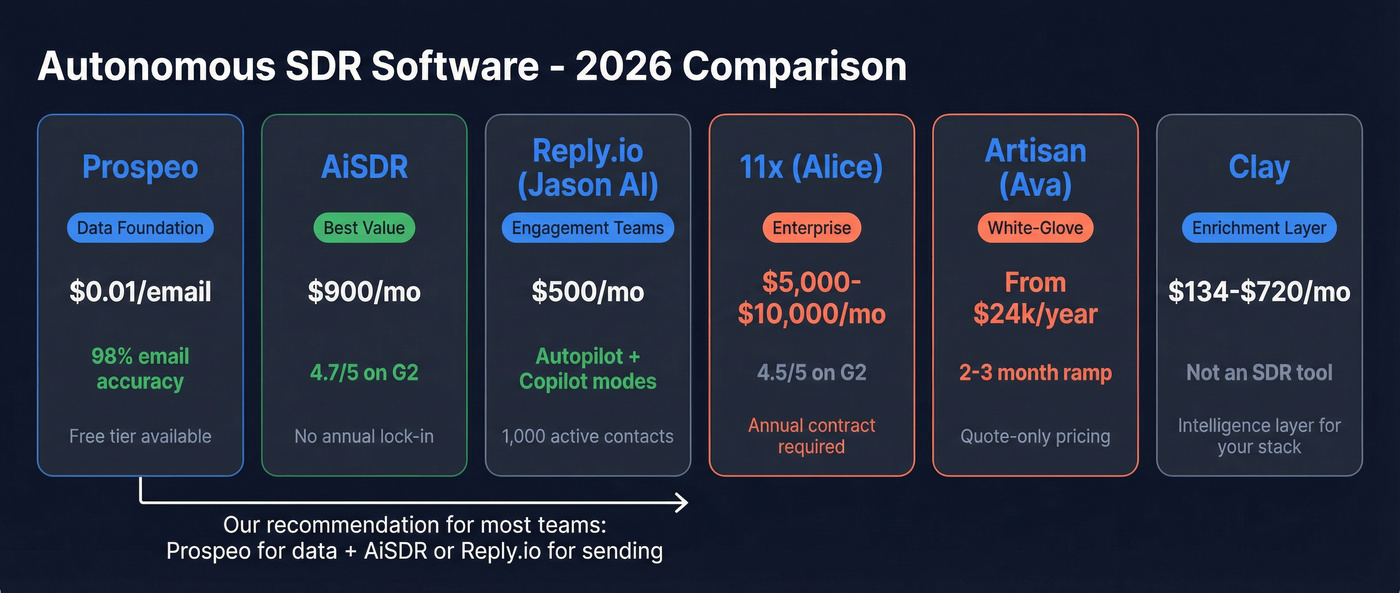
Best data foundation for any AI SDR stack: Prospeo. 98% email accuracy, 7-day data refresh, native integrations with Clay, Instantly, Smartlead, and Lemlist. Your AI SDR is only as good as the emails it sends to - and Prospeo's 5-step verification keeps bounce rates under 5%. Free tier available, paid plans from ~$0.01/email.
Best value autonomous SDR: AiSDR. $900/mo on the Explore plan with quarterly billing and no annual lock-in. Transparent pricing in a category where most vendors hide behind "request a demo." Includes built-in deliverability infrastructure.
Best for existing sales engagement teams: Reply.io (Jason AI). Starts at $500/mo for 1,000 active contacts, bolts onto Reply's multichannel platform. If you're already running Reply sequences, this is the lowest-friction path to AI-assisted outbound.
What "Autonomous" Actually Means
Not every tool calling itself an "AI SDR" does the same thing. The market breaks into three tiers, and the pricing gap between them is massive.
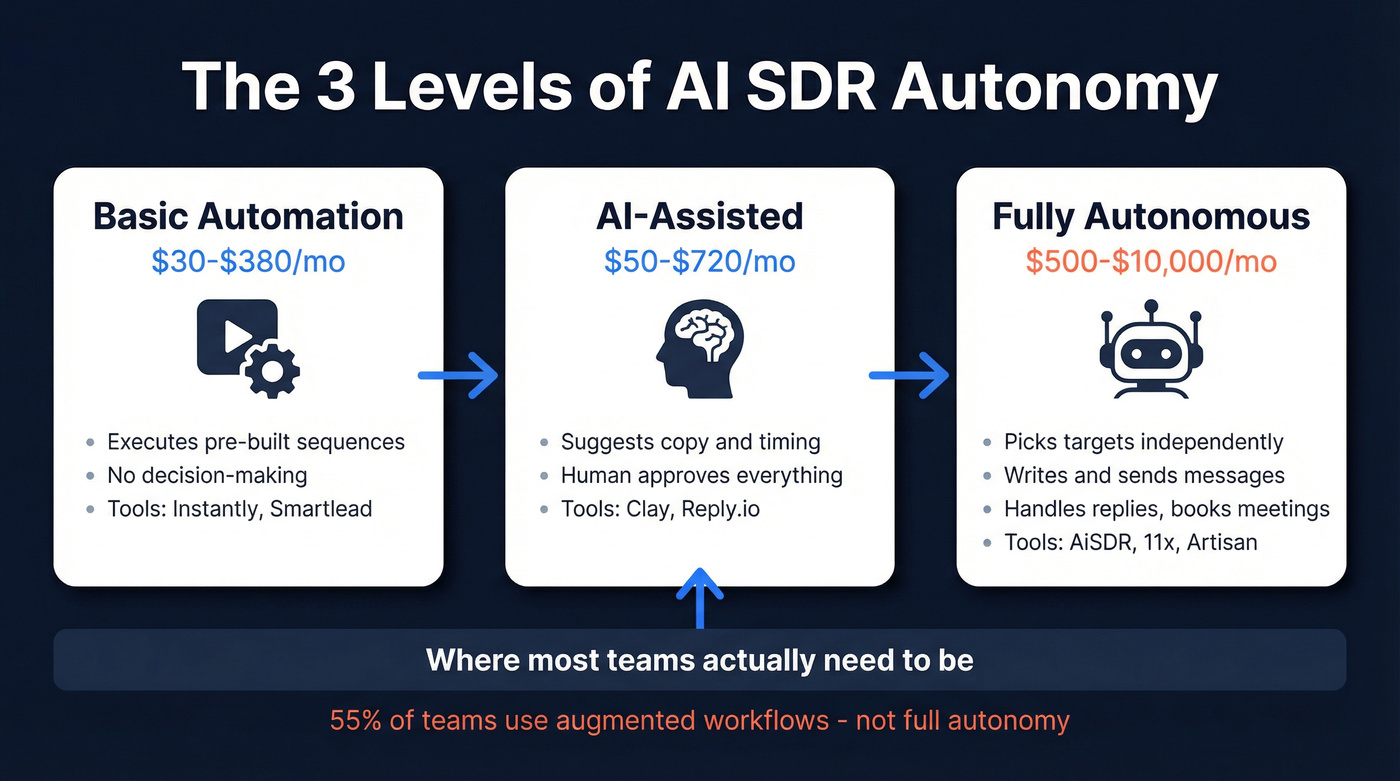
| Autonomy Level | What It Does | Example Tools | Typical Cost |
|---|---|---|---|
| Basic Automation | Executes pre-built sequences | Instantly, Smartlead | $30-$380/mo |
| AI-Assisted | Suggests copy, optimizes timing | Clay, Reply.io (non-agent) | $50-$720/mo |
| Fully Autonomous | Picks targets, writes messages, handles replies, books meetings | AiSDR, 11x, Artisan | $500-$10,000/mo |
About 22% of sales teams have gone full replacement - an autonomous AI SDR handles the entire workflow. Roughly 55% run augmented workflows where AI handles volume and humans handle nuance. Around 15% use lighter AI assistance, and about 8% don't use AI for SDR work at all.
Here's the thing most teams get wrong: they think they want full autonomy, but they actually need the middle tier. A fully autonomous agent that sends hallucinated emails to the wrong ICP does more damage than a human SDR having a slow week. The emerging frontier is multi-agent architectures - systems where specialized AI agents handle different parts of the workflow (research, writing, reply handling) rather than one monolithic model doing everything.
AI SDR vs. Human SDR
Let's put real numbers on this, because the "AI replaces humans" narrative oversimplifies what's actually a nuanced trade-off.
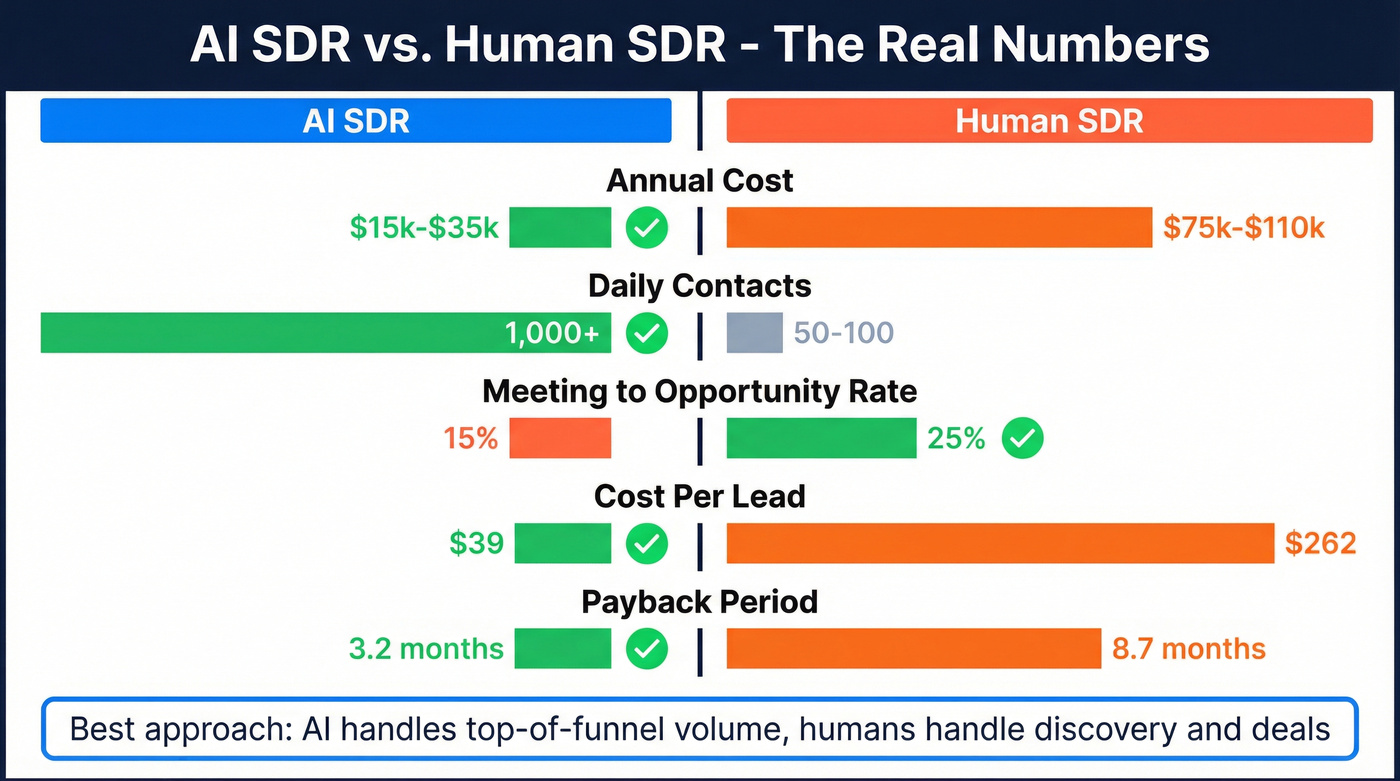
| Metric | AI SDR | Human SDR |
|---|---|---|
| Annual cost | $15k-$35k | $75k-$110k |
| Daily contact volume | 1,000+ | 50-100 |
| Meeting-to-opportunity rate | ~15% | ~25% |
| Cost per lead | ~$39 | ~$262 |
| Payback period | ~3.2 months | ~8.7 months |
The volume and cost advantages are obvious: an automated agent touches 10-20x more contacts per day at a fraction of the cost. But that 15% vs. 25% meeting-to-opportunity conversion gap matters. AI-booked meetings tend to be less qualified because the prospect agreed to a call but wasn't deeply engaged.
If your average deal size is under $10k, a fully autonomous agent is probably overkill. We've seen this pattern repeatedly: the economics work best when you have enough contract value to justify the ramp time and enough volume to justify the tooling cost. For lower ACVs, an AI-assisted sequencer with verified data will outperform a half-configured autonomous tool every time.
The best-performing teams don't choose one or the other. They use AI SDRs to handle top-of-funnel volume - first touch, follow-up cadence, meeting booking - and route qualified conversations to human reps for discovery and deal progression. That hybrid model captures the cost efficiency of AI without sacrificing the conversion quality of human judgment.
How We Evaluated
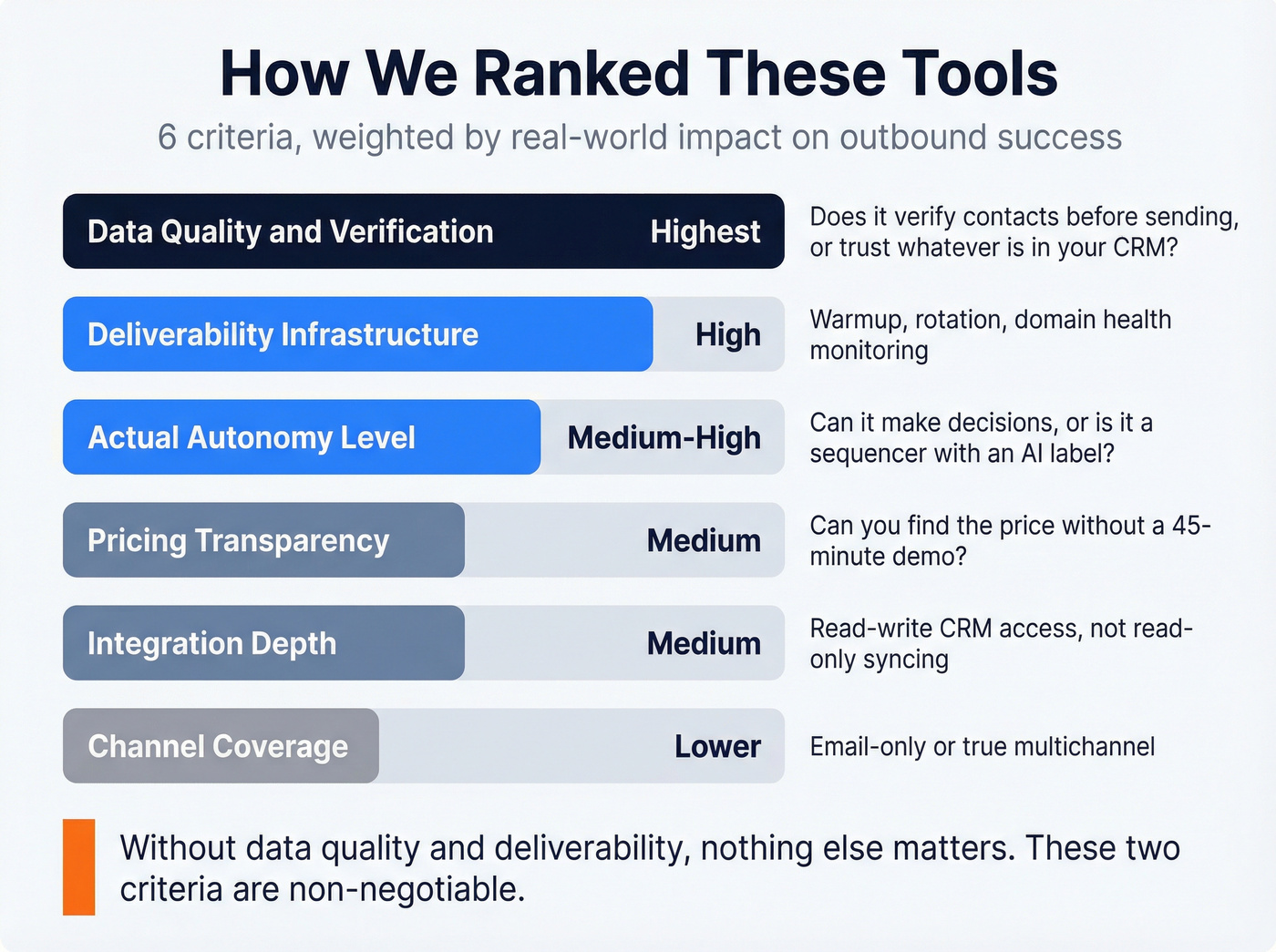
We weighted data quality and verification highest - does the tool verify contacts before sending, or does it trust whatever's in your CRM? Deliverability infrastructure came next: warmup, rotation, domain health monitoring. Without these two, nothing else matters. After that, we assessed actual autonomy level (can it make decisions, or is it a sequencer with an AI label?), pricing transparency (can you find the price without a 45-minute demo?), integration depth (read-write CRM access, not read-only syncing), and channel coverage (email-only or multichannel).

50-70% of AI SDR buyers churn because of bad data, not bad software. Prospeo's 5-step verification delivers 98% email accuracy with a 7-day refresh cycle - keeping bounce rates under 5% so your autonomous SDR actually reaches real inboxes.
Stop burning domains. Start with data your AI SDR can trust.
10 Best Tools for 2026
Prospeo - Best Data Foundation
Every autonomous SDR tool has the same weakness: contact data quality. If your bounce rates climb above ~5%, your domain reputation tanks fast and every subsequent campaign suffers. We've watched teams blow through three sending domains in a month because they skipped verification.
Prospeo's database covers 300M+ professional profiles with 98% email accuracy. That benchmarks against 87% at ZoomInfo and 79% at Apollo - and in outbound, that accuracy gap shows up directly in deliverability and reply rates. Teams book 26% more meetings versus ZoomInfo and 35% more versus Apollo.
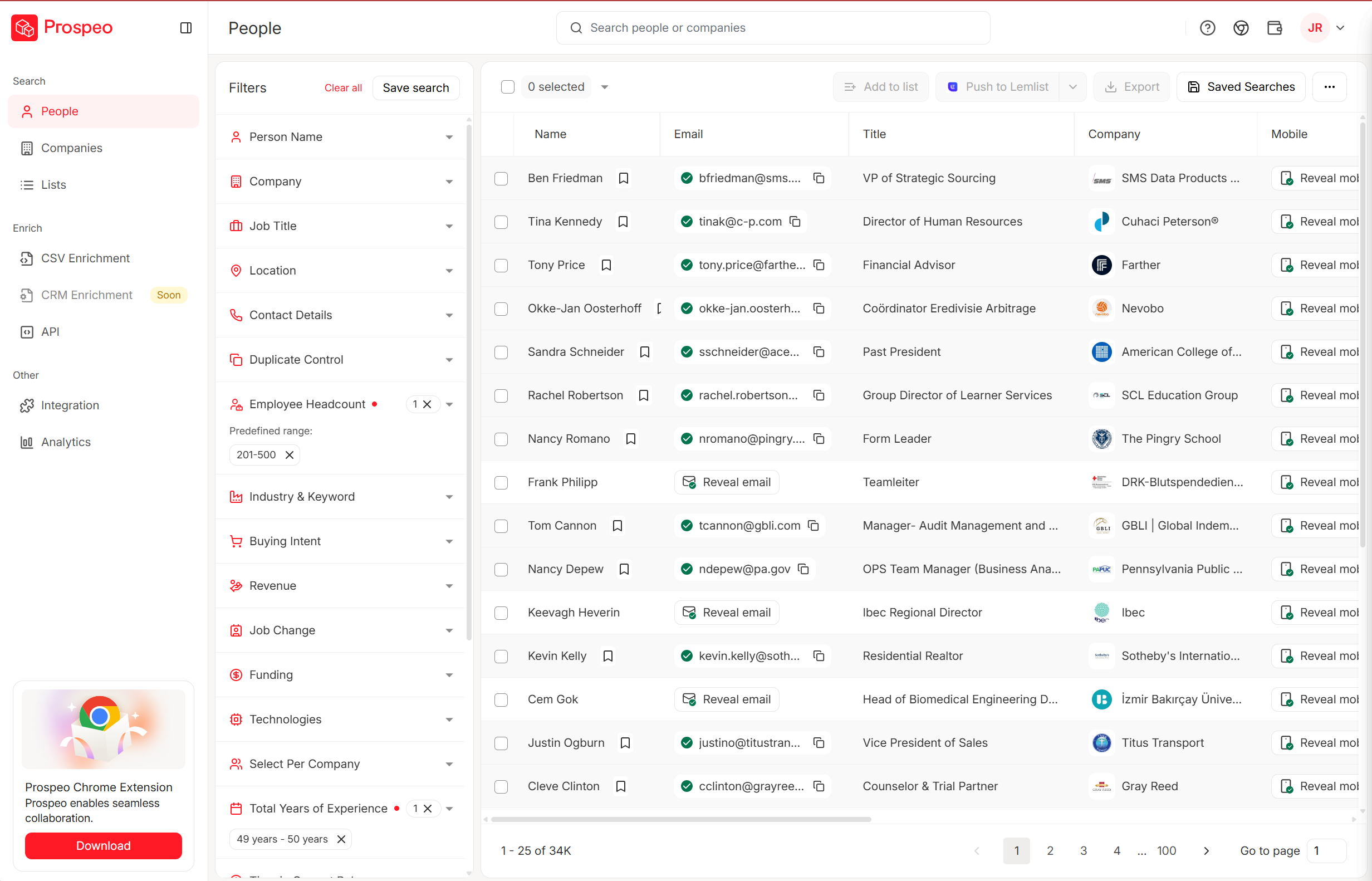
The 5-step verification process includes catch-all handling, spam-trap removal, and honeypot filtering. Data refreshes every 7 days versus the 6-week industry average. Native integrations with Clay, Instantly, Smartlead, Lemlist, Salesforce, and HubSpot mean it slots into whatever AI SDR stack you're building. Snyk's 50-person AE team went from 35-40% bounce rates to under 5% after switching, with AE-sourced pipeline up 180%.
Pricing runs ~$0.01 per email with a free tier (75 emails/month). No contracts, no sales calls required.
Use if: You're feeding contact data into any AI SDR tool and need verified emails that won't burn your domains.
Skip if: You already have a verified, fresh contact database. (You probably don't.)
AiSDR - Best Value Pick
AiSDR is the tool we'd recommend to any team buying their first autonomous AI SDR. The reason is simple: transparent pricing in a category that hides behind "request a demo" gates. (If you want the full breakdown, see our AiSDR pricing guide.)
The Explore plan runs $900/mo billed quarterly - 1,200 lead search credits, 1,200 AI messages, and an estimated ~3 meetings per month. The Grow plan at $2,500/mo bumps that to 4,500 credits and ~11 estimated meetings. No annual lock-in. Cancel anytime.
Quarterly billing isn't arbitrary. Deliverability warmup and ramp take 30-60 days, with strongest results after ~6 weeks. The plan includes mailbox creation, warmup, bounce checks, inbox rotation, and domain health tracking - infrastructure most competitors charge extra for or leave you to figure out yourself. If you need a deeper warmup playbook, start with automated email warmup.
G2 rating sits at 4.7/5 across ~60 reviews. Compared to ZoomInfo's all-in-one approach, AiSDR is purpose-built for autonomous outbound at a fraction of the cost - a 10-seat ZoomInfo contract with intent data runs $40-60k/year, while AiSDR's Grow plan is $24k/year.
Use if: You want a fully autonomous agent with predictable costs and no annual commitment.
Skip if: You need multichannel beyond email, or you're running complex ABM plays that require deep CRM orchestration (use an ABM account plan instead).
Reply.io (Jason AI) - Best for Engagement Teams
If your team already runs Reply.io for sequences, Jason AI is the lowest-friction path to autonomous outbound. It bolts directly onto Reply's multichannel platform - you're upgrading infrastructure, not ripping it out. If you're comparing platforms, use this sales engagement platform framework.
The AI SDR Starter plan begins at $500/mo for 1,000 active contacts (annual billing), scaling to $1,000/mo for 3,000 contacts. Growth plans run $1,500-$3,000/mo for 5,000-10,000 contacts.
What sets Jason AI apart is the autopilot/copilot toggle. Autopilot mode handles everything autonomously - prospecting, personalization, follow-ups, meeting booking. Copilot mode keeps a human in the loop for message approval. That flexibility matters for teams that aren't ready to go fully hands-off. Reply also offers non-agent plans starting at $49/user/mo for email volume and $89/user/mo for multichannel.
Use if: You're already on Reply.io, or you want autopilot + copilot flexibility in one platform.
Skip if: You need the cheapest possible entry point - AiSDR's $900/mo gets you more autonomy per dollar if you're starting fresh.
11x (Alice) - The Enterprise Bet
11x targets large sales orgs willing to pay for a premium AI sales agent. Pricing runs ~$5,000-$10,000/mo with annual contracts, putting the minimum commitment around $60k/year. G2 shows 4.5/5, but with only ~10 reviews.
Worth evaluating if you're an enterprise team with dedicated RevOps support and complex ICP requirements. But hallucinated content and generic messaging are common failure modes when ICP definitions aren't extremely tight. At this price point, those failure modes are expensive. Most teams under 20 reps should look elsewhere.
Artisan (Ava) - White-Glove, Long Ramp
Artisan doesn't publish pricing - it's quote-only, priced by outreach volume. Third-party estimates put the starting point around $24k/year, with total costs exceeding $80k when you add dedicated management. Configuration takes 2-3 months, which means you're paying for months before seeing meaningful output. If you want a managed, white-glove experience and have the budget and patience, Artisan delivers. For teams that need results in 30 days, keep scrolling. (If you're negotiating, see our Artisan pricing breakdown.)
Clay - The Enrichment Layer
Clay isn't an autonomous SDR. It doesn't send emails or book meetings. What it does is aggregate data from dozens of providers, run AI-powered research via Claygent, and pipe enriched contacts into your sending tools.
Pricing is credit-based: free tier (1,200 credits/year), Starter at $134/mo, Explorer at $314/mo, Pro at $720/mo. All plans include unlimited users. The value is in building custom enrichment workflows that feed tools like AiSDR, Reply.io, or Instantly with deeply researched prospect data. As the intelligence layer in your stack, it's hard to beat - just don't expect it to actually run your outbound. For a deeper dive, see data enrichment for cold email.
Amplemarket - Mid-Market All-in-One
Amplemarket bundles prospecting, multichannel outreach, and intent signals into a single platform. The entry point is roughly ~$600/month (annual) for small teams of 2 users, with higher tiers moving to custom pricing as you scale. It includes CRM integrations, AI-powered sequencing, and buying intent data.
Best for mid-market teams that want prospecting, outreach, and intent in one tool without stitching together a multi-vendor stack. Skip it if you need deep customization or you're already committed to best-of-breed tools for each layer. If you're shopping around, compare Amplemarket alternatives.
Instantly - Email Infrastructure at Scale
Instantly ($30-$380/mo) handles email warmup, rotation, and deliverability monitoring. It's not autonomous - you'll need a separate data source and AI layer. Think of it as the plumbing, not the brain. Pair it with verified data and an AI agent for a complete stack. If you're building a full stack, start with a B2B sales stack blueprint.
Smartlead - Deliverability-First Sending
Smartlead ($39-$379/mo) focuses on inbox rotation and deliverability. Like Instantly, it's a sending layer, not an autonomous agent. Choose Smartlead over Instantly if inbox rotation and multi-sender management are your primary concerns.
Salesforce Agentforce - For Salesforce Shops
Salesforce's Agentforce adds AI SDR capabilities at ~$2/conversation on top of your existing Salesforce investment. Deep CRM integration is the advantage. The disadvantage: you need the broader Salesforce ecosystem to make it work, and enterprise pricing applies. If you're already paying for Sales Cloud, this is the path of least resistance. If you're not, the total cost of entry makes standalone tools a better bet.
Honorable mentions: Landbase, Salesforge (Agent Frank), and Regie.ai each serve narrower use cases or have less transparent pricing. Worth evaluating if the tools above don't fit your specific workflow. Some vendors like OneShot are pushing toward fully autonomous prospecting where the AI handles everything from target identification through meeting booking with minimal human input.
Master Comparison
| Tool | Starting Price | Channels | Autonomy | G2 | Best For |
|---|---|---|---|---|---|
| Prospeo | Free / ~$0.01/email | Data layer | Foundation | - | Clean data for any stack |
| AiSDR | $900/mo | Full | 4.7/5 | Value-conscious teams | |
| Reply.io | $500/mo | Multichannel | Full/Copilot | 4.6/5 | Reply.io users |
| 11x | ~$5,000/mo | Full | 4.5/5 | Enterprise orgs | |
| Artisan | ~$2,000/mo | Full (managed) | - | White-glove buyers | |
| Clay | Free-$720/mo | Data layer | Assisted | 4.9/5 | Custom workflows |
| Amplemarket | ~$600/mo | Multichannel | Assisted+ | 4.5/5 | Mid-market teams |
| Instantly | $30/mo | None | 4.8/5 | Email volume | |
| Smartlead | $39/mo | None | 4.7/5 | Deliverability | |
| Agentforce | ~$2/conversation | CRM-native | Assisted | - | Salesforce shops |
Why Most Deployments Fail
The 50-70% annual churn rate in AI SDR tools isn't because the technology doesn't work. It's because teams skip the foundation and jump straight to automation. Gartner predicts 40%+ of agentic AI projects will be abandoned by end of 2027 - and the autonomous SDR category is ground zero for that trend.
The failure modes are predictable:
Bad contact data. Bounce rates above ~5% degrade your domain reputation fast. Every subsequent campaign - AI or human - suffers. Verify before you automate, full stop. (If you need a process, start with CRM hygiene.)
Shallow CRM integration. Many AI SDR tools connect to your CRM in read-only mode. They can pull contact records but can't write back meeting outcomes, update deal stages, or log activities. That creates data silos that compound over time. This is where AI CRM data entry automation matters.
No data prep. Teams underestimate the 40-60 hours of data cleaning, enrichment, and segmentation required before launch. You can't automate a mess.
Unrealistic timelines. ROI takes 3-6 months with clean data, 6-9 months if you're building from scratch. Teams that expect results in week two churn in month three. If you need a benchmark-driven model, use a sales ROI calculator.
Brittle integrations. Rate limits, stale syncs, and broken webhooks cause AI agents to act on outdated information. Real-time, event-driven integrations aren't optional.
Undefined ICP. Autonomous tools that pick their own targets will drift into irrelevant accounts if your ICP definition is vague. Hallucinated messaging follows. Use an account qualification checklist before you scale.

Look, the consensus on r/sales is pretty consistent: most teams that fail with AI SDRs blame the tool when the real problem was garbage data going in. We've seen this firsthand - one agency we talked to burned through four sending domains before realizing their contact list was 40% outdated. The tool worked fine. The inputs didn't.
Every autonomous SDR tool on this list needs clean contact data to perform. Prospeo integrates natively with Clay, Instantly, Smartlead, and Lemlist - feeding 300M+ verified profiles into your AI SDR stack at $0.01/email. Snyk's 50 AEs cut bounce rates from 35% to under 5%.
Plug verified data into your AI SDR stack in minutes.
30-Day Implementation Playbook
Don't launch an autonomous SDR tool on day one. Here's the week-by-week approach that works.
Week 1: Data audit and enrichment. Pull your target account list and verify every email address. Enrich contacts with job titles, company data, and intent signals. Start with 100-200 test accounts - not your entire TAM. Budget 40-60 hours for this step. It's tedious. It's also the single highest-ROI activity in the entire process. If you're seeing decay, start with B2B contact data decay.
Week 2: Tool setup and deliverability warmup. Configure your AI agent, connect CRM integrations (read-write, not read-only), and start warming up sending domains. Most tools need 2-4 weeks of warmup before you can send at volume. Use an email deliverability checklist to avoid preventable mistakes.
Week 3: Pilot launch with daily monitoring. Start sending to your test accounts. Monitor bounce rates, reply rates, and spam complaints daily. If bounces exceed 5%, stop and fix your data. Review AI-generated messages for accuracy - catch hallucinations early before they reach your best prospects.
Week 4: Review, adjust, scale cautiously. Analyze meeting booking rates, reply quality, and cost per meeting. Adjust ICP targeting and messaging based on what's working. Scale to 500-1,000 accounts only after metrics stabilize. In our experience, teams that resist the urge to scale prematurely in weeks 2-3 end up with 2-3x better results by month three than teams that blast their full list on day one.
The teams that skip weeks 1 and 2 are the ones that show up in the 50-70% churn statistic. The tool isn't the bottleneck. Your data readiness is.
FAQ
What's the difference between an AI SDR and a sales sequencer?
AI SDRs make autonomous decisions - who to contact, what to say, when to follow up, how to handle replies. Sequencers execute pre-built workflows you define. Autonomous SDR software runs $500-$10,000/mo; sequencers cost $30-$99/mo.
How much does autonomous SDR software cost?
Entry-level starts at $500-$900/mo (Reply.io, AiSDR). Mid-market tools run $1,500-$3,000/mo. Enterprise platforms like 11x cost $5,000-$10,000+/mo. Budget separately for data verification (~$0.01/email with tools like Prospeo) because bad data will tank any tool's performance.
Can an AI SDR fully replace a human rep?
Not yet. AI SDRs convert meetings to opportunities at ~15% versus ~25% for humans. About 22% of teams use full replacement; ~55% run augmented workflows where AI handles volume and humans handle complex conversations.
How long before an AI SDR shows ROI?
Three to six months with clean, verified data. Six to nine months if you're building from scratch. Plan for 40-60 hours of data prep before launch, and expect the first 30-60 days to be ramp - not production output.
What's the biggest reason AI SDR deployments fail?
Bad contact data. If bounce rates exceed ~5%, domain reputation degrades and every subsequent campaign suffers. The second biggest reason is unrealistic timelines - most teams need 3-6 months to see real ROI, and the ones who expect magic in week two are the ones who churn in month three.