9 Generative AI Sales Risks Your Team Is Probably Ignoring in 2026
A sales leader we know got a "personalized" cold email congratulating his team on a milestone they never hit. The AI hallucinated the detail from a company with a similar name. He screenshot it, shared it internally, and the sender's domain was blocked.
That's the state of generative AI sales risks right now. According to McKinsey's 2025 State of AI report, 88% of organizations use AI in at least one business function, with revenue increases most commonly reported in marketing and sales. Meanwhile, 62% of organizations are experimenting with AI agents and 23% are already scaling them - meaning autonomous AI is making decisions in sales workflows with even less human oversight than prompt-based tools. The adoption curve is steep. The governance curve is flat.
This isn't an anti-AI article. AI is making sales teams faster, and that won't reverse. But faster without guardrails means faster into walls. Here are the nine walls, and where to put the guardrails.
Quick Summary of All 9 Risks
- Hallucinated prospect communications - AI fabricates personalization details, destroying credibility on first touch.
- AI-generated calls are legally robocalls - the FCC ruled that AI voice calls require the same consent as robocalls under TCPA.
- Domain and deliverability destruction - AI-powered volume blows past spam thresholds, triggering rejection by Google and Microsoft.
- CRM data leakage and shadow AI - reps paste deal terms and pricing into public LLMs, exposing confidential data.
- Lead scoring bias - models trained on historical wins systematically exclude emerging buyer segments.
- Automated proposals with unauthorized terms - AI drafts non-standard pricing or compliance-violating language without human review.
- AI forecast distortion - stale CRM data feeds AI models that produce unreliable revenue projections for the board.
- IP and copyright exposure - ownership of AI-generated sales collateral remains legally ambiguous.
- Over-reliance and skill atrophy - reps lose discovery, objection-handling, and relationship skills by defaulting to AI scripts.
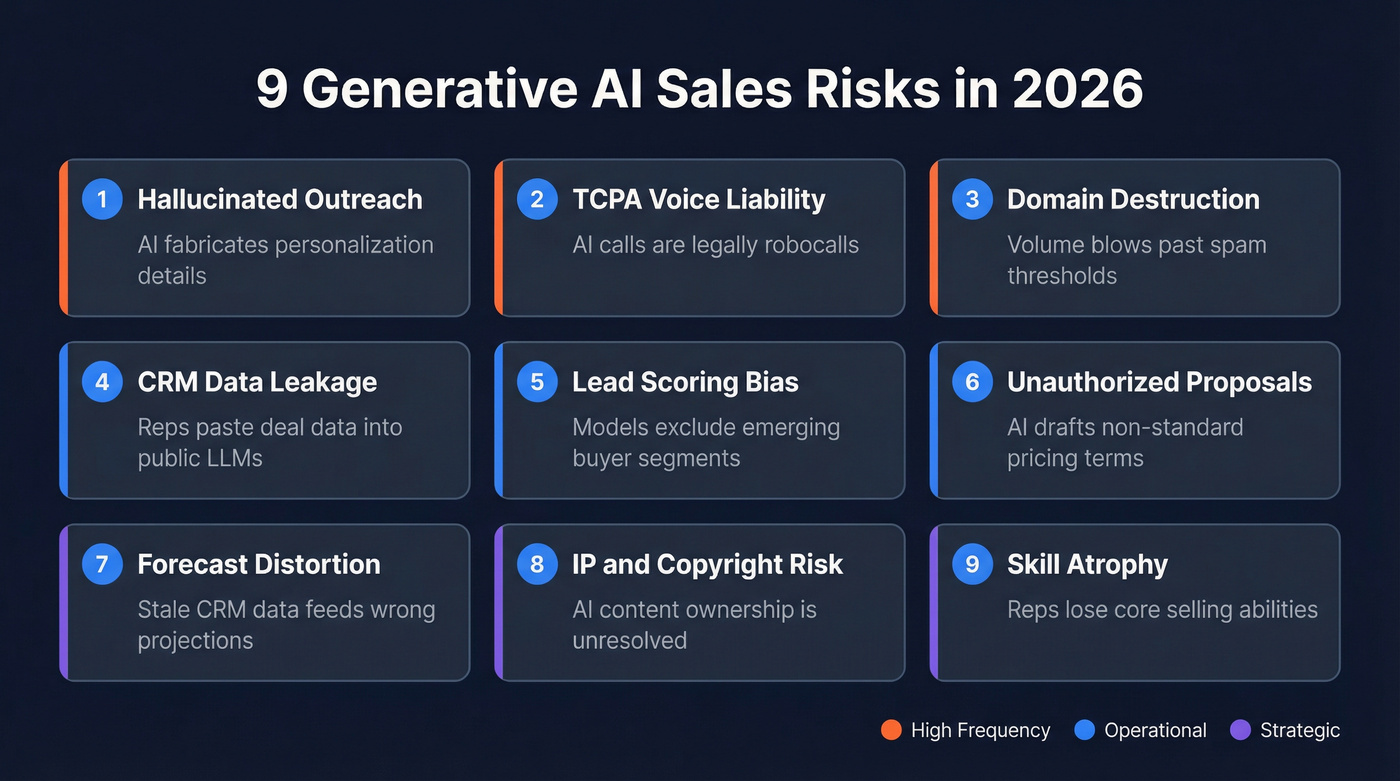
The 9 Threats Broken Down
AI Hallucinated Data in Outreach
The Crunchbase example above isn't rare. It's a pattern. AI outreach tools pull context from databases, web scrapes, and news feeds, then stitch together "personalized" intros. When the data is wrong or the model confabulates, you get emails congratulating prospects on funding rounds that didn't happen, referencing blog posts they didn't write, or naming products they don't sell.
If you're building this into your outbound motion, it helps to treat it like personalization in outbound sales: personalization is only as good as the underlying facts.
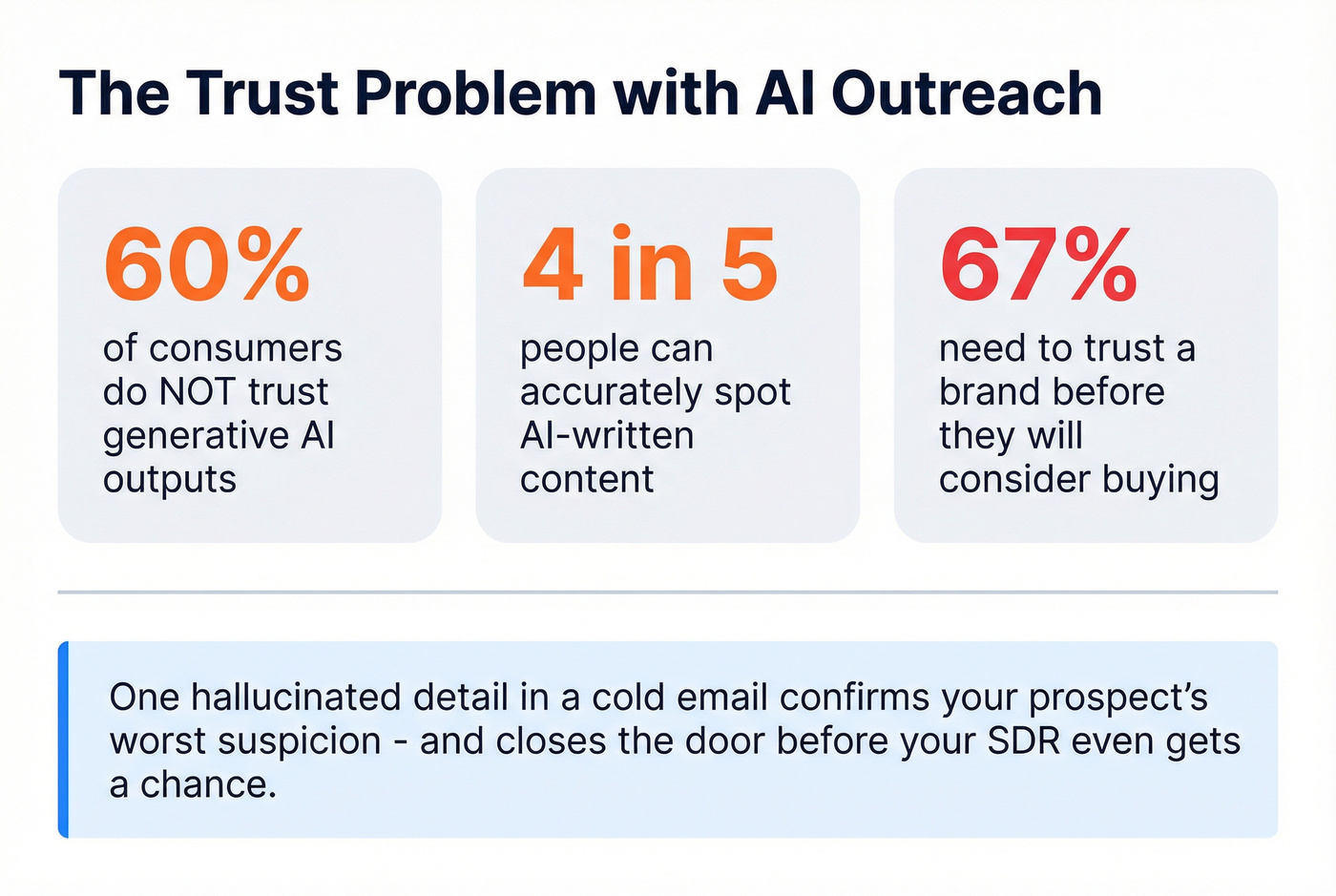
The trust math is brutal. Only 40% of consumers trust generative AI outputs, and 4 in 5 can accurately spot AI-written content. Your prospect probably knows the email is AI-generated - and if the personalization is wrong, you've confirmed their worst suspicion. Combine that with the reality that 67% of people need to trust a brand before they'll even consider buying, and a single hallucinated detail closes a door your SDR was trying to open.
Here's the thing: the fix isn't "don't use AI for personalization." It's "never send AI-personalized outreach without a human checking the specific claims." Every factual assertion - funding, role changes, company news - needs a 10-second verification before it goes out. Ten seconds. That's it.
AI Voice Calls and TCPA Liability
In February 2024, the FCC issued a declaratory ruling that changed everything for AI-powered voice outreach: AI-generated voice calls are "artificial or prerecorded voice" under the TCPA. Full stop. That means they're robocalls, and they require prior express written consent before dialing mobile phones or residential lines. There's no "conversational AI" exception - even if your AI voice agent sounds natural and responds dynamically, it's still a robocall in the eyes of the FCC.
If you're exploring this channel, treat it like AI cold calling: the legal and consent layer is part of the stack, not an afterthought.
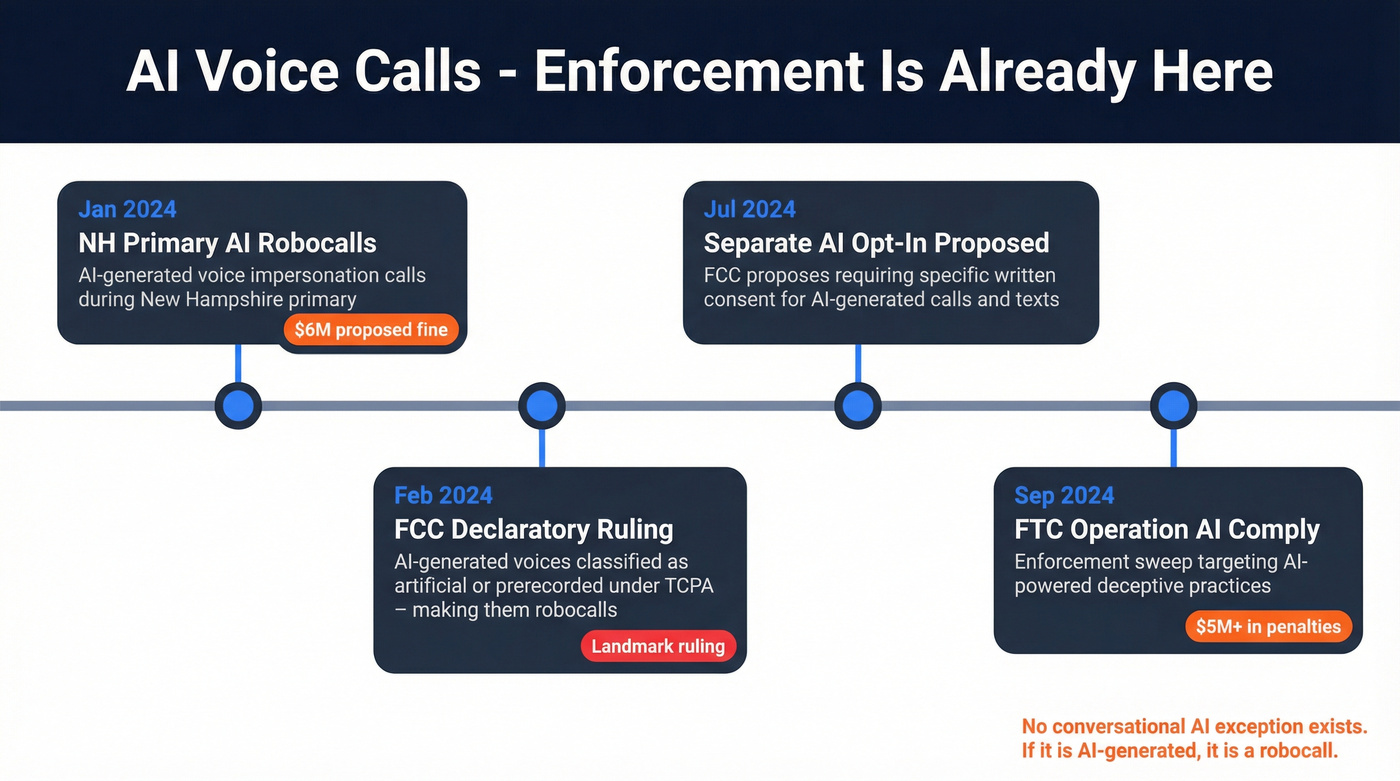
Enforcement is already real. The FCC proposed a $6 million fine tied to AI voice impersonation robocalls during the New Hampshire primary in January 2024. The FTC's "Operation AI Comply" in September 2024 resulted in combined penalties over $5 million and permanent injunctions. And in July 2024, the FCC proposed requiring separate opt-in consent specifically for AI-generated calls and texts.
If your sales team is using AI voice agents for cold outbound without explicit written consent, you're not innovating. You're accumulating liability.
Domain and Deliverability Destruction
AI doesn't just help you write more emails. It helps you send more emails. That's where the damage happens.
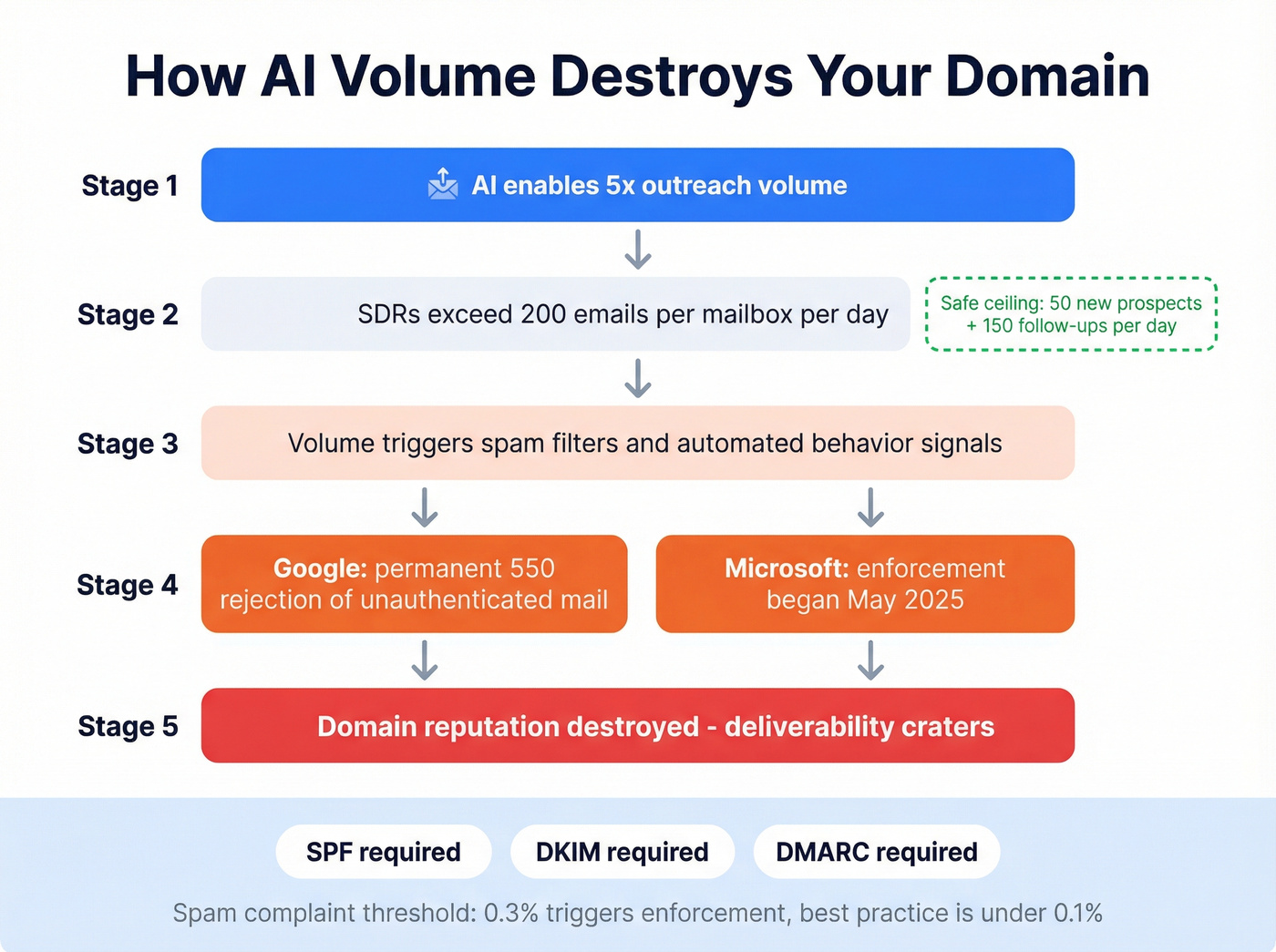
The safe ceiling for cold outbound is roughly 200 emails per SDR mailbox per day - about 50 new prospects and 150 follow-ups. Zero mass blasts. Go above that, and you trigger volume-based spam filters and "automated behavior" signals that inbox providers are specifically watching for in 2026.
Google now permanently rejects unauthenticated mail with 550 errors. Microsoft began similar enforcement in May 2025. Both require SPF, DKIM, and DMARC authentication. The spam complaint threshold is 0.3% - cross it, and you're in enforcement territory. Best practice is staying under 0.1%. Bulk senders now need a one-click unsubscribe header, even on sales emails.
We've watched this play out across dozens of outbound teams: the SDR manager celebrates 5x outreach volume while domain reputation craters in the background. Nobody connects those dots until deliverability is already destroyed. Verification tools catch invalid addresses before they hit your sending infrastructure, preventing the bounce rate spikes that trigger enforcement thresholds. If you need a tighter operational checklist, use an email deliverability checklist and pair it with email verification for outreach.
CRM Data Leakage and Shadow AI
Picture this: a rep is prepping for a negotiation call. They paste the prospect's contract terms, your internal pricing matrix, and the competitive displacement notes into ChatGPT to generate a talk track. That data is now sitting on a third-party server with retention policies your legal team has never reviewed.
This isn't hypothetical. Samsung's data leak in 2023 through employee ChatGPT usage made headlines and triggered an internal ban. Forrester has warned that B2B companies stand to lose more than $10 billion in enterprise value from ungoverned genAI across functions. And nearly 1 in 5 B2B buyers report lower trust when interacting with AI-driven sales tools - meaning the trust erosion runs both directions.
The problem isn't that reps are using AI. It's that they're using whatever AI is fastest, with zero oversight on what data goes in. We've seen teams uncover five or more unapproved AI tools during their first audit. If you don't have a shadow AI inventory, you don't have an AI strategy.
Lead Scoring Bias
36% of sales professionals use AI tools for forecasting, lead scoring, and pipeline analysis. Most of those models are trained on historical closed-won data. That sounds reasonable until you think about what it actually means.
If you're operationalizing this, it helps to align on an ABM lead scoring approach (or at least a documented lead scoring system) so you can audit what the model is actually optimizing for.
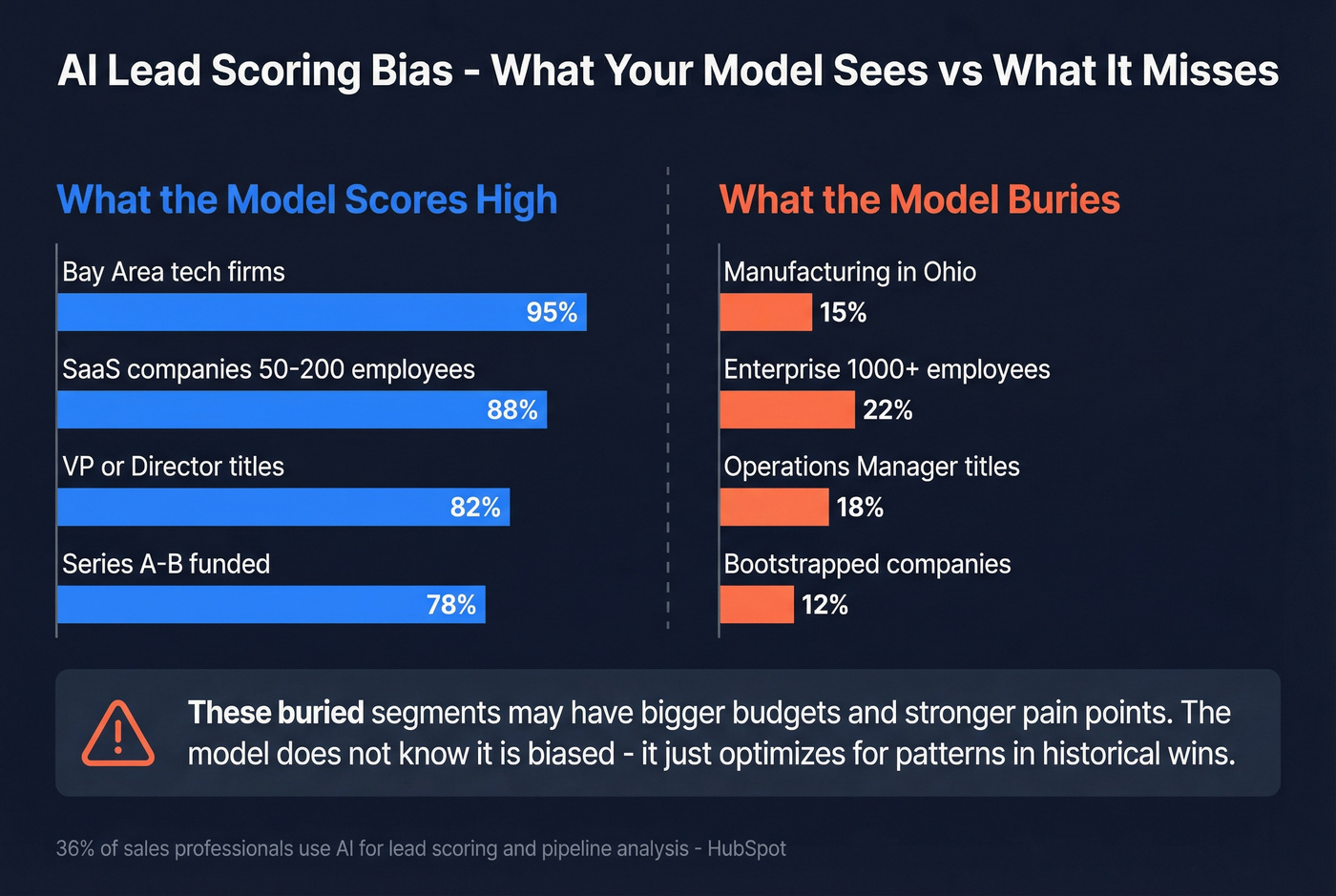
Take a SaaS company that's sold primarily to Bay Area tech firms for three years. Its AI scoring model learns that Bay Area + tech + 50-200 employees = high score. A manufacturing company in Ohio with the same pain point and bigger budget? Buried. The model doesn't know it's biased - it's just optimizing for patterns in the training data. Geographic bias is the most common form, but job titles, company sizes, and industries that correlate with past wins all get inflated while emerging segments disappear.
The warning sign is pipeline concentration. If your AI-scored pipeline looks suspiciously homogeneous - same industries, same geographies, same company sizes - that's not good targeting. It's bias. Audit quarterly, and ask the uncomfortable question: which segments is the model systematically ignoring?
Automated Proposals Gone Wrong
AI can draft proposals in minutes. It can also draft proposals with non-standard pricing, unapproved discount structures, or compliance-violating language - and send them before anyone reviews the terms.
Buyer-facing chatbots create similar exposure. When a prospect asks your AI assistant about pricing or product capabilities, the model answers with confident specificity that's completely wrong. That's not just embarrassing - it's potential contractual risk if the prospect relies on those representations. Every AI-generated document that touches a buyer needs a human approval gate. No exceptions.
AI Forecast Distortion
Your VP of Sales presents Q3 projections to the board. The numbers look solid - the AI model analyzed pipeline velocity, deal stages, and historical conversion rates. What the model didn't flag: 30% of the contacts in the CRM have outdated emails, half the deal stages are stale because reps haven't updated them in weeks, and the "high-intent" signals are based on web visits from bots.
AI forecasting models are only as reliable as the CRM data feeding them. Biased or incomplete data doesn't just produce wrong forecasts - it produces confidently wrong forecasts that drive real resource allocation decisions. Headcount plans, marketing budgets, and board expectations all flow downstream from a number built on garbage.
Let's be honest: most sales teams don't have an AI forecasting problem. They have a CRM hygiene problem that AI makes visible at the worst possible moment - in front of the board.
IP and Copyright Exposure
The US Copyright Office has issued guidance making clear that AI-generated content, on its own, isn't eligible for copyright protection. If your sales team is using AI to generate pitch decks, case studies, or white papers, the ownership question is genuinely unresolved.
Training data provenance adds another layer. If your AI tool was trained on copyrighted material, the collateral it produces carries infringement risk. For most sales teams, this is a low-probability, high-consequence risk - unlikely to bite you tomorrow, but worth understanding before you build your entire content library on AI-generated assets.
Over-Reliance and Skill Atrophy
90% of sales professionals report burnout, which is exactly why AI automation is so appealing. Let the machine handle the repetitive work.
The problem is where "repetitive work" starts bleeding into "core selling skills." When reps default to AI-generated discovery questions, AI-written objection responses, and AI-drafted follow-ups, they stop developing the muscles that close complex deals. Discovery becomes formulaic. Objection handling becomes scripted. Relationship building becomes transactional. AI-generated training content - call review notes, roleplay feedback, enablement analytics - can embed misinformation that reps then internalize as best practice, compounding the problem.
The reps who'll thrive in 2026 are the ones using AI to handle research and admin while keeping the human skills sharp - not the ones outsourcing the entire conversation to a model.

Hallucinated personalization starts with bad data. Prospeo's 5-step verification and 7-day refresh cycle ensure every email, phone number, and contact detail is accurate before it reaches your outreach tools - 98% email accuracy, not AI guesswork.
Stop sending AI-generated emails built on fabricated data.
Bad Data Is the Root Cause

The conversation about generative AI sales risks is backwards. Everyone worries about hallucinated copy and rogue chatbots, but the real damage is bad data being amplified at scale.
Every risk on this list gets worse when your underlying contact and account data is wrong. Hallucinated personalization? Starts with bad prospect data. Domain destruction? Starts with unverified emails. Forecast distortion? Starts with stale CRM records. Lead scoring bias? Starts with incomplete historical data.
AI is a force multiplier. If the data going in is accurate, AI multiplies your pipeline. If the data going in is garbage, AI multiplies the garbage - faster and at higher volume than any human team ever could. In our experience working with outbound teams, the ones that invest in data quality first and AI tooling second consistently outperform the ones that do it backwards. The first step to managing AI risk isn't an AI governance policy. It's a data quality audit.
The Fix-It Playbook
Six steps. Do them in order. Skip none.
1. Inventory your shadow AI. Ask every rep what AI tools they're actually using - browser extensions, ChatGPT, meeting note tools, email assistants. You can't govern what you can't see. In our experience, this step is always the most eye-opening.
2. Verify your contact data foundation. Every risk on this list gets worse with bad data. Prospeo refreshes its 300M+ profile database every 7 days and delivers 98% email accuracy with built-in verification. The free tier gives you 75 verified emails per month to audit your current data quality before you commit.
3. Check email authentication. SPF, DKIM, and DMARC aren't optional anymore. Google permanently rejects unauthenticated mail. Microsoft began similar enforcement in May 2025. Don't scale outbound until these are configured for every sending domain. (If you need a step-by-step, follow an SPF, DKIM, DMARC explained guide.)
4. Establish human-in-the-loop review. Every prospect-facing AI output needs a human approval gate. Spot-check factual claims, verify personalization details, and approve any document with pricing or contractual language.
5. Create a sales AI governance policy. Reference frameworks like NIST AI RMF or ISO/IEC 42001 and translate them into language your sales team will actually read. What data can reps paste into AI tools? What tools are approved? What requires manager review? Keep it to one page.
6. Set a compliance audit cadence. Quarterly minimum. Review domain health, bounce rates, spam complaints, CRM data freshness, AI tool inventory, and pipeline concentration metrics.
AI-powered volume without verified data is how domains die. Prospeo catches invalid addresses before they hit your sending infrastructure - 98% accuracy, catch-all handling, spam-trap removal, and honeypot filtering built into every lookup.
Protect your domain reputation with data that's verified every 7 days.
FAQ
What's the biggest legal risk of using AI in sales?
The FCC's 2024 ruling classifying AI-generated voice calls as robocalls under the TCPA. Any AI voice outreach to mobile phones requires prior express written consent. Violations carry fines in the millions - the FCC proposed $6 million for a single incident.
Can AI-generated sales emails hurt my domain reputation?
Yes. Cross 0.3% spam complaints or send to unverified addresses that bounce, and Google permanently rejects your mail with 550 errors. Authentication (SPF, DKIM, DMARC) and email verification are non-negotiable before scaling volume.
How do I audit my sales team's AI tool usage?
Survey reps directly, check browser extensions, review CRM integration logs, and audit third-party tools with API access. Build a spreadsheet of every AI tool, what data it accesses, and its retention policy. Update quarterly.
Does AI lead scoring create bias?
Models trained on historical closed-won data systematically favor prospects resembling existing customers. The clearest warning sign is pipeline concentration - if your AI-scored pipeline looks homogeneous across industry and geography, audit the model's training data and scoring weights quarterly.
What's the first step to reduce generative AI sales risks?
Verify your contact data. Bad data is the root cause that amplifies every other AI-related threat - from hallucinated personalization to domain destruction to forecast distortion. Prospeo's free tier (75 verified emails/month at 98% accuracy) lets you benchmark your current database before committing to a full audit.